Sample Category Title
USDJPY Only Bullish Above 110.03 Level
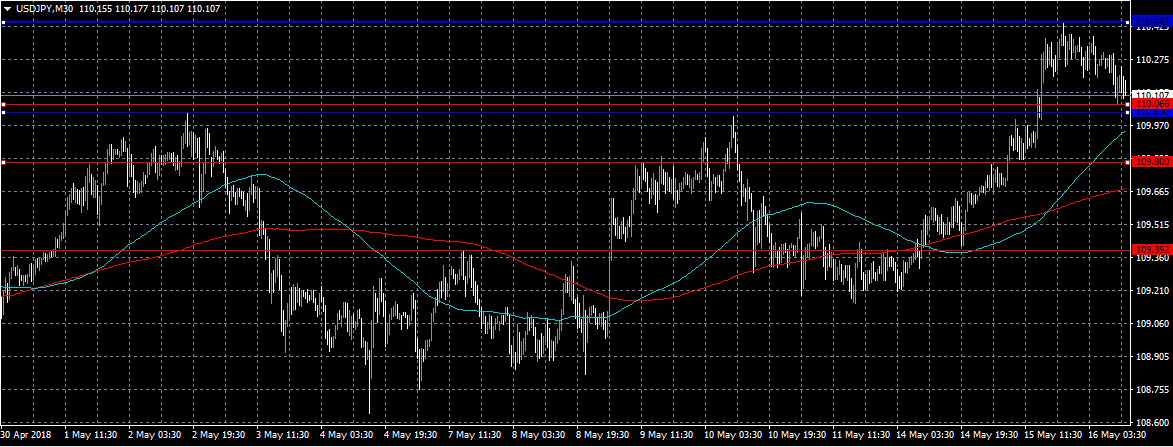
The US dollar has started to retreat lower towards the 110.00 level during the European trading session, as declining equity prices dampen risk-on trading sentiment. The USDJPY pair has so far managed to hold price above the key 110.03 level, as broad-based US dollar strength supports the pair on dips-lower. Traders continue to watch the 110.44 to 110.03 price-range on the USDJPY pair, and will likely get their intraday direction bias from the US dollar and US equity markets.
The USDJPY pair is only bullish while trading above the 110.03 level, key intraday technical resistance remains the 110.44 and 111.00 levels.
If the USDJPY pair does start to trade below the 110.03 level, we could expect to see price decline back towards the 109.80 and 109.39 support levels.
Italian Politics Pounds Euro
Wednesday May 16: Five things the markets are talking about
Investors continue to grapple with worries around global trade, growth and geopolitics.
Overnight in Asia, equities dipped after N. Korea's Pyongyang abruptly called off talks with Seoul, throwing a U.S/N. Korean summit into doubt, while surging bond yields stateside has re-energized market worries about faster Fed interest rate hikes that could curtail global demand.
Note: A cancellation of the June 12 summit in Singapore could see tensions on the Korean peninsula flare again. If talks do break down, President Trump may no longer feel that he needs to keep China content, which could escalate global trade tensions again.
In Europe, unlike its southern counterparts, stocks have opened a tad higher despite yesterday's spike in yields, while the ‘big' dollar is trading flat. Crude oil prices have eased a tad ahead of today's EIA inventory reports (10:30 am EDT).
Also in Europe, the focus is on Italian politics as the two populist parties – Five-Star and league – negotiate a coalition. Leaked draft documents have pushed the EUR (€1.1796) to test new yearly lows.
On tap: China's Vice Premier, Liu He, is expected in Washington this week for more trade talks.
1. Stocks mixed results
Asian markets produced some mixed results, carrying forth Wall Streets knocked sentiment from a spike in Treasury yields.
In Japan, stocks fell after Pyongyang called off talks with Seoul, throwing Trump's U.S/N. Korean summit into question. Not helping equities was Japanese data indicating that their domestic economy contracted more than expected in Q1 (-0.6%). The Nikkei ended -0.4% lower while the broader Topix fell -0.3%.
Down-under, Aussie stocks bucked the trend with the S&P/ASX 200 advancing +0.3%, while in S. Korea, the Kospi struggled for traction, rallying +0.05%.
In Hong Kong, stocks barely changed on trade worries. Investors are waiting for news on a second round of U.S/China trade talks in Washington this week. The Hang Seng index ended -0.1% down, while the China Enterprises Index was unchanged.
In China, it was a similar story. The market waits for some positive news from the Sino/U.S. trade talks where both sides are believed to be still far apart. The blue-chip CSI300 index fell -0.8%, while the Shanghai Composite Index lost -0.7%.
In Europe, regional bourses trade mixed Indices trade mixed following the recent run up, as U.S futures rebound following weakness in yesterday's session.
U.S stocks are set to open in the ‘black' (+0.1%).
Indices: Stoxx600 flat at 392.3, FTSE +0.1% at 7735.4, DAX flat at 12973, CAC-40 flat at 5551, IBEX-35 -0.7% at 10132, FTSE MIB -1.2% at 23994, SMI -0.2% at 8975, S&P 500 Futures +0.1%
2. Oil dips despite OPEC cuts and Iran sanctions, gold higher
Oil prices fell overnight, weighed down by sufficient supplies despite ongoing output cuts by OPEC and looming U.S sanctions against Iran.
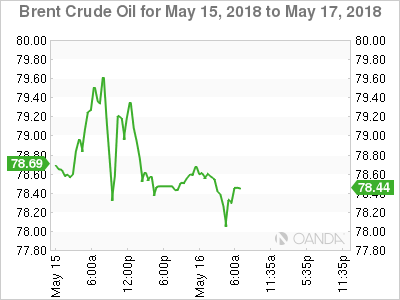
Brent crude futures are at +$78.22 per barrel, down -21c or -0.3% from the close. U.S West Texas Intermediate (WTI) crude futures are at +$71.03 a barrel, down -28c, or -0.4%.
Despite the dips, both benchmarks remain close to their four-year highs.
Expect investors to take their cues from today's U.S inventory reports. Official U.S government fuel storage data is due for release by the EIA this morning (10:30 am EDT). The market is expecting the report to display ‘bearish' results amidst higher rig counts and production levels in the U.S.
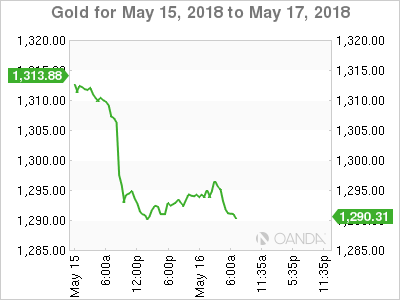
Ahead of the U.S open, gold prices have recovered some lost ground on short-covering after prices fell to the lowest level this year in yesterday's session on surging bond yields and a stronger dollar.
Spot gold has rallied +0.3% to +$1,294.30 per ounce, after shedding -1.7% and marking the lowest price this year at +$1,288.31 on Tuesday. U.S gold futures for June delivery are up +0.2% at +$1,293.60 per ounce.
3. Italy 10-year bond yield at two-month high
Italian bonds have slumped as populists struggle to reach an agreement to govern, but core European notes remain stable.
The 10-year Italian government bond yield has backed up +7 bps to a two-month high of +2.027%. The draft program of the League and of the Five Star Movement – the two populist parties in negotiations to form Italy's next government, has triggered the move.
A leaked draft version of the agreement shows the parties sought the creation of a mechanism to exit the E.U. They have called for the ECB to forgive billions of EUR's in Italian debt.
Stateside, strong U.S retail sales and factory data yesterday has pushed the U.S 10-year yield through a key level to hit +3.095%, its highest yield in seven-years.
Elsewhere, Germany's 10-year Bund yield has declined -2 bps to +0.63%, the biggest decrease in almost two-weeks, while in the U.K the 10-year Gilt yield has dipped -1 bps to +1.508%.
4. Dollar flat after sharp rise, EM currencies fall
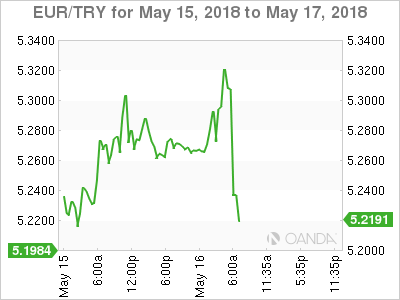
Ahead of the U.S session, the ‘big' dollar continues to hover atop of its five-month highs against G10 currency pairs, supported by yesterday's surge in the benchmark 10-year Treasury yield above +3.05%.
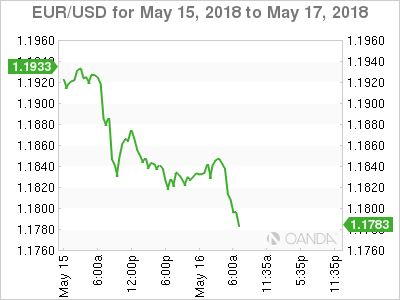
EUR/USD (€1.1796 -0.31%) continues to trade within striking distance of some key support levels atop of the psychological €1.1800 handle. USD/JPY (¥110.14 -0.12%) is above ¥110 with the yen largely shrugging off data that showed Japan's economy shrank more than expected in Q1, while the pound (£1.3472 -0.22%) has finally penetrated the £1.3500 handle.
Emerging market currencies are nearly all falling against the dollar, with the TRY and IDR rupiah taking the biggest hit. USD/TRY is up +0.5% at $4.4708 and USD/IDR up +0.5% at $14,103.
5. Euro area annual inflation falls
Data this morning from Eurostat showed that the Euro area annual inflation rate was +1.2% in April, down from +1.3% in March. A year earlier, the rate was +1.9%.
The European Union (EU) annual inflation was +1.4% in April, down from +1.5% in March. A year earlier, the rate was +2.0%.
Digging deeper, the lowest annual rates were registered in Cyprus (-0.3%), Ireland (-0.1%) and Portugal (+0.3%), while the highest annual rates were recorded in Romania (+4.3%), Slovakia (+3.0%) and Estonia (+2.9%).
Compared with March 2018, annual inflation fell in twelve Member States, remained stable in one and rose in fourteen. In April, the highest contribution to the annual euro area inflation rate came from food, alcohol & tobacco, followed by services, energy and non-energy industrial goods.
Japan Economy Shrinks
Japanese economy contracted in the first quarter
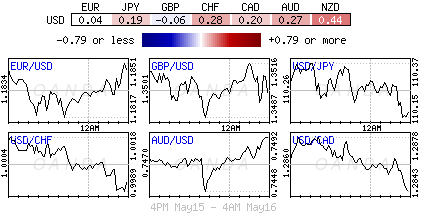
The Japanese yen took a dive yesterday as USD/JPY climbed to 110.45, the highest level since February 2nd. Most of the move could be explained by a renewed sell-off in US Treasury, which sent the 10-year yield to 3.09% yesterday that fuelled another dollar rally. Indeed, it seems that market participants are completely ignoring local development in Japan and focus exclusively on USD related developments. Indeed, despite a contraction of the Japanese economy in the first quarter (-0.2%q/q versus 0.0% median forecast and +0.1% in Q3), the yen reversed losses partially as USD/JPY eased to 110.08, down 0.15% on the day. Meanwhile, the US 10-year yield slid to 3.06%, down 3.7bps from yesterday’s high.
In addition, the mounting geopolitical tensions stemming from trade war initiated by Donald Trump, the US unilateral withdrawal from the Iran nuclear deal, which create tensions with the European Union and especially France as well as the recent opening of the US embassy in Jerusalem, are not enough to depreciate the risk sentiment and trigger a yen recovery.
The widening monetary policy divergence between the Federal Reserve and the Bank of Japan is all that matter right now. Even though it cannot be ruled out that the Fed could slow down its pace of tightening, the BoJ is miles away from tightening its monetary conditions against the backdrop of stalling inflation pressures and anaemic growth. We remain fundamentally long USD/JPY with the 114 level as medium-term target.
US – China round two talks have started
Amid increasing geopolitical tensions in the Middle East (incl. UN talks), adding up with North Korean threatening of summit cancellation, the US government is strongly solicited in the last few weeks. After a first unsuccessful negotiation session in Beijing in an attempt to unblock the situation, China’s economic advisor, Liu He, is in visit in Washington to discuss the matter. The meeting is set to be hard since last week’s US trade representative requested China to cut a total amount of $200 billion trade surplus by 2020, enforce intellectual property protection and decrease technology subsidies, putting doubt on a rapid diplomatic talk resolution ($150 billion tariffs against China are expected to come into effect next Tuesday). In addition, Trump’s attempt to calm the situation by lowering ZTE penalty rapidly vanished since US lawmakers recently rejected ZTE trade ban easing plan.
Unsurprisingly, the first topics discussed during the second week of negotiations concern trade issues and will be focusing on Chinese imports, certainly in an attempt to increase US-agro product exports trade in the future.
Expected to increase in the mid-term (+1.48% month-to-date and +0.56% week-to-date), USD/CNY pair is currently trading at 6.3695, slightly decreasing and heading along the 6.3625 range in the short-term.
WTI Oil Stands At The Back Foot, Awaiting Crude Stocks Data For Fresh Signal
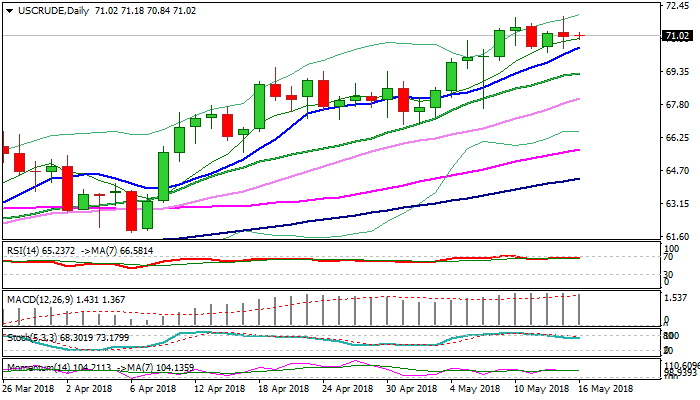
WTI oil price stands at the back foot but holding in tight range on Wednesday, after being hit by unexpected build of US crude stocks (API report released late Tuesday showed build of 4.85 million barrels, compared to 1.85 million barrels draw last week).
Oil price hit new marginally higher 3 ½ year high at $71.90 on Tuesday but reversed quickly to end day in long-legged Doji.
Overall structure remains bullish and tensions in the Middle East maintains positive sentiment, but fresh strength of the dollar could weigh on oil price.
Rising 10SMA continues to track the advance and marks strong support at $70.45 (along with Monday's correction low at $70.25) which is expected to hold and keep bulls intact.
EIA weekly crude report is due later today and closely watched for fresh signals. Forecast show draw of 0.76 million barrels vs last week's draw of 2.2 million barrels and release at /below forecasts would keep oil price supported.
Conversely, oil may come under increased pressure and risk deeper pullback on break below 10SMA, if US crude inventories rise.
Res: 71.18, 71.61, 71.90, 72.48
Sup: 70.84, 70.45, 70.25, 70.00
Europe Lower Due To Geopolitical Concerns | Oil And Gold Under Focus
- Traders are still not sure which direction the gold price is going to move
- Oil traders are holding on to their positions
- The S&P index is likely to test the 2800 mark
European markets are trading lower as investors have reacted to increase in the geopolitical situation over in the Middle East. Higher oil prices were bound to make investors concerned and this is what we are seeing today.
Gold
Traders are still not sure which direction the gold price is going to move. The consolidation pattern is strong and it isn’t breaking in any firm direction. The range base trading- from 1366-1300 has one major denominator, the dollar index. The Federal Reserve officials are still backing their case that there could be more interest rate hikes this year and this has pushed the dollar index higher. Any strength in the dollar index is negative for the dollar.
On the geopolitical front, we still have a lot of concerns after Israel shot a large number of prostrations. Donald Trump is determined to punish any country and company would do any business with Iran after the US sanctions are imposed. I do think there is a serious threat for the Dollar as a benchmark currency more than ever as Europeans are not on the same page as Trump. China-US trade spat isn’t resolved and we are somewhat more in a gridlock. Combined together, these geopolitical apprehensions do provide some support for the gold price.
Oil
Oil traders are holding on to their positions as they see that there is more juice to come out of their trade. Upcoming Iranian sanctions and OPEC’s commitment to keep their supply curbed are behind the move. It is only a matter of time before we see a headline print - Brent touched the level of $80. Who would have thought about that when oil was trading near its early thirties because renewable energy and boom in the US shale oil kept the firm lid on the price. Investors were certain that oil price is not going to touch those levels. But now that we are close enough to that historic price mark of $80, it seems like renewable energy or US shale oil doesn’t even matter. It is all about Saudi Arabia, if it wants to push the price lower, it can just open the tap more and the price would fall and if it wants to push the price higher, it needs to twist the tap in the other direction.
I do think that the $80 is the price level where traders would start taking profit off the table, it would make sense after a remarkable bull run.
Equity Markets
US equity markets are roaring again, the S&P index is likely to test the 2800 mark once again and it would be a further confirmation that the bottom is in place. If the US is able to avoid the trade tensions with China, we do think that the path of the least would be skewed to the upside. The trade talks are in full swing this week and trade officials are instructed to find a solution to resolve the trade dispute. It would be the US which has to show more softer stance now because China so far has already done the best from its side and indicated that there is no further room for any sharp maneuver.
Back in the UK, the focus would be on the average earnings index and claimant count change data. The Bank of England had to face embracement last week when it lowered its inflation, growth and wages forecast. Rising oil price could soon have an impact on the inflation but the wage growth element does not have any silver lining. With Brexit deadlines approaching soon and EU employee/employers looking for alternative places, we do think that the wage growth story would take a long time to heat up again.
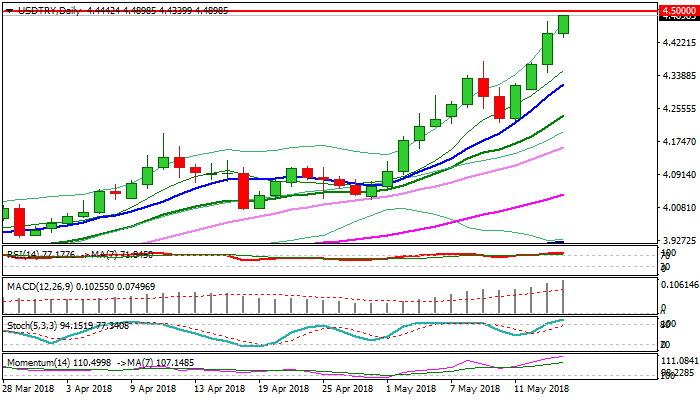
USDTRY – Break Of 4.50 Barrier Would Spark Further Bullish Acceleration
The USDTRY pair continues to move in uncharted territory and hit new record highs on Wednesday, after narrow consolidation preceded fresh acceleration higher. Bulls are coming closer to psychological 4.50 barrier, violation of which looks very likely and would spark fresh bullish acceleration after triggering a number of stops, parked above. The lira remains stuck by President Erdogan's opposition to rate hikes and could depreciate further, as sentiment is very negative and currency's steep fall so far doesn't show any signs of fatigue, despite strongly overbought daily/weekly studies. Break above 4.50 pivot would open 200% Fibo projection at 4.5278 as immediate barrier, but bulls could extend towards 4.5865 (Fibo 238.2% projection) and 4.6228 (Fibo 261.8% projection).
Res: 4.4915, 4.5000, 4.5278, 4.5500
Sup: 4.4750, 4.4691, 4.4328, 4.4104
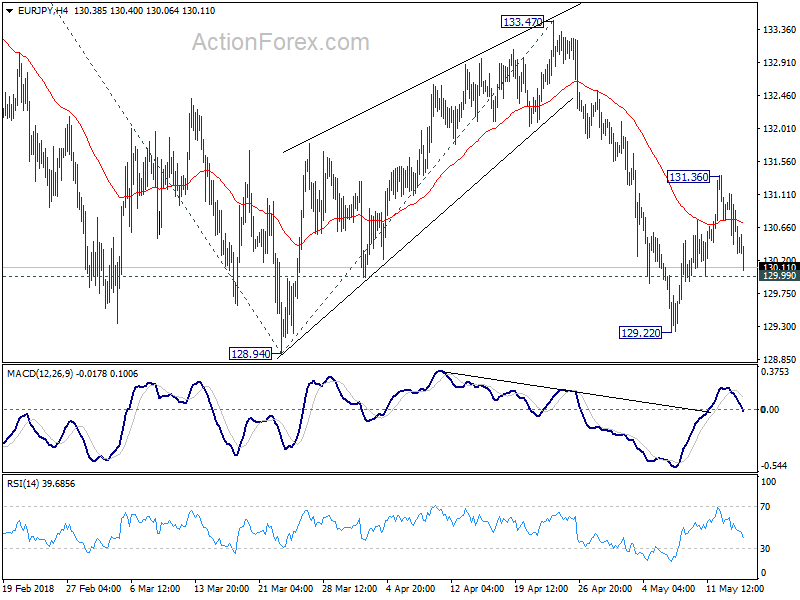
EUR/JPY Daily Outlook
Daily Pivots: (S1) 130.33; (P) 130.74; (R1) 131.05; More....
Sharp fall in EUR/JPY dragged 4 hour MACD below signal line. Intraday bias is turned neutral first. Consolidation from 129.22 could extend. But even in case of another rise, we'd expect strong resistance below 133.47 resistance to bring fall resumption. Below 129.99 minor support will turn bias back to the downside for 128.94. Break will resume the corrective fall from 137.49 and target 61.8% projection of 137.49 to 128.94 from 133.47 at 128.18 next.
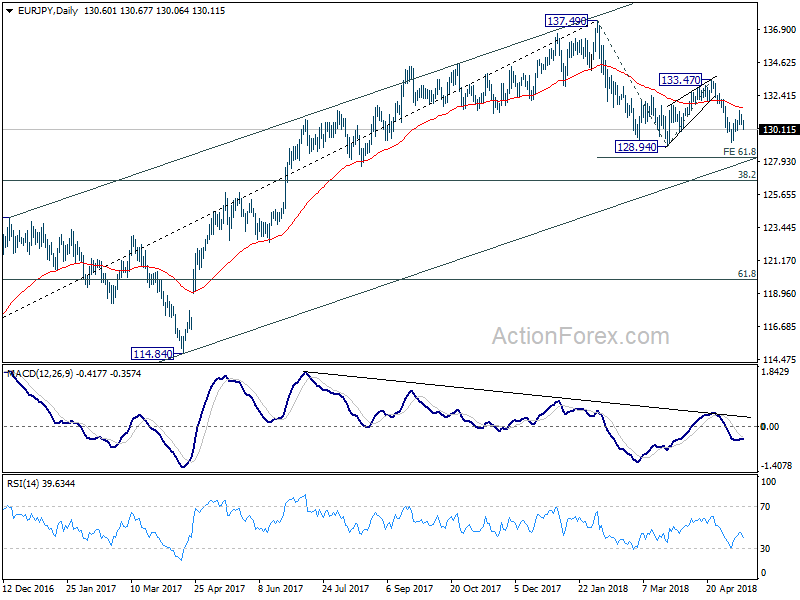
In the bigger picture, for now, price actions from 137.49 are viewed as a corrective pattern only. Hence, while, deeper decline would be seen, strong support is expected at 38.2% retracement of 109.03 to 137.49 at 126.61 to contain downside and bring rebound. Up trend from 109.03 (2016 low) is expected to resume afterwards. Though, sustained break of 126.61 will be an important sign of trend reversal and will turn focus to 124.08 resistance turned support.
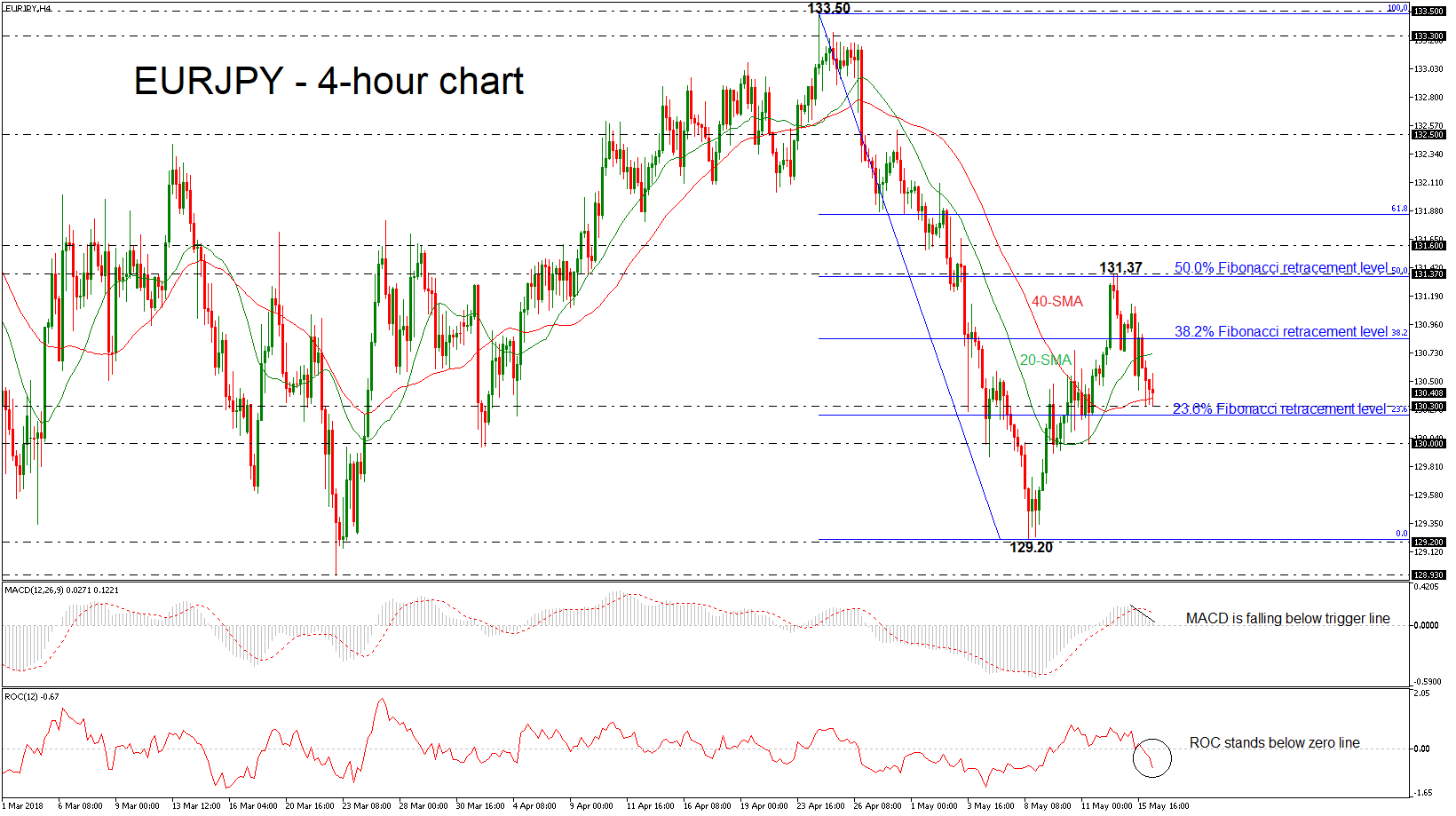
EURJPY Posts Losses Re-Challenging 40-SMA In Short Term
EURJPY bounced off the 131.37 high during Monday’s trading session and posted some losses reaching the 130.30 support level and the 40-simple moving average in the 4-hour chart. Hence the upside momentum appears to have run out of steam as prices have been attempting and failing to close above the 137.37 line in the past couple of days.
Looking at momentum oscillators on the chart though, they suggest further declines may be on the cards in the short-term. The MACD is below its trigger line, detecting negative movement, and is moving downwards, while the ROC, already negative, lies below its zero line with strong momentum.
Should prices decline, immediate support could be found around the 130.30 barrier, an area which was challenged earlier in the European session. A bit lower the 23.6% Fibonacci retracement level of 130.20 of the downleg from April 24 to May 8 could act as major support for the bulls. Below this area, the price should challenge the significant 130.00 handle. A successful close below the aforementioned obstacle could push the price towards the 129.20 support, raising chances for further declines.
However, if the market manages to pick up speed, the 38.2% Fibonacci of 130.85 could offer nearby resistance ahead of the 131.37 barrier, which holds near the 50.0% Fibonacci mark.
In the daily chart, the outlook remains bearish since prices completed a negative day on Tuesday and are set to post another one after four consecutive positive sessions.
Forex Analysis: GBPUSD And USDJPY
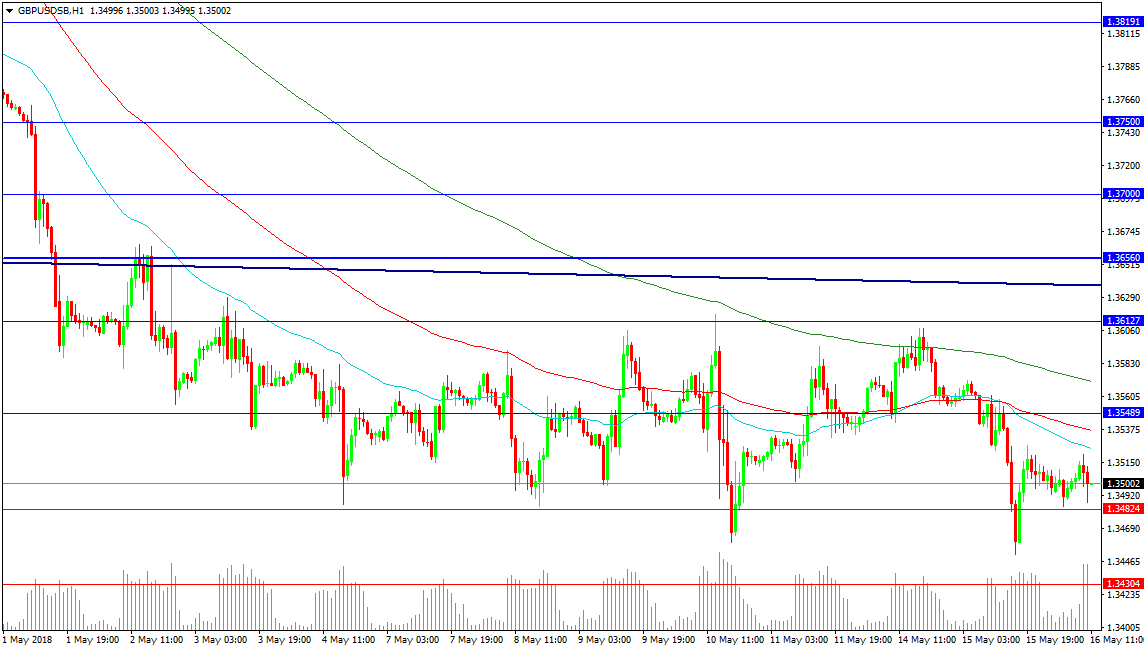
The GBPUSD pair pulled back from resistance at 1.36000 this week and remains in a sideways consolidation pattern between 1.36500 and 1.34500, a 200-point range. USD strength yesterday pushed price to new lows at 1.34510, and this remains the level to break if that strength returns. For now, price is back above previous support at 1.34825. Further support is found at 1.34300, followed by 1.34000 and the 1.33500 area.
Resistance comes in at the 50-hour MA at 1.35246 and the 100-hour MA at 1.35370. Price has churned around the 1.35500 area, with a strong rejection from this level a potential indicator that traders are finding direction. The 200-hour MA is at 1.35700 and a strong break of this level would lead to a retest of 1.36127, with trend line resistance at 1.36375. Any move above this area could target 1.37000 or 1.37500.
USDJPY
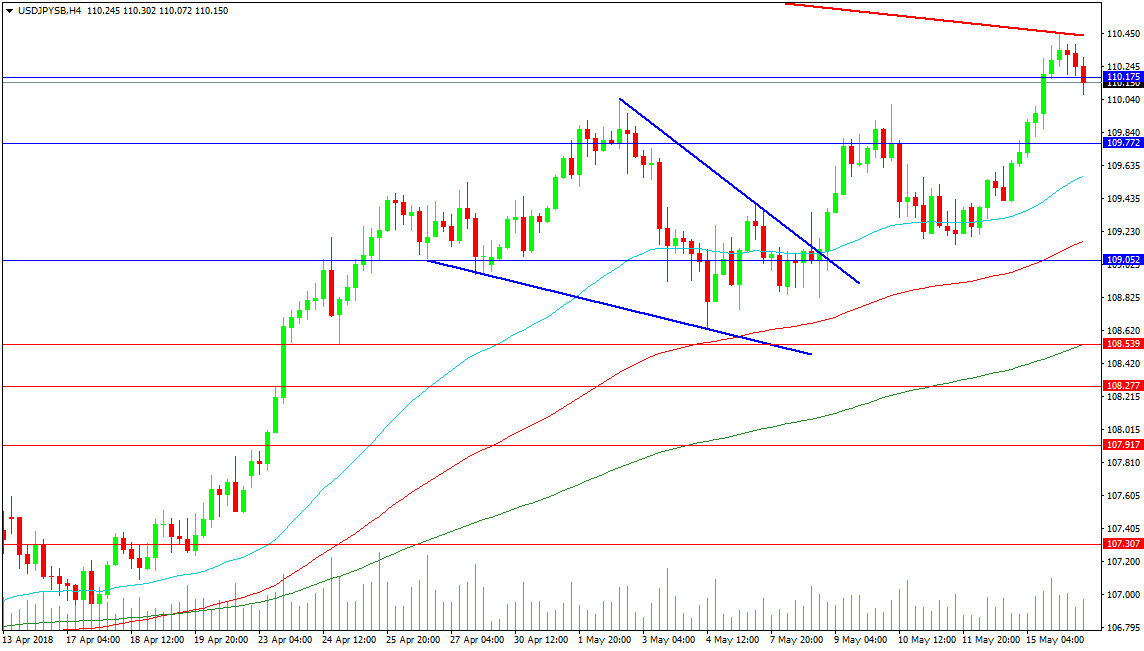
This pair also pushed against a key level due to the dollar move yesterday, with the resistance at 110.000 taken out and price advancing to the long-term trend line resistance from October 2017 and January 2018 at 110.450, shown in red. This trend line halted the advance in price but presents an excellent opportunity for traders to engage with the market. The previous resistance at 110.000 would need to be tested as support for any strong breakout to develop quickly. A break above the trend line may be powerful enough to target 112.000, with resistance at 110.835 and 111.391 needing to be taken out first.
Bearish traders will be left disappointed that the potential double top pattern at 110.000 did not play out. But the creation of higher lows marked an advantage for bulls, with shorts relegated to scalp trades. Bears also have an opportunity here, with the trend line resistance giving them a chance to turn yesterday’s move into a false breakout. They would need to drive price under 110.000 and the swing low at 109.150, followed by 108.635, taking long stops as they go. A loss of the 108.539 level, which is also the present 200-period MA, would put pressure on the 108.000 and 107.600 areas.
GBP/JPY Daily Outlook
Daily Pivots: (S1) 148.03; (P) 148.55; (R1) 149.15; More...
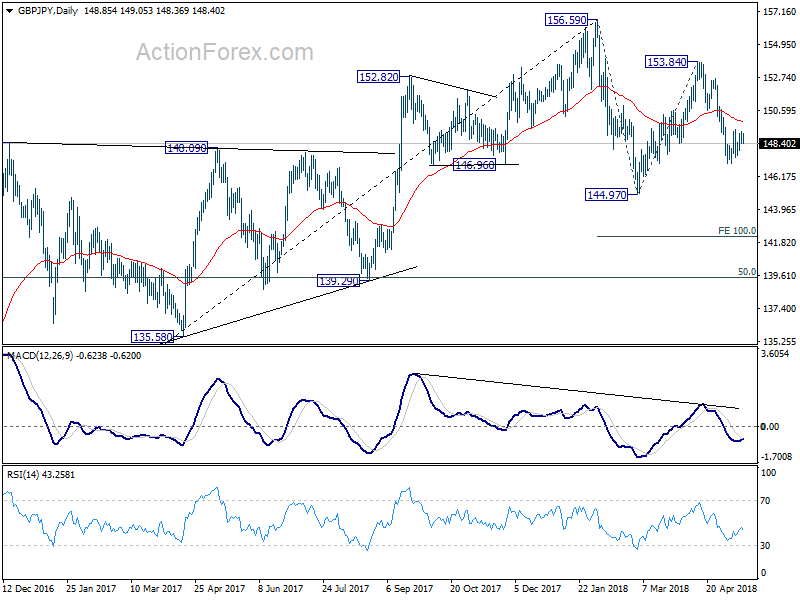
GBP/JPY is still bounded in range of 147.04/149.29 and intraday bias remains neutral. Consolidation from 147.04 temporary low could extend. But upside should be limited below 150.60 support turned resistance to bring fall resumption. Below 147.04 will target 144.97 first. Break there will resume the fall from 156.59 and target 100% projection of 156.59 to 144.97 from 153.84 at 142.22 next.
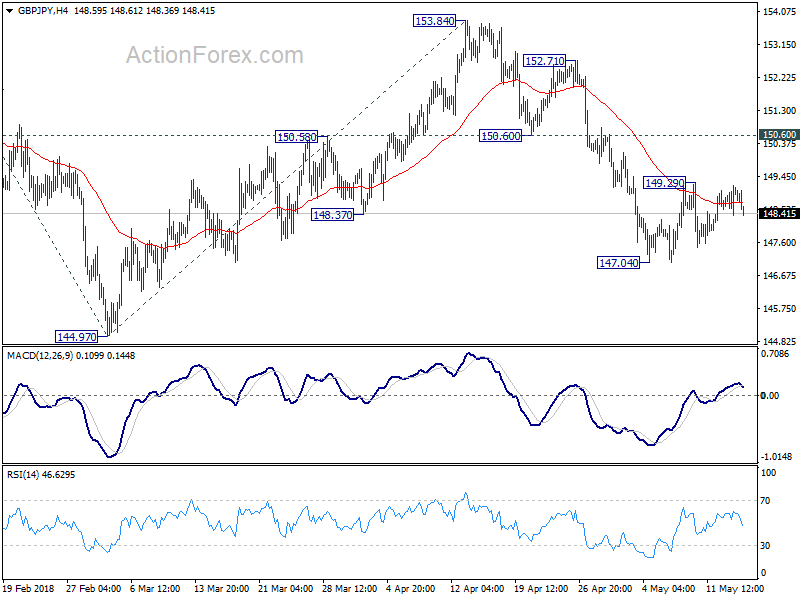
In the bigger picture, for now, we're treating price actions from 156.59 as a corrective move. Therefore, while deeper fall is expected, strong support should be seen above 139.29 cluster support (50% retracement of 122.36 to 156.59 at 139.47) to contain downside and bring rebound. There is still prospect of extending the rise from 122.36. However, considering that GBP/JPY failed to sustain above 55 month EMA (now at 153.94), firm break of 139.29 will confirm trend reversal and turn outlook bearish.