Sample Category Title
EU Tusk: Unity needed facing capricious assertiveness of the American administration
European Union Council President Donald Tusk urged unity in EU in his remarks ahead of the EU-Western Balkans summit.
Tusk said a "united European front" is needed after US withdrawal from the Iran nuclear deal. The deal is "good for European and global security" and should be maintained. And officials should also "protect European companies from negative consequences of the US decision."
Regarding EU-US trade frictions, Tusk emphasized unity as "our greatest strength" and urged Europeans to "stick to our guns". That is, a permanent exemption from the steel tariffs "if we are to discuss possible trade liberalisation with the US."
Tusk also named a new phenomenon of "capricious assertiveness of the American administration." He pointed to latest decisions of Trump and noted "with friends like that who needs enemies." And thanks to Trump," Europeans have "got rid of all illusions". And, " if you need a helping hand, you will find one at the end of your arm. "
US: Drop in April Housing Starts Belies Positive Trend
U.S. housing starts gave back their March gains in April, falling 3.7% to 1.287 million units. Permits were also down, but to a lesser extent (-1.8%).
The drop in headline starts was driven by the volatile multi-family component (-11.3%). April marks the fourth month in a row of double-digit moves in multi-family housing starts. Looking through the month-to-month swings, multi-family starts remained strong after a period of weakness in mid-2017, and are up 19% versus a year ago.
Single family starts were basically flat (+0.1%). But, much like multi-family starts, still show a steady upward trend, rising 7% versus a year ago. Permits for single-family homes were up 0.9% in April, but are below their recent highs seen over the winter months.
Housing starts were down in most regions. The Northeast (-8.1%), Midwest (-16.3%) and the West (-12.0%) all fell, while the South (+6.4%) bucked the trend. Activity in the South was particularly strong, driven by a 52% gain in multi-family units.
Key Implications
What comes up, must come down. Following a strong rebound in March, housing starts have retreated in April, giving up all of the last month's gain. Some consolation in this otherwise disappointing print can be found is the fact that the decline was entirely due to the lower starts in the smaller and more volatile multifamily sector, while the single-family starts have held relatively flat on the month, and were up 7.2% on a year-over-year basis.
Looking through the monthly volatility, the trend in the forward-looking permits data is still positive. There are headwinds to homebuilding activity, including labor shortages in the construction industry, rising building material costs and a lack of buildable lots. But, homebuilder sentiment did take a tentative step higher in May after some weakness over the winter, suggesting these barriers are not insurmountable.
We expect housing starts to continue to gain ground through 2018, supported by positive fundamentals such as low unemployment and healthy wage increases, which are expected to offset higher mortgage rates. At the same time, tight inventories and rising prices will continue to support homebuilding.
A Solid End to Q1 for Canadian Manufacturers
It was another solid month for Canadian manufacturers, with sales up 1.4% month-on-month in March after a significantly-upwardly-revised gain of 2.7% in February (initially reported as 1.9%). Much of the gain came through price growth, but volumes were still up a respectable 0.6%.
Durable goods manufacturers led the way again, posting a 2.2% sales gain, as solid climb in the aerospace sector (+10.6%; volumes +3.6%) offset a pull-back in motor vehicle sales (-2.0%, with a similar change in volumes). Performances were generally strong across the other durable sectors, with the notable exception of machinery (-1.7%; volumes). Among the non-durable industries, mixed performances were observed, with overall sales up 0.4% ( in volume terms).
With aerospace leading the way, Quebec contributed the most to March's gains, up 2.9% month-on-month. B.C. and Saskatchewan also performed well, up 4.0% and 5.6% respectively.
Inventories reached another record high of $79.2 billion, climbing for a sixth straight month, but sales growth was again strong enough to keep the inventories-to-sales ratio effectively unchanged at 1.39 (from a revised 1.40 in February).
Indicators of future sales were mixed. Unfilled orders rose for a second month, up 1.5%, but new orders fell slightly (--0.7%), albeit after a healthy (an upwardly revised) climb of 7.4% in the month prior.
Key Implications
Another pleasant surprise from the Canadian economy. March's manufacturing report was chock full of good news, benefitting significantly from currency moves (aerospace in particular, where goods are generally priced in U.S. dollars), but nevertheless turning in a solid climb in volume terms. This should not only provide solid momentum heading into the second quarter of the year, but with decent revisions to previous months in the mix, we see some upside risk to our first quarter growth tracking of 1.7% (Q/Q, at annual rates).
Outside of the resale housing market, and beneath some idiosyncratic shocks early in the year, the Canadian economy continues to perform well. There are obviously some countervailing forces at play, but with solid U.S. demand in the cards, the outlook for Canadian manufacturers remains healthy. What's more, with factories running near full-tilt despite solid investment through 2017, there is a clear incentive for firms to continue building out their capacity to meet demand. We continue to expect that 2018's soft start will give way to an above-trend pace of growth through the remainder of the year, supported by continued business investment.
EUR/USD Mid-Day Outlook
Daily Pivots: (S1) 1.1793; (P) 1.1866 (R1) 1.1912; More....
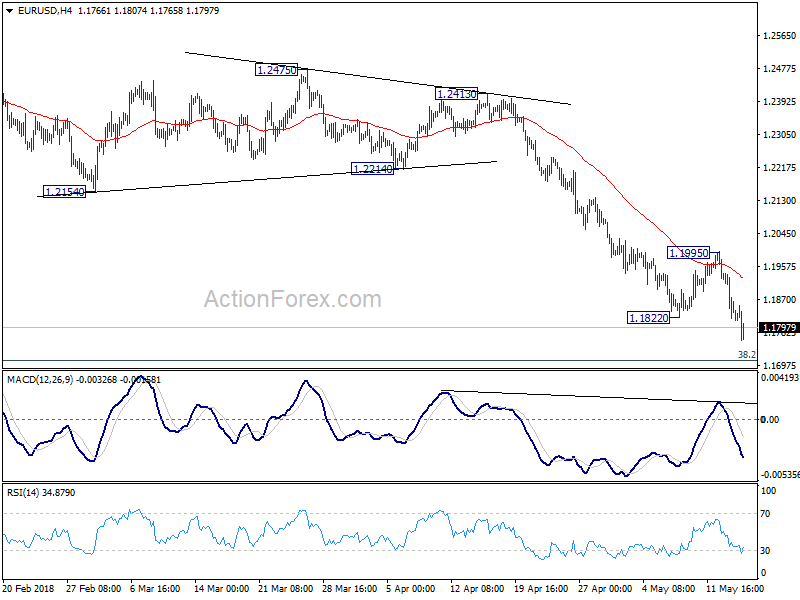
EUR/USD drops sharply to as low as 1.1762 as recent decline extends. Intraday bias stays on the downside at this point. Current fall from 1.2555 should target 1.1708 medium term fibonacci level next. Break will target 1.1553 support. And, on the upside, break of 1.1995 resistance is needed to indicate short term bottoming. Otherwise, outlook will remain bearish in case of recovery.
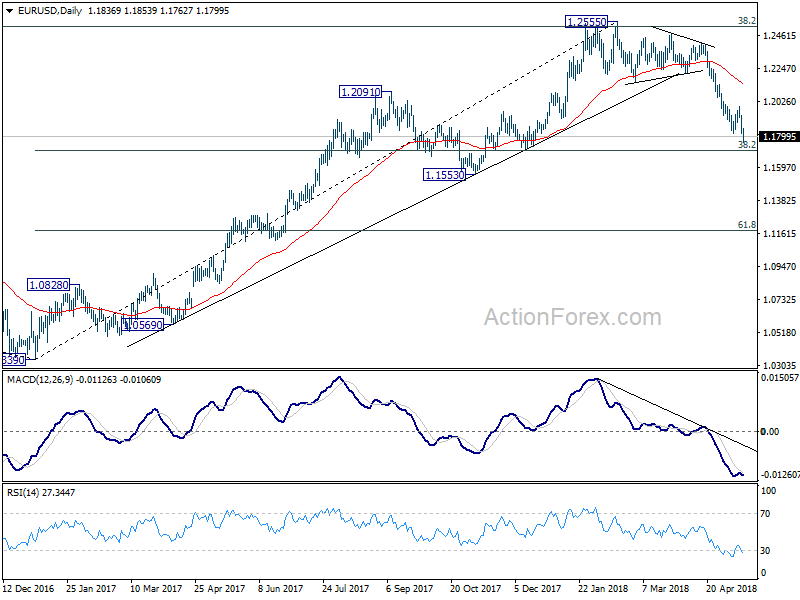
In the bigger picture, current development suggests that EUR/USD was rejected by 38.2% retracement of 1.6039 (2008 high) to 1.0339 (2017 low) at 1.2516. And, a medium term was formed at 1.2555 already. Decline from there should extend further. Break of 38.2% retracement of 1.0339 to 1.2555 at 1.1708 will target 61.8% retracement at 1.1186. For now, even in case of rebound, we won't consider the fall from 1.2555 as finished as long as 55 day EMA (now at 1.2162) holds.
GBP/USD Mid-Day Outlook
Daily Pivots: (S1) 1.3435; (P) 1.3524; (R1) 1.3598; More...
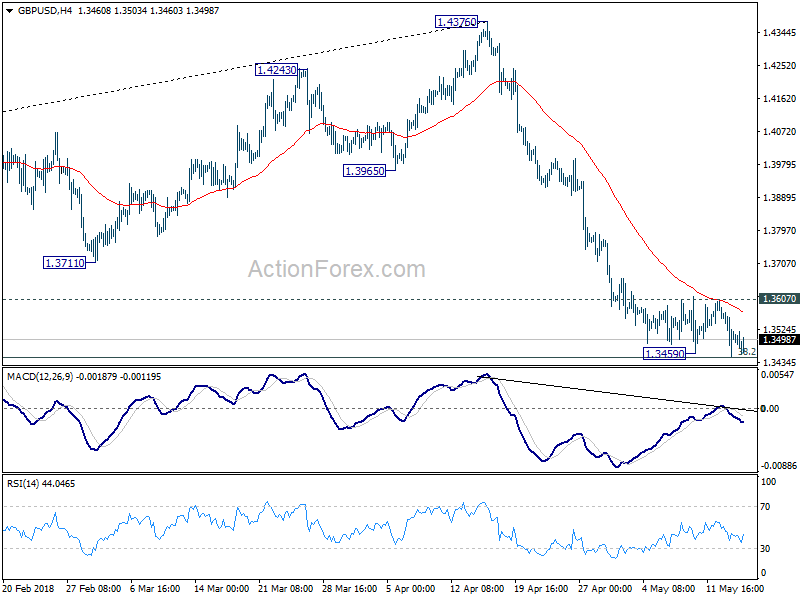
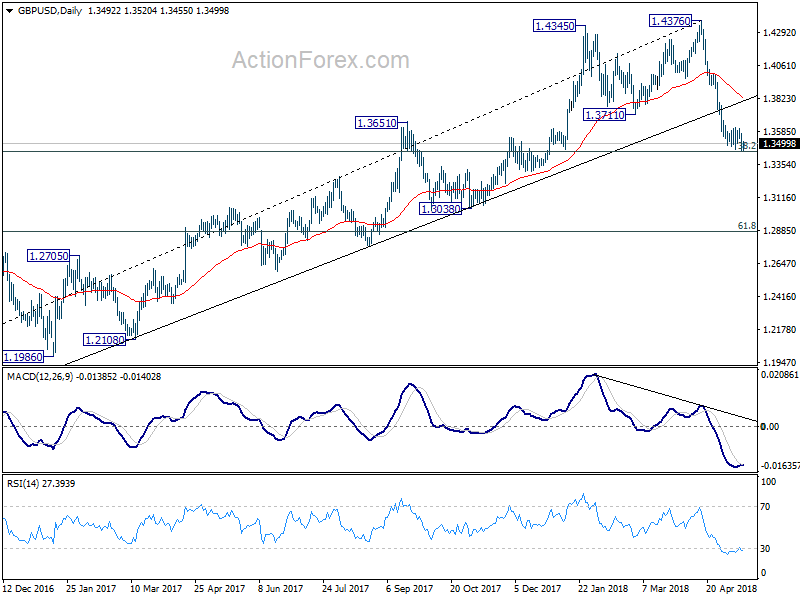
Intraday bias in GBP/USD remains on the downside as fall from 1.4376 is seen as resuming. Sustained break of 1.3448 fibonacci level will pave the way to next one at 1.2874. On the upside, break of 1.3607 resistance is needed to indicate short term bottoming. Otherwise, outlook will stay bearish in case of recovery.
In the bigger picture, current development suggests that whole medium term rebound from 1.1936 (2016 low) has completed at 1.4376 already, with trend line broken, on bearish divergence condition in daily MACD, after rejection from 55 month EMA (now at 1.4223). 38.2% retracement of 1.1936 (2016 low) to 1.4376 at 1.3448 was almost met. Break there will target 61.8% retracement at 1.2874 and below. Outlook will stay bearish as long as 55 day EMA (now at 1.3861) holds, even in case of strong rebound.
USD/JPY Mid-Day Outlook
Daily Pivots: (S1) 109.84; (P) 110.15; (R1) 110.66; More...
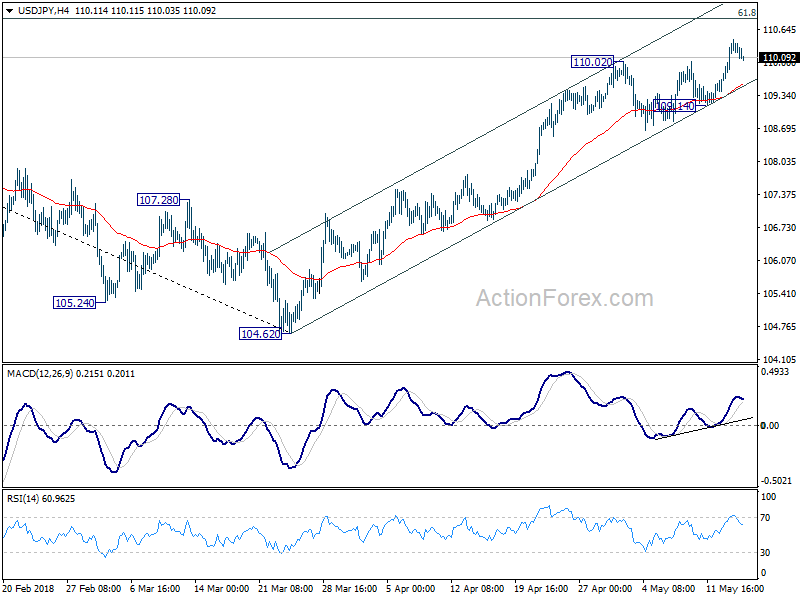
Despite today's retreat, intraday bias in USD/JPY remains on the upside for further rally. Current rise from 104.62 should target 61.8% retracement of 114.73 to 104.62 at 110.86 next. Firm break there will target medium term trend line resistance at 112.43. On the downside, below 109.14 support is needed to indicate short term topping. Otherwise, outlook will remain bullish in case of retreat.
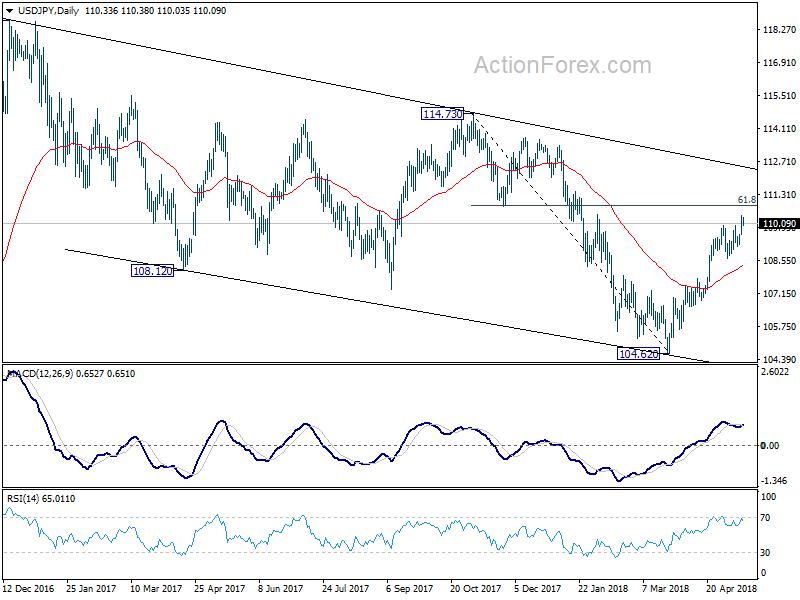
In the bigger picture, corrective decline from 118.65 (2016 high) has completed with three waves down to 104.62. Rise from 104.62 is possibly resuming the up trend from 98.97 (2016 low). This will be the preferred case as long as 55 day EMA (now at 108.30) holds. Decisive break of 114.73 resistance will confirm our view and target 118.65 and above.
USD/CHF Mid-Day Outlook
Daily Pivots: (S1) 0.9984; (P) 1.0013; (R1) 1.0043; More...
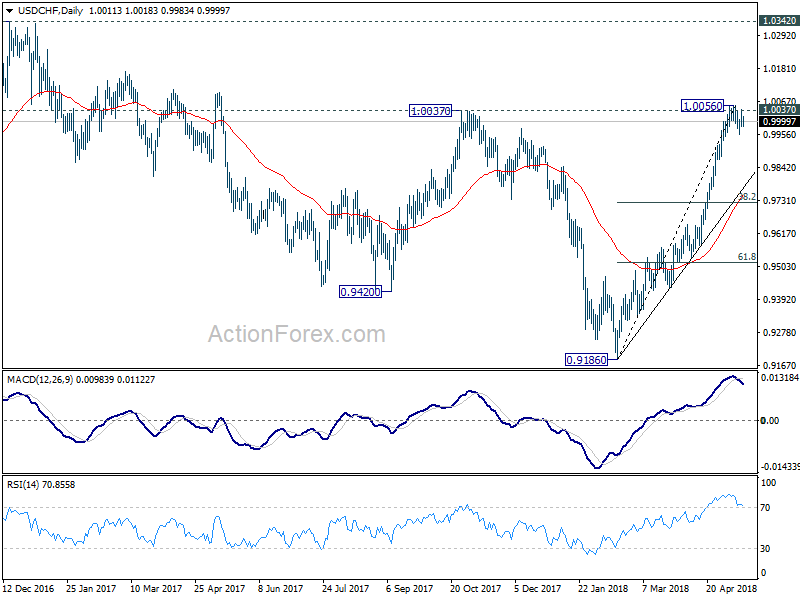
Intraday bias in USD/CHF remains neutral as consolidation pattern from 1.0056 is extending. Deeper pull back cannot be ruled out. But in that case, downside should be contained by trend line support (now at 0.9778) to bring rebound. On the upside, sustained break of 1.0037 will resume recent rise for 1.0342 key resistance next.
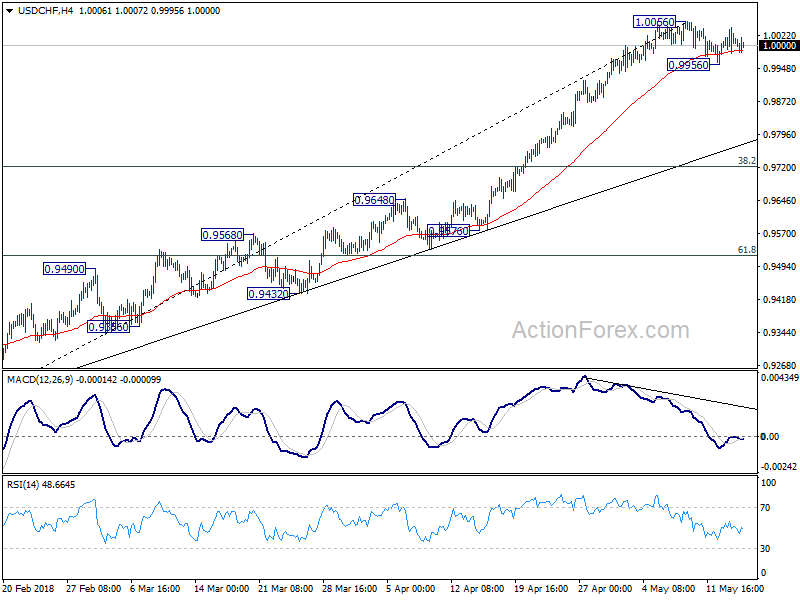
In the bigger picture, medium term decline from 1.0342 has completed with three waves down to 0.9186. Rise from there is currently viewed as a leg inside the long term range pattern. Hence, while further rally would be seen, we'd be cautious on strong resistance from 1.0342 to limit upside. For now, further rise is expected as long as 38.2% retracement of 0.9186 to 1.0056 at 0.9724 holds.
EUR/AUD Mid-Day Outlook
Daily Pivots: (S1) 1.5813; (P) 1.5852; (R1) 1.5879; More....
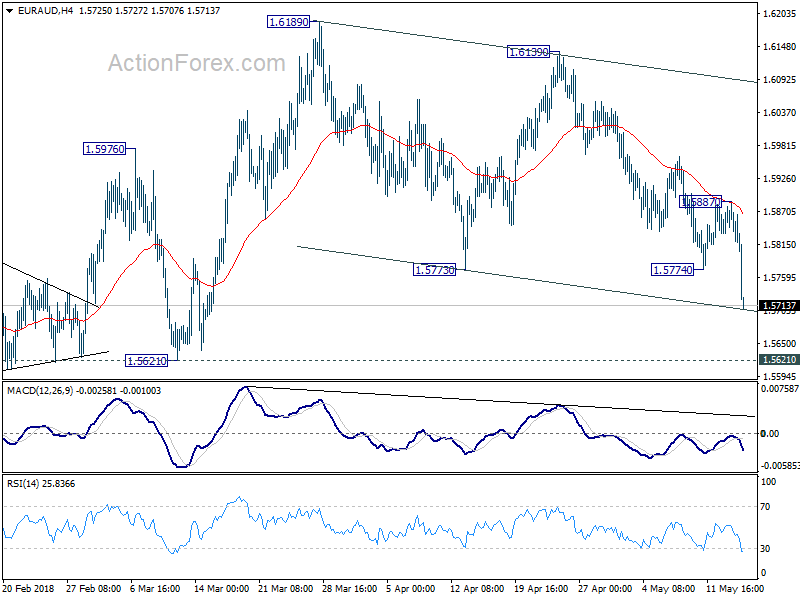
EUR/AUD's sharp decline and break of 1.5774 indicates resumption of fall from 1.6139. Intraday bias is back on the downside towards 1.5621 support. For now, price actions from 1.6189 are viewed as a corrective pattern. So strong support would be seen above 1.5621 to bring rebound. But break of 1.5887 resistance is needed to indicate near term reversal first. Otherwise, deeper fall is expected even in case of recovery. Meanwhile, decisive break of 1.5621 will carry larger bearish implications.
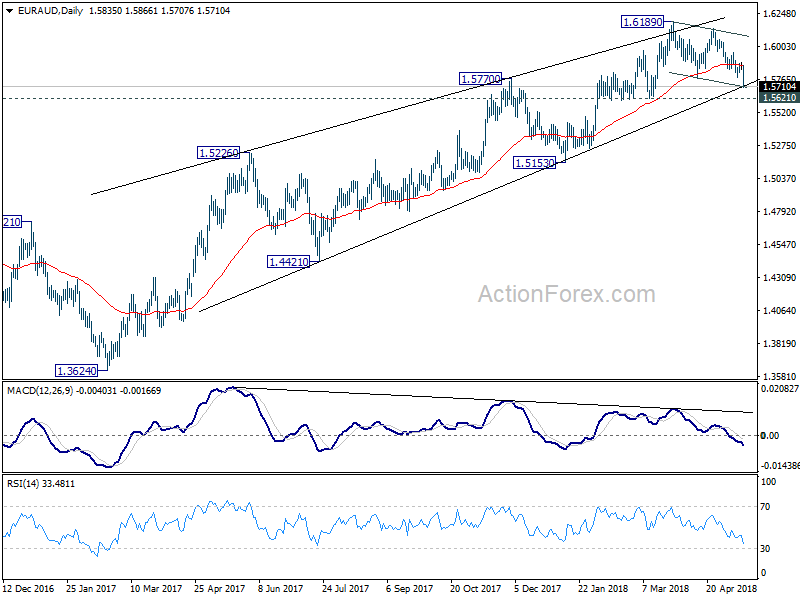
In the bigger picture, while there is bearish divergence condition in daily MACD, there is no clear sign of reversal yet. Current rally from 1.3624 could extend to 1.6587 key resistance (2015 high). Nonetheless, we'd expect further loss of upside momentum, and strong resistance from 1.6587 to limit upside and bring reversal. On the downside, sustained break of 1.5621 support should confirm reversal and turn outlook bearish for 1.5153 support and below.
EUR/JPY Mid-Day Outlook
Daily Pivots: (S1) 130.33; (P) 130.74; (R1) 131.05; More....
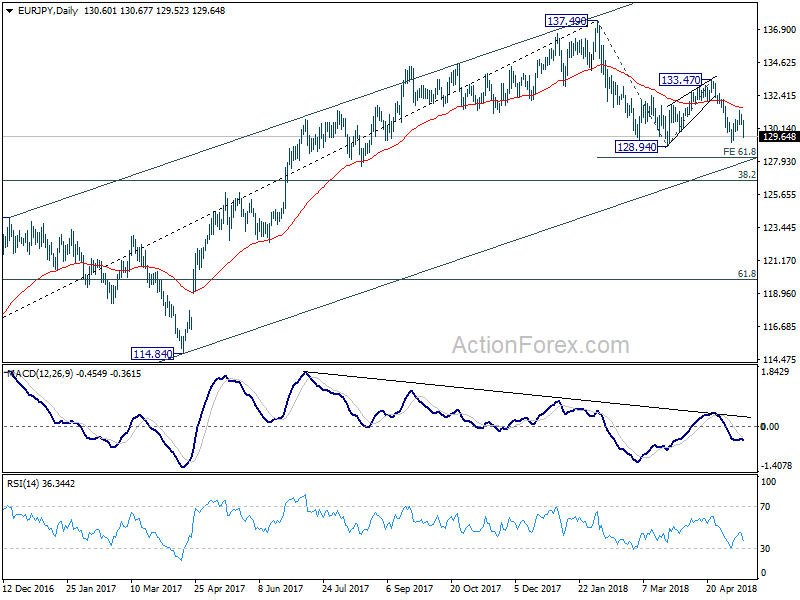
EUR/JPY's strong break of 129.99 minor support indicates that recovery from 129.22 has completed at 131.36 already. Intraday bias is turned back to the downside for 128.94 first. Break will resume the corrective fall from 137.49 and target 61.8% projection of 137.49 to 128.94 from 133.47 at 128.18, and possibly further to 126.61 medium term fibonacci level. On the upside, break of 131.36 resistance is now needed to indicate near term reversal. Otherwise, outlook will stay bearish in case of recovery.
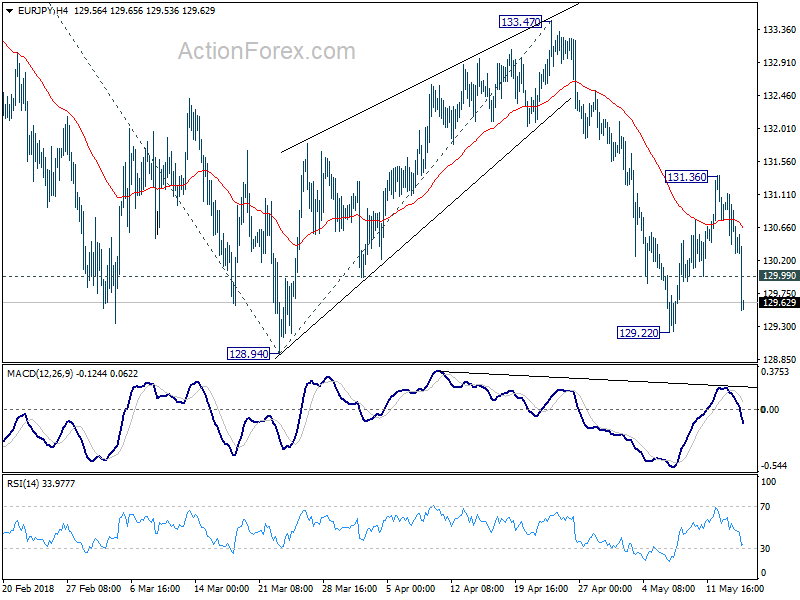
In the bigger picture, for now, price actions from 137.49 are viewed as a corrective pattern only. Hence, while deeper decline would be seen, strong support is expected at 38.2% retracement of 109.03 to 137.49 at 126.61 to contain downside and bring rebound. Up trend from 109.03 (2016 low) is expected to resume afterwards. Though, sustained break of 126.61 will be an important sign of trend reversal and will turn focus to 124.08 resistance turned support.
EUR/CHF Mid-Day Outlook
Daily Pivots: (S1) 1.1819; (P) 1.1883; (R1) 1.1917; More...
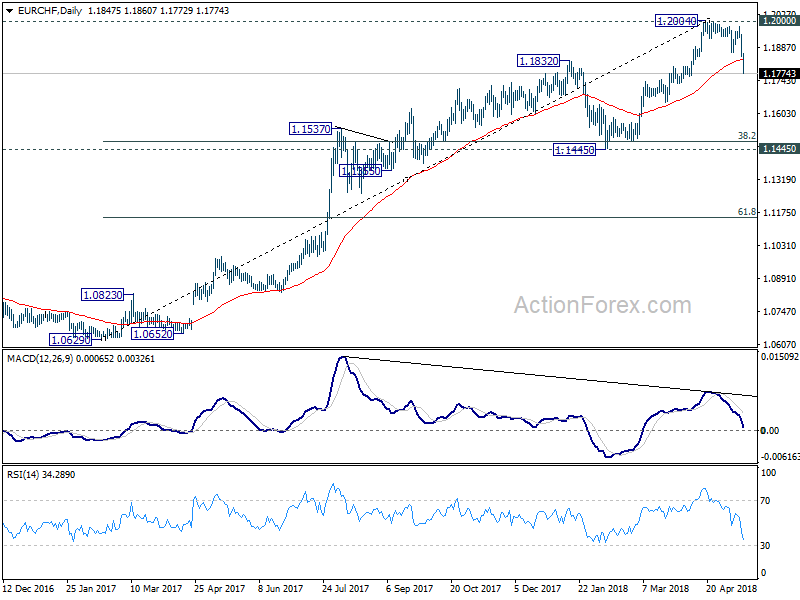
EUR/CHF drops sharply to as low as 1.1777 so far today and breaks 38.2% retracement of 1.1445 to 1.2004 at 1.1790. Based on current momentum, deeper decline would likely be seen. Intraday bias stays on the downside for 61.8% retracement at 1.1659 and below. On the upside, break of 1.1864 support turned resistance is needed to indicate short term bottoming. Otherwise, near term outlook will be mildly bearish even in case of recovery.
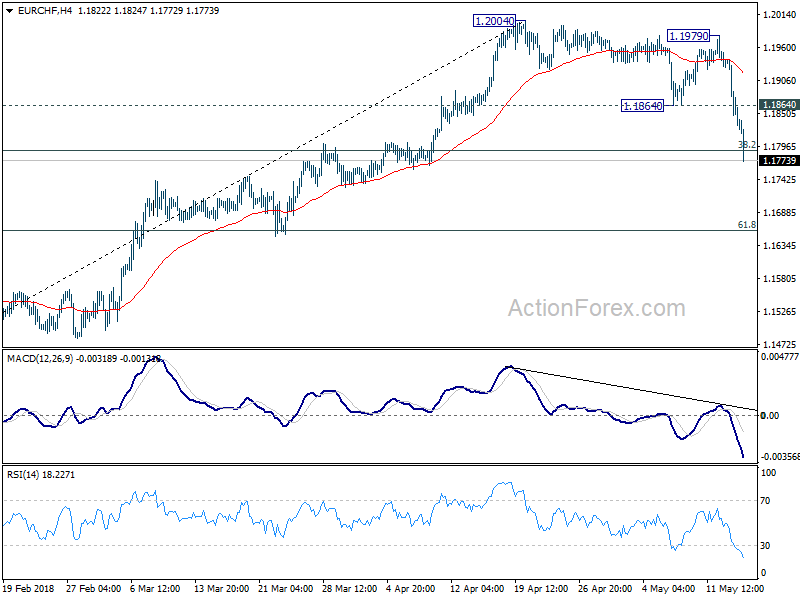
In the bigger picture, current development suggests solid rejection by prior SNB imposed floor at 1.2000. Considering bearish divergence condition in daily MACD, 1.2004 could be a medium term top. And price action from 1.2004 is corrective the up trend from 1.0629. Hence, for now, deeper fall could be seen back to 1.1445, which is close to 38.2% retracement of 1.0629 to 1.2004 at 1.1479. We'd expect strong support from there to bring rebound to extend the medium term corrective pattern.