Sample Category Title
USD/JPY Breaks 110 Resistance And Builds Bull Flag Pattern
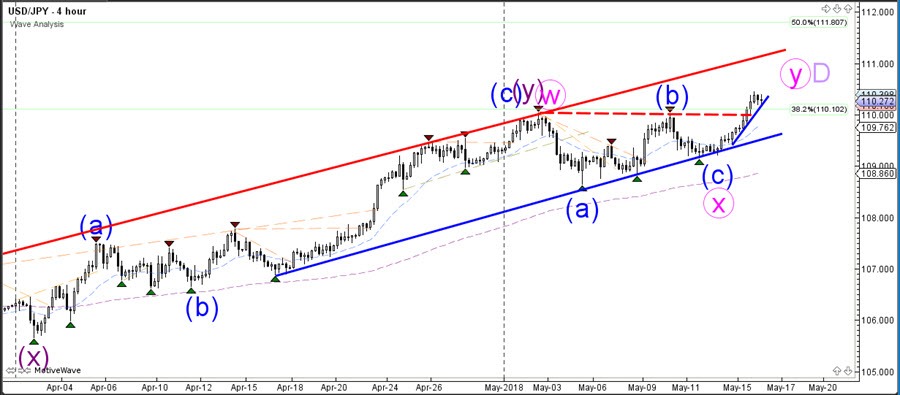
The USD/JPY broke above the previous top and resistance trend line (dotted red), which could indicate a continuation of the bullish channel towards 50% Fibonacci retracement level of wave D (light purple) at 111.80. The USD/JPY will need to stay above support trend lines (blue) to make an uptrend continuation more likely.
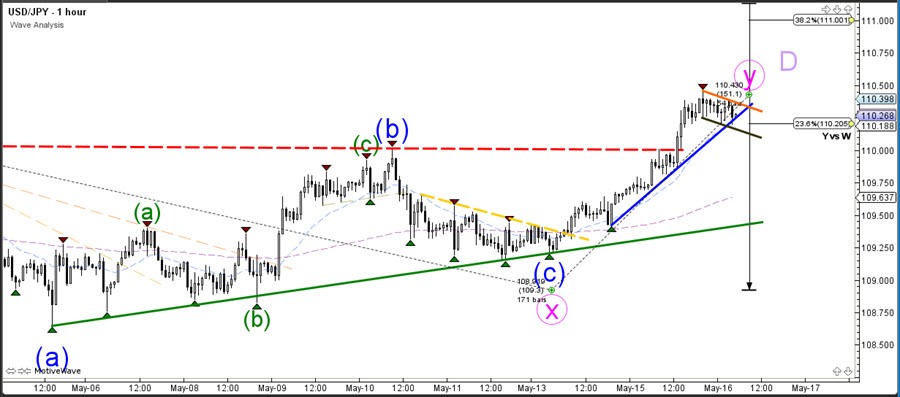
The USD/JPY is now building a bull flag chart pattern which could indicate a bullish continuation once price breaks above the pattern. Price can always retrace back down to retest the broken 110 resistance level which now could act as a potential support zone.
GBP/USD Bearish Wave 3 Breaks 1.3550 Support Zone
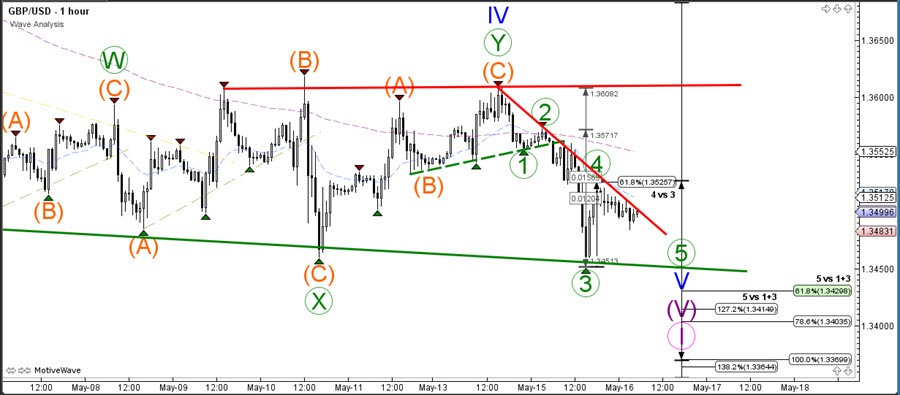
The GBP/USD downtrend showed a strong bearish continuation yesterday when it broke below the 1.3550 and 1.35 support levels and support trend line (dotted green). Price did bounce at the next support trend line at 1.3450 (green) which makes a bearish continuation uncertain. A break below that the trend line (green) could indicate a next bearish fall towards the Fibonacci targets of wave 5.
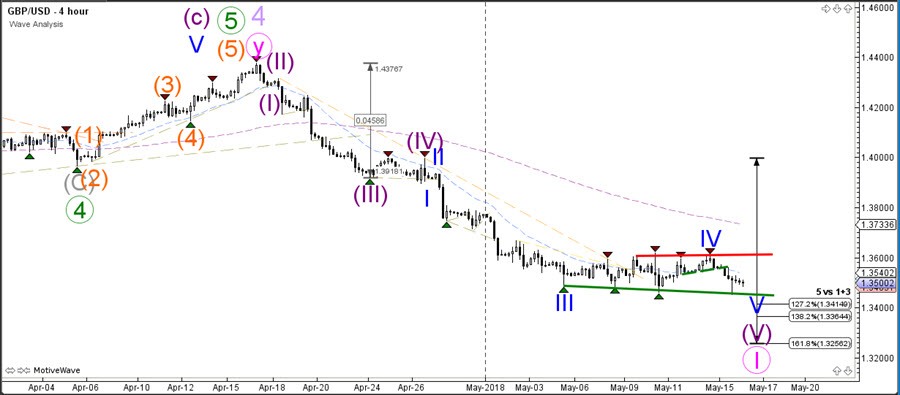
The GBP/USD seems to have completed 4 bearish waves and could have one more wave 5 (green) remaining but price needs to stay below the 61.8% resistance Fib of wave 4 (green) otherwise a larger consolidation might still be taking place.
Elliott Wave Analysis: EURUSD Strength Can Be Temporary
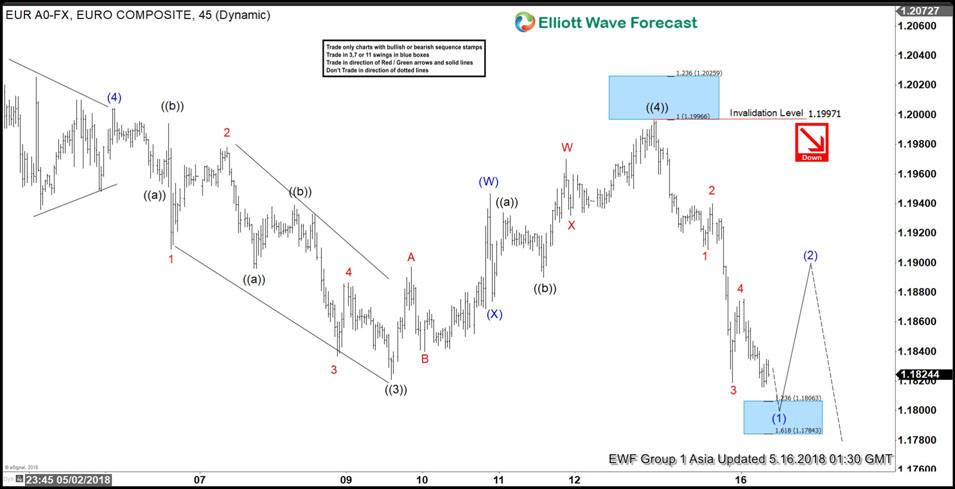
EURUSD Short Term Elliott Wave view suggests that the decline to 1.1821 on 5/09/2018 low ended Primary wave ((3)). The move lower came from 4/17/2018 peak as a 5 waves impulse structure. Above from 1.1821, pair ended the correction of cycle from 4/17/2018 high in Primary wave ((4)) at 1.1997. The internals of that rally unfolded as Elliott Wave Double three structure. Intermediate wave (W) of ((4)) ended at 1.1946 as zigzag, pullback to 1.1874 ended Intermediate wave (X), and rally to 1.1997 high ended intermediate wave (Y) of ((4)).
Down from there, the pair already broke to new low below 1.1821 confirming the next leg lower in primary wave ((5)) has started. The internals of the decline is unfolding as Elliott Wave impulse structure with lesser degree subdivision of each leg down as 5 waves structure. Intermediate wave (1) is currently in progress as 5 waves where Minor wave 1 ended at 1.1909, Minor wave 2 ended at 1.194, Minor wave 3 ended at 1.1819 and Minor wave 4 ended at 1.1875.
Near-term focus remains towards 1.1806-1.1784 to end Minor wave 5 of (1) lower. Afterwards, pair should bounce in Intermediate wave (2) to correct cycle from 1.1997 high in 3, 7 or 11 swings before further downside is seen. However, in case of further extension in Minor wave 5 of (1), the pair can see 1.1789-1.1769, which is 100%-123.6% 5=1 Fibonacci extension area where Minor wave 5 = Minor wave 1. before Intermediate wave (2) bounce takes place. We don’t like selling the pair.
EURUSD Elliott Wave 1 Hour Chart
North Korea infuriated by Bolton, threatens to cancel Trump-Kim summit
North Korea threatened to cancel Trump-Kim summit after they're infuriated by comments from Trump's national security adviser John Bolton that North Korea could follow a Libyan model of nuclear disarmament. The meeting is scheduled to be on June 12.
North Korea's vice-foreign minister Kim Kye-gwan used strong words in a statement carried by the state news agency KCNA. He condemned that Bolton's suggestion was "not an expression of intention to address the issue through dialogue". And, "it is essentially a manifestation of awfully sinister move to impose on our dignified state the destiny of Libya or Iraq which had been collapsed due to yielding the whole of their countries to big powers."
Kim went further and warned that if the US "corners us and unilaterally demands we give up nuclear weapons we will no longer have an interest in talks and will have to reconsider whether we will accept the upcoming DPRK-US summit". And, "if President Trump follows in the footsteps of his predecessors, he will be recorded as more tragic and unsuccessful president than his predecessors, far from his initial ambition to make unprecedented success."
UK’s ILO Unemployment Remained Steady At A 42 Year Low In The Three Months To March, Wage Growth Slows...
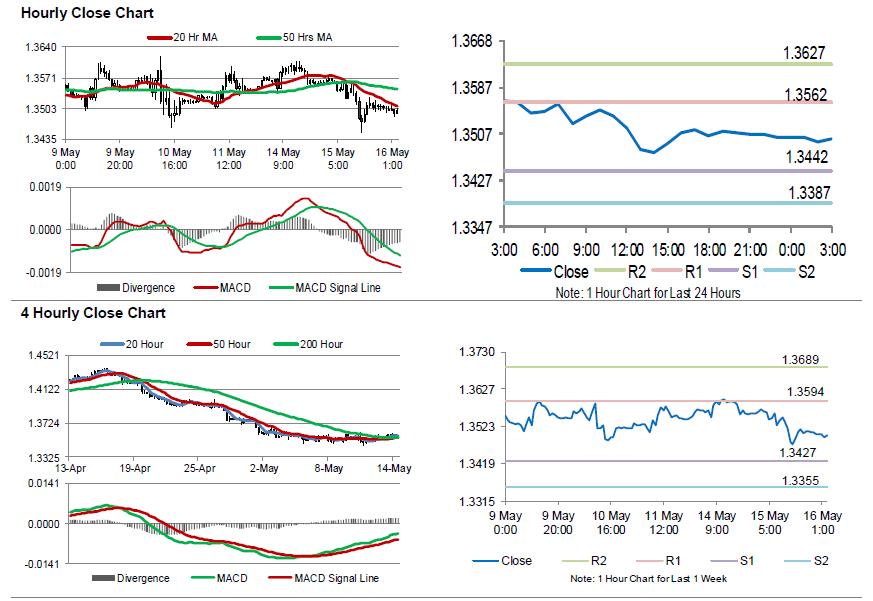
For the 24 hours to 23:00 GMT, the GBP declined 0.44% against the USD and closed at 1.3501, after fresh figures pointed to a slowdown in UK's wage growth.
On the macro front, Britain's ILO unemployment rate remained steady at 4.2% in the January-March 2018 period, at par with market expectations. However, the nation's average earnings including bonus grew less-than-expected by 2.6% in the three months to March, meeting market expectations. Average earnings including bonus had risen 2.8% in the December-February 2018 period.
In the Asian session, at GMT0300, the pair is trading at 1.3498, with the GBP trading marginally lower against the USD from yesterday's close.
The pair is expected to find support at 1.3442, and a fall through could take it to the next support level of 1.3387. The pair is expected to find its first resistance at 1.3562, and a rise through could take it to the next resistance level of 1.3627.
With no key macroeconomic releases in the UK today, investor sentiment would be determined by global macroeconomic factors.
The currency pair is trading below its 20 Hr and 50 Hr moving averages.
Japan’s Economy Surprisingly Contracted In The First Three Months Of 2018
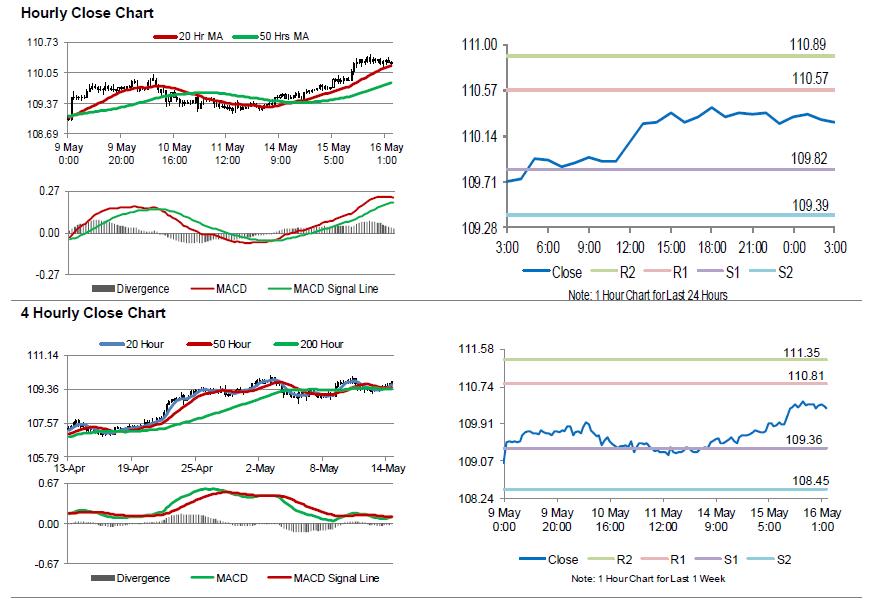
For the 24 hours to 23:00 GMT, the USD rose 0.49% against the JPY and closed at 110.25.
In the Asian session, at GMT0300, the pair is trading at 110.26, with the USD trading slightly higher against the JPY from yesterday's close.
Data released overnight showed that Japan's flash gross domestic product (GDP) unexpectedly fell 0.2% on a quarterly basis in the first quarter of 2018, compared to a revised rise of 0.1% in the previous quarter, while markets were anticipating the nation's GDP to remain flat.
Earlier today, Japan's final industrial production rose more than initially estimated by 1.4% MoM in March, while the preliminary figures had indicated a rise of 1.2%. In the previous month, industrial production had climbed by a revised 2.0%.
The pair is expected to find support at 109.82, and a fall through could take it to the next support level of 109.39. The pair is expected to find its first resistance at 110.57, and a rise through could take it to the next resistance level of 110.89.
Moving ahead, traders would await Japan's machinery orders for March, set to release overnight.
The currency pair is showing convergence with its 20 Hr moving average and trading above its 50 Hr moving average.
GDP Growth Across The Euro-Bloc Slowed In The First Quarter Of 2018
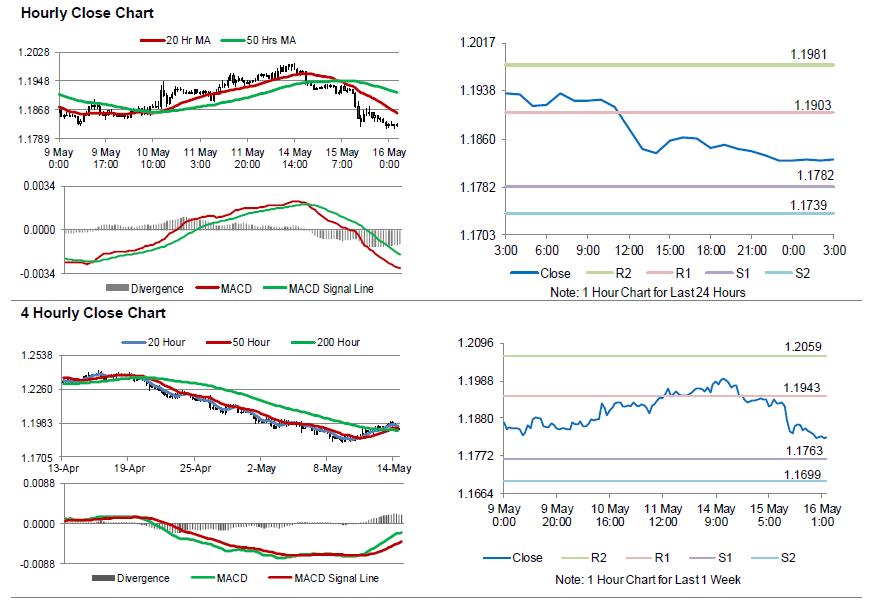
For the 24 hours to 23:00 GMT, the EUR declined 0.89% against the USD and closed at 1.1824, following downbeat GDP figures across the Euro-zone.
Data indicated that the Euro-zone's seasonally adjusted flash gross domestic product (GDP) rose 0.4% on a quarterly basis in the first three months of 2018, in line with market expectations.
In other economic news, the region's ZEW economic sentiment index advanced to a level of 2.4 in May, compared to a level of 1.9 in the previous month. Further, the region's seasonally adjusted industrial production gained 0.5% on a monthly basis in March, undershooting market expectations for a rise of 0.7%. Industrial production had registered a revised drop of 0.9% in the previous month.
Separately, Germany's seasonally adjusted flash GDP advanced 0.3% QoQ in 1Q 2018, falling short of market consensus for a rise of 0.4%. In the previous quarter, the nation had registered an expansion of 0.6%. Meanwhile, the nation's ZEW economic sentiment index remained unchanged at a level of -8.2 in May, in line with market expectations.
The US Dollar advanced against a basket of major currencies, following a pair of upbeat economic releases in the US.
Data indicated that advance retail sales in the US climbed 0.3% on a monthly basis in April, meeting market expectations and compared to a revised gain of 0.8% in the prior month. Also, the nation's NAHB housing market index climbed more-than-anticipated to a level of 70.0 in May, compared to a revised reading of 68.0 in the prior month, while markets were expecting the index to advance to a level of 69.0.
Another set of data showed that business inventories in the US remained flat on a monthly basis in March, defying market consensus for a rise of 0.1%. Business inventories had posted an advance of 0.6% in the previous month. Additionally, the nation's New York Empire State manufacturing index unexpectedly increased to a level of 20.1 in May, compared to a level of 15.8 in the previous month and confounding market consensus for it to ease to a level of 15.0.
In the Asian session, at GMT0300, the pair is trading at 1.1826, with the EUR trading slightly higher against the USD from yesterday's close.
The pair is expected to find support at 1.1782, and a fall through could take it to the next support level of 1.1739. The pair is expected to find its first resistance at 1.1903, and a rise through could take it to the next resistance level of 1.1981.
Moving ahead, investors would focus a speech by the ECB President, Mario Draghi, due later in the day. Also, the release of final inflation figures for April across the Euro-zone, scheduled to release in a few hours, will be eyed by traders. Moreover, the US housing starts and building permits as well as industrial and manufacturing production, all for April, slated to release later in the day, will garner significant amount of market attention.
The currency pair is trading below its 20 Hr and 50 Hr moving averages.
San Francisco Fed Williams: Neutral rate to stay at 2.5% despite stronger growth
San Francisco Fed President John Williams said that the r-star neutral rate remains at 2.5% despite strong growth. He noted that "some economists and central bankers have pointed to signs that the fortunes of r-star are set to rise." However, he didn't see "convincing evidence" yet.
Fed has been describing monetary policy as "accommodative" for years. With federal funds rates just a few hikes from 2.5%, William saw the need to "revisit" the language. But "that would be a committee decision about how to best describe the committee's view around where monetary policy is positioned and where we see it going."
Switzerland’s Producer & Import Prices Rebounded In April
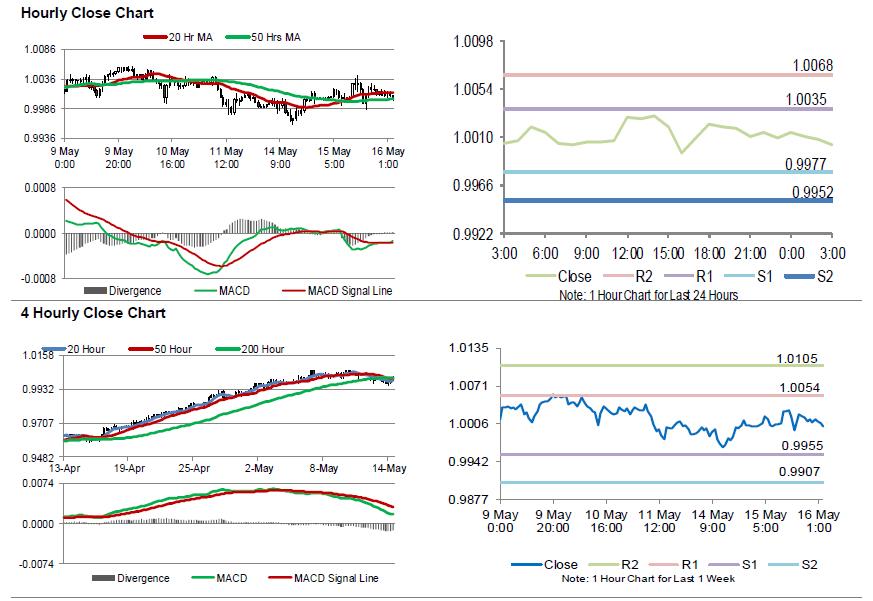
For the 24 hours to 23:00 GMT, the USD rose 0.05% against the CHF and closed at 1.0009.
On the data front, Switzerland producer and import price index rose 0.4% on a monthly basis in April, after registering a fall of 0.2% in the previous month.
In the Asian session, at GMT0300, the pair is trading at 1.0003, with the USD trading 0.06% lower against the CHF from yesterday's close.
The pair is expected to find support at 0.9977, and a fall through could take it to the next support level of 0.9952. The pair is expected to find its first resistance at 1.0035, and a rise through could take it to the next resistance level of 1.0068.
The currency pair is trading below its 20 Hr moving average and showing convergence with its 50 Hr moving average.
Canada’s Existing Home Sales Surprisingly Declined To A 5-Year Low In April
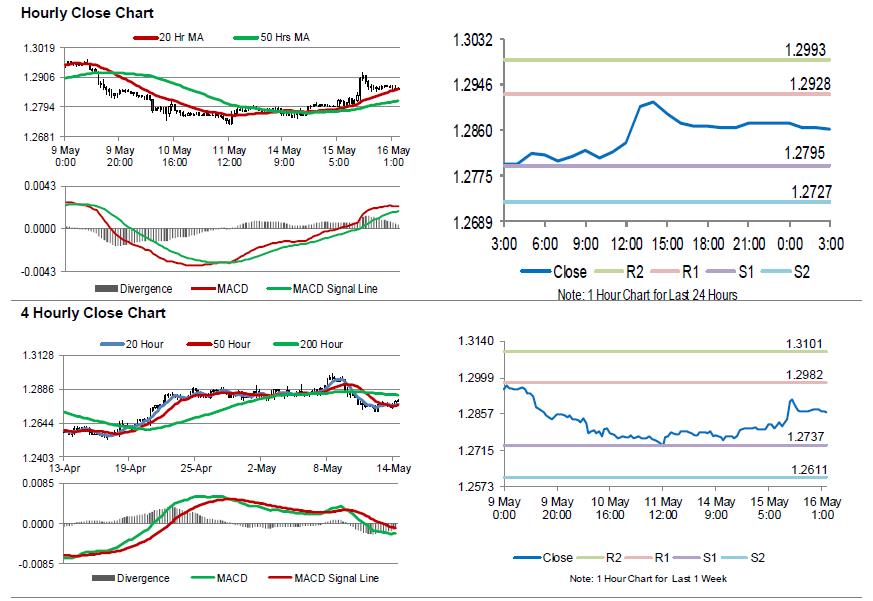
For the 24 hours to 23:00 GMT, the USD rose 0.55% against the CAD and closed at 1.2874.
The Canadian Dollar declined against the USD, after Canada's existing home sales unexpectedly dropped 2.9% on a monthly basis in April, dipping to a 5-year low level and defying market consensus for a gain of 0.4%. Existing home sales posted a rise of 1.3% in the prior month.
In the Asian session, at GMT0300, the pair is trading at 1.2863, with the USD trading 0.09% lower against the CAD from yesterday's close.
The pair is expected to find support at 1.2795, and a fall through could take it to the next support level of 1.2727. The pair is expected to find its first resistance at 1.2928, and a rise through could take it to the next resistance level of 1.2993.
Later in the day, traders would look forward to Canada's manufacturing shipments for March.
The currency pair is showing convergence with its 20 Hr moving average and trading above its 50 Hr moving average.