Sample Category Title
Euro Subdued Ahead of Eurozone CPI
EUR/USD is showing limited movement in the Wednesday session. Currently, the pair is trading at 1.2365, down 0.04% on the day. On the release front, the focus is on eurozone inflation indicators. Eurozone Final CPI is expected to climb to 1.4%, while Final Core CPI is forecast to remain unchanged at 1.0%. There are no major events in the US, but we’ll hear from FOMC members Williams and Quarles.
The German and eurozone economies have looked solid in 2018, making soft ZEW Economic Sentiment reports all the more surprising. The April reports were much weaker than expected, but investors shrugged off the numbers as risk appetite remains high. The German release of -8.2 points showed pessimism on the part of institutional investors and analysts and marked the weakest reading since November 2012. The eurozone release of 1.9 was the lowest since July 2o16. The readings are a major disappointment, as the eurozone economy has been performing well and key indicators have been steady. Investors will be hoping that these ZEW releases are one-time blips and that the May readings will be in line with recent releases.
The ECB remains cautious about winding down its stimulus program, and this stance was underscored in last week’s minutes from the March policy meeting. Policymakers pointed to some concerns which could affect plans to end stimulus, which the ECB has had in place for years in order to boost the economy. These include the tariff spat between the US and China, which ECB policymakers stated would hurt “all countries involved.” As well, there is concern that Britain’s departure from the European Union could cause more economic harm than previously expected. At the same time, the eurozone economy continues to perform well and inflation has been steady. This makes it unlikely that the ECB will extend stimulus, but could opt for a longer exit path. As for interest rate policy, no rate hikes are expected anytime soon. Last week, Commerzbank pushed back its forecast for an ECB interest-rate increase by three months to September 2019.
The recent trade battle between the US and China has been overshadowed by events in Syria, but the threat of further tariffs between the world’s largest two economies could again roil the markets and in turn, send gold prices higher. Another salvo was fired on Tuesday, as China slapped a tariff of some 179% on US sorghum crops, which is a livestock feed. China imports about $1 billion of sorghum annually, and the tariff, if it remains in place, will essentially halt US exports of sorghum to China. The Chinese government has threatened to impose tariffs on US soybean exports, valued at some $12 billion each year. If the US opts to retaliate, the specter of an ugly trade war between the US and China could spook investors and push the US dollar higher.
Gold Trend Line Break Expected On A Positive Momentum
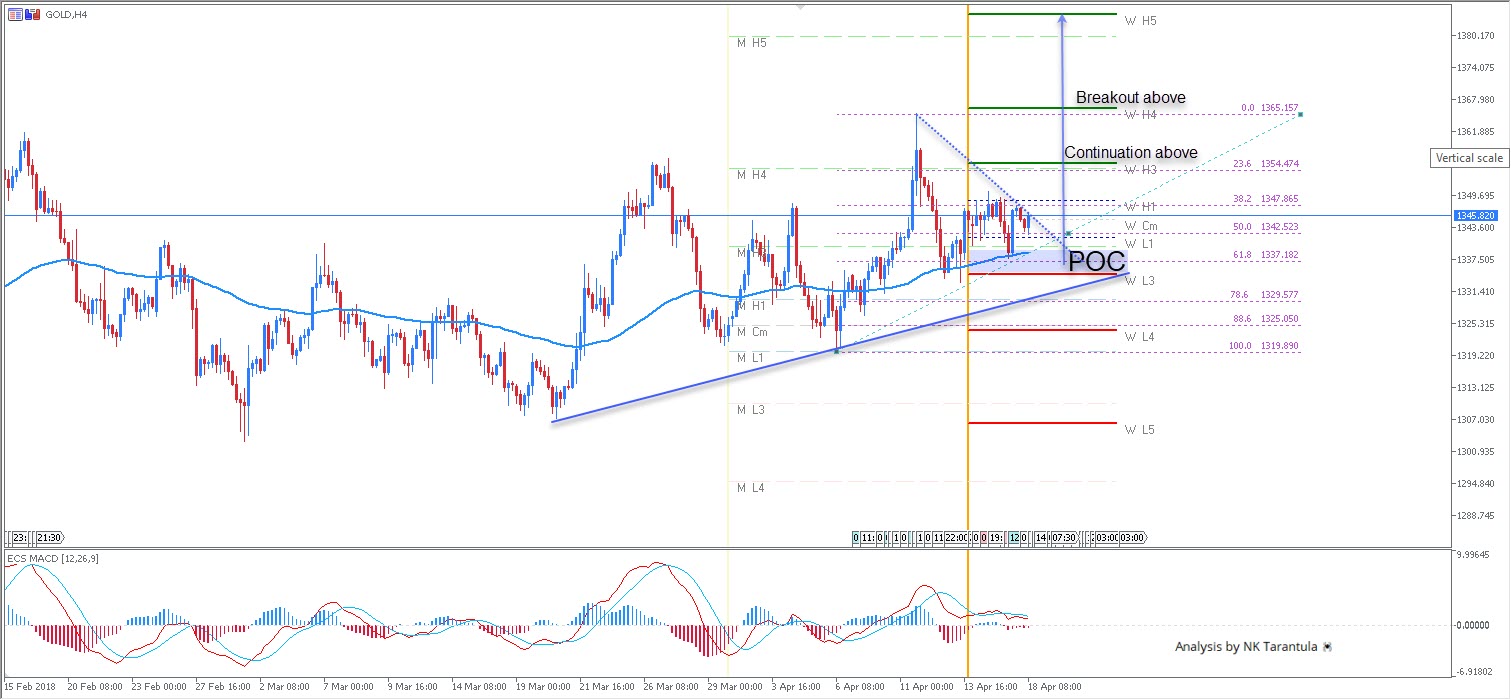
Gold is rejecting POC zone, and soon we might see a trend line break (blue dotted line) that could be a sign of a trend continuation. 1335-40 is the POC zone, and the trend line break is expected if the price closes above 1348. The first target is 1354.47 and continuation above should target 1365.15. A 4h close above 1365.16 should make a breakout move towards M H5 / W H5 1380-84. As long as the price is supported above M L1 around 1319, bulls should be safe.
W L3 - Weekly Camarilla Pivot (Weekly Interim Support)
W H3 - Weekly Camarilla Pivot (Weekly Interim Resistance)
W H4 - Weekly Camarilla Pivot (Strong Weekly Resistance)
M H4 - Monthly Camarilla Pivot (Very Strong Monthly Resistance)
M L3 – Monthly Camarilla Pivot (Monthly Support)
M L4 – Monthly H4 Camarilla (Very Strong Monthly Support)
POC - Point Of Confluence (The zone where we expect price to react aka entry zone)
GBP/USD Approaches Decision Zone After Bearish Momentum Pattern
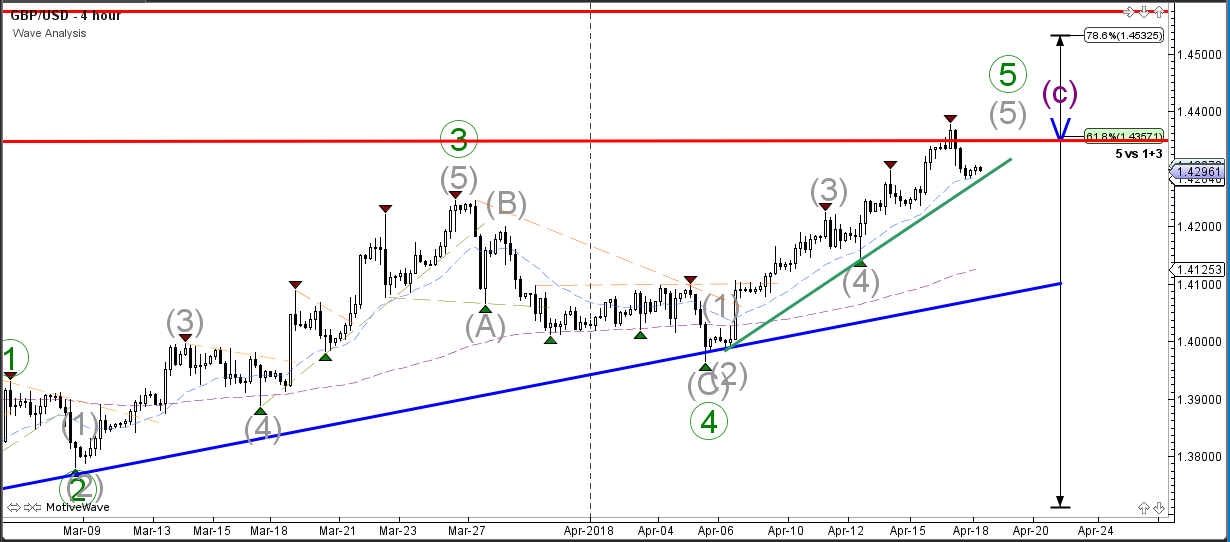
The GBP/USD made a strong bearish retracement at the previous top (red). Price could either be building a bearish reversal after it completed bullish waves 5 or it could keep pushing for one higher high. A bullish breakout could see price make an extension towards the round level at 1.45 whereas a bearish reversal could see price break below the support trend line (green).
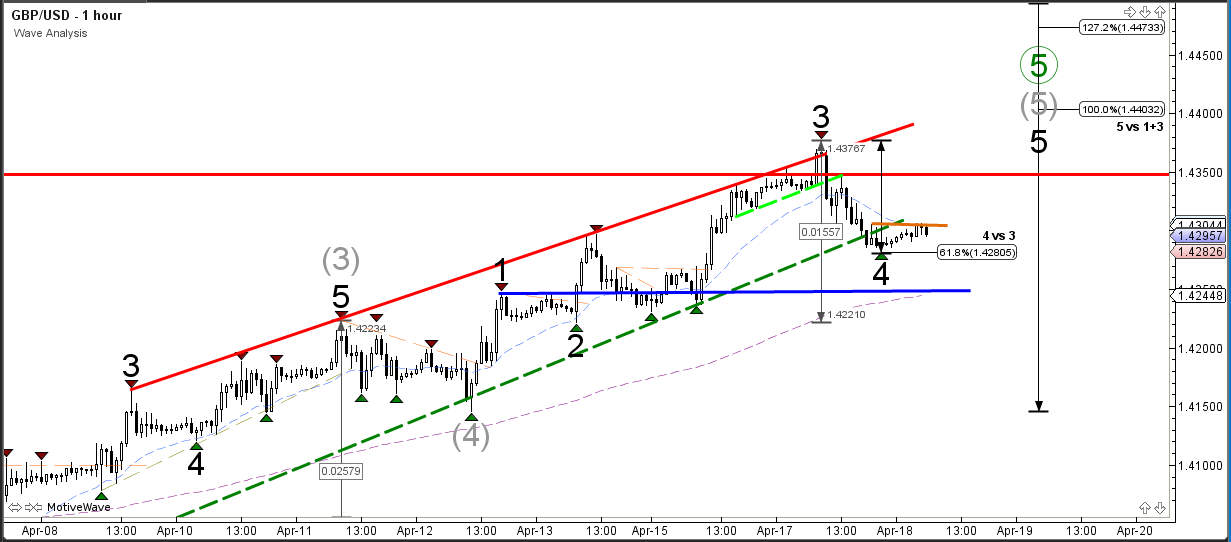
The GBP/USD bearish pullback has retraced all the way back to the 61.8% Fibonacci level, which is a key level for the wave 4 (black) pattern. A bullish breakout above the local resistance (orange) could indicate a move higher towards the Fib targets of wave 5 whereas break below the 61.8% makes a wave 4 less likely and a break below the blue line invalidates this wave pattern. Considering the strong bearish momentum, a reversal might occur but the breakout direction is key.
AUDUSD Remains Bullish In Medium-Term, Pares Some Previous Losses In Short-Term
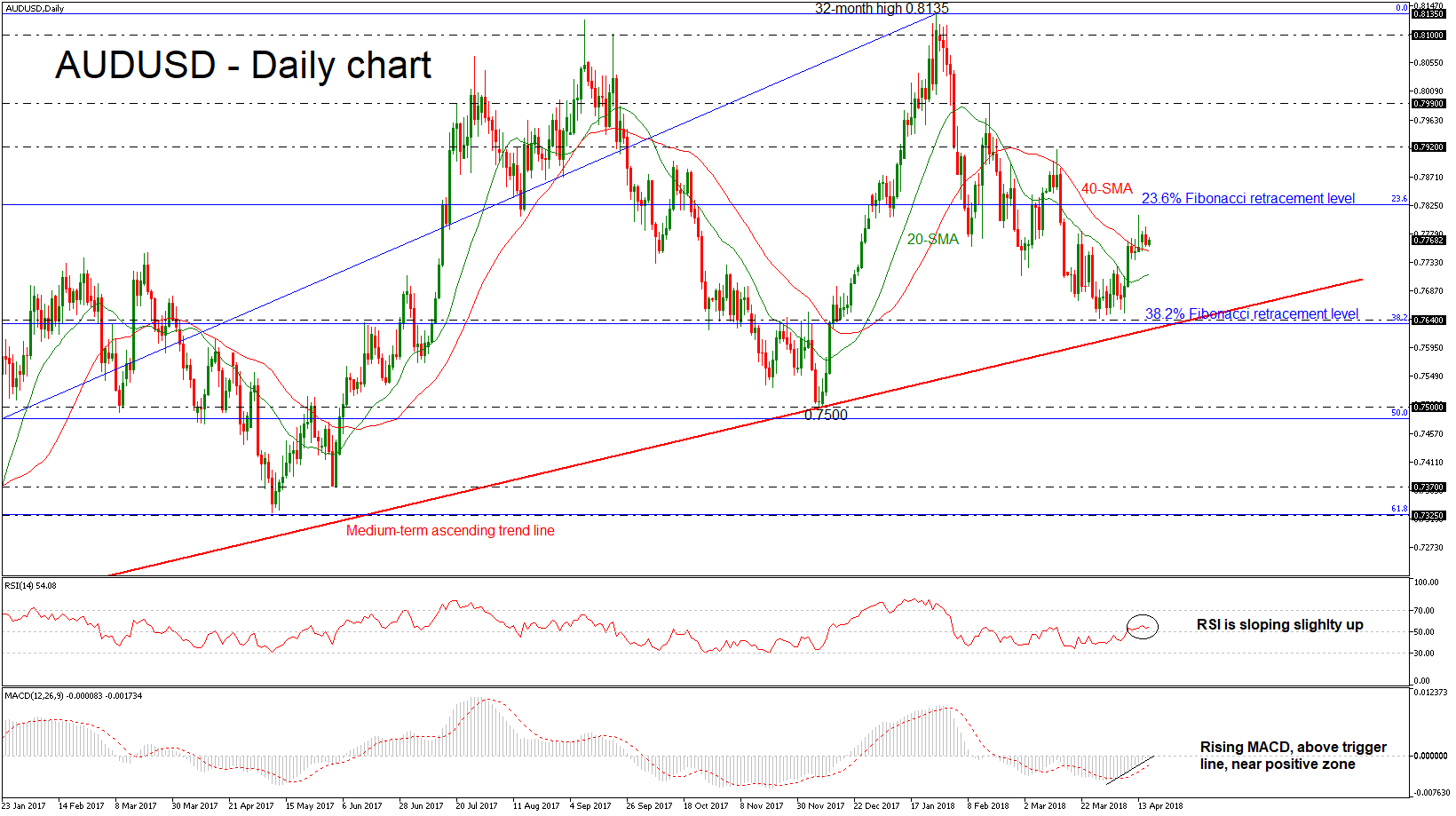
Since its deep fall towards the 0.7640 support level at the end of March, AUDUSD has been developing between the 38.2% Fibonacci retracement level of 0.7635 and the 23.6% Fibonacci mark of 0.7825. The Fibonacci levels are taken from the upleg of the last big upward movement in the weekly timeframe, with the low of 0.6820 and the high of 0.8135.
Last week the pair snapped the four losing weekly sessions and posted a positive candle, while the 50-week simple moving average (SMA) recorded a bullish cross with the 200-week SMA, suggesting a buying interest. In the near-term, the moving averages are sloping to the upside and the price is holding above them.
Looking at momentum indicators, the RSI is standing above the threshold of 50 and is moving north, while the MACD oscillator is rising in the negative zone but is approaching the positive territory.
If prices continue to head higher, immediate resistance could come from the 23.6% Fibonacci. A jump above this level would reinforce the short-term bullish view and open the way towards the 0.7920 resistance barrier.
However, should a downside reversal take from, the next support to have in mind is the 38.2% Fibonacci. In case of a penetration of this area, the strong bullish movement could shift to bearish, as the price would break the medium-term ascending trend line as well. The next support is coming from the 0.7500 handle, taken from the low on December 2017.
Safe Havens Retreat As Geopolitical Tensions Ease, UK CPI And BoC Rate Decision Coming Up
Here are the latest developments in global markets:
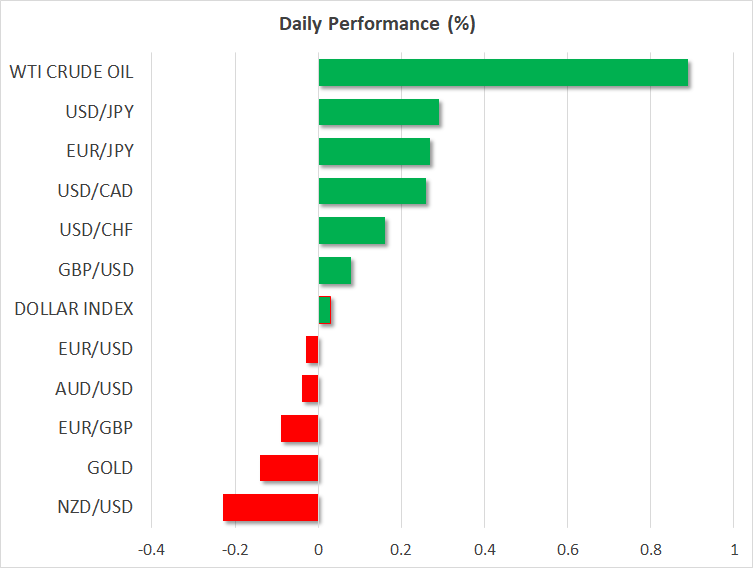
FOREX: The US dollar index was practically unchanged on Wednesday, after it posted some gains on Tuesday. The Japanese yen and the Swiss franc were on the back foot as geopolitical risks were perceived as easing, while the British pound steadied somewhat after retreating yesterday.
STOCKS: US markets soared for a second day in a row, as a strong earnings season and diminishing risks on the Korean Peninsula boosted risk appetite. The Nasdaq Composite led the way higher, climbing by 1.74%, buoyed by Netflix (+9.2%) and Amazon (+4.3%). Meanwhile, the S&P 500 and the Dow Jones gained nearly 1.1% and 0.9% respectively. Moreover, futures tracking the Dow, S&P, and Nasdaq 100 are all pointing to a slightly higher open today. Asia was a sea of green as well. Japan’s Nikkei 225 and Topix surged by 1.4% and 1.1% correspondingly, while in Hong Kong, the Hang Seng gained 0.4%. Over in Europe, futures tracking all the major benchmarks were flashing green as well.
COMMODITIES: Oil prices edged up amid the broader risk on environment. WTI rose by 0.9% on Wednesday, while Brent gained 0.8%. Besides risk appetite, prices were supported by a surprising drawdown in the private API crude inventory data, which likely fueled speculation for a similar reaction in today’s official EIA stockpile figures. In precious metals, gold traded 0.15% lower, last seen near the $1345/ounce barrier. The safe haven is being weighed on by a combination of diminishing geopolitical risks in Korea and in Syria, as well as a broader improvement in risk sentiment.
Major movers: Yen drops as North Korea risks fade, sterling retreats after data
The most notable moves overnight were seen in the Japanese yen, which fell by nearly 0.3% against both the dollar and the euro as tensions on the Korean Peninsula eased. The risk-on reactions came after President Trump said the US and North Korea have been holding talks “at extremely high levels” to try to arrange a summit between himself and Kim Jong Un. Soon thereafter, media reports said that CIA Director and soon-to-be Secretary of State Mike Pompeo had travelled to North Korea over the Easter and met with Kim, laying the groundwork for a meeting between the leaders.
Coming on top of separate reports yesterday that the two Koreas are discussing plans for ending their military conflict – as they are still at war technically – these signals likely amplified the narrative that things are calming down. Bearing also in mind that the situation in Syria is not expected to escalate further, geopolitical risk premium appears to have declined significantly. Besides the yen, the safe-haven Swiss franc also tumbled. Euro/franc climbed to 1.1970, its highest level in three years – ever since the SNB removed the floor in the pair.
On the trade front, developments were a mixed bag. China pledged to allow US car makers greater freedom in its market, but also imposed temporary 179% tariffs on American sorghum, a grain used to feed livestock. The move is consistent with China’s approach to this entire ordeal so far; the nation is willing to make some concessions, but will not shy away from a trade standoff either. While these developments were largely overlooked by equity investors, who instead focused on diminishing geopolitical tensions and a strong earnings season, they serve as a reminder that trade risks are still looming and that we have not entered the “talks” phase just yet.
Elsewhere, the British pound steadied against the dollar today, after it retreated off its nearly-two-year-high on Tuesday. The tumble in the pound came after UK wage growth data disappointed. Nonetheless, the probability for a BoE rate hike in May remained elevated at 70%. Today, markets will focus on the release of the nation’s inflation data (see below).
Day ahead: UK inflation and Bank of Canada decision the highlights of the day
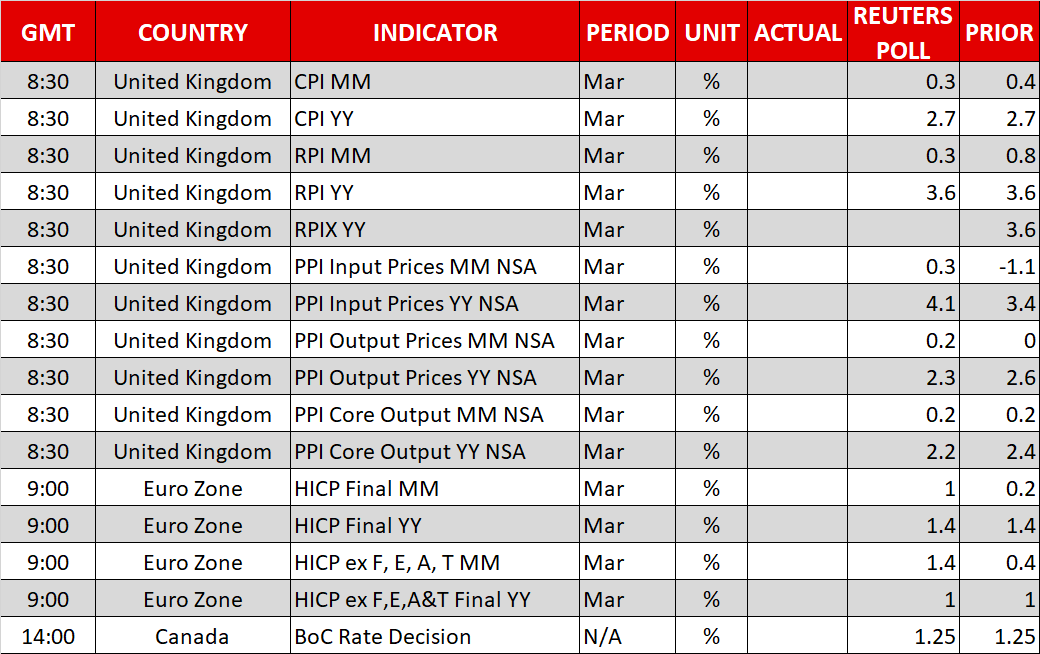
UK CPI figures and the Bank of Canada’s interest rate decision are likely to attract the most attention out of Wednesday’s economic calendar.
At 0830 GMT, UK inflation figures will be made public. Headline CPI is projected to stand at 2.7% y/y in March, the same pace as in February, while on a monthly basis it is expected to ease to 0.3% from 0.4%. If the numbers come in line with expectations, they would perhaps instill more confidence in positive real income growth making a comeback; Tuesday’s data showed average weekly earnings rising by 2.8% y/y. Core CPI will also be watched, while data on producer prices and retail price inflation – a measure used for the indexation of pensions and the adjustment of indexed-bonds – will be released at the same time as well.
UK overnight index swaps are projecting a 70% probability for a May rate hike by the Bank of England. It would be interesting to see how the odds for such a move are affected after the release of today’s figures.
Inflation figures for the month of March out of the eurozone are also slated for release today (0900 GMT), though those will pertain to the final release and are thus not that likely to spur sharp movements in currency markets.
Later in the day, the focus will turn to the Bank of Canada which will be completing its two-day meeting on monetary policy. The decision on interest rates is scheduled for release at 1400 GMT. The Bank is not expected to proceed with a rate hike, though there has been rising speculation for the central bank to tighten policy in the meeting that follows. To the extent the BoC signals that such a move could take place – for example by expressing confidence on a positive outcome in NAFTA talks – then the loonie is likely to receive a boost. The Canadian dollar is currently trading not far below a two-month high versus its US counterpart. Also on the agenda is a press conference by BoC Governor Stephen Poloz and Senior Deputy Governor Carolyn Wilkins at 1515 GMT.
Of interest to oil traders will be EIA’s report on US crude stocks for the week ending April 13. Crude inventories are anticipated to decline by 1.4 million barrels after rising by 3.3m in the previously tracked week.
With the earnings season in full swing, Morgan Stanley will be releasing its quarterly results before Wednesday’s US market open.
Fed officials making appearances include outgoing New York Fed President William Dudley (1900 GMT) and Fed Vice Chair for Supervision Randal Quarles (2015 GMT). Both hold permanent voting rights within the FOMC. Also attracting some interest is the Federal Reserve’s Beige Book which gauges current economic conditions in the 12 Federal districts in the US. It is scheduled for release at 1800 GMT.
In politics, US President Donald Trump and Japanese Prime Minister Shinzo Abe will be completing their two-day meeting taking place in Florida. Up to now, talks have focused on the prospective U.S.-North Korea summit that could take place around May or June. Trade issues are likely to be discussed as well.
Technical Analysis: EURGBP short-term bearish, trades not far above 11-month low
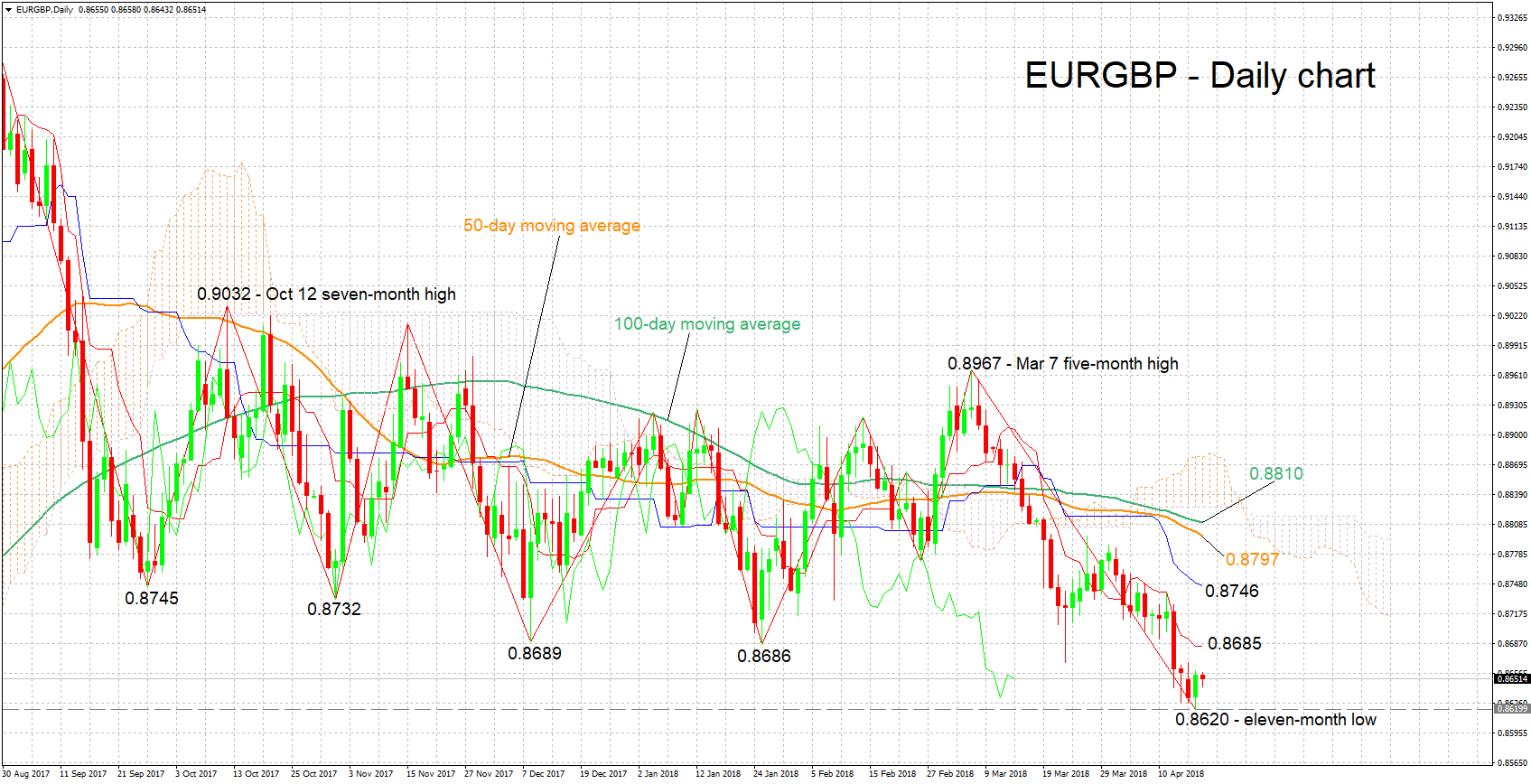
EURGBP has lost considerable ground after touching a five-month high of 0.8967 on March 7, eventually reaching an 11-month low of 0.8620 during Tuesday’s trading. The Tenkan- and Kijun-sen lines are negatively aligned in support of a bearish short-term picture. Notice though that the Chikou Span may be signaling an oversold market.
If today’s UK data more conclusively put a May rate hike by the Bank of England on the table, then EURGBP is likely to decline, with support potentially coming around yesterday’s 11-month low of 0.8620; the 0.86 round figure is also part of the area around this trough.
On the upside and in case market participants see reduced chances for a May rate increase, resistance could come around the current level of the Tenkan-sen at 0.8685. Notice that the range around this point encapsulates a couple of bottoms from the recent past, as well as the 0.87 handle.
XAUUSD Intraday Analysis
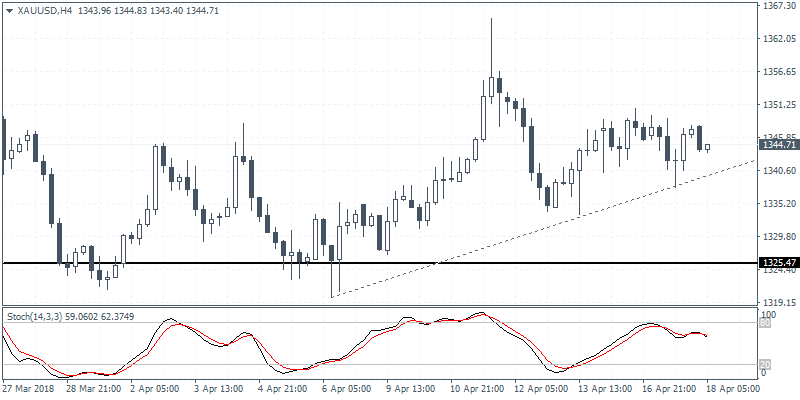
XAUUSD (1344.71): Gold prices continued to trade sideways with the daily price action closing with a doji pattern. As long as prices remain supported above the 1336 handle, we expect to see this ranging pattern continue for the near term. The rising trend line is expected to hold any declines to the downside but a breakdown below the trend line could see gold prices extending the losses to test the lower support at 1325 level.
GBPUSD Intraday Analysis
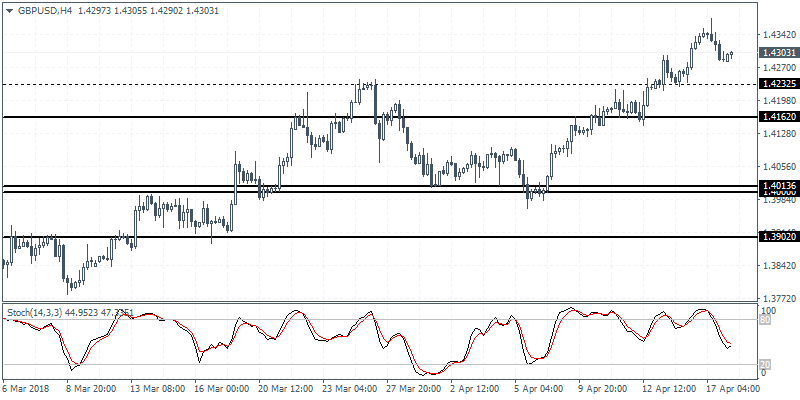
GBPUSD (1.4303): The British pound maintained strong gains on the day with the currency pair testing fresh highs of 1.4377. The 4-hour chart shows the Stochastics oscillator building up the momentum, which could signal further gains in the near term. However, unless the previous high is breached, we expect to see price action likely to correct back to the 1.4232 level of support in the near term
EURUSD Intraday Analysis
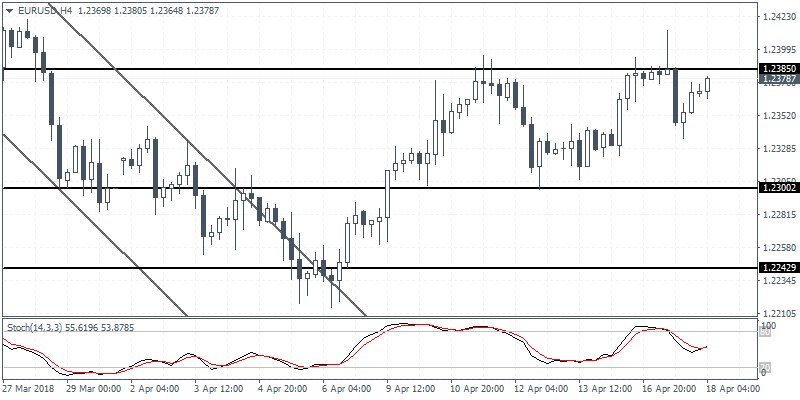
EURUSD (1.2378): The EURUSD was bearish yesterday as the currency pair failed to breakout above the resistance level established at 1.2400. Price action was seen testing intraday highs of 1.2411 before giving up the gains. The declines were however met with another reversal with the common currency now attempting to retest the resistance level once again. Unless the EURUSD posts a breakout above 1.2385, we expect to see price action trading below the resistance level and continuing to maintain the sideways range.
UK Wages Rise Less Than Forecast, Inflation Data Eyed
The U.S. dollar was seen trading on firmer ground yesterday amid a busy trading day. Investor appetite was seen improving across the board.
Economic data from the UK showed that the unemployment rate fell to 4.2%, which was better than the expected 4.3% level. Wage growth was however subdued, rising 2.8% on the month. This was below forecasts of 3.0% increase from the previous month.
Data from the United States showed that building permits increased 1.35million which was higher than the previous month's 1.32 million.
Looking ahead, the economic calendar today will see the release of the UK's inflation data. Economists forecast that inflation will rise at the pace of 2.7%, the same pace of increase as the month before. Core CPI is expected to slightly accelerate 2.5% on the year ending March.
The Bank of Canada will be holding its monetary policy meeting today. Interest rates are expected to remain unchanged at 1.25% on the month. The central bank is expected to however strike a hawkish tone. Later in the day FOMC members, Quarles and Dudley are expected to speak.
New Zealand quarterly inflation data will be coming out later in the evening. Economists forecast that quarterly inflation increased 0.5% during the first quarter. This marks a slight increase from 0.1% seen in the previous quarter.
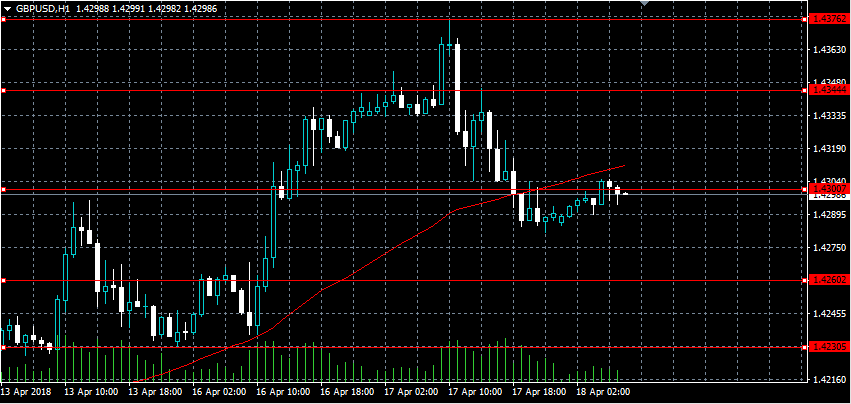
GBPUSD Gains Limited Below 1.4344 Level
The British pound continues to unwind from overbought- trading conditions against the greenback, as rising U.S stocks and Treasury-yields help to boost the U.S dollar index higher. The GBPUSD pair currently trades around the 1.4300 level, after finding interim technical support from the 1.4280 level on Tuesday. Sterling traders now look towards the release of key monthly and year-on-year CPI inflation and PPI inflation data, from the United Kingdom economy.
The GBPUSD pair retains its bullish bias while trading above the 1.4300 level, key intraday resistance is then found at the 1.4344 and 1.4376 levels.
If the GBPUSD pair fails to gain traction above the 1.4300 level, sellers may test back towards the 1.4260 and 1.4230 levels.