

Sample Category Title
Dallas Fed Kaplan: Growth will fall below 2% after next year
Dallas Fed president Robert Kaplan expect solid growth in the US this year, with falling unemployment and rising wages. According to him, unemployment rate could fall further to as low as 3.7%. However, he warned of sluggish growth ahead.
He noted that "because the near-term outlook for GDP growth is positive, this may lull observers into believing we are on a path to sustained improvement in the economic performance of the U.S. economy." However, as the effect of tax cut and budget stimulus fade, also as Fed normalizes monetary policy, growth will fall below 2% after next year.
He added that "unless Congress and the White House initiate structural reforms that improve workforce growth, education and skill levels of our labor force, moderate the expected path of government debt growth, and adopts policies that allow us to capture the opportunities provided by globalization, we are likely to see sluggish rates of GDP growth in the medium and longer term,"
Also, Kaplan pointed out that business are lacking pricing power for the moment. He noted "pricing power of businesses is more limited than we're historically accustomed to seeing at this stage in an economic expansion." And that could limit inflation and inflation expectations.
EUR/USD Mid-Day Outlook
Daily Pivots: (S1) 1.2307; (P) 1.2327 (R1) 1.2346; More....
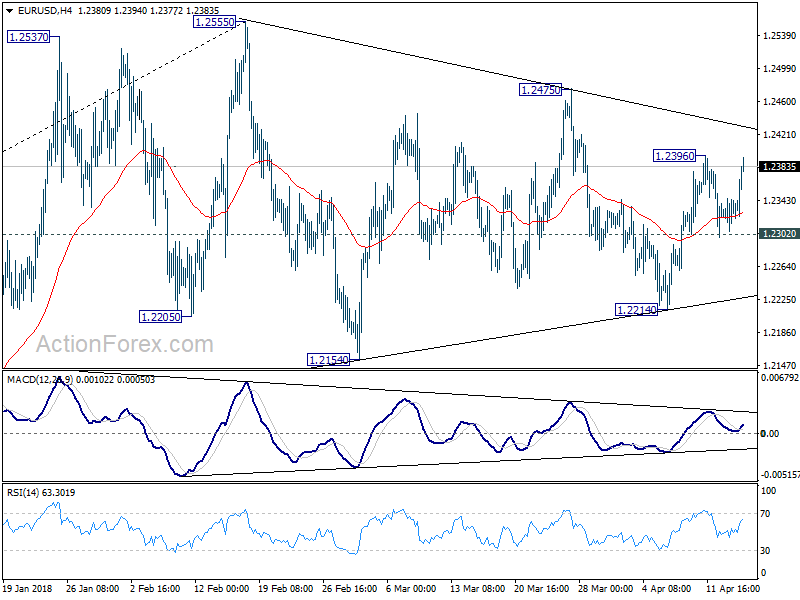
EUR/USD rebounds strongly today and while intraday bias remains neutral, focus is back on 1.2396 temporary top. Break there will resume the rise from 1.2214 and target 1.2475 and above to 1.2516/2555 key resistance zone. On the downside, break of 1.2302 will indicate completion of the rebound from 1.2214. Intraday bias would be turned back to the downside for 1.2214. Firm break there will revive the bearish case of trend reversal.
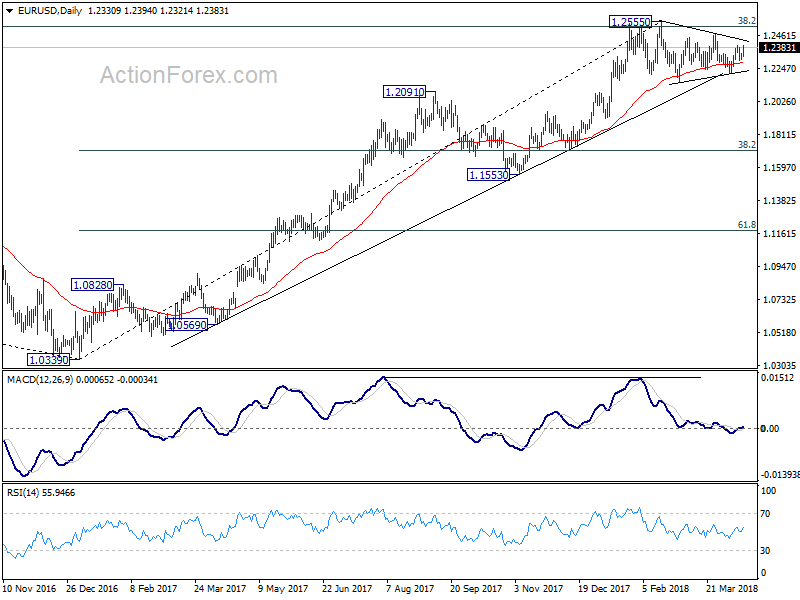
 In the bigger picture, key fibonacci level at 38.2% retracement of 1.6039 (2008 high) to 1.0339 (2017 low) at 1.2516 remains intact despite attempts to break. Hence, rise from 1.0339 medium term bottom is still seen as a corrective move for the moment. Rejection from 1.2516 will maintain long term bearish outlook and keep the case for retesting 1.0039 alive. Firm break of 1.1553 support will add more medium term bearishness. However, sustained break of 1.2516 will carry larger bullish implication and target 61.8% retracement of 1.6039 to 1.0339 at 1.3862 in medium term.
USD/JPY Mid-Day Outlook
Daily Pivots: (S1) 107.10; (P) 107.43; (R1) 107.67; More...
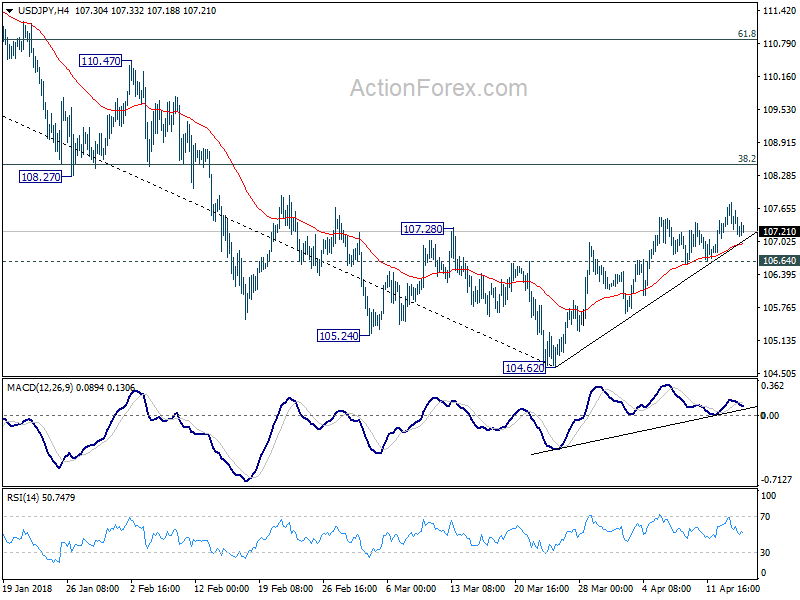
Intraday bias in USD/JPY remains neutral for the moment. Further rise could be seen as long as 106.64 minor support intact. But 38.2% retracement of 114.73 to 104.62 at 108.48 9 which is close to 108.12, remains crucial in determining the medium outlook. Break of 106.64, however, will indicate the rebound from 104.62 has completed. And in that case, bias will be turned back to the downside for retesting 104.62.
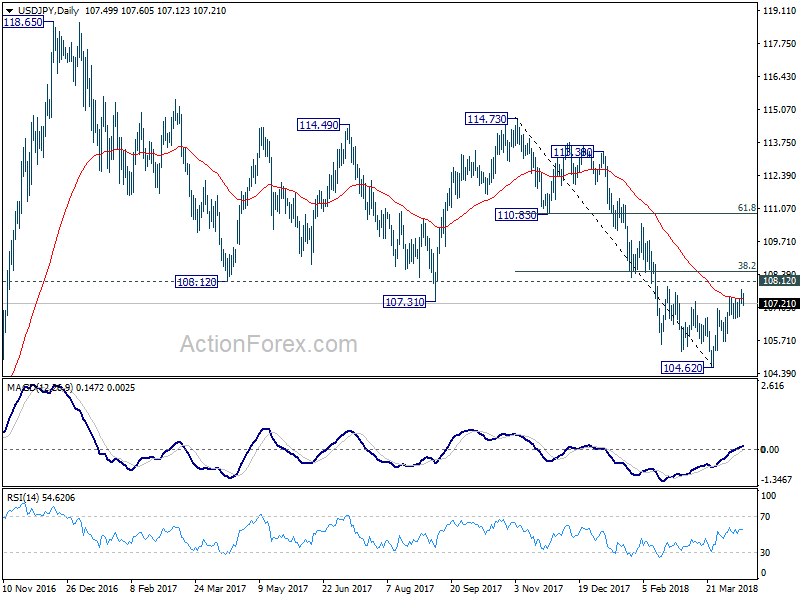
 In the bigger picture, as long as 108.12 support turned resistance holds, the medium term down trend from 118.65 (2016 high) should still continue lower, at least to retest 98.97 (2016 low). However, sustained break of 108.12 will be an early sign of medium term reversal. In that case, further rise would be seen to 114.73 resistance to confirm completion of the fall from 118.65.
USD/CHF Mid-Day Outlook
Daily Pivots: (S1) 0.9599; (P) 0.9618; (R1) 0.9638; More...
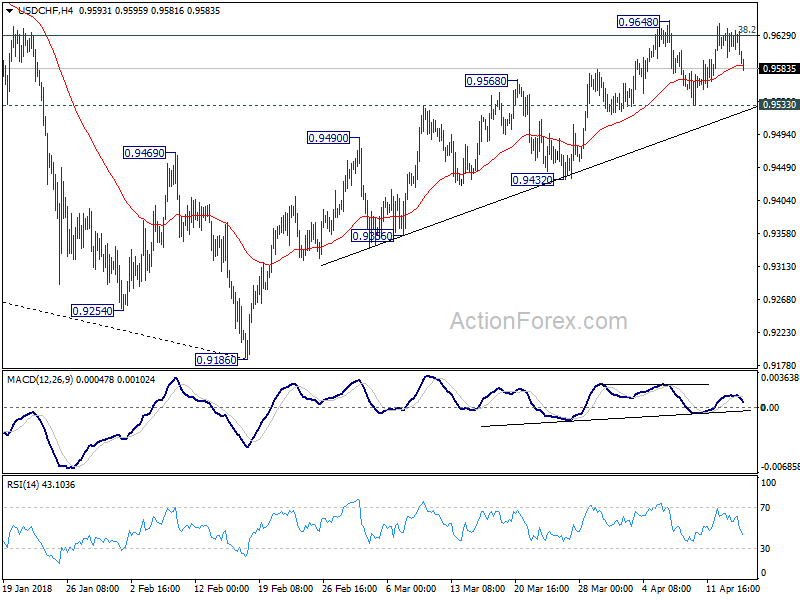
USD/CHF failed to take 0.9648 and weakens again today. But it's staying in range of 0.9533/9648 and intraday bias remains neutral. On the downside, break of 0.9533 minor support should indicate rejection by 0.9626 key fibonacci resistance. Intraday bias would then be turned to the downside side for 0.9432 support. Further break there will turn near term outlook bearish for retesting 0.9186 low. On the upside, sustained trading above 0.9626 will be another evidence of larger reversal. In that case, further rally should be seen back to next fibonacci level at 0.9900.
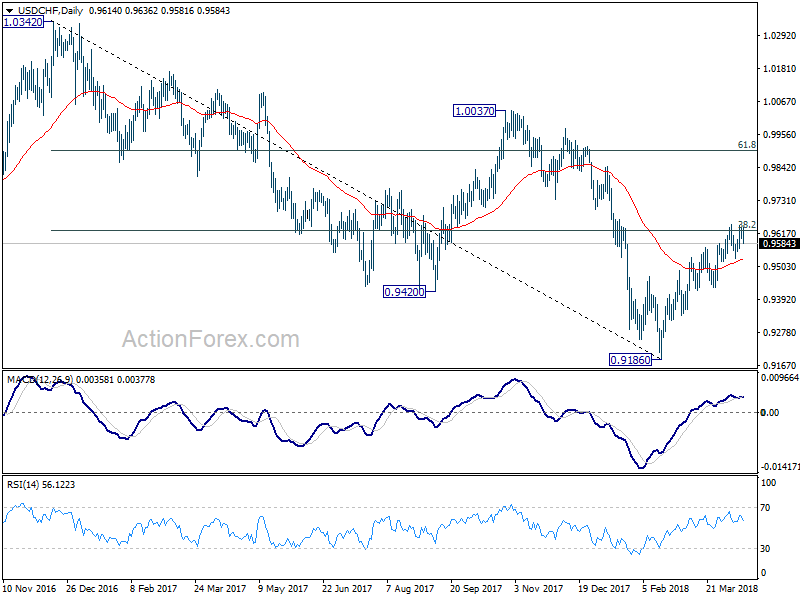
 In the bigger picture, fall from 1.0342 is seen as a medium term down trend. Main focus is on 38.2% retracement of 1.0342 (2016 high) to 0.9186 (2018 low) at 0.9626. Sustained break there will add to the case of trend reversal and target 61.8% retracement at 0.9900 and above. However, rejection from 0.9626 will maintain medium term bearishness for another low below 0.9186.
US: Retail Sales Continue Soft Performance in February on Delayed Tax Returns
Retail sales jumped 0.6% in March, rebounding from a 0.1% drop in February, and slightly beating market expectations for a 0.4% gain.
A 2% increase in motor vehicle & parts dealers led the way, but gains were relatively widespread across categories. This was borne out in the so-called 'control group' used in calculating GDP, which excludes gasoline, autos, building materials, and food services, and was up a healthy 0.4% on the month, matching market expectations.
Delving into the details, sales were up for furniture (0.7%), electronics and appliances (0.5%), health and personal care (1.4%), and non-store retailers (0.8%). Sales at non-store retailers are up 9.7% year-on-year, driven by healthy gains in online shopping.
On the negative side of the ledger, sales were down at building material & garden equipment supplies dealers (-0.6%), clothing and accessories stores (-0.8%) and sporting goods hobby, books and music (-1.8%). The latter two categories are areas of retail spending where online retailers have been gaining significant ground. Building material sales are up a healthy 5.3% year-on-year, and the decline in March likely reflects a give back after post-hurricane rebuilding activity in prior months. Sales were also down at gasoline stations (-0.3% m/m), but are still up almost 10% year-on-year, in large part reflecting higher prices at the pump.
Key Implications
Expectations were high for retail sales in March, and the data did not disappoint. It was the first full month where taxpayers would have felt the impact of tax cuts on their paychecks. Consumers responded by ramping up spending in a variety of areas, encouragingly for discretionary big-ticket items like cars and furniture, and also at online retailers.
The good report for March comes too late to save consumer spending for the first quarter, where residual seasonality is expected to hold spending to not much better than 1% annualized. The good news is that a strong March result helps set the second quarter up for a healthy rebound, with consumer spending likely to growth around 3%. Our latest Quarterly Forecast calls for healthy consumer spending through the remainder of 2018, with growth in the neighborhood of 2.5%-3.0% annualized.
GBP/USD Mid-Day Outlook
Daily Pivots: (S1) 1.4205; (P) 1.4250; (R1) 1.4281; More....
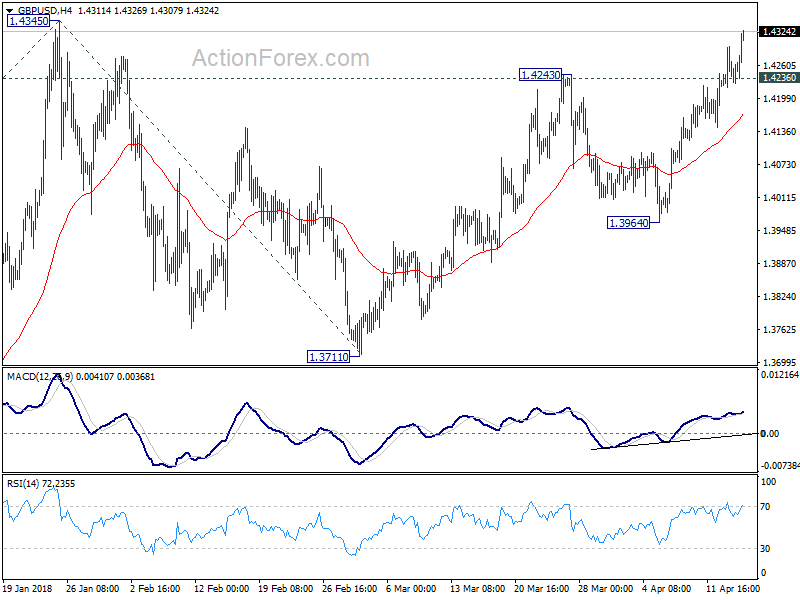
GBP/USD rises to as high as 1.4326 so far today. Intraday bias remains on the upside for 1.4345 high. Firm break there will resume medium term rally and target 61.8% projection of 1.3038 to 1.4345 from 1.3711 at 1.4519 next. On the downside, below 1.4236 minor support will turn intraday bias neutral again. But retreat should be contained well above 1.3964 support to bring another rally.
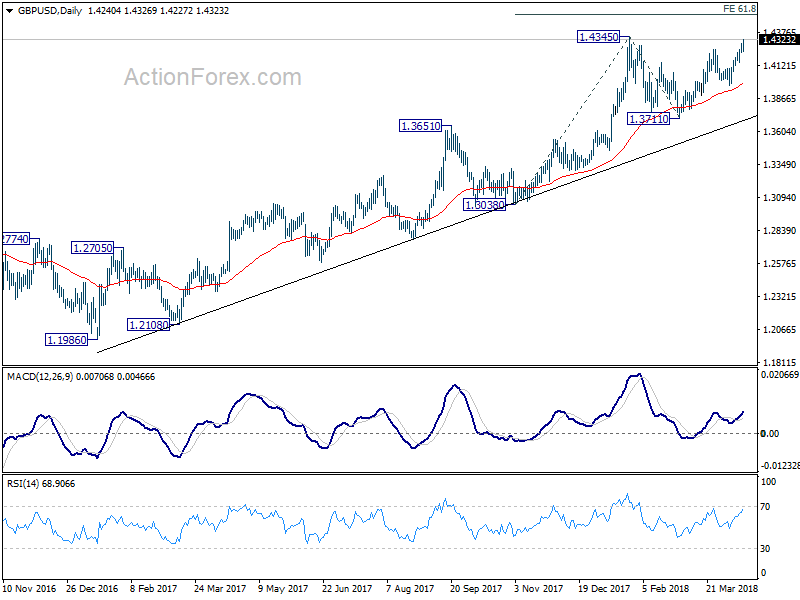
 In the bigger picture, as long as 1.3651 resistance turned support holds, medium term outlook in GBP/USD will remain bullish. Rise from 1.1946 is at least correcting the long term down trend from 2007 high at 2.1161. Further rally would be seen back to 38.2% retracement of 2.1161 (2007 high) to 1.1946 (2016 low) at 1.5466. However, GBP/USD fails to sustain above 55 month EMA (now at 1.4267) so far. Break of 1.3651 will be the first sign of medium term reversal and turn focus to 1.3038 support for confirmation.
Dollar Weak after Mixed Data, Sterling Shines
Dollar remains general weak in early US session after mixed economic data, in particular against European majors. The greenback does try to rebound against Australian Dollar and Canadian Dollar. But momentum is being capped. Yen also tried to rebound earlier today but quickly lost steam. Sterling is emerging as the strongest on today, without any special reason. Traders could be jumping the gun ahead of a string of important UK data, including CPI and employment, including wage growth, to be featured later in the week. These data would be important by BoE policymakers to decide whether to hike again in May.
In other markets, investors are quick to leave the Syria strike behind. Nikkei closed the up 0.26%. Hong Kong HSI closed down -1.60% but that was mainly due to worry on weakness of its currency. European indices are mixed with DAX and CAC flat at the time of writing. FTSE is down -0.45% thanks to strength in the Pound. US futures point to slightly higher open. Gold remains bounded in tight range between 1340/50.
US headline retail sales rose 0.6% mom in March, above expectation of 0.5%. Ex-auto sales rose 0.2% mom, in-line with consensus. Empire State Manufacturing index, however, tumbled sharply to 15.8 in April, down from 22.5 and missed expectation of 18.6. In particular, the index for future business conditions dived -26 pts to 18.3, hitting the lowest level in more than two years. That's a sharp contrast to the reading back in February, at 44.1, which was a several year high.
Also released today, Swiss PPI came in at -0.2% mom, 2.0% yoy in March, below expectation of -0.4% mom, 2.6% yoy. German WPI rose 0.0% mom in March. UK Rightmove house price rose 0.4% mom in April.
Minneapolis Fed Kashkari: Fed might be one hike away from achieving neutral
Minneapolis Fed President Neel Kashkari is seen clearly as a dove as he voted against al three of Fed's rate hikes last year. He said in a WSJ interview published today that fiscal stimulus ofthe federal government, including tax cuts would make Fed meeting its 2%inflation target more likely. The tax cuts and spending increases are"macroeconomically significant, and they are big enough to have aneffect on the trajectory of the economy… that could change things in ameaningful way." And with that development, Fed can move ahead with theplanned tightening.
But he also argued that "it isn't going to be obvious to me once weachieve our inflation target that we need to now put the brakes on theeconomy." He reiterated his stance that " once we achieve our inflationtarget, we should try to get to neutral in a reasonable period of time." And he added that "we might be one hike away from achieving neutral."
BoJ Wakatabe: Maintaining currency policy could heighten inflation expectations
BoJ Deputy Governor Masazumi Wakatabe urged patience in maintainingultra loose monetary policy. He repeated that "inflation has yet toreach our 2 percent target" even though price growth is on an "upwardtrend". And by "patiently maintaining our current policy", BoJ could"heighten inflation expectations".
Waktatabe is not concerned with falling behind the curve as "even iffor some reason inflation accelerates rapidly, we have the tools to dealwith it." Though, he noted that "the merits and demerits of the BOJ's monetarypolicy change over time." And he added that BoJ needs to be "mindful ofthe danger, or risk, a prolonged low-interest rate environment wouldweigh on bank profits and that such impact could accumulate."
Separately, the Japan Cabinet Office maintained the assessment that the economy is "recovering at a moderate pace".
GBP/USD Mid-Day Outlook
Daily Pivots: (S1) 1.4205; (P) 1.4250; (R1) 1.4281; More....
GBP/USD rises to as high as 1.4326 so far today. Intraday bias remains on the upside for 1.4345 high. Firm break there will resume medium term rally and target 61.8% projection of 1.3038 to 1.4345 from 1.3711 at 1.4519 next. On the downside, below 1.4236 minor support will turn intraday bias neutral again. But retreat should be contained well above 1.3964 support to bring another rally.
In the bigger picture, as long as 1.3651 resistance turned support holds, medium term outlook in GBP/USD will remain bullish. Rise from 1.1946 is at least correcting the long term down trend from 2007 high at 2.1161. Further rally would be seen back to 38.2% retracement of 2.1161 (2007 high) to 1.1946 (2016 low) at 1.5466. However, GBP/USD fails to sustain above 55 month EMA (now at 1.4267) so far. Break of 1.3651 will be the first sign of medium term reversal and turn focus to 1.3038 support for confirmation.
Economic Indicators Update
| GMT | Ccy | Events | Actual | Forecast | Previous | Revised |
|---|---|---|---|---|---|---|
| 23:01 | GBP | Rightmove House Prices M/M Apr | 0.40% | 1.50% | ||
| 06:00 | EUR | German WPI M/M Mar | 0.00% | 0.40% | -0.30% | |
| 07:15 | CHF | Producer & Import Prices M/M Mar | -0.20% | 0.40% | 0.30% | |
| 07:15 | CHF | Producer & Import Prices Y/Y Mar | 2.00% | 2.60% | 2.30% | |
| 12:30 | USD | Empire State Manufacturing Index Apr | 15.8 | 18.6 | 22.5 | |
| 12:30 | USD | Retail Sales Advance M/M Mar | 0.60% | 0.40% | -0.10% | |
| 12:30 | USD | Retail Sales Ex Auto M/M Mar | 0.20% | 0.20% | 0.20% | |
| 14:00 | USD | Business Inventories Feb | 0.60% | 0.60% | ||
| 14:00 | USD | NAHB Housing Market Index Apr | 70 | 70 | ||
| 20:00 | USD | Net Long-term TIC Flows Feb | 62.1B |
CADJPY Maintains Bullish Bias after Rebound on 80.50
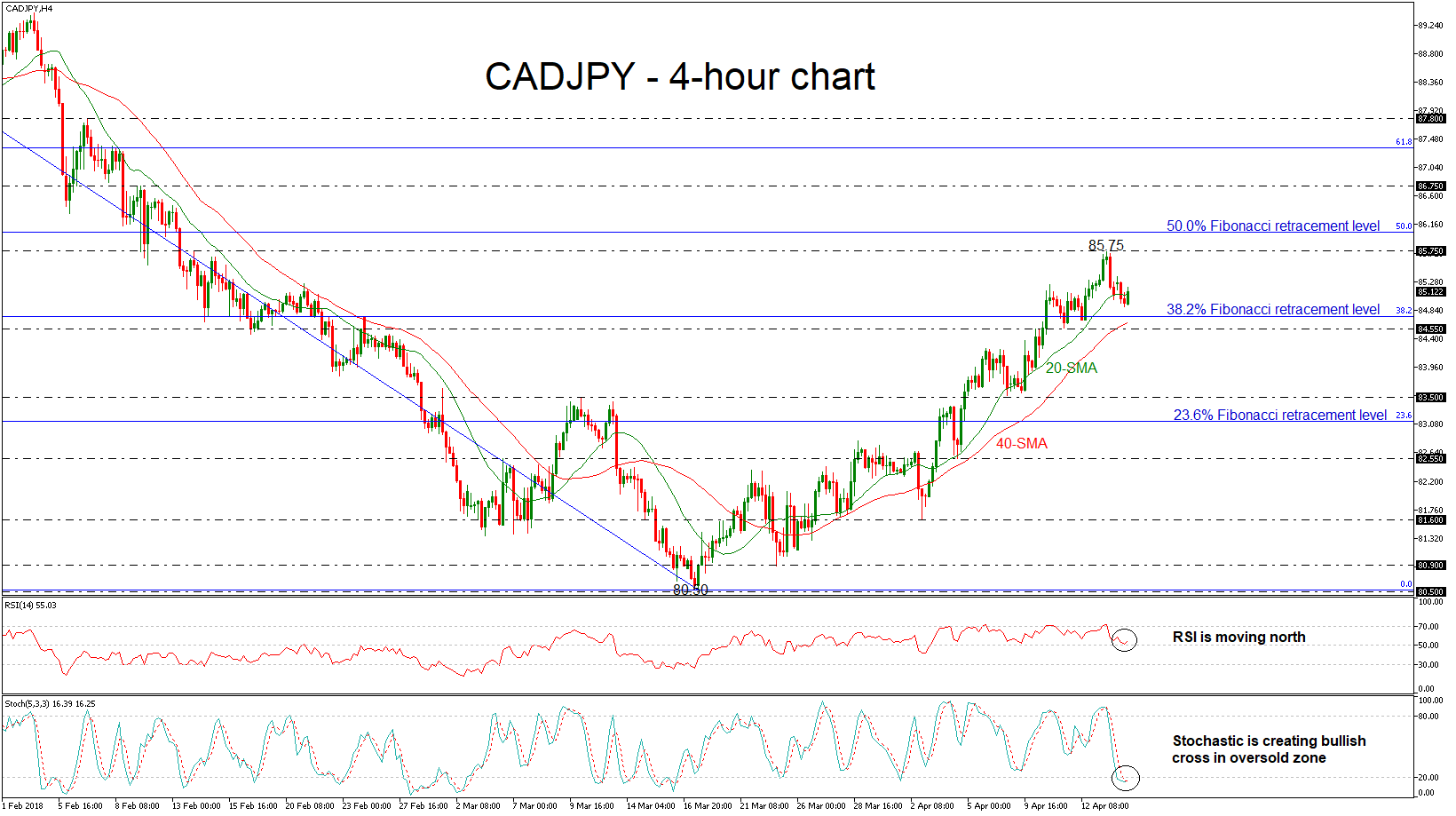
CADJPY has been making higher lows and higher highs since the middle of March when it touched a nine-month low of 80.50, pausing the downtrend and creating a bullish tendency. The technical indicators continue to send bullish signals, suggesting that the strong upward movement in the market is not over yet.
In the 4-hour chart, the Relative Strength Index (RSI) is sloping to the upside, while the %K line of the stochastic oscillator is creating a bullish cross with the %D line in the oversold zone, signaling further strong gains in price action. Over the last few hours, the pair headed above the 20-simple moving average (SMA) and is holding well above the 40-SMA.
If the market manages to pick up speed, the price could touch the two-month nearby resistance of 85.75. A jump above this level could open the way towards the 50.0% Fibonacci retracement level of 86.00 of the downleg from 91.56 to 80.50. Moreover, in case of further upside movement, it would raise the chances for a challenge of the 86.75 barrier.
Should prices decline, immediate support could be found around the 38.2% Fibonacci level of 84.74, an area which is near the 84.55 support. Then a leg below that level, the pair could meet the 83.50 barrier before the focus shifts to the 23.6% Fibonacci near 83.12.
US retail sales beat expectaiton, but Empire State survey showed outlook waned sharply
Dollar stays weak in early US session after mixed data.
Headline retail sales rose 0.6% mom in March, above expectation of 0.5%. Ex-auto sales rose 0.2% mom, in-line with consensus.
Empire State Manufacturing index, however, tumbled sharply to 15.8 in April, down from 22.5 and missed expectation of 18.6. In particular, the index for future business conditions dived -26 pts to 18.3, hitting the lowest level in more than two years. That's a sharp contrast to the reading back in February, at 44.1, which was a several year high.
Canadian Dollar Subdued Ahead of US Retail Sales
The Canadian dollar has started the week quietly. Currently, USD/CAD is trading at 1.2604, down 0.08% on the day. In economic news, the US releases key consumer sales reports. Retail Sales are expected to improve to 0.4%, after two straight declines. Core Retail Sales is forecast to remain unchanged at 0.2%. On Tuesday, the US releases Building Permits and Housing Starts.
It was a dramatic weekend, as a US-led strike destroyed several chemical installations in Syria. Predictably, Syria and Russia strongly condemned the attack, but are unlikely to retaliate despite the rhetoric. The markets had already priced in an attack, and are hopeful that Trump’s declaration of “mission accomplished” means that things will remain relatively quiet in Syria. However, further chemical attacks by the Syrian regime could trigger a response from the US and its allies, which could result in volatility in the markets, and minor currencies like the Canadian dollar would likely take a hit.
The Canadian dollar has looked sharp in the month of April, posting gains of 2.5 percent. However, there could be some headwinds around the corner, as the US has threatened to attack Syria for an alleged chemical attack on the weekend. The situation has become further complicated as Russia has promised it will shoot down any US missiles aimed at Syria. President Trump had vowed that a strike was imminent, but has since backtracked, to the relief of the markets. Still, Trump is unpredictable, and if the US carries out a military strike, panicky investors could dump minor currencies such as the Canadian dollar. Meanwhile, a fact-finding team from the Organization for the Prohibition of Chemical Weapons has arrived in Syria to attempt to verify if a chemical attack did indeed take place.