Sample Category Title
Eco Data 4/17/18
[php_everywhere instance="1"]
The Lingering Effect on Real PCE from the Great Recession
Although real PCE growth has been the driving force in the U.S. economy, the recovery of real PCE throughout this expansion differs significantly from previous recoveries from recession.
Similar Length, Different Intensity
If our economic forecast is correct and the U.S. economy does not fall into a recession in 2018 or 2019, it will mean that the recovery from the Great Recession will be the longest economic expansion in U.S. history. However, the recovery has been all but impressive. Although this expansion is close to beating all other recoveries in terms of its length, the strength of this recovery has been very weak. This helps explain the weak recovery in inflation experienced during this expansion. Furthermore, this weakness has allowed the Federal Reserve to keep interest rates low for a very long period of time.
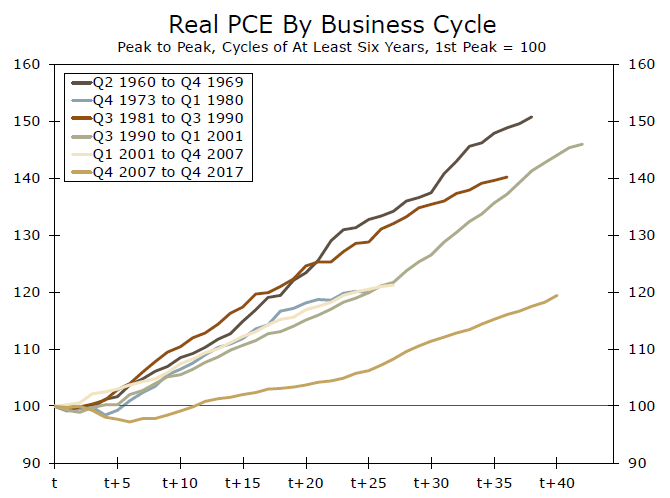
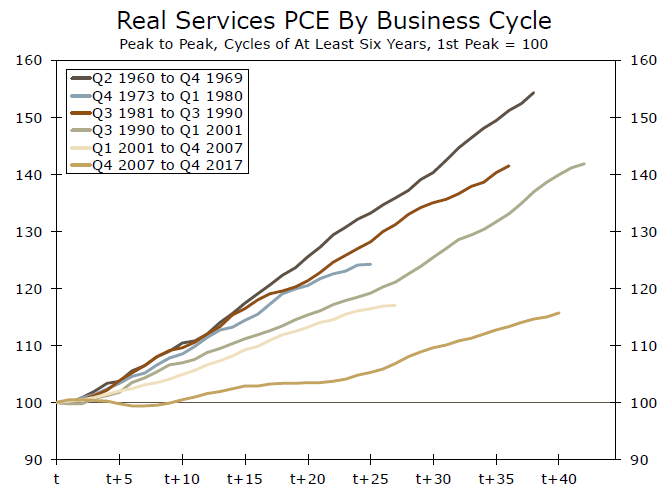
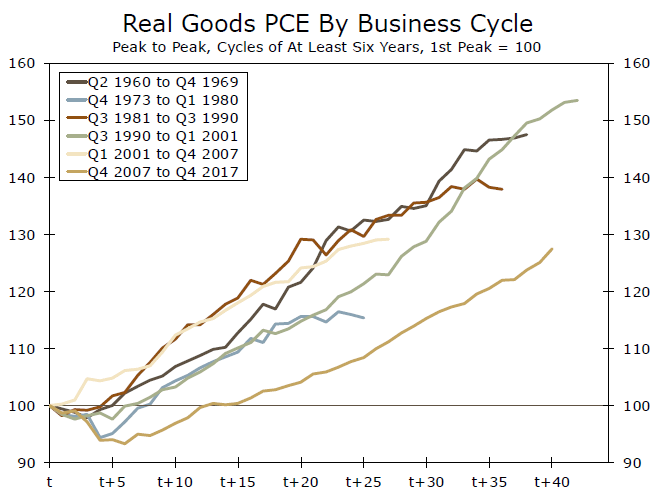
Recessions, typically, do not negatively affect personal consumption expenditures (PCE) as much as other GDP components. That is, the recession has to be very severe to bring consumption growth into negative territory, as real PCE is normally the most stable component of GDP. The Great Recession was one such recession, as real PCE remained under pressure for more than two years from the peak of the previous expansion (top graph).
Although much of the decline in real PCE during the Great Recession was due to a collapse in the consumption of goods, the service side of real PCE was also slow to recover from the Great Recession. The services side has remained weak well into this economic recovery, something very uncharacteristic if compared to previous business cycles (middle graph). That is, although the slope of the line in the middle graph labeled Q4 2007 to Q4 2017 has steepened somewhat during the past several years, it remains flatter than in previous recoveries.
The story from the goods side of real PCE is a bit better. Although the consumption of goods collapsed as the Great Recession hit, and remained depressed for more than two years, the recovery in goods consumption has strengthened since (steeper line in bottom graph). The consumption of goods has remained relatively strong compared to the service side of real PCE. Once again, as the bottom graph shows, the growth in the consumption of real goods has remained weak if compared to previous recoveries, but it has performed a bit better than the service side of real PCE.
Real PCE: Strong but Not Strong Enough
Although the American consumer has been in the driver seat of the U.S. economy since the recovery from the Great Recession, the recovery in real PCE has been weak compared to previous recoveries going back to the 1960s. That is, it is clear the Great Recession has had a lasting effect on the behavior of the American consumer. In future reports we will take a look at which sectors within goods and services consumption have been driving this weakness, and if there are any sectors within these two broad categories that have bucked the trend.
Trump tweeted down the Dollar?
USD trades broadly lower today. And some attributes the weakness to Trump's tweet on Russia and China devaluation.
https://twitter.com/realDonaldTrump/status/985858100149309441?ref_src=twsrc%5Egoogle%7Ctwcamp%5Eserp%7Ctwgr%5Etweet
Originally, we prefer not to cover some random morning comments like that. But it's getting a bit annoying to see reports on this flying around, making it a big news.
It's not, at least for now.
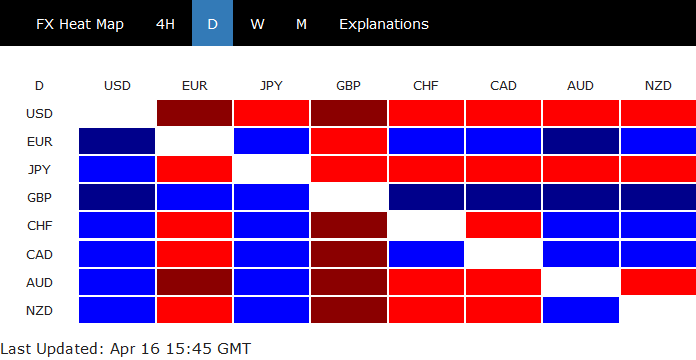
Just take a look at the D heatmap. Yes USD is in red against all others. But it's only in deep red against EUR and GBP. Meaning that it's staying in Friday's range except versus EUR and GBP.
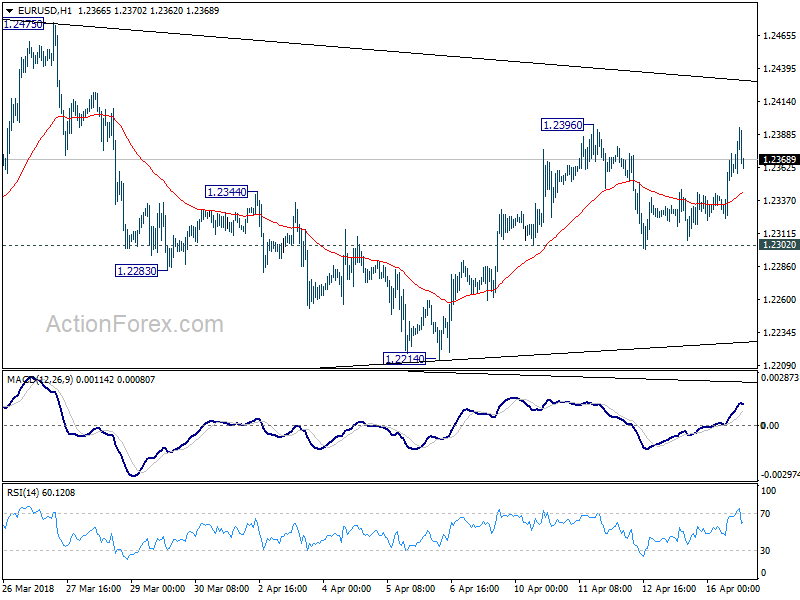
 And take a look at this, EUR/USD. It can't find enough buying through 1.2396 resistance yet.
 How about USD/JPY? It's well above 106.64 support and even holding above a near term trend line.
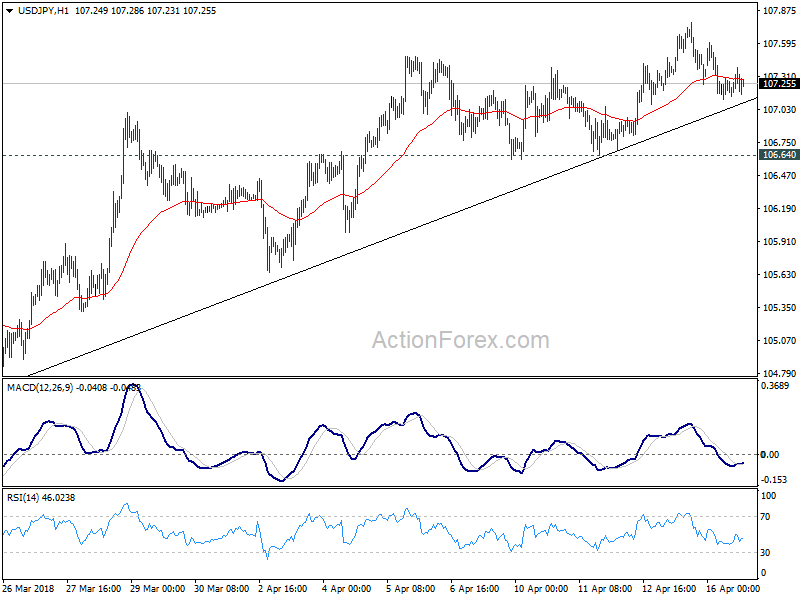 So, USD weak? Yes. But not that weak to make it an everywhere headline. Looking at the above D heatmap, it's GBP's strength that's worth a mention. Even if USD dives further during the rest of the session, it's likely because of some other reason.
And some people said that Trump needs to stay away from his tweets. We'll say it's the media and people who need to stay away from these random nonsense.
New York Fed Dudley: 3 or 4 hikes a reasonable expectation for 2018
New York Fed President William Dudley said that three or four rate hike is a "reasonable expectation" for 2018. And, "as long as inflation is relatively low, the Fed is going to be gradual." However, "if inflation were to go above 2 percent by an appreciable margin", "the gradual path might have to be altered."
Nonetheless, for now, "the market understands that more than four is quite unlikely, because that would no longer be a gradual path of monetary policy tightening." He added that " the market sort of sees three as possible and four as possible, but five or six seems to be quite unlikely."
Regarding trade war with China, Dudley said the US has "legitimate issues" with China over trade. However, "if trade barriers go up, it's bad for the U.S. economy. You're going to have more inflation, less growth, lower productivity, just bad, bad outcomes."
Dollar Bulls Eye Fed Speakers as USDJPY Climbs Back above 50-Day MA
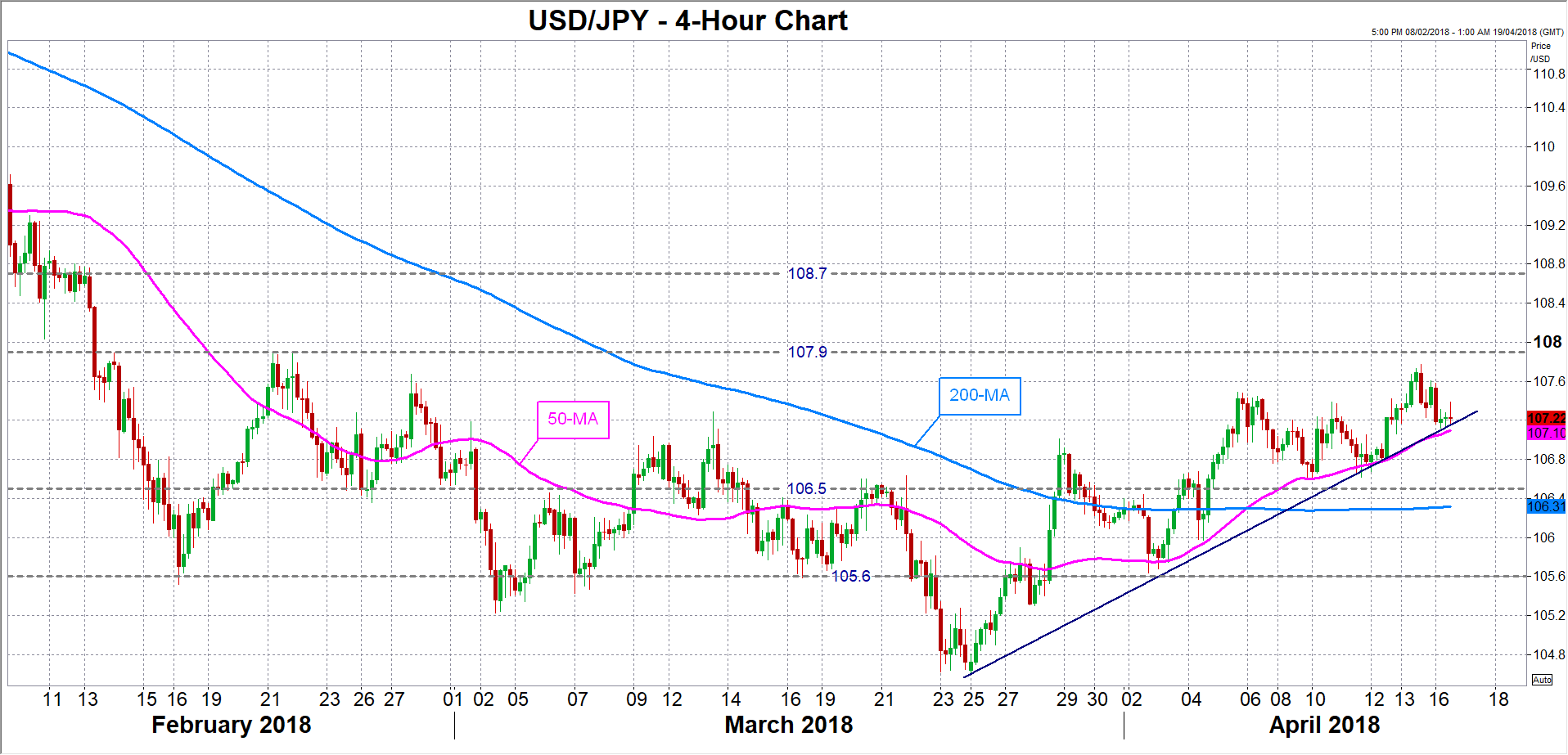
Members of the Federal Open Market Committee (FOMC) have a busy schedule ahead this week as many of them are lined up to make public appearances. Investors will be looking for a hawkish tilt in policymakers’ views after one FOMC member, Eric Rosengren, fuelled speculation of four rate hikes this year in a speech last week. Further talk of a likelihood of more than three rate increases in 2018 could boost the greenback’s recovery from the 16-month low of 104.55 touched at the end of March.
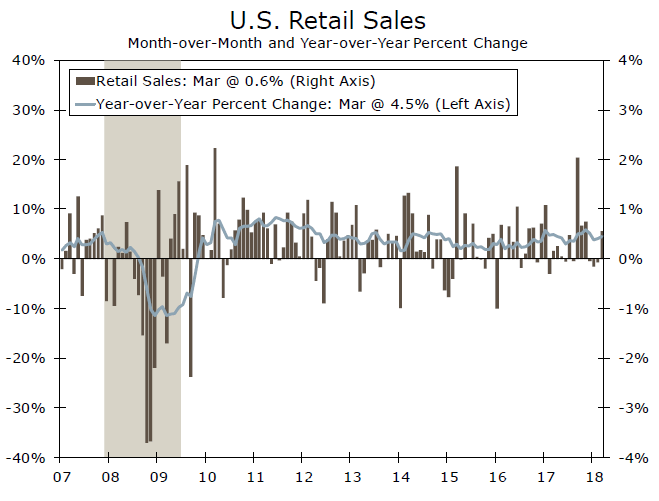
While recent Eurozone data has repeatedly been missing economists’ forecasts, US indicators in contrast have been broadly positive, underscoring the view that US economic fundamentals remain solid even as growth likely slowed somewhat in the first three month of 2018. The Q1 GDP data won’t be out until April 27 but retail sales figures released today showed US consumers have already started loosening their purse strings after a poor start to the year. Retail sales rebounded by 0.6% month-on-month in March following three consecutive months of declines, possibly getting a boost from the Republican tax package. Inflation is also creeping upwards with the consumer price index hitting a one-year high of 2.4% in March.
This leaves wage growth as the only remaining weak link in preventing Fed policymakers from foreseeing a steeper rate path than the one projected at the March FOMC meeting. Wage growth has been confined to between 2.3%-2.8% since 2016, showing little sign of accelerating out of control despite a remarkable pace of job creation since the end of the financial crisis. However, with trade war and geopolitical risks subsiding, and more evidence of the US tax cuts feeding through to the economy, the Fed may start laying the groundwork this week of three more rate hikes in 2018 instead of the two currently priced by the markets.
On Friday, Boston Fed President, Eric Rosengren, said he expected “somewhat more tightening may end up being needed” this year than the median forecast of three rate rises in the March dot plot chart. Although Rosengren is not a voting member in 2018, his views mark a hawkish shift of the traditionally more dovish members of the committee in recent months. Should the hawkish rhetoric be followed by the voting members this week, including San Francisco Fed President and soon to be New York Fed President John Williams, current NY Fed head William Dudley, and Fed Governor Lael Brainard, then the US dollar could receive fresh impetus to push through the 108-yen level.
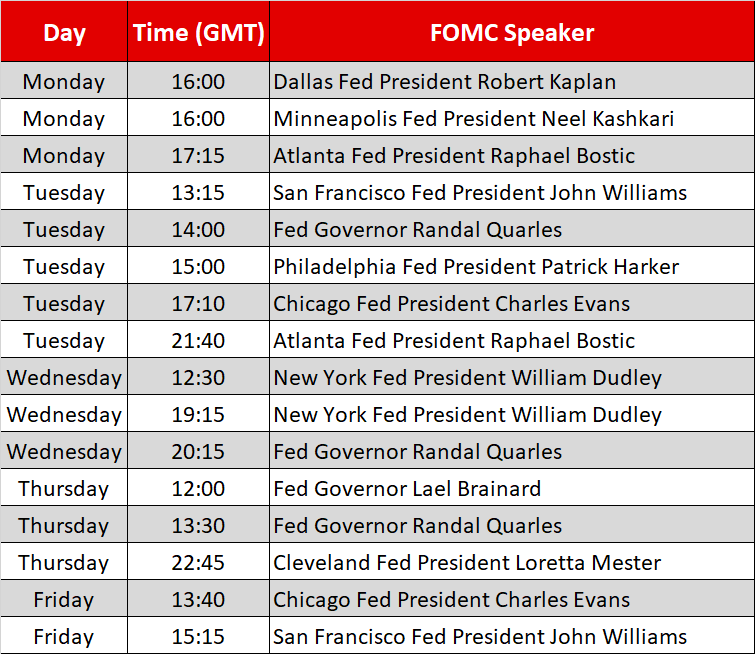 Dollar/yen has turned bullish in the near term, forming higher lows and higher highs in the 4-hour chart and rising above its 50-moving average in the daily chart for the first time since January. However, based on the past year’s performance, growing confidence by Fed officials of meeting their 2% inflation target might not necessarily lead to sustained gains for the US currency.
Bearish bets or net short positions for the dollar rose to the highest in seven years in the week ending April 13, reaching $27.2 billion, according to data from the US Commodity Futures Trading Commission. But with growth in the Eurozone seemingly cooling in the first few months of 2017 and the Bank of Japan still signalling it is in no hurry to follow its peers in exiting from its stimulus program, investors may have become overly bearish about the greenback’s outlook, opening the prospect for a surprise rebound in the dollar.
With dollar/yen starting the week on a firm footing, upbeat language by FOMC members could drive the pair towards the 107.90 resistance area. A break above this level would bring into scope the 108.70 congestion zone. However, should the Fed speakers maintain a cautious tone or, in the absence of a speech by the Fed chief, Jerome Powell, their comments fail to generate significant attention, the greenback could quickly lose upside momentum and head back towards tested support in the 106.50 region. Deeper losses could see the pair retreating nearer the 105.60 support level.
Raft of Crucial UK Data Releases Set to Guide sterling
It’s going to be a busy week for sterling traders. The UK will release its employment figures for February on Tuesday at 0830 GMT, while inflation and retail sales data for March will follow at the same time on Wednesday and Thursday respectively. Wages are projected to have picked up speed, while inflation is anticipated to have risen at the same pace as previously, pushing real wage growth back into positive territory. Such prints would likely be encouraging news for the Bank of England (BoE), and could cement expectations for a rate hike in May.
Following the Brexit vote, UK inflation accelerated sharply but wage growth remained largely flat, leading to a ‘squeeze’ in the real incomes of consumers. With inflation running ahead of wages, people essentially become poorer on average, as living expenses increase faster than their incomes. This has been one of the main factors that have deterred the BoE from raising interest rates too much. The Bank considers the surge in inflation to be a transitory effect that will fade over time, caused by the depreciation of sterling back in 2016. As such, it is reluctant to raise rates in order to fight high inflation, as higher rates could weigh further on consumers’ disposable incomes, thereby hurting consumption and slowing the economy.
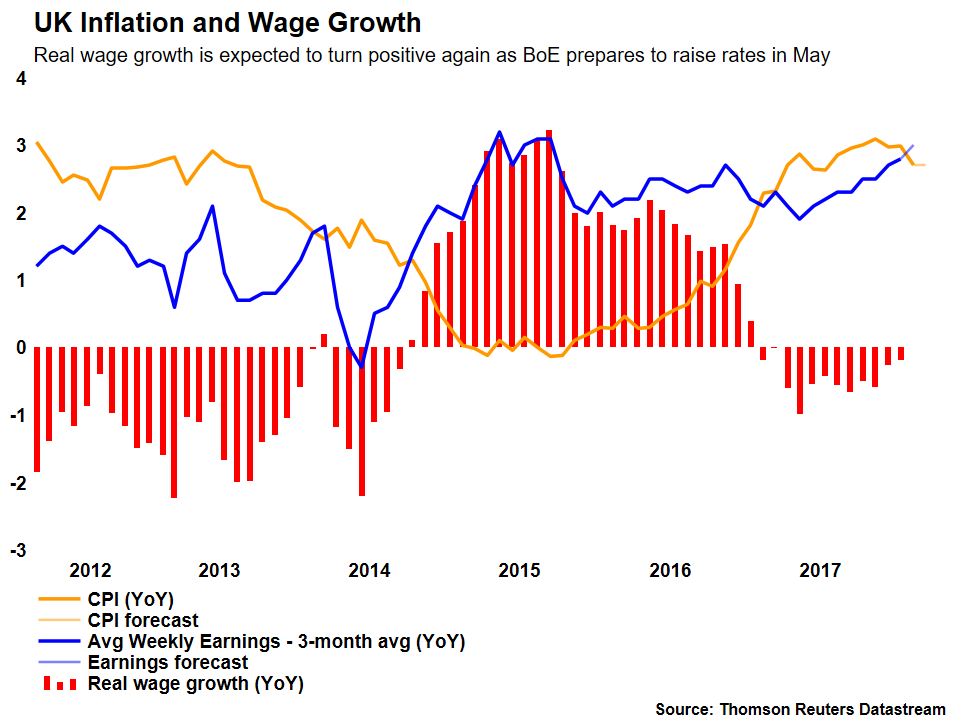
This week, investors will get an update on whether the ‘income squeeze’ continues to haunt UK consumers, or whether the situation is turning around. According to forecasts, wages are expected to outpace inflation, pushing real income growth back into positive territory. Specifically, the unemployment rate is projected to have remained unchanged in February, while average weekly earnings both including and excluding bonuses are expected to have accelerated, reaching 3.0% and 2.8% respectively in yearly terms. Meanwhile, CPI inflation is anticipated to have remained unchanged at 2.7% year-on-year in March, while the core print that excludes the effects of volatile items is forecast to have ticked up to 2.5%, from 2.4% in February.
Gauges of the labor market and inflationary pressures support these forecasts. With regards to wages, the Markit UK Report on Jobs for February showed that starting salaries continued to rise sharply, holding close to a 31-month high amid shortages for candidates. As for inflation, the Markit services PMI for March noted that prices charged by service firms continued to increase at a robust pace, with Markit’s Chief Business Economist Chris Williamson concluding that “consumer price inflation could remain stubbornly high in coming months”.
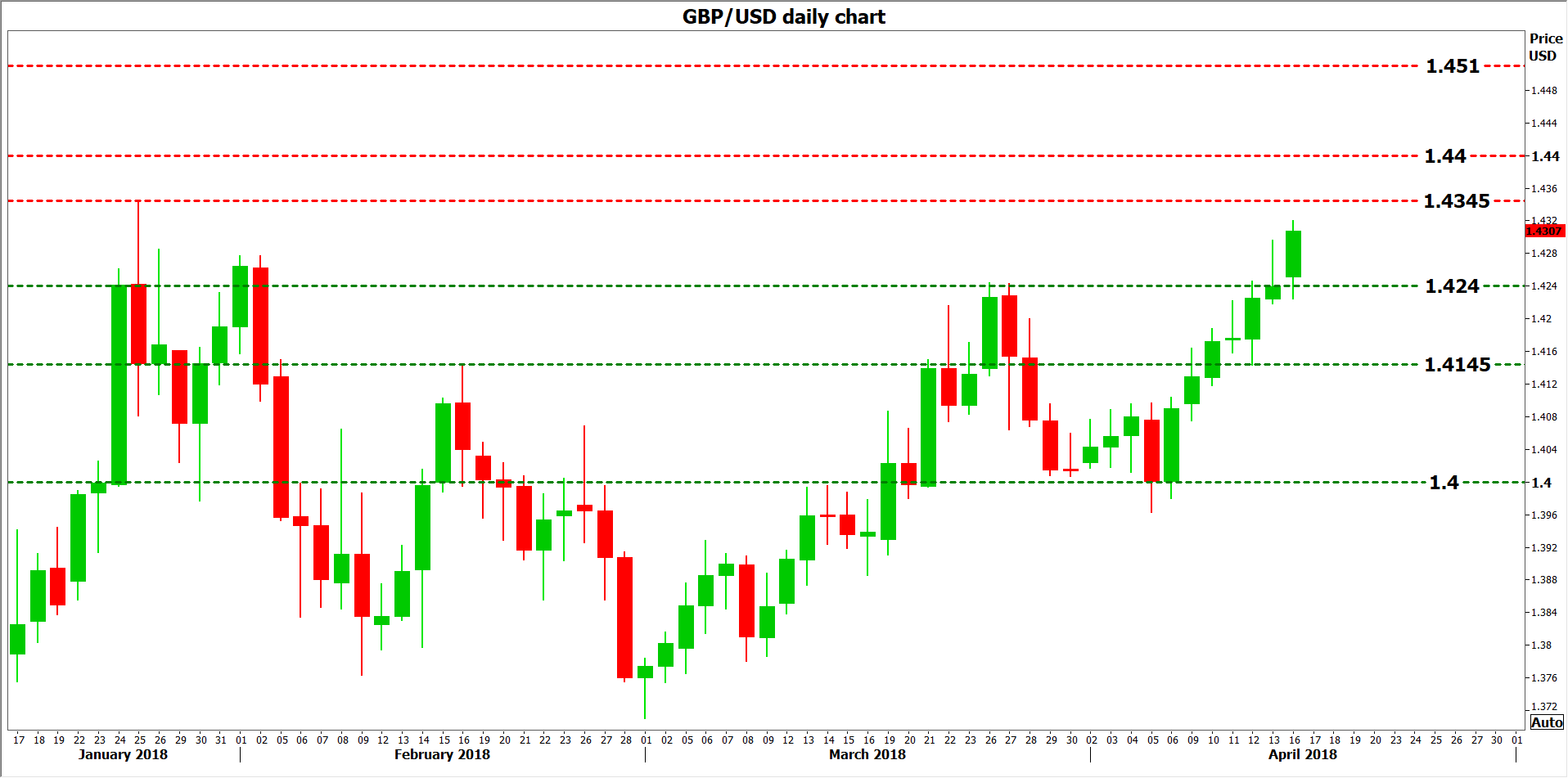 Looking at what is priced in, the UK’s overnight index swaps currently suggest a 73% probability for the BoE to raise rates by 25bps at the May meeting. In case the actual data prints are roughly in line with the forecasts, and earnings accelerate while inflation holds steady, investors could become more confident about a May rate hike, helping sterling to extend its latest gains. Pound/dollar could edge higher and challenge its January high of 1.4345, with an upside break of that hurdle likely to shift the focus to the round figure of 1.4400, a level last seen in June 2016. Even further up, prices advances could encounter resistance near 1.4510, the peak of March 2016.
On the flip side, if real wage growth remains negative – for example with wages failing to accelerate or inflation surprising to the upside – then sterling could come under pressure as markets begin to doubt whether a May hike will indeed materialize and traders take some profit on their prior long-pound bets. Immediate support in pound/dollar could come around 1.4240, the peaks of March 27, with a downside violation of that barrier bringing into view the 1.4145 area, which was congested in the recent past and also encapsulates a peak from February. If sellers manage to overcome that zone, then buy orders may be found near the psychological handle of 1.4000.
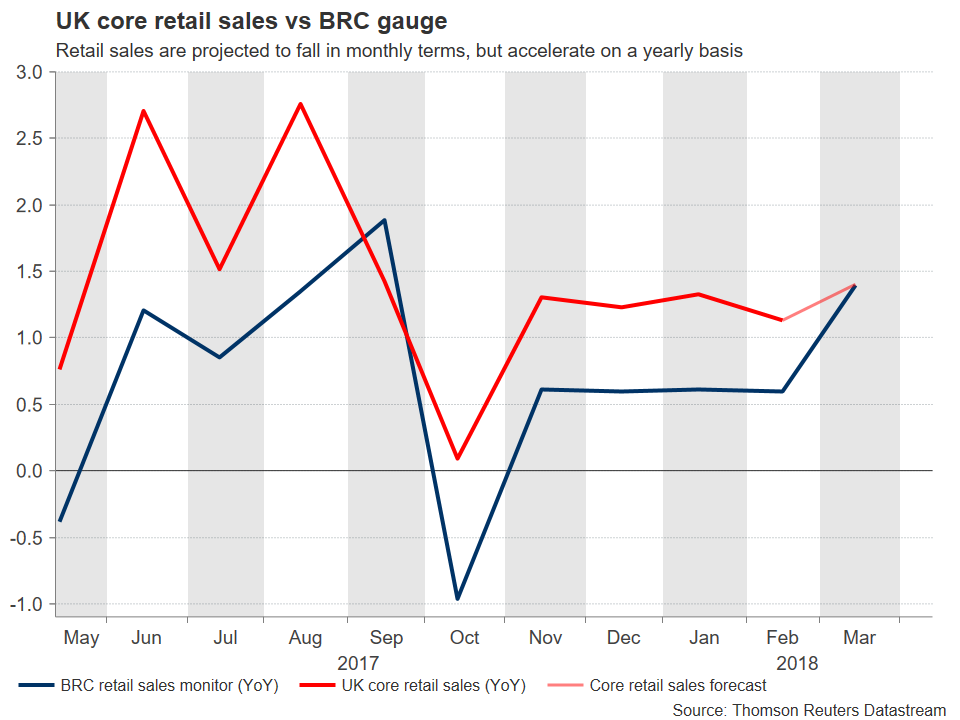 Finally, besides jobs data on Tuesday and inflation prints on Wednesday, the other risk event for sterling this week will be the release of retail sales for March on Thursday. Retail sales are forecast to have fallen month-over-month, but to have risen year-over-year. Such prints would signify that although UK consumption is still struggling, the situation is improving relative to a year ago. Indeed, the British Retail Consortium (BRC) retail sales monitor – a gauge of sales in yearly terms – surged in March, supporting the case for the yearly rate to rise. Such prints may prove relatively neutral for sterling, unless of course there is a major deviation from the forecasts.
European Markets Shrug off Syrian Strike
European stock markets have started the week with a whimper. In the Monday session, the DAX is trading at 12,432 points, down 0.08% on the day. On the release front, it’s a very light day. The sole event, the German Wholesale Price Index, improved to 0.0%, but fell short of the estimate of 0.4%. On Tuesday, German releases ZEW Economic Sentiment.
Global stock markets showed plenty of volatility last week, as nervous investors waited to see if US President Trump would make good on his threat to punish Syria for using chemical weapons against rebel positions. On Saturday, a US-led strike destroyed several chemical installations in Syria. Predictably, Syria and Russia strongly condemned the attack, but are unlikely to retaliate despite the rhetoric. The markets had already priced in an attack, and are hopeful that Trump’s declaration of “mission accomplished” means that things will remain relatively quiet in Syria. However, further chemical attacks by the Syrian regime could trigger a response from the US and its allies, which could result in more volatility in the markets.
The ECB minutes pointed to some concerns which could affect plans to wind down its stimulus program. These include the tariff spat between the US and China, which ECB policymakers stated would hurt “all countries involved.” As well, there is concern that Britain’s departure from the European Union could cause more economic harm than previously expected. At the same time, the eurozone economy continues to perform well and inflation has been steady. This makes it unlikely that the ECB will extend stimulus, but could opt for a longer exit path. As for interest rate policy, no rate hikes are expected anytime soon – On Friday, Commerzbank pushed back its forecast for an ECB interest-rate increase by three months to September 2019.
U.S. Economic Growth: 2 Be, Or Not 2 Be
It's sometimes a hard sell for economists at client meetings to describe the long term forecast of the American economy as no better than 2%. How can this be? Corporate tax rates have been slashed, productivity is rising and the government has never primed the pump more during an all-out economic expansion. Yet, the consensus for economic growth over 2020 to 2022 averages just 1.8%. Further confirmation came from the CBO last week following their analysis of fiscal measures that placed GDP projections within the 1.5-1.8% range from 2020-2028. This is because fiscal policies have yet to change the arithmetic that anchors U.S. growth prospects. I often refer to this as the DNA of an economy – its inherent structure.
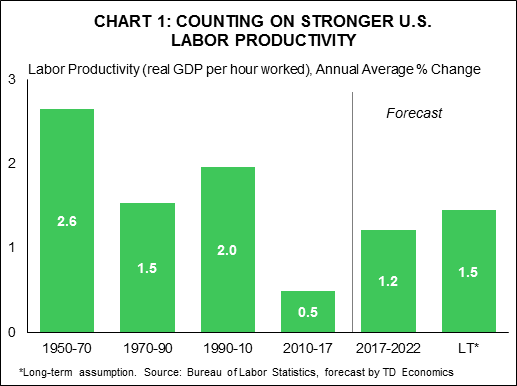
Yes, productivity is improving and expected to continue to do so. In fact, our forecast embeds a growth rate that is at least double that of the past five years (Chart 1). So when people ask us if advances in the digital economy are represented in the forecast, the answer is YES. In fact, we are desperately counting on a persistence of stronger productivity growth, otherwise the economic tendency ends up within a more meagre range of 1% to 1.5%. Of course, there is always the potential for productivity to surprise to the upside on our expectation. However, in order to push GDP to 3% and, more importantly, sustain it there, productivity would have to perform similar to the 1950-1970 period. These were different times, embodying a sharp ramp-up in the labor force's educational attainment coupled with meaningful advances in the quality of life.
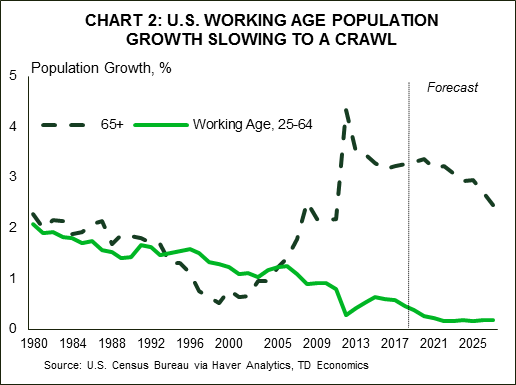
 There are two elements to this economic chromosome, and each is just as important as the other. Fiscal policy has not addressed the realities of demographics and its impact on the labor force. Many of our readers are well aware that the U.S. is faced with an aging population, just like most advanced economies in the world. But, what's less appreciated is the speed at which this is occurring.
A while back I heard a reference that really stuck with me as an apt characterization. We're at the point in population dynamics where there will be more diaper sales to adults, than babies.
So, even with heftier productivity estimates boosting GDP growth, there is a large counterweight coming from a slowdown in the labor force due to demographics. And, if you're wondering if our estimates take into account higher participation rates in the workplace from longer attachment of the older population, the answer is YES.
There you have it; all the pumping and priming of the fiscal pump via taxes and budget expenditures have not addressed a critical genetic component of the economy. But, similar to a biological chromosome, the economics can be changed with time…through policy.
Options On The Table
There are a few ways to tackle the demographic time bomb. A first instinct may be to encourage greater domestic population growth through higher birth rates. This is a tall order where few countries have found success. China stands out as an extreme poster-child on this. In 2013, they relaxed one-child policies set in the late 1970s, and have continued to implement further adjustments only to find that the government repeatedly overestimates the willingness of households to increase their family size. For example, the birth rate rose in 2016 to 1.30% from a five year average of 1.21% after the official two-child policy came into effect at the start of that year. It has since fallen back to 1.24%. Furthermore, Chinese demographic experts believe that the demographic dividend from the policy change is likely done.1 This is not all together surprising since considerations around family are deeply rooted in social and cultural beliefs, alongside economic considerations. There's no fiscal tool that can easily address all of these factors and, even if successful, there would be a long time lag of at least one generation to feed through to the labor market.
Casting An Eye Overseas
However, there are other paths where policy can boost growth prospects in a shorter timeframe to at least mitigate the downside to the labor force. Let's start with the most politically sensitive of these: immigration. Most of the U.S. political dialogue has been on limitations for immigrants rather than expansion. Currently, the U.S. allows over a million immigrants per year. This may seem like a large figure, but it's not. Immigration flows in 2016 amounted to 0.37% of the population base, which is in line with a relatively static average of 0.33% since 2010. Comparing this to other countries from a relative scale perspective, U.S. immigration permits about one-half of that of Canada and the United Kingdom, and about one-third of Germany. U.S. immigration policy is roughly on par with the policies of countries like France and Portugal. At the end of the day, all of these countries face labor force growth challenges similar to the U.S. and are in intense competition for a skilled and adaptable workforce. The most proactive countries implement targeted immigration policy as a stop-gap measure, but in doing so, the scale still doesn't fully offset aging demographic dynamics.
It's important to keep in mind that simply boosting immigration flows doesn't mean a country will align labor force growth to its corporate and entrepreneurial needs. Ideally, policy would not only increase the number of people flowing in, but attract those of a working age and with a composition of education, skills or experience where labor force demand is intensifying. In this regard, U.S. policy can be improved.
Immigration currently relies heavily on whether the applicant is an immediate relative of a U.S. citizen. In the 2016 fiscal year, 68% of permanent resident admissions were either family-sponsored or an immediate relative of a U.S. citizen. Employment-based admission amounted to roughly 12%, or the third largest entry category, with the majority of these classed as priority workers. Investor class immigrants were 0.8% of total resident admissions.
Now compare this to a country like Canada. Through the implementation of a merit-based system, Canada is aiming for 310,000 immigrants in 2018, of which 177,500 will be approved via economic entry. In a simplified form, an economic class for entry involves a point system based on a combination of many factors, including language, education, work experience, secured employment, age and adaptability. The latter offers a broader range of characteristics, including awarding points to applicants with a spouse or common-law partner who is also applying for immigration and meets some of the characteristics, or an applicant with prior educational experience within Canada. In truth, not all of those targeted 177,500 immigrants will enter Canada via the economic class. In the past, just over half were selected as a close family member of the applicant. Doing so helps with the success, permanency and adaptability of a newcomer to a country.
However, even Canada's merit-based system and higher immigration inflows are not a panacea for its demographic and economic challenges. Very often, newcomers face difficulty having their prior skills, work experience and education fully recognized and integrated into the workforce of their new home.
The merit-based system does not mean it requires skirting responsibilities towards refugees or other distressed groups. In this regard, Canada accepts more refugees as a share of the population or immigration flows (17% of 2016 immigrants) than the U.S. (13% of immigrants characterized as refugees and asylum seekers). Immigration goals need not be mutually exclusive. With the understanding and acceptance that the population base is eroding the growth of the labor force, both the number and skill level of immigrants can be raised, without necessarily requiring a give-back in areas of humanitarian need and leadership.
Tapping Into Your Backyard Potential
Let's assume that altering immigration policy is simply too politically charged to be used as a primary tool to materially boost the labor force. Is there another path of least resistance? The answer is yes. The gold standard would be to attract the needed skilled workers from other countries, while also simultaneously fully leveraging the workforce already within your borders. But, the latter does offer the lowest hanging fruit on the policy front.
Chart 3 shows that U.S. female participation rates have been in decline for much of the past two decades. This trend is at complete odds with the international experience, despite having educational attainment rates that are on par or higher relative to international peers.
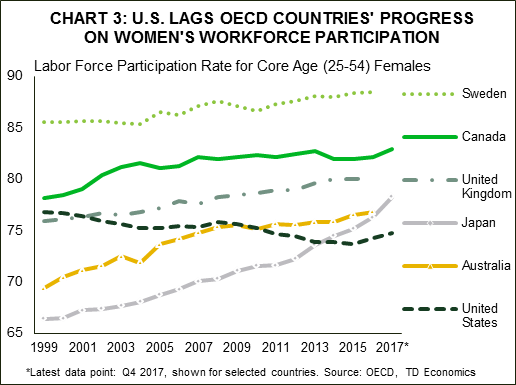 U.S. labor force growth is already decelerating materially due to aging demographics. Reinforcing that pattern further via a counterintuitive decline within the core-working aged female population simply cannot be afforded in this environment. Of interest, if female and male participation rates converged in the U.S., it could lift the level of real GDP by close to 10%.
So what gives? Over the years, parental leave policies have been enhanced in every country except within the United States. In fact, it's fair to say that the U.S. is stuck in a time warp dating back to the Family and Medical Leave Act (FMLA) established by President Clinton in 1993. The FMLA provides workers with 12 weeks of unpaid, job-protected leave for the birth and care of a newborn child or the adoption or fostering of a newly placed child (parental leave). This similarly holds for family care or medical leave. This law was a first step that has not evolved to the needs of the population.
Among the shortcomings, FMLA does not apply to all employees. Companies are exempt from participation that have fewer than 50 staff, leaving roughly 60% of the workforce eligible for the protection it offers.6 In addition, the FMLA lacks a critical component: paid leave. Its absence has been demonstrated in large amounts of research to be a deal-breaker for many trying to navigate work and family responsibilities.
Surprisingly, the U.S. is the only advanced economy that does not provide a statutory right to paid leave at the federal level. Not surprisingly, this helps perpetuate low female participation rates in the labor force relative to peer countries.
According to researchers at the NBER in 2012, about 28% of the decline in female labor force participation in America relative to other countries in the OECD can be explained by the lack of family-friendly workplace policies, including paid parental leave.7 Some states have stepped up efforts to offer more inclusive policy prescriptions of paid leaves, such as California, New Jersey, Rhode Island and, more recently, New York. But, the lack of a nationwide strategy limits the consistency of benefits, awareness and take-up rate. For instance, California's paid family leave policy was implemented in 2004, and ten years later the take-up rate by eligible mothers ranged from 25 to 40%.
Looking at it another way, the impact of paid-leave policies is evident in Chart 3. Female participation rates between Canada and the U.S. were near-identical until the year 2000. Thereafter, the U.S. not only fails to keep pace, but actually declines. It's no coincidence that in December of 2000, Canada increased paid parental leave benefits from 10 to 35 weeks, and lowered the threshold for eligibility from 700 to 600 hours of insurable employment.9
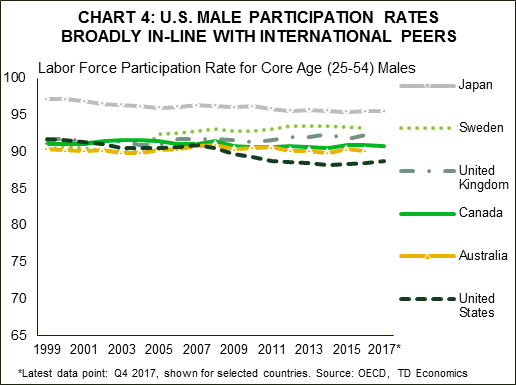
In a world of an increasing share of dual income households and shared family responsibilities, paid parental leaves should be exactly that…parental. It should be up to both parents to decide on what makes the most sense for their household regarding a paid leave. This may also help stem the tide of falling male participation rates, which is the other juggernaut of the U.S. labor force. However, the best bang for the immediate buck is to target women given intensifying demographic pressures and international evidence of its effectiveness. Of note, U.S. male participation rates are also lower than a number of international peers (Chart 4), but remain elevated relative to women. In addition, downward pressure on male participation rates is not a uniquely American phenomenon. It has been occurring across a number of advanced economies due to a myriad of factors, including the impact of automation. In contrast, the downward trend of female participation rates is a uniquely American phenomenon. Research and peer country analysis demonstrate that if women, and specifically, new mothers, remain attached to the labor market, this attachment is persistent over time. This claim was substantiated within the recent research by Goldin and Mitchell.10 Analyzing labor market attachment across age cohorts and over time, they found that 77% of those who worked more than six of the years when they were within the 25-34 age bracket went on to work roughly 80% of the period between the ages of 35-44. Likewise, a similar percentage carried through when they became 45-54 years old. In contrast, among those who departed the labor market with five years or less experience over the 25-34 year old age bracket, only 32% were employed more than 80% of the time between the ages 35-44 years. Simply put, remaining in the labor market for longer periods at a younger age resulted in a significant persistence of labor market attachment in the 20 years that followed. This highlights the importance of policies that encourage life-cycle employment.
 Let's now dovetail back to why paid-leaves are important to this outcome of job market persistence. This same study demonstrated that since the 1990s, those mothers on paid leave have the highest employment rates before, during and after pregnancy, followed by those on unpaid leave. The gap is quite stark. Those who had access to paid leave had a participation rate of 82% ten years after the birth of their first child. This compares to those who quit during their pregnancy, and showed a labor market participation rate of only 64% ten years later.
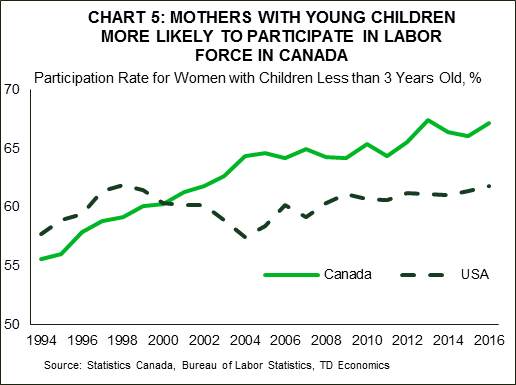
Returning to a comparison of Canada and the U.S., Chart 5 shows a large and widening wedge in participation rates among mothers with young children. Greater spending in labor market programs can drive greater attachment over the long term, create a more diverse labor market and mitigate the economic downdraft from an aging population.
Conclusion
At the end of the day, there are only two levers to pull to permanently boost U.S. economic growth: productivity and labor force growth. Recent corporate tax cuts should help to improve the former, while personal tax cuts could incent more workers into the labor force. But, these alone will offer an insufficient thrust to return U.S. GDP growth to the 3% mark – on a sustained basis – against a strengthening demographic headwind. There are solutions for greater labor force growth that aren't exactly wild cards.
There are plenty of international models that demonstrate the effectiveness of social policies to drive greater female labor force engagement that pays dividends in both the shorter and longer term. Perhaps the biggest example comes from Japan, where family friendly and social policies enacted by Abe in 2013 took the female participation rate from 73.6% to 78.3% in just four years.
Policymakers have a key role to play in moving the dial to bolster labor market participation. The first consideration should be given to leveraging the talent, education and population within your borders, and this requires encouraging labor force attachment from the get-go of entry. The second consideration is to revisit immigration policy and assumptions to help backfill the needed skills, as domestic population availability alone may not fully push against aging dynamics and needed employer skills. In the absence of bolder, proactive initiatives to drive labor force growth, the country's economic DNA will ultimately rule the day.
Sunset Market Commentary
At the end of the last week, markets were uncertain of the impact of expected military action against Syria on global risk sentiment. Airstrikes against the country this weekend didn’t provide a clear signal for markets. There is no indication of an escalation of the conflict. At the same time, geopolitical tension stays highs and might still become a factor of market uncertainty at any time. Asian equities failed to build on a constructive market open. European equity markets showed no clear directional trend. US equities opened in positive territory. The Bund and 10-y Note contract started the week with a cautiously negative bias. The US 2-year yield even set a new cycle top at 2.39%. Fed Kashkari (dovish wing of the Fed) in a WSJ interview supported the Fed rate hike intentions. US eco data (Empire manufacturing and retail sales) were close to expectations. The tentative intraday decline of the 10-y Note future halted after the data. Still, the US yield curve bear steepens with yields rising between 1.8 bp (5-y) and 2.5 bp (30-y). The German yield curve moved in a similar way with yields between 0.2 bp (2-y) and 1.6 bp (30-y) higher. Intra-EMU spread changes versus Germany were mostly little changed to marginally tighter, Greece outperforming (-7bp). Spain hardly profited from Moody’s rating upgrade (-1bp).
The tentative easing of geopolitical tensions after the action against Syria this weekend didn’t help the dollar. USD/JPY soon reversed opening gains and settled in the lower half of the 107 big figure. EUR/USD jumped from the 1.2335 area to the 1.2370 area. CFTC data last week showed that most investors continue to feel comfortable with a substantial US short position even as the dollar enjoys rising interest rate support against most majors, especially against the euro. The US retail sales and the Empire manufacturing survey were not strong enough to change USD fortunes for the better. EUR/USD is drifting higher in the 1.23 big figure (currently 1.2390 area). USD/JPY is going nowhere (107.25/30 area).
At the end of last week, sterling had a strong run. The UK currency tested key resistance against the euro (0.8650 area). The 1.4345 resistance in cable was left intact, but was coming on the horizon. Today, sterling preserved last week’s gains as investors are looking forward to a series of key eco data (including labour market data tomorrow and CPI on Wednesday). This week a next round of EU-UK Brexit negotiations starts. For now, there is no indication that there will be high profile progress. Especially, the issue of the Irish boarder remains an obstacle. However, for now it doesn’t hurt the positive repositioning on sterling. Markets apparently still see a decent/growing chance of a relatively soft Brexit. The test of the EUR/GBP 0.8650 area continues. Later this week, we look out whether the eco data will support the scenario of a BoE rate hike in May and at least a high probability of an additional rate hike later this year.
News Headlines
In an interview with the WSJ, Minneapolis Fed Kashkari indicated that tax cuts and higher fiscal spending made it more likely for the Fed to reach its inflation target in the near future. The Fed governor more or less agrees with the Fed rate hike path as indicated by the dots published after last month’s Fed meeting.
Today, US retail sales were close to expectations. Headline sales rose more than expected at 0.6% M/M, mostly due to strong auto sales. However, core series of the report (including the control group sales (0.4% M/M) which is closely monitored as a pointer for consumption in the GDP report) were close to expectations. Even so, the report doesn’t completely erase the impact of poor sales in previous months.
In a tweet, US President Trump accused Russia and China to play the ‘currency devaluation game’. Remarkably, the tweet was launched only three days after the US Treasury labelled no country as currency manipulator.
US Retail Sales: Spring is in the Air
After three consecutive monthly declines, retail sales improved 0.6 percent in March, driven by strong auto sales, health & personal care and nonstore retailers' sales.
Strong Auto Sales Drive Retail Sales Higher
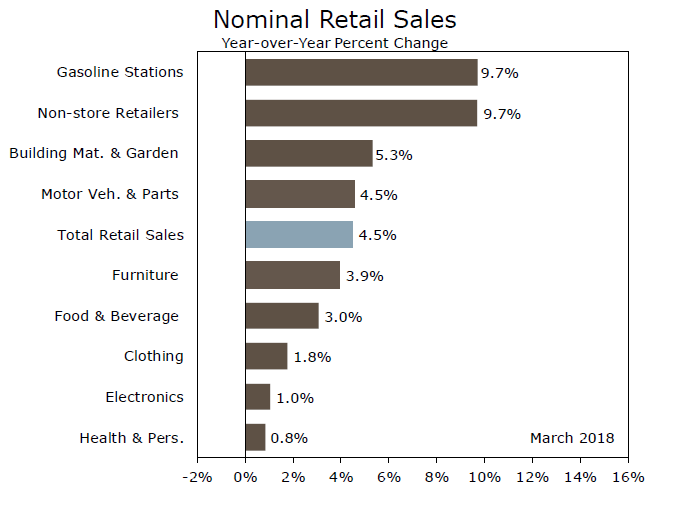
Driven by strong motor vehicle & parts dealers' sales, up 2.0 percent in March, the retail & food services' index increased 0.6 percent after three consecutive monthly declines. The increase of 2.0 percent in motor vehicle & parts dealers' sales came after a decline of 1.3 percent in February. Retail sales excluding autos increased 0.2 percent during the month, while sales excluding autos and gas were up 0.3 percent.
The second strongest sector in March was health & personal care stores' sales, increasing 1.4 percent in the month, while nonstore retailers' sales jumped 0.8 percent. Furniture & home furnishings stores' sales were also strong, up 0.7 percent, while electronics & appliance stores' sales were up 0.5 percent. On the service side of the retail report, food services & drinking places' sales were up 0.4 percent. The weakest sectors were sporting goods, hobby, book & music stores' sales, whose index plunged 1.8 percent in the month, while building material & garden equipment & supplies dealers' sales declined 0.6 percent.
Although general merchandise stores' sales increased 0.3 percent in the month, department stores' sales declined 0.3 percent, continuing to show the troubles affecting that sector of retail. A similar decline was recorded for miscellaneous store retailers' sales. Gasoline stations' sales, on the other hand, declined 0.3 percent, while clothing & clothing accessories stores' sales were down 0.8 percent.
This report was better than expected, as markets were probably looking at a larger impact from several weather related events that affected the northeast region during the month.
Strong Control Group Sales Point to a Recovery in Consumption
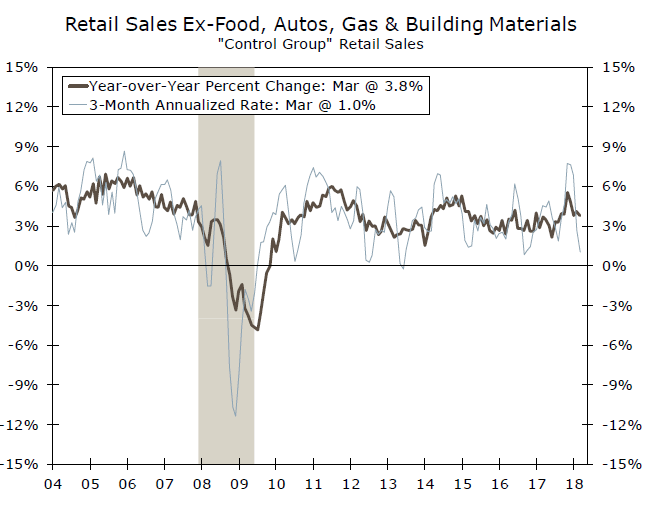
The overall March retail sales report was relatively mixed, with very strong sectors as well as very weak sectors. However, the control group retail index, which goes into the calculation of GDP, was relatively strong, up 0.4 percent, registering the first positive reading since November of last year when it rose a strong 1.2 percent.
Although we still expect a relatively weak consumer during the first quarter of the year, the better-than-expected retail sales report today plus the relatively strong control group sales number will keep first quarter consumption from being a complete disappointment after such a strong quarter at the end of last year.
Furthermore, the fact that food services & drinking places sales were also relatively strong could point to stronger growth in the consumption of services during the first quarter of the year, which will help consumption expenditures from the service side, even as goods consumption will come in very weak during the first quarter of the year. Thus, this report was relatively strong and will likely help revert some of the weakness we saw during the first two months of the year.