

Sample Category Title
USDJPY – 30SMA Support Came Under Pressure After Repeated Failure At 106.65 Fibo Barrier
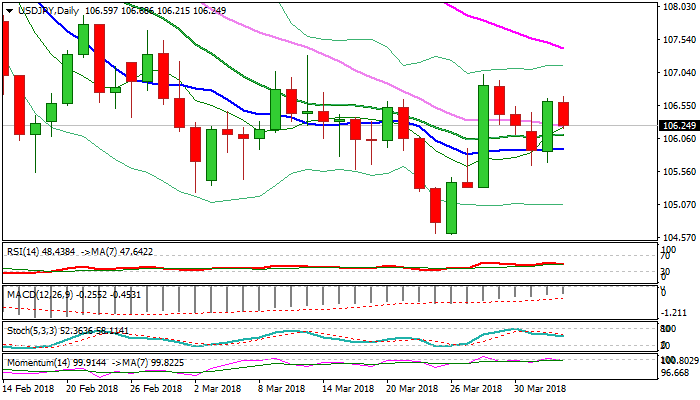
The pair eases from the session high at 106.68 after repeated failure to clear strong barrier at 106.65 (Fibo 61.8% of 107.90/104.63 descend).
Initial support at 106.23 (30SMA) is under pressure, with weakening momentum seeing risk of break lower break lower and test of next pivots at 106.11 (20SMA) and 105.91 (10SMA), clear break of which would be negative signal.
Conversely, near-term bulls would remain in play while 30SMA holds and would look for renewed attack at 106.65 pivot, to signal fresh recovery extension towards 107.01 (28 mar high) and 107.40 (falling 55SMA/base of falling thick daily cloud).
Res: 106.65, 107.01, 107.40, 106.67
Sup: 106.23, 106.11, 105.91, 105.65
China annoucned 25% retaliation tariffs to USD 50b of US imports, including soybeans, aircrafts
In a quick response to US Section 301 tariffs, China announced to impose additional tariffs of 25% on 106 US products. The total value of the products will add up to around USD 50b, matching the size of the US 301 tariffs.
The Finance Ministry also said in a press briefing that the goods will include soybeans, autos, chemicals, some types of aircraft and corn products, among other agricultural goods. Additional, extra tariffs will be imposed on whisky, cigars and tobacco, some types of beef, lubricants, and propane and other plastic products. The list also include certain sorghum products, cotton, some types of wheat, as well as trucks, some SUVs, certain electric vehicles.
Here is the statement from the Ministry of Finance (in Simplified Chinese).
GBPUSD – Recovery Dented Pivotal Barriers At 1.4100 Zone, But So Far Unable To Break Higher
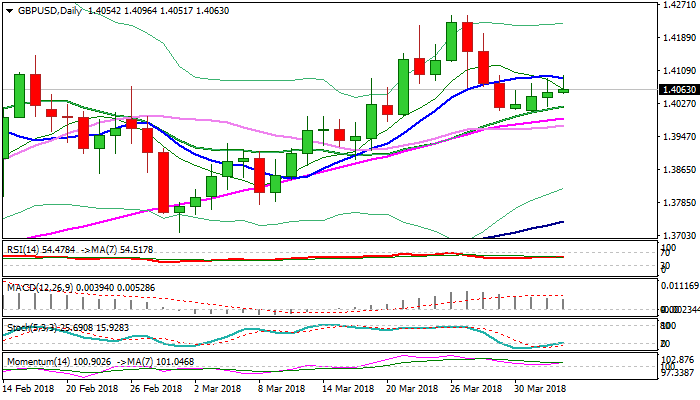
Cable remains in green for the fourth straight day on Wednesday, gradually extending recovery from the higher base at 1.4010.
Fresh extension higher dented pivotal barriers at 1.4090/99 (10SMA / Fibo 38.2% of 1.4243/1.4010 bear-leg) but without break higher for now.
Daily techs are bullish and need break above 10SMA to turn into full bullish setup and generate signal for extension of recovery.
Firm break higher would open way for further retracement of 1.4243/1.4010 and expose Fibo barriers at 1.4127 (50%) and 1.4154 (61.8%).
On the other side, thick 4-hr cloud continues to weigh and could delay recovery.
Rising 20SMA tracks the advance and offers solid support (currently at 1.4020) loss of which would be bearish signal.
UK Construction PMI is due today and eyed for fresh signal (Mar f/c 50.9 vs 51.4 in Feb).
Res: 1.4099, 1.4126, 1.4154, 1.4188
Sup: 1.4051, 1.4020, 1.4010, 1.3990
EURUSD Stands At The Back Foot Ahead Of EU Inflation Data
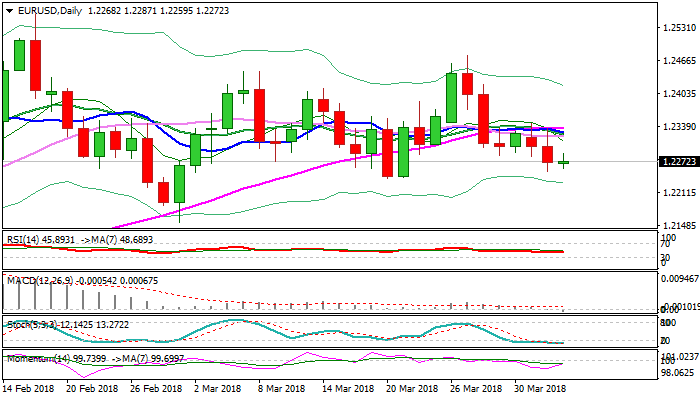
The Euro started European session at the back foot after short-lived recovery in Asia which was capped by previous congestion floor, now acting as initial resistance at 1.2283.
Tuesday's strong fall was sparked after a cluster of MA's limited upside attempts and resulted in close below four-day congestion, generating bearish signal.
Near-term outlook is negative as daily tech remain in bearish setup and favor test of next supports at 1.2240/30 (20/21 Mar double-bottom / 20-d lower Bollinger band), violation of which would open way towards key supports at 1.2154/46 (01 Mar low / daily Ichimoku cloud base).
Sideways-moving daily Kijun-sen (1.2315) is expected to keep the upside protected, while sustained break above converged MA's (between 1.2320 and 1.2340) would provide relief.
EU CPI data is the key release of the European session. Inflation is expected to pick up in March, according to the forecast for 1.4% vs downward-revised February's figure at 1.1%, with upbeat inflation numbers expected to boost the single currency.
Res: 1.2300, 1.2320, 1.2335, 1.2368
Sup: 1.2240, 1.2230, 1.2200, 1.2154
AUDUSD Trades Above 19-Week Low, Bullish Bias In Medium-Term
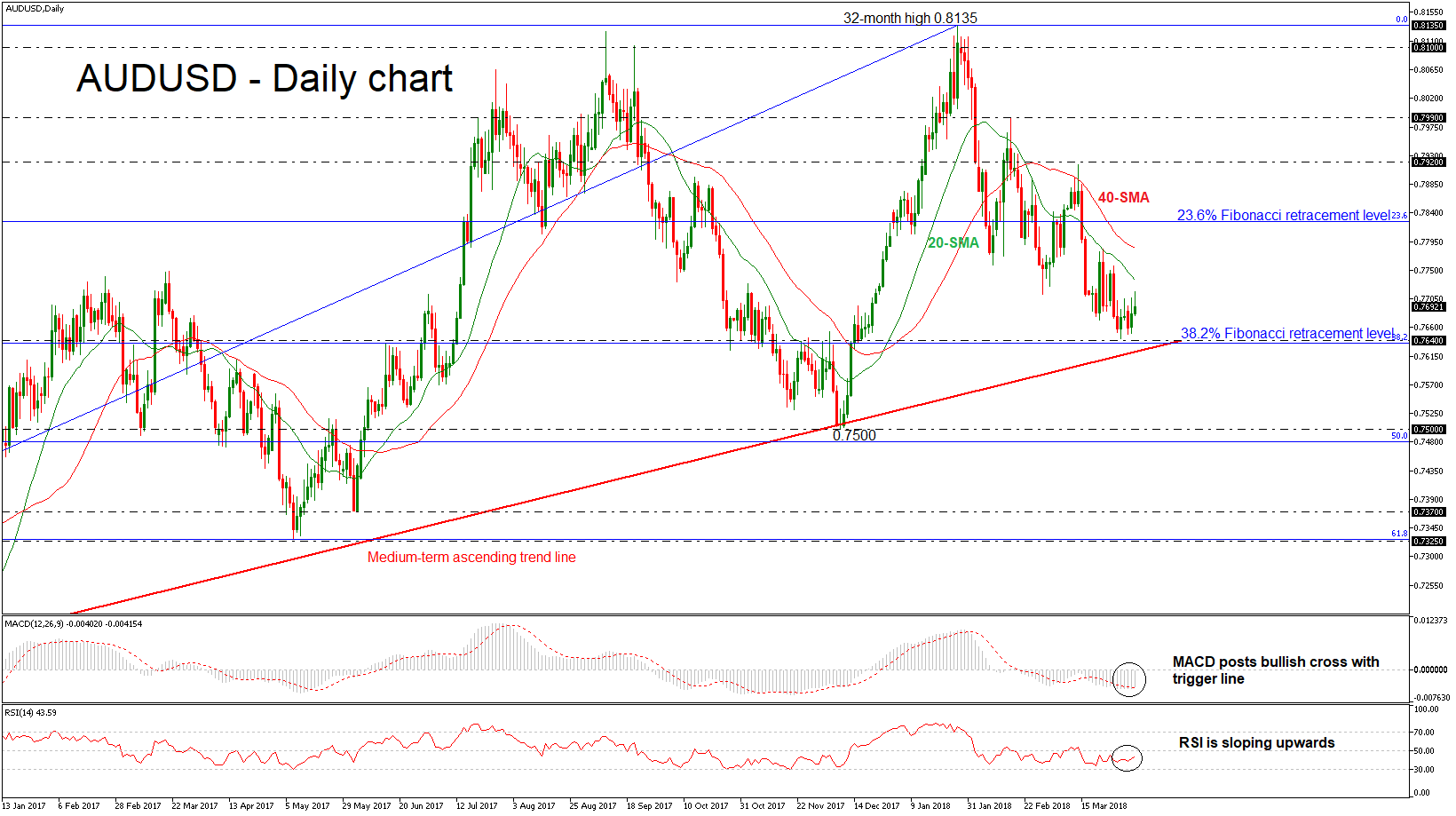
AUDUSD has been creating a short-term bearish movement since the end of January when it challenged a more than 2 ½-year high of 0.8135, pausing this downtrend at 19-week lows of 0.7640 over the previous week. Also, the price almost touched the 38.2% Fibonacci retracement level of the upleg from 0.6820 to 0.8135, which stands near the aforementioned obstacle.
The technical indicators, in the daily timeframe, turned their bias to the upside, suggesting that the softness in the market may end soon. The RSI indicator is sloping slightly north below 50 indicating that the market could increase the positive momentum and surpass this threshold in the short-term. The MACD oscillator crawled above its trigger line, creating bullish crossover and suggesting further gains at price action. However, the index is still moving in the negative territory.
If the market manages to pick up speed, the 20-day simple moving average (SMA) at 0.7735 could offer nearby resistance ahead of the 40-SMA which currently stands near 0.7785. A significant jump above the latter would break the 23.6% Fibonacci mark of 0.7825, raising chances for further increases. In this case, prices could climb towards the 0.7920 resistance level.
Should prices decline and a successful close below the medium-term ascending trend line around 0.7640, the next support level to have in mind is the 0.7500 handle, taken from the low on December 8.
In the medium-term, the outlook remains positive since prices hold above the more than 2-year rising trend line.
Risk Appetite Recovers Despite US Tariff News, Eurozone Inflation In Focus
Here are the latest developments in global markets:
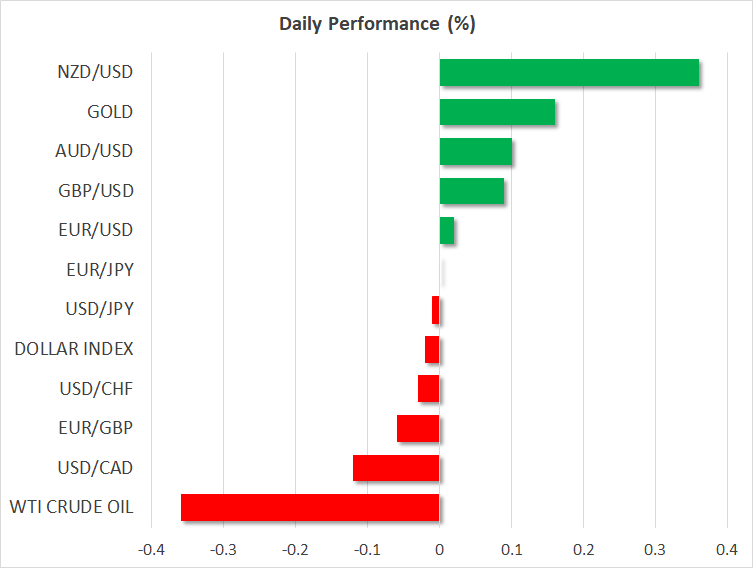
FOREX: The US dollar index was practically unchanged on Wednesday, consolidating after it posted some notable gains yesterday amid a recovery in risk sentiment and a surge in longer-dated US Treasury yields. Kiwi/dollar was among the prime winners today, gaining 0.35%. The loonie surged yesterday as well, on the back of optimism that a NAFTA deal may be reached soon.
STOCKS: US markets recovered sharply, helped by a combination of diminishing risks surrounding Amazon’s outlook and smaller-than-expected US tariffs on Chinese technology exports. The Dow Jones led the rebound, gaining 1.65%, while the S&P 500 and the Nasdaq Composite rose by 1.26% and 1.04% respectively. The S&P 500 managed to climb back above its notorious 200-day moving average. However, the rebound may remain short-lived, as futures tracking the S&P, Dow, and Nasdaq 100 are currently flashing red, pointing to a lower open today. In Asia, Japanese markets followed Wall Street higher but to a much smaller degree, with the Nikkei 225 and the Topix both climbing by roughly 0.1%. In Hong Kong, the Hang Seng was down by 1.1%. As for Europe, futures tracking the major indices are lower, for the most part.
COMMODITIES: In energy markets, oil prices are down today. Both WTI and Brent crude are almost 0.4% lower, unable to draw support from the recovery in equity markets. Oil traders seem to be hesitant to assume new long-positions ahead of today’s weekly EIA crude inventory data, which are projected to show another build in stockpiles, albeit a smaller one than previously. In precious metals, gold is trading 0.15% higher today, recouping some of the losses it posted yesterday in the midst of the risk-on environment.
Major movers: Risk sentiment rebounds despite US tariffs announcement; ball now in China’s court
Risk appetite improved markedly yesterday, evident by the recovery in US stock indices and the losses in safe-haven assets, most notably the yen and gold. The dollar index gained as well, helped by a surge in longer-dated US Treasury yields. The rebound in risk appetite was probably owed to three key factors.
The first was optimism around an imminent NAFTA deal, amid recent reports that the US is pushing for a swift resolution, which helped the loonie regain ground. Secondly, media reports suggested that despite the President’s frequent Twitter outbursts against Amazon, there are no discussions within the White House on how to take action against the company. That pushed Amazon’s stock back into the green (+1.40%), and the rest of the market followed higher. Finally, even though the US announced the details of its technology tariffs against China, the actual size of the tariffs was smaller than previously touted. The US will target Chinese goods worth $50bn, instead of the $60bn that had been rumored, which likely came as a positive surprise and helped ease some concerns that this trade skirmish will escalate much further.
Now, the ball is back in China’s court, and the Asian nation noted it will retaliate with measures of equal intensity and scale. Market chatter suggests China will target US soybean and aircraft exports, bringing into focus companies like plane-maker Boeing. If this is accurate, then another wave of risk-aversion may be in store soon, implying further volatility for equities and safe havens. In the bigger picture though, the overall direction in stock markets could depend on what comes after China retaliates. Will the US announce its own countermeasures and continue playing the tit-for-tat game, or will the two sides sit down at the negotiating table and reach common ground?
In other news, Fed Board Governor Lael Brainard (voter) appeared rather hawkish yesterday, noting that rates will probably rise above the predicted “neutral” level in the coming years due to fiscal stimulus. She is typically on the cautious side of the spectrum, so optimistic comments from her are especially important.
As for the antipodeans, both aussie/dollar and kiwi/dollar are up by 0.1% and 0.35% respectively, boosted by the broader risk-on environment.
Day ahead: Eurozone flash inflation and US ISM non-manufacturing PMI & factory orders on the agenda
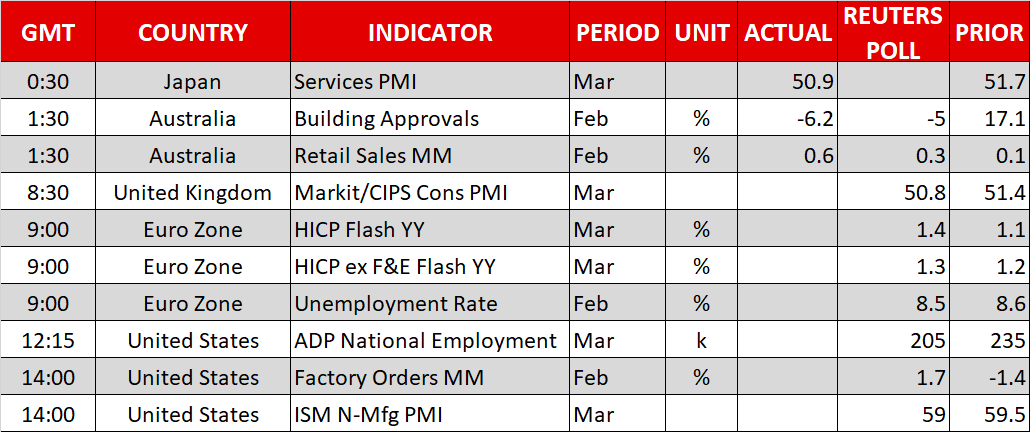
Wednesday's economic calendar will feature some important releases, including inflation figures out of the eurozone.
At 0830 GMT, the UK's construction PMI for the month of March will be made public, one day before the corresponding reading for the all-important for the UK economy services sector is released.
The eurozone's flash inflation figures for the month of March are due at 0900 GMT. The headline Harmonised Index of Consumer Prices (HICP), that uses a common methodology across EU countries, is forecast to rise to 1.4% y/y from February's 1.1% which constituted the lowest pace of growth for the measure since late 2016. Remarks by ECB policymakers advising against premature tightening – given the inflation rate's shortfall relative to the Bank's target of close to but below 2% on a yearly basis – weighed on the common currency recently. A data miss later on the day could further boost such concerns, leading to a weakening euro. The core measures of inflation, that exclude volatile items, will also be watched. February's unemployment rate out of the eurozone will also be released alongside the numbers for inflation. The rate is projected to decline to 8.5% from the previous 8.6%, hitting its lowest since December 2008.
Releases of importance out of the US include March's ISM non-manufacturing PMI and February's factory orders, both scheduled for release at 1400 GMT, while earlier (1215 GMT), the ADP national employment report on the number of positions added to the economy by the private sector during the month of March will also be gathering attention. The latter is viewed by some as a preamble to the non-farm payrolls report (due on Friday) which covers both the public and private sectors.
In energy markets, the weekly EIA crude inventory data at 1430 GMT will be gathering attention, providing fresh indications on the state of US oil production and demand. Crude stockpiles are forecast to have risen by 1.4m barrels in the week ending March 30, less than the 1.6m barrels from the week that preceded.
Any updates on trade have the capacity to drive sentiment in equity markets.
Policymakers making appearances on Wednesday include St. Louis Fed President James Bullard (1345 GMT) and Cleveland Fed President Loretta Mester (1500 GMT). Only the latter is a voting member within the FOMC in 2018.
Technical Analysis: EURUSD trades near 2-week low; looking mostly bearish in the short-term
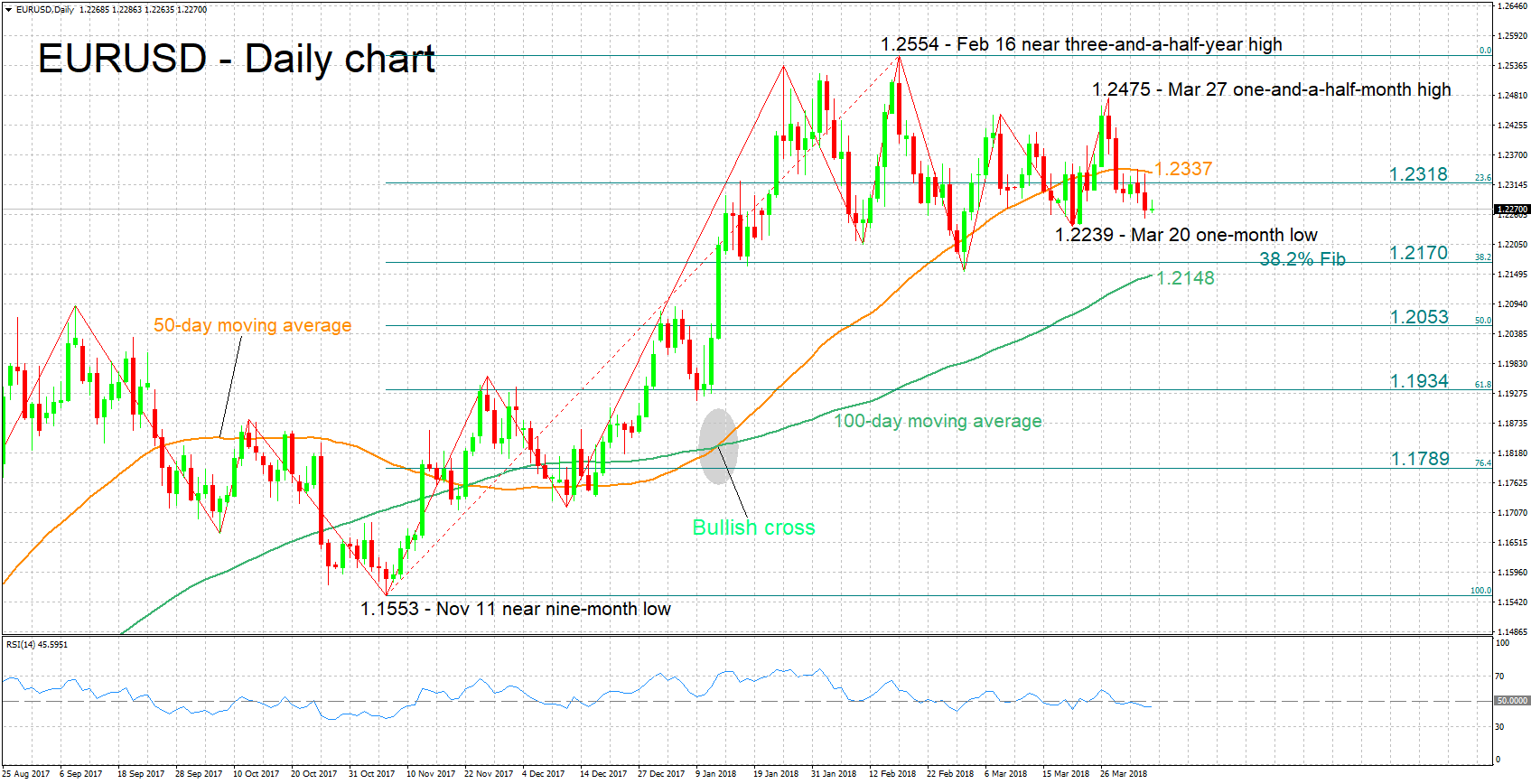
EURUSD has lost significant ground after hitting a one-and-a-half-month high of 1.2475 on March 27, eventually posting a two-week low of 1.2253 during Tuesday's trading. Price action is currently taking place not far above the aforementioned low. The RSI continues to decline in support of a bearish short-term bias, though it is only moderately negatively sloped at the moment, a sign that negative momentum is not that strong.
Stronger-than-expected inflation figures out of the eurozone later on Wednesday are anticipated to boost the pair, with resistance to advances potentially coming around the 23.6% Fibonacci retracement level of the November 11 to February 16 upleg at 1.2318. The area around this level also includes the 1.23 round figure, as well as the current level of the 50-day moving average at 1.2337.
Conversely, a data miss is likely to be met with selling pressure in EURUSD. Support to declines could initially come around the one-month low of 1.2239 from March 20 – including yesterday's two-week low of 1.2253 – with steeper falls shifting the focus to the 28.2% Fibonacci mark at 1.2170.
XAUUSD Intraday Analysis
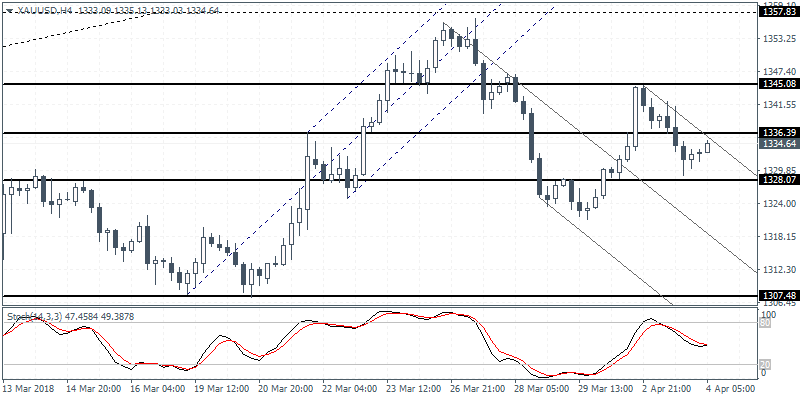
XAUUSD (1334.64): Gold prices gave up the gains rather quickly after rising to the 1345 handle. Price action fell past the 1336 support before reversing the losses just a few points above the 1328 level of support. The sideways range could continue within the 1336 handle and the 1328 level. A breakout from this range could signal further declines. We expect gold prices to push lower following a reversal at the 1336 region. This could send gold prices lower to 1328 with a breakdown below this level likely to see gold prices falling back to the 1307 level of support.
GBPUSD Intraday Analysis
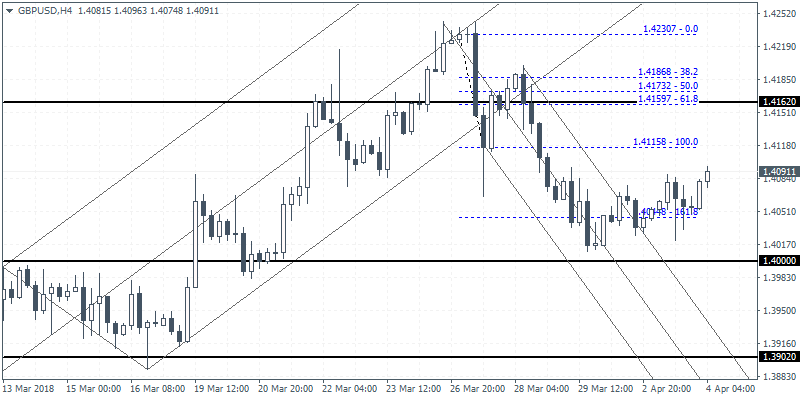
GBPUSD (1.4091): The British pound managed to post strong gains as price action briefly consolidated around the 1.4044 level before pushing higher. As noted in yesterday's commentary, we expect the upside to see GBPUSD rising toward 1.4115 where resistance is most likely to be established. With the UK's construction PMI on the tap, a positive beat on the estimates could see the GBPUSD extend the gains as much as 1.4162 where the major resistance level could be tested.
EURUSD Intraday Analysis
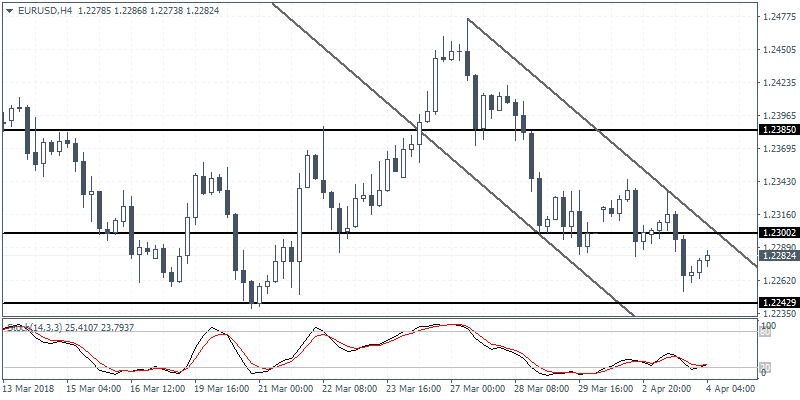
EURUSD (1.2282): The common currency was seen extending the declines yesterday marking a five day decline as prices fell to intraday lows of 1.2253. Initial resistance in the short term is seen at 1.2300 which could be tested. A reversal off this level could keep the EURUSD biased to the downside. However, in the event that the common currency manages to close above 1.2300, further gains could push the EURUSD towards the 1.2385 handle which marks a retest of a major resistance level. To the downside, the lower end of the range near 1.2243 is likely to hold the declines in the near term.
ADP Payrolls On The Tap
The U.S. dollar managed to post some modest gains on the day amid most of the economic data focusing on the manufacturing PMI's. Data showed that the Eurozone final manufacturing PMI was steady at 56.6, matching estimates and unchanged from the previous month.
In the UK, manufacturing PMI rose to 55.1 which was slightly higher than the estimates and up from the previous month's print of 55.0.
FOMC member, Brainard spoke late yesterday where she warned on the risks of an acceleration in inflation. She said that the government's fiscal stimulus which comes at a time when the U.S. was heading to full employment could push consumer prices higher. The USD was broadly unchanged on her comments.
Looking ahead, the economic calendar today will see the release of the monthly private payrolls data from ADP/Moody's analytics. Economists forecast that private sector jobs rose 208k during the month of March, slightly lower than the 235k jobs created the month before.
In the Eurozone, the flash inflation estimates for March is expected to show that consumer prices surged 1.4% on the year up from 1.1% previously. Core CPI is expected to rise 1.1%, slightly up from 1.0% previously.
The weekly crude oil inventories report will be coming out today with estimates showing another week of inventory buildup of 1.4 million barrels per day.