Sample Category Title
Fed’s Williams highlights uncertainty tied to fiscal, trade, and regulatory Policies
New York Fed President John Williams said today that monetary policy remains "well-positioned" to balance Fed’s dual mandate of stable prices and maximum employment. He noted that the process of disinflation is expected to persist, though achieving the 2% target may take time, with a return to the goal likely “in the coming years.” The pace and direction of monetary policy, however, remain highly data-dependent
Williams highlighted significant uncertainties clouding the economic outlook, including risks related to fiscal policies, trade dynamics, immigration changes, and regulatory shifts.
Therefore, "our decisions on future monetary policy actions will continue to be based on the totality of the data, the evolution of the economic outlook, and the risks to achieving our dual mandate goals," he added.
Separately, Richmond Fed President Thomas Barkin commented on the December CPI report released today, acknowledging that it reinforces the narrative of inflation gradually declining toward Fed’s target. Barkin also downplayed the potential impact of rising 10-year Treasury yields on the Fed’s monetary policy stance.
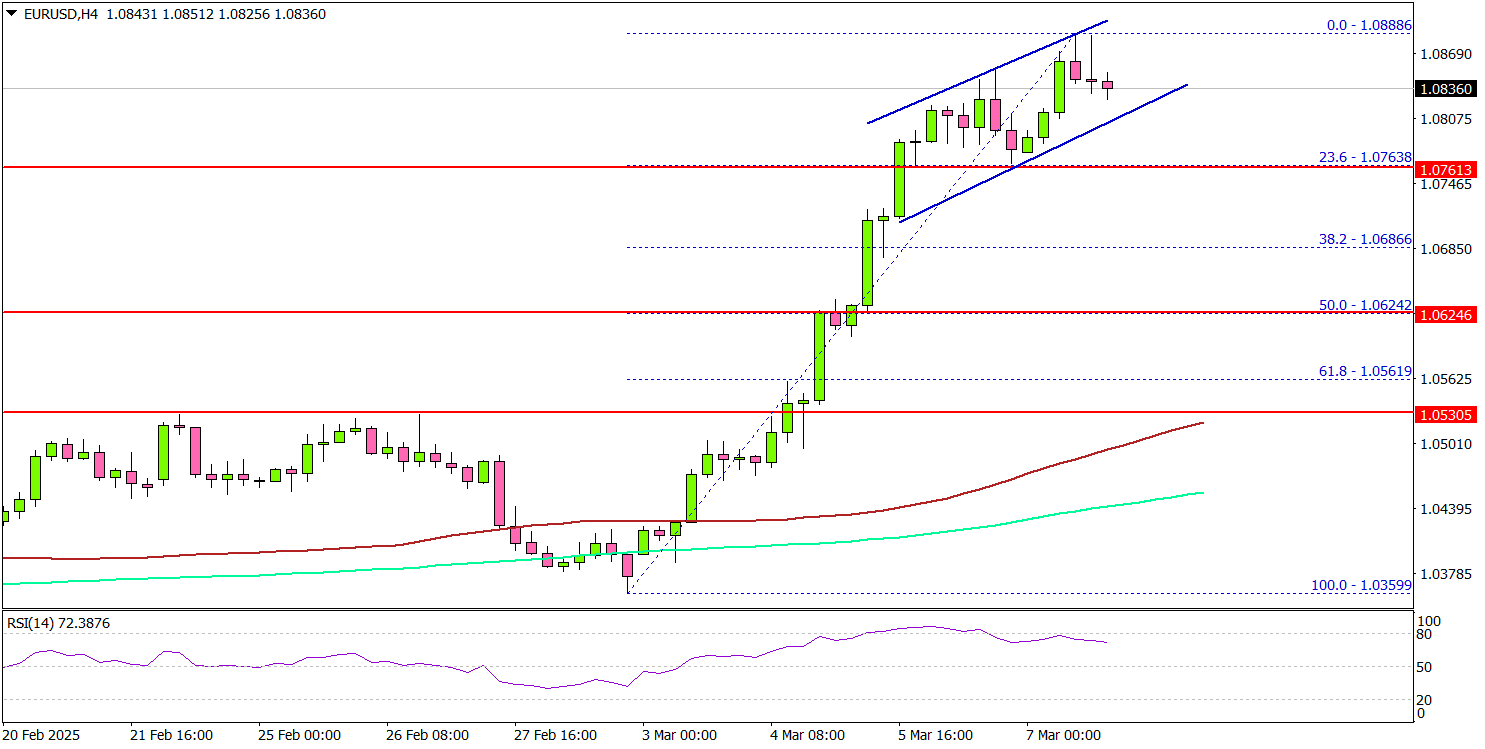
EURUSD Wave Analysis
- EURUSD reversed from key support level 1.0225
- Likely to rise to resistance level 1.0425
EURUSD currency pair recently reversed up with the daily Japanese candlesticks reversal pattern Morning Star (with the daily Hammer in its middle) from the key support level 1.0225, which stopped the previous impulse wave i at the end of December.
The upward reversal from the support level 1.0225 started the active short-term correction iv, which belongs to the downward impulse wave 3 from last month.
Given the bullish divergence on the daily RSI indicator, EURUSD currency pair can be expected to rise to the next resistance level 1.0425, which stopped the previous waves ii and (ii).
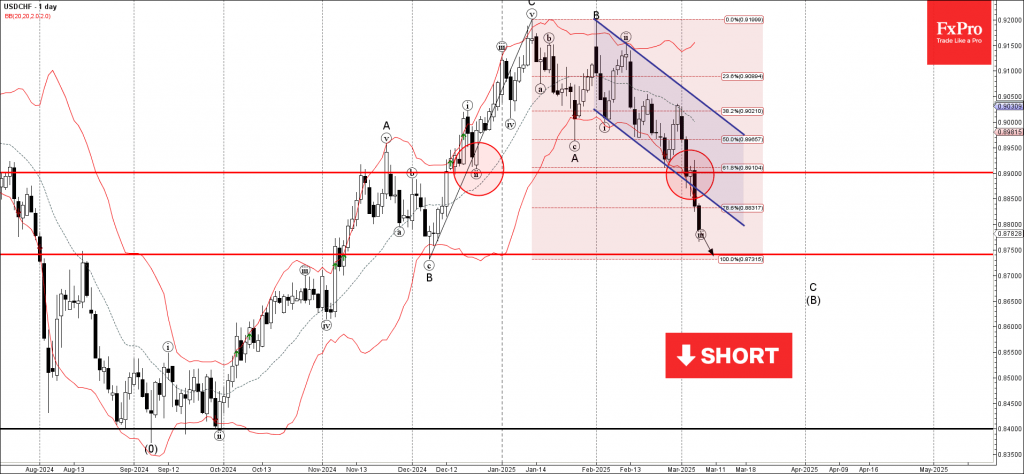
EURGBP Wave Analysis
- EURGBP reversed from multi-month resistance level 0.8445
- Likely to fall to support level 0.8380
EURGBP currency pair recently reversed down from the strong multi-month resistance level 0.8445, which has been steadily reversing the price from the start of September, as can be seen below.
The resistance level 0.8445 was further strengthened by the upper daily Bollinger Band and by the nearby 61.8% Fibonacci correction of the downtrend from the start of August.
Given the overbought daily Stochastic, EURGBP currency pair can be expected to fall to the next support level 0.8380.
Gold Cycle Since September 2022 Low Calling For More Upside
More than two years back, we were calling Gold to end a Zigzag Elliott Wave correction in the blue box area and resume the rally. Zigzag is a 5-3-5 Elliott wave structure in which wave A and C are in 5 waves and wave B is in 3 waves. Blue Boxes are High-Frequency areas and are based in a relationship of sequences, cycles and calculated using Fibonacci extensions. We refer to them as High Frequency trading areas, mainly because at Blue Boxes majority of the times, both buyers and sellers agree in the direction of the next moves and, hence why they present high probability and low-risk opportunities to enter the market in the direction of the trend. Let’s take a look at the weekly Elliott wave chart of Gold from September 2022.
Gold Weekly Chart September 2022
Gold cycle from 2015 low ended at $2075.14 on 08.03.2020 high. Following this peak, $XAUUSD started a pullback which lasted more than two years. Back in September 2022 (as shown in the chart above), we expected the yellow metal pullback to complete in the blue box area between $1668.46 – $1420.66 and rally to resume for a new high above 08.03.2020 high or for a three waves reaction higher at least. $1420.66 being the 161.8% Fibonacci extension of (( A )) related to (( B )) was the invalidation level which we expected to hold.
Gold Weekly Chart January 2025
Gold buyers indeed appeared in the blue box as expected and it started a rally which has lasted 27 months but is still not over yet. Blue box low was seen on 09.22.2022 at $1615.01 and since then we see Gold rally to be in fifteen (15) swings. Gold made a new all-time high, rally is extended as third wave went past 161.8 Fibonacci extension of wave (( 1 )) related to wave ((2)) but we still expect more upside because fifteen (15) is part of a corrective sequence and we need at least 1 more high to make it seventeen (17) swings and hence complete the cycle since 09.22.2022 low. As dips hold above wave (( 4 )) low at $2536.89, we are expecting more upside in Gold toward $2852.91 – $2950.50 area to complete wave ((5)). Following this, there should be a larger 3 waves pull back to correct the cycle from 09.22.2022 low. In the unlikely event of a break below $2536.89, Gold should still be in wave ((4)) and can see a test of $2474.41 – $2318.80 area before it turns higher in wave ((5)).
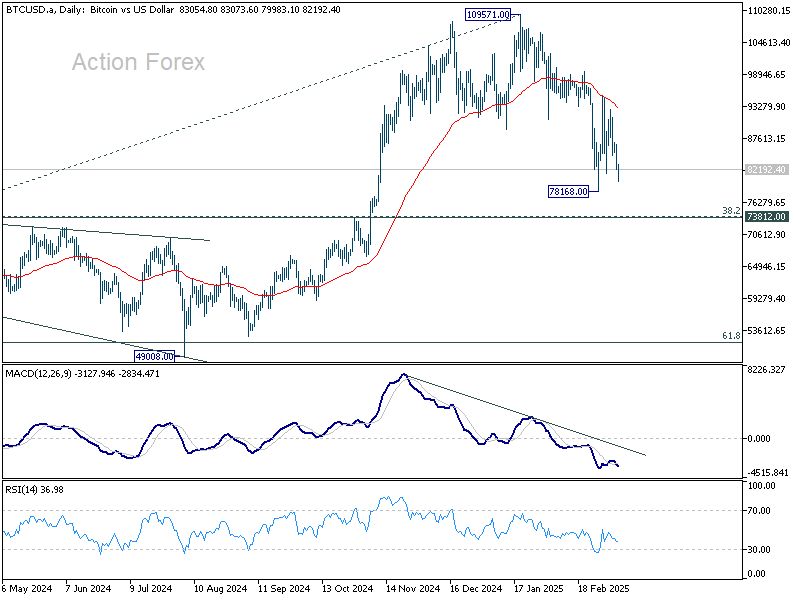
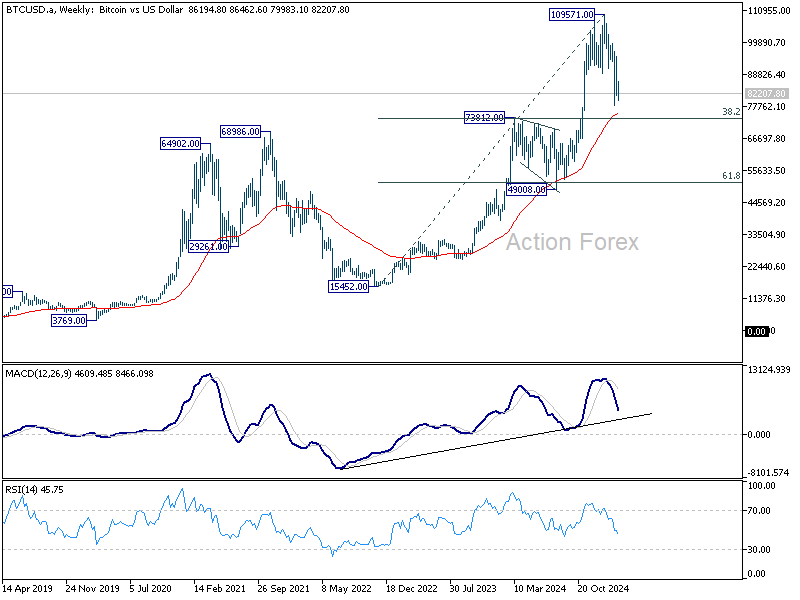
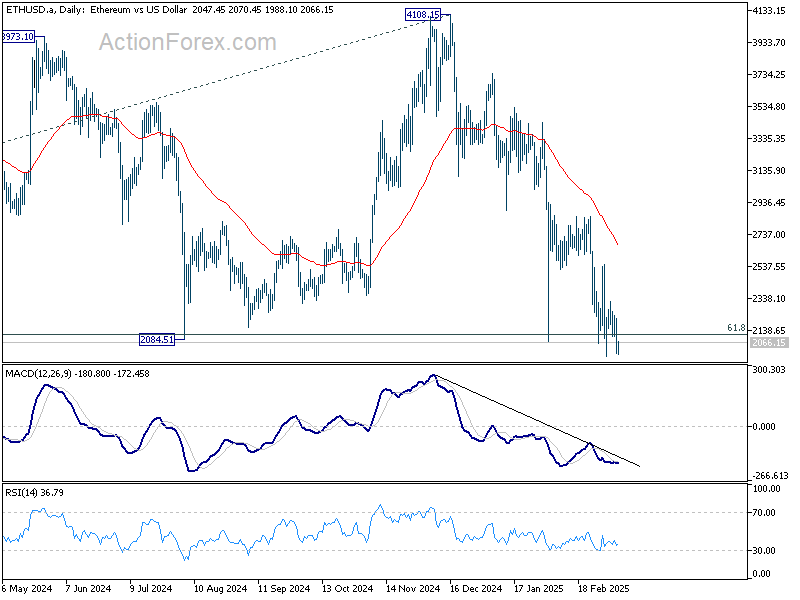
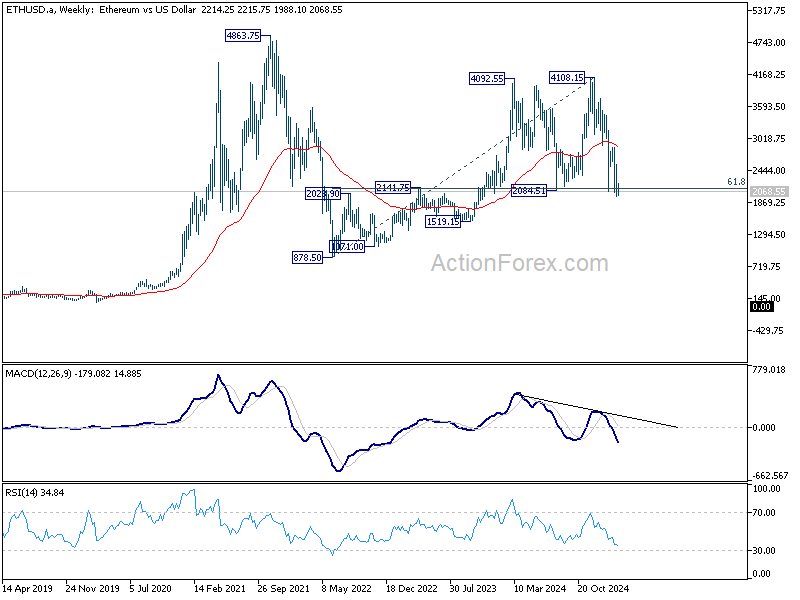
Bitcoin (BTC/USD) vs. Nasdaq: Is the Correlation Affecting Crypto Outflows?
- Bitcoin has recovered from a sharp selloff earlier in the week, rising from around 89000 to nearly 98500 post CPI.
- ETF flow data shows three consecutive days of net outflows for Bitcoin as correlation with Nasdaq grows.
- Could a Trump Presidency lead to significant capital inflow into Bitcoin in 2025?
- Technically, Bitcoin is at a critical juncture breaking the 50-day moving average and eyeing the 100k handle.
Bitcoin has staged an impressive recovery since Monday afternoon lows around the 89000 mark. Cryptocurrencies were also affected by US jobs data ahead of the weekend and the stronger US Dollar early on Monday was in part responsible for the sharp selloff.
The recovery has been swift however with Bitcoin rising from a Monday low of around 89000 to end the day just shy of the 95000 handle. Yesterday the worlds largest Crypto by market cap edged above the key 95000 handle to trade at a high of 97339 (helped by softer than expected US PPI data) before facing some resistance by the 50-day MA.
Let us take a look at the performance of the Crypto market for the day.
Crypto Heatmap (post CPI), January 15, 2025
Source: TradingView (click to enlarge)
ETF Flow Data Shows 3 Successive Days of Outflows
Looking at ETF flow data courtesy of Farside investors, Bitcoin has recorded three consecutive days of net outflows with the largest being on Monday. Bitcoin started the week recording $284.1m of net outflows and followed that up with outflows totaling $209.8m yesterday.
It will be interesting to gauge whether ETF flows turn positive again ahead of the Trump inauguration next week.
Source: Farside Investors (click to enlarge)
There could be a host of reasons for this but one which has gained traction this week stems from a report showing the increase in correlation between US indices (particularly Nas100) and Bitcoin.
K33 Research Report – Nasdaq vs Bitcoin Correlation
K33 Research’s latest “Ahead of the Curve” report highlights that the crypto market is facing the same challenges affecting global markets. Over the past month, Bitcoin (BTC) and the Nasdaq have become more closely linked, with their current 30-day connection reaching its highest point in 2024.
According to K33’s analyst, Trump is expected to push for policies that grow the economy, extend the 2017 tax cuts, and provide more tax breaks for working-class Americans. These actions could be positive for riskier investments like crypto. The analyst also noted that Trump is likely to introduce crypto-friendly policies, which could benefit the crypto market.
Such data may be contributing to ETF outflows as institutional investors looked at Bitcoin as a sort of portfolio hedge providing diversification. However if the correlation with US stocks continues this could result in allocations for equities and Bitcoin being split rather than having their own allocations.
In an interview with Bloomberg on Tuesday, VanEck’s CEO, Jan van Eck stated that ‘it is disappointing to note the correlation between Bitcoin and Nasdaq over the past 6 months. Mr van Eck went further by saying that many people are looking at Bitcoin for the first time which is not what you want (referring to the growing correlation). If you look at the ten-year correlations, they are almost zero, which is really what diversification should be. We’ll have to see how Bitcoin performs going forward.’
Such comments tend to support the idea that the higher the correlation between the Nasdaq and Bitcoin, the greater the chance that outflows may increase due to portfolio diversification and positioning.
Trump Inauguration to Fuel Crypto Rally?
As you can see from the K33 research report above, there is optimism that a Trump Presidency will provide a major boost to the crypto industry.
According to CryptoQuant, About $520 billion of fresh capital could flow into Bitcoin in 2025. In the context of favorable regulatory, monetary and cyclical conditions, it’s reasonable to expect capital to continue flowing into Bitcoin in 2025 the data and analytics provider added.
The idea of a bullish run in 2025 for crypto is further supported by Pantera Capital, who claims that the upcoming inauguration of Donald Trump should propel Bitcoin to new heights.
Another interesting one to keep an eye on as inauguration day draws closer.
Bitcoin realized cap data
Source: CryptoQuant (click to enlarge)
An accompanying chart (above) shows Bitcoin’s realized market cap with the combined value of the supply as it moves on chain since 2015. If the market follows historical patterns, CryptoQuant said, the $520 billion tally becomes attainable. Such a move would no doubt fuel rallies in price but leaves one with many questions.
US Data Could Temporarily Drive Bitcoins Price
US inflation data came out a short while ago with the Core inflation print YoY softer than expected. It will be interesting to see if this helps propel Bitcoin toward the 100000 mark and beyond.
Technical Analysis – BTC/USD Rests at Critical Juncture
Bitcoin (BTC/USD) from a technical standpoint on the daily timeframe the overall price action has been messy.
The reason for my observation stems from the lack of a convincing break of the previous swing low around 91800.
Though prices plunged below $90000 handle for a moment on Monday the swiftness with which prices rose suggest strong buying pressure remains in play.
As things stand, BTC/USD is a critical juncture as it tests 50-day MA which could serve to cap gains.
A failure to break back above and find acceptance could lead to a sharper selloff.
A rejection of this level brings the 95000 and 90000 into play, before attention turns to the 91804 and 90000 handle.
Bitcoin (BTC/USD) Daily Chart, January 15, 2025
Source: TradingView.com (click to enlarge)
Support
- 97500
- 95000
- 91804
Resistance
- 100000
- 102261
- 103647
UK Inflation: Below Expectations But Above Target
The UK Consumer Price Index (CPI) added 0.3% m/m in December, slightly below the average expectation of 0.4%. Annual inflation eased to 2.5%, having remained mostly in the 2.0-2.5% range for the past nine months. This is quite a long period without a significant decline and with some upward bias.
Core consumer inflation was 3.2% y/y in December, having remained in the 3.2-3.5% range for the past eight months. This figure is well above the 2% target and without a clear downward trend. As a higher reading was expected, the report probably stirred the bears, but did not allow them to play up to their full potential due to US inflation expectations.
Input producer prices have barely been out of negative territory for the past year and a half, recording the latest data at -1.5% y/y. Producer prices ‘on the way out’ have shown near-zero momentum for the past 18 months, hitting 0.0% y/y in December.
Producer prices work to suppress inflation, while the rising cost of services raises the final price tag for consumers, suppressing their activity. The Bank of England is likely to use the weakness in producer prices and low economic activity as an excuse to cut rates. However, this support for the economy has its own negative effect in the form of higher inflation expectations. If inflation picks up again, rates will need to be raised for longer and more aggressively than they were when expectations were anchored at 2.0%.
GBPUSD has been hovering around the 1.22 level for the fifth trading session, finding solid buying on dips towards 1.21. This local bottom roughly coincides with the 2023 year-end pivot area, which further fuels bullish hopes. Short-term, they have the accumulated oversold pound on their side after a 5.5% failure in the last five weeks. The start of growth of GBP/USD is well within the framework of technical correction with the potential of increase up to the area of 1.24-1.26. And only a confident exit to higher levels will allow us to speak about a global reversal in this pair.
December CPI: Hotter Headline, But Healthier Core
Summary
Consumer price inflation was hot in December, rising 0.4% in the month on the back of higher food and energy prices. Excluding food and energy, the inflation picture looked better. The core CPI rose 0.23%, in line with economist forecasts and marking a slowdown from the pace that had prevailed over the previous few months. Fairly flat prices for core goods and slower inflation for items like medical care helped to push core CPI down to 0.2% from its recent run rate of 0.3%.
That said, when looking through the month-to-month noise, the inflation data have been fairly stubborn in recent months, neither gathering nor losing speed. The 12-month change in the core CPI (+3.2%) is more or less the same as the three-month annualized rate (3.3%). The picture looks a bit better for the Fed's preferred inflation metric, the core PCE deflator, where we project December inflation to be 0.2% month-over-month and 2.8% year-over-year. But, this marks only a modest slowdown relative to the 3.0% core PCE inflation registered in December 2023, and it is still well above the central bank's 2% inflation target.
Accordingly, and given the more resilient labor market data seen over the past couple months, we have revised our expectations for the federal funds rate outlook. We now expect two 25 bps rate cuts by the FOMC this year, in September and December, down from the three cuts we anticipated coming into the year. If realized, the target range for the federal funds rate would be 3.75%-4.00% at year-end 2025. We will publish additional details and a full economic forecast update tomorrow in our flagship Monthly Economic Outlook publication.
More Work To Do in 2025
The Consumer Price Index finished 2024 in hot territory, rising 0.4% in December and roughly matching the largest monthly increase of the year. Higher gasoline prices (+4.4%) and food prices (+0.3%) contributed to the robust gain in the headline index. Despite the strong reading for food and energy prices in December, inflation in these categories was relatively subdued over the entirety of 2024 (chart). Gasoline prices were 3.4% lower in December 2024 compared to 2023, while food prices were up 2.5%, a smaller gain the 3.9% increase in average hourly earnings. Note that this masks some divergences beneath the surface for individual categories. As an example, prices for eggs at the grocery store rose 3.2% in December and 37% over the past year amid a bird flu epidemic outbreak that has constrained supply. Total CPI inflation was 2.9% in the 12-months ending in December, a modest improvement from the 3.4% rate registered in December 2023 and consistent with a moderate pace of real wage gains.
Excluding food and energy, there was slightly better news on the price front. After advancing 0.3% in each of the prior four months, the core index rose 0.23%. As expected, the tamer reading was driven by a more modest rise in core goods prices, which were up 0.1%. New and used vehicle prices continued to rise in December, but at a slower rate than in November, while prices for the remainder of the core goods index fell 0.2%.
Core services prices increased 0.3%—in line with November. Primary rent growth (owners' equivalent rent and primary rent) reverted to its recent trend of 0.3% after slowing sharply in November. But excluding housing, core services advanced 0.2% amid more modest gains in medical care and other services like recreation, tuition and personal care.
Today's CPI report along with yesterday's December Producer Price Index suggest the core PCE deflator, the Fed's preferred measure to gauge the current trend in inflation, rose 0.21% in the final month of the year. That would leave the year-over-year rate at 2.8%, only marginally better than the 3.0% change registered in December 2023. The core CPI, however, has seen more improvement, moving from 3.9% to 3.2%, thanks to the moderation in primary shelter and auto inflation. Similarly, the market-based measure of core PCE also has pointed to a more meaningful slowdown in price growth over the past year (chart). This measure excludes categories where prices are imputed and not directly observed, and has been mentioned by Fed officials including Chair Powell with increasing frequency.
Nevertheless, progress in the fight against inflation has seemed to effectively stall in recent months. Over the past three months, the core CPI has risen at an annualized rate of 3.3%, little different than the 6-month and 12-month rates of 3.2%. The sideways move in core inflation in recent months comes as deflation in core goods has faded since the summer and offset the frustratingly slow pace of services disinflation (chart).
The stubborn inflation readings over the past few months, alongside the stabilization in the labor market data, have led us to revise our expectations for the federal funds rate this year. We now expect two 25 bps rate cuts this year, in September and December, down from the three cuts we anticipated coming into this year. If realized, the target range for the federal funds rate would be 3.75%-4.00% at year-end 2025. We will publish additional details and a full economic forecast update tomorrow in our flagship Monthly Economic Outlook publication.
US: Small Signs of Progress in Core Inflation in December
As markets expected, the Consumer Price Index (CPI) rose 0.4% month-on-month (m/m) in December, after rising 0.3% m/m in November. On a twelve-month basis, CPI ticked up to 2.9% (from 2.7% in November).
Over 40% of the headline inflation increase was due to a 2.6% m/m increase in energy prices. Even with that big increase in December, energy prices remain 0.5% below their year ago levels.
Core CPI was slightly softer than expected in December. Excluding food and energy, CPI rose 0.2% m/m after four consecutive 0.3% m/m gains. The twelve-month change edged down a tick to 3.2%.
Core goods prices rose a more modest 0.1% m/m, after a 0.3% gain in November. Prices for new and used vehicles are still exerting upward pressure, but to a lesser extent than in November.
Core services were up 0.3% m/m, matching November's pace. On a year-ago basis, services prices were up 4.4%, down two tenths from the prior month. Shelter prices rose 0.3% m/m in December, with matching 0.3% increases for both rent and owners' equivalent rent. Shelter inflation is 4.6% on a year-on-year basis, continuing to make steady downward progress from its 2023 highs.
Key Implications
December's CPI report contained a little bit of good news on core inflation. After a few months of hotter readings, core prices posted a softer-than-expected gain. Fed members have indicated a desire for a more gradual pace of interest rate cuts this year, and we still think they will take a pause in January. Last Friday's healthy payrolls report provided little reason for the Fed to cut rates quickly. But we expect that a March cut remains on the table, with today's CPI providing reassurance that inflation data surprises are not all in one direction.
One challenge for inflation watchers is that the CPI is not the Fed's preferred inflation measure. That is the core PCE deflator, which did not follow the CPI's lead in November. The 3-month annualized change remained more benign at 2.5%, and still points to downward momentum on the year-on-year measure. The Fed will not get this number before their Jan. 29th decision date. Next week will also bring a deluge of policy shifts from the incoming Trump administration, giving the Fed plenty to think about as it heads into its deliberations.
Sunset Market Commentary
Markets
A minor downward surprise in the December US inflation report triggered an outsized market rally. It’s testament to current stretched market positioning rather than to really softening price pressure. US money markets arrived at the point where adding to the recent calibration would mean betting on a rate hike as a next Fed move rather than a rate cut. Even though we side with the view that there’s limited room left to lower policy rates further, we agree that it’s way too early to already turn that ship the Brazilian way. Turning to the inflation numbers, headline CPI accelerated to 0.4% M/M and 2.9% Y/Y (from 2.7%) as expected. The pace of underlying core CPI unexpectedly slowed down from 0.3% M/M to 0.2% M/M with the annual figure slowing from 3.3% to 3.2% instead of the expected stabilization. US Treasuries rallied with daily yield changes falling by 10 bps to 14 bps with the belly of the curve outperforming the wings. A next 25 bps rate cut by the Fed is now discounted by June rather than by end 2025. The dollar faced a setback but damage was contained as European bonds followed US Treasuries higher. EU swap rates cede 8 to 10 bps with the belly also outperforming. On top, from the euro side of the equation there’s still little to cheer on. Especially in anticipation of president-elect Trump’s inauguration this weekend which could result in an avalanche of immediate executive orders. EUR/USD went from 1.03 to 1.0350. EUR/GBP 0.8448 resistance survived even as UK Gilts received a double boost today. Apart from the US-CPI, we’ve also had lower December UK inflation numbers this morning. Headline, core and services inflation respectively slowed from 2.6% Y/Y to 2.5% Y/Y, from 3.5% Y/Y to 3.2% Y/Y and from 5% Y/Y to 4.4% Y/Y. UK Gilt yields crash 15 bps across the curve with a February BoE rate cut being all of sudden back into play. Vibrant risk sentiment is the dominant force here though. European stock markets currently gain 1%-1.5% with key US equity indices opening 1.5% higher as well. Apart from the goldilocks combination of stronger US payrolls and avoiding more price pressure, it’s worth mentioning the strong start to Q4 earnings season by US financials (Goldman Sachs, JP Morgan, Citigroup).
News & Views
First calculations by the German Federal Statistical Office (Destatis) learnt that the price adjusted gross domestic product (GDP) was 0.2% lower in 2024 than in the previous year. Ruth Rand of the Statistical office commented that "Cyclical and structural pressures stood in the way of better economic development in 2024." From the gross value added point of view, activity in the economy contracted by 0.4%, with significant differences in the performance of individual economic sectors. Gross value added in manufacturing dropped significantly (-3%) The decline in valued added in the construction industry was even more pronounced at -3.8% due to higher prices for building products and interest rates remaining high. The service sector still registered positive growth overall in 2024 (+0.8%). However, here were also significant differences between subsectors (stagnation in the likes of trade, transport, accommodation and food services, but a better performance in gross value added in the information and communication sector, +2.5%). There was a steady rise in the sectors of the economy that are closely linked to general government (1.6%). In a demand approach, gross fixed capital formation declined 2.8%. Despite higher income, household consumption only rose 0.3%. Government consumption growth was much more pronounced at 2.6%. The difficult economic climate in 2024 was also reflected in foreign trade. Exports of goods and services were down 0.8% while imports were up slightly by 0.2% on the previous year, primarily due to increased imports of services. Despite the unfavorable context, the labour market hit a new record high in 2024 with on average 46.1 million persons being employed in 2024 (+0.2% compared to 2023). The general government deficit ratio (2.6%) in a first estimate is assessed to have remained unchanged at previous year's level.
UK Inflation Lower Than Expected, Sterling Shrugs
The British pound is showing limited movement on Wednesday. In the European session, GBP/USD is currently trading at 1.2224, up 0.11%.
UK inflation softer than expected
The UK’s annual inflation rate eased slightly in December 2024, dropping to 2.5% from 2.6% in November. This was also lower than the market estimate of 2.6%, although it matched the BoE inflation forecast from November. Monthly, CPI rose 0.3% in December from 0.1% a month earlier. Core CPI fell to 3.2% y/y from 3.5% in November but the monthly rate climbed to 0.3%, up from 0% in November.
The key drivers in the drop in headline CPI were lower prices for hotels and restaurants. As well, services inflation, which is monitored carefully by the Bank of England, dropped to 4.4% in December from 5% in November. This was the lowest level since March 2022.
The inflation report was warmly received by the money markets, which increased their expectations of a BoE rate cut next in February. Currently, the money markets have priced in an 82% probability of a quarter-point hike next month and two cuts have been almost fully priced for 2025. It is also good news for the government, as borrowing costs, which have been on the rise, eased slightly following the inflation release. The increase in borrowing costs have raised the possibility that the government would fall short of its budget rules and would have to make further spending cuts.
US inflation expected to rise to 2.9%
All eyes on are on the December US CPI report, which will be released later today. Headline CPI is expected to rise 2.9% y/y, up from 2.7% in November. Monthly, headline CPI is projected to remain unchanged at 0.3%. Core CPI, which is a better gauge of inflation trends, is expected to remain unchanged at 3.3% y/y and dip to 0.2% m/m from 0.3% in November. An unexpected inflation reading could have a significant impact on the direction of the US dollar.
GBP/USD Technical
- GBP/USD is putting pressure on support at 1.2202. Below, there is support at 1.2154
- 1.2264 and 1.2312 are the next resistance lines