Sample Category Title
EUR/CHF Weekly Outlook
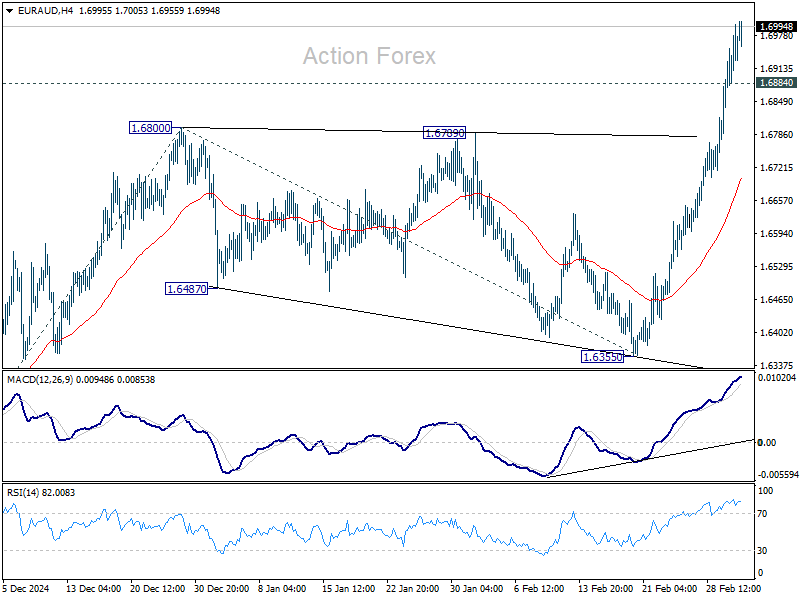
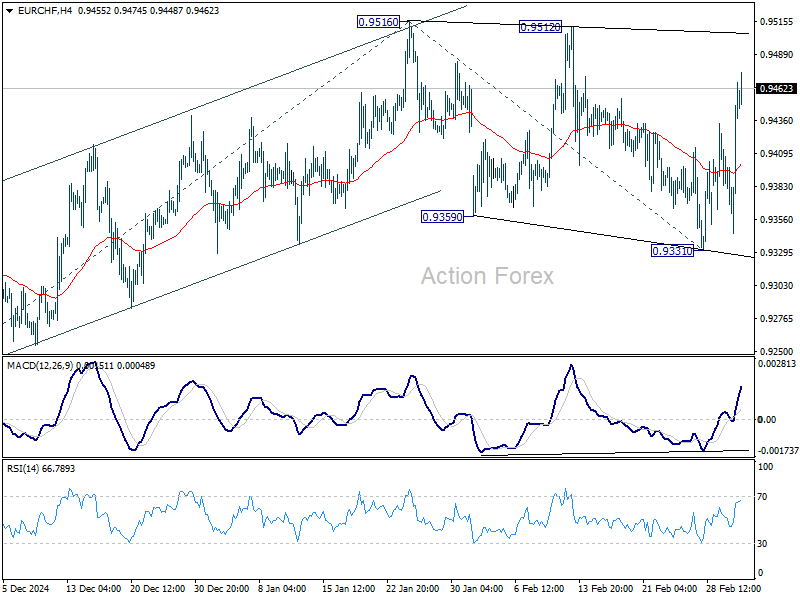
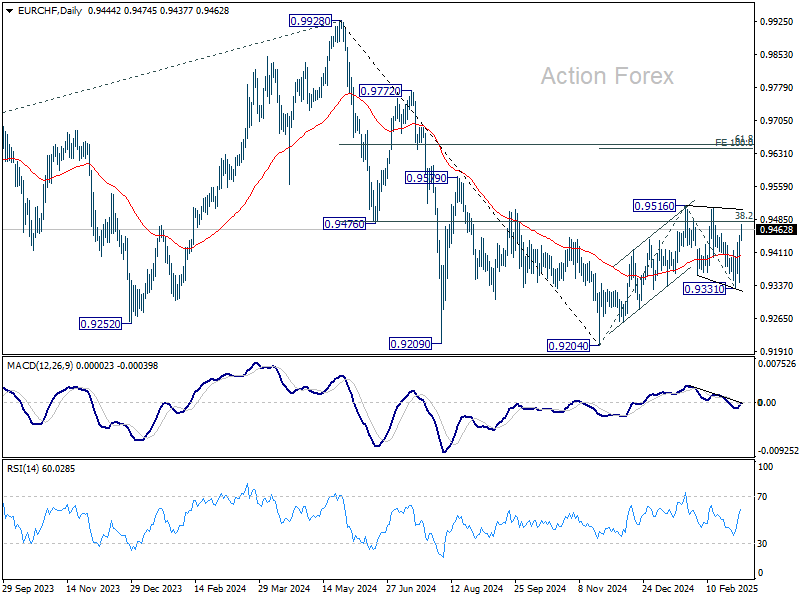
EUR/CHF stays in sideway trading below 0.9440 last week and outlook is unchanged. Initial bias remains neutral this week first. Corrective rebound from 0.9204 could still extend higher. But upside should be limited by 0.9481 fibonacci resistance. On the downside, firm break of 0.9329 support will argue that the correction has completed, and turn bias back to the downside for 0.9284 support first.
In the bigger picture, while corrective rebound from 0.9204 might extend higher, strong resistance could be seen from 38.2% retracement of 0.9928 to 0.9204 at 0.9481 to limit upside. Down trend from 0.9928 (2024 high) is still in favor to resume through 0.9204/9 support zone at a later stage.
In the long term picture, fall from 1.2004 (2018 high) is part of the multi-decade down trend. Corrective pattern from 0.9407 (2022 low) might have completed with three waves to 0.9928. Decisive break of 0.9252 (2023 low) will confirm long term down trend resumption to 61.8% projection of 1.1149 to 0.9407 from 0.9928 at 0.8851. For now, outlook will stay bearish as long as 0.9928 resistance holds, even in case of strong rebound.
Dollar Gains Momentum as Fed Cuts Come Into Question
The US markets last week were shaped by two dominant themes: uncertainty surrounding trade policies of the incoming US administration and the impact of robust US economic data. Initial market confusion, driven by ambiguous signals regarding tariffs, created significant volatility. However, this indecisiveness gave way to clarity as strong US data reaffirmed the resilience of the economy, casting doubt on the likelihood of more Fed rate cuts in 2025.
US Treasury yields surged as markets recalibrated their expectations for Fed policy, while equities faced notable selling pressure. This dual development provided a substantial boost to Dollar, which ended the week broadly higher. While some traders remain cautious, wary of surprises tied to US political developments, the Dollar's upward momentum appears poised to persist, supported by the hawkish shift in Fed expectations and strong macroeconomic fundamentals.
Across the Atlantic, Sterling faced intense pressure, falling sharply as concerns over fiscal de-anchoring took center stage. Rising UK gilt yields, coupled with a weakening Pound, highlighted fears of a negative spiral for the UK's fiscal health. Investors are increasingly concerned that higher borrowing costs could exacerbate fiscal imbalances, particularly in an environment of tepid growth and stagflationary risks. Sterling's underperformance made it the worst performer among major currencies.
Elsewhere, Canadian Dollar emerged as the strongest currency of the week, but only for consolidating recent losses. Yen followed Dollar as the third strongest, benefiting from a late-week risk-off environment. On the other hand, Aussie and Kiwi, reflecting their risk-sensitive nature, were among the weakest performers. Euro and Swiss Franc ended in middle positions.
Fed Pause to Extend, Rate Cuts in 2025 Less Certain, Hike Risks Emerge?
Dollar and US Treasury yields soared last week, while equities took a hit, as a new idea gained traction: Fed might refrain from any rate cuts in 2025. This shift in market sentiment emerged after several catalysts converged, including robust employment data, jump in inflation expectations, and public remarks from key Fed officials. Traders are now rethinking their scenarios for the months ahead, pricing in the possibility that the central bank will remain on hold longer than previously thought.
Driving the narrative is the unexpectedly strong December non-farm payroll report. Employers added 256k new jobs, surpassing consensus forecasts of 150k and even outpacing the monthly average of 186k for 2024. Unemployment rate dipped back to 4.1%, reinforcing the view that the labor market is in solid shape.
These data points suggest not only a healthy labor market but also reacceleration in hiring after last year's elections, bolstered by expectations of pro-business policies under the incoming Trump administration. If these dynamics persist, the labor market could tighten further, reigniting inflationary pressures. The timing of these numbers matters greatly too, as they have arrived just as the market was anticipating a more tempered economy heading into 2025.
Another factor reshaping investor expectations is the January University of Michigan survey, which revealed a marked rise in inflation expectations. One-year inflation forecasts jumped from 2.8% to 3.3%, the highest since May, while long-run expectations climbed to 3.3%, not seen since June 2008. These developments highlight a growing concern that inflation could move beyond Fed's comfort zone, especially with additional fiscal and trade policies fueling price pressures ahead.
In parallel, the incoming Trump administration’s policy stance, in particular on trade, adds more complexity. While the president-elect denied reports of a shift to sector-specific tariffs out of concerns over political backslash, subsequent speculation about declaring a national economic emergency to justify tariffs has left markets unsettled.
It should be emphasized that these scenarios are not mutually exclusive. Trump could still use emergency powers to target specific sectors or countries. This uncertainty is likely to persist at least until his inauguration on January 20.
Looking at Fed, three key takeaways have taken form. First, a pause in January appears virtually locked in, with robust data and upbeat official commentary reinforcing the case for no immediate move. Second, markets are now leaning toward the next cut being postponed until May, representing a prolonged window of inactivity. Third, there is a growing notion that Fed could deliver just one cut in 2025 or potentially none at all, should inflation remain elevated and growth hold steady.
Meanwhile, central bank communication has echoed these changing expectations. Former rate-cut proponents at Fed have begun to indicate growing consensus that policy easing may be nearing an end. However, it should be clarified that Fed Governor Michelle Bowman described December’s cut as the “final step” in the "recalibration" process only. She stopped short of declaring an outright end to the cycle. Still, Bowman's words imply that a higher threshold for further reductions is now in play.
Adding to the hawkish tilt, analysts from Bank of America have raised the possibility of a Fed rate hike rather than additional cuts. Such a scenario isn’t the baseline, given that policies are still restrictive, despite being close to neutral. Fed appears content to let existing policy restrictions work their way through the economy for now.
However, significant acceleration in core inflation—particularly if it exceeds 3%—could force Fed policymakers to reconsider their stance. But then the bar for a hike is also high.
DOW Correction Deepens, 10-Year Yield and Dollar Index Power Up
Technically, DOW's correction started to take sharp as the decline from 45703.63 resumed last week. Two near term bearish signal emerged recently, rejection by 55 D EMA and break of rising channel support.
Further fall is expected as long as 55 D EMA (now at 43504.46) holds, targeting 38.2% retracement of 32327.20 to 45073.63 at 40204.49. Nevertheless, this decline is seen as correcting the rise from 32327.20 only. Hence strong support should be seen from 40204.49 which is close to 40k psychological level, to contain downside.
Also, the broader US equity markets remain relatively resilient, with S&P 500 and NASDAQ hold well above support levels at 5669.67 and 18671.06, respectively. These two levels will need to be decisively broken to confirm broader medium-term corrections. Without such breaks, the overall market appears to be in a sideways consolidation phase, with DOW underperforming.
10-year yield's rally from 3.603 reaccelerated last week and powered through 61.8% projection of 3.603 to 4.505 from 4.126 at 4.683. Further rally is now expected in the near term to 4.997 high. And possibly further to 100% projection at 5.028. In any case, near term outlook will remain bullish as long as 4.517 support holds during any pullbacks.
The bigger picture in 10-year yield still suggests that up trend from 0.398 (2020 low) is ready to resume. Consolidations from 4.997 (2023 high) should have completed at 3.603 already.
It may still be a bit early, but this bullish medium term scenario is getting closer. Firm break of 4.997 will target 38.2% projection of 0.398 to 4.997 from 3.603 at 5.359.
Dollar Index's rally from 100.15 continued last week and remains on track to 61.8% projection of 100.15 to 108.87 from 105.42 near term target. Decisive break there will target 100% projection at 113.34. In any case, near term outlook will stay bullish as long as 107.73 support holds.
In the bigger picture, Dollar index now looks on track to retest 114.77 key resistance (2022 high). But more importantly, considering the strong support from rising 55 M EMA, it might also be ready to resume the long term up trend from 70.69 (2008 low), with its sight on 61.8% projection of 89.20 to 114.77 from 100.15 at 115.95.
Fiscal De-anchoring Fears Send UK Bond Yields Soaring, Pound Plunging
The UK also found itself at the center of market attention last week, with 10-year Gilt yield surging to its highest level since 2008. At the same time, Sterling sank to a more-than-one-year low against Dollar.
The simultaneous rise in bond yields and depreciation of the currency has raised alarm bells, as some analysts interpret it as a sign of fiscal de-anchoring. In this scenario, higher yields push up borrowing costs, compounding fiscal worries and creating a negative feedback loop.
Investors have increasingly voiced concern about stagflationary environment in the UK, marked by both subdued economic growth and rising inflationary pressures. The Autumn Budget, with its array of tax and fiscal measures—including an increase in employers’ national insurance contributions—appears to have hindered economic activity to a greater extent than initially expected.
Comparisons to the “Truss Crisis” of 2022 have naturally emerged. Back then, the mini-budget proposed by Prime Minister Liz Truss and Chancellor Kwasi Kwarteng triggered a dramatic collapse in Sterling from 1.16 to 1.05 against Dollar, alongside a sudden spike in Gilt yields. Those moves, however, were entirely reversed within a few weeks once both the Chancellor and Truss resigned, paving the way for a change in policy direction.
The scope of last week’s market shifts is notably smaller by comparison, providing a measure of reassurance that the current situation may not descend into a repeat of that crisis. Nonetheless, market sentiment appears less likely to stabilize quickly this time, as there is no indication of immediate change in key government positions.
Prime Minister Keir Starmer and Chancellor of the Exchequer Rachel Reeves are expected to remain in office despite the current headwinds, which differs markedly from the abrupt reshuffling seen in 2022. Without a rapid pivot in fiscal policy, the overhang of higher borrowing costs and fragile investor confidence could persist, prolonging downward pressure on Sterling and upward pressure on bond yields.
The confluence of looming stagflation, renewed fiscal anxieties, and limited policy flexibility casts a shadow over Sterling’s outlook. Where the pound plummeted sharply during the Truss episode—only to bounce back swiftly—the new environment suggests a more gradual but persistent decline.
Technically, with last week's strong rally, EUR/GBP's is now back on 0.8446 resistance, which is close to 55 W EMA (now at 0.8444). Decisive break there will firstly confirm medium term bottoming at 0.8221, after drawing support from 0.8201 (2022 low). Further rally should be seen to 0.8624 cluster resistance ( 38.2% retracement of 0.9267 to 0.8221 at 0.8621), even as a correction. Reactions from there would then decide whether the whole down trend from 0.9267 (2022 high) has reversed.
As for GBP/CHF, it has clearly struggled to sustain above flat 55 W EMA, which kept outlook neutral at best. Break of 1.1106 support will indicate that rebound from 1.0741 has completed, and deeper fall should be seen back to this support. More importantly, downside acceleration below 1.1106 will raise the chance that fall from 1.1675 is resuming the long term down trend, which could send GBP/CHF through 1.0741 to retest 1.0183 (2022 low) at least.
AUD/USD Weekly Report
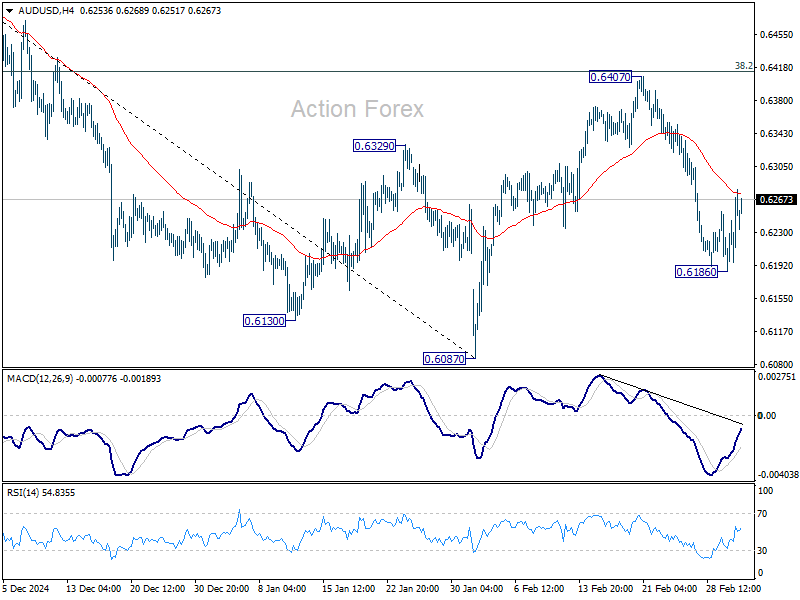
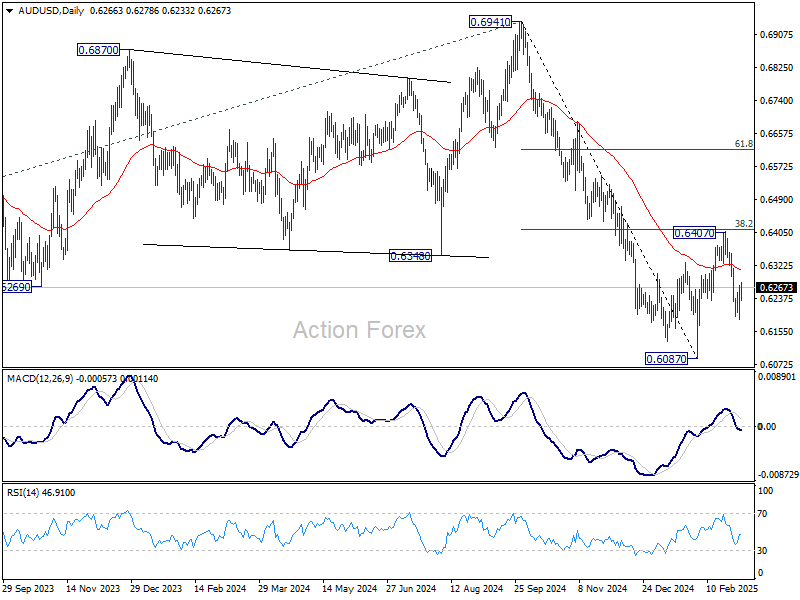
AUD/USD's break of 0.6169 key support level last week confirms larger down trend resumption. Initial bias stays on the downside this week for 61.8% projection of 0.6687 to 0.6198 from 0.6301 at 0.5999. For now, outlook will stay bearish as long as 0.6301 resistance holds, in case of recovery.
In the bigger picture, down trend from 0.8006 (2021 high) is resuming with break of 0.6169 (2022 low). Next medium term target is 61.8% projection of 0.8006 to 0.6169 from 0.6941 at 0.5806, In any case, outlook will stay bearish as long as 55 W EMA (now at 0.6587) holds.
In the long term picture, prior rejection by 55 M EMA (now at 0.6846) is taken as a bearish signal. But for now, fall from 0.8006 is still seen as the second leg of the corrective pattern from 0.5506 long term bottom (2020 low). Hence, in case of deeper fall, strong support should emerge above 0.5506 to contain downside to bring reversal. However, this view is subject to adjustment if current decline accelerates further.
Summary 1/13 – 1/17
Monday, Jan 13, 2025
| GMT | Ccy | Events | Consensus | Previous |
|---|---|---|---|---|
| 21:45 | NZD | Building Permits M/M Nov | -5.20% | |
| 00:00 | AUD | TD-MI Inflation Gauge M/M Dec | 0.20% | |
| 03:00 | CNY | Trade Balance (USD) Dec | 100.0B | 97.4B |
| 21:00 | NZD | NZIER Business Confidence Q4 | -1% | |
| 23:30 | AUD | Westpac Consumer Confidence Jan | -2% | |
| 23:50 | JPY | Bank Lending Y/Y Dec | 3.10% | 3.00% |
| 23:50 | JPY | Current Account (JPY) Nov | 2.59T | 2.41T |
| GMT | Ccy | Events | |
|---|---|---|---|
| 21:45 | NZD | Building Permits M/M Nov | |
| Forecast: | Previous: -5.20% | ||
| 00:00 | AUD | TD-MI Inflation Gauge M/M Dec | |
| Forecast: | Previous: 0.20% | ||
| 03:00 | CNY | Trade Balance (USD) Dec | |
| Forecast: 100.0B | Previous: 97.4B | ||
| 21:00 | NZD | NZIER Business Confidence Q4 | |
| Forecast: | Previous: -1% | ||
| 23:30 | AUD | Westpac Consumer Confidence Jan | |
| Forecast: | Previous: -2% | ||
| 23:50 | JPY | Bank Lending Y/Y Dec | |
| Forecast: 3.10% | Previous: 3.00% | ||
| 23:50 | JPY | Current Account (JPY) Nov | |
| Forecast: 2.59T | Previous: 2.41T | ||
Tuesday, Jan 14, 2025
| GMT | Ccy | Events | Consensus | Previous |
|---|---|---|---|---|
| 05:00 | JPY | Eco Watchers Survey: Current Dec | 49.6 | 49.4 |
| 11:00 | USD | NFIB Business Optimism Index Dec | 100.8 | 101.7 |
| 13:30 | USD | PPI M/M Dec | 0.30% | 0.40% |
| 13:30 | USD | PPI Y/Y Dec | 3.00% | 3.00% |
| 13:30 | USD | PPI Core M/M Dec | 0.20% | 0.20% |
| 13:30 | USD | PPI Core Y/Y Dec | 3.20% | 3.40% |
| 23:50 | JPY | Money Supply M2+CD Y/Y Dec | 1.20% | 1.20% |
| GMT | Ccy | Events | |
|---|---|---|---|
| 05:00 | JPY | Eco Watchers Survey: Current Dec | |
| Forecast: 49.6 | Previous: 49.4 | ||
| 11:00 | USD | NFIB Business Optimism Index Dec | |
| Forecast: 100.8 | Previous: 101.7 | ||
| 13:30 | USD | PPI M/M Dec | |
| Forecast: 0.30% | Previous: 0.40% | ||
| 13:30 | USD | PPI Y/Y Dec | |
| Forecast: 3.00% | Previous: 3.00% | ||
| 13:30 | USD | PPI Core M/M Dec | |
| Forecast: 0.20% | Previous: 0.20% | ||
| 13:30 | USD | PPI Core Y/Y Dec | |
| Forecast: 3.20% | Previous: 3.40% | ||
| 23:50 | JPY | Money Supply M2+CD Y/Y Dec | |
| Forecast: 1.20% | Previous: 1.20% | ||
Wednesday, Jan 15, 2025
| GMT | Ccy | Events | Consensus | Previous |
|---|---|---|---|---|
| 07:00 | GBP | CPI M/M Dec | 0.10% | |
| 07:00 | GBP | CPI Y/Y Dec | 2.70% | 2.60% |
| 07:00 | GBP | Core CPI Y/Y Dec | 3.40% | 3.50% |
| 07:00 | GBP | RPI M/M Dec | 0.10% | |
| 07:00 | GBP | RPI Y/Y Dec | 3.70% | 3.60% |
| 07:00 | GBP | PPI Input M/M Dec | 0.20% | 0.00% |
| 07:00 | GBP | PPI Input Y/Y Dec | -1.90% | |
| 07:00 | GBP | PPI Output M/M Dec | 0.10% | 0.30% |
| 07:00 | GBP | PPI Output Y/Y Dec | -0.60% | |
| 07:00 | GBP | PPI Core Output M/M Dec | 0% | |
| 07:00 | GBP | PPI Core Output Y/Y Dec | 1.60% | |
| 10:00 | EUR | Eurozone Industrial Production M/M Nov | 0.30% | 0.00% |
| 13:30 | CAD | Manufacturing Sales M/M Nov | 0.50% | 2.10% |
| 13:30 | CAD | Wholesale Sales M/M Nov | -0.70% | 1.00% |
| 13:30 | USD | CPI M/M Dec | 0.30% | 0.30% |
| 13:30 | USD | CPI Y/Y Dec | 2.80% | 2.70% |
| 13:30 | USD | CPI Core M/M Dec | 0.20% | 0.30% |
| 13:30 | USD | CPI Core Y/Y Dec | 3.30% | 3.30% |
| 13:30 | USD | Empire State Manufacturing Jan | -1.8 | 0.2 |
| 15:30 | USD | Crude Oil Inventories | -1.0M | |
| 19:00 | USD | Fed's Beige Book | ||
| 23:50 | JPY | PPI Y/Y Dec | 3.80% | 3.70% |
| GMT | Ccy | Events | |
|---|---|---|---|
| 07:00 | GBP | CPI M/M Dec | |
| Forecast: | Previous: 0.10% | ||
| 07:00 | GBP | CPI Y/Y Dec | |
| Forecast: 2.70% | Previous: 2.60% | ||
| 07:00 | GBP | Core CPI Y/Y Dec | |
| Forecast: 3.40% | Previous: 3.50% | ||
| 07:00 | GBP | RPI M/M Dec | |
| Forecast: | Previous: 0.10% | ||
| 07:00 | GBP | RPI Y/Y Dec | |
| Forecast: 3.70% | Previous: 3.60% | ||
| 07:00 | GBP | PPI Input M/M Dec | |
| Forecast: 0.20% | Previous: 0.00% | ||
| 07:00 | GBP | PPI Input Y/Y Dec | |
| Forecast: | Previous: -1.90% | ||
| 07:00 | GBP | PPI Output M/M Dec | |
| Forecast: 0.10% | Previous: 0.30% | ||
| 07:00 | GBP | PPI Output Y/Y Dec | |
| Forecast: | Previous: -0.60% | ||
| 07:00 | GBP | PPI Core Output M/M Dec | |
| Forecast: | Previous: 0% | ||
| 07:00 | GBP | PPI Core Output Y/Y Dec | |
| Forecast: | Previous: 1.60% | ||
| 10:00 | EUR | Eurozone Industrial Production M/M Nov | |
| Forecast: 0.30% | Previous: 0.00% | ||
| 13:30 | CAD | Manufacturing Sales M/M Nov | |
| Forecast: 0.50% | Previous: 2.10% | ||
| 13:30 | CAD | Wholesale Sales M/M Nov | |
| Forecast: -0.70% | Previous: 1.00% | ||
| 13:30 | USD | CPI M/M Dec | |
| Forecast: 0.30% | Previous: 0.30% | ||
| 13:30 | USD | CPI Y/Y Dec | |
| Forecast: 2.80% | Previous: 2.70% | ||
| 13:30 | USD | CPI Core M/M Dec | |
| Forecast: 0.20% | Previous: 0.30% | ||
| 13:30 | USD | CPI Core Y/Y Dec | |
| Forecast: 3.30% | Previous: 3.30% | ||
| 13:30 | USD | Empire State Manufacturing Jan | |
| Forecast: -1.8 | Previous: 0.2 | ||
| 15:30 | USD | Crude Oil Inventories | |
| Forecast: | Previous: -1.0M | ||
| 19:00 | USD | Fed's Beige Book | |
| Forecast: | Previous: | ||
| 23:50 | JPY | PPI Y/Y Dec | |
| Forecast: 3.80% | Previous: 3.70% | ||
Thursday, Jan 16, 2025
| GMT | Ccy | Events | Consensus | Previous |
|---|---|---|---|---|
| 00:00 | AUD | Consumer Inflation Expectations Jan | 4.20% | |
| 00:01 | GBP | RICS Housing Price Balance Dec | 28% | 25% |
| 00:30 | AUD | Employment Change Dec | 15.0K | 35.6K |
| 00:30 | AUD | Unemployment Rate Dec | 4.00% | 3.90% |
| 07:00 | EUR | Germany CPI M/M Dec F | 0.40% | 0.40% |
| 07:00 | EUR | Germany CPI Y/Y Dec F | 2.60% | 2.60% |
| 07:00 | GBP | GDP M/M Nov | 0.20% | -0.10% |
| 07:00 | GBP | Industrial Production M/M Nov | 0.10% | -0.60% |
| 07:00 | GBP | Industrial Production Y/Y Nov | -1.00% | -0.70% |
| 07:00 | GBP | Manufacturing Production M/M Nov | 0.20% | -0.60% |
| 07:00 | GBP | Manufacturing Production Y/Y Nov | -0.30% | 0.00% |
| 07:00 | GBP | Goods Trade Balance (GBP) Nov | -18.0B | -19.0B |
| 10:00 | EUR | Eurozone Trade Balance (EUR) Nov | 7.2B | 6.1B |
| 12:30 | EUR | ECB Meeting Accounts | ||
| 13:15 | CAD | Housing Starts Y/Y Dec | 250K | 262K |
| 13:30 | USD | Initial Jobless Claims (Jan 10) | 210K | 201K |
| 13:30 | USD | Retail Sales M/M Dec | 0.50% | 0.70% |
| 13:30 | USD | Retail Sales ex Autos M/M Dec | 0.50% | 0.20% |
| 13:30 | USD | Import Price Index M/M Dec | 0.10% | |
| 13:30 | USD | Philadelphia Fed Manufacturing Jan | -8.5 | -16.4 |
| 15:00 | USD | NAHB Housing Market Index Jan | 47 | 46 |
| 15:00 | USD | Business Inventories Nov | 0.10% | |
| 15:30 | USD | Natural Gas Storage | -40B | |
| 21:30 | NZD | Business NZ PMI Dec | 45.5 |
| GMT | Ccy | Events | |
|---|---|---|---|
| 00:00 | AUD | Consumer Inflation Expectations Jan | |
| Forecast: | Previous: 4.20% | ||
| 00:01 | GBP | RICS Housing Price Balance Dec | |
| Forecast: 28% | Previous: 25% | ||
| 00:30 | AUD | Employment Change Dec | |
| Forecast: 15.0K | Previous: 35.6K | ||
| 00:30 | AUD | Unemployment Rate Dec | |
| Forecast: 4.00% | Previous: 3.90% | ||
| 07:00 | EUR | Germany CPI M/M Dec F | |
| Forecast: 0.40% | Previous: 0.40% | ||
| 07:00 | EUR | Germany CPI Y/Y Dec F | |
| Forecast: 2.60% | Previous: 2.60% | ||
| 07:00 | GBP | GDP M/M Nov | |
| Forecast: 0.20% | Previous: -0.10% | ||
| 07:00 | GBP | Industrial Production M/M Nov | |
| Forecast: 0.10% | Previous: -0.60% | ||
| 07:00 | GBP | Industrial Production Y/Y Nov | |
| Forecast: -1.00% | Previous: -0.70% | ||
| 07:00 | GBP | Manufacturing Production M/M Nov | |
| Forecast: 0.20% | Previous: -0.60% | ||
| 07:00 | GBP | Manufacturing Production Y/Y Nov | |
| Forecast: -0.30% | Previous: 0.00% | ||
| 07:00 | GBP | Goods Trade Balance (GBP) Nov | |
| Forecast: -18.0B | Previous: -19.0B | ||
| 10:00 | EUR | Eurozone Trade Balance (EUR) Nov | |
| Forecast: 7.2B | Previous: 6.1B | ||
| 12:30 | EUR | ECB Meeting Accounts | |
| Forecast: | Previous: | ||
| 13:15 | CAD | Housing Starts Y/Y Dec | |
| Forecast: 250K | Previous: 262K | ||
| 13:30 | USD | Initial Jobless Claims (Jan 10) | |
| Forecast: 210K | Previous: 201K | ||
| 13:30 | USD | Retail Sales M/M Dec | |
| Forecast: 0.50% | Previous: 0.70% | ||
| 13:30 | USD | Retail Sales ex Autos M/M Dec | |
| Forecast: 0.50% | Previous: 0.20% | ||
| 13:30 | USD | Import Price Index M/M Dec | |
| Forecast: | Previous: 0.10% | ||
| 13:30 | USD | Philadelphia Fed Manufacturing Jan | |
| Forecast: -8.5 | Previous: -16.4 | ||
| 15:00 | USD | NAHB Housing Market Index Jan | |
| Forecast: 47 | Previous: 46 | ||
| 15:00 | USD | Business Inventories Nov | |
| Forecast: | Previous: 0.10% | ||
| 15:30 | USD | Natural Gas Storage | |
| Forecast: | Previous: -40B | ||
| 21:30 | NZD | Business NZ PMI Dec | |
| Forecast: | Previous: 45.5 | ||
Friday, Jan 17, 2025
| GMT | Ccy | Events | Consensus | Previous |
|---|---|---|---|---|
| 02:00 | CNY | GDP Y/Y Q4 | 5.00% | 4.60% |
| 02:00 | CNY | Industrial Production Y/Y Dec | 5.40% | 5.40% |
| 02:00 | CNY | Retail Sales Y/Y Dec | 3.50% | 3.00% |
| 02:00 | CNY | Fixed Asset Investment (YTD) Y/Y Dec | 3.30% | 3.30% |
| 07:00 | GBP | Retail Sales M/M Dec | 0.40% | 0.20% |
| 09:00 | EUR | Current Account (EUR) Nov | 28.0B | 25.8B |
| 10:00 | EUR | Eurozone CPI Y/Y Dec F | 2.40% | 2.40% |
| 10:00 | EUR | Eurozone CPI Core Y/Y Dec F | 2.70% | 2.70% |
| 13:30 | USD | Building Permits Dec | 1.46M | 1.49M |
| 13:30 | USD | Housing Starts Dec | 1.32M | 1.29M |
| 14:15 | USD | Industrial Production M/M Dec | 0.30% | -0.10% |
| 14:15 | USD | Capacity Utilization Dec | 77.10% | 76.80% |
| GMT | Ccy | Events | |
|---|---|---|---|
| 02:00 | CNY | GDP Y/Y Q4 | |
| Forecast: 5.00% | Previous: 4.60% | ||
| 02:00 | CNY | Industrial Production Y/Y Dec | |
| Forecast: 5.40% | Previous: 5.40% | ||
| 02:00 | CNY | Retail Sales Y/Y Dec | |
| Forecast: 3.50% | Previous: 3.00% | ||
| 02:00 | CNY | Fixed Asset Investment (YTD) Y/Y Dec | |
| Forecast: 3.30% | Previous: 3.30% | ||
| 07:00 | GBP | Retail Sales M/M Dec | |
| Forecast: 0.40% | Previous: 0.20% | ||
| 09:00 | EUR | Current Account (EUR) Nov | |
| Forecast: 28.0B | Previous: 25.8B | ||
| 10:00 | EUR | Eurozone CPI Y/Y Dec F | |
| Forecast: 2.40% | Previous: 2.40% | ||
| 10:00 | EUR | Eurozone CPI Core Y/Y Dec F | |
| Forecast: 2.70% | Previous: 2.70% | ||
| 13:30 | USD | Building Permits Dec | |
| Forecast: 1.46M | Previous: 1.49M | ||
| 13:30 | USD | Housing Starts Dec | |
| Forecast: 1.32M | Previous: 1.29M | ||
| 14:15 | USD | Industrial Production M/M Dec | |
| Forecast: 0.30% | Previous: -0.10% | ||
| 14:15 | USD | Capacity Utilization Dec | |
| Forecast: 77.10% | Previous: 76.80% | ||
The Weekly Bottom Line: Little Sign of Slowing Down
Canadian Highlights
- Canada’s job market ended 2024 on a high note. The economy added the most jobs in almost two years, while a decrease in the unemployment rate and robust gains in hours worked support economic strength into 2025.
- Trade data is moving into focus as Trump leans on the U.S. trade deficit with Canada as a motivation for implementing his tariff plan.
- The Bank of Canada is still expected to deliver a 25 bps cut on January 29th, but the likelihood is falling on the back of economic and political developments.
U.S. Highlights
- U.S. Treasury yields have jumped yet again, after another payrolls report topped expectations.
- If the economy can manage this level of interest rates without losing much momentum, the need for additional rate cuts becomes an open question.
- The Trump administration is set to take over on January 20th, with tariffs top-of-mind.
Canada – No More Holidays for the Bank of Canada
The main event looming over Canada’s economy is Donald Trump’s impending inauguration on January 20th. Trump’s tariff-focused agenda has kept anxiety rising north of the border, particularly in the wake of Prime Minister Trudeau’s recent resignation announcement. Political developments have overshadowed domestic data flow, but key updates this week on the labour market and the state of trade may help inform the Bank of Canada’s (BoC’s) next policy decision at the end of January. On the financial side, the Canada 10-year government bond yield jumped 10 basis points (bps) on the week, while the Loonie stayed roughly flat, after depreciating by around 7% since September.
Canadian jobs data for December capped off the year with a roar. An employment gain of just over 90k was the highest print since January 2023 (Chart 1). Meanwhile, the unemployment rate retreated by a tenth of a percentage point (ppt)—in line with our view and against the consensus view for a slight uptick–reversing some of November’s labour-force fueled jump. Hours worked also saw their biggest jump since July-2023, providing some evidence of decent economic activity to close out the year. We maintain the view that Canada’s labour market is relatively healthy under the hood despite the overall souring sentiment on Canada’s economy.
On the trade side, November data showed Canada tallied a ninth-consecutive trade deficit. The nation’s trade balance with the U.S. has recently come into focus, as perceived trade imbalances are serving as a rationale for Trump’s tariff plans. Trump has argued that “the U.S. can no longer suffer the massive trade deficits that Canada needs to stay afloat”— but we think this view is misguided. True, Canada’s goods trade surplus with the U.S. in 2024 is tracking about 3.2% of Canadian GDP. But looked at from the U.S. side of the ledger, it only equates to a small deficit of -0.2% of U.S. GDP. What’s more, the U.S. trade deficit with Canada, when stacked against other major trading partners, is comparatively small (Chart 2). It’s also worth noting that stripping energy exports out of the equation leaves the U.S. with a healthy trade surplus with Canada. If anything, Canada’s energy-heavy relationship with the U.S. highlights their importance in energy security between the two nations.
The BoC certainly has their work cut out for them. The economy has started to respond to the cumulative 175 bps in cuts that have been delivered so far, though downside risks are mounting. The downside to the economy could be greatly exacerbated should Trump move forward with broad tariffs. Consensus expectations are for the BoC to lower the policy rate by 25 bps in January, though it’s a less likely outcome after today’s healthy employment report. Upcoming data on inflation and the BoC’s Business Outlook Survey will be key data inputs into their decision. The goal for the BoC now is to follow a rate path supportive enough to balance the downside risks to growth while keeping inflation steady around its 2% target.
U.S. – Little Sign of Slowing Down
U.S. Treasury yields have jumped yet again, after another payrolls report topped expectations, buoyed by healthy economic momentum through to the end of the year. For policymakers looking to fine tune the path of policy rates through 2025, the data confirm their suspicions of an economy that continues to charge ahead, despite elevated interest rates.
All eyes were on December’s labor market report and boy did it deliver. A whopping 256k new jobs added, almost 100k more than consensus expectations. The household survey also showed gains, pushing the unemployment rate back down to 4.1%. This isn’t far off from the 4.2% median expected to close out 2024 in the FOMC’s last set of projections, but it does confirm that the unemployment rate has been virtually unchanged since June of 2024 (Chart 1). Put another way, after rising from a low of 3.4% in April 2023 to 4.2% in July 2024, the unemployment rate has been steady over the past five months despite still elevated interest rates. If the economy can manage this level of interest rates without losing much momentum, the need for additional rate cuts becomes an open question.
The remarkable resilience of the labor market was noted by a series of Fed speakers this week. Their assessments of how restrictive interest rates currently are varied, but all advocated for a measured approach to setting policy in the coming months. In fact, comments by Governors Bowman and Cook both used some version of the word “cautious” on the pace of further interest rate cuts. Based on today’s data, markets have pushed out expectations for the sole cut of 2025 to the back half of the year, implying that the pace of rate cuts could be nearing a virtual stand-still.
Adding to the uncertainty is the prospect of renewed inflationary forces. The Trump administration is set to take over on January 20th, with tariffs top-of-mind. How these could pass-through to the economy will depend on their structure and how trade partners retaliate. However, the ISM services survey already showed a large jump in its input price index as firms looked to pre-empt any possible trade action. Layer on a healthy domestic economy, and we could see firms more willing to pass on additional costs than prior to the pandemic.
With policymakers committed to a data-dependent approach to setting rates, the focus shifts to next week’s CPI and retail sales reports. The information for December thus far suggests that the U.S. economy has shrugged off the 4.5% policy rate, and we could see some upside surprise. Survey measures from the ISM showed a notable uptick in growth to close the year (Chart 2), while the three-month average of job gains rose from 113k in August to 170k in December.
As 2025 gets underway, if things keep going like this, the balance of risks now suggests that the Fed may not have much more to do.
Weekly Economic & Financial Commentary: Cutting Rates, but Higher Yields
Summary
United States: A Matter of Conditioning and a Matter of Fact
- This week brought with it a hot print on service-sector prices and a solid job gain for December. When combined with looming tariff-related uncertainly, these developments add more fodder to the case that the Fed will pause interest rate cuts at its upcoming meeting.
- Next week: CPI (Wed.), Retail Sales (Thurs.), Housing Starts (Fri.)
International: In with the New: Updated Economic Data from Economies Around the Globe
- A new year has begun, and with it has come a wave of economic data from countries around the world. Eurozone inflation picked up mildly, while Swiss price pressures eased. Developments in Canada made headlines this week, with Prime Minster Justin Trudeau stepping down as leader of the Liberal Party. In Latin America, inflation data from Mexico and Brazil were somewhat mixed.
- Next week: U.K. CPI (Wed.), Australian Employment (Thu.), China GDP (Fri.)
Interest Rate Watch: Cutting Rates, but Higher Yields
- When U.S. markets closed on Sept. 17, the 10-year Treasury yield was 3.65%. The next day, the FOMC announced that it was reducing the federal funds rate by 50 bps, the first rate cut by the central bank since 2020. Since then, the FOMC has cut the fed funds rate by an additional 50 bps, but the 10-year Treasury yield is roughly 100 bps higher at 4.65%. What happened?
Credit Market Insights: Gaps Persist in Household Net Worth Across Wealth Spectrum
- The Federal Reserve recently released the Q3-2024 Distributional Financial Accounts, providing a more in-depth look at how aggregate gains in household net worth were distributed across the income and wealth spectrum.
Topic of the Week: Immigration Drove Population Growth in 2024
- The U.S. population expanded by 1.0% in 2024, marking the fastest pace of population growth in more than two decades. As demographics remained unfavorable, immigration drove most of the increase. Domestic movements within the United States also quieted; however, Americans continued to leave expensive coastal areas for more affordable locations across the Sunbelt and Mountain West.
Limited U.S. Inflation Easing Not Enough to Support Another Fed Rate Cut
December’s U.S. consumer price index release on Wednesday will be the last major data print before the first U.S. Federal Reserve meeting of 2025, and we expect it to show further moderation in price pressures after some acceleration in September and October, but not by enough for an interest rate cut this month.
Headline CPI growth is expected to have ticked higher in December to 2.8% from 2.7% in November as a smaller decline in gasoline prices push energy prices back closer in line with year-ago levels following four straight year-over-year declines. We expect food inflation to hold at 2.4%, while the core price growth for everything outside of energy and food edges down to 3.2% from 3.3%.
The expected tick lower in core price growth is a result of a lower 0.2% month-over-month increase, driven by slowing rent price growth alongside easing in other core services. The scope of price pressures across the consumer basket has widened in recent months. Our diffusion index showed a third of the basket outside of shelter saw inflation up 5% or more on a three-month annualized basis in November—up from less than a tenth earlier in the summer. We’ll watch this measure closely on Wednesday for any improvements in December.
Lower core price growth in December will not be enough to cancel out recent upside surprises in economic data for the Fed, including the U.S. jobs report on Friday that showed strong hiring gains and solid labour market conditions at the end of 2024. In the December meeting, the Fed had already scaled back their easing bias after a 25 basis point rate cut with Chair Jerome Powell saying the central bank is “at or near a point at which it will be appropriate to slow the pace of further adjustments.”
We now expect the Fed will forego an interest rate cut on Jan. 29th and hold the Fed funds rate unchanged at 4.25%-4.5% throughout 2025.
Week ahead data watch
A 0.5% increase in Statistics Canada’s advance estimate of November manufacturing sales looks to have largely reflected an increase in prices – the increase coupled with reported industrial output prices suggest sale volumes declined after jumping 1.4% in October.
December Canadian home resales likely showed mixed results across regions given early market reports – sales showed strength in Montreal but pulled back in Toronto to reverse earlier fall/winter increases.
Higher auto sales and an increase in gasoline prices are expected to support a 0.4% increase in U.S. retail sales as U.S. consumer spending remains resilient.
Markets Weekly Outlook – Fed Policy in Focus as US Inflation Lies Ahead
- Strong US Jobs Report Impacts Fed Expectations with some analysts now predicting no cuts at all.
- The S&P 500 experienced a sell-off, breaking below key support levels and raising concerns about further potential downside.
- US inflation and retail sales data will be crucial in shaping market expectations for future monetary policy.
- In addition to US data, the week ahead includes key economic releases from China, UK and Australia.
Week in Review: US Jobs Growth Surge as Markets See Less Fed Rate Cuts
Another shortened trading week has come to an end as the US had a day of mourning on Thursday for former President Jimmy Carter.
The week turned out to be an eventful one with the first NFP jobs report of the year stoking volatility and coming in much better than expected. The US jobs report shows that 256,000 jobs were added in December, much higher than the expected 165,000. Job numbers for the past two months were adjusted down by 8,000.
The unemployment rate dropped to 4.1% from 4.2%, even though it was expected to stay at 4.2% or possibly rise to 4.3%. Wages grew 0.3% from the previous month, while yearly wage growth slowed to 3.9% from 4%.
Source: ING, Macrobond (click to enlarge)
The impact resulted in a selloff in US equities with the S&P 500 hitting a one-week low after a strong jobs report raised new worries about inflation and made people think the Federal Reserve will be more careful about cutting interest rates this year.
Bank of America for its part has already said that they are now pricing in no rate cuts from the Federal Reserve in 2025.
The commodities picture is one of the few bright spots for market participants. Gold and Oil both enjoyed stellar weeks with gains of 1.92% and 2.48% respectively. Oil was up around 5% at a stage in the US session but failed to hold onto gains.
On the FX front, the US Dollar continues to rule the roost. Friday’s data only served to cement that with losses for a host of US dollar denominated fx pairs. GBP/USD tapped its 2024 low before bouncing higher to trade at 1.2250.
Following this week’s Jobs data, The Fed is now certain to keep rates unchanged in January, with the market barely expecting any chance of a rate cut. There’s also a growing chance of a longer pause, as the market doesn’t fully expect a rate cut to happen before September.
All of this is likely to keep the US Dollar on the front foot moving forward.
The Week Ahead: US, UK Inflation and China in the Spotlight
Asia Pacific Markets
The week ahead in the Asia Pacific region still remains light on the data front.
The highlights all come from China as markets hope the stimulus announced at the back end of 2024 may begin to transmit to the data.
All data releases will be on Friday and include retail sales, industrial production and GDP data. Retail sales and industrial production will be watched closely for signs of a demand recovery which may have a knock on effect on sentiment as well as commodity linked currencies like the Australian Dollar and the South African Rand.
Australia will also be in the limelight this coming week with a double header of high impact releases. Both of the releases relate to the Australian labor market which may provide more insights into the health of the Australian economy.
Europe + UK + US
In developed markets, the US ended last week with blockbuster jobs data which saw markets now price in just one rate cut in 2025. Obviously this will change as more and more data is released and President Trump assumes office.
The Federal Reserve will likely be focused on inflation moving forward as evidenced by the minutes released this past week. The week ahead brings exactly that, US inflation and retail sales data will be released.
Inflation has been rising too quickly in recent months, but experts expect it to slow slightly with a 0.2% increase in December, which might calm worries about high inflation sticking around. Retail sales could get a boost from strong car sales, but other areas might show weakness, especially with recent signs that people are borrowing less.
In Europe, it is a quiet week on the data front but the UK will release inflation and retail sales numbers as well. Following a topsy-turvy week for the UK with losses for the GBP and a significant drop in yields, markets will no doubt be paying close attention.
Chart of the Week
This week’s focus is on the S&P 500 again following the selloff on Friday.
The S&P 500 has printed a fresh low following Friday’s selloff which could leave the index ripe for an early week recovery.
However, the bigger question will be whether any recovery is sustainable or is it a retracement before the next leg to the downside.
The Daily candle close on Friday will be key as price is currently flirting with the 100-day MA. A break and close below this could add bearish pressure on the index.
A retracement from current price may find resistance at 5910, 6000 and of course the swing high at 6025.
A break of the 100-day MA could bring support at 5757,5669 and 5635 all into focus.
S&P 500 Daily Chart – January 10, 2025
Source: TradingView.Com (click to enlarge)
Key Levels to Consider:
Support
- 5757
- 5669
- 5635
Resistance
- 5910
- 6000
- 6025
US December CPI Preview: Concerns About Sticky Inflation to Linger
Summary
The December CPI report should indicate that the underlying trend in inflation is not re-accelerating, but it is unlikely to allay the FOMC's increased concerns that inflation has become stuck uncomfortably above its target. We look for the headline CPI to rise 0.4% on the back of a strong gain in energy prices, which would push the year-over-year rate up to a five-month high of 2.9%. Excluding food and energy, price growth looks to have been more moderate in December. After advancing 0.3% for four consecutive months, we look for the core index to increase 0.2%. If realized, that would leave the year-over-year rate at 3.3% for a fourth straight month. While we do not believe progress in the fight against inflation is going into reverse, we do see it stalling this year as earlier tailwinds to disinflation from supply chain improvements and lower commodity prices have faded and as fresh headwinds from trade policy are likely to emerge.
Headline Inflation Firming as Energy Prices Rebound
The lack of additional progress recently in the fight against inflation has tilted the Fed's focus back toward the price stability side of its mandate. The core Consumer Price Index has increased an average of 0.30% the past three months, or at an annualized rate of 3.7%. The Fed's preferred measure of inflation has fared a little better; over the past three months, the core PCE price index has increased an average of 0.21%, or an annualized rate of 2.5%. But that still leaves price growth running above the Fed's 2% target, with the more limited pace of improvement in 2024 evident in the year-over-year rate ticking up to 2.8% in November from 2.6% in June.
With the jobs market looking steadier since late last summer, we believe the FOMC will need to see progress on inflation resume as soon as this month in order to keep another rate cut in Q1 on the table. The December CPI report is likely to provide a half-hearted step to that end. We look for the core CPI to advance a more palatable 0.2% in November (0.22% unrounded). That said, with the increase in headline CPI looking likely to round up to 0.4% (0.36% unrounded), concerns about inflation becoming stuck above target are likely to linger. We estimate the 12-month change in CPI to rise to a five-month high of 2.9% in December.
Solid increases in energy and food prices in December look set to bolster the headline's gain. Gasoline prices fell less than usual this December and point to energy goods rising 3.7% over the month on a seasonally adjusted basis. Energy services inflation also looks likely to have firmed, with a further pickup in store in early 2025 after the recent spike in natural gas prices.
We suspect the late timing of Thanksgiving and the typical discounting that goes on at grocers around the holiday contributed to November's pop in prices for food at home. However, payback in December is likely to be minimal, with promotional activity at supermarkets down relative to last December and food-related commodity prices moving up since the fall.
Softer Core Unlikely to Be a Game-changer for Sticky Outlook
While the December CPI report is likely to show a more challenging price environment for necessities such as food and energy, a more tepid gain in the core index should suggest that the underlying trend in inflation is at least not re-accelerating. We look for the easing in monthly core CPI inflation to 0.2% from 0.3% in November to keep the year-over-year rate at 3.3% and within the narrow range of 3.2%-3.3% for a seventh straight month.
The moderation in the monthly pace of core CPI increases in December is likely to be primarily driven by core goods. New and used vehicles provided a sizable lift to core goods prices the past few months, fueled by replacement demand following Hurricanes Helene and Milton and lower financing costs. Yet with the CPI for used autos vehicles largely realigned with wholesale auction prices, we look for more modest gains in vehicle prices in December (Figure 3). Other core goods prices are likely to be unchanged and continue to firm on a year-over-year basis as the deflationary impulse from un-kinked supply chains has faded.
We expect core services to advance 0.3% again in December, but for the drivers to look a little different from November. While the deceleration in primary shelter in November was a welcome sign that housing disinflation has further room to run, last month's move likely overstated the pace at which the trend is slowing. As a result, we look for the monthly change in primary shelter to edge back up to 0.3% in December from 0.2% in November (Figure 4). The pickup should be offset, however, by a partial reversal of last month's 3.2% jump in hotel prices. Among all non-housing core services, we look for the monthly change in inflation to ease from 0.3% in November to 0.2% in December, which would push the year-over-year change in the CPI "super core" down to a 12-month low of 4.2%.
Our estimates point to the core PCE deflator advancing 0.2% in December, which would leave the year-over-year rate, at 2.8%, above its summer level. Yet Fed Chair Powell and other officials have been emphasizing that, excluding categories where prices are imputed rather than directly observed, progress on inflation has not gone into reverse (Figure 5). We estimate that the market-based core PCE, the Fed's inflation measure du jour, rose 0.2% in December to remain closer than the traditional core to the FOMC's target at 2.5% year-over-year.
While Fed officials have not completely lost faith in further disinflation ahead, the slow progress over the past year has underscored that the last leg of inflation's journey back to target will be the most arduous. The path ahead looks even more challenging now with economic policies under the incoming administration likely to be inflationary. While downward forces remain in place from stronger productivity growth, the cooler labor market and more price-conscious consumers, business remain more willing to raise prices than before the pandemic as consumers have not fully gone into hiding and increases in tariffs are likely to leave them little choice (Figure 6). As a result, we look for the pace of inflation to be little changed this year, leaving it stuck above the FOMC's target for a fifth consecutive year (Table).
Weekly Focus – Bracing for Trump 2.0
A new year is upon us and for sure it shapes up to be another interesting year. A key question from the start is how much of his policies US President-elect Donald Trump will actually pursue on issues such as tariffs, immigration, fiscal policy and Ukraine peace talks? We are yet to find out how much is rhetoric and what he will actually go for. And there is also a question of what he will be able to implement. On trade and foreign policy issues he has a lot of power, though. This week we introduced a revamp of our Geopolitical Radar, 9 January, where we take stock of geopolitical developments and outline scenarios. As we wrote in Nordic Outlook in December 2024, despite the uncertainties our baseline is still that it will be a year of normalisation in growth and inflation - and a further removal of tightness in monetary policy in most countries. Our baseline is a soft landing in the US, moderate growth improvement in the eurozone and continued muddling through in China. Often, we tend to overestimate the impact of politics on growth compared to other key drivers of the economies, such as the development in labour markets.
Speaking of labour markets, we see signs of cooling in the euro area after a long period of resilience: Consumers' unemployment expectations have shot higher lately and now point to rising unemployment and the PMI employment index has fallen below 50 indicating a decline in employment. At the same time, though, unemployment data this week showed another low reading at 6.3% so we have yet to see the cooling in the hard data. Focus in the euro area is predominantly on growth risks with clear structural concerns over too much regulation, high energy costs and rising competition from China coming on top of the weak cyclical indicators. We look for ECB to cut rates all the way to 1.5% by late summer (from 3% currently), which is around 50bp more than what markets price. Inflation data this week for December was in line with expectations showing an unchanged reading of 2.7% y/y for core inflation with a continued disinflationary trend in underlying momentum.
In the US, focus has instead shifted back on inflation risks, as the labour market has stopped cooling and consumer demand continues to look robust. This week JOLTS data showed an increase in job openings and a further decline in initial jobless claims (non-farm payrolls was released after deadline). Bond yields have shot higher lately due to the change in focus back on inflation as well as higher term premia related to debt concerns. We believe the optimism about the US economy is a bit overdone as we still look for moderation, not least due to much slower growth in the labour force. We believe the Fed has room to continue to cut rates on a quarterly basis in 2025 vs. market pricing of less than two cuts.
China has shown some rays of light in the housing market lately and policy makers have sharply increased focus on lifting home sales and private consumption (see China Headlines, 8 January). However, a trade war with the US is looming later this year and China is likely to face another bumpy year when it comes to growth.
Focus in the coming week will be on US CPI where consensus looks for 0.2% m/m in core CPI. An upward surprise could be challenging for bonds that are under pressure at the moment. Other market movers will be US retail sales, UK CPI, Chinese data for GDP, housing and retail sales.
Sunset Market Commentary
Markets
The week ended with a bang. December US payrolls beat consensus by a wide margin (256k vs 165k) while October and November data barely faced a revision (-8k combined). Big contributors were health care (+46k), leisure & hospitality (+43k) and government (+33k). Today’s numbers strongly add to the feeling that the Fed’s momentum to lower policy rates is rapidly fading. US money markets barely take into account one additional 25 bps rate cut by the end of 2025. The best payrolls report since March was accompanied by a good household survey (+478k), resulting in an unexpected tick lower in the unemployment rate (4.1% from 4.2%). Average hourly earnings increased by 0.3% M/M (& 3.9% Y/Y), in line with consensus. Markets reacted strongly to the US labour market figures. US Treasuries extend their sell-off with US yields rising by 5.9 bps (30-yr) to 8.5 bps (5-yr). The US 30-yr yield temporarily breached 5%. Together with a brief spell in the second half of October 2022, that’s the only the second time since July 2007. The US 10-yr yield took out the 2024 top at 4.73%, paving the way to test the 2023 top at the similar 5% mark. Imagine next week’s US December CPI numbers (release on Wednesday) beating consensus expectations… Markets are currently looking at 0.3% M/M rise for headline inflation (2.9% Y/Y from 2.7%) and 0.2% M/M pace for underlying core inflation (steady at 3.3% Y/Y). Global bonds follow US Treasuries lower with German yields adding 2.6 bps (30-yr) to 4.3 bps (5-yr) and UK yields rising another 3.1 bps to 4.9 bps. The dollar strengthened with EUR/USD testing the sell-off low at 1.0226. The trade-weighted dollar touched 110 for the first time since November 2022. Cable (GBP/USD) touched 1.22 for the first time since November 2023. USD/JPY set a minor new short term high around 158.85, erasing earlier JPY-gains following rumours that the BoJ could raise its inflation outlook at the policy meeting later this month, bringing it closer to a next rate hike. The BoJ currently sees underlying inflation rising by 2% this fiscal year, 1.9% next year, and 2.1% the year after. Upgrades would bring the forecasts consistently at or above the 2% inflation target. US stock markets took the higher for longer perspective badly with the S&P and Nasdaq opening respectively 0.75% and 1% lower. Brent crude prices hit $80/b (from $77/b) after Reuters reported that the US would impose sanctions on Russian’s oil fleet.
News & Views
Norwegian inflation in December came in on the softer side of expectations. Headline prices fell by 0.1% m/m to be at 2.2% on a yearly basis. That’s an unexpected deceleration from the 2.4% in November. A core gauge (excluding taxes and energy) dropped a monthly 0.1% too, allowing the y/y reading to wipe out November’s uptick to 3% back to 2.7% again. The inflation numbers strengthen the central bank’s case to finally start its easing cycle after having kept rates steady at 4.5% since December 2023. It clearly hinted at a pivot to come in early 2025. While the central bank meets later this month, we think it’ll wait until the March meeting when it has updated forecasts at its disposal to substantiate the decision. The Norwegian krone barely budged on the eco news, hovering around EUR/NOK 11.76. The currency has been trading relatively weak in a broader perspective though for the last two years. It was (and still is) one of the major reasons the Norges Bank resisted rate cuts for so long.
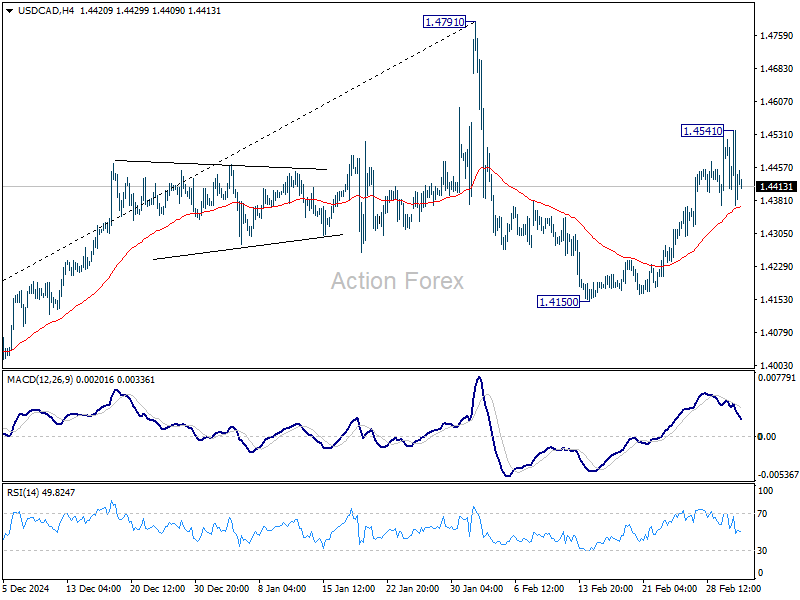
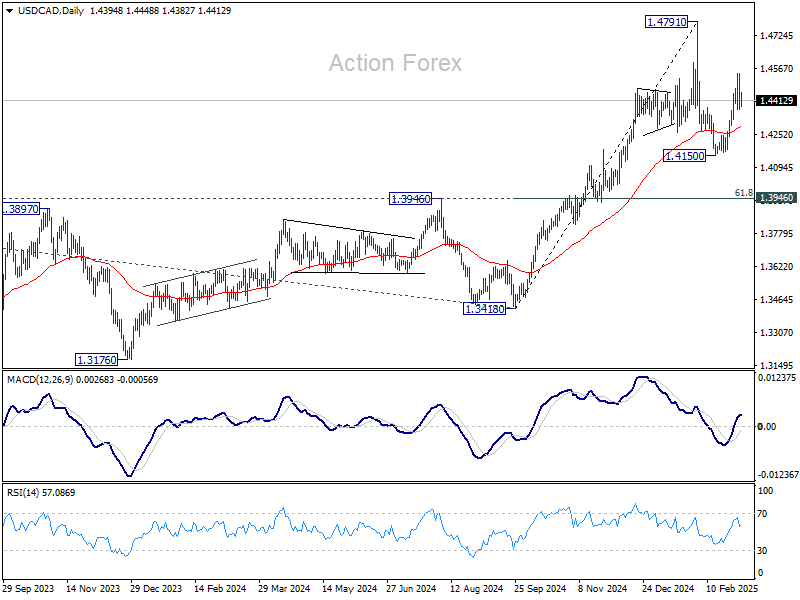
Canadian payrolls growth in December picked up sharply from the 50.5k in November. Employment grew by 90.9k, the quickest pace since January 2023, well beyond the 25k consensus estimate. Full-time jobs increased by 57.5k, part-times by 33.5k. It made the employment rate rise for the first time since January 2023 by 0.2 ppt to 60.8%. The unemployment rate ticked lower to 6.7% as did average hourly wages, from 4.1% to 3.8% y/y. The overall stronger-than-expected labour market report helps the Canadian Loonie fend off outright payroll-driven USD strength. USD/CAD trades little changed around 1.441. The Bank of Canada since its last meeting of 2024 is eying more gradual rate cuts after slashing them by 50 bps back to back. Money markets pared easing bets in the wake of the release but still assume two 25 bps reductions throughout 2025 (to 2.75%).