Sample Category Title
EUR/GBP Mid-Day Outlook
Daily Pivots: (S1) 0.8268; (P) 0.8287; (R1) 0.8323; More...
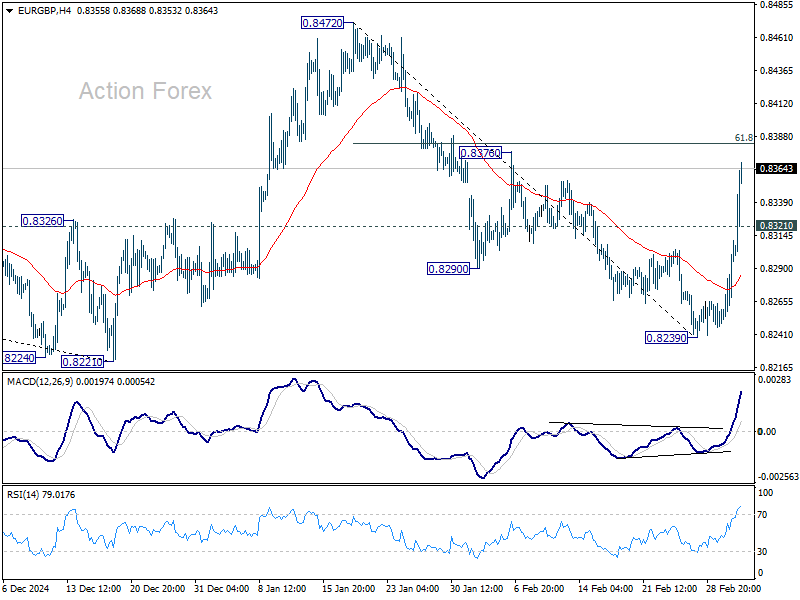
Current upside acceleration affirms the case that corrective fall from 0.8472 has completed at 0.8239 already. Intraday bias in EUR/GBP remains on the upside for 61.8% retracement of 0.8472 to 0.8239 at 0.8383. Sustained break there will target 0.8472 resistance next. On the downside, below 0.8321 minor support will turn intraday bias neutral first.
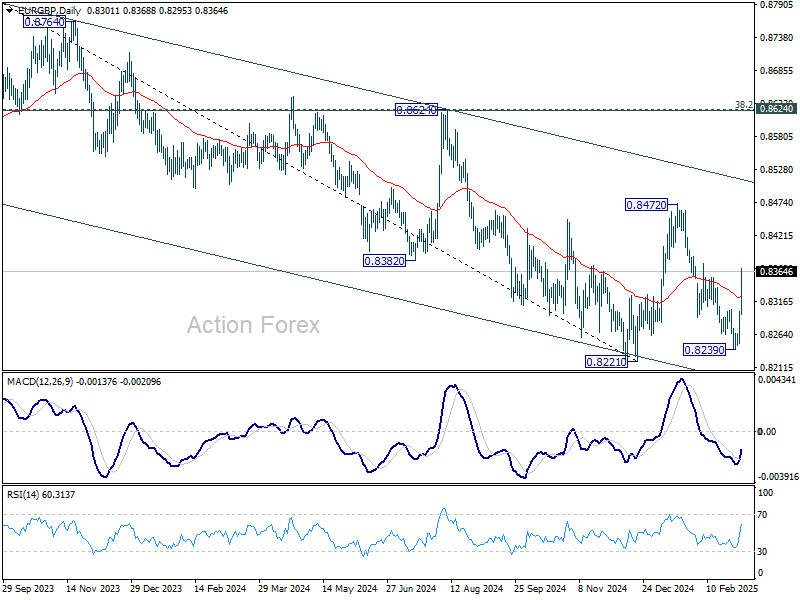
In the bigger picture, EUR/GBP is still bounded inside medium term falling channel. While rebound from 0.8221 might extend higher, it could still develop into a corrective pattern. Overall outlook will be neutral at best, at least until decisive break of channel resistance (now at 0.8511).
USD/JPY Mid-Day Outlook
Daily Pivots: (S1) 148.64; (P) 149.26; (R1) 150.43; More...
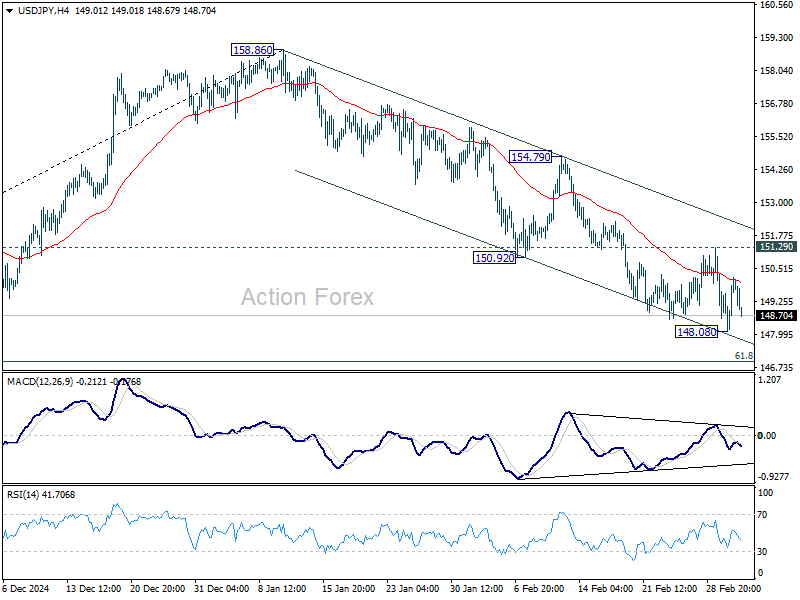
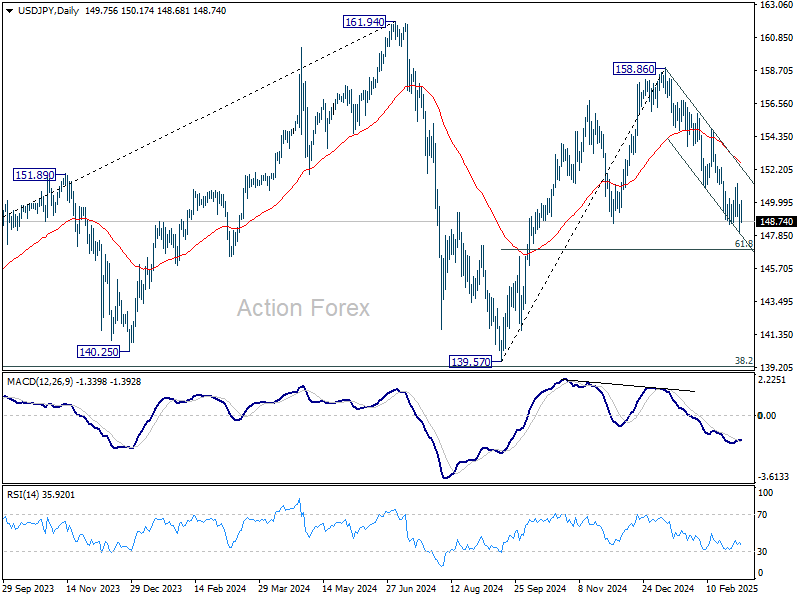
Intraday bias remains neutral at this point. With 151.29 resistance intact, fall from 158.86 is still expected to continue as the third leg of the corrective pattern from 171.96 high. Below 148.08 will target 61.8% retracement of 139.57 to 158.86 at 146.32. Sustained break there will pave the way back to 139.57 low. However, break of 151.29 will turn bias back to the upside for stronger recovery first.
In the bigger picture, price actions from 161.94 are seen as a corrective pattern to rise from 102.58 (2021 low). In case of another fall, strong support should be seen from 38.2% retracement of 102.58 to 161.94 at 139.26 to bring rebound. However, sustained break of 139.26 would open up deeper medium term decline to 61.8% retracement at 125.25.
USD/CHF Mid-Day Outlook
Daily Pivots: (S1) 0.8851; (P) 0.8916; (R1) 0.8960; More…
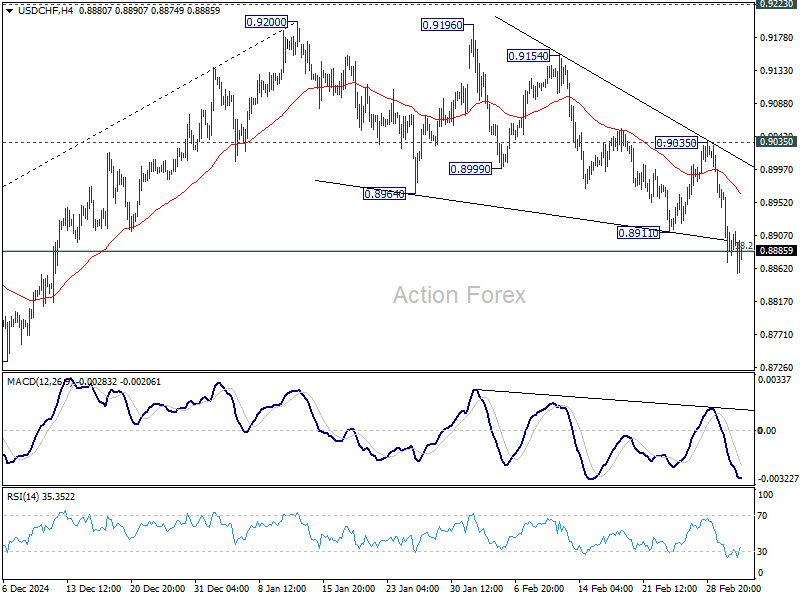
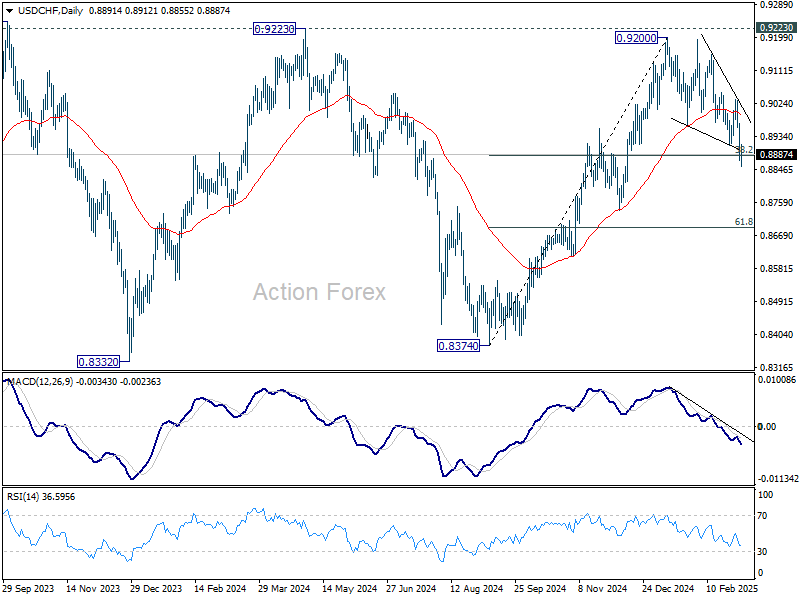
Intraday bias in USD/CHF remains on the downside, and focus stays on 38.2% retracement of 0.8374 to 0.9200 at 0.8884. Strong rebound from current level, followed by break of 0.9035 resistance, will retain near term bullishness, and bring retest of 0.9200/23 resistance zone. However, firm break of 0.8444 will confirm rejection by 0.9223 resistance and turn near term outlook bearish for 61.8% retracement at 0.8690.
In the bigger picture, decisive break of 0.9223 resistance will argue that whole down trend from 1.0342 (2017 high) has completed with three waves down to 0.8332 (2023 low). Outlook will be turned bullish for 1.0146 resistance next. Nevertheless, rejection by 0.9223 will retain medium term bearishness for another decline through 0.8332 at a later stage.
GBP/USD Mid-Day Outlook
Daily Pivots: (S1) 1.2716; (P) 1.2758; (R1) 1.2837; More...
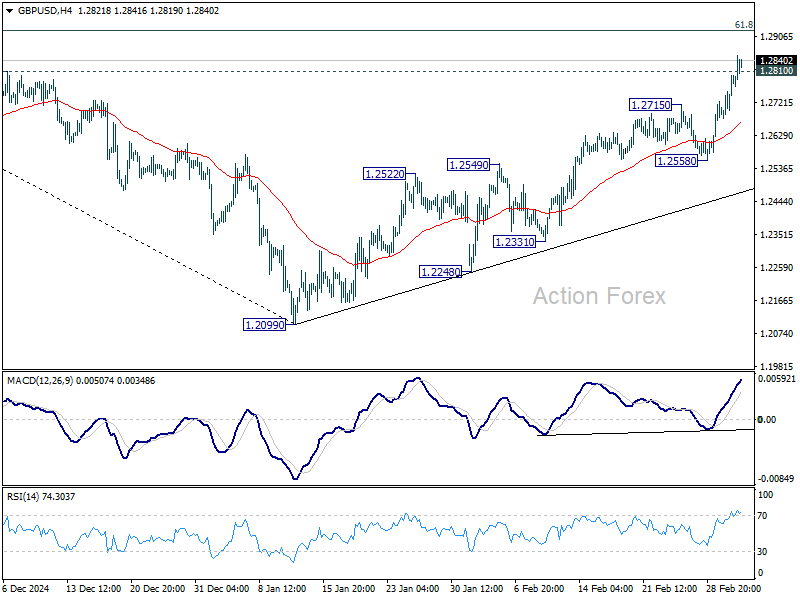
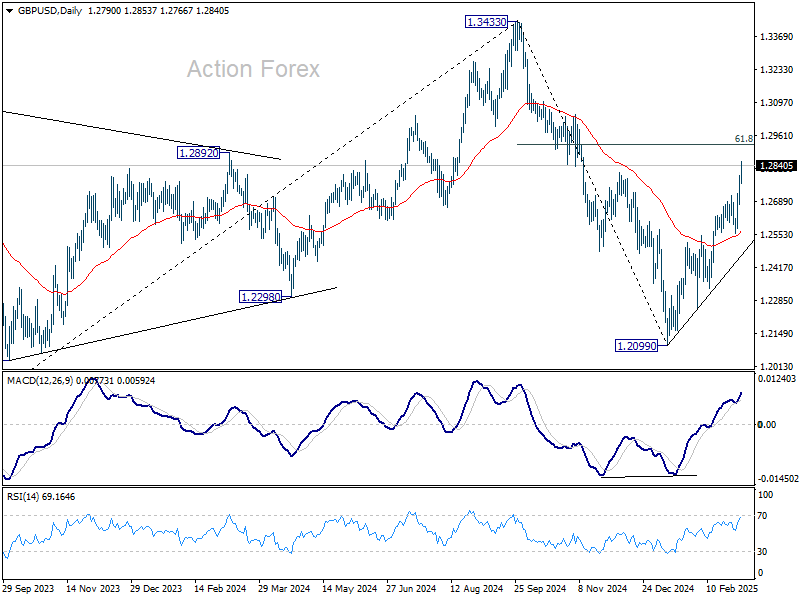
GBP/USD's rally from 1.2099 continues today and breaks through 1.2810 resistance. Next target is 61.8% retracement of 1.3433 to 1.2099 at 1.2923. Sustained break there will bring retest of 1.3433 high. For now, further rise is expected as long as 1.2558 support holds, in case of retreat.
In the bigger picture, the break of 55 W EMA (now at 1.2607) argues that fall from 1.3433 (2024 high) has completed at 1.2099 as a corrective move. The uptrend from 1.0351 (2022 low) is not over yet. Firm break of 1.2810 resistance will solidify this bullish case.
EUR/USD Mid-Day Outlook
Daily Pivots: (S1) 1.0522; (P) 1.0575; (R1) 1.0679; More...
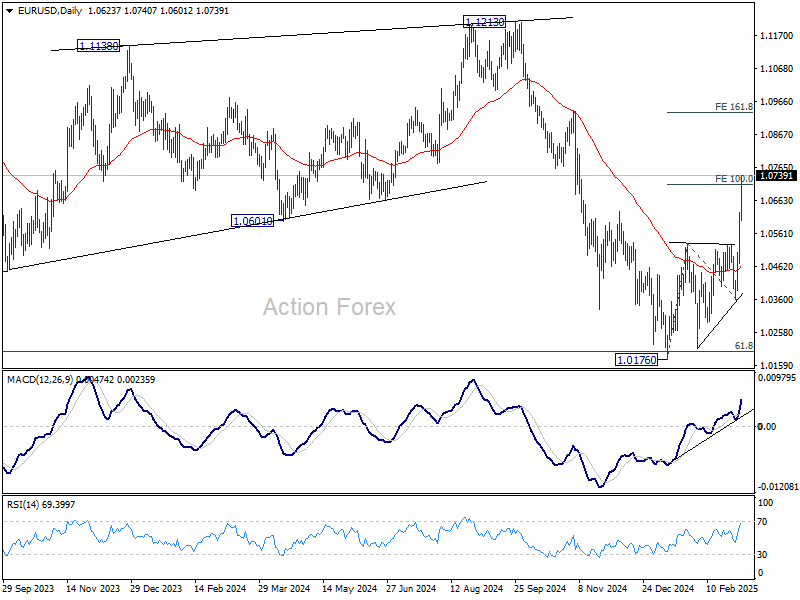
EUR/USD accelerates further higher today and met 100% projection of 1.0176 to 1.0531 from 1.0358 at 1.0173 already. There is no sign of topping yet. Intraday bias stays on the upside for 161.8% projection at 1.0932 next. On the downside, below 1.0636 minor support will turn intraday bias neutral again first.
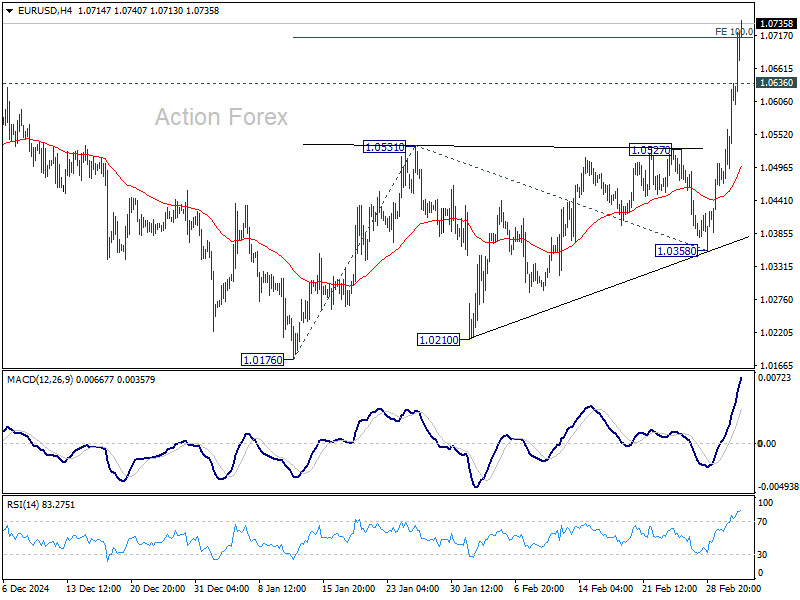
In the bigger picture, the strong rebound from 61.8 retracement of 0.9534 (2022 low) to 1.1274 (2024 high) at 1.0199 argues that fall from 1.1274 might be a correction only. Sustained trading above 55 W EMA (now at 1.0668) should indicate that this correction has already completed with three waves down to 1.0176. Rise from 0.9534 (2022 low) might then be ready to resume through 1.1274. Nevertheless, rejection by 55 W EMA would keep outlook bearish for another fall through 1.0176 at a later stage.
Euro and DAX Surge on German Spending Boost, Dollar Struggle Continues after Poor ADP
Investor sentiment in Europe is exceptionally upbeat today, with German stocks leading the rally as DAX surges over 3%, breaking above the 23k mark. Euro also rallies across the board with solid momentum, with help from rise in Germany's benchmark yield, the overall positive sentiment, as well as a struggling Dollar.
The boost to European sentiment was driven by the announcement that Germany’s two biggest parties, CDU/CSU and SPD, have agreed to overhaul borrowing rules to expand defense and infrastructure spending. More importantly, they are accelerating these investment plans rather than waiting out a lengthy coalition-building process. This commitment to boosting government spending is seen as a significant stimulus for the German economy, which has been struggling with recession.
The prospect of higher public investment in Europe stands in stark contrast to the growing uncertainty surrounding the US economy. The latest ADP jobs report significantly missed expectations. The report cited policy uncertainty and slowing consumer spending as key factors behind the hiring slowdown. Focuses are now on Friday’s non-farm payrolls report, which could further cement concerns over a softening U.S. labor market.
At the same time, the tariff situation remains highly fluid, with reports indicating that the Trump administration is considering exemptions for Canadian and Mexican products that comply with USMCA trade rules. However, no official confirmation has been made, leaving uncertainty over trade policy still hanging over the markets.
In the currency markets, Euro is leading the pack as the strongest performer of the day, followed by Japanese Yen and New Zealand Dollar. Dollar remains the weakest, with Canadian Dollar also underperforming, followed by Swiss Franc. British Pound and Australian Dollar are positioned in the middle of the pack.
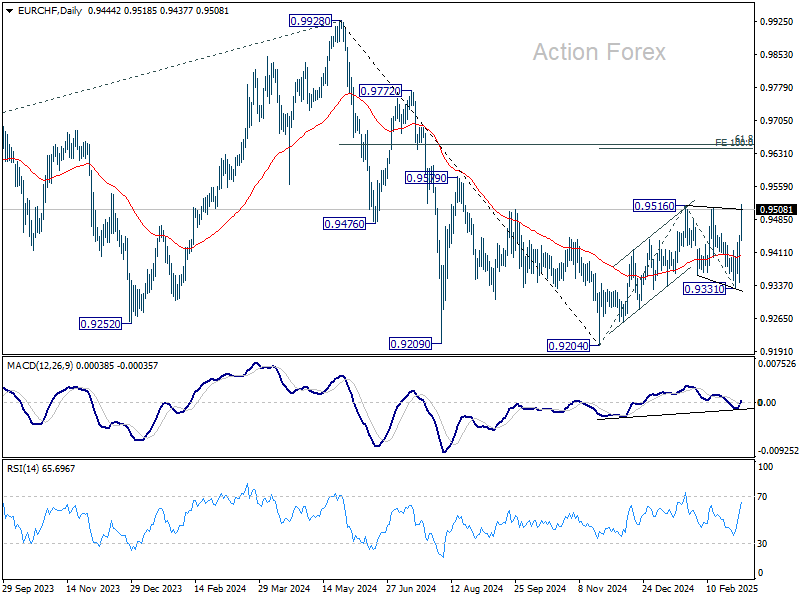
Technically, an immediate focus is on 0.9516 resistance in EUR/CHF. Firm break above this level would confirm resumption of rebound from 0.9204. More significantly, it would also strengthen the case that the downtrend from 0.9928 (2024 high) is reversing. In this case, EUR/CHF should target 100% projection of 0.8204 to 0.9516 from 0.9331 at 0.9643 next.
In Europe, at the time of writing, FTSE is up 0.37%. DAX is up 3.42%. CAC is up 2.05%. UK 10-year yield is up 0.118 at 4.619. Germany 10-year yield is up 0.219 at 2.713. Earlier in Asia, Nikkei rose 0.23%. Hong Kong HSI rose 2.84%. China Shanghai SSE rose 0.53%. Singapore Strait Times rose 0.20%. Japan 10-year JGB yield rose 0.020 to 1.446.
US ADP jobs grow only 77, hiring slowdown
US private sector employment growth slowed sharply in February, with ADP reporting an increase of just 77k jobs, far below market expectations of 140k.
The breakdown showed that goods-producing sectors contributed 42k jobs, while service-providing sectors added only 36k. By company size, small businesses shed -12k jobs, while medium-sized firms led hiring with a 46k gain, followed by large businesses with a 37k increase.
Wage growth showed little change, with job-changers seeing annual pay gains slow slightly from 6.8% to 6.7%, while job-stayers remained steady at 4.7%.
ADP’s chief economist Nela Richardson attributed the hiring slowdown to "policy uncertainty and a slowdown in consumer spending," which may have prompted layoffs or cautious hiring.
Eurozone PPI up 0.8% mom 1.8% yoy in Jan, above expectations.
Eurozone producer prices rose sharply by 0.8% mom and 1.8% yoy in January, exceeding expectations of 0.3% mom and 1.4% yoy, respectively.
The monthly increase in Eurozone PPI was primarily driven by a 1.7% mom jump in energy prices, while capital goods and durable consumer goods also saw notable gains of 0.7% mom and 0.6%, respectively. Intermediate goods prices edged up by 0.3% mom, while non-durable consumer goods saw a modest 0.2% mom rise.
The broader EU also recorded a 0.8% mom, 1.8% yoy in producer prices. Among individual member states, Ireland saw the largest monthly price jump at 6.2%, followed by Bulgaria (+5.4%) and Sweden (+2.3%).
However, not all countries experienced inflationary pressures, as Portugal (-2.2%), Austria (-0.6%), Slovenia (-0.5%), and Cyprus (-0.3%) registered price declines.
Eurozone PMI composite finalized at 50.2, barely grow for two months
Eurozone economy showed little momentum in February, with PMI Services finalizing at 50.6, down from 51.3 in January, while PMI Composite was unchanged at 50.2.
The picture was mixed across the region with Spain, Ireland, and Italy showing signs of expansion, while Germany’s services sector slowed and France’s continued its sharp contraction, posting its lowest reading in 13 months at 45.1.
Cyrus de la Rubia, Chief Economist at Hamburg Commercial Bank, noted that services growth is barely offsetting the prolonged slump in manufacturing. He pointed to rising input costs, particularly wage pressures, as a growing concern for ECB.
Political uncertainty in key economies is also weighing on sentiment. France’s services sector is deteriorating at a much faster pace, likely influenced by unresolved political instability. In contrast, Germany’s services sector, though slowing, remains in expansion, with hopes that post-election stability could support economic recovery.
However, with external risks from trade tensions and weak consumer spending, a decisive rebound in Eurozone remains uncertain.
UK PMI services finalized at 51, stagflation risks grow
The UK services sector showed little improvement in February, with PMI Services finalized at 51.0, slightly up from January’s 50.8 but still well below its long-run average of 54.3. Meanwhile, PMI Composite edged lower from 50.6 to 50.5, signaling stagnant overall economic activity as demand conditions continue to weaken both domestically and in export markets.
Tim Moore, Economics Director at S&P Global Market Intelligence, warned of "elevated risk of stagflation on the horizon". New orders falling at their sharpest rate in over two years. Rising payroll costs and economic uncertainty have eroded business confidence, bringing sentiment to its lowest level since December 2022.
Concerns over slowing growth and persistent inflation pressures have also led to continued job losses, with employment in the services sector contracting for a fifth straight month—the longest period of decline outside of the pandemic since early 2011.
Swiss annual CPI ticks down to 0.3% yoy, remains weak
Swiss inflation accelerated on a monthly basis in February, with CPI rising 0.6% mom, slightly above the expected 0.5%. Core CPI, which excludes fresh and seasonal products, energy, and fuel, increased by 0.7% mom. The rise was driven by both domestic and imported product prices, which climbed 0.5% mom and 0.9% mom, respectively.
However, the broader inflation trend remains subdued. On a year-over-year basis, headline CPI slowed to 0.3% yoy from 0.4% yoy, though it was still slightly above expectations of 0.2% yoy. Core CPI remained steady at 0.9% yoy. While domestic product price inflation eased from 1.0% yoy to 0.9% yoy, imported prices continued to contract, staying at -1.5% yoy.
BoJ's Uchida: Interest rate to gradually approach neutral by late FY 2025 to FY 2026
BoJ Deputy Governor Shinichi Uchida reinforced today that interest rates will continue to rise if the bank’s economic projections hold. He highlighted in a speech that BoJ expects inflation to stabilize around the 2% target in the second half of fiscal 2025 to fiscal 2026, with "effects of the cost-push wane" while underlying inflation strengthens with wages growth.
"The policy interest rate at that time is considered to approach an interest rate level that is neutral to economic activity and prices," he added.
However, Uchida acknowledged that determining the "neutral" interest rate level remains uncertain. While in theory, it should be around 2% plus Japan’s natural rate of interest, estimates for the latter vary significantly from -1% to +0.5%.
Given this wide range and estimation errors, BoJ will avoid relying solely on theoretical models and instead "examine the response of economic activity and prices as it raises the policy interest rate"
Japan's PMI service finalized at 53.7, sector strengthens but confidence wanes on labor shortages and trade risks
Japan's PMI Services was finalized at 53.7 in February, up from January's 53.0, marking a six-month high. PMI Composite also improved from 51.1 to 52.0, the strongest reading since September 2024.
According to Usamah Bhatti, Economist at S&P Global Market Intelligence, service sector businesses saw higher sales volumes, with export demand contributing to the expansion. Meanwhile, the broader private sector recorded its steepest rise in activity in five months, supported by a milder contraction in manufacturing.
Despite the growth, overall business confidence showed signs of softening. Bhatti noted Firms expressed concerns over labor shortages and uncertainty stemming from US trade policies, leading to the weakest sentiment since January 2021.
RBA’s Hauser: Uncertain on further easing disputes market’s rate-cut outlook
RBA Deputy Governor Andrew Hauser emphasized in a speech today that monetary policy is set to ensure inflation returns to the midpoint of the target range, which is crucial for maintaining price stability over the long run.
He justified the February rate cut, stating that it “reduces the risks of inflation undershooting that midpoint.”
However, Hauser pushed back against market expectations of a sustained easing cycle, saying the "Board does not currently share the market’s confidence that a sequence of further cuts will be required".
While Hauser acknowledged that interest rates will go where they need to go to balance inflation control with full employment, he made it clear that progress so far does not warrant complacency.
He stressed that RBA will continue to assess economic developments on a “meeting by meeting” basis.
Australia’s GDP grows 0.6% qoq in Q4, ending per capita contraction streak
Australia’s GDP grew by 0.6% qoq in Q4, exceeding expectations of 0.5% qoq, while annual growth stood at 1.3% yoy. A key highlight was the 0.1% qoq per capita GDP growth, marking the first increase after seven consecutive quarters of contraction.
According to Katherine Keenan, head of national accounts at the ABS, "Modest growth was seen broadly across the economy this quarter." She noted that both public and private spending contributed positively, alongside a rise in exports of goods and services.
China’s Caixin PMI services rises to 5.14, but uncertainties rising in employment and income
China’s Caixin Services PMI climbed to 51.4 in February, up from 51.0, beating market expectations of 50.8. Composite PMI also improved slightly to 51.5, signaling steady expansion across both manufacturing and services for the 16th consecutive month.
According to Wang Zhe, Senior Economist at Caixin Insight Group, supply and demand showed improvement in both sectors, supported by robust consumption during the Chinese New Year holiday and technological innovations in select industries. However, "employment saw a slight contraction", mainly due to weakness in the manufacturing sector.
Concerns remain over China’s broader economic recovery. Wang noted that overall price levels "remained subdued", with declining sales prices in both manufacturing and services. "Rising uncertainties in employment and household income constraining efforts to boost domestic demand and stabilize the economy," he added.
EUR/USD Mid-Day Outlook
Daily Pivots: (S1) 1.0522; (P) 1.0575; (R1) 1.0679; More...
EUR/USD accelerates further higher today and met 100% projection of 1.0176 to 1.0531 from 1.0358 at 1.0173 already. There is no sign of topping yet. Intraday bias stays on the upside for 161.8% projection at 1.0932 next. On the downside, below 1.0636 minor support will turn intraday bias neutral again first.
In the bigger picture, the strong rebound from 61.8 retracement of 0.9534 (2022 low) to 1.1274 (2024 high) at 1.0199 argues that fall from 1.1274 might be a correction only. Sustained trading above 55 W EMA (now at 1.0668) should indicate that this correction has already completed with three waves down to 1.0176. Rise from 0.9534 (2022 low) might then be ready to resume through 1.1274. Nevertheless, rejection by 55 W EMA would keep outlook bearish for another fall through 1.0176 at a later stage.
US ADP jobs grow only 77, hiring slowdown
US private sector employment growth slowed sharply in February, with ADP reporting an increase of just 77k jobs, far below market expectations of 140k.
The breakdown showed that goods-producing sectors contributed 42k jobs, while service-providing sectors added only 36k. By company size, small businesses shed -12k jobs, while medium-sized firms led hiring with a 46k gain, followed by large businesses with a 37k increase.
Wage growth showed little change, with job-changers seeing annual pay gains slow slightly from 6.8% to 6.7%, while job-stayers remained steady at 4.7%.
ADP’s chief economist Nela Richardson attributed the hiring slowdown to "policy uncertainty and a slowdown in consumer spending," which may have prompted layoffs or cautious hiring.
Gold Poised for a Rally as Support Builds from Multiple Factors
Gold is trading around 2,910 USD per troy ounce on Wednesday, pausing after the previous day's growth. The temporary slowdown comes as rising US Treasury bond yields exert pressure on prices.
Key drivers influencing gold prices
Despite this pause, gold remains near its record highs, supported by strong safe-haven demand amid escalating trade tensions. On Tuesday, the US implemented 25% tariffs on Canada and Mexico and a 10% tariff on China, worsening the global trade climate and triggering retaliatory measures.
US Commerce Secretary Howard Lutnick suggested that tariff reductions for Canada and Mexico may be possible in the future, which has slightly calmed market fears but has not eliminated concerns entirely.
Further bolstering gold’s appeal as a safe-haven asset is the broader geopolitical landscape. The US suspended military aid to Ukraine, while reports emerged suggesting a potential easing of sanctions against Russia. These developments increase uncertainty in global markets, enhancing gold’s attractiveness.
In the near term, market participants are awaiting key US economic reports, including the ISM services PMI and employment data. These indicators will provide further clues about the Federal Reserve’s monetary policy direction. Recent data suggests growing economic strains, strengthening the argument for additional rate cuts, which would further support gold prices.
Technical analysis of XAU/USD
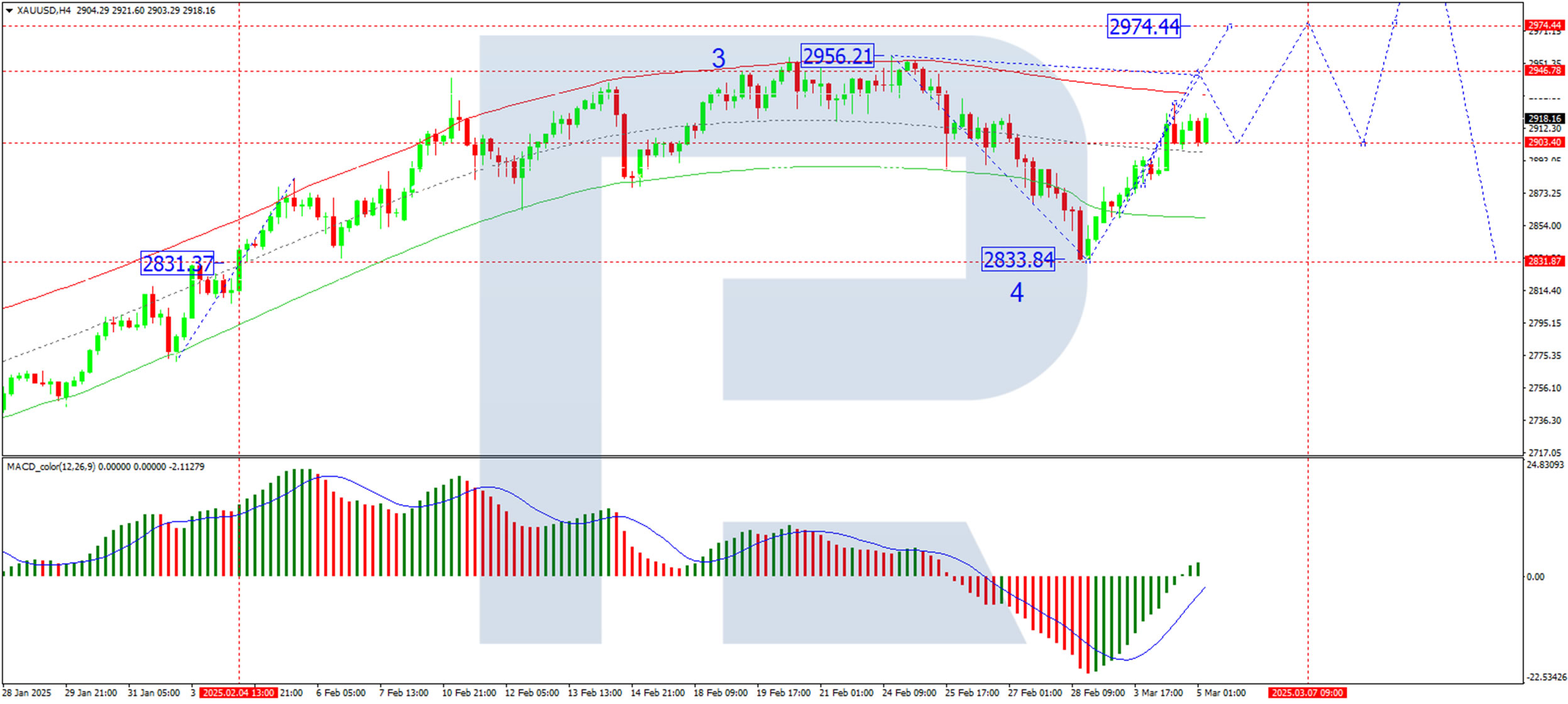
On the H4 chart, XAU/USD has formed a growth wave to 2,900. Currently, the market is consolidating around this level. A breakout to the upside is expected, with a target of 2,974 as the next local resistance level. After reaching this target, a correction towards 2,900 could follow. The MACD indicator confirms this scenario, with its signal line positioned below zero but trending upwards, indicating strong bullish momentum.
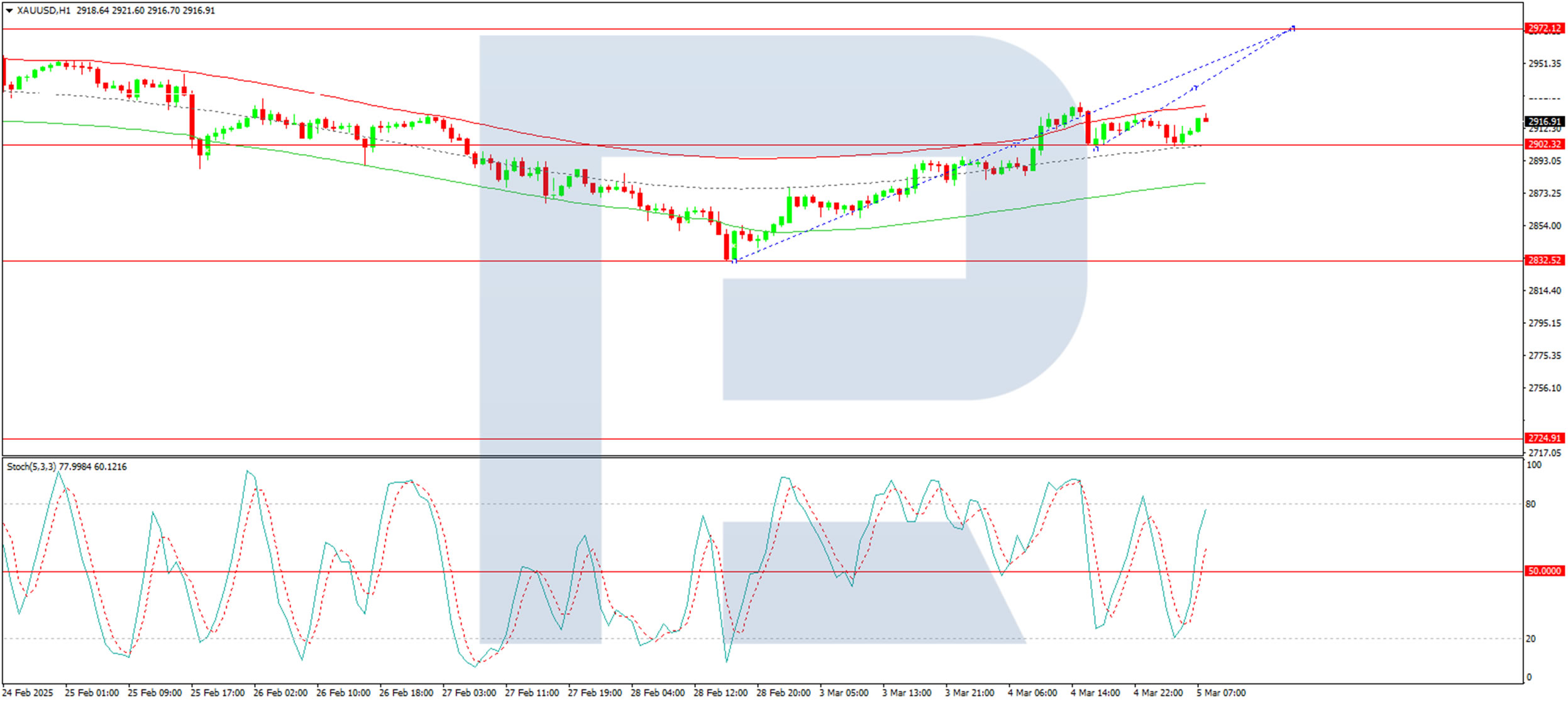
On the H1 chart, gold has already executed a growth wave to 2,900, forming a consolidation range at this level. If the price breaks downward, a correction to 2,880 is possible before another upward impulse begins. A bullish breakout from the consolidation range would open the potential for a direct rally towards 2,974. The Stochastic oscillator supports this view, with its signal line above 50 and pointing towards 80, indicating a continuation of upward momentum.
Conclusion
Gold remains well-supported by trade tensions, geopolitical uncertainties, and expectations of Federal Reserve rate cuts. While a temporary pullback could occur, the broader trend suggests further upside towards 2,974. Market participants should watch upcoming US economic data releases for additional confirmation of gold’s next move.
Australian GDP Beats Forecast, Aussie Edges Higher
The Australian dollar has extended its gains on Wednesday. AUD/USD is trading at 0.6271 in the European session, up 0.20% on the day. The Australian dollar jumped 0.75% on Tuesday, driven by the hawkish Reserve Bank of Australia minutes and a solid retail sales report.
Australian GDP rises 1.3%
Australia’s economy expanded by 1.3% y/y in the fourth quarter of 2024, up from 0.8% in Q3 and above the market estimate of 1.2% and the RBA’s forecast of 1.1%. This marked the fastest pace of growth since Q4 2023.
Quarterly, GDP grew by 0.6%, following 0.3% in Q3 and higher than the market estimate of 0.5%. This was the fastest pace of growth since Q4 2022. The strong gain was driven by strong increases in household spending and exports.
The positive GDP report follows last week’s rate cut, after the central bank held rates for over a year. The cash rate is currently at 4.10%, its lowest level since Oct. 2023. The RBA has remained hawkish, even with the rate cut. The minutes of the meeting stated that members remained concerned that further cuts could jeopardize maintaining inflation in the target range of 2%-3%.
The markets are more dovish and expect the cash rate to fall to 3.6% by the end of the year, which would mean two more cuts of 25 basis points. The central bank’s rate path will largely depend on the inflation levels as well as the strength of the labor market, which has been surprisingly robust despite high interest rates and a weak economy.
In China, this week’s PMIs are pointing to slightly stronger growth. The Caixin Manufacturing PMI for February improved to 50.8, up from 50.1 in January and above the market estimate of 50.3. The Caixin Services PMI rose to 51.4, up from 51.0 in January and above the market estimate of 50.8.
AUD/USD Technical
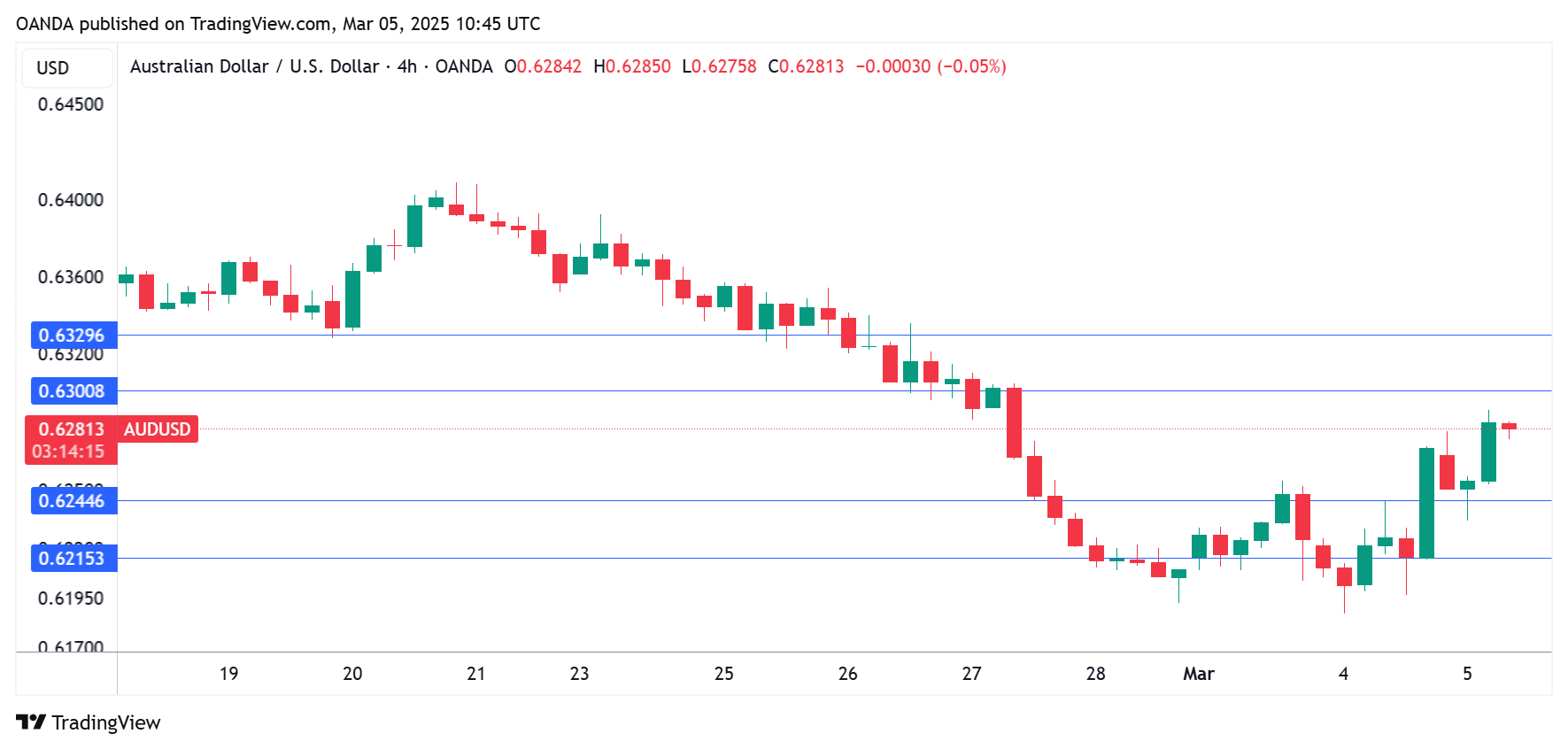
- AUD/USD is testing resistance at 0.6228. Above, there is resistance at 0.6251
- 0.6200 and 0.6177 are providing support
XAU/USD: Weaker Dollar and Trade War Uncertainty to Continue to Support
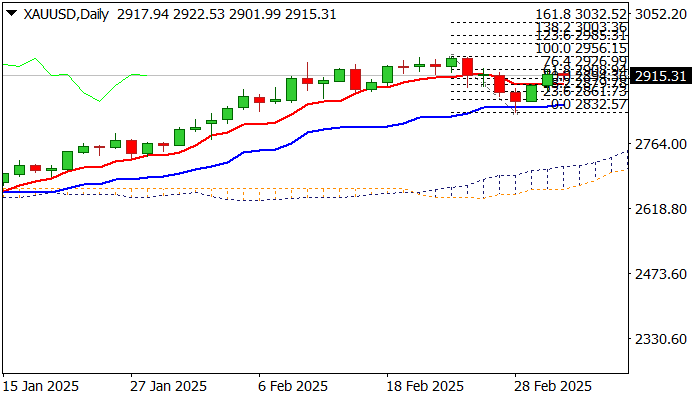
Gold remained steady on Wednesday and in consolidation mode after strong rally in past two days, which reversed around 76.4% of pullback from new record high ($2956) to $2832 (correction low).
Weaker dollar across the board continues to fuel gold advance with revived safe-haven demand on strong uncertainty over the impact of trade war expected to additionally support metal’s price.
Return and close above $2900 level generated fresh positive signal, although situation is still vulnerable as daily studies are mixed (fresh negative momentum is conflicting MA’s in bullish configuration.
Near-term action is expected to remain biased higher while holding above $2900/$2894 supports (psychological / daily Tenkan-sen) with firm break of cracked Fibo barrier at $2926 (76.4%) to bring bulls fully in play for renewed attack at all-time high and possible extension higher on break.
Res: 2926; 2942; 2956; 2985.
Sup: 2908; 2900; 2894; 2879.