Sample Category Title
Crypto Stumbles on the Upswing
Market Picture
The cryptocurrency market took a hit on Tuesday as strong US data brought speculation of tighter monetary policy back into play. As a result, crypto market capitalisation lost over 6.2% in 24 hours by the start of active trading in Europe on Wednesday. US President-elect Trump continues with his passages about Canada as the 51st state, buying Greenland, and regaining control over the Panama Canal, which increases the pull from risk assets, hurting Bitcoin, among others.
The market is still bullish, but temporarily, investors have become more cautious, preferring to lock in profits quickly.
Bitcoin has lost about 7%, coming close to $96,000. This is a desperate attempt to bring the price back below its 50-day moving average. Failure to consolidate above $102,000 had short-term speculators looking for a reason to sell, and they quickly found one. That said, the positivity of the data and Trump’s outbursts are not news and do not drastically change expectations.
Ethereum erased all of its gains since the start of the year, pulling back to $3,360 during Tuesday’s sell-off. The sharp decline has brought the price back deep under its 50-day moving average, raising concerns about the near-term outlook.
News Background
Tech analyst Ali Martinez notes that Bitcoin’s important support zone is in the $95,400 to $98,400 range, where 1.77 million addresses have purchased more than 1.53 million BTC.
Glassnode draws attention to the decline in the funding rate to neutral levels below 0.01%. This suggests cautious positioning as speculators show limited willingness to pay premiums for long positions.
Ex-BitMEX CEO Arthur Hayes expects the bull rally in the crypto market to end in mid-March, after which the market will firmly correct. In his opinion, dollar liquidity will begin to decline in March and will resume growth no earlier than the third quarter.
The head of the Czech Central Bank suggested considering the possibility of using Bitcoin as part of a strategy to diversify the bank’s reserves. Still, it explained that there are no plans to acquire any cryptocurrency yet. In December, the country passed a law that exempts hodlers from capital gains tax when holding BTC for more than three years.
Pierre Poilievre, a Bitcoin supporter who has openly declared his support for BTC and blockchain technology, may become Canada’s new prime minister.
USDCHF Wave Analysis
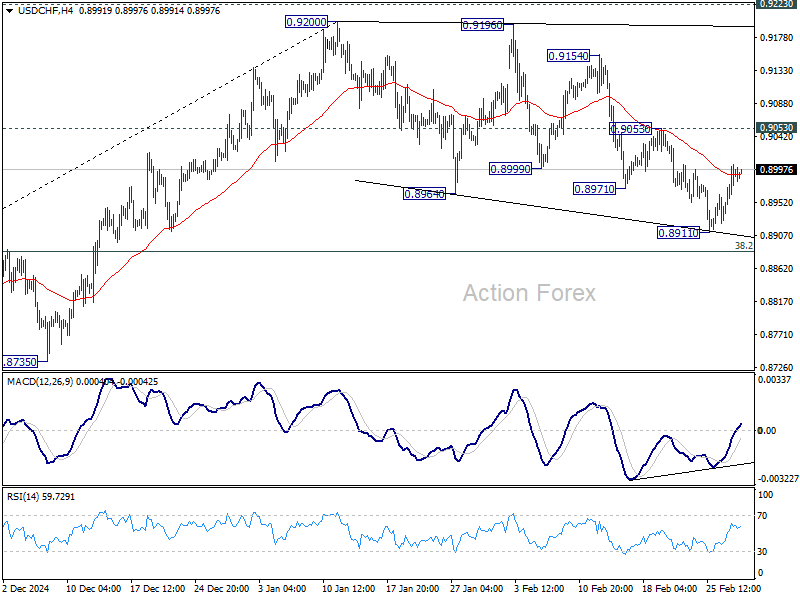
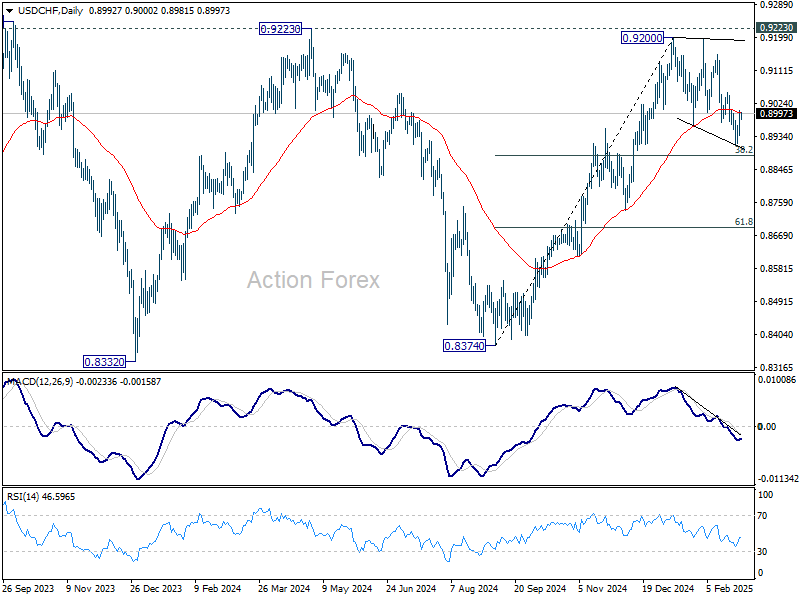
- USDCHF reversed from support zone
- Likely to rise to support level 0.9130
USDCHF currency pair recently reversed up from the support zone located between the support level 0.9020 (former top of the impulse wave 1 from December) and the 50% Fibonacci correction of the upward impulse from last month.
The upward reversal from this support zone continues the active minor impulse wave 3 of the intermediate impulse wave (3) from December.
Given the persistent daily uptrend and the bullish US dollar sentiment, USDCHF currency pair can be expected to rise to the next resistance level 0.9130 (which reversed the earlier upward impulse).
EURUSD Wave Analysis
- EURUSD reversed up from resistance zone
- Likely to fall to support level 1.0255
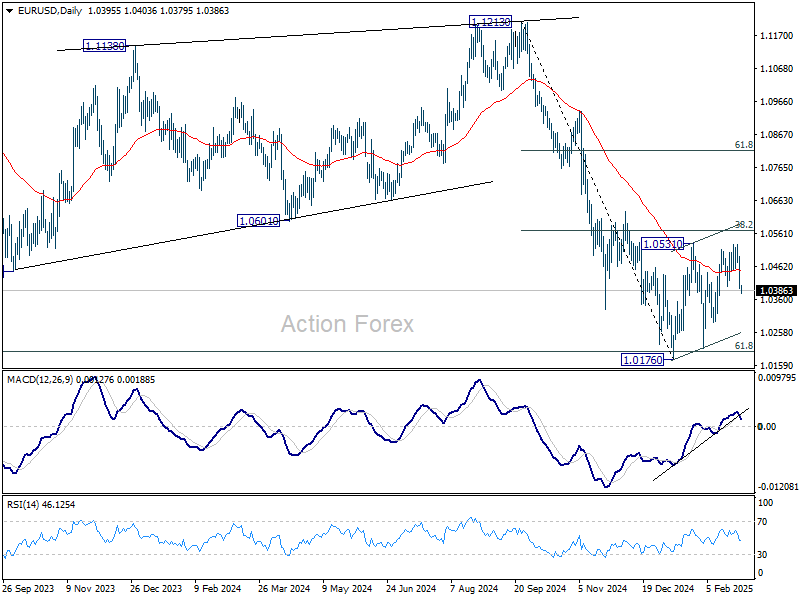
EURUSD currency pair recently reversed down from the resistance zone set between the resistance level 1.0435 (which has been steadily reversing the price from the end of December), 20-day moving average, 50% Fibonacci correction of the downward impulse from December.
The downward reversal from this resistance zone continues the active minor impulse wave 3 from the start of last month.
Given the clear daily downtrend, EURUSD currency pair can be expected to fall to the next support level 1.0255 (which reversed the price sharply at the start of January).
AUD/USD Daily Report
Daily Pivots: (S1) 0.6210; (P) 0.6249; (R1) 0.6270; More...
Intraday bias in AUD/USD is turned neutral with current retreat. Consolidation from 0.6178 could still extend with another rise to 55 D EMA (now at 0.6416). But near term outlook will stay bearish as long as 38.2% retracement of 0.6941 to 0.6178 at 0.6469. Nevertheless, firm break of 0.6169 key support will confirm larger down trend resumption.
In the bigger picture, price actions from 0.6169 (2022 low) are seen as a medium term consolidation to the down trend from 0.8006, and could have completed at 0.6941 already. Firm break of 0.6169 support will confirm down trend resumption for 61.8% projection of 0.8006 to 0.6169 from 0.6941 at 0.5806 next. In any case, outlook will stay bearish as long as 55 W EMA (now at 0.6587) holds.
Dollar Regains Ground Ahead of FOMC Minutes, Aussie Weakens on RBA Cut Prospects
Dollar regained some traction overnight, supported by strong services sector data that bolstered expectations for Fed to hold interest rates steady this month. Fed fund futures now imply a 95% probability of no rate cut in January, up from 90% last week. The upbeat economic performance placed moderate downward pressure on both equities and bonds, as markets reassess the Fed's path. Attention now turns to Friday’s non-farm payroll report, which could finalize the case for the Fed’s January decision and shift market focus toward policy moves for the remainder of the year.
The upcoming release of FOMC December meeting minutes today is another critical event for traders. At the meeting, policymakers projected a median year-end federal funds rate target of 3.75%–4.00%, reflecting a 50bps reduction from current levels. The minutes are expected to provide valuable insight into Fed’s internal deliberations, shedding light on whether risks favor a steeper or shallower easing path in 2025. This will be key in shaping market expectations for monetary policy throughout the year.
Elsewhere, Australian Dollar is under pressure today following release of November monthly CPI data. While headline inflation ticked higher due to the fading impact of energy rebates, the slowdown in trimmed mean CPI—a key measure of core inflation—provided welcome evidence of disinflation. Australian Treasurer Jim Chalmers highlighted the notable improvement in services inflation, which fell from 4.8% to 4.2%. Market expectations for an RBA rate cut in February have now increased to 60%-75%, with traders leaning toward an earlier start to the central bank’s easing cycle, rather than the May timeline initially anticipated.
For the week so far, most major currency pairs remain confined within last week's ranges. Yen, Swiss Franc, and Dollar are the weakest performers, while Canadian Dollar, British Pound, and New Zealand Dollar are showing relative strength. Euro and Australian Dollar are trading in the middle of the pack.
Technically, overall risk sentiment is a major focus for the rest of the week, for their reactions to FOMC minutes and NFP. NASDAQ is currently extending the consolidation pattern from 20204.58. Deeper retreat cannot be ruled out, but outlook will stay bullish as long as 18671.06 resistance turned support holds. The record-run up trend is expected to resume at a later stage.
Australian monthly CPI rises to 2.3%, but easing core pressures offer RBA relief
Australia's monthly CPI rose from 2.1% yoy to 2.3% yoy in November, slightly above market expectations of 2.2%. Inflation excluding volatile items and holiday travel jumped from 2.4% yoy to 2.8% yoy. However, trimmed mean CPI, a measure closely watched by RBA, declined from 3.5% to 3.2%, signaling some relief in underlying inflationary pressures.
The rise in CPI was influenced by the reduced impact of government electricity rebates compared to previous months. According to Michelle Marquardt, head of prices statistics at ABS, Electricity prices were -21.5% lower in November, compared to a -35.6% annual fall in October." Excluding government rebates, electricity prices would have declined by only -1.7% over the same period.
AUD/USD Daily Report
Daily Pivots: (S1) 0.6210; (P) 0.6249; (R1) 0.6270; More...
Intraday bias in AUD/USD is turned neutral with current retreat. Consolidation from 0.6178 could still extend with another rise to 55 D EMA (now at 0.6416). But near term outlook will stay bearish as long as 38.2% retracement of 0.6941 to 0.6178 at 0.6469. Nevertheless, firm break of 0.6169 key support will confirm larger down trend resumption.
In the bigger picture, price actions from 0.6169 (2022 low) are seen as a medium term consolidation to the down trend from 0.8006, and could have completed at 0.6941 already. Firm break of 0.6169 support will confirm down trend resumption for 61.8% projection of 0.8006 to 0.6169 from 0.6941 at 0.5806 next. In any case, outlook will stay bearish as long as 55 W EMA (now at 0.6587) holds.
Australian monthly CPI rises to 2.3%, but easing core pressures offer RBA relief
Australia's monthly CPI rose from 2.1% yoy to 2.3% yoy in November, slightly above market expectations of 2.2%. Inflation excluding volatile items and holiday travel jumped from 2.4% yoy to 2.8% yoy. However, trimmed mean CPI, a measure closely watched by RBA, declined from 3.5% to 3.2%, signaling some relief in underlying inflationary pressures.
The rise in CPI was influenced by the reduced impact of government electricity rebates compared to previous months. According to Michelle Marquardt, head of prices statistics at ABS, Electricity prices were -21.5% lower in November, compared to a -35.6% annual fall in October." Excluding government rebates, electricity prices would have declined by only -1.7% over the same period.
USD Against G10 Peers Driven by Risk-Off More Than Anything Else
Markets
Core bond yields extended their December surge with the long end once again taking the lead. A strong first batch of US economic data did the trick. November JOLTS job openings snapped back to above 8 million and a strong headline services ISM for December was coupled with a sharp rise in the prices paid subseries to the highest since March 2023. The US 2-yr yield added 1.7 bps with money markets gently pushing the next Fed cut further out in time to 2025H2. Yields in the 10-30-yr bucket rose 5.5-6.4 bps. The 10-yr tenor attacked the lower bound of the 4.68-4.73% resistance band. The $39 bln 10-yr auction yesterday produced a minimal tail with a lower bid-cover than the previous ones. European rates joined the bear steepening move with changes between +0.2 (2-yr) to +5.4 bps (30-yr) in Germany. European CPI printed bang in line with expectations, 2.4% y/y and 2.7% y/y for headline and core respectively, and final December PMIs enjoyed some marginal upward revisions compared to the flash release. UK gilts underperformed strongly. Net daily changes varied between 3.8 (2-yr) and 7.3 (10-yr) bps. The 30-yr year added 6.7 bps to hit a new 27-yr high. The same-dated auction yesterday tailed slightly and drew the lowest demand since December 2023. It suggests investor caution for upcoming bond supply after the Labour government’s “one of the largest fiscal loosenings in recent decades” (dixit OBR) presented in October resulted in a near-record £297 bn of planned government bond sales this year. The UK serves as a reminder to other governments in Europe, the US and elsewhere of a fundamentally changed interest rate environment that isn’t as forgiving for huge deficits and massive borrowing as the ZIRP/NIRP one. It’s central in our view for structurally higher long-term bond yields. From a shorter-term point of view, today’s economic calendar may further support the case as well with the ADP job report and jobless claims scheduled for release in the US. They come ahead of Friday’s more important officials payrolls report. Assuming markets this early in the year are not eager to fully let go on some additional Fed easing in 2025 it is the long end that remains the most vulnerable. The modest dollar appreciation yesterday (EUR/USD 1.034, DXY 108.54) reveals that this does not necessarily supports the US currency. We think USD against G10 peers was in fact driven by the risk-off more than anything else. Additionally, the battered euro’s downside is finally looking better protected. We feel a lot of negatives have been priced in by now. The bar for euro area money markets to price in more ECB easing (100 bps this year) is rising. EUR/USD is technically still in danger though with the recent low around 1.0226 acting as key support.
News & Views
Real Indian GDP growth for FY 2024-25 is estimated at 6.4% compared to the 8.2% provisional estimate in FY 2023-24, the statistics ministry reported. The growth deceleration in the 2024-25 FY is mainly due to a developing decline in government capital investments. At the same time private consumption expenditure is expected accelerate from 4.0% to 7.3%. Government consumption also is seen rising from 2.5% to 4.1%. Real GVA of agriculture and allied sector has been estimated to grow by 3.8% during 2024-25 as compared to the growth of 1.4% witnessed in FY 2023-24. Real GVA of ‘construction’ and ‘financial, real estate & professional services’ has been estimated to observe good growth rates of 8.6% and 7.3%, respectively during the FY2024-25, the ministry Statement reported. The Indian rupee this morning is setting an all time record low against the dollar in the USD/INR 85.84 area.
The Australian Bureau of statistics reported monthly CPI for November to have risen to 2.3% from 2.1% in October. However, the head of ABS price statistics in a comment indicated that the rise was in part due to timing of electricity rebates. The underlying inflation figure showed a mixed picture. The CPI excluding volatile items and holiday travel rose 2.8% in the 12 months to November, compared to a 2.4% rise in the 12 months to October. This rise was also mainly driven by changes in electricity prices. Annual trimmed mean inflation was 3.2% in November, down from 3.5% in October. The latter is an important pointer in the RBA’s inflation assessment and as such is moving closer to the RBA’s 2-3% inflation target. The RBA has its first policy meeting on February 17-18. After holding its policy rate unchanged at 4.35% since November 2023, markets now see a chance of about 75% of an inaugural 25 bps rate cut in February. The Ausie dollar, which has been under pressure from a strong US dollar of late, only showed a limited reaction to the data. At AUD/USD 0.6235, it trades close to recent lows (0.6180 area).
How to Think About the Exchange Rate and Inflation
The Australian dollar has depreciated against the US dollar recently, as have many other currencies. This should not have material implications for interest rate decisions.
Markets are generally thin over the Christmas period, which means there are often big moves in market pricing over the period. This summer was no exception. The US dollar strengthened against most currencies, including the Australian dollar, with the AUD/USD exchange rate briefly falling below US62c earlier in the month.
An exchange rate depreciation does tend to raise the local-currency prices of imported goods and services. If you are about to embark on a trip to the United States or have a USD-denominated contract to purchase goods or services, you will definitely feel the difference. Because of this, some observers have been asking if the recent depreciation could lift the inflation outlook enough to induce the RBA Board to delay cutting the cash rate, relative to what it would otherwise have done.
A closer look at the data, however, suggests that the effect on inflation trends will be small. There are a few reasons for this.
First, the depreciation needs to be sustained to affect inflation materially. Most importers and other users of foreign currency hedge at least some of their exposure. If an exchange rate move is short-lived, prices actually paid in Australia might not move much.
Second, the USD is not the only relevant currency for the Australian economic outlook. The RBA Board has previously highlighted that they view the trade-weighted index (TWI), not the bilateral exchange rate against the US dollar, as the relevant measure for assessing trends in imported inflation, and the RBA publishes such a TWI daily. The USD only has an 8.7% weight in this index, while China’s weight is just under 30%. Other Asian trading partners such as Japan and South Korea also figure more prominently than the US dollar. Taking the broader view afforded by the TWI, recent currency movements look much less stark. The Australian dollar has depreciated by nearly 10% against the US dollar since its brief peak around the end of September. Against the trade-weighted index, though, it is down less than 4% over the same period. The TWI is currently at roughly the same level as it was for most of the second half of 2023.
Third, while the landed price of imported goods does move closely with the (import-weighted) exchange rate, the relationship with the prices of imported items in the CPI is much more diffuse. (This is known as ‘second-stage pass-through’, as opposed to the ‘first-stage pass-through’ from global prices to landed import prices in Australia – see Graph 2 in this RBA Bulletin article.) The usual rule of thumb coming from the RBA’s own estimates is that a 10% sustained depreciation typically results in an increase in the level of the overall CPI of about 1%. Actual results can vary, though: for example, retail price inflation was lower in the 2010s than implied by movements in import prices, as the domestic retail landscape evolved.
Finally, it matters why the exchange rate depreciated. Much of the recent depreciation of the AUD was a response to shifting market views about the US rates outlook, following the December meeting of the Federal Reserve. However, it was also partly a response to a more negative outlook for the Chinese economy. The AUD is often seen as a proxy that traders use to express their views on China, given our tight trade relationship and deep, liquid FX market.
To the extent that the outlook in China has genuinely worsened, the exchange rate depreciation both implies a positive impulse to inflation and reflects an offsetting negative real-economy shock. The net effect on the domestic economy might not be inflationary at all in these circumstances. If on the other hand, market participants are being overly pessimistic about China, we would expect to see exchange rates evolve as people update their views.
It is also worth noting that China’s economic headwinds are also showing up as very weak inflation there, relative to Australia and most advanced-economy peers. Some other east Asian economies have also seen lower inflation rates lately than those prevailing in Australia, including some with material weights in the TWI.
Adjusted for relative inflation rates, the trade-weighted index was therefore in fact appreciating over most of this year; it is this ‘real TWI’ that the RBA uses in many of its models for forecasting domestic growth. While the RBA has only published its real TWI up to the September quarter – reflecting a lack of published inflation data for many countries – we can make some reasonable assumptions to ‘near-cast’ the real TWI for the December quarter. This shows a depreciation of only around 1.7% in the quarter.
The main reason for the smaller decline is that these indices are calculated using quarterly averages of daily exchange rates, which show a less extreme decline than the point-to-point change. The depreciation between the September quarter average and December quarter average was just 1.6% for the nominal TWI and 2.6% for the bilateral rate against the US dollar. If exchange rates hold at their current levels for the rest of the March quarter 2025, we will see a further 2% quarterly depreciation in the TWI and 4½% against the US dollar on this quarterly-average basis. The real TWI would also depreciate by a further 2% in the March quarter. This would take the series back to roughly where it was at the beginning of 2024.
Again, this estimate for the real TWI requires a few assumptions about inflation outcomes in the March quarter. We use our own forecasts for the Australian side of the relative price as well as for New Zealand. For other countries, we used some simple extrapolation and/or time series models. (We are also using forecasts of headline inflation, while the RBA series uses core inflation where available. In addition, we are ignoring the implications of the forthcoming change in TWI weights, which will affect the March quarter calculation slightly.)
These considerations are part of the reason why the RBA uses measures such as trimmed mean inflation as their best estimate of the near-term trend in inflation, even though headline inflation is what people actually experience. Short-term volatility in the exchange rate – and thus petrol and other imported prices – is not enough to tip the balance for the RBA’s decisions. Domestic inflation pressures, and the outlook for the labour market, continue to be more important factors influencing the monetary policy outlook.
Fed Hawks Getting Louder
Good news were bad news yesterday and they even wiped out the optimism that Nvidia initially created around AI with the announcement of new products. When Jensen Huang took stage at the opening of the CES this week, he didn’t only show off the company’s new products like the new $3000 personal AI supercomputer and its new gaming chip created with the same design than the now-famous Blackwell chip, but he also spit out a lot of new partnerships with advanced warehouses and autonomous driving carmakers around the world to improve their devices with their powerful AI chips - among them Toyota which gained yesterday and today in Tokyo, Uber that saw its share price jump more than 3% at the open, Accenture that saw its own share price jump more than 3% as well compared to the closing level of the day before, and Aurora which saw its share price jump up to 72%. Most of the gains were given back during the session, the selloff being put on the back of a broad-based market selloff. Nvidia hit a fresh record high before diving more than 6%. Some said that the new projects demanded long time to bring in concrete revenues, and many preferred taking their profit in their pockets and walk away.
But beyond the price action in Nvidia and growing number of related stocks, the new year begins strongly on how the AI technologies will affect – and improve – the existing tools for many technology companies beyond the Magnificent 7 and that – to me – is almost more exciting than how much more money Nvidia could make. In all cases, it looks like the AI talk is NOT ready to be over just yet. On the contrary, we are only getting started.
Zooming out
News were much less exciting on the economic data front than it has been on the AI front. The US released a set of higher-than-expected ISM data, suggesting that non-manufacturing activity was better than expected in December – in contradiction to the S&P’s PMI data released a day before. But what really dampened the market mood was that prices paid by companies unexpectedly - and meaningfully - jumped to the highest levels since 2023. Separately, JOLTS data hinted at an unexpected jump in job openings in November to above 8 mio jobs openings. The better-than-expected US data fuelled the hawkish Federal Reserve (Fed) expectations, pushed the US yields higher and kicked the expectation of the next Fed cut further down the road. A May cut is now a coin flip, and many believe that the Fed may want to wait until June to announce its next rate cut.
In the FX
The US dollar rebounded against most majors as the latest US data fuelled the Fed hawks. Due today, the ADP report is expected to print a relatively soft number of new private job additions last month – a consensus of analyst estimates on Bloomberg expects the US economy to have added just below 140K new private jobs in December down from 146K added a month before. A soft ADP print should easily scale back the hawkish Fed expectations – that may have gone a bit ahead of themselves, but a stronger-than-expected figure will certainly worsen the bond selloff.
Note that, the hawkish Fed expectations is not necessarily the root cause of the US bond selloff; the fear that the US government spending under Trump will explode is a bigger issue. Since the Fed started cutting the interest rates in September, the US yields only kept climbing. The US 10-year yield was near 3.60-3.65% into the Fed’s first rate cut in September and has risen more than a full percentage point since then... which is – yes – a bit disquieting. Also, the yield curve steepened a bit too fast. And the rapidly rising yields despite the Fed calling the end of its post-pandemic tightening cycle now sent the gap between the S&P500 earnings yield and the BBB bond yield to a deepest negative level since 2008. In plain English, the BBB-rated corporate bonds today pay less return than the riskier equity investments. And that’s an anomaly: it means that either the market is in a bubble or the credit risk is rising meaningfully. Presently, we could suspect both. The S&P500 fell more than 1% yesterday, while Nasdaq dived nearly 1.80%. The Dow Jones retreated 0.42%, mid cap stocks lost 0.61% and small caps retreated 0.74%.
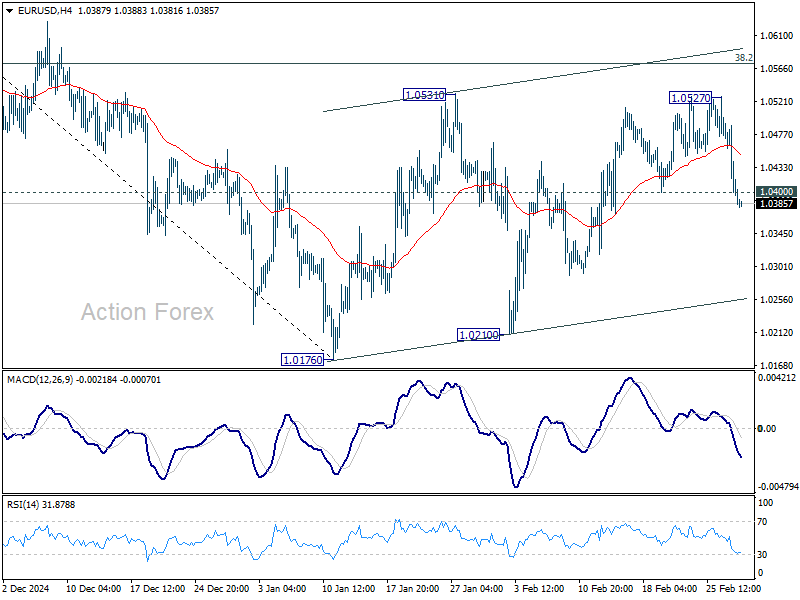
In Europe, the CPI reading went better than I expected. The latest CPI update from the Eurozone confirmed the rising price pressures in the December print, yet the number came in line with expectations as softer-than-expected figures in Italy and France compensated for the jump in German prices. The retreat in nat gas prices also improved the dovish ECB expectations on Tuesday and kept the upside in the EURUSD capped into the 1.0434 level. The pair tested the peak of the day before but failed to clear it as the combination of more dovish European Central Bank (ECB) expectations and more hawkish Fed expectations sent the pair below the 1.04 level.
Across the Channel, the UK’s 30-year gilt yield advanced to the highest level since 1998. Yes you are reading that right, the 30-year gilt yield hit the highest level since 1998 fuelling the expectation that the country will need more tax raises to finance its debt... Such a move would mean a bigger pain before any gain on the government’s spending plans. And that’s weighing on Cable right now, along with a broadly stronger US dollar. The pound remains bid against the euro, however, on expectation that the ECB will deploy a softer monetary policy than the Bank of England (BoE). And the latter – the dovish ECB expectations – remains well supportive of the Stoxx 600 which cleared the 100 and 200-DMA yesterday. The MACD indicator turned positive for the first time since 18th of December, hinting that momentum traders could continue to push the European stock valuations higher.
ADP and FOMC Minutes on the Menu
In focus today
From the US, ADP's private sector employment report for December will be released in the afternoon, and FOMC's December minutes are due for release in the evening. The former will give early hints of what to expect from Friday's key Jobs Report, while markets will keep a close eye on the latter for details on discussions that led to the hawkish stance at the meeting.
Today, focus is on German industrial production data for November - in which the trend has been declining in previous releases.
At 08:00 CET we will get the Swedish flash inflation estimates for December. We see CPIF at 1.7% y/y and CPIF ex energy at 2.3 % y/y. This is 0.2 pp. below and 0.1 pp. above Riksbank's forecasts. This month all core price components are expected to have contributed positively to inflation.
Economic and market news
What happened overnight
On the political front, incoming US President Donald Trump reiterated that he would not rule out any economic or military action to gain control of the Panama Canal and Greenland. With Denmark resisting his offer to acquire Greenland, Trump, also, for the first time, threatened to impose tariffs on Denmark. Yesterday Donald Trump Jr. visited Greenland.
What happened yesterday
In the US, the ISM services for December was stronger than expected at 54.1 (cons: 53.3, prior: 52.1). The uptick is largely attributed to the services priced paid sub-index, which increased to 64.4 from 58.2 - its highest level since February 2023. However, it is worth mentioning that the similar PMI index has been declining, suggesting mixed signals from the ISM print. Business activity climbed higher, though other sub-components were little changed.
Akin to the ISM data, the JOLTs report for November was a bit mixed. While job openings were higher than expected, printing 8.1m (cons: 7.7m) - the highest since last May, hiring slowed down coupled with involuntary layoffs crawling slightly higher. Suffice it to say, the report painted a picture of labour demand at healthy levels. Coupling both data releases, the rather hawkish market reaction with a stronger USD and USD rates trending higher is natural.
In the euro area, HICP inflation for December ticked up to 2.4% y/y as widely expected, mainly due to base effects on energy inflation, while core inflation stayed at 2.7% y/y. Looking at monthly data, core services inflation was on the high side, increasing 0.30% m/m SA. However, this also comes after a very low print in November, indicating that momentum remains broadly unchanged. Core goods inflation stayed very low in December like the previous many months and food inflation now declined again. All in all, data shows that the disinflationary trend in underlying inflation continued in December, which is positive for the ECB in their effort to bring down inflation. Going forward, we expect headline inflation to decline in Q1 2025 - and at the same time we project that base effects on services prices will also pull core inflation lower combined.
Turning to labour markets, the unemployment rate remained at its historically low level of 6.3% in November - attributed to a decline in the number of unemployed persons by 40k to the lowest number ever recorded. Combined with rising employment in Q3 the hard data thus continues to show a resilient labour market in the euro area in contrast to softening survey indicators.
In Switzerland, inflation for December printed broadly in line with expectations, aligning with the SNB's Q4 2024 forecast of 0.7% y/y. Headline was 0.6% y/y (cons: 0.6%, prior: 0.7%), while core was 0.7% y/y (cons: 0.8%, prior: 0.9%). The monthly momentum in seasonally adjusted terms showed further easing at 0.07% in headline and 0.05% in core with disinflation in the domestic components. While this should set the scene for the SNB delivering another cut in March, as we and markets expect, there are still two inflation reports before the meeting on 20 March. We remain positive on the CHF amid a backdrop of narrowing rate differentials to the ECB and fundamentals.
Equities: Global equities declined yesterday as US equities fell, dragging down global indices. Consequently, there was notable outperformance in Europe. Mainstream financial media seem to be attributing the downturn to macroeconomic data, particularly inflation-related figures, as yields continued to rise. This assessment is perhaps fair, as we noted this phenomenon yesterday. However, a strong set of macroeconomic data, even with a slightly high price component in the ISM Non-Manufacturing Survey, should still be viewed positively.
When markets are exuberant, and we are reminded of a challenge we've recently faced, such as inflation, it often leads to profit-taking. This is also why we did not see the typical yield-sensitive sectors losing the most yesterday, but rather the growth and tech sectors, which have been recent winners, being the losers yesterday. In the US yesterday, the Dow was down 0.6%, S&P 500 fell by 1.2%, Nasdaq decreased by 1.9%, and Russell 2000 dropped by 1.1%. This morning, most Asian markets are lower, along with European futures, although US futures are higher.
FI: The European inflation print did not leave clues for the near-term policy outlook where ECB is set to deliver a 25bp rate cut at the meeting later this month, and thus rates traded sideways in the morning. Markets are pricing roughly 100bp worth of ECB rate cuts this year. Better than anticipated US data, with JOLTS and ISM services beating expectations, led to a US driven sell-off across rates driven by the long-end in a bearish steepening move. Markets are now pricing and implied probability of 30% for higher SOFR rates by the end of the year.
FX: US yields climbed, and equities declined as US macro, including the ISM, showed a strong reading. The greenback performed, with EUR/USD breaching below 1.0350 whereas NOK/SEK found itself touching above 0.9800 amid poor SEK performance. A soft twist to the Swiss December inflation print prompted an initial move higher in EUR/CHF, although this faded later in the session.