

Sample Category Title
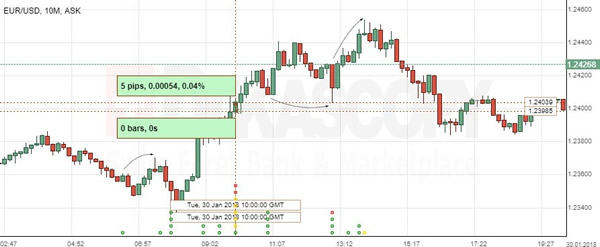
EUR/USD: EZ Flash GDP Q/Q
The EZ flash GDP data release was not a trend changer in the EUR/USD currency pair. The Euro kept strengthening against the Greenback to touch the intraday high of 1.2450.
The Euro zone economy marked the fastest growth pace in a decade last year, preliminary report revealed, with sentiment remaining at the strong level, suggesting a solid start entering 2018. Eurostat stated that estimated growth domestic product in the bloc marked a 0.6% quarterly increase in three months to December 2017, which put yearly growth to 2.7% in the same period. Investment is expected to recover fully from post-crisis lows, to continue providing essential contribution to expansion over the coming year.
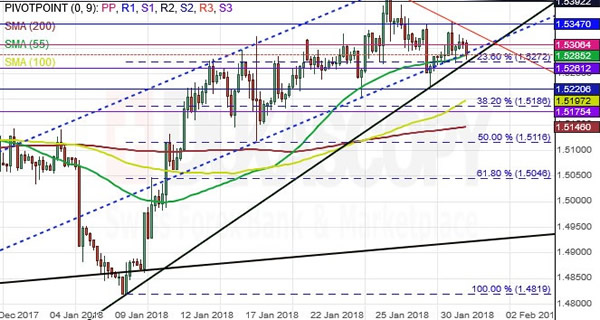
EUR/CAD 4H Chart: Full Review
EUR/CAD has been trading in an ascending channel since early January. The currency exchange rate has formed a new high during this period.
The bull movement was temporarily stopped by the weekly R1 at 1.5417 and retraces south for a brief period of time. The pair is likely to breach the dotted line and move further south.
Regarding the short-term, the pair might find support at the weekly S1 1.5203 combined with the 100—hour simple moving average. If looking at the Fibonacci retracement level, the pair is likely to move further south until it reaches the 50.00% level. This retracement can be measured with the low at 1.4819 and the high at 1.5417.
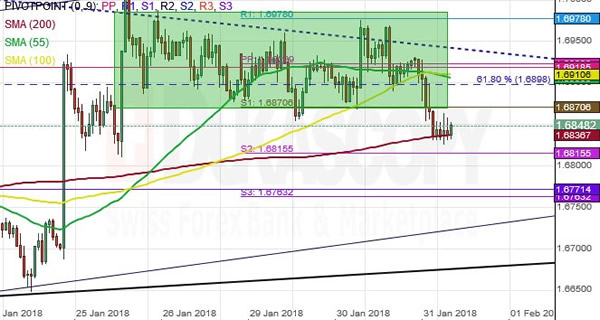
EUR/NZD 1H Chart: Breakout To The South
The common European currency continued to appreciate against the New Zealand Dollar after hitting the dominant support line near the 1.6520 level in early January.
After reaching the 50.00% Fibonacci retracement level, the pair started making a U-turn to the south. The retracement can be measured by connecting the January low at 1.6520 and the December high at 1.7480.
Meanwhile, in the 1H time frame there is already a breakout from a rectangle pattern, which can be observed on the chart. The currency exchange rate is likely to continue south until it finds support at the weekly pivot point level at 1.6690.
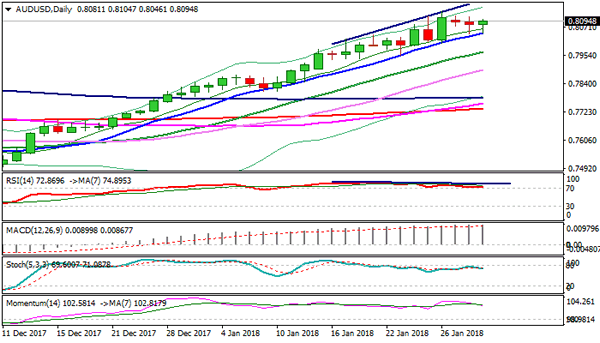
Technical Outlook: AUDUSD – Threats Of Deeper Pullback On Break Below Rising 10SMA
The Australian dollar rose in Asia on Wednesday despite downbeat Australian data released earlier (Q4 CPI fell below expectations (0.6% vs 0.7% f/c) and weaker than expected China’s Jan Manufacturing PMI (51.3 vs 51.5 f/c and 51.6 previous).
The Aussie was inflated by weaker US dollar, which fell after President Trump’s State of the Union speech, maintaining fragile sentiment ahead of key event, release of US monetary policy decision.
The pair maintains overall bullish tone as shallow corrective attempts were contained by rising 10SMA (currently at 0.8046), above which repeated strong downside rejections occurred (Tuesday / today).
Immediate bulls are expected to keep above 10 SMA and keep the structure intact for fresh attempts at 0.8135 (26 Jan peak, the highest since May 2015) and final push towards target at 0.8164 (14 May 2015 high / 50% retracement of 0.9503/0.6826 fall).
However, negative scenario on break below 10SMA and extension of pullback from 0.8135 cannot be ruled out as bearish divergence on overbought daily RSI warns of deeper correction.
Res: 0.8118, 0.8135, 0.8164, 0.8200
Sup: 0.8046, 0.8000, 0.7969, 0.7896
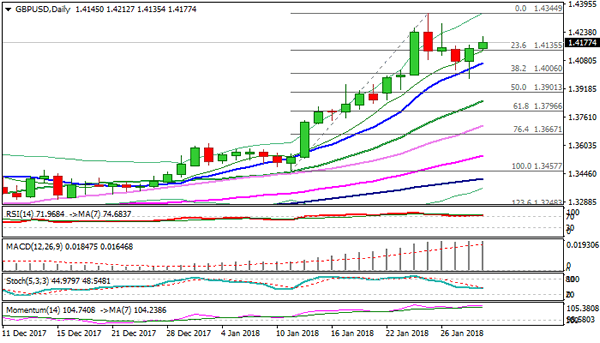
Technical Outlook: GBPUSD – Rising 10SMA Maintains Bulls And Marks Key Near-Term Support
Cable extends recovery on Wednesday and probes through important barrier at 1.4205 (Fibo 61.8% of 1.4344/1.3979 pullback).
Strong downside rejection at key 1.40 support zone on Tuesday signaled that corrective phase from 1.4344 peak might be over.
Bulls are underpinned by rising 10SMA (currently at 1.4063) and will remain in play while the latter holds.
Sustained break above 1.4205 Fibo barrier would open 1.4286 (26 Jan lower top) and could lead for extension above 1.4300 barrier.
Conversely, renewed probes below 10SMA would soften near-term structure, while firm break below 1.40 support (Fibo 38.2% of 1.3457/1.4344 upleg) would signal deeper correction from 1.4344 (25 Jan peak, the highest since 24 June 2016 Brexit vote).
Res: 1.4212, 1.4286, 1.4344, 1.4400
Sup: 1.4135, 1.4063, 1.4048, 1.4000
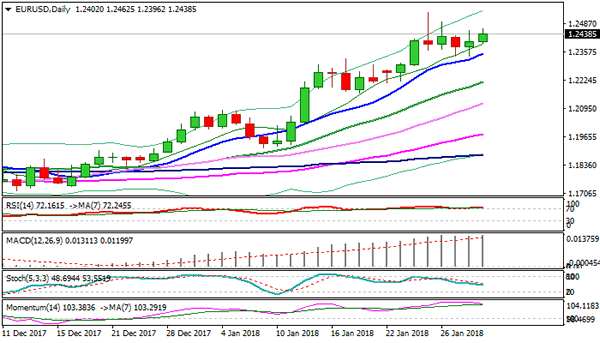
Technical Outlook: EURUSD Holds Firm Tone Head Of Batch Of Data
The Euro remains firm and moved higher in early Wednesday’s trading after downside attempts were repeatedly rejected at 1.2335, just above rising 10SMA which continues to underpin. Fresh upside cracked initial barrier at 1.2453 (Tuesday’s high) as dollar moved lower after US President Donald Trump’s State of the Union speech. Bullish techs continue to favor renewed attempts above 1.25 after rally stalled at 1.2537 last week. Thick hourly cloud (spanned between 1.2414 and 1.2376) marks initial support, followed by rising 10SMA (1.2347) which is expected to hold and maintain bullish bias Downbeat German retail sales data released earlier this morning (Dec -1.9% vs -0.4% f/c and 1.9% previous), showed little impact on the single currency, with focus turning towards German jobs data (Jan unemployment change -16K f/c vs -26K previous and unemployment rate forecasted unchanged at 5.5%) and EU CPI (Jan 1.3% f/c y/y vs 1.4% previous). US Federal Reserve policy decision, due later today, will be also closely watched for fresh signals. The Fed is widely expected to keep interest rates unchanged and focus will be on policy statement which could provide more signals about monetary policy outlook in coming months.
Res: 1.2462, 1.2493, 1.2537, 1.2597
Sup: 1.2414, 1.2376, 1.2347, 1.2335
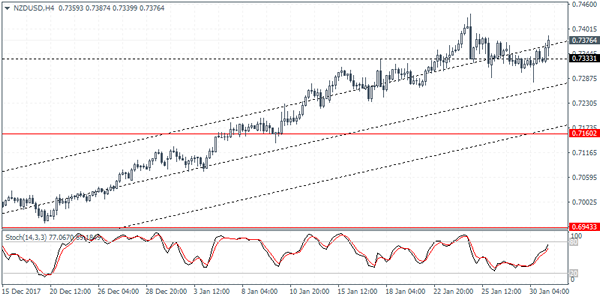
NZDUSD Intraday Analysis
NZDUSD (0.7376): The New Zealand dollar has stayed flat with prices consolidating near the 0.733 level. This potentially suggests that the upside could be exhausted. A major event catalyst could validate a downside move. This could come from today's FOMC meeting. Support for NZDUSD is seen at the technical level of 0.7160 that could be tested in the event that the kiwi dollar slips lower. Below 0.7160, another support level at 0.6943 could be in focus. Alternately, in the event that NZDUSD manages to bounce off the current levels, the currency pair will need to advance above January 24 highs at 0.7407 to maintain further gains.
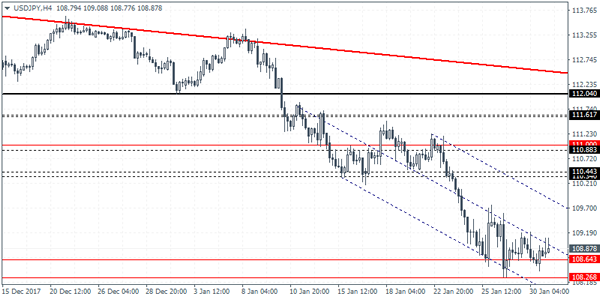
USDJPY Intraday Analysis
USDJPY (108.87): The USDJPY was seen trading flat yesterday with price action caught within the range from last Friday's high and low. Price action remains trading close to the 108.26 level in the near term. The modest decline yesterday resulted in a higher low being formed near the top end of the support at 108.64. A break out above 109.08 could suggest a reversal and a correction. The upside target comes in at 110.34 at the very least where the previously held support level could turn to resistance.
EURUSD Intraday Analysis
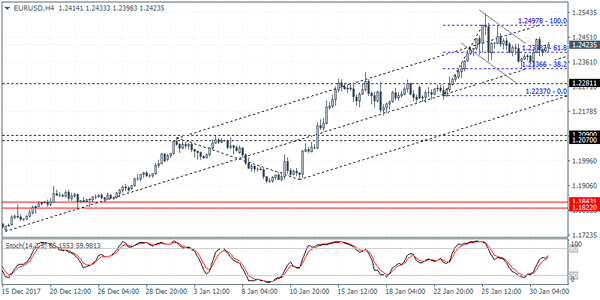
EURUSD (1.2423): The EURUSD managed to break out from the bullish flag pattern but the gains were quickly erased. Price action was seen falling back to the break out level and declined further. This potentially invalidates the bullish flag pattern unless the common currency is able to reverse the losses. The downside bias is now increasingly a risk for the EURUSD. Major support is seen at 1.2090 which could be tested. With the economic calendar busy today with data from the U.S. this could potentially weaken the euro further from the current highs. Despite the short term declines, the EURUSD is expected to maintain the bullish trend.
Euro Fails To Capitalize On GDP Data. Investors Turn To FOMC
The common currency posted strong intraday gains on the back of better than expected GDP data but the euro closed weaker by Tuesday's close.
The preliminary GDP data from the Eurozone released yesterday showed that the economy expanded 0.6% on the quarter ending December 2017. This was in line with the general expectations and it pushed the annual GDP to 2.7%. It was the fastest pace of annual GDP expansion since 2007. Germany and France GDP numbers were also released which managed to push the Eurozone economy higher and offset a weaker pace of GDP expansion from Spain.
Elsewhere, the BoE Governor Carney was quizzed by lawmakers. In his testimony, Carney brushed aside speculation of being overly biased towards Brexit and noted that inflation could remain at the current levels due to the depreciation in the exchange rate.
Looking ahead, a major event risk for the euro comes from the flash inflation estimates for the month of January. Economists forecast that consumer prices might have slowed even further at a pace of 1.3% on an annual basis. Core inflation is however expected to rise 1.0%, up from 0.9% in December. The ADP payrolls report will be coming up with forecasts showing a 191k gains in the private sector. This will be followed up later in the evening by the FOMC meeting. Fed officials are expected to keep rates steady.