

Sample Category Title
USD/CHF Mid-Day Outlook
Daily Pivots: (S1) 0.9860; (P) 0.9915; (R1) 0.9949; More....
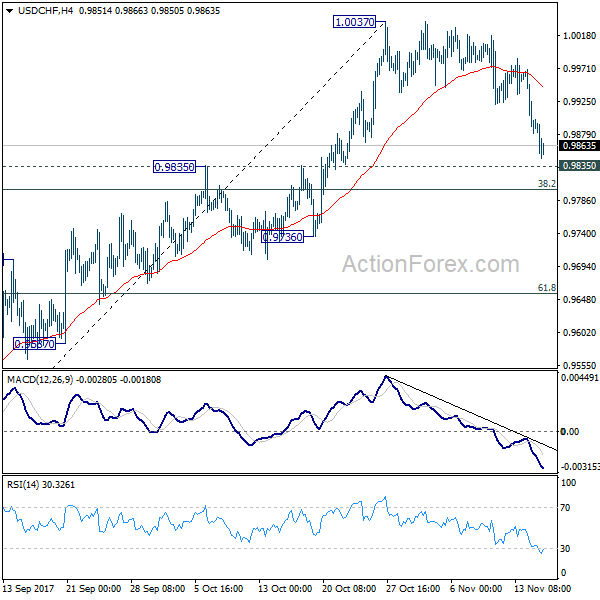
As the fall from 1.0037 extends, focus is now on 0.9835 resistance turned support. Decisive break there will argue that whole rebound form 0.9420 is completed and turn outlook bearish. In that case, USD/CHF should target 61.8% retracement of 0.9420 to 1.0037 at 0.9565 and possibly below. Nonetheless strong rebound from 0.9835 will retain near term bullishness. And, break of 1.0047 will extend the rise from 0.9420 and target 1.0342 high.
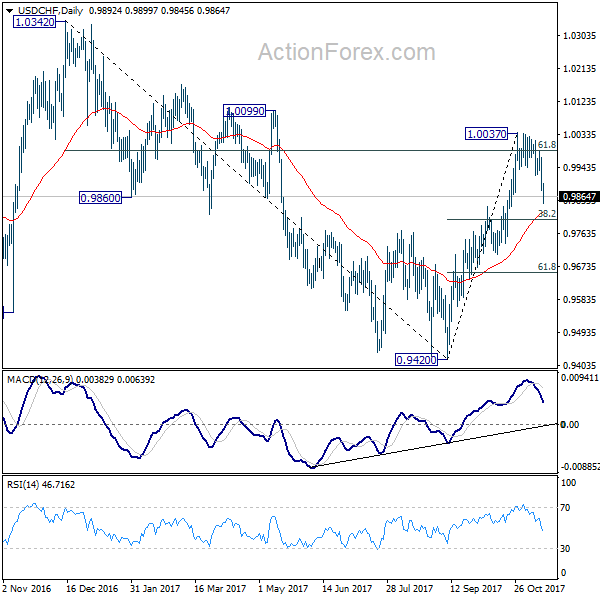
In the bigger picture, current development suggests that USD/CHF has defended 0.9443 (2016 low) key support level again. Rise from 0.9420 could is a medium term up move and should target a test on 1.0342 high. This represents the upper end of a long term range that started back in 2015. On the downside, break of 0.9736 support is now needed to indicate completion of the rise from 0.9420. Otherwise, further rally will remain in favor in medium term.
GBP/USD Mid-Day Outlook
Daily Pivots: (S1) 1.3088; (P) 1.3159; (R1) 1.3259; More....
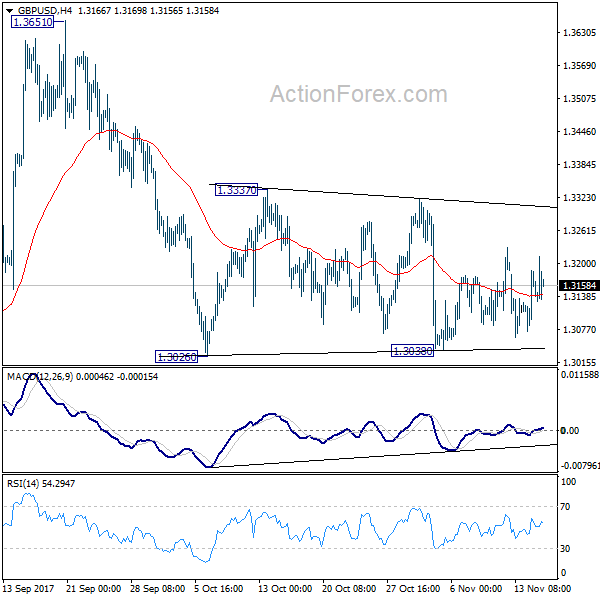
Intraday bias in GBP/USD remains neutral as it's still bounded in range of 1.3038/3337. In case of another recovery, upside should be limited below 1.3337 resistance to bring fall resumption. Break of 1.3038 will now resume decline from 1.3651 to 1.2773 key support level. However, decisive break of 1.3337 will indicate that pull back from 1.3651 is completed and medium term rise from 1.1946 is resuming.
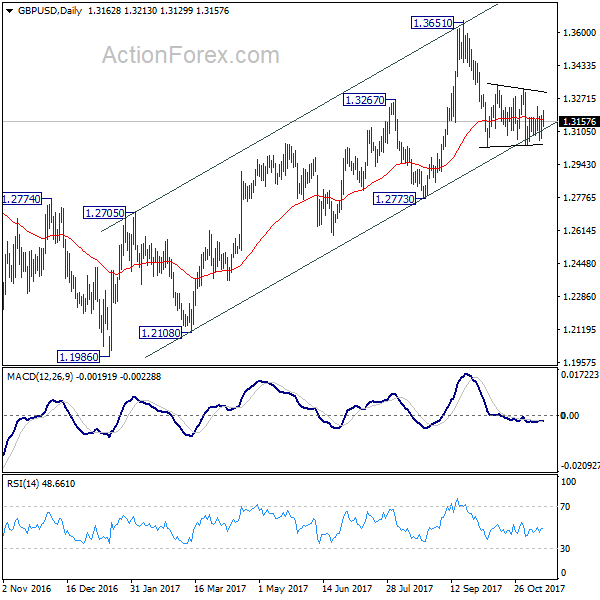
In the bigger picture, as noted before, GBP/USD hit strong resistance from the long term falling trend line. Current development is starting to favor that corrective rebound from 1.1946 low has completed at 1.3651. Decisive break of 1.2773 will confirm this bearish case and target a test on 1.1946 low next, with prospect of resuming the low term down trend. Nonetheless, break of 1.3320 resistance will restore the rise from 1.1946 for 38.2% retracement of 2.1161 (2007 high) to 1.1946 (2016 low) at 1.5466.
USD/JPY Mid-Day Outlook
Daily Pivots: (S1) 113.19; (P) 113.55; (R1) 113.80; More...
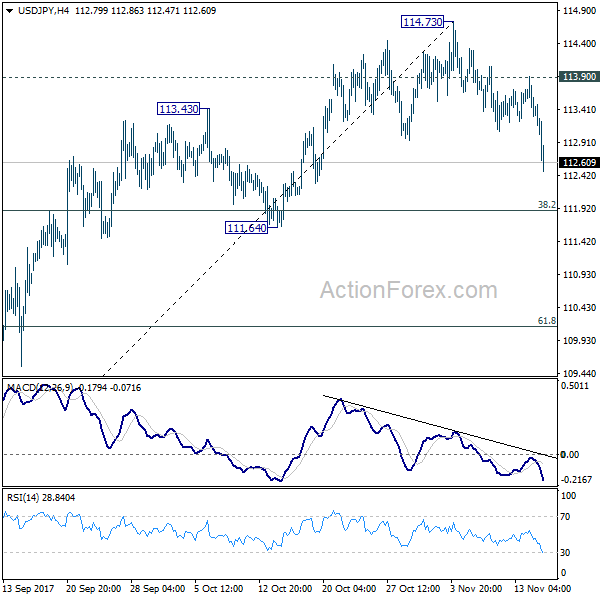
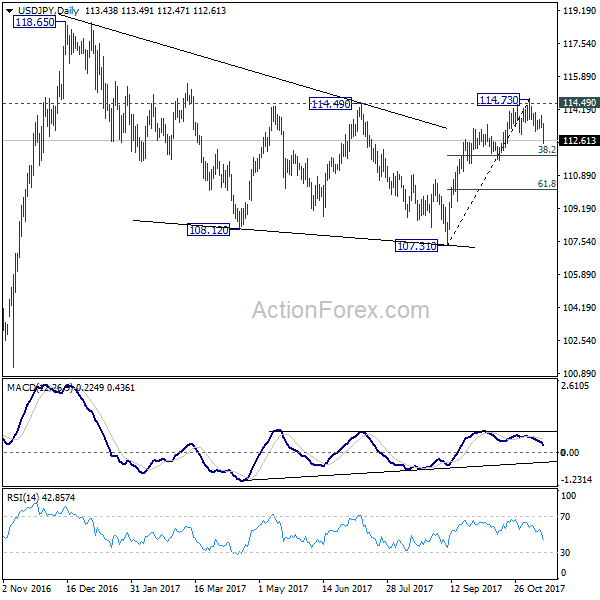
USD/JPY's drops to as low as 112.47 so far today. The strong break of 112.95 support should confirm rejection from 114.49 key resistance. Intraday bias is turned back to the downside for 38.2% retracement of 107.31 to 114.73 at 111.89 first. Sustained break of 111.64 support will now argue that rise from 107.31 has completed. In that case, USD/JPY should target 61.8% retracement at 101.14. On the upside, break of 113.90 resistance is needed to confirm completion of the fall. Otherwise, near term outlook will now stay cautiously bearish.
In the bigger picture, medium term rise from 98.97 (2016 low) is not completed yet. It should resume after corrective fall from 118.65 completes. Break of 114.49 resistance will likely resume the rise to 61.8% projection of 98.97 to 118.65 from 107.31 at 119.47 first. Firm break there will pave the way to 100% projection at 126.99. This will be the key level to decide whether long term up trend is resuming. However, firm break of 111.64 support will dampen this view and turn focus back to 107.31 instead.
Yen Surges on Global Equity Rout, Higher Core CPI Not Giving Support to Dollar
Yen surges broadly today on risk aversion as global equity markets suffer heavy selloff. At the time of writing, FTSE is trading down -0.5%, DAX down -1% while CAC is down -0.5%. DOW futures also point to triple digit loss. That followed -1.57% fall in Nikkei earlier. The correction in oil price is seen as a key facto that drives stocks down. WTI crude oil is trading at around 55, after dipping to 54.97, comparing to last week's high at 57.92. Euro remains generally firm and accelerates against Dollar, as supported by optimistic economic outlook. But the common currency is overwhelmed by Yen. Meanwhile, Aussie remains the weakest one today as weighed down by weak wage growth. Canadian Dollar follows as weighed down by oil. Dollar is trading as the third weakest, and it could try to recover on slightly higher than expected core CPI reading. But it's not showing any strong sign of rebound yet.
Crude oil tumbles as IEA lowered demand forecast
Correction in oil price is a key factor in driving the global equity rout. The Paris-based International energy Agency (IEA) unveiled in the monthly report that it has lowered the global oil demand growth forecast, by -0.05M bpd, to 1.5M bpd for this year. For 2018, the agency projects the demand would expand 1.3M bpd, down -0.19M bpd from last months' forecast for 2018. As a result, oil demand would reach 97.7M bpd this year and 98.9M bpd in 2018. It warned that the market might be oversupplied in 4Q17. While the market has used the downgrades as an excuse to lighten their long positions in oil and noted that the IEA has "poured cold water" on OPEC's upgrades on oil demand, one should note that IEA's demand forecasts for both this year and 2018 remain higher than OPEC's (2017: 96.9M bpd; 2018: 98.5M bpd), despite the downward revisions.
US core CPI accelerated, other data mixed
US headline CPI rose 0.1% mom, 2.0% yoy in October, slowed from 0.5% mom, 2.2% yoy but met expectation. Core CPI rose 0.2% mom 1.8% yoy, up from September's 0.1% mom 1.7% yoy. The annual reading also beat expectation at 1.7% yoy. Headline retail sales rose 0.2% in October, above expectation of 0.0%. But ex-auto sales rose 0.1%, missed expectation of 0.2%. Empire state manufacturing index dropped to 19.4 in November, below expectation of 25.0. While some Fed officials expressed concern on sluggish inflation, the pickup in core CPI should keep Fed on track for a December hike.
Fed doves showed concerns on inflation
Chicago Fed President Charles Evans expressed his concerns on inflation. He said that "when I look at the downward drift in multiple expectations measures, I find it tougher to confidently buy into the idea that inflation today is just temporarily low once again." And he urged his fellow Fed official that "our public commentary needs to acknowledge a much greater chance of inflation running at 2-1/2 percent in the coming years than I believe we have communicated in the past." Nonetheless, he remain optimistic on the economy and expects "continued solid growth" in 2018.
St. Louis Fed President James Bullard said yesterday that "inflation data during 2017 have surprised to the downside and call into question the idea that U.S. inflation is reliably returning toward target." And he warned that "the main concern I would have is that we raise rates in December and inflation expectations fall... which would in my view be a vote of no confidence from markets."
UK employment suffered worst contraction since 2015
UK claimant counts rose 1.1k in October, better than expectation at 2.4k. Claimant count rate was unchanged at 2.3%. ILO unemployment rate was unchanged at 4.3%, in line with consensus. Average weekly earnings rose 2.2% 3moy, slightly higher than expectation of 2.1% 3moy. Considering that CPI stood at 3.1% in October, real wage was indeed in decline and continued to squeeze household spending power. Overall employment dropped -14k in the three months to September. The contraction is the worst since 2015 and raised concerned that Brexit is hurting the labor market. Both job and wage data affirms the general view that BoE is no where near another rate hike and could only move a year from now.
Australian wage growth missed expectations
Australia wage price index rose 0.5% qoq in Q3, unchanged from quarter's figure and missed expectation of 0.7% qoq. Annually, wage grew 2.0% yoy, also missed expectation of 2.2% yoy. Growth in wage was driven by end of financial year salary reviews as well as the annual minimum wage review. The 3.3% rise in minimum wage already boosted quarterly wage growth by 0.2%. Hence, considering all factors, wage growth was like non-existent in the September quarter. And that clearly support RBA's neutral stance to divergence from global monetary tightening and stands pat ahead. Also from Australia, Westpac consume confidence dropped -1.7% in November.
Yen surges on Japan GDP miss
Japan GDP grew 0.3% qoq in Q3, below expectation of 0.4% qoq. That's also just half of prior quarter's 0.6% qoq. Nonetheless, that's still the second straight quarter of growth, held by exports as global economy recovers. GDP deflator rose 0.1% yoy, in line with consensus.
USD/JPY Mid-Day Outlook
Daily Pivots: (S1) 113.19; (P) 113.55; (R1) 113.80; More...
USD/JPY's drops to as low as 112.47 so far today. The strong break of 112.95 support should confirm rejection from 114.49 key resistance. Intraday bias is turned back to the downside for 38.2% retracement of 107.31 to 114.73 at 111.89 first. Sustained break of 111.64 support will now argue that rise from 107.31 has completed. In that case, USD/JPY should target 61.8% retracement at 101.14. On the upside, break of 113.90 resistance is needed to confirm completion of the fall. Otherwise, near term outlook will now stay cautiously bearish.
In the bigger picture, medium term rise from 98.97 (2016 low) is not completed yet. It should resume after corrective fall from 118.65 completes. Break of 114.49 resistance will likely resume the rise to 61.8% projection of 98.97 to 118.65 from 107.31 at 119.47 first. Firm break there will pave the way to 100% projection at 126.99. This will be the key level to decide whether long term up trend is resuming. However, firm break of 111.64 support will dampen this view and turn focus back to 107.31 instead.
Economic Indicators Update
| GMT | Ccy | Events | Actual | Forecast | Previous | Revised |
|---|---|---|---|---|---|---|
| 23:30 | AUD | Westpac Consumer Confidence Nov | -1.70% | 3.60% | ||
| 23:50 | JPY | GDP Q/Q Q3 P | 0.30% | 0.40% | 0.60% | |
| 23:50 | JPY | GDP Deflator Y/Y Q3 P | 0.10% | 0.10% | -0.40% | |
| 00:30 | AUD | Wage Price Index Q/Q Q3 | 0.50% | 0.70% | 0.50% | |
| 04:30 | JPY | Industrial Production M/M Sep F | -1.00% | -1.10% | -1.10% | |
| 09:30 | GBP | Jobless Claims Change Oct | 1.1K | 2.4K | 1.7K | 2.6K |
| 09:30 | GBP | Claimant Count Rate Oct | 2.30% | 2.30% | ||
| 09:30 | GBP | Average Weekly Earnings 3M/Y Sep | 2.20% | 2.10% | 2.20% | |
| 09:30 | GBP | ILO Unemployment Rate 3M Sep | 4.30% | 4.30% | 4.30% | |
| 09:30 | GBP | Employment Change 3M/3M Sep | -14k | 50k | 94k | |
| 10:00 | EUR | Eurozone Trade Balance (EUR) Sep | 25.0B | 21.4B | 21.6B | 21.0B |
| 13:30 | USD | CPI M/M Oct | 0.10% | 0.10% | 0.50% | |
| 13:30 | USD | CPI Y/Y Oct | 2.00% | 2.00% | 2.20% | |
| 13:30 | USD | CPI Core M/M Oct | 0.20% | 0.20% | 0.10% | |
| 13:30 | USD | CPI Core Y/Y Oct | 1.80% | 1.70% | 1.70% | |
| 13:30 | USD | Empire State Manufacturing Nov | 19.4 | 25 | 30.2 | |
| 13:30 | USD | Advance Retail Sales M/M Oct | 0.20% | 0.00% | 1.60% | 1.90% |
| 13:30 | USD | Retail Sales Ex Auto M/M Oct | 0.10% | 0.20% | 1.00% | 1.20% |
| 15:00 | USD | Business Inventories Sep | 0.00% | 0.70% | ||
| 15:30 | USD | Crude Oil Inventories | 2.2M | |||
| 21:00 | USD | Net Long-term TIC Flows Sep | 34.6B | 67.2B |
GOLD: Bullish, Sets Up For More Recovery Higher
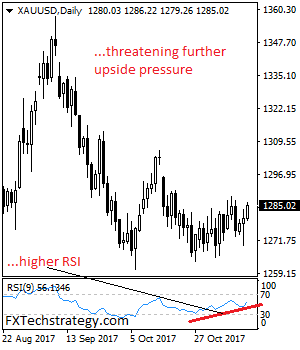
GOLD: The commodity now eyes further bull pressure after following though higher during early Wednesday trading today. On the downside, support comes in at the 1,280.00 level where a break will turn attention to the 1,270.00 level. Further down, a cut through here will open the door for a move lower towards the 1,260.00 level. Below here if seen could trigger further downside pressure towards the 1,250.00 level. Conversely, resistance resides at the 1,290.00 level where a break will aim at the 1,300.00 level. A turn above there will expose the 1,310.00 level. Further out, resistance stands at the 1,320.00 level. All in all, GOLD looks to strengthen further higher on correction.
Canadian Dollar Lower, US Consumer Data Next
The Canadian dollar has edged lower in the Wednesday session. In the North American session, USD/CAD is trading at 1.2758, up 0.20% on the day. There are no Canadian indicators on the schedule. In the US, the focus is on consumer spending and inflation numbers. CPI is expected to come in at 0.1% and Core CPI at 0.2%. Consumer spending is also expected to post low numbers, with the estimate for Retail Sales at 0.2% and Core Retail Sales at 0.0%. On Thursday, Canada releases Manufacturing Sales and the US publishes unemployment claims and the Philly Fed Manufacturing Index.
US President Trump reiterated his message of "America first" on his recent tour of Pacific Asian countries. This protectionist stance could signal trouble for Canada and Mexico, as Trump has vowed to renegotiate the NAFTA free trade agreement, which covers over $1 trillion a year in trade. On his Asian trip, Trump reiterated that he favors bilateral trade agreements rather than multilateral arrangements. Negotiators from the three countries are meeting for another round of talks on Wednesday, and by all accounts, the talks are progressing slowly. If NAFTA is not renegotiated, the Canadian economy will be negatively affected, and the Canadian dollar would likely lose ground against the greenback.
US Producer Price Index reports were stronger than expected in October. Core PPI and PPI remained unchanged at 0.4%, beating their estimates. PPI increased at an annualized rate of 2.8%, its fastest gain since February 2012. Will CPI numbers also beat the estimate? Inflation levels are being closely monitored by the Federal Reserve, as stronger inflation levels would likely result in a rate hike in early 2018. The markets are very bullish on higher rates, with a December hike priced in at 91% and a January raise priced in at 89%.
Dollar Index Stays Firmly in Red ahead of US Data
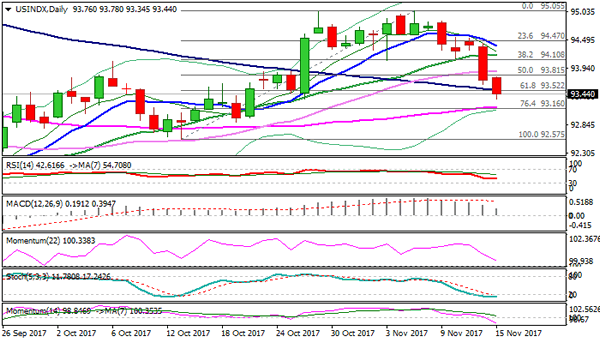
The greenback remains under strong pressure against its major counterparts and extends steep descend into fifth straight day.
Bears broke below strong double-Fibonacci support at $93.50 zone, reinforced by 100SMA today, signaling further extension of the bear-leg from $95.05 (07 Nov high). Close below $93.50 pivots is needed to confirm and open way for extension towards $92.96 (daily cloud top).
US CPI and retail sales data are in focus for fresh signals with weak numbers today expected to increase pressure on dollar.
Broken Kijun-sen ($93.81) is expected to ideally limit upside attempts.
Res: 93.50; 93.81; 94.20; 94.43
Sup: 93.34; 92.96; 92.53; 91.93
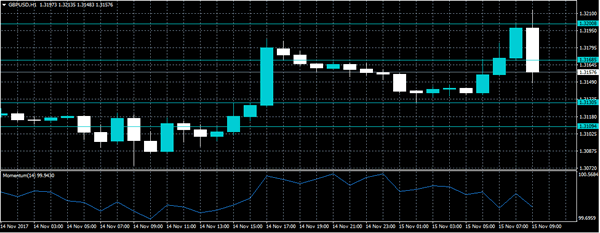
GBPUSD Intraday Bullish Above 1.3130 Level
The British pound has moved sharply higher against the U.S dollar, after better than expected macro-economic data from the United Kingdom economy, and intraday weakness in the U.S dollar index. The GBPUSD pair briefly traded above the 1.3200 level during the European trading session, after UK Average Earning Wage data increased better than economists had expected. Price-action has now pulled back towards the 1.3150 level, ahead of the release of U.S inflation and Retail Sales data later today.
The GBPUSD pair remains intraday bullish while price-action trades above the 1.3130 technical level. Further upside back towards the 1.3168 and 1.3200 levels appears likely. Extended resistance is found at the 1.3268 and 1.3320 levels.
Should price-action decline below the 1.3130 level, sellers will likely move to test the 1.3109 level. Extended intraday GBPUSD support is found at the 1.3075 and 1.3038 levels.
EURUSD Strongly Bullish Above 1.1800 Level
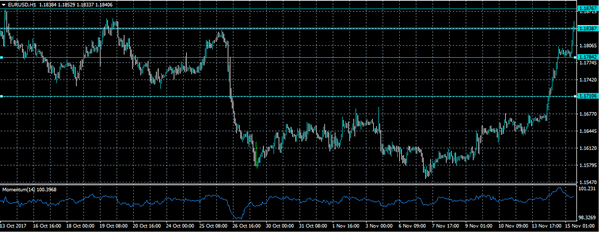
The euro has continued to move higher against the U.S dollar during the European trading session, hitting 1.1852, as the flight away from U.S dollars and into euros heightens. The EURUSD pair has pulled back marginally, with price-action currently trading around the 1.1840 level, as traders start to book intraday profits. Broad-based U.S dollar weakness has accelerated the euros rise, as the U.S dollar index breaks below long-term technical support. Traders and investors now await the releases of key macro-economic data from the United States economy.
Should the EURUSD pair continue to trade above the 1.1800 level, further upside towards the 1.1876 and 1.1910 levels remains likely.
Should price-action decline below the 1.1800 level, euro sellers will likely move to re-test the 1.1784 and 1.1710 technical support regions.
CAC Slump Continues, but Airbus Shines
The CAC continues to lose ground in the Wednesday session. Currently, the CAC is at 5,283.50, down 0.60% on the day. On the release front, the eurozone trade surplus jumped to EUR 25.0 billion, above the estimate of EUR 21.2 billion. French Final CPI posted a weak gain of 0.1%, matching the forecast. The markets are keeping a close eye on US consumer data. CPI is expected to come in at 0.1% and Core CPI at 0.2%. Consumer spending is also expected to post low numbers, with the estimate for Retail Sales at 0.2% and Core Retail Sales at 0.0%. On Thursday, the eurozone release Final CPI.
It's been a rough November for the CAC, which has plunged 4.5 percent. The index has posted six straight losing sessions and is at its lowest level since September 28. Financial stocks are lower on Wednesday, as BNP Paribas and Societe General have declined 0.87% and 0.81%, respectively. There was a bright spot from Airbus Group, which announced on Wednesday that it had signed an order for 430 aircraft to Indigo Partners, for a price of $49.5 billion. This marks the company's biggest deal in its history, and Airbus shares are up 2.53% on the day.
The heads of central banks met on Tuesday at an ECB event, with a focus on communication with the markets and the public. Federal Reserve Chair Janet Yellen acknowledged that the FOMC committee of 19 members posed problems, as members did not always speak with a unified voice. This led to the markets picking up on differences between policymakers, often leading to market volatility. Yellen admitted that this problem would not be solved anytime soon, saying it was "a work in progress". To be fair, this is also an issue for the ECB, as the markets have on occasion reacted to comments from individual policymakers regarding monetary policy or quantitative easing.
The eurozone economy received a respectable grade on Tuesday, as Flash GDP for the third quarter came in at 0.6%. The eurozone expanded in Q3 at an annualized rate of 2.5%. Germany's robust economy has led the way, with annualized growth of 2.8%, but traditional laggards France and Italy have also rebounded in 2017. At the same time, steady growth has failed to boost inflation, which remains well behind the ECB's target of around 2.0%. German Final CPI underscored the lack of inflation, with a reading of 0.0% in October. As long as inflation remains at low levels, the ECB is unlikely to further adjust its asset purchases program.