

Sample Category Title
Pound Claws Back After BoE Setback
The British pound has posted gains at the start of the week. In Monday's North American trade, GBP/USD is trading at 1.3121, up 0.35% on the day. On the release front, there are no major releases out of the UK or the US. The UK will release British BRC Retail Sales Monitor, an important consumer spending indicator. On Tuesday, the UK releases Halifax HPI and Fed Chair Janet Yellen will speak at event in Washington.
After taking a bath on Thursday, the British pound has made up some ground. The pound plunged 1.4 percent after the BoE raised rates for the first time since 2007. The rate hike had been expected for weeks, and the markets treated the BoE's move as a dovish rate, as the Bank indicated that this could be a "one and done" rate hike, given that the UK economy has lost a step, and the uncertainty of Brexit continues to concern investors. Thursday's rate hike reversed the rate cut back in August 2016, which was an "emergency cut" which the cautious BoE implemented to cushion the economy following the stunning Brexit vote in June 2016.
The Federal Reserve remains in the news, after FOMC member William Dudley announced that he will retire in mid-2018. This move could have implications for monetary policy, depending on who will replace Dudley. A possible candidate is Kevin Warsh, who made the short list for the successor to Fed Chair Janet Yellen. Warsh is in favor of higher rates and favors less regulation of the banking sector.
On Thursday, US President Trump nominated Federal Reserve Governor Jerome Powell to head the Federal Reserve. Powell will take over in February 2018 when Yellen's term expires. Powell is expected to hold the course with monetary policy, which has been marked by incremental and small rate hikes since December 2015. It's all but a given that the Fed will raise interest rates in December, but the forecast for 2018 is less clear. If the US economy continues to grow at current levels, we could see up to three rate hikes next year. Powell will also be tasked with continuing to trim the Fed's huge balance sheet of $4.2 billion. Last month, the Fed has started trimming the balance sheet by $10 billion/mth, but these cuts are expected to increase in size next year.
UK Economy at Important Crossroads: Brexit and Wider Politics, Inflation and Interest Rate Decisions Setting the Outlook
The UK economy's resilience to the Brexit vote did not continue into 2017 as largely upbeat economic releases following last year's vote did not manage to maintain momentum with economic activity eventually slowing down. Meanwhile, June 2016's vote shock led to sterling depreciating versus other currencies, pushing inflation higher.
Inflation is growing at a faster pace than wage growth resulting in consumers' reduced purchasing power. This is negatively affecting spending patterns.
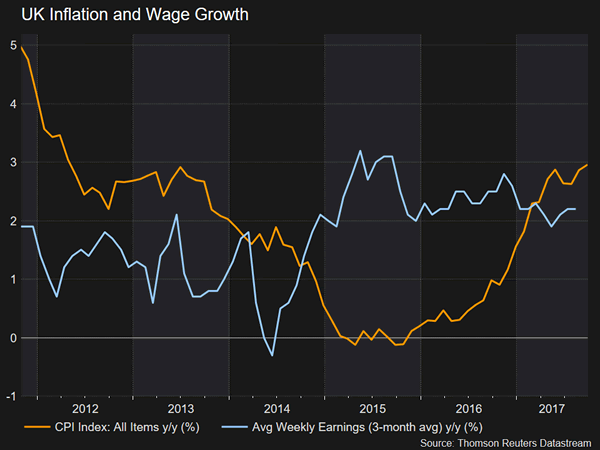
The Bank of England proceeded with a rate rise for the first time in over a decade upon completion of its November meeting on monetary policy in its efforts to push inflation lower towards the central bank's target. However, the central bank faces important tradeoffs: is it wise to raise rates in an environment of declining economic activity?
Adding to the challenges, politics go beyond Brexit-related uncertainty after Prime Minister Theresa May's Conservative Party failed to maintain its parliamentary majority following the elections that took place in early summer. On top of that, her leadership is challenged, further complicating the situation and acting as a drag on the pound.
Bank of England balancing act: inflation Vs risk to hamper economic activity
The BoE decided to raise its benchmark rate by 25bps to 0.5% as its complemented its latest policy meeting. However, just as markets interpreted the European Central Bank's tapering decision earlier in October as relatively dovish, the BoE's rate rise was also dubbed as a "dovish hike" with sterling recording sizable losses relative to majors including the dollar and the euro.
Given the BoE's guidance, markets now anticipate only two additional quarter percentage point hikes by the end of 2020 as the central bank appeared more dovish than many had anticipated. Using currency movements as a means to gauge dovishness in the BoE's message: euro/pound advanced by 1.8% on November 2, the day the bank completed its meeting. This represents the British currency's worst daily drop since sterling's "flash crash" on October 7, 2016.
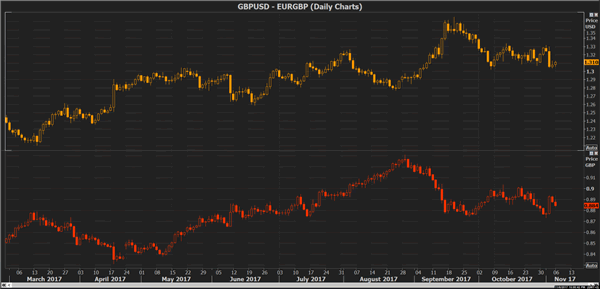
Monetary policy divergence with the Federal Reserve, which is normalizing its policies more "actively", is supportive of a weaker pound/dollar pair over the medium- to longer-term. As of now, the Fed remains on track to deliver an additional rate hike as it meets in December, while it has also started the process of shrinking its massive balance sheet in a gradual effort to slowly bring its size down to pre-crisis levels.
The BoE is in a difficult position. Its primary objective is price stability, interpreted as achieving an annual inflation rate of 2%. Inflation rose by 3% year-on-year in September, at its highest pace since 2012, with the bank anticipating further acceleration in consumer prices in October. In light of this and given its mandate, its hands in proceeding with a rate hike were tied to an extent; the bank acted to facilitate the return of inflation to its target.
However, raising rates - a tightening action - at a time when the UK economy is slowing down is a risky endeavor; the UK economy grew by 1.5% year-on-year in the third quarter of 2017, at its slowest pace since the first quarter of 2013. The BoE is in a balancing act. In the words of BoE Governor Mark Carney, it needs to: "balance any trade-off between the speed at which we (MPC members) return inflation sustainably to target with the support that monetary policy provides to jobs and activity."
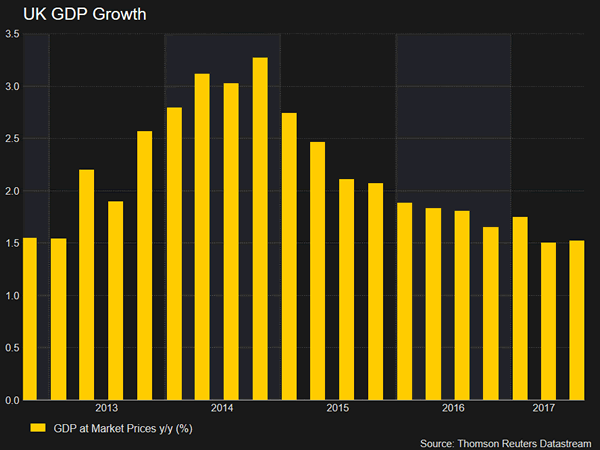
Governor Carney's considerations of the effects of Brexit on the UK economy of course persist as negotiations are ongoing. One of his remarks during the press conference that followed the central bank's latest meeting and having Britain's departure from the EU in mind was: "These aren't normal times."
Brexit asymmetry and PM May's position
Given that pending issues are resolved, Britain is set to officially exit the EU in March 2019, two years after triggering Article 50, this being the act of giving formal notice to the European Council of Britain's intention to withdraw from the EU bloc.
The UK's financial obligations to the EU, how the UK will protect the rights of EU citizens living in the nation and the future of the Irish border - the Republic of Ireland will remain an EU member state but Northern Ireland that is part of the UK will not - seem to, at least for now, constitute the most pressing issues in the talks that are taking place.
A statement from Brexit Secretary David Davis and the EU's Chief Negotiator for Brexit Michel Barnier indicated that talks would resume on November 9 and 10. A tough stance by the UK that does not leave much room for progress in negotiations and consequently leads to a no-deal scenario, though still a possibility, does not seem to be the base case scenario at the moment as tensions between the two sides appear to be on the decline. Given the immensely significant investment and trade ties between the two parties, this is also evidently a rational stance by the two sides.
It is noteworthy that market perception is one of an asymmetric burden in the case of a no-deal scenario; one that weighs much more on the UK economy than the eurozone's. And this is evident from the currency markets. Whenever a story of an impasse in negotiations emerges, it is often the case that sterling retreats considerably relative to other currencies (the British currency tends to lose ground versus the euro as well) with the eurozone's common currency not behaving in the same manner.
Asymmetry in investors' minds though does not just exist in relation to the effects of a no-deal outcome, but this also seems to be the case when the two sides seem to be moving towards achieving a constructive future relationship - sterling is much more likely to gain versus other currencies (including against the euro) when such positive developments emerge. Markets are therefore projecting an asymmetric burden as well as an asymmetric benefit.
One should not forget that Prime Minister Theresa May's bet when she called June's snap elections did not pay off as her Conservative party lost its parliamentary majority. This creates additional uncertainty not just within the context of Brexit but in a broader sense as well. On top of this, May's leadership has been recently challenged by members within her own party. This additional layer of uncertainty may prove too much for corporations making business decisions that involve investing large sums of money in the UK; the risk premium being applied potentially has the capacity to turn lucrative projects into unprofitable ones, with declining investments acting as a drag on the economy and its future prospects.
The UK is at important crossroads with decisions over the coming months having the capacity to steer the outlook both in favor but also to the nation's detriment - currency markets will react accordingly.
With the Federal Reserve remaining on what looks a firm path of policy tightening - contrasting the BoE - and uncertainty on US tax reform gradually dissipating, pound/dollar is looking likely to record losses further ahead. Of course, derailment on any of the aforementioned dollar positives will lead to greenback weakness, however the trend has been towards an ever-increasing tightening bias on behalf of the Fed, while similarly there is gradual progress on the delivery of business-friendly tax reforms. Should these trends continue, the view for a stronger dollar relative to sterling over the long-term remains well-supported.
Emmanuel Macron prevailing in the French elections earlier in the year seemed to open the way for more integration in the eurozone, delivering a blow - at least this was the perception - to populist forces. As a result, the euro rallied across the board. Things have changed since then. Angela Merkel secured a fourth term as German chancellor, but her party faced its worst result in decades in September's elections. The Free Democrats (potential partners in Merkel's government) remain skeptical of many of Macron's ideas for enhancing European integration. Merkel might find herself in a balancing act as well with uncertainty over Europe's future hurting eurozone's common currency versus sterling. Beyond this, one should not forget Catalonia's bid for independence with the latest polls showing regional pro-independence parties being in the lead, as well as next year's Italian elections with strong support expected for the populist-perceived Five Star Movement. While great uncertainty remains in relation to UK politics, on balance it might be argued that eurozone's headwinds over the coming months have a high chance of outweighing those faced by Britain, leading to a weaker euro/pound pair, though, at the moment, attempting to call this pair's direction further ahead is a trickier endeavor than pound/dollar's.
Yen Quiet as Investors Search for Cues
USD/JPY has ticked lower in the Monday session. In North American trade, USD/JPY is trading at 114.12, up 0.07% on the day. On the release front, the BoJ released the minutes of the October policy meeting. In the US, there are no major events. William Dudley, President of the New York Fed, announced his retirement. On Tuesday, Fed Chair Janet Yellen will speak at an event in Washington.
Bank of Japan Governor Haruhiko Kuroda spoke on Monday, after the release of the BoJ minutes. Kuroda expressed optimism that the improving economy will trigger higher inflation and move closer to the Bank's target of 2 percent. Kuroda called the economic expansion "highly sustainable", and the markets took his optimism as a sign that the BoJ has no plans to inject further stimulus in order to beef up inflation. The minutes from the October meeting indicated that many of the board members were satisfied that the inflation target would be met under current policy.
The Federal Reserve remains in the news, after FOMC member William Dudley announced that he will retire in mid-2018. This move could have implications for monetary policy, depending on who will replace Dudley. A possible candidate is Kevin Warsh, who made the short list for the successor to Fed Chair Janet Yellen. Warsh is in favor of higher rates and favors less regulation of the banking sector.
On Thursday, US President Trump nominated Federal Reserve Governor Jerome Powell to head the Federal Reserve. Powell will take over in February 2018 when Yellen's term expires. Powell is expected to hold the course with monetary policy, which has been marked by incremental and small rate hikes since December 2015. It's all but a given that the Fed will raise interest rates in December, but the forecast for 2018 is less clear. If the US economy continues to grow at current levels, we could see up to three rate hikes next year. Powell will also be tasked with continuing to trim the Fed's huge balance sheet of $4.2 billion. Last month, the Fed has started trimming the balance sheet by $10 billion/mth, but these cuts are expected to increase in size next year.
USDCAD – Last Week’s Fall is Taking a Breather; Daily Tenkan-sen Caps Recovery for Now
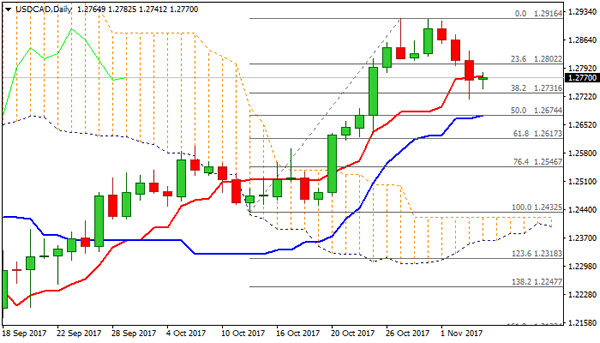
The pair is slightly firmer on Monday, following strong fall in last three days of past week. Bearish acceleration found footstep at 1.2700 zone and closed above cracked Fibo 38.2% of 1.2432/1.2916 upleg at 1.2731.
Upside attempts today remain capped by broken daily Tenkan-sen (1.2773) and repeated close below it would keep near-term focus at the downside for retest of 1.2731 Fibo support.
Sustained break here is needed to signal fresh extension of pullback from 1.2916 top towards next key support at 1.2674 (50% retracement / daily Kijun-sen).
Conversely, close above Tenkan-sen is required to sideline current bearish threats while sustained break above 1.2800 would signal reversal.
Res: 1.2773; 1.2802; 1.2835; 1.2875
Sup: 1.2731; 1.2714; 1.2674; 1.2617
EURGBP: Weakens On Price Follow Through
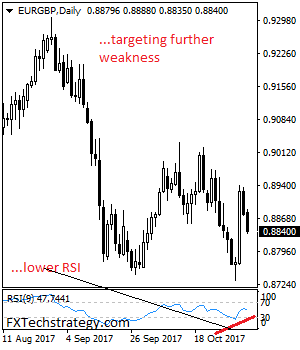
EURGBP - The cross saw a follow through lower on Monday. This is coming on the of its Friday weakness. Support lies at the 0.8800 Level where a violation will turn focus to the 0.8750 level. A break will expose the 0.8700 level. Its daily RSI is bearish and pointing lower suggesting further weakness. Resistance resides at the 0.8900 level where a violation if seen will turn risk towards the 0.8950 level. Further up, resistance resides at 0.9000 level followed by the 0.9050 level. All in all, EURGBP remains biased to the downside.
Euro Drifts South in Technical Trade
- European equities trade with small losses in this week's opening session. US stock markets opened narrowly mixed.
- Bill Dudley, the influential head of the NY Fed, announced plans to retire next year before his term expires. Mr Dudley is planning the mid-2018 retirement to "ensure that a successor is in place well before the end of his term" in January 2019, the regional branch of the central bank said.
- Donald Trump accused Japan of engaging in unfair trade practices on the first leg of his five-nation Asia tour, during which the American president will focus on improving the US trade balance and efforts to press North Korea to give up its nuclear weapons.
- Just one in seven people from Catalonia believe the current standoff between Barcelona and Madrid will end in independence for the region while more than two thirds think the process has been bad for the economy, a survey showed.
- German industrial orders rose unexpectedly in September (1% M/M), driven by strong demand from other euro zone countries for capital goods including machines and vehicles, suggesting the economy will extend its solid upswing into the coming months.
- Second tier EMU eco data were better than forecast with an upward revision to the final October Services PMI (55 from 54.9; despite downgrades to national figures), the highest Sentix investor confidence since 2007 (34 in November from 29.7) and more rapidly accelerating producer prices in September (0.6% M/M and 2.9% Y/Y from 0.3% M/M and 2.5% Y/Y).
- The ECB's decision to extend asset purchases was warranted by weak inflation and reinforces its guidance to keep rates at their current level for an extended period of time, ECB chief economist Peter Praet said.
Rates
Core bonds trade quiet, but constructive
Core bonds started the European session with a move higher that lasted till 10am CET. Afterwards, sideways trading in a very tight range kicked in. We don't have a good explanation for this spurt higher. Eco data were certainly not the reason. German factory orders and the EMU Sentix investor confidence were materially stronger-than-expected, but ignored. The final national October PMI figures were slightly revised lower, but nothing to get excited about. Dovish, but no new, comments of ECB Praet and some technical buying (Bund opened above 162.78 first resistance) may go some way to explain today's move. However, the key resistance/contract high at 163.43 remained as of yet out of reach, lowering the significance of today's price action, which wasn't exceptional in scope either. US Treasuries followed Bunds higher, but the latter outperformed. There were no US eco data and a speech of NY Fed Dudley will only take place after the European close.
At the time of writing, the German yield curve bull flattens with yields down between 0.6 bps (2-yr) and 2.7/2.8 bps (10-30-yr). The US yield curve also bull flattens with yields 0.1 bp (2-yr) to 1.6 bps (30-yr) lower. On intra-EMU bond markets, 10-yr yield spreads versus Germany are little changed (-1 to +2 bps).
Currencies
Euro drifts south in technical trade
Trading in the major FX cross rates was mostly technical in nature. EMU eco data were strong, but had no impact on trading. In a cautious risk-off context USD/JPY, EUR/JPY and EUR/USD all lost gradually ground in lockstep. EUR/USD finally dropped below the 1.16 barrier. The 1.1575 post-ECB low is on the radar. USD/JPY's topside attempt was rejected. The pair trades in well-known territory in the 114 area.
Asian equities traded mixed overnight. Chinese equities outperformed even as the PBOC warned on the risks of too high leverage. BOJ's Kuroda said that the BOJ wants inflation to overshoot the 2% target, suggesting the ultra-loose BOJ policy won't be scaled back anytime soon. USD/JPY spiked temporary north of the 114.50 barrier, but the break couldn't be sustained. EUR/USD held stable in the low 1.16 area.
There were several EMU eco data, but most of them were no market movers. German factory orders printed very strong at 1.0% M%/M and 9.5% Y/Y. The EMU Sentix investor confidence rose much more than expected, reaching the highest level since mid-2007. The Final EMU composite PMI was close to expectations at 56.0. The data confirmed that the EMU economy is in very good shape. However, it didn't help the euro. Risk sentiment turned a bit more cautious and core yields declined slightly. This weighed on USD/JPY, EUR/JPY and EUR/USD. The upside test of USD/JPY was rejected and the pair returned to the low 114 area. EUR/JPY tumbled almost one big figure from 133+ levels in Asia this morning. The rather sharp setback in EUR/JPY weighed on the overall performance of the euro. EUR/USD came within reach of the post-ECB low of 1.1575, but a real test didn't occur. If anything, euro softness (rather than USD strength) was the underlying FX trading theme today. A break below 1.1575 could inspire further euro losses.
Sterling extends rebound, partially on euro softness
On Friday, sterling regained modest ground after Thursday's post-BoE sell-off. This rebound continued today. We didn't see any eco or political news to support the move. In an appearance before a CBI audience, the UK PM acknowledged the need for clarity and for an implementation period, but didn't bring much new. Still the UK currency remained in relatively good shape today. Maybe some investors hope on signs of progress in the next round of Brexit-negotiations which start later this week. The political scandals (inside and outside the Conservative party) are apparently no really important factor for sterling trading yet. EUR/GBP trades in the 0.8845/50 area. The decline is at least partially due to euro softness. Cable also trades cautiously stronger in a daily perspective. The pair trades in the low 1.31 area.
EUR/USD Falls Below 1.1600
The euro price keeps consolidating in anticipation of new drivers. Less than expected non-farm payroll data out of US on Friday hasn't decreased the chances of another interest rate hike by the Fed in December. That along with the ECB's decision to prolong the asset purchasing programme into 2018 is exerting pressure on the common currency. The EUR/USD was mildly impacted by a weaker than expected report on German services PMI which dropped to 54.7 against the forecasted 55.2. The euro did receive support following the release of the services PMI for the Eurozone which increased by 0.1 to 55.0 and from the Sentix investor confidence index which grew to 34.0 in November, much better than the forecasted 31.2.
Investors are also reluctant to open new positions ahead of the speeches of the ECB's Mario Draghi and the Fed's Janet Yellen tomorrow. Analysts are however not expecting to get any new hints about future steps by the central banks.
The USD/JPY has fallen despite the negative effects from the speech by the head of the Bank of Japan. Haruhiko Kuroda confirmed the intention to keep the ultra-soft policy settings in Japan until inflation reaches the target level of 2.0%. Investors in the yen will be keeping an eye on the average cash earnings data due in Japan at 00:00 GMT.
Tomorrow the market turns its focus to the RBA's interest rate decision due at 03:30 GMT. The central bank is not expected to change monetary policy in Australia, but we may see a rise in volatility.
The bulls keep pushing WTI quotes upwards thanks to the fall in the number of active oil drilling rigs in the US by 8 to 729 units, according to oil services company Baker Hughes. Oil prices hit their highest level since July 2015 following Saudi Arabia's anti-corruption crackdown on the weekend and from statements on the Kingdom's intention to maintain OPEC's tightening of global supplies and target to reduce oil inventories.
EUR/USD
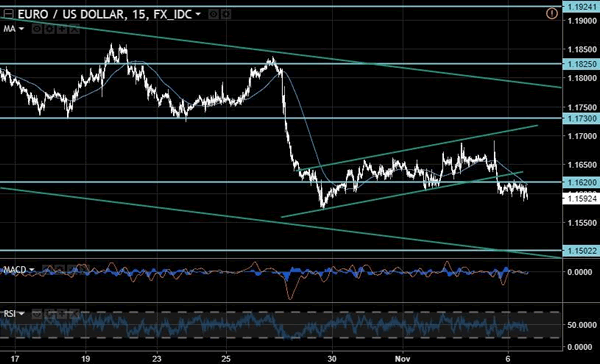
The EUR/USD price keeps consolidating under strong resistance at 1.1620. Fixing under this level may be the basis for further price drops to the 1.1500-1.1550 range. At the same time, we do not eliminate the chance of a current trend reversal to positive and in case of gaining a foothold above 1.1620, we may see further growth to 1.1730.
USD/JPY
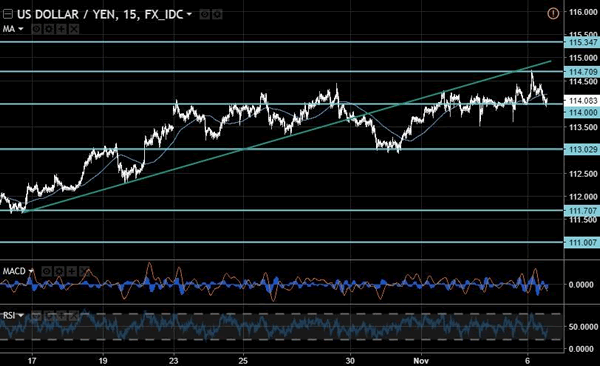
The USD/JPY retreated downwards after testing the resistance at 114.70. In case of breaking through the support at 114.00 and fixing below it, the next targets are likely to be 113.00 and 111.70. The RSI on the 15-minute chart just left the oversold zone, which points to the increased probability of a rising movement soon.
USD/WTI
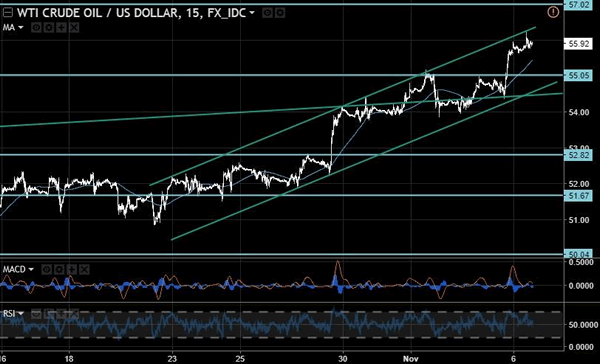
The USD/WTI is moving along the upper limit of the rising channel. The immediate goal in case of maintaining the current positive impulse will be at 57.00. In case of profit taking the quotes may return to the SMA100 on the 15-minute chart or even to the support at 55.00.
Elliott Wave Analysis: BTCUSD Land GBPJPY
Good day traders!
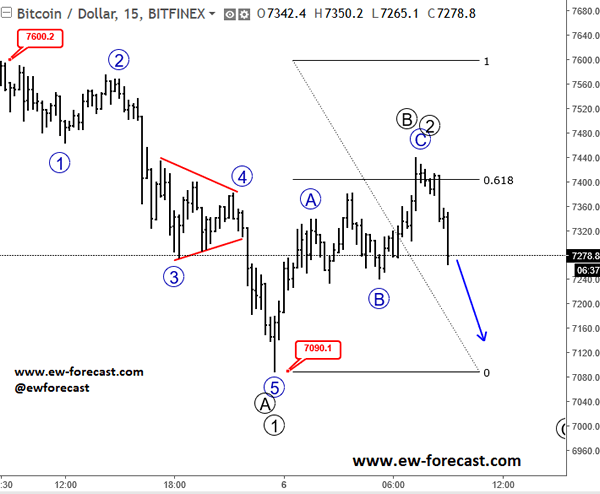
Bitcoin moved slightly higher up to 7400/7440 where we see a potential completion of a three wave recovery, either for wave B or wave 2, but in both cases there is room for a drop down to 7k while price is below 7600.
BTCUSD, 1H
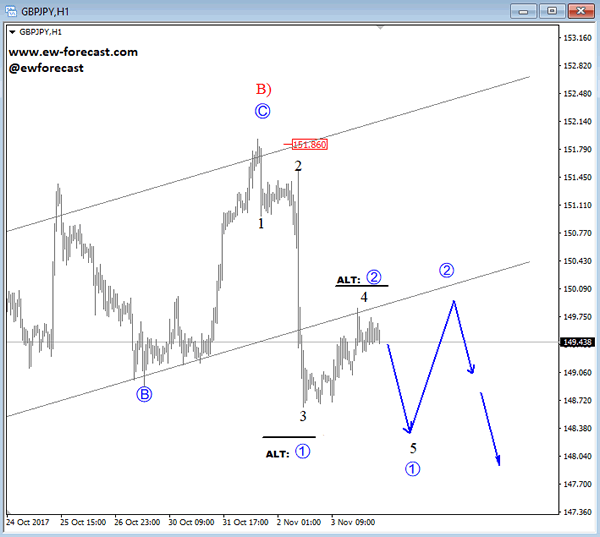
GBPJPY is making a slow recovery up from 148.60 towards the trendline resistance that we see it as a corrective bounce; it can be wave 4 maybe even wave 2, but in either case there is probability for a drop to 148.00 soon.
GBPJPY, 1H
EURUSD – Downside Under Pressure after Completion of Bearish Flag on Daily Chart
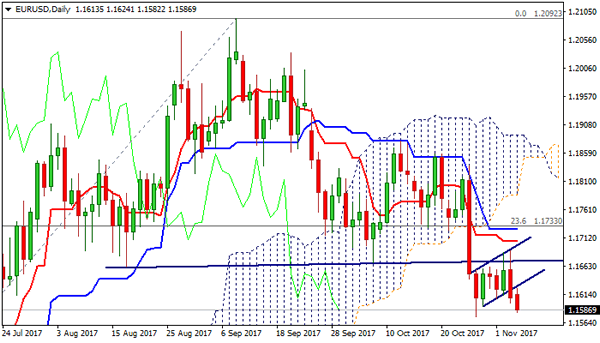
The Euro accelerated lower after recovery attempts on Monday were capped by falling 7SMA at 1.1624.
Fresh weakness returned below 1.1600 handle and pressuring key support at 1.1574 (27 Oct low), break of which would signal bearish continuation towards next target at 1.1510 (Fibo 38.2% of 1.0570/1.2092 rally/rising weekly Kijun-sen).
Completion of bearish flag pattern on daily chart was strong bearish signal for further weakness, as flag base now acts as initial resistance at 1.1623 (reinforced by falling 7 SMA).
Res: 1.1624; 1.1671; 1.1690; 1.1705
Sup: 1.1574; 1.1510; 1.1445; 1.1400
Twist in Saudi Game of Thrones
Major political upheaval is underway in Saudi Arabia after dozens of top officials were arrested on Saturday along with a series of other events that are unlikely to be a coincidence. The Canadian dollar was the top performer last week, while the pound lagged. CFTC positioning showed a shift against commodity currencies. A new Premium trade has been issued on a commodity currency, backed by 3 supporting charts.

Thirty-two year Prince Mohammed bin Salman continues to tighten his grip following his rise to Crown Prince in June. A series of arrests on Saturday, ostensibly for corruption, threaten major turmoil in the Kingdom. The arrests included 11 senior princes, a former finance minister and Prince al-Waleed bin Talal, who is the richest man in the Arab world and the largest shareholder of Citigroup. The head of the National Guard was also removed.
Also on Saturday, a missile was shot down near Riyadh while on Sunday a helicopter carrying Mansour bin Muqrin crashed. His father had been in-line to succeed King Salman until 2015.
This all comes just a week after Trump's son-in-law Jared Kushner made an unannounced trip to Saudi Arabia and on Saturday Trump tweeted asking Aramco to launch its IPO in New York. Lebanese PM Hariri's announced resignation on Friday on the grounds that it is no longer safe to remain on the post may be related to the Saudi equation as the Kingdom has long served as a safehaven to the PM and his family.
We struggle to believe this is all a coincidence but what comes next is equally opaque. The turmoil could be followed by assassinations and internal strife or Bin Salman could successfully tighten his grip on all the levers of power. For now, the present is developing quickly and the future highly uncertain.
Domestic market signals may also be tough to interpret. Saudi stocks fell 2.2% early but finished up 0.3% in what was likely government buying.
Late on Friday, WTI crude broke out to the highest since January 2015 and - once again - we can't dismiss that as a coincidence.We will be watching very closely in the days ahead.
CFTC Commitments of Traders
Speculative net futures trader positions as of the close on Tuesday. Net short denoted by - long by +.
- EUR +72K vs +84K prior
- GBP +1vs -1K prior
- JPY -119K vs -116K prior
- CHF -21K vs -12K prior
- CAD +58K vs +72K prior
- AUD +52K vs +57K prior
- NZD -6K vs +1K prior
The head-and-shoulders pattern in EUR/USD along with the resurgent US dollar placed substantial euro positions in jeopardy. Commodity currencies also remain in a precarious position despite last week's bounce. With the BoE decision out of the way and no more hikes coming in the near term, expect to see a slow build in GBP shorts unless the Brexit rhetoric improves in the coming 6 weeks.