

Sample Category Title
Gold Yawns After Fed, BoE Rate Decisions, Fed Chair Nomination Looms
Gold has ticked higher in the Thursday session. In North American trade, the spot price for an ounce of gold is $1275.93, up 0.16% on the day. On the release front, unemployment claims dropped to 229 thousand, beating the estimate of 235 thousand. The focus will be on employment numbers on Friday, as the US releases Average Hourly Earnings, Nonfarm Payrolls and the unemployment rate. We'll also get a look at ISM Nonfarm Manufacturing PMI.
The markets weren't expecting any fireworks from the Federal Reserve, as the November rate statement was expected to be little more than a run-up to the December rate decision. Fed policymakers signaled that a rate hike is very likely in December, and the Fed did not change the wording in the statement with regard to future rate hikes. The tone of the statement was positive, as the Fed noted that the storms which battered the US had caused a decline in payrolls in September, but the storms were not likely to "materially alter the course of the national economy over the medium term." After a excellent Advance GDP reading of 3.0%, the economy's next test is nonfarm payrolls on Friday. In September, the indicator declined by 33 thousand, but the markets are counting on a strong rebound, with an estimate of 311 thousand for October. The markets are less bullish on wage growth, which is expected to slow to 0.2%, as inflation remains at low levels, despite strong economic growth.
The Fed remains in the spotlight, as President Trump is expected to announce later on Thursday who will succeed Janet Yellen as Fed chair when her term ends in February 2018. Federal Reserve Governor Jerome Powell is expected to get the nod from Trump. With Powell at the helm, we can expect more of the same from regarding monetary policy; namely, small incremental rate hikes, which has been the stance of the central bank since it began raising rates in December 2015.
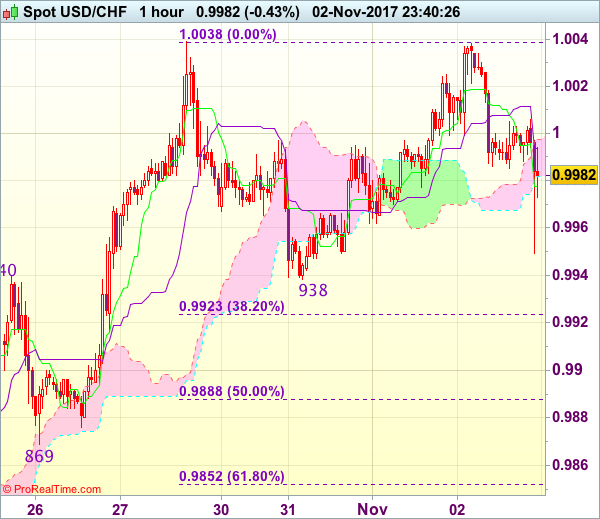
Trade Idea Wrap-up: USD/CHF – Hold long entered at 0.9950
USD/CHF - 0.9973
Most recent candlesticks pattern : N/A
Trend : Up
Tenkan-Sen level : 0.9978
Kijun-Sen level : 0.9994
Ichimoku cloud top : 0.9997
Ichimoku cloud bottom : 0.9982
Original strategy :
Bought at 0.9950, Target: 1.0050, Stop: 0.9915
Position : - Long at 0.9950
Target : - 1.0050
Stop : - 0.9915
New strategy :
Hold long entered at 0.9950, Target: 1.0050, Stop: 0.9915
Position : - Long at 0.9950
Target : - 1.0050
Stop : - 0.9915
As the greenback has retreated after faltering below indicated resistance at 1.0038, retaining our view that consolidation below this level would be seen, however, still reckon downside would be limited to 0.9945-50 and bring another rise later. Above 1.0005-10 would bring retest of 1.0038 but break there is needed to confirm recent upmove from 0.9421 low has resumed and may extend further gain to 1.0050-55, then towards 1.0075-80 but price should falter below 1.0100 resistance.
In view of this, we are holding on to our long position entered at 0.9950. Below said support at 0.9938 would abort and signal top is formed instead, risk correction to 0.9920-23 (38.2% Fibonacci retracement of 0.9737-1.0038) but 0.9885-90 (50% Fibonacci retracement) should limit downside and support at 0.9869 would remain intact.
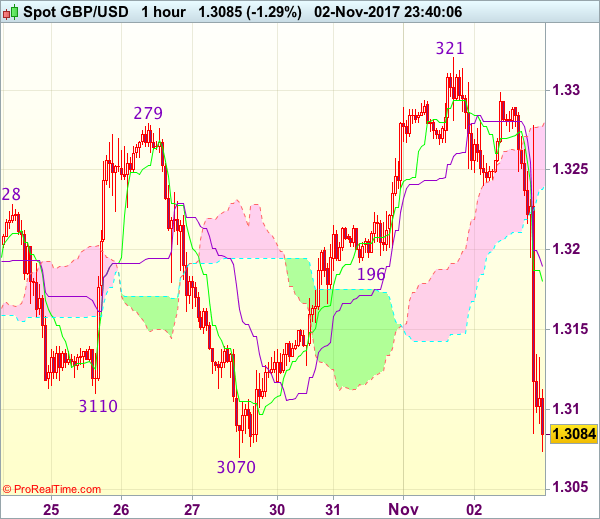
Trade Idea Wrap-up: GBP/USD – Sell at 1.3170
GBP/USD - 1.3072
Most recent candlesticks pattern : N/A
Trend : Near term down
Tenkan-Sen level : 1.3175
Kijun-Sen level : 1.3184
Ichimoku cloud top : 1.3278
Ichimoku cloud bottom : 1.3238
New strategy :
Sell at 1.3170, Target: 1.3040, Stop: 1.3205
Position : -
Target : -
Stop : -
Cable’s post-BOE selloff together with the breach of support at 1.3070 signals early erratic rise from 1.3027 has ended and bearishness remains for further fall to 1.3050, however, break of said support at 1.3027 is needed to signal early downtrend has resumed for weakness to psychological support at 1.3000, then towards 1.2970-75 which is likely to hold from here due to near term oversold condition.
In view of this, would not chase this fall here and would be prudent to sell cable on recovery as the Tenkan-Sen (now at 1.3175) should limit upside and bring another decline later. Above 1.3200 would defer and prolong choppy trading, risk rebound to 1.3235-40 first.
Pound Plunges on ‘Dovish’ Rate Hike; Dollar Unmoved by Tax Plan, Powell Nomination
The pound was the biggest loser of today's foreign exchange action after the Bank of England hiked rates by a quarter point but promised to be 'gradual' regarding future rate increases. The US dollar failed to benefit from the unveiling of key details regarding the tax reform plan of President Trump and Congressional Republicans.
The pound lost more than a cent against the dollar as it dropped to 1.3087 after the Bank of England raised interest rates but was cautious in signaling further hikes. The Bank said that additional rate hikes would be warranted while acknowledging the Brexit-related uncertainty. Any such hikes would be 'gradual and limited' however. The 2 deputy Governors dissented from the majority decision to bring the key rate back to 0.50% from 0.25%; reversing last year's cut that was aimed at cushioning the economy from the impact of Brexit. The euro also shot up versus sterling to challenge the 0.89 level. It was last at 0.8907. There were not many surprises in the Bank of England decision and statements, but the market was perhaps expecting a more hawkish stance and was thus disappointed.
In today's key economic numbers, UK construction PMI rose sharply in October to 50.8, back into expansion territory from the previous month's disappointing 48.1 print. German employment numbers more or less met expectations and confirmed a buoyant labor market in Europe's largest economy, while weekly initial jobless claims in the US fell to a new low of 229 thousand. In further good news for the US economy, labor productivity in the third quarter surged by 3%, which could allow for faster wage increases for American workers.
Euro/dollar posted some gains during the session but failed to break out of its post-ECB meeting range of the past 6 trading days. The pair was last at 1.1668, with the US dollar getting most of the attention this week due to the various key risk events out of the US, in contrast to the relatively more quiet news flow about the single currency.
There was also some modest disappointment for dollar bulls as details from the proposed tax plan of President Trump and Congressional Republicans did not spark much dollar buying. The prospect of a dovish-on-balance new Fed Chair also did not help the greenback to rally and dollar bulls have only Friday's employment report to look forward to for possible good news. The proposed tax plan would reduce the corporate tax rate to 20% and tax rates for individuals would drop too. It remains to be seen whether Republicans can muster enough unity among themselves to pass the proposed plan, which could result in both faster economic growth but also higher deficits. Judging by the action in foreign exchange markets, there are lingering doubts whether a passage of such tax cuts can be achieved soon, especially in the US Senate where the Republican majority is thin.
Looking ahead, the market will look forward to a speech by New York Fed President William Dudley, one of the most important Fed officials that regularly give guidance on monetary policy.
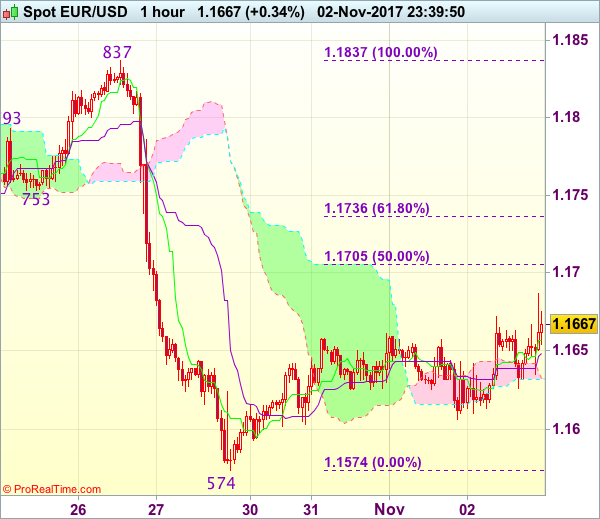
Trade Idea Wrap-up: EUR/USD – Sell at 1.1705
EUR/USD - 1.1672
Most recent candlesticks pattern : N/A
Trend : Down
Tenkan-Sen level : 1.1643
Kijun-Sen level : 1.1639
Ichimoku cloud top : 1.1643
Ichimoku cloud bottom : 1.1643
Original strategy :
Sell at 1.1705, Target: 1.1605, Stop: 1.1740
Position : -
Target : -
Stop : -
New strategy :
Sell at 1.1705, Target: 1.1605, Stop: 1.1740
Position : -
Target : -
Stop : -
Euro’s intra-day rebound has retained our view that near term sideways trading is likely to continue and although initial upside risk remains for the rebound from 1.1574 low to extend marginal gain from here, as this move is still viewed as retracement of recent decline, reckon upside would be limited to 1.1700-05 (50% Fibonacci retracement of 1.1837-1.1574) and bring retreat later, below 1.1600-05 would signal the rebound from 1.1574 low has ended, bring retest of this level first. A drop below said support at 1.1574 would extend recent decline from 1.2093 top to 1.1550-55 but loss of downward momentum should prevent sharp fall below 1.1520-25 and reckon 1.1500 would hold.
In view of this, we are looking to sell euro on further subsequent recovery as 1.1700-05 should limit upside and bring another decline. Only above previous support at 1.1725 (now resistance) would signal low is formed instead, bring retracement of recent decline to 1.1750-55 first.
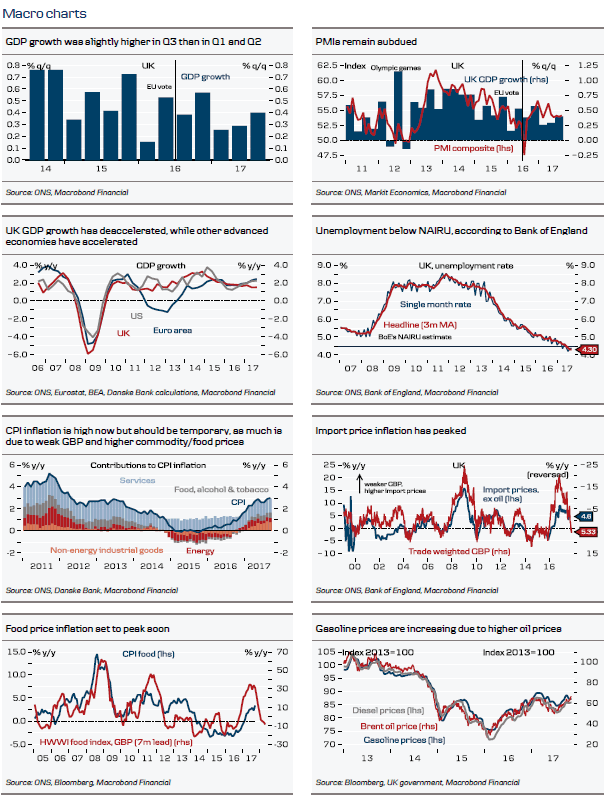
BoE Keeps its Flexibility on Further Rate Hikes Next Year
Bank of England did not comment on rate path
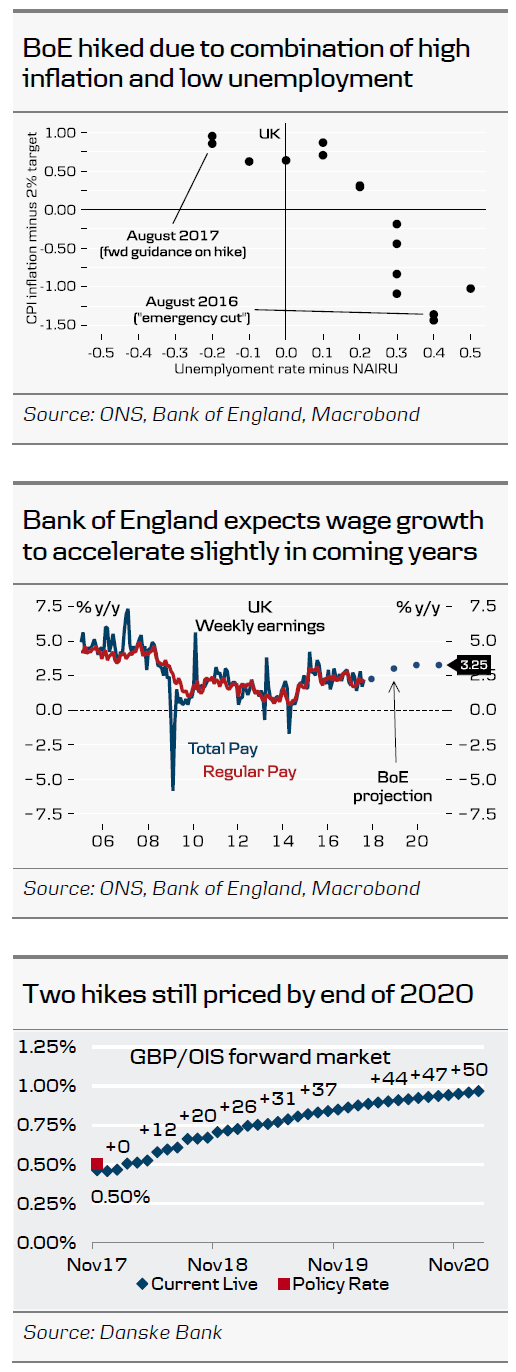
As expected, the Bank of England (BoE) raised the Bank Rate by 25bp from 0.25% to 0.50% with the vote count 7-2 (Sir David Ramsden and Sir Jon Cunliffe dissented) in line with our expectation but against the consensus view of a 6-3 vote count. It is likely this explains why EUR/GBP moved lower initially. However, UK yields declined 6-9bp across the 2-10Y curve and EUR/GBP ended higher, as the Bank of England did not comment on current market pricing (two hikes over three years, this is also what the BoE's projections are based on), meaning the BoE keeps its flexibility. In addition, the BoE said it will 'monitor closely' incoming data 'including the impact of today's increase in Bank Rate'. During the press conference, Mark Carney said the rate hike is just a 'small adjustment' and that the BoE has 'stretched the horizon of which CPI inflation should return to 2% target due to unusual circumstances' (Brexit). Still, Carney noted that inflation is expected to remain slightly above 2% even assuming the two hikes over three years currently priced in the market. Overall, the signal is neutral, which was more dovish than the market had expected, in line with our expectation. Another important thing is that the BoE says that potential growth is 1.5% y/y, so as long as GDP grows by above 0.3% q/q, then the economy will continue running hotter.
We still believe the BoE will stay on hold next year and not hike again before 2019, so this is more about taking back the emergency cut from August 2016 just after the Brexit vote. We think it is likely the BoE is too optimistic on wage growth and we believe the BoE does not want to tighten monetary policy too much relative to the ECB. The ECB has just extended QE by nine months, meaning it is unlikely to raise rates before 2019. Markets currently price in a Fed-like hiking cycle with one hike a year.
Relative rates, growth and Brexit uncertainty set to support EUR/GBP near term
EUR/GBP increased following the rate hike announcement in line with our expectation as the BoE refrained from commenting on future rate hikes. With the next rate hike priced by November 2018, we see market pricing as slightly on the hawkish side in the sense that it is more likely that rate hike expectations for 2018 will be lowered in coming months than that more rate hikes in 2018 are priced in. Overall, we still expect EUR/GBP to trade within the 0.8650-0.9000 range in coming months, with Brexit uncertainty remaining a source of volatility. In the near term, we expect relative rates, growth and Brexit uncertainty to be EUR/GBP positive and we still expect the cross to test the high end of the range.
Longer term, Brexit negotiations remain the key determinant for GBP and we still see potential for a further decline in EUR/GBP driven by possible clarification on Brexit negotiations and valuations. However, with the ECB moving towards an exit as well and as relative growth is set to remain EUR/GBP positive, we see only modest downside potential in the year ahead. We target 0.87 in 6M and 0.86 in 12M.
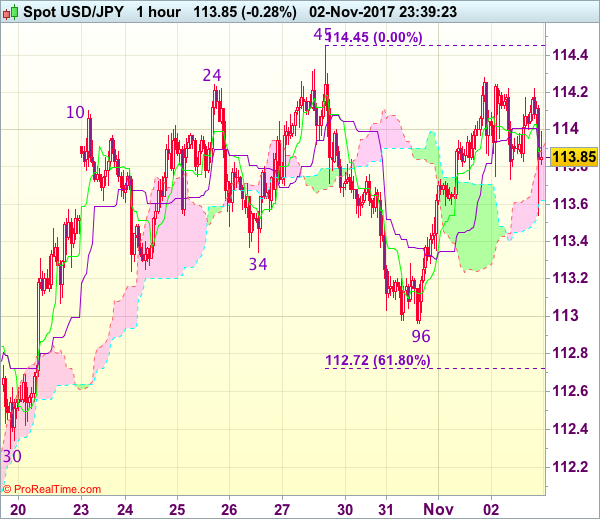
Trade Idea Wrap-up: USD/JPY – Buy at 113.20
USD/JPY - 113.84
Most recent candlesticks pattern : N/A
Trend : Near term up
Tenkan-Sen level : 113.98
Kijun-Sen level : 114.01
Ichimoku cloud top : 113.61
Ichimoku cloud bottom : 113.45
Original strategy :
Buy at 113.40, Target: 114.30, Stop: 113.05
Position : -
Target : -
Stop : -
New strategy :
Buy at 113.20, Target: 114.20, Stop: 112.85
Position : -
Target : -
Stop : -
As the greenback has retreated after rising to 114.28 yesterday, suggesting consolidation below said resistance would take place and pullback to 113.60 cannot be ruled out, however, reckon downside would be limited to 113.40 and bring another rise later towards indicated strong resistance at 114.45-50 but break there is needed to retain bullishness and confirm early upmove has resumed for headway to 114.75-80 and later towards 115.00 but near term overbought condition should limit upside.
In view of this, we are looking to buy dollar on pullback as 113.15-20 should limit downside and bring another rise later. Below said support at 112.96 would abort and suggest top has been formed at 114.45, bring retracement of recent rise to 112.70-75 (61.8% Fibonacci retracement of 111.65 to 114.45) but previous resistance at 112.48 should hold.
The Bank of England Lowers Economic Forecast
The EUR/USD price keeps consolidating despite yesterday's publication of the FOMC statement on monetary policy where it was noted that the regulator plans to increase interest rates one more time during this year and three more times in 2018. At the same time, the news of Donald Trump nominating Jerome Powell to the Fed's chair position should stimulate the hawkish sentiment on the market. The greenback was supported by news on the decline in the initial jobless claims in the US to 229,000 from the expected 235,000 thousand. Traders are waiting for tomorrow's release of labor market data. The NFP report is expected at 12:30 GMT to come in at 312,000 so an improvement on that number is likely to lead to a price decline of the EUR/USD.
The British pound has shown a sharp decline after the Bank of England increased the interest rate by 0.25% to 0.50% and lowered the economic outlook of the UK economy. GDP is now growing at 1.5% compared to 1.75% in August. The economic growth in 2018 is forecasted at 1.7% compared to 1.8% anticipated earlier. The GBP/USD remains under pressure thanks to negative sentiment around the influence of Brexit on the state of the national economy.
The aussie price resumed positive dynamics after the recent correction. Optimistic sentiment has strengthened on the background of positive statistics on the trade balance, which showed the surplus increased to 1.75 billion compared to 1.42 billion expected. Tomorrow traders will be on the watch for the retail sales report in Australia due at 00:30 GMT.
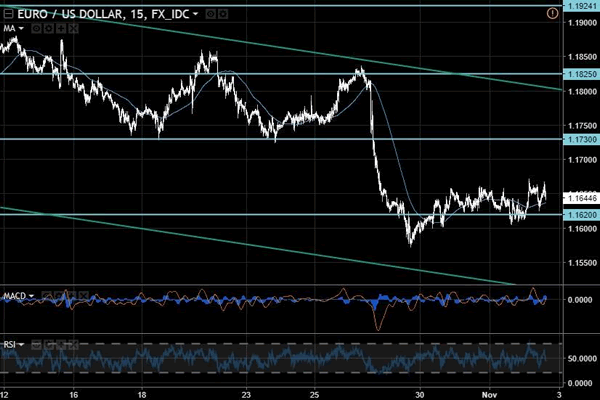
EUR/USD
The EUR/USD price continued growing after touching the SMA100 on the 15-minute chart. In case of further growth, the price may return to the important 1.1700 line. The signal to sell may come from breaking through the local minimum near 1.1600. In this case the next targets will be at 1.1500 and 1.1450.
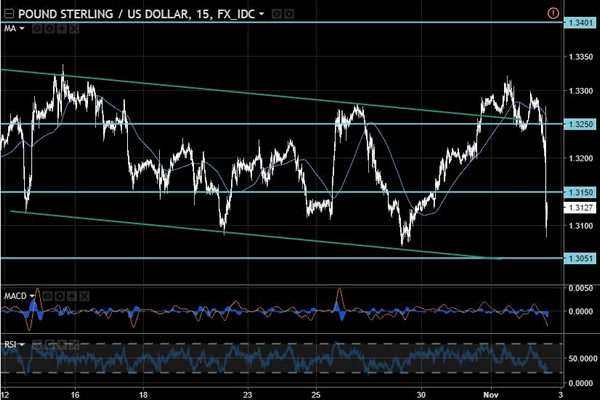
GBP/USD
The GBP/USD price has shown a sharp decline after it was not able to gain a foothold above 1.3250. The target range in case of further decline will be 1.3000-1.3050. The RSI on the 15-minute chart is in the oversold zone which may trigger a price rebound with potential target at 1.3150.
AUD/USD
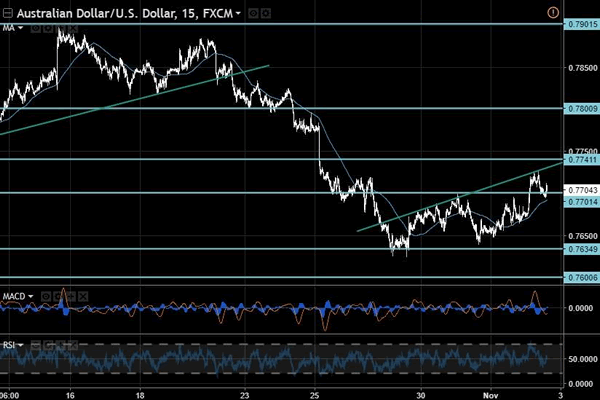
The AUD/USD was not able to reach the SMA on the 15-minute chart and resumed positive dynamics. Growth may continue the positive dynamics along the inclined resistance line and in case of breaking through 0.7740, the immediate objectives will be at 0.7800 and 0.7900. Strong support at 0.7635 is likely to restrain negative dynamics.
Yen Gains Ground Ahead of Fed Chair Nomination
USD/JPY has posted losses in the Thursday session, erasing the gains seen on Wednesday. In North American trade, USD/JPY is trading at 113.96, down 0.27% on the day. On the release front, Japanese Consumer Confidence improved to 44.5, beating the estimate of 43.6 points. In the US, today's highlight was unemployment claims, which dropped to 229 thousand. This beat the estimate of 235 thousand. The focus will be on employment numbers on Friday, as the US releases Average Hourly Earnings, Nonfarm Payrolls and the unemployment rate. We'll also get a look at ISM Nonfarm Manufacturing PMI.
The Federal Reserve rate statement was expected to be little more than a run-up to the December rate decision, and indeed there were no surprises from Janet Yellen and Co. The Fed indicated that a rate increase is very likely at the December meeting, and was careful not to change any of the wording in its statement regarding future rate hikes. The rate statement noted that hurricanes which hit the US had caused a decline in payrolls in September, but the Fed did not expect the hurricanes to "materially alter the course of the national economy over the medium term." The markets are expecting a strong rebound in nonfarm payrolls – the forecast for Friday's US nonfarm payrolls is a robust 311 thousand, after a decline of 33 thousand in September. Still, wage growth, which was remained soft despite the strong economy, is expected to slow to 0.2 percent, as inflation remains the Achilles heel of a robust US economy.
With fed futures prices in at 96 percent, a December rate hike from the Fed appears a done deal. What can we expect in 2018? This will depend to a large degree on the new chair of the Fed, who will take over from Janet Yellen in February. Janet Yellen will wind up her 3-year term in February, and she is not expected to be reappointed by President Trump. The front runner is economist Jerome Powell, who is expected to maintain the Fed's current policy of small, incremental rates. Trump is expected to make his choice later on Thursday, and the markets could react once the new Fed chair is announced.
BoE Hikes, But Sterling Tumbles on Soft BoE Assessment
- European equities traded down today, but are off the intra-day lows, showing currently losses of 0.30%. US equities show marginal losses, as the initial dive on the tax reform headlines is reversed.
- Republicans unveiled plans to slash the corporate tax rate to 20%, without cutting the top rate for the richest Americans as part of a sweeping overhaul of the tax code as they seek to secure a first major legislative victory for President Donald Trump
- Traders are painting the Bank of England's tightening cycle with the 'one and done' brush after the central bank finally raised overnight borrowing costs for the first time in more than a decade. UK gilts prices rallied sharply. The decline in yields means the policy sensitive two-year gilt yield is drifting below the new base rate of 0.5%.
- The BoE warned Brexit was having a "noticeable impact" on the UK's economic outlook in its monetary policy release earlier this afternoon, as it increased interest rates for the first time in a decade, with "considerable risks" for how households, businesses and financial markets respond to Britain's withdrawal from the trading bloc
- Germany's labour market continued tightening in October, leaving the country's jobless rate (5.6%) at the lowest level since its reunification in 1991. The number of unemployed Germans decreased by 11,000, a decline of 1,000 more than economists had forecast.
Rates
UK gilts only game in bond markets today.
Global core bonds had a sideways oriented session in the absence of new valuable information and ahead of tomorrow's US payrolls that kept many investors sidelined. During the European session, the EMU PMI business sentiment for October was nearly unchanged compared to the preliminary figures and German unemployment fell further, but did so in line with expectations. During the US session, initial claims were somewhat lower than expected and productivity somewhat higher, but they were as often ignored. At the time of closure of our report, some headlines on the tax plan roll over the screens. In an initial reaction, US Treasuries go marginally higher, but have ceded in the meantime part of the "minimal" gains. At the time of writing, changes on the German yield curve are insignificant range (0-0.6 bp). The US yield curve flattens somewhat further with yield declines varying between 1.2 bp (2-yr) and 2.9 bps (10-30-yr).
The calmness in the core bond markets wasn't duplicated in the UK bond space. The BoE meeting triggered a large decline of UK yields across the curve. The BoE, as expected, raised the bank rate by 25 bps to 0.50%, the first rate hike in more than 10 years. However, more importantly for markets, it was likely the most dovish hike that was delivered by the BoE. Indeed, the statement no longer said that rates might have to rise faster than markets discount. This means that in the next 2-3 years rates are expected to be increased only 2 times to bring the bank rate in 2020 at 1%. The statement also said that the next rate hike is not imminent and few hikes are enough to bring inflation close to the objective in a 3-yr horizon.
On intra-EMU bond markets, 10-yr yield spreads versus Germany are little changed with Greece again the noticeable exception, as it still profits from rumours about a big rate swap that should enhance liquidity (-20 bps).
Currencies
USD awaits new Fed-chair, tax bill and payrolls
Today, the dollar showed no clear trend. The EMU and US eco data were OK but hardly affected FX trading. Markets awaited to nomination of the new Fed-chairman and were looking for concrete details on the US tax reform bill. EUR/USD hovered in the mid 1.16 area. USD/JPY tried to regain the 114 area. Even so, the dollar hardly profited from the Fed keeping the door open for a December rate hike.
Overnight, Asian equities outside Japan trade with modest losses. The US equity rally showed some signs of fatigue. This weighed on Asian indices and on US yields. It prevented the dollar to return to the recent highs against the euro and yen. USD/JPY returned below the 114 handle, while EUR/USD traded again in the mid 1.16 area.
The EMU Manufacturing PMI was revised marginally lower from 58.6 to 58.5. Even so, the report still indicates above-trend EMU growth at the start of the fourth quarter. German unemployment data gave a similar signal. As usual the data had no impact on the euro. In technical trading, EUR/USD hovered up and down around the 1.1650 pivot. USD/JPY struggled to regain the 114 barrier. Yesterday's Fed statement kept the door open for a December rate hike. However, it didn't changed the USD trading dynamics today.
The early morning US data didn't bring any high profile news. Jobless claims declined slightly more than expected to 229K (from 234K). Q3 productivity (3.0%) and unit labour costs (0.5%) were slightly higher than expected. The impact on the dollar remained very limited. At the time of writing, the first fragmented details of the GOP tax plan are rolling on the screens. (FX) markets are not impressed. US bond yields, the dollar and US equities are all ceding modest ground. EUR/USD trades in the 1.1675 area. USD/JPY trades around 113.65.
BoE hikes, but sterling tumbles on soft BoE assessment
Over the previous days, sterling had a strong run as investors didn't want to be positioned short sterling in the run-up to the first BoE rate hike in more than 10 year. However, the sterling rally slowed in the run-up to the BoE decision this morning. The BoE voted 7-2 to raise the base rate by 0.25% to 0.50%. However, the policy assessment was very dovish. The BOE assumes that inflation will return close to the 2% policy horizon by the end of the 3-year forecasting horizon. In order to meet the target, the BOE assumes that only two additional rate hikes are needed till the end of 2020. Of course, several risk factors can change the main BoE scenario, but the main scenario only sees very limited interest rate support for sterling in the short-to-medium term. UK yields nosedived and sterling was heavily sold upon the BoE policy announcement. EUR/GBP jumped from the low 0.88 area and filled offers in the 0.89 area. Cable fell off a cliff. The pair trades currently in the low 1.31 area. The BoE continues to give more weight to supporting growth in times of (Brexit-related) uncertainty rather than to reducing inflation when setting its policy balance. This is a structural negative for sterling.