

Sample Category Title
Bank of England Raises Interest Rates for the First Time in Over a Decade
As widely anticipated and well communicated in advance, the Bank of England's Monetary Policy Committee (MPC) raised its policy rate by 25 basis points to 0.5%. The decision was well supported by the MPC, with a majority voting in favour (7-2).
This is the first increase in the Bank's key policy rate since July 2007. But, back then the economy was growing at a 2.5% annualized pace, and the policy rate was set at 5.75%, or 525 basis points higher than the current policy rate. In addition, the MPC voted unanimously to maintain their stock of corporate and UK government bond purchases at £10 billion and £435 billion, respectively.
The MPC made it clear that the decision to tighten was due to the shift in the balance of risks around inflation to the upside. Bank of England Staff projections anticipate that headline inflation will peak at just above 3.0% y/y in October, which is just above the operational target range of 1 to 3%. Inflation has been running at the upper end of the range since this past Spring, driven by the pass-through to consumer prices from the post-Brexit referendum depreciation in the exchange rate and a steady move higher in energy. Today's move is widely viewed by the MPC as necessary to ensure that inflation moves sustainably back down within the target range.
Financial market reaction to the announcement was dovish, sending the pound down by about 1% versus the U.S. dollar in the aftermath of the decision. UK government bonds were bid, with the 10-yr UK government bonds yield falling by over 6 basis points to 1.28.
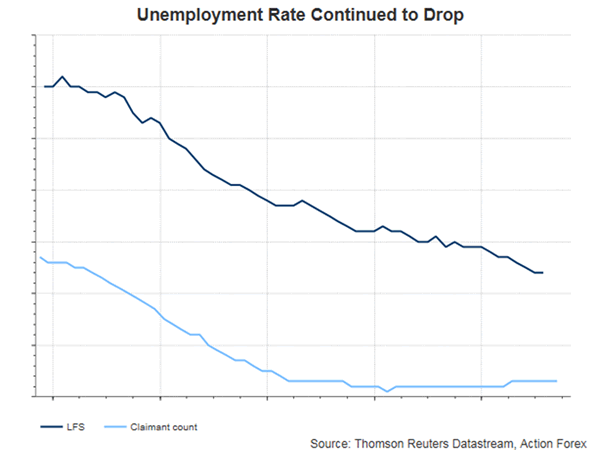
In the Inflation Report, projections for economic growth have been revised up on a Q4/Q4 basis for 2017 to 1.5% from 1.3%, revised down for 2018 to 1.7% from 1.8%, and unchanged in 2019 at 1.7%. Similarly, the inflation outlook was revised up for 2017 to 3.0% from 2.8%, and revised down slightly in 2018 to 2.4% from 2.5%; the outlook for 2019 was unchanged at 2.2%. The unemployment rate is now expected to hold at 4.2% through 2019, down from the 4.5% level in the August projection. This is consistent with the Bank's view that tightening labour market will help support wage growth, but low productivity growth will prevent nominal wages from rising persistently above 4.0% as was typical in the pre-2007 era. Low productivity growth is a phenomenon that has been plaguing other advanced economies as well, often being singled out as one of the key reasons as to why wage growth has remained so weak in the past decade despite unemployment rates falling to historic lows.
With today's decision, the Bank of England joins two of its G7 peers, the Bank of Canada and the U.S. Federal Reserve, in raising its key monetary policy interest rate this year. However, the Bank of England is in the unique situation of raising rates to ensure inflation moves back down to within its target band, while both the Bank of Canada and the U.S. Federal Reserve raised interest rates to head off what they believe to be rising wage and price pressures that will help move inflation up toward target in coming quarters.
Carney on the Defensive, Tax Reform and Fed Chair Announcement to Come
The controversial decision to raise interest rates at a time of significant economic uncertainty unsurprisingly left Mark Carney on the defensive throughout his press conference on Thursday, as reporters repeatedly questioned why the central bank decided it was the appropriate time for the first rate hike in a decade.
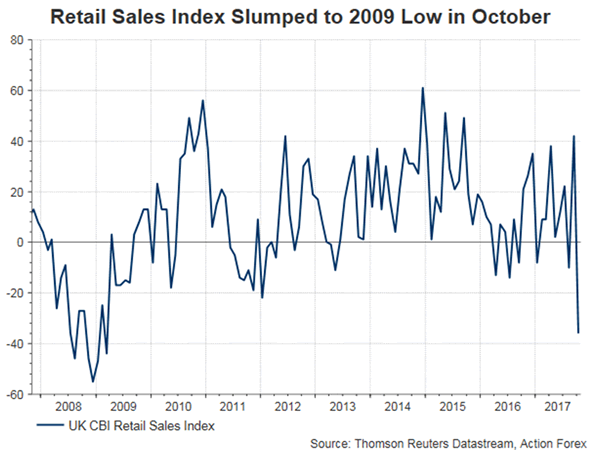
Naturally the decision on whether the raise interest rates is far from straightforward with inflation significantly overshooting the central bank's 2% target and the labour market in good shape, while at the same time the economic outlook is uncertain at best and real incomes are already being squeezed. While the MPC has been divided on the correct course of action in recent months, the pendulum eventually swung in favour of the hawks with some policy makers clearly of the belief that they had reached the limitations of how much inflation they could stomach.
As can be interpreted from the market reaction though, the rate hike came with quite a dovish twist. Policy makers refrained from including language in the statement that suggest markets were behind the curve on rate hikes which would indicate that two over the next three years is expected, which would represent an extremely gradual tightening process. Given the assumptions that the central bank has on labour market slack and the relationship with wages and inflation, it's possible that even two hikes may be a little punchy. The experience of the Fed would certainly support this view.
All things considered, the view appears to be that the BoE has taken a risky and unnecessarily step in raising interest rates today, one they may regret and be forced to reverse over the next year or so. Even if this is avoided, with the rate now back at the level the central bank deemed the lower bound for seven years prior to the Brexit referendum, we may be waiting some time for interest rates to rise again.
The BoE's job may be done for the day but the fun may be just beginning for markets, with details of Trump's tax reforms and the new Fed Chair announcement still to come. Jerome Powell is expected to be announced as Janet Yellen's successor late on in the session which will leave another seat available on the Board of Governors for Trump to fill. Certain candidates may have missed out on the position of Chair but with other important roles to be filled, there's potential for them to join Powell at the top.
Tax reform and the future leadership of the Fed have both been very important factors in the dollar revival over the last couple of months so it will be interesting to see how the greenback responds to both of these events today.
Trade Idea: EUR/GBP – Stand aside
EUR/GBP - 0.8893
Original strategy :
Sold at 0.8850, Target: 0.8735, Stop: 0.8890
Position : - Short at 0.8850
Target : - 0.8735
Stop : - 0.8890
New strategy :
Stand aside
Position : -
Target : -
Stop : -
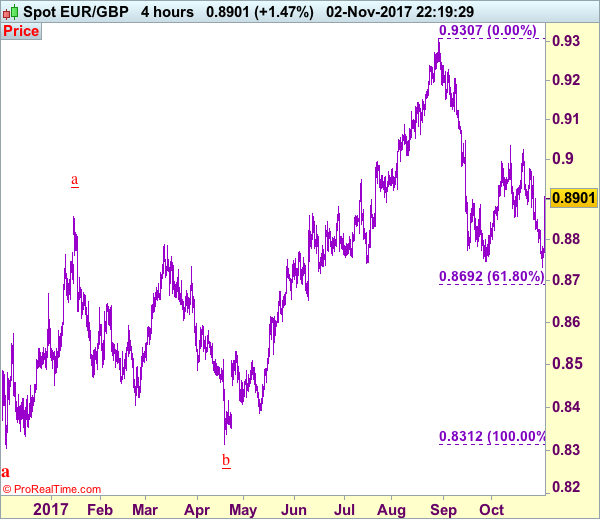
Current much stronger-than-expected rebound has dampened our bearishness and signals the fall from 0.9033 has ended at 0.8733 yesterday, hence upside risk remains for further gain to 0.8925-30, then test of resistance at 0.8957, however, break of 0.8976 resistance is needed to add credence to this view, bring further gain to 0.9000, then retest of 0.9033 later.
In view of this, would not chase this rise here and would be prudent to stand aside in the meantime. On the downside, expect pullback to be limited to 0.8870 and reckon 0.8830-35 would hold, bring another rise later. Below 0.8830-35 would risk weakness to 0.8800 but only break of 0.8765-70 would abort and signal the rebound from 0.8733 has ended instead.
Our preferred count is that, after forming a major top at 0.9805 (wave V), (A)-(B)-(C) correction is unfolding with (A) leg ended at 0.8400 (A: 0.8637, B: 0.9491 and 5-waver C ended at 0.8400. Wave (B) has ended at 0.9413 and impulsive wave (C) has either ended at 0.8067 or may extend one more fall to 0.8000 before prospect of another rally. Current breach of indicated resistance at 0.9043 confirms our view that the (C) leg has ended and bring stronger rebound towards 0.9150/54, then towards 0.9240/50.
Trade Idea: USD/CAD – Buy at 1.2755
USD/CAD - 1.2816
Trend: Near term up
Original strategy :
Buy at 1.2755, Target: 1.2955, Stop: 1.2695
Position: -
Target: -
Stop: -
New strategy :
Buy at 1.2705, Target: 1.2905, Stop: 1.2645
Position: -
Target: -
Stop:-
As the greenback has retreated after faltering below resistance at 1.2917, suggesting consolidation below this level would be seen and pullback to 1.2750 cannot be ruled out, however, reckon downside would be limited to 1.2700-05 and bring another rise later, above said resistance at 1.2917 would signal the rise from 1.2061 low is still in progress and extend gain to 1.2950, having said that, as we are still treating this rebound from 1.2061 as wave iv, reckon 1.2975-80 (61.8% Fibonacci retracement of wave iii) would limit upside and 1.3000 should hold, bring selloff later in wave v. We are keeping our count that wave v as well as wave (C) ended at 1.3794 and impulsive wave (i ii, i ii) is now unfolding with minor wave iii ended at 1.2414, followed by wave iv correction ended at 1.2778, wave v has reached our indicated downside target at 1.2100 and may extend to 1.2000.
In view of this, we are looking to reinstate long on subsequent pullback as 1.2700-05 should limit downside and bring another rise. Below 1.2670-75 would defer and suggest a temporary top is possibly formed, bring correction to 1.26350-40 but break there is needed to confirm, bring weakness to 1.2610-15, then test of 1.2591.
To recap, wave B from 1.3066 is unfolding as an a-b-c and is sub-divided as a: 1.2192, b: 1.2716 and wave c is a 5-waver with i: 1.1983, ii: 1.2506, extended wave iii with minor iii at 1.0206, wave iv ended at 1.0781 and wave v as well as wave iii has ended at 0.9931, hence the subsequent choppy trading is the wave iv which is unfolding as (a)-(b)-(c) with (a) leg of iv ended at 1.0854, followed by (b) leg at 1.0108 and (c) leg as well as the wave iv ended at 1.0674. The wave v is sub-divided by minor wave (i): 0.9980, (ii): 1.0374, (iii): 0.9446, (iv): 0.9913 and (v) as well as v has possibly ended at 0.9407, therefore, consolidation with upside bias is seen for major correction, indicated target at 1.3700 and 1.4000 had been met and further gain to 1.4700 would be seen later.

EURUSD Consolidates With Downside Bias
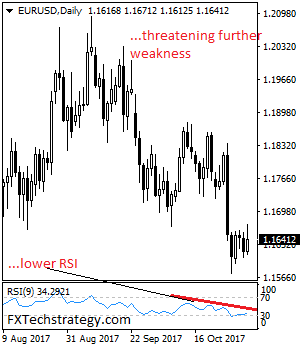
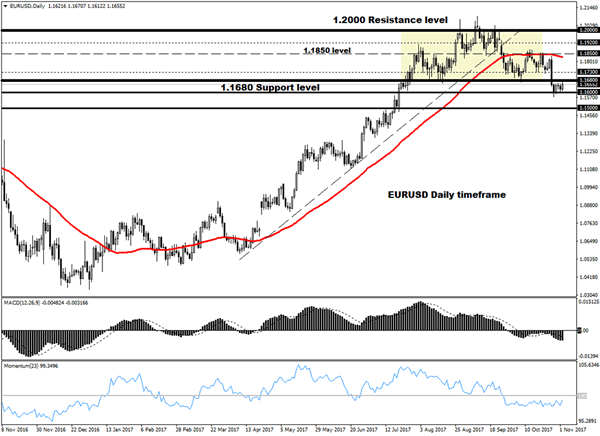
EURUSD: With the pair facing consolidation threats, directional move is now a challenge. Resistance comes in at 1.1700 level with a cut through here opening the door for more upside towards the 1.1750 level. Further up, resistance lies at the 1.1800 level where a break will expose the 1.1850 level. Conversely, support lies at the 1.1600 level where a violation will aim at the 1.1550 level. A break of here will aim at the 1.1500 level. Below here will open the door for more weakness towards the 1.1450. All in all, EURUSD faces further consolidation threats.
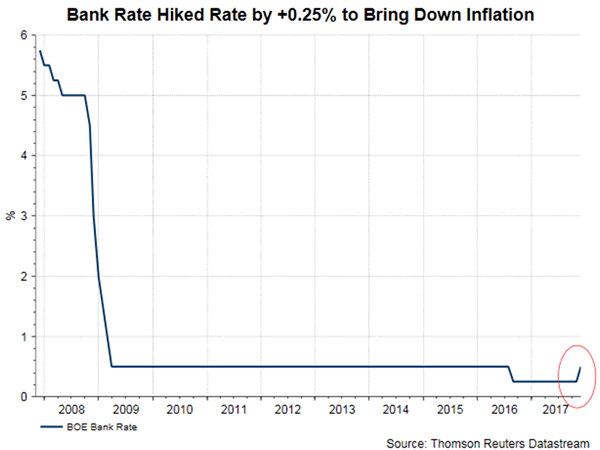
BOE Increased Policy Rate for First Time in More than A Decade
BOE voted 7-2 to raise the Bank rate by +25 bps to 0.5%, the first time in over a decade, in November. Two deputy governors, Sir Jon Cunliffe and Sir Dave Ramsden, voted to leave borrowing costs unchanged. BOE voted unanimously to leave the asset purchase program unchanged at 435B pound. Governor Carney declined to comment when the unwinding would begin. Traders have begun to dump British pound ahead of the announcement on profit-taking. The selloff accelerates upon release of the meeting statement and the quarterly inflation report. The rate hike this month is to remediate excessive inflation which has sustainably overshot the +2% target for months. We do not believe UK's current growth momentum, clouded by Brexit uncertainty, justifies further monetary tightening in coming months. Indeed, BOE affirmed that "any future increases in Bank Rate will be at a gradual pace and to a limited extent".
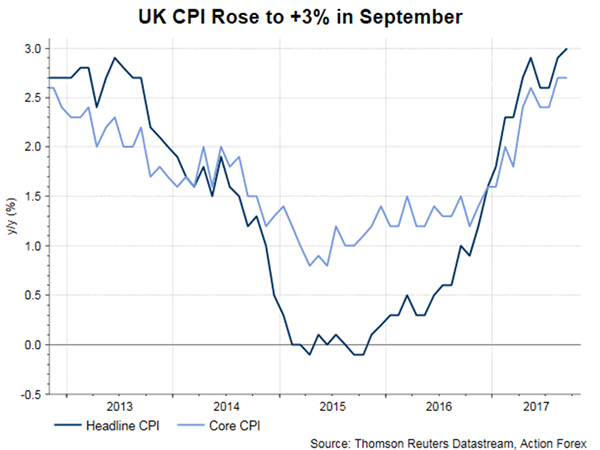
Economic Outlook
BOE forecast steady growth of about +1.7%, while inflation would reach +2.2%, over the next three years. inflation rose to +3% in September, and is expected to "peak above +3% in October, as the past depreciation of sterling and recent increases in energy prices continue to pass through to consumer prices". Carney suggested in the press conference that inflation is "unlikely to return to the 2% target" without a rate hike. Yet, he remained confident that the UK households are "well-positioned" to handle the increase, as the overall monetary policy remains accommodative. Carney also suggested that real wages would gradually pick up soon, as inflation should start to fall next year and wage growth should be boosted by growth in productivity. He added that, despite the improvement, wage growth should remain below historical levels for several years.
Brexit
BOE admitted the Brexit vote has "noticeable impact on the economic outlook". As noted in the accompanying statement, "the overshoot of inflation throughout the forecast predominantly reflects the effects on import prices of the referendum-related fall in sterling. Uncertainties associated with Brexit are weighing on domestic activity, which has slowed even as global growth has risen significantly" It added that "Brexit-related constraints on investment and labour supply appear to be reinforcing the marked slowdown that has been increasingly evident in recent years in the rate at which the economy can grow without generating inflationary pressures".
Monetary Policy
The members judged "it appropriate to tighten modestly the stance of monetary policy in order to return inflation sustainably to target". They also agreed that "any future increases in Bank Rate will be at a gradual pace and to a limited extent". Note that the central bank this time dropped the reference that rate needs to rise more than market expects, signaling it might pause for some time after this increase. BOE's forecasts suggest two more rate rises over the coming three years.
“Dovish Hike” Excites Sterling Bears
After over a decade, the Bank of England has finally lifted interest rates by 25 basis points, to 0.5% from the 0.25% record low - but Sterling is not amused.
Under normal circumstances, such an auspicious event would have immediately elevated Sterling and boosted sentiment towards the UK economy, however, we are seeing a completely opposite reaction. With the central bank cautioning that future rate increases will be "at a gradual pace" and to "a limited extent", this is clearly a dovish hike which has raised questions over the future path of interest rates beyond November. There is a suspicion that this could be a "one-and-done" move, especially when considering how the unsavory combination of Brexit uncertainty and weakening economic growth continues to weigh heavily on sentiment.
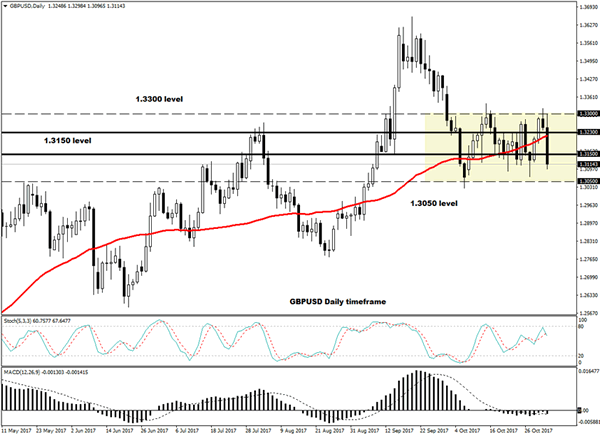
The GBPUSD found itself exposed to heavy losses following the dovish hike, with prices tumbling back below 1.3150. Pound bears have been re-awoken thanks to the BoE, with the next level of interest at 1.3050.
Bitcoin sprints past $7000….
It's another day, another fresh record high for Bitcoin, which soared past $7000 during early trading on Thursday. This has been another incredibly bullish week for the cryptocurrency, with the visible upside attracting investors from all directions. With Bitcoin surging over 640% this year and its total value currently standing at a massive $100 billion, it's fair to say the outlook is increasingly encouraging. It must be kept in mind that Bitcoin's exponential gains are not only phenomenal, but somewhat frightening, and it will be interesting to see where prices close this year.
Taking a look at the technical picture, Bitcoin is extremely bullish on the daily charts. A weekly close above $7000 may inspire buyers to push the cryptocurrency towards $8000. With the upside gaining momentum almost by the day, could Bitcoin hit $10,000 before year end?
Dollar searches for catalyst
The Greenback surprisingly edged lower against a basket of major currencies on Thursday, as investors digested November's relatively hawkish statement from the Federal Reserve.
With the central bank stating that "economic activity has been rising at a solid rate, despite hurricane-related disruptions", expectations of a rate hike in December rose to 96.7%, according to CME's FedWatch tool. Today's main attraction in the United States and risk event for the Dollar, will be President Trump's nomination for the next Chair of the Federal Reserve. With reports confirming that Jerome Powell, who is seen as less hawkish, will be Trump's nominee, it will be interesting to see how the Dollar reacts. Taking a look at the technical picture, the Dollar Index remains bullish on the daily charts. Prices are currently in a wide range, with minor support at 94.40 and resistance at 94.90. A catalyst may be needed in order for the Dollar Index to break from the range, and this could come in the form of Trump's nomination, or with the NFP report on Friday.
Currency spotlight - EURUSD
The Euro has had a calm trading session these past days, when compared to the chaos witnessed last week. With the political drama in Spain ebbing somewhat, after Madrid suspended Catalonia's political autonomy and sacked Carles Puidgemont, investors have redirected their attention towards Europe's fundamentals. On the data front, Eurozone inflation unexpectedly dipped to 1.4% in October, from 1.5% in September, which supported the dovish ECB QE tapering. From a technical standpoint, the EURUSD has traded in a range this week, with support at 1.1600 and resistance at 1.1680. Sustained weakness below 1.1680 may encourage a further decline towards 1.1600 and 1.1500, respectively. In an alternative scenario, prices need to break back above 1.1730 for bulls to jump back into the game.
GBPUSD Strongly Bearish Below 1.3157
The British pound has declined sharply against the U.S dollar, hitting 1.3100, following the Bank of England's monetary policy decision. The GBPUSD pair tumbled, despite the BOE hiking UK interest rates 0.25 basis points as expected. The pound declined, as UK policy makers struck a dovish tone towards inflation and the UK economy, inside the BOE Meeting Minutes. Price-action currently trades around the 1.3130 level, as traders now price-in the BOE is unlikely to raise UK rates again this year.
The GBPUSD pair remains strongly bearish while trading below the key 1.3157 technical level. Further selling remain likely towards the 1.3070 and 13023 level, while price trades below 1.3157.
Should price-action break back above the 1.3157 level for a sustained period, further upside towards 1.3200 and 1.3236 should be expected.
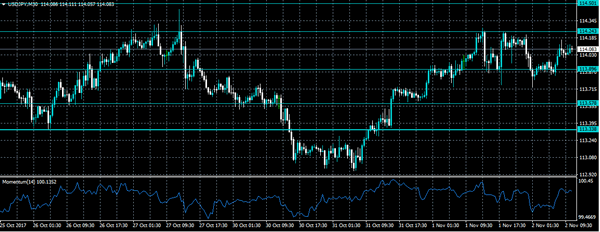
USDJPY Buyers in Control above 113.89
The U.S dollar continues to trade higher against the Japanese Yen, hitting 114.22, as the U.S dollar index gains traction following the FOMC policy meeting. Divergence in fiscal policy between the U.S Federal Reserve and the Bank of Japan continues to drive the USDJPY pair. Price-action currently trades above the 114 level, ahead of the Trump administrations pending choice for the new FED Chair, which is set to be announced during today's U.S trading session.
The USDJPY pair remains intraday bullish why trading above the key 113.89 technical level. Further upside should be expected toward the 114.24 and 114.50 resistance levels.
Should price-action trade below the 113.89 level for an extended period, further USDJP selling towards the 113.57 and 114.33 technical support zones remains likely.
“One and Done” Rate Hike Triggers GBP Selling
A dovish rate hike from the Bank of England on Thursday has triggered a sell-off in the pound while yields on UK debt have also fallen.
We may be jumping to the wrong conclusions prior to the press conference with Mark Carney but the impression that the MPC has given is this is a "one and done" rate hike. Dropping the reference to the market under-pricing future tightening while at the same time referencing the market pricing in two rate hikes over the next three years doesn't suggest another rate hike is planned any time soon.
With inflation expected to return closer to target over the next 12 months, the chance to raise rates may not exist for long and policy makers were clearly keen to seize the opportunity while it still could.