Sample Category Title
Trade Idea Wrap-up: GBP/USD – Sell at 1.3170
GBP/USD - 1.3120
Most recent candlesticks pattern : N/A
Trend : Near term down
Tenkan-Sen level : 1.3163
Kijun-Sen level : 1.3171
Ichimoku cloud top : 1.3193
Ichimoku cloud bottom : 1.3158
Original strategy :
Sell at 1.3285, Target: 1.3155, Stop: 1.3320
Position : -
Target : -
Stop : -
New strategy :
Sell at 1.3170, Target: 1.3060, Stop: 1.3205
Position : -
Target : -
Stop : -
As cable met renewed selling interest at 1.3228 earlier today and has retreated sharply, suggesting the rebound from 1.3088 has ended there and bearishness remains for another test o said support, break there would extend the fall from 1.3338 to 1.3050, then towards recent low at 1.3027 which is likely to hold from here due to near term oversold condition, bring rebound later.
In view of this, wee are looking to sell cable on minor recovery as the Kijun-Sen (now at 1.3171) should limit upside and bring another decline. Above 1.3200-05 would risk another test of 1.3228, break there would bring a stronger rebound to 1.3240-45 (61.8% Fibonacci retracement of 1.3338-1.3088) but still reckon resistance at 1.3287 would cap upside.

Trade Idea Wrap-up: EUR/USD – Stand aside
EUR/USD - 1.1763
Most recent candlesticks pattern : N/A
Trend : Sideways
Tenkan-Sen level : 1.1760
Kijun-Sen level : 1.1751
Ichimoku cloud top : 1.1796
Ichimoku cloud bottom : 1.1762
New strategy :
Stand aside
Position : -
Target : -
Stop : -
Although the single currency broke below previous support at 1.1730, lac of follow through selling and the subsequent rebound from 1.1725 suggest further consolidation would take place and recovery to 1.1780-90 cannot be ruled out, however, still reckon upside would be limited to 1.1820-25 and price should falter well below resistance at 1.1858, bring further choppy trading later.
On the downside, below said support at 1.1725 would extend the fall from 1.1880 top to 1.1700 and possibly towards indicated previous support at 1.1669 but break of latter level is needed to retain bearishness and extend further subsequent decline to 1.1640-45 first. As near term outlook is still mixed, would be prudent to stand aside in the meantime.

Trade Idea : USD/JPY – Buy at 113.40
USD/JPY - 113.95
Most recent candlesticks pattern : N/A
Trend : Near term up
Tenkan-Sen level : 113.78
Kijun-Sen level : 113.62
Ichimoku cloud top : 113.74
Ichimoku cloud bottom : 113.20
Original strategy :
Buy at 113.00, Target: 114.00, Stop: 112.65
Position : -
Target : -
Stop : -
New strategy :
Buy at 113.40, Target: 114.40, Stop: 113.05
Position : -
Target : -
Stop : -
As the greenback found renewed buying interest at 113.24 and has staged a strong rebound, suggesting the pullback from 114.10 has ended and break of this level would confirm recent rise from 111.65 has resumed for headway to 114.45-50 (50% projection of 111.65-114.10 measuring from 113.24) but reckon upside would be limited to 114.75-80 (61.8% projection) and 115.00 would hold from here.
In view of this, we are looking to buy dollar again on pullback as 113.30-40 should hold, bring another rise. Below 113.20-24 (50% Fibonacci retracement of 112.30-114.10 and said support) would defer and bring correction to 112.95-00 (61.8% Fibonacci retracement) but reckon 112.60-70 and bring another rise later.

Yen Dips on Soft Japanese Manufacturing Report
USD/JPY has posted gains in the Tuesday session, erasing the losses at the start of the week. In North American trade, USD/JPY is trading at 113.95, up 0.45% on the day. On the release front, there are no major events on the schedule. Japanese Flash Manufacturing PMI came in at 52.5, missing the estimate of 53.1 points. In the US, the Richmond Manufacturing Index softened to 12 points, well off the forecast of 19 points. This marked its weakest gain since June. On Wednesday, the US will release Core Durable Goods Orders and New Home Sales.
Japanese voters went to the polls on Tuesday, and there were no surprises as Prime Minister Shinzo Abe cruised to an easy victory. Abe's Liberal Democratic Party and a small junior coalition party won a convincing victory, winning at least 312 seats out of 465 seats in the lower house of parliament. The result gives Abe a two-third majority in both seats of parliament, which will allow him to continue his policies. We can expect to see the ultra-loose monetary policy continue until inflation moves closer to the Bank of Japan's target of around 2 percent. Although Abe won a decisive victory, his popularity remains low. The LDP took full advantage of a divided opposition which failed to provide the Japanese voter with a credible alternative. The Tokyo stock markets posted gains after the election, but the Japanese yen responded with slight losses.
The guessing game at the Federal Reserve continues, as investors await the next choice for Federal Reserve chair. Janet Yellen's 3-year term expires in February, and President Trump has said he will nominate a new Fed head in the coming days. The front runners are economist John Taylor and Federal Reserve Governor Jerome Powell. Taylor advocates a rule in which rates which be as high as 3 percent, given current economic conditions. Powell is more closely aligned to Fed Chair Janet Yellen's monetary stance which advocates an incremental increase in rates. With the two candidates representing sharply differing views on interest rate levels, Trump's choice for the new Fed chair could have have an effect on monetary policy and the strength of the US dollar. Still, most economists are of the view that monetary policy will be largely driven by the performance of the US economy. Inflation levels remain weak and may not reach Fed's target of 2 percent before 2020, but that has not dampened expectations of a December rate hike. According to CME FedWatch, the odds of a raise in December stand at 96 percent.
Trade Idea: EUR/GBP – Stand aside
EUR/GBP - 0.8964
New strategy :
Stand aside
Position : -
Target : -
Stop : -
Despite falling to 0.8886 yesterday, the subsequent rebound has retained our view that further consolidation within recent established range would be seen and initial gain towards 0.9000 cannot be ruled out, however, as broad outlook remains consolidative, reckon upside would be limited to resistance at 0.9033 and bring retreat later.
In view of this, would not chase this rise here and would be prudent to stand aside for now. Below 0.8910-15 would bring another test of said support at 0.8886 but only break of indicated previous support at 0.8856 would signal top has been formed at 0.9033 and bring further fall to 0.8820-25, then towards 0.8800.
Our preferred count is that, after forming a major top at 0.9805 (wave V), (A)-(B)-(C) correction is unfolding with (A) leg ended at 0.8400 (A: 0.8637, B: 0.9491 and 5-waver C ended at 0.8400. Wave (B) has ended at 0.9413 and impulsive wave (C) has either ended at 0.8067 or may extend one more fall to 0.8000 before prospect of another rally. Current breach of indicated resistance at 0.9043 confirms our view that the (C) leg has ended and bring stronger rebound towards 0.9150/54, then towards 0.9240/50.

Dollar Strengthens on Tax Reform Hopes While Sterling and Kiwi Face Pressure
The US dollar did well versus a number of currencies on Tuesday as it gained significantly versus the pound, the kiwi and the aussie. The euro closely mirrored the dollar's gains as traders are waiting for the outcome of the ECB meeting on Thursday before moving the world's most traded foreign exchange pair: euro/dollar.
The dollar was helped by optimism that tax reform in the United States was a feasible goal in the near-term for President Trump and Congress. An upbeat Markit PMI reading for the US economy also provided support for the greenback, although most participants pay more attention to the ISM surveys for a measure of business conditions in the country.
The US dollar was unable to make progress against the euro following the announcement of relatively positive PMI indices out of the Eurozone. The Services' PMI was a little weak as it missed expectations, although the services index at 54.9 still pointed to healthy growth. The region's manufacturing PMI surpassed expectations by coming in at a strong 58.6, showing that the region's manufacturers and exporters were benefitting from strong growth elsewhere. The PMI numbers showed that the crisis in Catalonia did not yet dampen business sentiment in Europe and markets did not appear too worried about the implications of the tense standoff between the government in Madrid and regional leaders seeking independence. Euro/dollar traded in a narrow range for most of the day at 1.1750-60.
The pound was weak as pound/dollar dropped to 1.3155 from a high of 1.3220 near the end of the Asian session, while euro/pound also rallied above 89 pence to reach 0.8940. The pound had staged a rebound in previous sessions due to a more positive outlook for the Brexit talks but that rally seemed to be foundering. Dovish comments by the Deputy Governor of the Bank of England caused the sell-off in the pound, as he questioned whether interest rates would need to rise during the November meeting of the policy-setting committee. It looks like the decision to raise rates might not be such a 'done deal' as the market had priced in, despite relatively high inflation and a healthy labor market in the UK. Economic growth, in particular, is not looking so positive for Britain compared to other advanced economies.
Selling in the kiwi was relentless throughout the day between the end of the Asian session and the end of the European session on concern that New Zealand's governing coalition that emerged from the recent elections could lead to low interest rates for longer as well as economic policies that could hinder the country's economic potential. Kiwi/dollar found some support at the 69 cent level and was trading near that level at 0.6911. The kiwi might be looking oversold but traders appeared reluctant to try and catch a falling knife and most would probably wait for the policy uncertainty to lift before undertaking long positions.
Looking ahead, API crude oil stocks could have an impact on oil prices (WTI oil was at the healthy $52.25 per barrel mark), while New Zealand employment numbers and Australian inflation will be the main highlights of tomorrow's Asian session.
EURJPY Rallies on Weaker Yen, Solid EU Data, Hopes of ECB’s Tapering
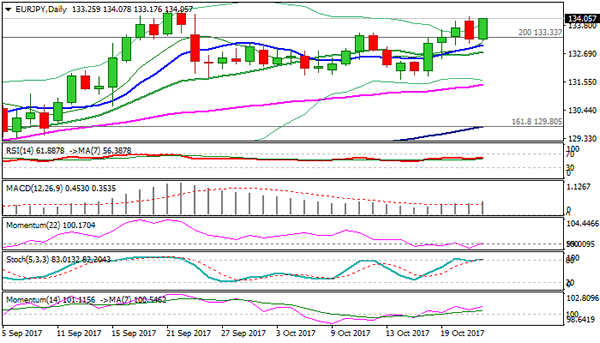
The cross rallies strongly on Tuesday and is on track to fully reverse Monday's pullback.
Weaker yen helps the fresh Euro bulls, inflated by strong Manufacturing PMI data today, which offset negative Services PMI reading.
Focus turns towards Thursday's ECB meeting and hopes of QE tapering (expectations for 25-30 billion Euros a month reduction) which would further boost the single currency. Bulls eye 22 Sep peak at 134.40 (the highest since Nov 2015) for retest, with break here to trigger fresh extension of wave C from 114.84 (16 Apr trough) which is part of broader five-wave sequence from 109.38 (24 June 2016 low), towards its Fibonacci 138.2% expansion at 135.19.
Ascending 10SMA marks solid support at 133.02, followed by 20 SMA at 132.73, loss of which will be bearish.
Res: 134.12; 134.40; 134.57; 135.19
Sup: 133.79; 133.52; 133.02; 132.73
Trade Idea: USD/CAD – Buy at 1.2570
USD/CAD - 1.2657
Trend: Down
Original strategy :
Buy at 1.2570, Target: 1.2770, Stop: 1.2510
Position: -
Target: -
Stop: -
New strategy :
Buy at 1.2570, Target: 1.2770, Stop: 1.2510
Position: -
Target: -
Stop:-
As the greenback has maintained a firm undertone after last week’s late rally, confirming the rise from 1.2061 low has resumed and mild upside bias remains for this move from there (wave iii trough) to extend further gain towards previous resistance at 1.2691 but price should falter well below another previous resistance at 1.2778. We are keeping our count that wave v as well as wave (C) ended at 1.3794 and impulsive wave (i ii, i ii) is now unfolding with minor wave iii ended at 1.2414, followed by wave iv correction ended at 1.2778, wave v has reached our indicated downside target at 1.2100 and may extend to 1.2000.
In view of this, we are looking to reinstate long on pullback as 1.2570-75 should limit downside and bring another rise. Below 1.2520 (previous minor resistance) would abort and suggest top is possibly formed, risk test of 1.2475-80, break there would confirm and then further fall to 1.2450 would follow. Only a break of support at 1.2433 would turn outlook bearish, bring retracement of recent rise to 1.2400, then towards 1.2350-55 but support at 1.2313 should remain intact.
To recap, wave B from 1.3066 is unfolding as an a-b-c and is sub-divided as a: 1.2192, b: 1.2716 and wave c is a 5-waver with i: 1.1983, ii: 1.2506, extended wave iii with minor iii at 1.0206, wave iv ended at 1.0781 and wave v as well as wave iii has ended at 0.9931, hence the subsequent choppy trading is the wave iv which is unfolding as (a)-(b)-(c) with (a) leg of iv ended at 1.0854, followed by (b) leg at 1.0108 and (c) leg as well as the wave iv ended at 1.0674. The wave v is sub-divided by minor wave (i): 0.9980, (ii): 1.0374, (iii): 0.9446, (iv): 0.9913 and (v) as well as v has possibly ended at 0.9407, therefore, consolidation with upside bias is seen for major correction, indicated target at 1.3700 and 1.4000 had been met and further gain to 1.4700 would be seen later.

Dollar Still Shows Diffuse Trading Pattern
- WS opened higher supported by the run of strong earnings amongst others from Caterpillar and 3M. Also McDonald and GM beat expectations. However, opening gains are fading fast after a few minutes of trading.
- Italy's Banca Monte dei Paschi di Siena has said mooted European Central Bank rules that would demand higher provisioning against soured loans risk it failing to meet planned targets for its turnaround
- British chancellor Philip Hammond has said the benefits of the internal market are "absolutely clear to us" and "we won't allow it to be compromised" in relation to the union between Scotland and the rest of the UK.
- PMI business conditions in the euro zone fell slightly more than expected this month, with the services sector reporting a slowdown in activity growth. The composite PMI index slipped to 55.9 in October from 56.7 in September. That was well under the consensus estimate of 56.5. Overall, the PMI's suggest ongoing strong growth.
- EC president, Mr. Juncker, has insisted that Brussels wants to reach a "fair deal" with Britain, in a bid to dampen down the furore over media reports allegedly containing details of his dinner last week with UK PM May
Rates
Core bonds sell off as fears of a hawkish ECB mount.
Core bonds were under pressure throughout the whole session. The EMU PMI business confidence was a mixed bag with manufacturing stronger and services weaker-than-expected. Overall though, they suggest ongoing strong growth. However, the PMI's weren't behind the bond selling. We suggest that jittery investors positioned for a more hawkish than expected ECB and maybe also for a more hawkish composition of the FOMC after US president Trump nominates a new chair and other new governors. At least investors don't want to be long bonds ahead of these events. There was little fresh news on these items, but today's sell-off might have been a resumption of selling that occurred after the US Senate adopted the 2018 budget and was interrupted yesterday by a dull Monday session. Interestingly, the US 10-yr yield tests the key 2.40% resistance area, which if broken, opens the way for an extension towards 2.64%. The T-Note future set a new correction low at 124-23 and is now close to the key 124-14 July low. Other markets didn't show a similar straight directional move. Caution is warranted, as there wasn't an obvious driver behind the bond moves and as volumes traded were rather modest.
At the time of writing, the German yield curve bear steepened with yields up between 2.2 bps (2-yr) to 4.9 bps (10-yr). The US curve also steepened with yields up between 1.3 bp and 4.3 bps (30-yr). In the intra-EMU bond market, Peripheral 10-yr yield spreads narrowed by 4 bps (Greece/Portugal & Spain), while Italy lagged (-1 bp), maybe due to upcoming supply.
Currencies
Dollar still shows diffuse trading pattern
Trading in the major USD cross rates showed again no consistent trading pattern. An initial decline of EUR/USD was blocked after mixed, but still strong EMU PMI's. A further rise in US and EMU yields supported the likes of USD/JPY and EUR/JPY as investors continue to look forward to the ECB policy decision later this week.
Overnight, Asian equity indices mostly traded slightly stronger despite yesterday's correction on WS. The dollar eased marginally as the rise in core yields halted (temporary ). USD/JPY hovered in the 113.25/50 area, near yesterday's intraday low. The euro remained resilient despite ongoing uncertainty on Spain. EUR/USD rebounded slightly to 1.1760/70 area.
Early in Europe a rise of core yields initially favoured the dollar. EUR/USD dropped to the 1.1745 area. The EMU PMI's were mixed French data were stronger than expected. The German manufacturing PMI was also stronger than expected, but services and the composite PMI missed the consensus. This pattern was also visible in the EMU PMI. Even so, the PMI's confirmed that the EMU growth remained solid at the start of the final quarter of the year. EUR/USD rebounded to the 1.1765/70 area. Changes in interest rate differentials were limited. If anything, they narrowed marginally in favour of the euro. The rise in EMU and US yields also supported the likes of USD/JPY and EUR/JPY (and e.g. EUR/CHF). Sentiment on risk also improved throughout the morning session.
US equity futures indicated stronger US cash stocks. This positive sentiment on risk prevented further USD losses. USD/JPY jumped close to the 114 area, but the move stalled just ahead of the big figure. The pair trades currently in the 113.85/90 area. EUR/USD is little changed compared to the start in Europe and trades in the 1.1760 area. Trading in core bonds and in the major USD cross rates is driven by conflicting factors going into Thursday's ECB meeting. Investors apparently don't want to be wrong-footed if the ECB would reduce policy stimulation in a more aggressive way. This attitude currently prevents a further decline of EUR/USD and supports USD/JPY and EUR/JPY.
Sterling returns part of recent rebound
Today, sterling erased part of last week's post EU summit gains. The exchange of words between EU and UK officials turned more constructive of late, even without any concrete progress in the negotiations. UK officials also feel that an agreement on a transition period is unlikely until there is sufficient progress on the nature of the future EU-UK trade relationship. This scenario leaves UK businesses in uncertainty as the Brexit negotiations drag on. EUR/GBP rebounded off the sub-0.89 recent lows and trades again in the 0.8940 area. Cable dropped modestly and trades in the 1.3150 area.
Copper – Recovery Extends to One-Week High, But So Far Unable to Hold Gains
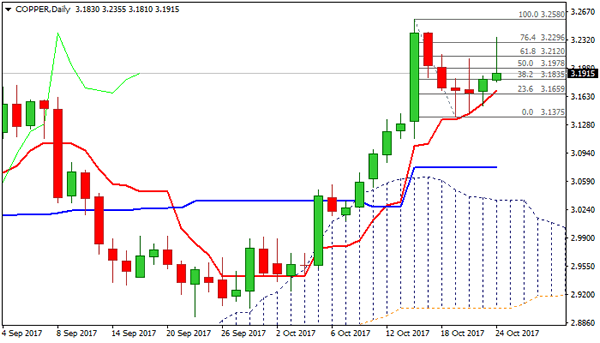
Copper future contract for December delivery extended recovery on Tuesday and spiked to one-week high at $3.2355, signaling higher low formation. Pullback from fresh over three-year high at $3.2580, posted last week, was contained by ascending Tenkan-sen at $3.1375, with formation of reversal pattern and subsequent bounce, signaling that corrective phase might be over. Today's recovery extension spiked above Fibo 76.4% of $3.2580/$3.1375 pullback, but was so far unable to hold gains. Fresh near-term bulls off 3.1375 low need close above $3.2120 (Fibo 61.8%) for bullish signal and to re-focus $3.2580 peak. Conversely, failure to hold today's gains and return below rising Tenkan-sen (currently at $3.1703) would increase downside risk on revisiting correction low at $3.1375. Overall picture remains bullish as investors are optimistic about prospects for global economic growth, although remain cautious on existing risk of slowdown, especially in China, metal's top consumer.
Res: 3.2000; 3.2120; 3.2355; 3.2415
Sup: 3.1810; 3.1703; 3.1510; 3.1375