Sample Category Title
Gold Expected To Remain Soft As Near-Term Risks Point To Downside
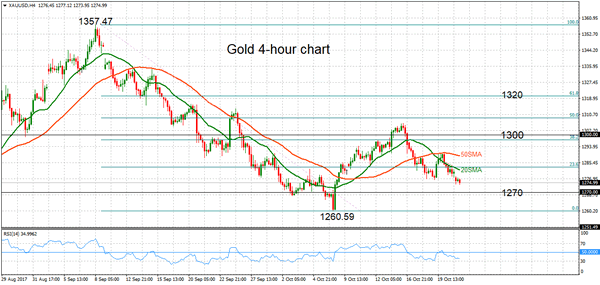
Gold has taken on a bearish bias again in the short-term after failure to sustain an upside move above the key psychological level at 1300. Prices attempted a recovery off the 1260 area but this move proved to be a correction of the September to October downtrend that is in progress since the more than one-year peak at 1357.47.
Near-term risk is clearly tilted to the downside with trend and momentum signals supporting this view. On the 4-hour chart, there was a bearish crossover of the 20 and 50-period moving averages, while the RSI indicator has fallen below 50.
Softness in the market is expected in the near term with high odds for a dip towards the 1270 level before the 1260.59 low. A deeper extension lower cannot be ruled out as long as the market remains below the 50% Fibonacci retracement level (1308.78) of the downleg from 1357.47 to 1260.59.
Only a rise back above 1300 would suggest that downside pressure has weakened. Clearing resistance at 1320 (61.8% Fibonacci) would indicate the bearish phase has ended.
USD/CAD Is Riding Momentum From Higher Time Frames
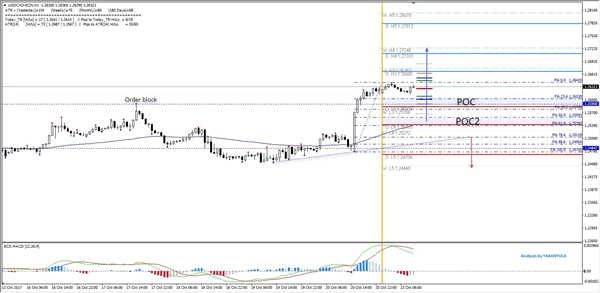
The USD/CAD both daily and 4h time frames are in uptrend and at this point we can also see a bullish swing has formed on H1 time frame too. The MACD is strongly positive and price action has formed two POC zones. POC 1.2590-1.2605 ( ATR pivot, order block,38.2 D L3) and POC2 1.2540-60 (D L4,EMA89, 61.8,ATR low). Any of these zones might potentially spike the price to the upside in case of retracement. If we don't see a retracement watch for continuation above 1.2645. Targets are 1.2670, 1.2687 and 1.2724. Only the break of W L4 -1.2527 could change the bias to bearish targeting 1.2495 and 1.2440.
W L3 - Weekly Camarilla Pivot (Weekly Interim Support)
W H3 - Weekly Camarilla Pivot (Weekly Interim Resistance)
W H4 - Weekly Camarilla Pivot (Strong Weekly Resistance)
D H4 - Daily Camarilla Pivot (Very Strong Daily Resistance)
D L3 – Daily Camarilla Pivot (Daily Support)
D L4 – Daily H4 Camarilla (Very Strong Daily Support)
POC - Point Of Confluence (The zone where we expect price to react aka entry zone)
Key Events To Watch The Week Ahead
Who's the next Fed Chair?
The U.S. dollar and stocks made a fantastic run towards the end of last week, after the Senate voted on Thursday to pass a budget resolution for 2018. The vote was interpreted as the first step towards promised tax reforms. Investors will require confirmation from the House, which needs to approvethe budget resolution in order to put together a detailed tax reform legislation. Although we might continue to see hurdles in the weeks to come, Republicans will put all their efforts into passing a tax reform package, as it is considered the most critical issue of the 2018 mid-term elections.
Investors are likely continue ignoring overstretched valuations, and keep driving equities higher for the remainder of the year, if they believe fiscal reforms will be implemented soon. It remains to be seen how the Federal Reserve will respond to fiscal change. To some extent, I think this willdepend on who will chair the Fed for the next four years. Some reports suggest that Jerome Powell is taking the lead. If Powell does get elected next February, we can expect the tightening monetary policy to remain very gradual. This means that, even though the bull market will still have legs, Powell still may not be the best candidate for the U.S. dollar.
Friday's GDP figure is expected to show that the U.S. economy grew 2.6% in the third quarter, vs. 3.1% in Q2. While hurricanes Harvey and Irma may create some noise in the data, any bias will be considered temporary, and will likely be shrugged off by investors.
ECB's quantitative easing future
Thursday's European Central Bank meeting is expected to be the main risk event of the week, especially for Euro traders. EURUSD traded within a tight range of 130 pips during last week, which comes as no surprise ahead of such a significant meeting. The first key question traders need an answer tois -how much will the monthly purchase of assets be reduced in 2018? And secondly, what is the duration of the amended QE? Markets are expecting asset purchases to be cut in half, to around 30 billion Euro. However, the duration will likely have more impact on the direction of the single currency. If Mr. Draghi signaled that QE might continue running beyond December 2018, it would be interpreted as a dovish taper, thus pushing further expectations ofa rate hike and draggingthe Euro lower.
Bitcoin smashing new highs
Bitcoin has become an asset that's hard to ignore. Despite many warnings from the likes of JP Morgan's CEO Jamie Dimon, Nobel Prize Winner Robert Shiller, and former Fed Chair Ben Bernanke, the cryptocurrency continues to outperform all asset classes. On Friday, Bitcoin broke another key psychological level of $6,000, to post a high on Saturday of $6,180. There's no doubt that it has become the most crowded trade in 2017,but the risks of jumping in now are very high. This is just to say that Bitcoin trading is not for the faint-hearted; however, when looking at the charts, after every new high break, Bitcoin'sprice has displayed an incredible rally. For instance, when Bitcoin broke above $2,980 in early August, the price surged 67% to $4,980 in 29 trading days. In April, we saw a similar reaction when a record high was broken, and the price rallied 120%. If such a pattern continues, then $8,000 may be the next target bulls are looking for.
Technical Outlook: EURUSD Remains In Red, Eyes Daily Cloud Base, ECB On Thursday In Focus
The Euro holds in red on Monday with fresh weakness in early European trading erasing brief recovery in Asia.
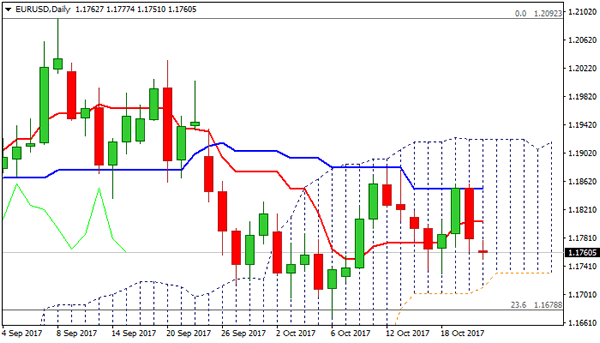
Long bearish candle which was left on Friday after repeated failure at daily Kijun-sen (1.1851) weighs on near-term action, with additional bearish pressure coming from Friday's bearish engulfing pattern and formation of 30/55SMA bear-cross.
Monday's action was so far capped by 4-hr cloud base (1.1774) which guards daily Tenkan-sen (1.1804).
Bears are looking for test of daily cloud base (1.1711) and possible extension towards another key support at 1.1669 (06 Oct trough) on break lower.
Political uncertainty over Catalonia keeps the Euro at the back foot but so far without stronger reaction, with markets turning focus towards ECB's policy meeting on Thursday.
Res: 1.1774, 1.1804, 1.1829, 1.1851
Sup: 1.1751, 1.1711, 1.1669, 1.1612
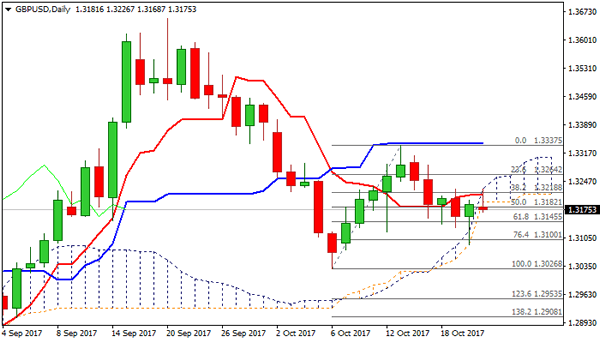
Technical Outlook: GBPUSD – Near-Term Bulls Were So Far Unable To Break Above Thin Daily Cloud
Cable stands at the front foot on Monday and probes through thin daily cloud (1.3195/1.3227) following bullish close on Friday, when bullish daily candle with long tail was left, signaling strong downside rejection.
Upside attempts today were so far capped by cloud top (1.3228) with falling 20SMA (1.3245) reinforcing barrier.
Sterling received support from cautious optimism over Brexit talks but mixed technical studies on daily chart show no clear direction signal while daily cloud top / 20SMA limit upside action.
Sustained break higher would trigger stronger recovery of 1.3337/1.3087 downleg.
Solid supports lay at 1.3182/68 (4-hr cloud base / session low) and should protect the downside to keep in play near-term bulls from 1.3087 (Friday’s low).
Sustained break below the latter would shift near-term focus lower.
Res: 1.3215, 1.3228, 1.3245, 1.3286
Sup: 1.3182, 1.3168, 1.3131, 1.3087
Technical Outlook: USDJPY Hit Three-Month High On PM Abe’s Election Victory, Bulls Eye Key Barrier At 114.49
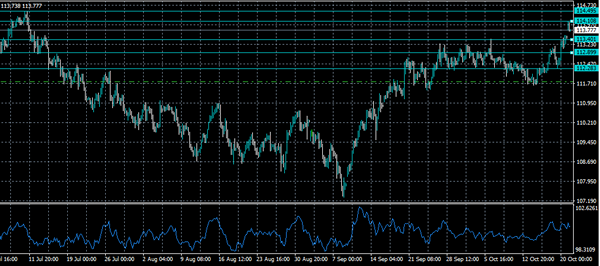
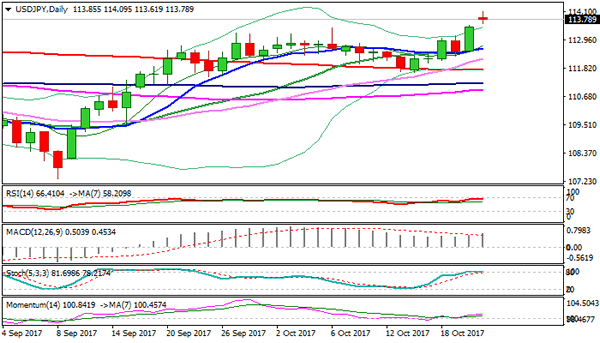
The dollar hit fresh over three-month high against Japanese yen after Japanese PM Abe's coalition won election on Sunday. The pair cracked 114.00 barrier and posted new high at 114.09 (the highest since July 11), following gap-higher opening on Monday. Bulls are looking for final push towards key barriers at 114.33 (Fibo 61.8% of 118.66/107.31 descend) and 114.36/49 (11 May/11 July former tops) break of which would generate strong bullish signals. Studies are bullish but overbought slow stochastic on daily chart warns of consolidation before clear break above 114.00 barrier. Strong supports at 113.58/43 zone (hourly Kijun-sen/Friday's high/former top of 06 Oct) so far keep the downside protected, however, deeper dips towards rising daily Tenkan-sen (112.85) cannot be ruled out before bulls resume. Conversely, return below 112.54 (rising daily Kijun-sen/4-hr cloud top) would sideline bulls.
Res: 114.09, 114.33, 114.50, 114.95
Sup: 113.58, 113.43, 113.16, 112.85
EURUSD Continues To Trade In A Range, Longer-Term Trend Still Up
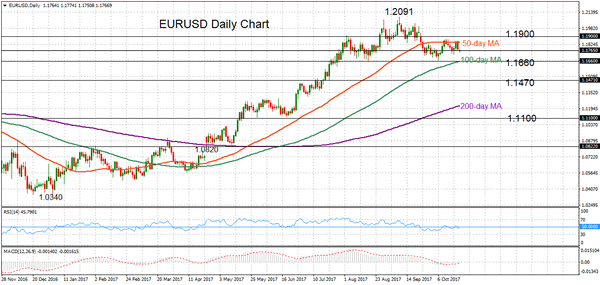
EURUSD maintains a neutral bias in the short term as it continues to consolidate below the 50-day moving average. The longer-term uptrend stalled at 1.2091 in early September and since then there was a pullback that took the pair below the key 1.1900 level.
The RSI and MACD indicators are neutral but the market is expected to remain soft with the possibility of a move lower in the near-term to target 1.1660, where the 100-day MA is currently located. Further declines would target support at 1.1470 and 1.1290 ahead of the key 1.1100 level.
Rising back above resistance at the 50-day MA at 1.1846 could see prices move up to the 1.1900 level, which if broken, would increase the odds for another extension towards the 1.2091 peak. From here, there would be a resumption of the uptrend from April, with scope to rise to the 1.25 area.
In the near-term, EURUSD is expected to remain in a range as the market continues to be capped by the 50-day MA. But looking at the bigger picture on the daily chart, the broader trend is still up and there are no signals of a reversal yet. The pullback from multi-year highs is likely a corrective move after upside momentum weakened.
Politics Rule As Japanese Elections, Catalan Independence, US Tax Plan And Fed Chair Appointment Closely Watched
Foreign exchange markets were under the spell of political developments in the absence of important economic news, with developments in Japan, the US and Spain more or less setting the tone.
The yen was the session's biggest loser as Prime Minister Abe's comfortable win over the weekend meant the probable continuation of fiscal and monetary stimulus in the world's third-largest economy. Dollar/yen briefly pierced the 114 level to trade at a three-month high of 114.09 before backing down to 113.77. The continuation of the weaker yen trade could remain in place under the new mandate that Abe has secured, given of course that risk sentiment remains broadly positive. In the event of risk aversion and negative geopolitical developments, the yen could receive a boost despite Abe's policies.
The US dollar was doing relatively well as optimism about possible tax cuts agreed by the Congress and President Trump was tempered a little as Fed Governor Jerome Powell seemed to be taking a lead in the race of who will be the new Fed Chair in 2018. Previous speculation had placed John Taylor as the leading candidate, who is seen as more hawkish on interest rates. In the past, Taylor has advocated a more rules-based approach to setting interest rates and as a result interest rates could be somewhat higher in the event he is chosen to lead the Fed.
The euro was under continued pressure because of the turmoil in Spain's region of Catalonia, where the Madrid central government has revoked the region's autonomy in emergency measures taken over the weekend. The events in Catalonia have not been heavily priced in the euro but the region's bid for independence combined with electoral gains by the far-right in Germany, have stopped the single currency from continuing to rally on the back of the more positive political news earlier in the year. Another key event to watch for this week is the ECB meeting on Thursday, where the pace of asset purchases for next year will be announced. The more the ECB cuts its monthly QE purchases, the stronger the euro will be but if on the other hand the market senses some hesitancy by the ECB to substantially reduce purchases, the euro could drop. Recent indications have been that the ECB will be reluctant to cut its purchases by too much and hence the euro's inability to extend its rally. Euro/dollar was off during Monday's trading at 1.1753, not far from the key 1.17 level which has served as support during the previous 3 weeks.
Finally, the pound recovered from its lows of the previous week on signs that the UK was adopting a more conciliatory approach in its Brexit negotiations. The UK's rhetoric has been toned down somewhat and the British Prime Minister was making positive overtures regarding the rights of the EU citizens presently residing in the UK. Pound/dollar gained to 1.3188.
Today's economic calendar is particularly quiet as only Eurozone consumer confidence is on tap. The market will no doubt closely follow political developments in Japan, Europe and the United States.
EURO Bearish Below The 1.1770 Level
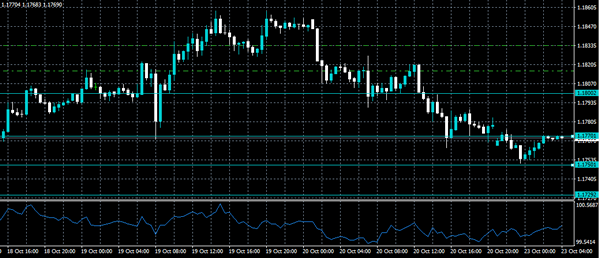
The euro continues to soften against the U.S dollar, hitting 1.1750 during the Asian trading session, as political in-fighting escalates between Catalonia and Madrid. The EURUSD currently trades on the back-foot, around the 1.1768 level, as Catalonian's President PuigDemont refuses to accept direct rule from Madrid after Spain's Prime Minister Mariano Rajoy declared the referendum vote illegal.
The EURUSD pair is increasingly bearish while trading below the key 1.1770 level. Further intraday declines remain likely towards the 1.1750 and 1.1729 technical support levels.
Should the EURUSD pair regain price-action above the 1.1770 level, a recovery towards the 1.1800, 1.1815 and 1.1833 levels should be expected.
USDJPY Strongly Bullish Above 113.40
The U.S dollar has moved sharply higher against the Japanese Yen, hitting 114.10, following Shinzo Abe's LDP parties sweeping victory in Sunday's general elections in Japan. The USDJPY pair currently trades around the 113.77 level, as post-election optimism continues to support the intraday buying sentiment surrounding the USDJPY.
The USDJPY pair remains strongly bullish while trading above the 113.40 technical support level. Further buying can be expected towards the 114.10 and 114.49 resistance levels. Extended intraday resistance is found at the 114.73 and 115 levels.
Should price decline below the 113.40 support, sellers are likely to target the 112.89 and 112.28 levels. Extended intraday support is located at the 111.79 level.