Sample Category Title

CAC Ticks Higher as French Manufacturing PMI Improves

The CAC index has started the trading week quietly. In the Monday session, the index is at 5,338.75, up 0.12% on the day. On the release front, manufacturing numbers in France and the eurozone improved in September. French Final Manufacturing PMI rose to 56.1, its highest level since April 2011. In the Eurozone, Final Manufacturing PMI improved to 58.1, just shy of the estimate of 58.2 points.

All eyes were on Spain over the weekend, as the region of Catalonia held a referendum on Sunday. The vote was marked by violence as police tried to shut down polling centers and confiscated ballots. The national government banned the referendum, and police used tear gas and rubber bullets against defiant voters, causing over 800 casualties. Catalonian officials claimed that 90 percent of voters had voted for independence. The stage has now been set for a full-blown constitutional crisis with Madrid. The Catalan regional government is holding an emergency meeting on Monday to discuss what steps it will take regarding independence, and the markets will be monitoring the situation, which remains fluid. Although, the drama in Spain is not expected to have a serious impact on the eurozone nervous investors reacted to the news on Monday by selling euros in favor of the dollar and Swiss franc.

There was good news from the manufacturing front on Monday, as French Final Manufacturing PMI accelerated for a fourth straight month, and continues to point to expansion. The French economy has rebounded in 2017, as growth is up and unemployment has fallen. Last week, the Bank of France revised upwards its growth forecast to 1.7 percent, up from 1.6 percent in July and 1.4 percent in June. Villeroy de Galhaum, head of the Bank of France, said that although the economy was improving, a growth rate of 1.7% was still short of the eurozone growth rate of 2.0 percent. The Bank's forecast is in line with that of the OECD, which has revised its growth forecast for France from 1.3 percent to 1.7 percent.

EUR/USD Mid-Day Outlook

Daily Pivots: (S1) 1.1779; (P) 1.1806 (R1) 1.1839; More...

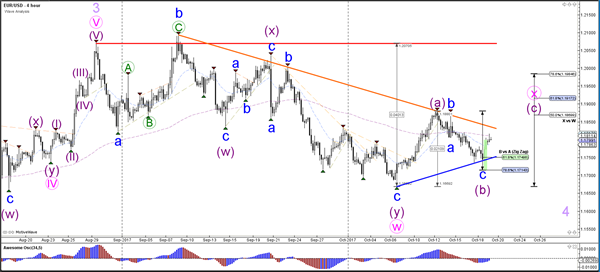
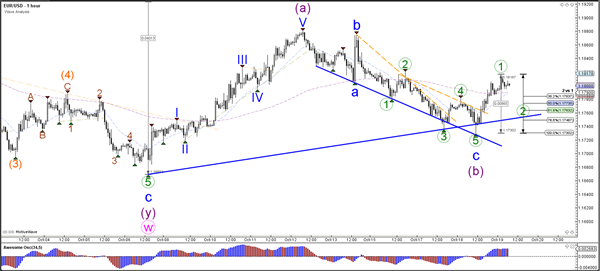
EUR/USD is still staying above 1.1716 temporary low and intraday bias stays neutral at this point. Outlook is unchanged that decline from 1.2091 is correcting whole rise from 1.0569. Deeper fall is expected as long as 1.22029 resistance holds. Below 1.1716 will target 38.2% retracement of 1.0569 to 1.2091 at 1.1510, where we're expecting support to bring rebound.

In the bigger picture, rise from medium term bottom at 1.0339 is not finished yet. It's expected to continue after pull back from 1.2091 completes. And, next target will be 38.2% retracement of 1.6039 (2008 high) to 1.0339 (2017 low) at 1.2516. However, it should be noted that there is no confirmation of trend reversal yet. That is, such rebound from 1.0399 could be a correction. And the long term fall from 1.6039 (2008 high) could resume. Hence, we'd be cautious on strong resistance from 1.2516 to limit upside.

EUR/USD 4 Hours Chart

EUR/USD Daily Chart

USD/CHF Mid-Day Outlook

Daily Pivots: (S1) 0.9656; (P) 0.9689; (R1) 0.9707; More....

Intraday bias in USD/CHF remains neutral for the moment, with focus on 0.9772 resistance. On the upside, decisive break of 0.9772 key resistance will suggest that whole down trend form 1.0342 has completed. In that case, near term outlook will be turned bullish for 0.9860/1.0099 resistance zone. Nonetheless, with 0.9772 resistance intact, outlook remains bearish. Below 0.9587 minor support will turn bias back to the downside for retesting 0.9420 low.

In the bigger picture, focus remains on whether 0.9443 key support (2016 low) could be taken out firmly as down trend from 1.0342 extends. There are various interpretation of the price actions. But in any case, medium term outlook will stay bearish as long as 0.9772 resistance holds. Current down trend could extend to 38.2% retracement of 0.7065 (2011 low) to 1.0342 (2016 high) at 0.9090. However, break of 0.9772 will indicate that USD/CHF has successfully defended 0.9443 again and turn outlook bullish for 1.0099 resistance.

USD/CHF 4 Hours Chart

USD/CHF Daily Chart

USD/JPY Mid-Day Outlook

Daily Pivots: (S1) 112.20; (P) 112.47; (R1) 112.72; More...

Intraday bias in USD/JPY remains neutral for consolidation below 113.25 temporary top. As long as 111.46 minor support holds, further rise is in favor. Sustained break of medium term channel resistance will argue that correction from 118.65 is already completed with three waves down to 107.31. Break of 114.49 will confirm this bullish case and target a test on 118.65 next. On the downside, considering bearish divergence condition in 4 hour MACD, break of 111.46 will suggest rejection from the channel resistance and turn bias back to the downside.

In the bigger picture, rise from 98.97 (2016 low) is seen as the second leg of the corrective pattern from 125.85 (2015 high). It's unclear whether this this second leg has completed at 118.65 or not. But medium term outlook will be mildly bearish as long as 114.49 resistance holds. And, there is prospect of breaking 98.97 ahead. Meanwhile, break of 114.49 will bring retest of 125.85 high. But even in that case, we don't expect a break there on first attempt.

GBP/USD Mid-Day Outlook

Daily Pivots: (S1) 1.3347; (P) 1.3395; (R1) 1.3441; More....

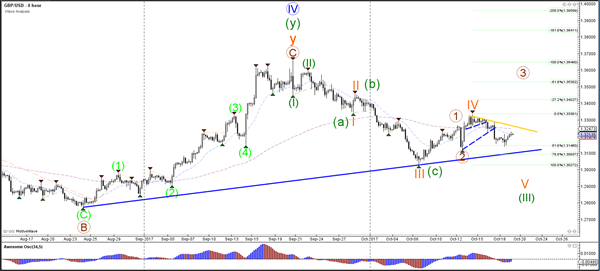
Intraday bias in GBP/USD remains on the downside for the moment as fall from. Deeper decline would be seen to 61.8% retracement of 1.2773 to 1.3651 at 1.3108. On the upside, break of 1.3454 minor resistance is needed to signal completion of the decline. Otherwise, near term outlook remains mildly bearish in case of recovery.

In the bigger picture, current development argues that the long term trend in GBP/USD has reversed. That is, a key bottom was formed back in 1.1946 on bullish convergence condition in monthly MACD. Current rise from 1.1946 will target 38.2% retracement of 2.1161 (2007 high) to 1.1946 (2016 low) at 1.5466 next. In any case, medium term outlook will now stay bullish as long as 1.2773 support holds.

GBP/USD 4 Hours Chart

GBP/USD Daily Chart

Sterling Overtakes Euro as the Weakest after Poor UK PMI Manufacturing

Quick update: Little reactions to better than expected ISM manufacturing, which rose to 60.8 in September. ISM price paid also rose to 71.5.

Sterling weakens sharply today as pressured by weaker than expected manufacturing data. Indeed, the Pound performs even worse than Euro, which is troubled by the political tensions in Spain. And, in spite of the early selloff, EUR/USD is holding above last week's low at 1.1716 and no follow through selling is seen yet. Meanwhile, commodity currencies are trading broadly higher, recovering part of last week's loss. In other markets, gold extends recent fall and dips to as low as 1273.7 so far. WTI crude oil also declines sharply and breaches 50.5, comparing to last week's high at 52.86.

Spanish markets rocked by Catalonia referendum

Despite government's violent intervention, Catalonia's referendum took place and resulted in an overwhelmingly "yes" to seceding the region from the rest of Spain. Peripheral European markets' reactions are rather negative to the outcome. Spanish equities fell with the benchmark IBEX index losing over -1% in the morning session. Treasuries fell, sending yields higher. The 10-year Spanish government bond yields soared to a 2.5-month high of 1.68%. Spread between Spanish-German 10 yields rose to the highest in 3 weeks. Last Friday, S&P affirmed Spain's sovereign credit rating at BBB+/A-2 with a positive outlook. Despite optimism over the economic outlook, the rating agency warned of the current tensions between the central government and the regional government of Catalonia. It suggested that rating outlook would be revised to "stable from "positive" if the tensions "escalated and started weighing on business confidence and investment, leading to less predictable future policy responses". More in .

UK PMI manufacturing missed expectations

UK PMI manufacturing dropped to 55.9 in September, down from 56.7, missed expectation of 56.2. Markit noted that "the growth slowdown in September is a further sign that momentum is being lost across the broader UK economy." And, "on balance, the continued solid progress of manufacturing and export growth is unlikely to offset concerns about a wider economic slowdown, but the upward march of price pressures will add to expectations that the Bank of England may soon decide that the inflation outlook warrants a rate hike."

Also released from Europe, Swiss retail sales dropped -0.2% yoy in August, SVME PMI rose to 61.7 in September Italy PMI manufacturing was unchanged 56.3 in September. Eurozone PMI manufacturing was revised down by 0.1 to 58.1 in September. Eurozone unemployment rate was unchanged at 9.1% in August.

Tankan large manufacturers index hit decade high

In Japan, the quarterly Tankan survey painted a positive picture for the economy. The large manufacturers index jumped to 22 in Q3, up from 17 and beat expectation of 18. That's also the highest reading in a decade since 2007. Large manufacturers outlook rose to 19, up from 15 and beat expectation of 16. That is seen as a result from a weaker Yen, that helped exports. However, non-manufacturing index was unchanged at 23, missing expectation of 24. Non-manufacturing outlook improved to 19, missing expectation of 21. All industrial capex rose 7.7%, slowed from 8.0% and missed expectation of 8.4%. The overall upbeat data could provide Prime Minister Shinzo Abe a mild lift going into the snap election on October 22.

China PBoC cut RRR, PMI upbeat

In China, PBoC announced targeted cuts to the reserve requirement ratio (RRR) ranging from 0.5% to 1.5%. The moves should apply to the majority of banks (90% of city commercial banks, and 95% of rural commercial lenders) in order to spur lending to small firms. This is the first reduction in RRR since February 2016. An RRR cut is regarded as an accommodative monetary policy in nature and the PBoC's move is estimated to release around RMB300-400B to the market. But the central bank claimed that it has not derailed from the prudent and neutral policy stance.

The official manufacturing PMI added 0.7 points to 52.4 in September, highest since April 2012. Looking into the details, the new orders index gained 1.7 points to 54.8 while the new export orders index added 0.9 point to 51.3. The input prices index jumped 3.1 points to 68.4, highest since December 2016. The Caixin manufacturing PMI, however, slipped -0.6 points to 51 for the month. On the non-manufacturing sector, official PMI added 2 points to 55.4, highest since May 2014.

GBP/USD Mid-Day Outlook

Daily Pivots: (S1) 1.3347; (P) 1.3395; (R1) 1.3441; More....

Intraday bias in GBP/USD remains on the downside for the moment as fall from. Deeper decline would be seen to 61.8% retracement of 1.2773 to 1.3651 at 1.3108. On the upside, break of 1.3454 minor resistance is needed to signal completion of the decline. Otherwise, near term outlook remains mildly bearish in case of recovery.

In the bigger picture, current development argues that the long term trend in GBP/USD has reversed. That is, a key bottom was formed back in 1.1946 on bullish convergence condition in monthly MACD. Current rise from 1.1946 will target 38.2% retracement of 2.1161 (2007 high) to 1.1946 (2016 low) at 1.5466 next. In any case, medium term outlook will now stay bullish as long as 1.2773 support holds.

GBP/USD 4 Hours Chart

GBP/USD Daily Chart

Economic Indicators Update

GMT Ccy Events Actual Forecast Previous Revised
23:50 JPY Tankan Large Manufacturers Index Q3 22 18 17
23:50 JPY Tankan Large Manufacturers Outlook Q3 19 16 15
23:50 JPY Tankan Non-Manufacturing Index Q3 23 24 23
23:50 JPY Tankan Non-Manufacturing Outlook Q3 19 21 18
23:50 JPY Tankan Large All Industry Capex Q3 7.70% 8.40% 8.00%
23:50 JPY Tankan Small Mfg Index Q3 10 8 7
23:50 JPY Tankan Small Mfg Outlook Q3 8 6 6
23:50 JPY Tankan Small Non-Mfg Index Q3 8 7 7
23:50 JPY Tankan Small Non-Mfg Outlook Q3 4 2 2
00:00 AUD TD Securities Inflation M/M Sep 0.30% 0.10%
00:30 JPY PMI Manufacturing Sep F 52.9 52.6 52.6
07:15 CHF Retail Sales (Real) Y/Y Aug -0.20% 0.50% -0.70%
07:30 CHF SVME PMI Sep 61.7 60.5 61.2
07:45 EUR Italy Manufacturing PMI Sep 56.3 56.8 56.3
07:50 EUR France Manufacturing PMI Sep F 56.1 56 56
07:55 EUR Germany Manufacturing PMI Sep F 60.6 60.6 60.6
08:00 EUR Eurozone Manufacturing PMI Sep F 58.1 58.2 58.2
08:30 GBP PMI Manufacturing Sep 55.9 56.2 56.9 56.7
09:00 EUR Eurozone Unemployment Rate Aug 9.10% 9.00% 9.10%
13:30 CAD Canada Manufacturing PMI Sep 55 54.6
13:45 USD Manufacturing PMI Sep F 53.1 53 53
14:00 USD ISM Manufacturing Sep 60.8 58 58.8
14:00 USD ISM Prices Paid Sep 71.5 64 62
14:00 USD Construction Spending M/M Aug 0.50% 0.40% -0.60%


Government Misstep Exacerbates Political Instability in Spain

Despite government's violent intervention, Catalonia's referendum took place and resulted in an overwhelmingly "yes" to seceding the region from the rest of Spain. European financial markets' reactions are rather negative to the outcome. Euro's selloff accelerated in the European morning with EURUSD falling -0.7% at the time of writing this report. Spanish equities fell with the benchmark IBEX index losing over -1% in the morning session. Treasuries fell, sending yields higher. The 10-year Spanish government bond yields soared to a 2.5-month high of 1.68%. Spread between Spanish-German 10 yields rose to the highest in 3 weeks. Last Friday, S&P affirmed Spain's sovereign credit rating at BBB+/A-2 with a positive outlook. Despite optimism over the economic outlook, the rating agency warned of the current tensions between the central government and the regional government of Catalonia. It suggested that rating outlook would be revised to "stable from "positive" if the tensions "escalated and started weighing on business confidence and investment, leading to less predictable future policy responses".

Referendum Result

90% of voters said "yes" to Catalonia independence but the turnout rate, at 42.3% (2.3M votes), was similar to the one held in 2014. Back then, the Catalan government estimated a turnout rate of 41.6%, of which 80.8% voted yes to the questions "Do you want Catalonia to become a State?" and "Do you want this State to be independent?". The turnout for this year might be higher if the central government had not implemented such a "crackdown" on the campaign.

The referendum result – low turnout with a high level of affirmative votes-has been anticipated. Such outcome is common for non-binding referendums as "yes" voters turn out while others cold-shoulder. Indeed, anti-independence parties, such as PM Rajoy's Partido Popular party, Ciudadanos and the PSOE, have discouraged their supporters to participate in this "illegal" referendum.

Catalan President Carles Puigdemont declared that "the citizens of Catalonia have won the right to have an independent state". He pledged to send the result to the Catalan parliament in the next few days "so that it can act in accordance with the law of the referendum". This could eventually lead to a unilateral declaration of independence within 48 hours after notifying the regional parliament of the voting result. By contrast, the Spanish prime minister, Mariano Rajoy continued to vowed the referendum illegal, condemning that the vote "only served to cause serious harm to coexistence" among Spaniards.

Aftermath

We expect the referendum outcome alone has limited impact on the solid economic fundamentals. The referendum has been declared unlawful by the court and the central government would by no means approve the result. However, depending how the conflicts evolve and how the government proceeds, the economic costs can be huge. Catalonia represents about 20% Spain's GDP, prolonged strike and demonstrations would affect GDP.

Indeed, the actions adopted by the central government so far have escalated tensions between the Spanish government and the Catalan regional authorities, and accelerated political instability.

The minority government led by PM Rajoy has adopted various means, such as asking the Constitutional Course to invalidate the referendum bill passed by the Catalan government, removing voting materials and arresting regional officials involved in the referendum, in order to stop the referendum from taking place. The world has even witnessed the national police firing rubber bullets and hitting voters. It is estimated about 900 people were injured. A huge strike has been called across Catalonia on October 3 in protest to the violence, which would inevitably make future negotiations between the Spanish government and the Catalan regional authorities more difficult.

Rajoy's moves have reduced his options to deal with the mess. There are two directions he can move. First, he can trigger Article 155 of the 1978 constitution to suspend Catalonia's autonomous power. However, this hard-line strategy would only aggravate the situation and intensify the tensions further. Some analysts suggested that the Catalan authority prefers the central government to invoke Article 155 as the government's radical step would stimulate the support for the independence movement. Another scenario is negotiations on more autonomy and more decentralization of power. However, the process would be lengthy and arduous.

In either case, Rajoy has hurt his own image by mishandling the situation. While his tough moves were aimed at preventing other regions from following Catalonia footsteps, the might probably result in diminished support by other parties. Note that Rajoy is leading a minority government, which requires supports of other parties to pass key legislations. For instance, it needed the help of the Basque Nationalist Party to pass this year's budget. However, the party has indicated that it might not approve the 2018 budget due to dissatisfaction over the government's harsh stance on the referendum. As a result, Finance Minister Cristobal Montoro has postponed the 2018 budget presentation, originally scheduled on September 29, until after October 1.

Catalan Referendum Leads to Constitutional Crisis in Spain, Spreads Jitters to Peripheral Markets


Notes/Observations

  • Spanish Ibex trades lower after Catalan referendum, Catalonia says on track towards declaration of independence
  • Concert shooting in Las Vegas leaves at least 20 dead
  • PMI data in Europe saw Spain beat, while Italy and the UK missed estimates

Overnight

Asia:

  • PBOC cut reserve requirement ratio (RRR) for some banks that meet certain requirements for lending to small business and agricultural sector (1st cut since Feb 2016); affirms prudent and neutral monetary policy
  • China Sep CAIXIN Manufacturing PMI fell short of estimates after the official Government Manufacturing PMI rose to a 5 year high
  • Japan business confidence comes in ahead of estimates, hitting a 10 year high ahead of the elections

Europe:

  • UK PMI comes slightly shy of forecasts but still marks 14th month of expansion, weighs on Sterling.
  • UK FinMin Hammond acknowledges business fears over Brexit, reiterates support for PM May
  • Euro country PMIs generally in line with forecasts, Spain strong beat, Italy slight miss, Swiss PMI was a 6 year high. Eurozone PMI confirms highest reading since Feb 2011
  • Spain's Catalonia is now on track towards a declaration of independence. According to regional officials, results showed 90% of voters backed independence (with a turnout of 2.3M vote, 42%). The government in Madrid will hold talks with Spanish parties to discuss a response.
  • Low cost Airlines Monarch Airlines ceases to trade, Easyjet, Ryanair gain

Americas

  • 20 reported dead in Las Vegas shooting, over 100 said to be injured at concert

Economic data

  • (UK) SEPT PMI MANUFACTURING: 55.9 V 56.2E (14th month of expansion)
  • (EU) EURO ZONE SEPT FINAL MANUFACTURING PMI: 58.1 V 58.2E (confirms 49th straight month of growth)
  • (DE) GERMANY SEPT FINAL MANUFACTURING PMI: 60.6 V 60.6E (CONFIRMS 34TH MONTH OF EXPANSION)
  • (FR) FRANCE SEPT FINAL MANUFACTURING PMI: 56.1 V 56.0E (Confirms 12th month of expansion)
  • (IT) ITALY SEPT MANUFACTURING PMI: 56.3 V 56.8E
  • (ES) SPAIN SEPT MANUFACTURING PMI: 54.3 V 53.0E (47th month of expansion)
  • (IE) IRELAND SEPT MANUFACTURING PMI: 55.4 V 56.1 PRIOR (52nd month of expansion)
  • (SE) Sweden Sept Manufacturing PMI: 63.7 v 57.0e
  • (RU) RUSSIA SEPT MANUFACTURING PMI: 51.9 V 52.1E (14th month of expansion)
  • (EU) EURO ZONE AUG UNEMPLOYMENT RATE: 9.1%V 9.0%E

Fixed Income Issuance:

SPEAKERS/FIXED INCOME/FX/COMMODITIES/ERRATUM

Equities

Indices [Stoxx50 +0.2% at 3,591, FTSE +0.5% at 7,407, DAX +0.3% at 12,871, CAC-40 flat at 5,330, IBEX-35 -1.2% at 10,261, FTSE MIB -0.1% at 22,682, SMI +0.4% at 9,194, S&P 500 Futures +0.1%]

Market Focal Points/Key Themes: European stocks opened slightly higher and performed mixed as the session progressed; Spanish stocks impacted by Catalan referendum over weekend, dragging on banking; political uncertainty lead to peripheral indices lagging; risk sentiment slightly off; airlines supported following bankruptcy of Monarch in the UK; home builders in the UK supported by PM May's comments regarding Brexit; upcoming earnings in US session include TerraForm Power and Cal-Main Foods; reminder this week both South Korea and China markets to be closed for holidays

Equities

  • Consumer discretionary: BIC BB.FR % (cuts outlook), Bonduelle BON.FR -9.3% (results), Roularta ROU.BE +27.9% (analyst action)
  • Energy: Trevi TFI.IT -17.4% (extension on Friday's results), Neste Oil NES1V.FI +2.8% (analyst action)
  • Financials: Nex Group NXG.UK 7.1% (results), UBI Banca UBI.IT +2.7% (analyst action)
  • Healthcare: Ablynx ABLX.BE -3.6% (study results), Pharming Group PHARM.NL +5.7% (study results)
  • Industrials: Carillion CLLN.UK -9.3% (extension on Friday's results)
  • Materials: Avocet Mining AVM.UK 4.1% (results)

Speakers

  • (UK) Chancellor of Exchequer Hammond (Fin Min): Reiterates support for PM May in what is a complex negotiation with the EU
  • (EU) ECB's Georghadji (Cyprus): Euro area inflation dependent on ECB policy, to early to declare success
  • (RU) Russian Energy Min Novak: Oil Stabilizing between $50-60/barrel, which is a 'suitable' level - Saudi Tv
  • (ES) Spain Justice Minister: Spain could use constitutional power to suspend Catalan autonomy if independence is claimed - press

Currencies

  • EUR/USD traded lower following the violence-marred independence vote in Spain's Catalonia region and as higher US Treasury yields drove the dollar up across the board.
  • GBP/USD trades at over 2 week lows approaching 1.32 handle. A break below 1.33 targets 1.3269.

Fixed Income

  • Bund futures trade at 160.97 down 4 ticks following the Catalonia vote that pressured the euro and Spanish stocks. Continued downside targets 160.25 while upside resistance stands initially at 162.07, followed by 163.27.
  • Gilt futures trade at 123.58 down 3 ticks following the move lower from Treasuries. Continued downside eyeing 123.26. Upside targets 124.90 then 125.24.
  • Monday's liquidity report showed Friday's marginal lending facility rose to €169M from €122M.
  • Corporate issuance saw $20B last week via 31 tranches, bringing YTD issuance to above $1.06T. For the week ahead analysts forecast around $15-20B to come to market.
    In Euro denominated issuance ~€25.5B came to market via 38 issuers and 44 tranches

Looking Ahead

  • 07:00 (CA) Canada Aug MLI Leading Indicator M/M: No est v 0.2% prior
  • 07:25 (BR) Brazil Central Bank Weekly Economists Survey
  • 08:00 (CZ) Czech Sept Budget Balance (CZK): No est v 15.6 prior
  • 08:00 (BR) Brazil Sept PMI Manufacturing: No est v 50.9 prior
  • 08:05 (UK) Baltic Dry Bulk Index
  • 09:00 (SG) Singapore Sept Purchasing Managers Index: No est v 51.8 prior
  • 09:30 (CA) Canada Sept Canada Manufacturing PMI: No est v 54.6 prior
  • 09:45 (US) Sept Final Markit Manufacturing PMI: 53.0e v 53.0 prelim
  • 10:00 (US) Aug Construction Spending M/M: +0.4%e v -0.6% prior
  • 10:00 (US) Sept ISM Manufacturing: 57.9e v 58.8 prior; Prices Paid: 64.0e v 62.0 prior
  • 10:00 (MX) Mexico Central Bank Economist Survey
  • 10:00 (MX) Mexico Aug Total Remittances: No est v $2.5B prior
  • 10:00 (BR) Brazil Aug CNI Capacity Utilization: No est v 77.4% prior
  • 10:30 (MX)Mexico Sept PMI Manufacturing: No est v 52.2 prior
  • 12:00 (IT) Italy Sept New Car Registrations Y/Y: No est v 15.8% prior
  • 13:00 (MX) Mexico Sept IMEF Manufacturing Index: No est v 54.0 prior; Non-Manufacturing Index: No est v 54.0 prior

DAX Edges Higher on Sharp German Mfg. PMI

The DAX index has started the week with slight gains. In the Monday session, DAX is trading at 12,863.25, up 0.27% on the day. On the release front, German Final Manufacturing PMI improved to 60.6, matching the forecast. In the Eurozone, Final Manufacturing PMI improved to 58.1, just shy of the estimate of 58.2 points. On Tuesday, the eurozone releases the Producer Price Index, which is expected to edge up to 0.1%.

There was drama and violence in the Spain on the weekend, as Catalonia, one of the richest regions in Spain held a referendum on independence. However, the vote was marked by street battles and widespread violence between voters and police. The national government banned the referendum, and police used tear gas and rubber bullets in against defiant voters, causing over 800 casualties. Catalonian officials claimed that 90 percent of voters had voted for independence. The Catalan regional government is holding an emergency meeting on Monday to discuss what steps it will take regarding independence, setting up the stage for a full-blown constitutional crisis with Madrid. Although, the drama in Spain is not expected to have a serious impact on the eurozone nervous investors reacted to the news on Monday by selling euros in favor of the dollar and Swiss franc.

The eurozone economy continues to hum in 2017, and the manufacturing sector has rebounded, thanks to a stronger global economy which continues to show strong demand for European products. German and Eurozone Final Manufacturing PMIs both improved in September, with the German indicator recording its strongest reading since April 2011. The labor market also has been improving. The eurozone unemployment rate remained at 9.1%, just below the estimate of 9.0%. Better economic conditions have led to louder calls for the ECB to tighten its monetary policy, particularly from Germany, where officials feel that that the robust economy needs tighter policy. However, the ECB must take into account those member countries that are lagging behind Germany, and ECB President Mario Draghi reiterated last week that the ECB had not made any plans to taper its asset purchase program. On Wednesday, Germany and the eurozone release Services PMIs, with both indicators expected to show expansion.

Euro’s Catalan Woes

Monday October 2: Five things the markets are talking about

The 'mighty' U.S dollar remains bid along with Treasury yields as investors contemplate the markets outlook for U.S tax cuts as well as the chances of a new, and potentially less 'dovish' Fed Chief.

In currencies, the EUR (€1.1741) has retreated in the wake of a controversial vote for independence in the Spanish region of Catalonia. The region is now on track towards a declaration of independence – results showed that +90% of voters backed independence (with a turnout of +2.3M), while GBP (£1.3310) trades under pressure ahead of this week's U.K Conservative Party's annual conference where there could be challenges to PM Theresa May's leadership.

Elsewhere, this week, there will be a number of central bank policy announcements – the Reserve Bank of Australia (RBA), the Reserve Bank of India (RBI) and the European Central Bank (ECB).

No change is expected down-under, while slow growth in India and muted inflation would suggest a cut from the RBI, while forward guidance is looked for from the ECB regarding QE.

Manufacturing PMI's for September are due for most of the world's major economies – the U.S ISM measure comes this morning at 10:00 am ETD.

In North America, Canada and the U.S will round off this busy week with their respective employment reports on Friday.

1. Global stocks mixed results

Asian equity markets opened higher after stronger China PMI over the weekend and a cut by the People's Bank of China (PBoC) to their reserve requirement ratio (RRR).

Note: China (closed all week), Hong Kong, India and South Korean markets closed for holidays so liquidity remained light.

In Japan, the Nikkei rose to a 25-month high, +0.2%, as the yen (¥112.78) weakened outright following 'hawkish' rhetoric from the Fed. Ongoing N. Korea concerns continue to cap the index. The broader Topix index dropped -0.1%.

Down-under, Australia's S&P/ASX 200 Index gained +0.8%, with resources companies climbing on optimism China's growth slowdown will be modest.

In Europe, the Spanish Ibex trades lower after Catalan referendum. Catalonia says they are on track towards declaration of independence. The referendum has lead to a constitutional crisis in Spain and is beginning to spread jitters to peripheral markets.

U.S stocks are set to open in the 'black' (+0.1%).

Indices: Stoxx50 +0.2% at 3,591, FTSE +0.5% at 7,407, DAX +0.3% at 12,871, CAC-40 flat at 5,330, IBEX-35 -1.2% at 10,261, FTSE MIB -0.1% at 22,682, SMI +0.4% at 9,194, S&P 500 Futures +0.1%

2. Oil slips after Q3 rally, gold lower

Oil trades under pressure as an increase in U.S drilling and higher OPEC output has put the brakes on a rally that recorded its biggest Q3 gain in 13-years.

Last week, U.S energy companies' added oilrigs for the first week in seven, while Iraq announced its exports increased slightly in September.

Brent crude is down -12c at +$56.67 a barrel – it recorded a Q3 gain of around +20%, the biggest Q3 increase since 2004 and traded as high as $59.49 last week. U.S. crude (WTI) is down -17c at +$51.50. The benchmark posted its strongest quarterly gain since Q2 2016.

Note: Signs that a three-year supply glut is easing helped by a production cut deal by OPEC and non-OPEC members, have driven the 'Black gold's' rally.

Overnight, gold slipped to its lowest in nearly two-months as the U.S dollar rallied and global equities gained, while growing expectations for a Fed interest rate hike in December also added to pressure. Spot gold is down -0.4% at +$1,273.60 an ounce.

3. U.S yields rally

Firming expectations that the Fed will hike rates in December coupled with domestic data pointing to steady growth in the U.S and talk of a potentially more hawkish successor to Fed Chair Janet Yellen is helping to push U.S yields higher.

Ten-year yields are trading atop of +2.37%; it's highest yield since mid-July, which has also pushed the dollar +0.5% higher against a basket of currencies.

Note: Speculation that President Trump could choose former Fed Governor Kevin Warsh, who is considered more 'hawkish' than Yellen, to replace her as head of the Fed.

Elsewhere, Germany's 10-year Bund yield gained +2 bps to +0.48%, the highest in two-months. In the U.K, 10-year Gilt yield has advanced +2 bps to +1.39%, the highest in eight-months.

Note: Spanish 10-year government bond yields rallied as much as +7 bps to +1.69%, taking the gap between them and German benchmarks close to its widest in nearly four-months.

3. EUR's Catalan Woes

The EUR (€1.1742) trades under pressure after the Spanish Catalan independence referendum, in which an overwhelming majority voted to separate from Spain.

Note: The ballots represented only about +40% of eligible voters in the region.

Expect the pound to be fuelled by political mongering. In Manchester U.K this week, the Conservative Party's annual conference is taking place and its expected to be awash with rumors of potential challenges to PM May's leadership. Also investors should expect some fierce arguments about the shape that Brexit should take.

5. U.K manufacturing PMI below forecasts

The purchasing managers' index on U.K. manufacturing activity falls to 55.9 in September, from 56.7 in August, below the consensus forecast for 56.4.

IHS Markit, which compiles the survey, said production and new orders rose at above long-run average rates, but cost inflationary pressures 'surged higher.”

'Although it looks as if the sector made solid progress through the Q3, the growth slowdown in September is a further sign that momentum is being lost across the broader U.K. economy,” said Rob Dobson, director at IHS Markit.

The U.K. economy has slowed markedly this year as inflation, which accelerated sharply after sterling's steep post-Brexit depreciation, began to outpace wages and squeeze the ever-important U.K consumer.