Sample Category Title
Gold Posts Small Gains, Markets Eye ADP Employment Report
Gold has posted slight gains in the Tuesday session. In North American trade, the spot price for an ounce of gold is $1274.56, up 0.27% on the day. There are no major US events on the schedule. On Wednesday, the US releases two key events – the ADP Nonfarm Payrolls and the ISM Nonfarm Manufacturing report. As well, Federal Reserve Chair Janet Yellen will speak at an event in hosted by the St. Louis Fed.
After failing to pass a new health care act through a skeptical Congress, Donald Trump has now set his sights on tax reform, another key campaign pledge from Trump's election campaign. Last week, the White House announced the new tax proposal, called the Unified Tax Reform Framework, which includes lowering corporate and personal income taxes. However, the plan is sketchy and short on specifics, most importantly, how will the plan be paid for? Trump has insisted that the cuts will trigger strong economic growth which will more than pay for itself. However, Moody's, the well-respected credit rating company, is not impressed by the rhetoric. On Monday, Moody's said that the tax plan is "likely credit negative", arguing that tax cuts would not be offset in spending cuts, which would result in a higher federal budget deficit and debt. The reduction in federal government revenue would negatively affect the US credit rating. Some Republican lawmakers have already come out against the plan, so it appears that the proposal will have an uphill battle to pass through the House of Representatives and the Senate.
US manufacturing indicators have been pointing upwards, as a stronger global economy has led to increased demand for US goods. The positive trend continued on Monday, as ISM Manufacturing PMI, the primary gauge of manufacturing activity, accelerated in September to 60.8 points. This reading indicated strong expansion, and was the indicator's highest level since April 2011. Gold prices reacted to the sharp reading with losses. Gold has been in retreat, as prices declined 3.2 percent in September. With the North Korean conflict again on the back burner and the US continuing to post strong numbers, investors have a renewed appetite for riskier assets, which has weighed on safe-haven gold. On Wednesday, the US releases key employment and services data, and if these releases beat expectations, gold prices could drop lower.
Pound Edges Lower as UK Construction PMI Spells C-O-N-T-R-A-C-T-I-O-N
The British pound continues to lose ground this week. After considerable losses on Monday, the pair has posted slight losses in the Tuesday session. In North American trade, GBP/USD is trading at 1.3249, down 0.22% on the day. On the release front, British Construction PMI dropped to 48.1, missing the forecast of 51.2 points. As well, the BoE released the minutes of the quarterly Financial Policy Committee meeting. There are no major US events on the schedule. On Wednesday, the US releases two key events – the ADP Nonfarm Payrolls and the ISM Nonfarm Manufacturing report. As well, Federal Reserve Chair Janet Yellen will speak at an event in St. Louis.
Two British PMIs this week, two soft readings. Is the British economy facing a downturn? There was disappointing news out from the construction sector on Tuesday, as Construction PMI fell to 48.1 points. This reading points to contraction, the first time that has occurred since August 2016, shortly after the Brexit vote. The soft reading comes on the heels of the Manufacturing PMI, which slipped to 55.9 in September, down from 56.9 points a month earlier. Although the Manufacturing PMI indicates expansion, the indicator missed expectations, and investors could become nervous about the health of the British economy, as it faces an uncertain future after Brexit. The soft PMIs could also affect the BoE's interest rate plans. The Bank has broadly hinted that it will raise rates in the near future, with low unemployment and high inflation the main arguments for raising rates. However, if economic indicators are pointing downwards, policymakers will have to carefully consider if the economy is strong enough to absorb a rate hike. We'll get a look at Services PMI on Wednesday, and if the indicator misses the forecast of 53.3, the pound could lose ground.
The Conservatives are gathered this week in Manchester for a party conference, and there had been speculation that Prime Minister Theresa May would face a challenge to her leadership from foreign secretary Boris Johnson. However, all seems calm, at least for now, and Johnson went out of his way to demonstrate his full support for May. The Conservatives are still smarting from a disastrous election in June, with May being blamed for running a lackluster campaign. She has also zigzagged on Brexit, and has recently toned down her rhetoric, notably with a conciliatory speech in Florence. Still, the Brexit talks have been difficult, with little progress to report after several rounds of negotiations. Key sticking points include the amount that Britain will pay upon leaving, whether the European High Court will have jurisdiction over EU citizens living in Britain, and the border with Ireland. There is also discussion about a transition period, which British businesses argue is crucial for a smooth shift to the post-Brexit era.
After failing to pass a new health care act through a skeptical Congress, Donald Trump has now set his sights on tax reform, another key campaign pledge from Trump's election campaign. Last week, the White House announced the new tax proposal, called the Unified Tax Reform Framework, which includes lowering corporate and personal income taxes. However, the plan is sketchy and short on specifics, most importantly, how will the plan be paid for? Trump has insisted that the cuts will trigger strong economic growth which will more than pay for itself. However, Moody's, the well-respected credit rating company, is not impressed by the rhetoric. On Monday, Moody's said that the tax plan is "likely credit negative", arguing that tax cuts would not be offset in spending cuts, which would result in a higher federal budget deficit and debt. The reduction in federal government revenue would negatively affect the US credit rating. Some Republican lawmakers have already come out against the plan, so it appears that the proposal will have an uphill battle to pass through the House of Representatives and the Senate.
Central Bank Inertia
A quite Tuesday in the markets following a fast-moving risk-on Monday and a busy rest of the week. Germany is closed for a public holiday. The ISM manufacturing index jumped to the highest since 1988 but it might be a different detail in the report that grabs the Fed's attention. NZD is the day's worst performing currency after a 2% decline in the dairy auction.The RBA reiterated its concerns with Aussie strength to the extent ot reducing all odds of a 2017 hike. Tuesday's Premium GBP trade is now in the green. The chart below is one of the 3 charts backing this trade.
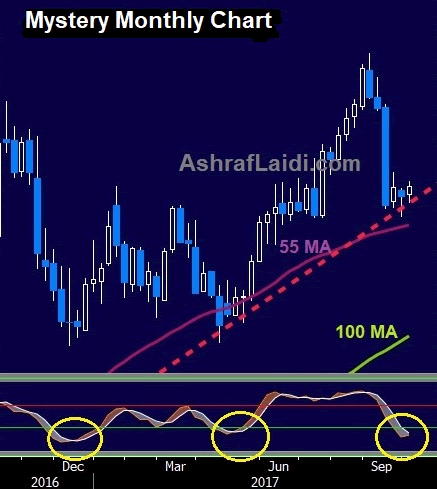
The ISM manufacturing index rose to 60.1 compared to 58.1 in September and that gave a slight lift to the US dollar. What could lend a more-lasting bid is a hawkish tilt from the Fed. What they're watching for is a genuine sign of inflation. An early one came in the prices paid component, which was at 71.5 compared to 63.0 expected. That's a six year high.
The quick take is that hurricanes caused a temporary spike (and the mild USD reaction gives that theory weight) but it's still a move in the direction the FOMC wants to see.
Other positive signs for the dollar were construction spending at +0.5% versus +0.4% prior, a rise in the Atlanta Fed GDP tracker to +2.7% from +2.3% and another record for stock markets.
GBP broadened losses as interest rate hike speculation took a back seat to the feeling of confusion and lack of unified Brexit message from the Party Conference underway this week. Disappointing manufacturing and construction PMIs sped up GBP selling, raising scrutiny over tomorrow's release of the important services ISM and speeches from BoE's Mcafferty and Haldane.
The RBA reinforced its view that a stronger AUD is "weighing on the outlook for output and employment" and is expected to continue to "subdue" price pressures, which means an RBA hike is unlikely in the next 3 months. Meanwhile the RBA made a rate cut non-viable as it would further fuel household debt relative to income.
Dollar Retreats as Investors Take Profits; Euro Rebounds
The dollar pared earlier gains during the European trading hours as investors were engaging in profit-taking, while the euro managed to rebound despite political uncertainty remaining in the background.
The dollar index retreated from the 1 ½-month high of 93.92, falling to 93.45 before the session-end as investors were locking in gains ahead of the nonfarm payrolls report to be released on Friday. Investors though seem to remain confident on the US economic environment and Trump's tax policy which aims to deliver large tax cuts to businesses.
The pound slipped back to $1.3256 after the HIS Markit/CIPS construction PMI reading fell short of expectations in September and below the 50-threshold that separates expansion from contraction, as concerns over rising interest rates weighed on the construction industry's activities. The figure dropped to 48.1, a level seen before just after the Brexit vote, instead of edging down to 51.0 as analysts anticipated. This was also 3 points below August's mark of 51.1.
Meanwhile, the UK Brexit negotiator, David Davis, speaking on the third day of the Conservatives' annual conference in Manchester, supported a "no deal" prospect on Brexit if any errors in negotiations emerge, while he added that officials were working on all scenarios to ensure talks will not fail.
Although political uncertainty in Spain and Germany continued weighing on the euro, a sizable volume of option expiries helped the common currency to rebound from the six-week low of $1.1695 – touched during the Asian session – to $1.1772. The focus will also turn on the ECB meeting minutes to be released on Thursday.
Against the pound, the euro gained 0.42% on the day, climbing to a fresh near two-week high of £0.8870.
In other currencies, the aussie inched up from a 2 ½-month low of $0.7784 to $0.7821, erasing most of the losses made earlier when the RBA retained its neutral stance on monetary policy and kept interest rates steady at the record low levels of 1.5%.
Today's bi-weekly dairy auction, which tends to affect the kiwi as New Zealand heavily relies on dairy exports, showed prices declining by 2.4%. Two weeks ago, prices advanced by 0.9%. Kiwi/ dollar fell as the data went public. On the day, the pair was last down by 0.5%, reaching a one-month low of 0.7147 earlier in the day.
In energy markets, oil prices pulled back following remarks by the Russian Energy Minister, Alexander Novak, who said today that there was no immediate need to discuss on additional output cuts as part of the deal between OPEC and non-OPEC members. However, prices managed to found support on comments made by the OPEC General Secretary, Mohammed Barkindo, who said that compliance on supply cuts between OPEC and non-OPEC countries is "extremely high". WTI crude was flat around $50.57 per barrel and Brent was 0.20% up at $56.23 ahead of the weekly API crude oil report later today.
Gold gained 0.20%, climbing to $1,272.80 per ounce.
GBP/USD On The Way Down
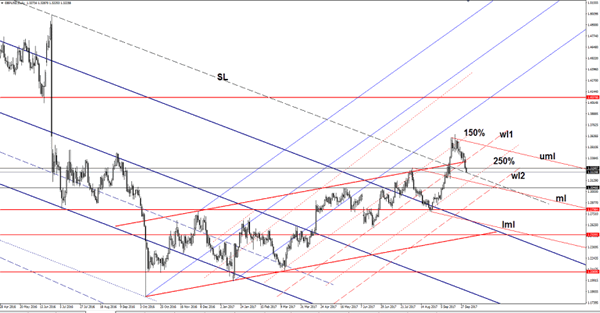
The currency pair drops further and ignored another static support. GBP is trading in the red also versus the Euro and versus the Yen, not only against the greenback. The pair is into a corrective phase on the Daily chart, remains to see how long this will be.
GBP/USD reached another downside obstacle, we'll see if will have enough directional energy to resume the downside movement or will bounce back on the short term. Is very important to see what will happen on the USDX in the upcoming days, the index climbed above the 93.81 level, but failed to stay there and now is trading at 93.64 level. Only a valid breakout above the 93.81 level will confirm a further increase and a USD dominance, while a rejection will send the dollar in agony. The USDX is somehow expected to climb much higher in the upcoming period despite a minor drop.
The GBP/USD extends the sell-off and has touched the outside sliding line (SL) of the major descending pitchfork. Has ignored the 1.3268 static support and technically is somehow expected to approach and reach the median line (ml) of the minor descending pitchfork. However, a failure to reach the median line (ml) will send it towards the upper median line (uml) of the descending pitchfork.
Is expected to reach also the 250% Fibonacci line (ascending dotted line), which represents a very strong dynamic support.
Brent Oil Further Drop To Come
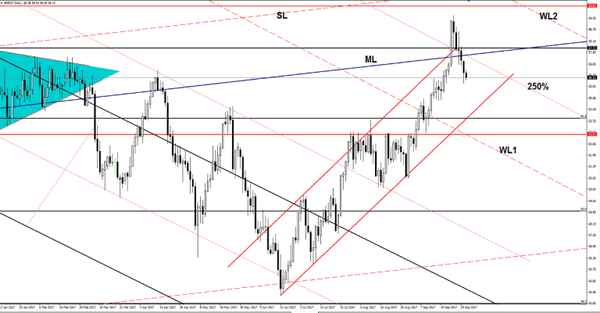
Brent drops towards the 55.81 yesterday's low. A failure to make new lows will force the rate to climb towards the 250% Fibonacci line (descending dotted line again). Technically is somehow expected to drop further towards the downside line of the ascending channel. However, it could turn back to retest the median line (ML) before will drop further.
EUR/USD Is The Retreat Completed?
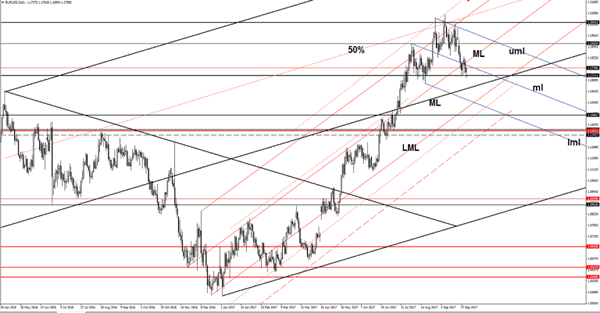
Price increased and erased the morning drops. Is trading in the green and approaches the median line (ml) of the descending pitchfork. A retest followed by a minor drop will signal a breakdown below the 1.1711 horizontal support. Price increased only because the USDX has decreased today, but it could still develop a minor Head and Shoulders pattern as long as will stay within the descending pitchfork's body. Only a breakout from the descending pitchfork's body will signal a further increase.
Dollar Rally Stalls Due to Lack of ‘New News’
- European equities showed modest gains today in an uneventful trading session. German markets are closed for the Day of German Unity. US stock markets opened with small gains (+0.2%).
- Eurozone producer price growth picked up significantly more than expected in August, underscoring the rebound in inflation across the currency bloc. Industrial producer prices rose 2.5% Y/Y in August, compared with 2% Y/Y in July.
- The British government has not yet cleared hurdles over its Brexit bill, Ireland and the rights of citizens, to move on to the next phase of its EU exit talks, Brussels' chief negotiator Barnier said.
- UK construction unexpectedly shrank for the first time in more than a year in September as Brexit weighed on investment in commercial building. The construction PMI fell from 51.1 to 48.1, way below 51.1 forecast. Crucially, it's also below the 50 level that divides expansion from contraction.
- Brexit poses risks to the ability of British companies to borrow from European banks and to some clearing activity which might have to relocate from London once Britain leaves the EU, the Bank of England said. Policymakers also feared that financial markets' reliance on Libor created a major risk to the UK's financial stability.
- Turkey's core inflation spiked to a 13-year high last month (11.2% Y/Y), prompting President Erdogan to blame high interest rates for fuelling price growth, reiterating an unorthodox stance that has unnerved investors. EUR/TRY rose to 4.22, matching the highest levels on record.
- Romania's central bank kept its benchmark interest rate unchanged at a record low 1.75% as expected, but altered overall policy by narrowing the gap between its deposit and lending rates. The symmetrical corridor will shrink to 1.25% from Oct. 4, from 1.50%, affecting interbank rates.
- Saudi Arabia is mulling oil and gas investments in Russia in a sign of deepening ties between the two countries. Talks are still at an early stage but framework accords could be signed this week during the Saudi king's visit to Moscow. A proposal on extending OPEC cuts could also come this week, Russian Energy Minister Novak said.
Rates
Uneventful trading session
Global core bonds traded with a downward bias until European noon. Higher EMU August PPI data can explain the Bund's underperformance. Sentiment turned for the better for core bonds as US traders entered dealings. Traded volumes in the Bund were extremely low with German markets closed for Day of the Unity and amid the uneventful eco calendar. Many investors remained also side-lined with key US eco releases in mind (US non-manufacturing ISM, ADP employment and payrolls). Today's moves had no technical implications. We remain in a sell-on-upticks environment in the Bund and especially the US Note future.
At the time of writing, the German yield curve bear steepens with yields 0.2 bps (2-yr) to 3.1 bps (30-yr) higher. Changes on the US yield curve vary between -0.4 bps (2-yr) and +1.5 bps (30-yr). On intra-EMU bond markets, 10-yr yield spread changes versus Germany ranged between +1 bp (Spain) and -4 bps (Portugal).
Currencies
Dollar rally stalls due to lack of 'new news'
There was hardly any (economic) news to guide USD trading today. The dollar rally took a breather after recent gains, awaiting more guidance from key eco data (including the US payrolls) later this week. EUR/USD even succeeded a cautious intraday rebound. The pair trades currently in the mid 1.17 area. USD/JPY hovers in the 113 area as major US equity indices continue to set (minor) new all-time record levels.
Overnight, Asian equities ex-Australia joined the positive sentiment from WS. The dollar stayed well bid, supported by strong equities and a minor rise in US yields. USD/JPY rebounded north of 113. EUR/USD dropped to a new correction low in the low 1.17 area. The Reserve Bank of Australia as expected left its policy rate unchanged at 1.5%. The policy statement repeated that a stronger Aussie dollar weighs on inflation, growth and employment. The Aussie dollar declined to the 0.78 area.
EUR/USD filled bids just below 1.17 at the start European dealings. So, it looked like yesterday's gradual resumption of the reflation trade would continue, resulting in higher yields, higher equities and a higher dollar. However this wasn't the case. Equities mostly traded with marginal gains and so did European yields. This time it didn't help the dollar. On the contrary. EUR/USD rebounded back higher in the 1.17 big figure. We didn't see any specific news to explain the move. If anything, interest rate differentials between the US and Germany narrowed slightly. This perhaps triggered some USD profit talking. There was also a lot of market talk about option-related activity. However, we don't make too much out of it. There was little news and trading volumes were low as German markets enjoyed a banking holiday.
There were also very few eco data in the US. Even so, the intraday USD correction halted. EUR/USD trades in the 1.1755/60 area. USD/JPY tries to stay north of the 113 big figure as US equities extend their gradual record-setting uptrend. In a broader perspective, the dollar rebound takes a breather awaiting more guidance from key eco data later this week, including the payrolls.
Sterling extends correction
Over the previous days sterling momentum clearly become less buoyant and this was also the case today. However, this time sterling in the first place lost ground against the euro. EUR/GBP rebounded further away from the key 0.8742/75 support area. Losses in cable were more modest as the dollar declined intraday. The UK September construction PMI dropped from 51. to 48.1, 1 indicating that activity in the sector contracted last month. The construction PMI is not the most important indicator for markets. However, coming on the heels of a softer manufacturing PMI yesterday, it didn't help sterling. The BoE also warned for potential disruptions in clearing activity after Brexit, but also on financing of UK corporations via from European banks. EUR/GBP trades currently in the 0.8875/80 area. Cable still set another ST correction low intraday and trades currently in the 1.3240 area. The scenario of a BoE rate is apparently (more than discounted).
Dollar Pushes Above 113 as Yen Under Pressure
USD/JPY has posted small gains in the Tuesday session. In North American trade, the pair is trading at 112.86, up 0.08% on the day. Earlier in the session, the dollar broke above the symbolic 113 level. On the release front, Japanese BoJ Core CPI accelerated to 0.6% in August. Japanese Consumer Confidence improved to 43.9, beating the estimate of 43.5 points. There are no major US releases on the schedule. On Wednesday, the US releases two key events – the ADP Nonfarm Payrolls and the ISM Nonfarm Manufacturing report. As well, Federal Reserve Chair Janet Yellen will speak at an event in St. Louis.
Low Japanese inflation levels have been a sore point in an improving economy, but there was positive news on Tuesday. BoJ Core CPI, the inflation indicator relied upon by the BoJ, accelerate to 0.6% in August, its strongest gain since May 2016. This reading follows Tokyo Core CPI, which rebounded in September with a respectable gain of 0.5%, its best gain since March 2015. Still, inflation levels remain well below the BoJ inflation target of just below 2.0%, and the BoJ has been crystal clear that it has no plans to tighten its accommodative monetary policy until inflation levels move higher.
Japanese manufacturing data has been pointing upwards, so it should come as a surprise that the Tankan Manufacturing Index, which measures confidence levels among large manufacturers, continues to accelerate in 2017. The indicator came in at 12 points in Q1, 14 points in Q2 and an impressive 22 points in Q3, its highest level since 2007. The manufacturing sector has benefited from a stronger global economy, as the demand for Japanese products remains strong. The weak Japanese currency has also helped strengthen the manufacturing and export sectors. The yen declined 1.9 percent in September, as the US dollar has gained ground against its major rivals.
President Trump's plans to reform health care have come to naught, as the proposed bill never made it past the Senate floor. Next stop is tax reform, another key campaign pledge from Trump's election campaign. The White House announced the new tax proposal, called the Unified Tax Reform Framework, which includes lowering corporate and personal income taxes. However, the plan is sketchy and short on specifics, most importantly, how will the plan be paid for? Trump has insisted that the cuts will trigger strong economic growth which will more than pay for itself. However, Moody's, the well-respected credit rating company, is not impressed by the rhetoric. On Monday, Moody's said that the tax plan is "likely credit negative", arguing that tax cuts would not be offset in spending cuts, which would result in a higher federal budget deficit and debt. The reduction in federal government revenue would negatively affect the US credit rating. Some Republican lawmakers have already come out against the plan, so it appears that the proposal will have an uphill battle to pass through the House of Representatives and the Senate.
Gold Struggles to Shine as Dollar Firms
Gold struggled to hold onto its shine on Tuesday, as the risk-on mood encouraged investors to seek riskier assets, such as equities.
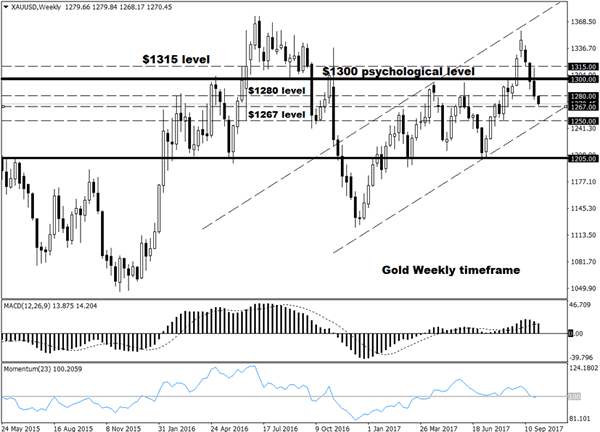
The yellow metal dipped to a seven-week low below $1270 during early trading, and it looks like further punishment is in store, as firming US rate hike expectations buoy the US Dollar. With prices securing a solid monthly close below the $1300 psychological level, and extended losses towards $1267, bears are in the vicinity.
From a technical standpoint, Gold is under intense selling pressure on the daily charts, with $1267 acting as minor support. A breach below this level may instill sellers with enough inspiration to attack $1250.
Dollar Index eyes 94.00
The Greenback stood tall against a basket of major currencies during early trading on Tuesday, as positive US economic data reinforced expectations of a rate hike before year end. With the Federal Fund Futures markets pricing in more than a 75% probability of a rate hike in December, the Dollar is likely to remain supported moving forward.
Much attention will be directed towards the anticipated US Jobs Report due on Friday, which could spark some Dollar volatility. With the impact of Hurricanes Irma and Harvey adding some unplanned components into the mix, the data could be distorted.
King Dollar is making a comeback; this was displayed on Tuesday, when the Dollar Index strode towards 93.92. A breakout and daily close above the 94.00 resistance may encourage a further incline towards 94.50.
Currency spotlight - GBPUSD
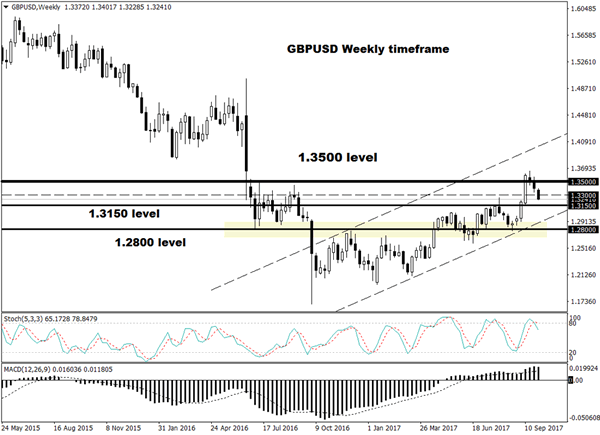
Sterling extended losses against the Dollar on Tuesday, after data showed activity in the construction sector fell for the first time in 13 months, in September.
The Purchasing Manager Index (PMI) for construction dropped to 48.1 in September. The index falling below the 50 level indicates a contraction; with Brexit uncertainty and soft economic data eroding buying sentiment towards Sterling, further downside is on the cards. Technical traders will continue to observe how the GBPUSD behaves below 1.3300, sustained weakness under this level, could open a path towards 1.3150.