Sample Category Title

Eco Data 7/26/17

[php_everywhere] [/php_everywhere]

Eco Data 7/25/17

[php_everywhere] [/php_everywhere]

Eco Data 7/24/17

[php_everywhere] [/php_everywhere]

Summary 7/24 – 7/28

Monday, Jul 24, 2017

[php_everywhere] [/php_everywhere]

Tuesday, Jul 25, 2017

[php_everywhere] [/php_everywhere]

Wednesday, Jul 26, 2017

[php_everywhere] [/php_everywhere]

Thursday, Jul 27, 2017

[php_everywhere] [/php_everywhere]

Friday, Jul 28, 2017

[php_everywhere] [/php_everywhere].

Weekly Economic and Financial Commentary


U.S. Review

Inflation Soft & Housing Starts Solid in Quiet Week

  • A strong print for housing starts in June was the most noteworthy piece of economic news in an otherwise quiet data week. Starts jumped 8.3 percent, while building permits also rose a healthy 7.4 percent.
  • Import price inflation was subdued in June, although excluding petroleum, prices eked out a gain.
  • The Leading Economic Index surged 0.6 percent in June, the largest increase since December 2014. Initial jobless claims matched the second-lowest reading of the expansion this past week, another encouraging sign for economic growth in H2.

Inflation Soft & Housing Starts Solid in Quiet Week

A strong print for housing starts in June was the most noteworthy piece of economic news in an otherwise quiet data week. Housing starts rose 8.3 percent to a 1.215 million-unit pace in June following three months of declines (see chart on front page). Permits for future construction also increased, climbing 7.4 percent. Starts were up for both single- and multifamily. Multifamily starts were particularly strong, with construction bouncing back to a 13.3 percent month-over-month pace. Activity was up sharply in the Midwest and Northeast but fell in the South, which has seen an onslaught of new apartment supply. At the midway point of the year, single-family starts accounted for the entirety of the six percent gain in total housing starts, with single-family rising a steady 10.7 percent year to date.

The import price index release for June was the last inflation reading before next week's FOMC meeting, and it did little to assuage fears about the recent slowdown in inflation. Total import prices declined 0.2 percent in June. Prices for imported petroleum fell for the fourth consecutive month, declining 2.2 percent. On a year-over-year basis, import prices moderated to a 1.5 percent pace, down from the recent cycle high of 4.6 percent in February. Ex-fuel, import prices eked out a 0.1 percent gain. Nonfuel import price growth has stalled on a year-ago basis, but expectations for a weakening U.S. dollar should pressure non-fuel import prices higher (top chart). This should be supportive to the Fed's goal of getting inflation up to two percent as policymakers grapple with the recent deceleration in prices.

The Leading Economic Index (LEI) surged 0.6 percent in June, the largest monthly increase since December 2014 and a promising sign for economic growth in the second half. The jump in building permits added 0.21 percentage points to the topline figure, and the strong June reading from the ISM manufacturing new orders component also provided a boost. The LEI is a key input into our preferred recession forecasting model, which produces the probability of a recession in the next six months. The LEI has had a solid run of late, rising at a 5.0 percent annualized rate over the past six months (middle chart). This string of healthy readings has helped push the probability of a recession in the next six months down to low levels.

Initial jobless claims was the sole negative contributor to the June LEI, but claims fell to 233,000 in the week of July 15, matching the second-lowest reading of the expansion. Initial jobless claims continue to show few signs of distress in the labor market, and the downward trend has been remarkably steady; the 52-week moving average is currently at the lowest level since 1974. This fact is yet another unusual aspect of today's labor market that complicates monetary policy decision making. The number of people joining the unemployment rolls is near historical lows, yet the number of long-term unemployed is historically high for this point in the cycle (bottom chart). More than eight years of steady recovery from the Great Recession and the economic scars still show.

U.S. Outlook

Existing Home Sales • Monday

Resales rose 1.3 percent in May to a 5.62 million annualized pace. Sales of existing homes are restrained by unusually lean inventories of homes for sale, which has made for a very competitive market for would-be homebuyers across much of the country. The typical home was on the market for just 27 days before being sold in May. Tight inventories have boosted the median selling price to a record $252,800 in May.

Tight inventory also weighed on pending home sales in May, which is a good predictor for June existing sales. Pending sales were down 0.8 percent in May, its third consecutive drop. Demand for homes is solid, boosted by rising incomes and job prospects, though supply is likely to remain a limiting factor. The competitive market and rising prices are likely to continue for some time, but strong demand fundamentals will continue to encourage more home building.

Previous: 5.62M Wells Fargo: 5.60M Consensus: 5.56M

Consumer Confidence • Tuesday

The Conference Board's overall measure of consumer confidence rose 1.3 points in June to 118.9, as consumers' upbeat assessment of the present situation offset declining expectations for the future. Improvement in the job market was a key factor in consumers' positive present attitude. The diminishing lift from the expectations component likely reflects increasing skepticism of major progress toward the new administration's policy objectives, at least as soon as some had hoped.

The preliminary figures from the University of Michigan's survey of consumer sentiment showed diminishing expectations continued in July, but consumers were still pleased with the current economy. Final numbers for that survey are also released next week. Consumers' expectations influence spending more than confidence in the present situation.

Previous: 118.9 Wells Fargo: 117.0 Consensus: 116.0

GDP • Friday

Our call for Q2 GDP growth is 2.2 percent, as our expectations remain more muted than the consensus forecast. We continue to expect a stronger print than the first quarter, particularly for the personal consumption component, which we expect will increase 3.3 percent in Q2 after a paltry 1.1 percent in Q1. Our call has a lift from both residential and business fixed investment in Q2, albeit smaller than that of Q1. We also expect the change in inventory investment to add to growth in Q2 after a large contraction in Q1, while net exports also reverses direction, cutting into Q2 growth. Government spending is likely to remain a drag in Q2.

We see little reason to expect economic growth to ramp up significantly through the end of the year, and remain confident real GDP will grow between 2.0-2.5 percent in 2017. Without a major ramp up in productivity growth, the U.S. economy is unlikely to stray from its current course.

Previous: 1.4% Wells Fargo: 2.2% Consensus: 2.5% (Quarter-over-Quarter, Annualized)

Global Review

Good Data on the Economy; Weak Data on Inflation

  • The week started with a slightly better-than-expected result for the Chinese economy in the second quarter, with growth topping expectations at 6.9 percent over a year earlier and matching the rate of growth of the first quarter of the year.
  • As expected, the ECB kept its policy stance without change but Mario Draghi, the ECB president, sounded a bit more dovish than what markets have been expecting as the monetary institution gets closer to what should be the start of a tightening process.

Good Data on the Economy & Weak Data on Inflation

The week started with a slightly better-than-expected result for the Chinese economy in the second quarter with growth topping expectations at 6.9 percent over a year earlier and matching the rate of growth of the first quarter of the year. We also saw a better-than-expected retail sales index for June, up 11.0 percent versus expectations for a 10.6 percent increase, and besting the previous months' print of 10.7 percent. Meanwhile, industrial production for June was also a bit better than expected, up 7.6 percent, year over year, versus expectations of a 6.5 percent increase. Year to date, industrial production was up 6.9 percent versus expectations of a 6.7 percent increase. Thus, GDP, retail sales and industrial production in China are indicating that the Chinese economy ended the second quarter on a positive note.

However, data from the Eurozone were mixed with the Zew expectations survey for July coming a bit weaker than in June, at 35.6 versus 37.7. Similarly, in Germany, the Zew expectations index was lower than expectations as well as lower than the June reading, at 17.5 versus 18.6 in June. Meanwhile, the German Zew current situation index was 86.4 versus 88.0 in June. Markets were also expecting the current situation index to remain at 88.0 in July.

Meanwhile and as expected, the ECB kept its policy stance without change but Mario Draghi, the ECB president, sounded a bit more dovish than what markets have been expecting as the monetary institution gets closer to what should be the start of a tightening process. However, the biggest issue today is that inflation is showing no upward momentum, in Europe or the United States, even in the face of an improving economic outlook in the former, which puts the reflation story in jeopardy and can change the timing of a starting date for the tightening process.

In the U.K. retail sales were stronger than expected in June, up 0.6 percent, partially reversing May's 1.1 percent decline. Excluding auto fuel, retail sales were stronger, up 0.9 percent but also only partially reversing the 1.5 percent decline recorded in May. However, analysts pointed to the fact that June was the warmest month since 1976, pushing people "to buy more clothing and thus helping to offset declines in food and fuel."

Recent economic weakness is also slowing down price pressures in the U.K. economy. CPI inflation was flat in June and lower than markets expectations of a 0.2 print. June's print pushed down the year-over-year rate from 2.9 percent to 2.6 percent while the core rate was down from 2.6 percent to 2.4 percent. This was likely music to the ears of the majority of the Monetary Policy Committee members who were expecting lower inflation numbers and were not convinced of the need to raise interest rates.

In Japan, June exports grew at a stronger-than-expected rate of 9.7 percent year over year. However, they slowed down from a 14.9 percent year-over-year rate recorded in May. Imports also grew at a better-than-expected rate, up 15.5 percent, but were also weaker than the 17.8 percent year-on-year rate reported in May.

Global Outlook

Eurozone PMIs • Monday

ECB President Draghi made reference this week to the "robust recovery" going on in the Eurozone. For financial markets that were expecting dovish undertones out the ECB, the more neutral assessment of the Eurozone's economy spooked the stock market.

When bourses open on Monday of next week in Europe, investors will get the pulse of business activity for July when the preliminary survey results for manufacturing and services. While the PMIs have been in expansion territory for the past four years, only recently have they broken north of 55. This represents the fastest pace of expansion since the relief rally in 2011, which followed the European sovereign debt crisis of a year earlier.

In the latest print, the manufacturing PMI rose while the service sector gave up some ground. No major change is expected, which suggests any change we do get could be market moving.

Previous: Manufacturing: 57.4 Services: 55.4 Consensus: Manufacturing: 57.2 Services: 55.4

U.K. GDP • Wednesday

Recent meetings of the Bank of England's Monetary Policy Committee have shown growing dissent over keeping rates unchanged with some members calling for rate increases. The shift to a more hawkish bias was one of a number of factors driving British pound sterling higher over the past few months.

The momentum toward an eventual rate hike was dealt a setback this week when the June CPI report showed virtually no inflation in the month-over-month rate for June. The year-over-year rate remains high at 2.6 percent, but that is slower than the 2.9 percent annual rate reported in the prior month.

On Wednesday of next week, financial markets in the United Kingdom will be focused on Wednesday's initial estimate for second quarter GDP growth. After a 0.2 percent increase in the first quarter, markets are looking for 0.3 percent in the second.

Previous: 0.2% Wells Fargo: 0.3% Consensus: 0.3% (Not Annualized)

Japanese CPI • Friday

The Fed and the Bank of Canada are raising rates, and most of the world's major central banks have at least begun to talk about policy normalization, but the Bank of Japan (BoJ) has been the holdout. At its policy meeting this week, the BoJ maintained its comprehensive program of policy easing with no clear end in sight.

As the nearby chart shows, the CPI inflation backdrop justifies the BoJ's accommodative stance. Aside from a brief spurt in reaction to the 2014 consumption tax, sustained CPI inflation north of 2.0 percent has not been achieved since the early 1990s.

The June CPI report is due out on Friday of next week. The headline rate is not expected to be much different from the 0.4 percent rate posted in May. The BoJ has talked about the need to overshoot its 2.0 percent target before dialing back monetary policy support.

Previous: 0.4% Wells Fargo: 0.4% Consensus: 0.4% (Year-over-Year)

Point of View

Interest Rate Watch

Cautiously Resolute

There was little in the way of economic news to sway the policymakers one way or the other just ahead of the July 25-26 FOMC meeting. While no major policy moves are expected at that meeting the language in the policy statement will likely acknowledge that labor market conditions have strengthened further and inflation remains on the low side of expectations. Financial conditions have also eased since the last FOMC meeting, with equity prices rising and bond yields falling. The policy statement will also likely provide some indication that the Fed is closer to formally announcing when and how it plans to begin to reduce its balance sheet. We expect a formal announcement in September.

Fed Chair Yellen and many other FOMC members remain resolute in their faith that the recent soft inflation data are transitory. The pullback in inflation on a year-ago basis is largely due to a series of one-0ff factors, including lower cell phone service prices and lower health care costs. Rents are now also decelerating, as a surge of new apartments is being delivered to many of the markets that had seen sharp rent increases. Lower oil prices are also helping hold down transportation and utility costs.

The bond market does not appear to share the Fed's conviction that today's lower inflation will prove transitory. The bond market's doubts are backed up with seven years where inflation has largely remained below the Fed's expectations. And inflation is also lower around the world. Bond yields declined this week, and the financial markets are increasingly buying into the notion the Fed is close to being done hiking rates for this cycle. We do not share this conclusion and continue to see the terminal federal funds rate well above two percent. The Fed is only half way there.

In addition to the FOMC meeting, second quarter GDP is released next Friday along with revisions for the past three years. The annual revisions are one reason why there is such a wide range of estimates for second quarter growth. Beyond that, the markets can look ahead to the July jobs data, which based on the most recent claims figures, should once again come in hot.

Credit Market Insights

Sentiment for Credit Access Rises

The Federal Reserve Bank of New York released its Credit Access Survey on Monday. The survey breaks down loan application and rejection rates for loan categories over the past four months, such as auto, mortgage and credit card, and segments the data into demographics and credit score categories. The survey showed the share of discouraged applicants with low credit scores reached a record low in June, suggesting the overall pool of applicants is more optimistic about the potential to receive approval.

Indeed, the discouraged proportion of potential credit seekers with credit scores below 680 fell to just 14.6 percent. Despite this, individuals from that credit range who submitted applications saw a rejection rate of 37.8 percent over the past four months, up 8 percentage points since February.

No credit type reflects this trend more than mortgage refinancing loans, which saw a 2 percent decrease in total applications, but a staggering 10.4 percent increase in the rejection rate. Total applications increased only in those same low credit score applicants. It is possible that the recent rate hike by the Fed, as well as similar hawkish sentiments coming from other central banks, might have pushed those applicants to refinance mortgages while interest rates remain low. Our projections indicate a modest rise in interest rates over the next year, which should not have a major effect on the supply of credit.

Topic of the Week

A Warning Sign from Federal Tax Revenues?

Federal tax revenues have sharply decelerated, leading some commentators to draw attention to this potential red flag. Admittedly, the current pace of federal revenue growth is more in line with recessionary periods than with healthy expansions (top chart). As recently as January, the Congressional Budget Office projected total federal revenue growth in FY 2017 would be 4.2 percent and individual income tax collections would grow a healthy 6.8 percent. However, with three-quarters of the fiscal year complete, federal receipts growth has been just 1.6 percent for total revenue and 2.4 percent for individual income tax receipts.

We believe that fears regarding this indicator are overblown. The prospect for tax cuts in the wake of the presidential election likely led investors to delay realizing capital gains at the end of 2016, hoping to instead realize the gains in 2017. The net investment income tax imposed by the Affordable Care Act has been on the chopping block all year, and the House Republican tax plan calls for a top capital gains tax rate more in line with the rate seen after the Bush tax cuts.

We have data for two subsets of tax receipts that provide evidence for our case: income taxes withheld from workers' paychecks and payroll taxes. These data are less volatile sources of federal revenues, proxy employment and income growth and comprise the bulk of federal tax receipts. Payroll taxes are the only category running ahead of the CBO's projections fiscal year to date (bottom chart). Similarly, withheld income tax receipt growth has slowed, but at a more modest pace that is consistent with the gradual deceleration in employment over the past couple years. When viewed through this lens, the weakness in federal revenue growth suggests the economic fundamentals are not as bad as they appear from headline federal tax collections.

For more on this topic, see our special report "Is Federal Revenue Growth Flashing a Warning Sign?" available on our website.

The Weekly Bottom Line

U.S. Highlights

  • It was a light domestic data week with investors focused on politics, central banks, and international data. U.S. equities set new records with the S&P 500 a mere 25 points from 2,500. while the dollar weakened broadly.
  • China's economy grew by 6.9% y/y in Q2 with broad-based gains. The robust headline, alongside consensus-beating details helped shore up confidence in the evolving and decelerating economy.
  • Despite the unchanged policies and dovish tone from the BoJ and ECB both the yen and euro strengthened.
  • U.S. data was robust but not market-moving, with investors looking forward to FOMC and Q2 GDP next week.

Canadian Highlights

  • This week's economic data continues to support the view that another Bank of Canada rate hike is coming in October.
  • Retail spending data this week showed that consumers strengthened their grip on the growth baton. With retail sales up 1.1% in real terms in May, second quarter consumer spending growth looks to exceed 3% (annualized).
  • Overall economic growth is also on track for a gain of 3% or higher in the second quarter, firmly in line with the Bank of Canada's July forecast.
  • Meanwhile, two of the Bank of Canada's core inflation measures ticked up for the first time in several months.

U.S. - More Growth.... Less Inflation

It was a light week for domestic economic data with investor focus primarily on political events, G7 central banks, and international data. China kicked off the week with the release of economic growth estimates for the second quarter. The world's second largest economy grew by 6.9% in Q2 with gains broad-based. The robust headline, alongside consensus-beating details helped shore up confidence in an evolving and slowing economy with the strength of the largest consumer of materials providing some support to commodity prices.

Oil got a further lift from a bullish U.S. inventory report, with a brief recovery developing before petering out on Friday morning. Still, commodity-exposed currencies did fairly well (see Chart 1). The Norwegian krone and Brazilian real were up about 2% vis-à-vis the greenback, while the antipodes gained half that. Equity markets also fared well. U.S. indices, helped by strong earnings and a pullback in the dollar to a one-year low, reached record peaks by mid-week. Tech and health care stocks led, with the latter boosted by diminishing prospects for ACA repeal. Equities in Hong Kong and China also did well, with U.K. indices boosted by the recent pound depreciation. On the other hand, Japanese and European equities suffered losses as their currencies strengthened by 0.9% and 1.5% relative to the U.S. dollar on the week.

Paradoxically, the yen and euro appreciated despite the dovish stance communicated on Thursday by both the Bank of Japan (BoJ) and the European Central Bank (ECB). The BoJ left the policy rate unchanged and will continue to buy assets for some time still. The BoJ upgraded the growth forecast for the Japanese economy, but also lowered the inflation forecast and pushed out its timeframe for achieving the inflation target. Gov. Kuroda now expects inflation to reach 2% a year later than previously projected, or by March 2020. This is the sixth time that the BoJ pushed out the timeline under his tenure. .

A similar theme is apparent in the Eurozone. Growth projections were lifted over the medium-term while inflation forecasts have been downgraded, with inflation unlikely to hit ECB's 2% target this decade. Importantly, in the latest press conference ECB President Draghi communicated that inflationary momentum in the Eurozone is not self-sustaining and the ECB is in no rush to taper its bond purchases at this point so as to maintain support.

U.S. economic data were relatively constructive. The pace of homebuilding bounced back above the 1.2 million annualized pace, Empire and Philly surveys telegraphed robust growth, and jobless claims fell to 233 thousand. Still, the robust data offered little to support the greenback, with political uncertainty related to the ACA, debt ceiling, and NAFTA remaining front-and-center. The dollar also lacked Fed hawks' support with the FOMC in a 10-day blackout period ahead of next week's policy meeting. While we only expect only minor tweaks to the policy statement we look forward to the post-meeting speaking circuit in anticipation of updated Fed communication, which remains at odds with markets on upcoming rate hikes. We believe that the truth about rate hikes in the next eighteen months is somewhere between the market's two and Fed's four. Moreover, while we can't rule out a hike later this year, the probability of such a move is diminished at this point, especially taken together with balance sheet normalization slated to begin in the fall.

Canada - Where to From Here?

This week brought with it a slew of economic data to support the view that the Bank of Canada will continue to raise rates in October.

Perhaps most importantly, consumers are strengthening their grip on the growth baton. Retail spending was up 0.6% in May and a colossal 1.1% in real terms. Autos remained a key area of strength, suggesting that households remain confident in their future economic prospects. Overall, consumer spending is on track to grow by 3.2% (annualized) and should contribute almost 2 percentage points to economic growth last quarter. Overall, Real GDP growth is expected to come in above 3% (annualized) in the second quarter, squarely in line with the Bank of Canada's July forecast.

The Bank of Canada opted to ignore soft consumer price growth in its decision to lift the overnight rate last week, emphasizing temporary factors weighing on inflation and noting that improving economic conditions would eventually help lift it back to its 2% target. This week's CPI report may be the first step in that direction. Overall inflation edged lower to 1.0% (year-on-year) in June, as falling energy prices (-1.3% y/y) weighed on the headline number. Notably, however, two of three of the Bank of Canada's core inflation measures edged up for the first time in several months. The turn in core inflation, while nascent, is in line with the central bank's expectation for a firming in underlying price pressures.

The housing market continues to offer a note of caution for future growth. The June data out this week recorded a third month of declining activity. Existing home sales fell 6.7% in the month, led by a sharp drop in markets in Ontario. In Toronto, existing home sales are down a whopping 42% peak-to-trough. Weakness was also pretty widespread across markets outside of Ontario. The recovery in Vancouver seems to have petered out, with sales now down for two months in a row. Meanwhile, total sales excluding BC and Ontario were down 3.9%.

The slowdown in national home sales is unlikely to sway the Bank of Canada from raising rates, however. For one, home price growth remains robust, which will only continue to add fuel to the consumer spending binge. While average home price growth slowed to 0.4% in June, that largely represented a shift in sales away from more expensive markets like Toronto and Vancouver to cheaper markets like Montreal and Ottawa. Adjusted for quality, home prices were still up 15.8% year-over-year. Second, the sales adjustment has been largely policy-driven, the impact of which has historically proven to be temporary. Ultimately, it will be higher interest rates that will keep housing activity from re-accelerating.

Overall, consumer led-economic growth in Canada has accelerated to a pace that no longer warrants emergency level interest rates. As long as economic activity remains robust, it will continue to eat into economic slack. At this point, an additional hike this October seems assured. Provided that the global economy cooperates, the downturn in housing remains contained, and inflation eventually moves higher, the central bank will likely raise rates another two times in 2018.

U.S.: Upcoming Key Economic Releases

U.S. Real GDP- Q2 Advance Estimate

Release Date: July 28, 2017
Previous Result: 1.4%
Consensus: 2.5%

The advance GDP release is likely to confirm a pickup to an above-trend pace following the Q1 disappointment. We are near the market consensus for a 2.5% annual rate, reflecting a robust pickup in consumer spending and a further advance in nonresidential business investment. We look for real consumer spending (PCE) to reaccelerate to near a 3% pace while business investment should reflect growth across all sub-categories. Both residential investment and net exports, however, should be a small drag, partially offset by inventory accumulation. A GDP print closer to 2% would be taken negatively by markets, as weaker than expected growth amid low inflation can be expected to lower the Fed's conviction in its policy rate path.

Canada: Upcoming Key Economic Releases

Canadian Real GDP - May

Release Date: July 28, 2017
Previous Result: 0.2% m/m
TD Forecast: 0.2% m/m
Consensus: N/A

Industry level GDP should rise by 0.2% in May, matching the prior month. We expect growth to reflect strength in goods and services, though both should receive significant support from the auto industry. Manufacturing output surged in May on the strength of motor vehicle shipments and automobiles accounted for all of the growth in nominal retail sales. Meanwhile, a sharp cooling in the Toronto housing market should provide an offset through the conduit of residential construction and broker commissions, though the latter is admittedly a small portion of the wider industry. With the headwinds from real estate likely to persist into Q3 and consumer spending unlikely to repeat its blockbuster performance, we may be at the peak of the current cycle. Our forecast for a 0.2% monthly print translates into 4.1% advance on a year-ago basis, though base-effects from the Fort McMurray wildfires are sizeable.

With Q2 GDP tracking at 3.2%, the real side of the economy is performing in line with the Bank of Canada's expectations, signaling a high likelihood for a 25bp hike in October.

Week Ahead – FOMC Meeting and Q2 GDP Data in Focus; Eurozone PMIs also Eyed

The Federal Reserve meets next week for a scheduled policy meeting but with no change in rates expected, the focus will likely fall on the balance sheet reduction plan. Data-wise, second quarter GDP estimates will be watched for France, the United Kingdom and the United States. Japanese and Australian inflation data will also be important, while flash PMIs for the Eurozone and the US should give the first glimpse on economic activity in July.

Eurozone PMIs

Starting the week on Monday will be the flash PMI releases for the Eurozone for July. Eurozone growth eased slightly in June according to IHS Markit's PMI indicator but held not too far from April and May's 6-year high. July's flash readings are forecast to show the manufacturing PMI falling marginally to 57.2, the services PMI improving slightly to 55.5 and the composite PMI remaining unchanged at 56.3.

More business surveys will follow on Tuesday with the release of the German Ifo report and the European Commission's economic sentiment index on Friday. Meanwhile, France will publish the first estimate of GDP growth for the second quarter on Friday. Growth in the Eurozone's second largest economy is forecast to edge up to 0.5% quarter-on-quarter in the three months to June. Next week's data should provide further evidence of a broadening recovery in the euro area and reinforce expectations that the ECB will begin to scale back its asset purchases early in 2018, despite Mario Draghi's efforts to bypass the topic at the European Central Bank's policy meeting on Thursday.

Australian inflation eyed as aussie rallies to 2-year highs

The Australian dollar rocketed to a more than 2-year high this week after the Reserve Bank of Australia sounded more confident about the growth outlook in its meeting minutes than had been expected. However, inflation remains low and the aussie's recent sharp appreciation has the potential to add significant downside pressure on prices. Inflation data out on Wednesday will therefore be watched closely given the premature talk of a rate hike in the markets this week, which has been rebutted by the RBA.

Japanese inflation making snail-pace progress towards target

The Bank of Japan held policy unchanged on Thursday and reiterated its commitment in maintaining its ultra-loose monetary policy until inflation has reached its 2% goal. Data out on Friday will likely show the target remains far-off as annual CPI excluding fresh foods is forecast to stay unchanged at 0.4% in June. Other data out of Japan on Friday will also come into focus, which will include household spending, retail sales and the unemployment rate. Household spending growth in June is expected to turn positive on a year-on-year basis for the first time since February 2016. Retail sales are also forecast to improve in June, while the unemployment rate is expected to decline to 3.0%.

A recovery in consumer spending from a tightening labour market remains the BoJ's best hope of lifting inflation. But the yen is unlikely to respond much to any data surprises on the upside just yet as only a sustained improvement in the key indicators would warrant a shift in tone by the BoJ.

UK to report another quarter of lacklustre growth

Just as the Bank of England begins to contemplate raising UK rates for the first time in a decade, serious doubts are being raised about the UK's growth prospects as the start of Brexit negotiations has so far only added to the uncertainty. GDP data out on Wednesday is forecast to show the UK economy had another poor quarter, with growth recovering only modestly from 0.2% q/q in the first three months to 0.3% in the second quarter. A stronger-than-expected reading could provide the pound some support after it came under pressure this week on weak inflation data and renewed fears of a 'hard' Brexit.

Fed to hold rates but could begin balance sheet reduction

There will be plenty of US data next week to keep investors busy, though the focal point will be the FOMC meeting and the preliminary GDP estimates for the second quarter. Starting things off on Monday are the flash PMI readings for July, along with existing home sales. There will be more housing data on Tuesday with the CaseShiller 20-city house price index and new home sales on Wednesday. Also out on Tuesday is the Conference Board's consumer confidence index, which is expected to ease slightly in July. The latest durable goods orders are due out on Thursday and are forecast to rebound by 1.9% month-on-month in June. But the data highlight will likely be Friday's GDP figures. After a traditionally soft first quarter, US growth is expected to gather pace in the second quarter, though the rebound is projected at only a paltry annualized rate of 2.5%.

The week's other big headline will the FOMC meeting on Wednesday. The Fed is almost certain to keep rates at between 1.00-1.25% but could surprise with a decision to proceed with its balance sheet reduction plans earlier than expected. Most analysts anticipate the Fed to announce its plans in September and to initiate it in October, but an earlier date cannot be ruled out given that despite the undershoot in inflation, overall growth has been solid.

Canadian Inflation and Retail Sales Moderate in June But Loonie Rallies

The commodity-linked Canadian dollar, which has benefited this week from a rebound in energy prices, extended its gains on Friday despite data out of the country indicating softer inflation and retail sales in June. The focus now turns to the Bank of Canada, which is expected to maintain the hawkish stance it held earlier this month.

Statistics Canada released on Friday the latest numbers on inflation and retail sales. According to the data, Canadian headline CPI turned negative in June for the first time since December 2016, falling as expected by 0.1% month-on-month from a positive 0.1% in May. On a yearly basis, CPI reached its lowest growth since October 2015, rising in line with expectations by 1%, down from 1.3% in the previous month. Excluding energy and food prices, core CPI remained unchanged, standing flat at 0.1% month-on-month and 0.9% year-on-year.

Regarding retail sales, consumer spending in May moderated to 0.6% month-on-month from the downwardly revised 0.7% in April. Yet, the figure surprised analysts who anticipated instead an increase of only 0.2%. More surprising, however, was the shift in core retail sales. The figure missed the forecast of 0.3%, dropping by 0.1% and diverging significantly from the previous figure of 1.3%.

Earlier this month, the BOC raised interest rates for the first time in almost seven years on the back of stronger labour and housing markets. However, Governor Stephen Poloz mentioned during a recent speech that the bank will proceed with further monetary tightening in the future if economic conditions appear to be improving and inflation gradually moves back towards the target of 2%. Although today's data seem to reduce the odds of an additional rate hike as the gap between inflation and the 2% target widens, market watchers remain optimistic that the Bank will not change its hawkish view. Instead, they believe, that policymakers will be satisfied with the numbers when they meet again in the autumn, most likely in October, to decide on interest rates.

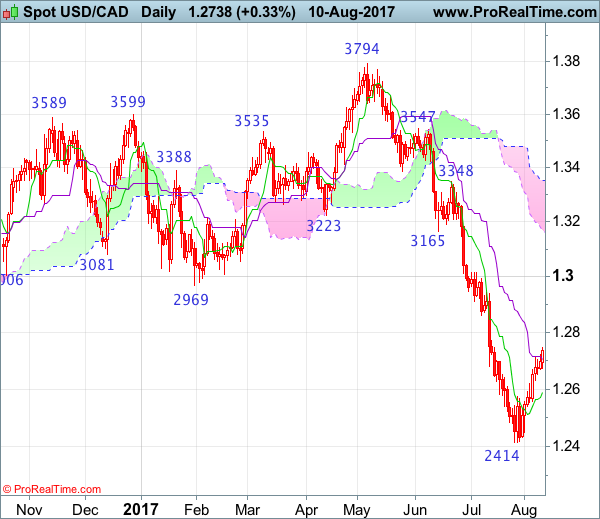
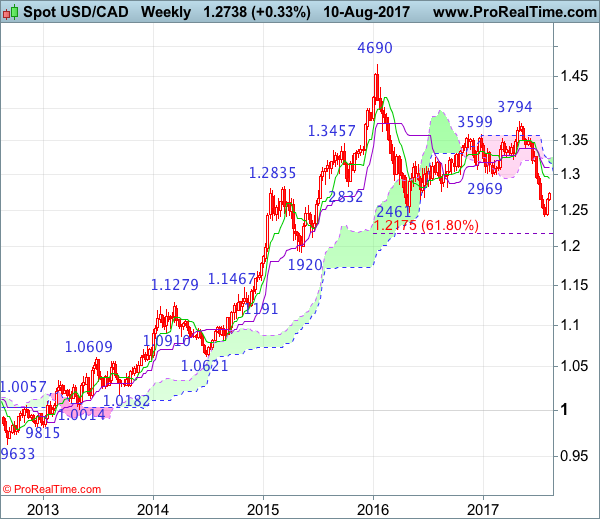
Turning to the reaction in the forex markets, the loonie advanced against its US counterpart, extending its daily gains. The loonie jumped immediately after the data to rise to C$1.2545 from around C$1.2600, before hitting a fresh 14-month high of C$1.2521.

FOMC Policy Gathering, Key Economic Data in Focus

Next week's market movers

  • In the US, the highlight will probably be the FOMC policy decision. Even though no change in policy is expected, investors may focus on any signals regarding the timing of the next rate hike.
  • In Australia, CPI data for Q2 could shed some light on whether the RBA will officially turn hawkish soon. That said, comments from RBA's Debelle suggest that rate-hike talk may still be premature.
  • We also get key economic data from the Eurozone, Germany, the UK, the US, and Japan.

On Monday, we get the preliminary manufacturing and services PMIs for July from many European nations and the Eurozone as a whole. The forecast is for the bloc's manufacturing index to decline slightly, but for the services print to tick up, something that would leave the composite figure unchanged. We think that relatively unchanged prints would still be encouraging news for ECB policymakers, considering that all of these indices are expected to remain at elevated levels, consistent with robust growth in the Eurozone. Solid PMIs could enhance speculation that the ECB may continue shifting to a more hawkish stance at its upcoming meetings, and that the Bank could make a formal announcement as early as October that the pace of QE purchases may be reduced by the turn of the year.

On Tuesday, we have a relatively quiet day, with no major events or indicators due to be released.

On Wednesday, the highlight of the day will be the FOMC rate decision and the forecast is for no change in policy. This is one of the smaller meetings that are not accompanied by updated forecasts or a press conference by Chair Yellen. As such, all of the action will come from the language of the statement accompanying the decision. What should investors expect from this meeting? Not much, we think.

Economic data following the Fed's June policy meeting have been disappointing, on balance. The headline CPI rate declined again in June for the 4th consecutive month, casting doubts as to whether the recent softness in inflation is indeed transitory. Meanwhile, retail sales for the month surprisingly tumbled. What's more, even though the labor market posted another month of solid jobs gains in June, we doubt that will be enough to comfort policymakers, considering that wage growth remains lackluster.

Bearing all these in mind, we think that the statement accompanying the decision may have a somewhat more cautious tone than previously, acknowledging the recent softness in the data. Even though the Committee could signal once more that it views this weakness as transitory and that it expects the indicators to recover soon, we find it difficult to envision a scenario in which policymakers appear optimistic enough to bring rate-hike expectations forward and boost USD. Market pricing currently suggests that the probability for another hike this year is roughly 50%. We believe investors may need to see a material rebound in inflation and GDP data, before that probability rises notably.

From Australia, we get CPI data for Q2. In the absence of any forecast, we see the case for the nation's inflation rate to have ticked up from +2.1% yoy in Q1. We base our view on the Melbourne Institute inflation gauge, which rose to +2.3% yoy in June. Even though a potential acceleration in inflation could enhance speculation regarding a rate hike by the RBA in the foreseeable future, we remain doubtful on that prospect. Recent comments from RBA Deputy Governor Debelle suggest that rate-hike talk may still be premature. His remarks signaled that the Bank may be somewhat uncomfortable with the recent rise in Australian yields, as well as AUD appreciation. As such, we would like to hear from Governor Lowe, or wait for the next RBA meeting, before we become confident that the Bank may turn hawkish soon.

In the UK, the 1st estimate of GDP for Q2 will take center stage, though no forecast is available yet. Our own view is that growth may have accelerated somewhat from an anemic +0.2% qoq in Q1. We base this assessment on the nation's NIESR GDP estimate, which shows growth ticked up to +0.3% qoq in Q2. Even though accelerating growth would be encouraging news for the BoE, we don't think that +0.3% qoq is robust enough to boost market expectations regarding a hike in the near term.

On Thursday, from the US, we get durable goods orders for June. The forecast is for both the headline and the core rates to have risen. This would mark a rebound for the headline print, which has fallen for two consecutive months now. The case for solid durable goods is supported by the nation's ISM manufacturing PMI for June, the new orders sub-index of which rose notably, indicating accelerating growth in orders.

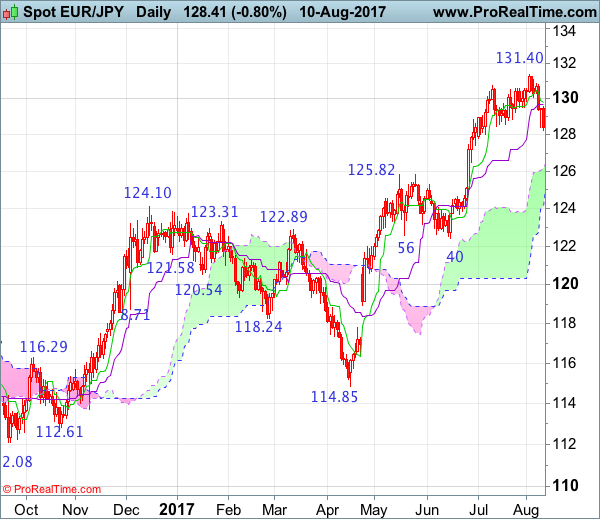
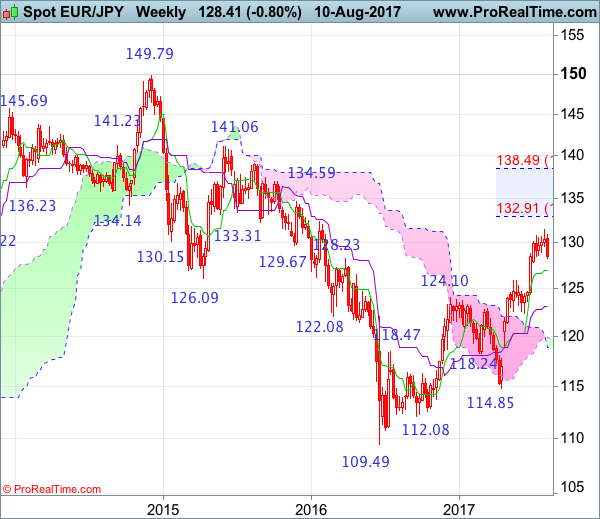
On Friday, during the Asian morning, Japan's CPIs for June will be in focus. No forecast is available for the headline rate, while the core rate is expected to have held steady at +0.4% yoy. We view the risks surrounding both rates as skewed to the downside, considering that the nation's forward-looking Tokyo CPI rates declined notably in June. A potential pullback in the nationwide rates as well could amplify our view that even though many of its foreign counterparts have turned hawkish, the BoJ is likely to keep its ultra-loose QQE with yield-curve control framework intact for the foreseeable future. Given that under this framework the BoJ keeps yields on longer-dated JGBs fixed near 0%, we maintain our broader view that JPY may continue to underperform EUR and CAD, given that the ECB and the BoC have turned optimistic.

From Germany, we get preliminary CPI data for July, ahead of Eurozone's figures that are due to be released the following Monday. The forecast is for the nation's inflation rate to have ticked down. Even though such a decline could be seen as a somewhat discouraging development for ECB policymakers, we would like to stress that Germany reports only a headline, not a core, inflation rate. This implies that a small slide in this rate may be owed mainly to movements in the prices of volatile items, and may not necessarily be descriptive of underlying inflationary pressures in Eurozone's largest economy. We think that investors will focus primarily on Eurozone's core CPI print in order to gauge when and how the ECB may act next.

From the US, we get the 1st estimate of GDP for Q2. The forecast is for economic growth to have accelerated to +2.5% qoq SAAR from +1.4% qoq SAAR in Q1. The forecast is supported by the Atlanta Fed GDPNow model, which at the time of writing estimates Q2 growth at +2.5% qoq SAAR. We believe this indicator will be closely watched, as it may prove critical with regards to market expectations regarding the timing of the next Fed rate hike. Looking back at the June FOMC meeting, where the Committee raised rates, policymakers noted that even though growth was soft in Q1, they expected it to rebound soon. Therefore, if growth regains momentum as anticipated, that would confirm the Fed's view that the slowdown in Q1 was only transitory, and is likely to heighten speculation regarding another rate hike this year.

US Dollar Set To Weaken Again

  • Draghi Backs Away From Reflation Story - Peter Rosenstreich
  • US Dollar Set To Weaken Again - Yann Quelenn
  • Dark Clouds Ahead For US Car Traditional Industry - Arnaud Masset
  • Curing Cancer

Economics - Draghi Backs Away From Reflation Story

With the summer trading fully upon us we don't expect any single driver to get to far ahead. This includes the central bank "normalization" theme. The ECB vs. Fed divergent normalization policy trade has already run a far distance, increasing the likelihood of a USD bullish correction. Weakness in the US economic backdrop and lingering reputation for the economic data to underperform the Fed own forecasts has prompted traders to push out the next Fed rate hike. Expectations for a December interest rate increased has gone from 55% to 35% in a few weeks while since April the USD has lost nearly 9.5% against the Euro. Yet beyond speculation, Europe data and the ECB have not provided a convincing argument that tighten will occur at any quicker pace.

Last Thursday ECB meeting was a tame event providing limited new information. The ECB held operations unchanged while not proving any real insight when tapering of asset purchases would begin. Draghi stated that no precise date was given to ending asset purchased, going further communicating that discussion would take place in the autumn. Draghi sounded dovish stating that inflation "is not where we want it to be". Taking a clear step back from Sintra speech which highlighted the reflation story. He also mention that exchange rate has gathered some attention and would effect decisions on formulating policy.

The steady appreciation of the EUR and increase in bund yields recently is a likely a worry for the central bank. Draghi is clearly interested in avoiding aggravating the ensuing tightening of financial conditions and slowing inflation further. Draghi saying vaguely that "autumn" would be appropriate for discussion on exit he limited expectations for the Jackson Hole confidence. Overall we suspect that the ECB will use the September meeting to set the stage for an October announcement.

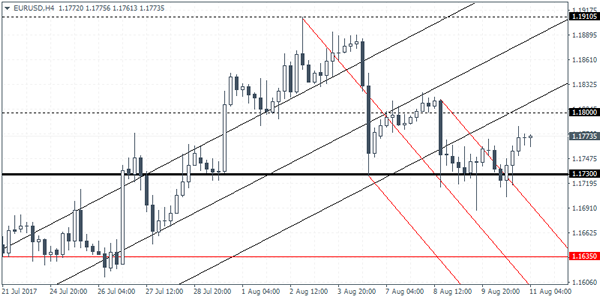
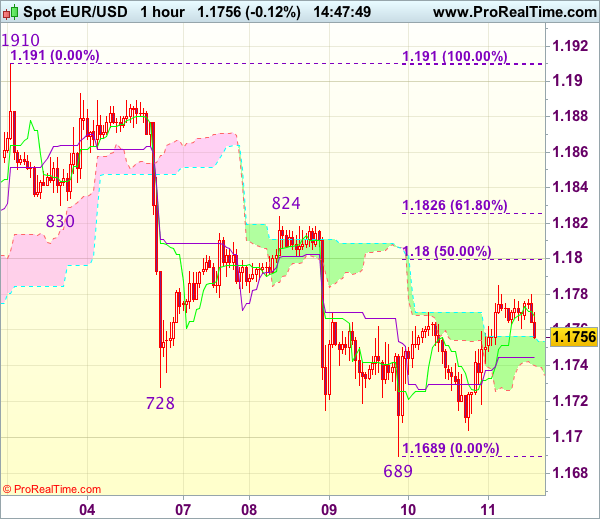
This strategic delay should allow a level of uncertainty to creep in and bullish EURUSD momentum to subside. Especially since Fed 16th September meeting is highly likely to bring a critical announcement on re-balancing. The US incoming data continue to indicate solid activity and solid labor markets with inflation rebounding. Supporting the theory of an earlier then expected Fed announcement (26th July meeting). We see EURUSD key resistance at 1.1716 to cap current bullish extension with a likely downside correction on fundamentals factors.

Economics - US Dollar Set To Weaken Again

Last week, at the Fed's semi-annual monetary policy, Janet Yellen admitted that stocks markets are overheated. She declared that there are strong "valuation pressures" across a range of assets. Despite that, Fed Chair Yellen appeared… dovish while markets were expecting hints about further rate hike before year-end. It is ironic as over the last eight years, during the zero-interest rate policy time, the US central bank boosted stocks higher through liquidity and strong verbal interventions.

We now believe that the Fed wants to leave inflation running. To do so, the Fed won't drain liquidity from its balance sheet and rates are not going to be increased above 2%. Yellen and the Fed knows anyway that increasing rates above 2% would likely trigger a massive recession as the US debt is too massive and the service of the debt would not be sustainable. We strongly believe in this hypothesis knowing the level of indebtness of the North-American country. A snowball effect could be disastrous.

The normalization of the monetary policy is definitely going to take longer. The dilemma is getting worse for US policymakers. The stock bubble is underpinned by the Fed monetary policy but increasing rates would trigger a recession.

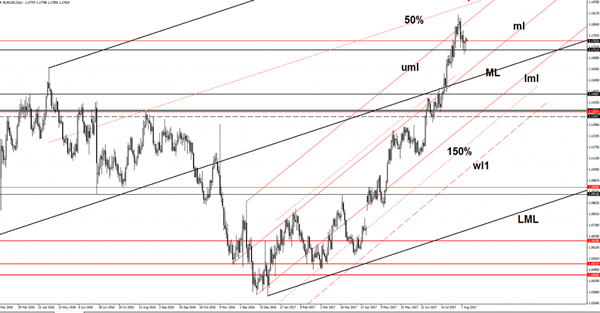
Next Thursday, the US rates are then not going to be increased and we consider that the US central bank wants to kill its debt through inflation. The greenback should further weaken against the single currency and reaching $1.17 for 1 euro definitely represents a short-term target. The greenback is getting weaker against major G10 currencies and the euro dollar is now trading at levels unseen since May 2016. The bullish trend seems very deep.

For the time being, we still consider that the true state of the US economy is overestimated. Economic fundamentals are mixed. Import prices for June have been released and have declined by 0.2%. In May imports price already declined by 0.3% m/m. Excluding Oil, import prices have slightly increased. On top of that, the US CPI recoded four successive declining monthly print. The Fed target seems less and less attainable in a reasonable timeframe. As a result, we firmly believe that reloading bearish positions on the dollar is a good bet within the next few months. There is no evidence at the moment that the greenback will strengthen in the medium run.

Economics - Dark Clouds Ahead For US Car Traditional Industry

Over the last few years, the pace of new car selling went through the roof in the US, fuelled by subprime loan. The shares of car manufacturers enjoyed a decent ride as low income borrowers were given the opportunity to acquire a brand new car despite weak financial means.

First have a look at the recent development in the secondary market. The average transaction price of pre-owned cars rose to $19.2k dollar in the first quarter of 2017 compared to $18.8k a year earlier, which may suggest that the demand is solid and that the second-hand market still has beautiful days ahead. However, do not get misled, this increase comes essentially from rising MSRP (Manufacturer's Suggested Retail Price) and the effect of a persistent decrease in the average age of pre-owned cars. Indeed, the average age of a retail used vehicle was 4.4 years in the first quarter, compared to 4.5 years twelve months ago, while the average initial MSRP rose to $34.2k from $32.9k.Taken together, these developments result into a consistently widening spread between MSRP and retained value of pre-owned cars. In other words, owners of a new car have to take a bigger hit when they are selling their asset on the secondary market. This trend should even accelerate in the future amid rising supply of second-hand vehicles in the market, reducing substantially the incentive to buy a new car as cheaper alternatives are available in the pre-owned market.

Unfortunately this phenomena is definitely not about to reverse as the US auto market is facing a new crisis. The auto loan market - and more specifically subprime loans - has come under the spotlight recently amid surging default rate. Indeed, similarly to what happened during the US housing market a decade ago - when lenders didn't even care about verifying incomes or job histories of borrowers - the history repeats itself but this time with the auto industry. Low income borrowers were able to drive new cars but were charged high interest rate, making the investment very interesting, especially against the backdrop of ultra-low interest rates.

As expected, low income borrowers cannot afford such a drain on the long-term and therefore default on the loan and trigger the usual mechanism: the lender seize the car and tries to sell it on the secondary market, thus inflating the supply of pre-owned car. Without going too much into the details, the bottom line is that after years with record sales volumes, the US auto industry is ahead of years of low entries. The top brands in market share in the US will inevitably take a hit. Ford, Toyota, Honda, Nissan and General Motors are the first in line. Therefore it is likely that the price of those companies will sooner or later start moving south as sales volumes shrink.

Themes Trading - Curing Cancer

According to cancer.org, it is estimated that 21.7 million new cases of cancer will be diagnosed in 2030. Thirteen million cancer deaths are forecast that same year. And with new lifestyles already suspected to increase cancer risk, these figures are likely to be underestimated. As a result, there are important discoveries to be made, and many companies - including start-ups - are investing time and money to find treatments.

Of course, finding a cure for cancer takes time, dedication and knowledge. Today's investment is tomorrow's cure. It is also difficult to know just what research is being done: findings often appear in confidential reviews. We have therefore selected 12 stocks where research and development is focused on a wide range of medications. Our main diversification is between start-ups and revenue-generating companies.

We have selected five recent start-ups that completed IPOs in 2015 but have yet to release any products. These companies are candidates to become future pharmaceutical blue chips. Beigene and Syndax are focusing their research on developing cancer treatment drugs, while Edita