Sample Category Title

GBPUSD: Extends Weakness, Remains Vulnerable

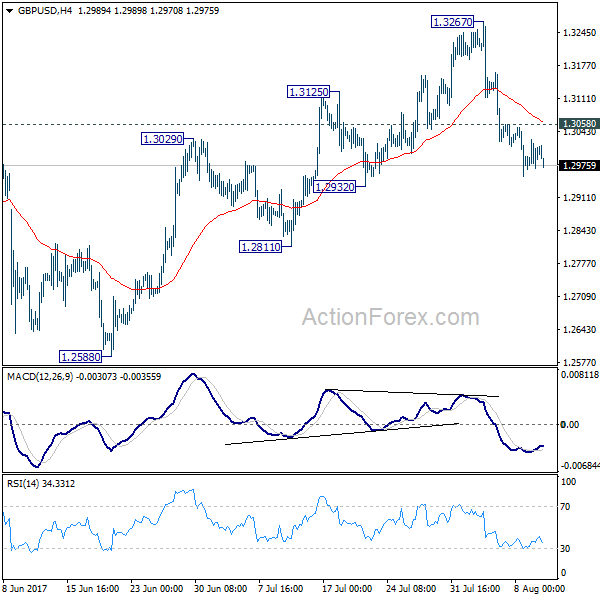
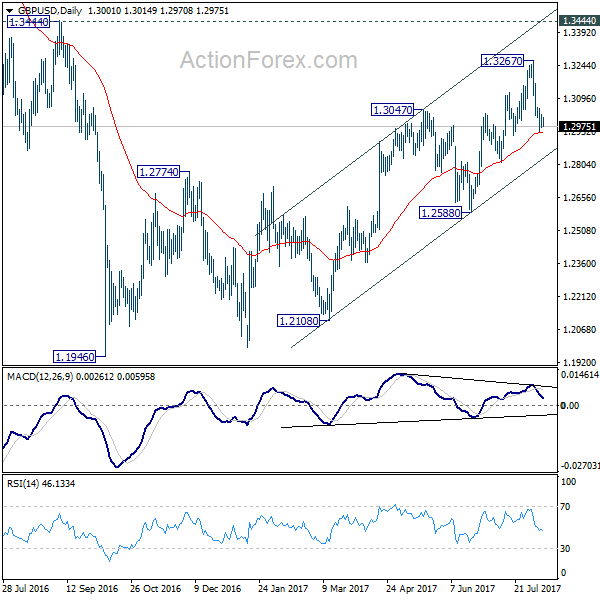
GBPUSD: The pair continues to retain its nearer downtrend weakening further on Thursday. Support lies at the 1.2900 level where a break will turn attention to the 1.2850 level. Further down, support lies at the 1.2800 level. Below here will set the stage for more weakness towards the 1.2750 level. Its daily RSI is bearish and pointing lower suggesting further weakness. Conversely, resistance stands at the 1.3000 levels with a turn above here allowing more strength to build up towards the 1.3050 level. Further out, resistance resides at the 1.3100 level followed by the 1.3150 level. On the whole, GBPUSD continues to face downside threats on pullback.

ECB Leaves Rates Unchanged, Draghi in Focus

The Euro slightly depreciated against the Dollar on Thursday, after the European Central Bank left monetary policy unchanged in July. It was widely expected that the central bank would stay put on interest rates, with the spotlight directed towards Mario Draghi's press conference which is likely to come under heavy scrutiny. With Draghi's optimistic remarks in Sintra fuelling speculations of QE tapering by the ECB, investors may seize this opportunity to obtain further clues on whether the central bank will announce plans to reduce its bond-buying program in September. Although the economic conditions in Europe remain encouraging, inflation is still a sore spot and Draghi may be heavily quizzed on this.

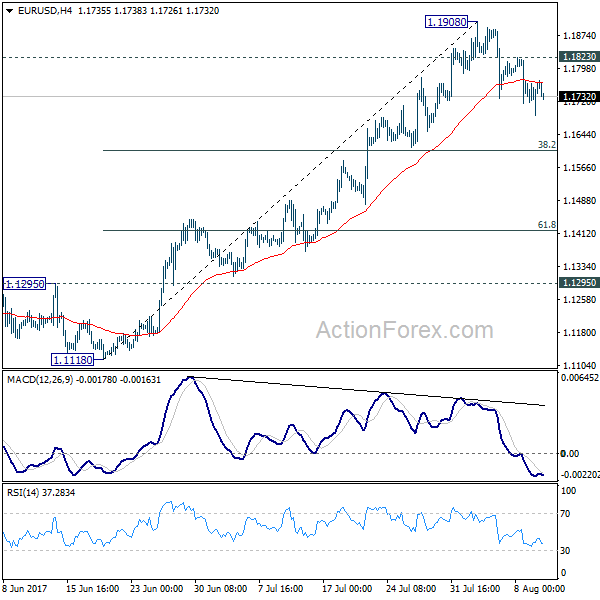
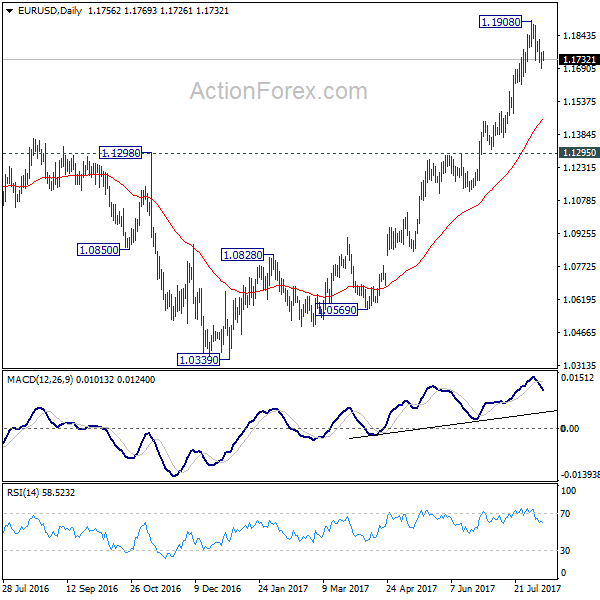
If ECB hawks make an appearance and offer bulls some fresh inspiration in the form of renewed QE tapering expectations, the EURUSD may receive a solid welcome boost towards 1.1615. On the other hand, if Draghi picks his words carefully and gives little away at his news conference, the EURUSD is likely to experience a technical correction towards 1.1400.

Sterling bears unfazed positive retail sales

It is interesting how the Sterling tumbled against the Dollar on Thursday despite UK retail sales rising by 0.6% in June thanks to warmer weather. While the impressive rebound in retail sales compared to May's dismal -1.2% decline could raise hopes over the resilience of consumers amid Brexit, such may not be enough to dissolve fears regarding the longer-term outlook for spending. With rising inflation and falling real wages negatively impacting household spending power, concerns still remain elevated over the sustainability of the UK's consumer driven economic growth.

Brexit developments have also played a leading role in the Sterling's selloff today as concerns rose over the negotiations in Brussels smashing into a steel wall. Reports circulating over the lack of breakthrough regarding citizen rights or the Brexit divorce bill, have simply compounded to the Sterling's woes and this can be reflected in price action. With uncertainty still the name of the game when dealing with the British Pound and bears finding inspiration from the Brexit blues, further downside may be on the cards. From a technical standpoint, the breakdown below 1.3000 on the GBPUSD has provided sellers with the permission to attack prices towards 1.2850.

(ECB) Monetary Policy Decisions

At today's meeting the Governing Council of the ECB decided that the interest rate on the main refinancing operations and the interest rates on the marginal lending facility and the deposit facility will remain unchanged at 0.00%, 0.25% and -0.40% respectively. The Governing Council expects the key ECB interest rates to remain at their present levels for an extended period of time, and well past the horizon of the net asset purchases.

Regarding non-standard monetary policy measures, the Governing Council confirms that the net asset purchases, at the current monthly pace of €60 billion, are intended to run until the end of December 2017, or beyond, if necessary, and in any case until the Governing Council sees a sustained adjustment in the path of inflation consistent with its inflation aim. The net purchases are made alongside reinvestments of the principal payments from maturing securities purchased under the asset purchase programme. If the outlook becomes less favourable, or if financial conditions become inconsistent with further progress towards a sustained adjustment in the path of inflation, the Governing Council stands ready to increase the programme in terms of size and/or duration.

The President of the ECB will comment on the considerations underlying these decisions at a press conference starting at 14:30 CET today.

GBP/USD False Breakout? USD/CAD Could Bounce from the Lows; AUD/USD Erased the Yesterday’s Gains

GBP/USD false breakout?

Price dropped significantly in the last hours and ignored a major support line, a valid breakdown below this level will open the door fro more declines in the upcoming period. GBP/USD has turned to the downside as the USDX has managed to rebound and to recover after the impressive drop.

USDX is pressuring the 95.00 psychological level, but is premature to say that we'll have a large rebound in the upcoming days because is still located below a very strong dynamic resistance (support turned into resistance).

The Cable drops aggressively even if the United Kingdom Retail Sales increased by 0.6% in the previous month, beating the 0.4% estimate. The indicator increased significantly after the 1.1% drop in the former reading period.

Continues to move within an ascending channel, but has failed once again to reach the upside line of the chart pattern, signaling an exhaustion. Has failed to stabilize above the 150% Fibonacci line (ascending dotted line) and above the upper median line (UML) of the major descending pitchfork. A valid drop below the UML will bring us a perfect selling opportunity.

I've said in the previous analysis that we should wait to see if we'll have a valid breakout above the UML, a USDX upside increase will invalidate the breakout, the sellers could take full control and could drive the price towards the downside line of the ascending channel.

A broader decrease will be confirmed after a valid breakdown below the first warning line (wl1) of the minor ascending pitchfork.

The perspective remains bullish as long as the rate stays above the warning line (wl1) of the minor ascending pitchfork, we'll have a buying opportunity only if the rate will climb and will stabilize above the UML again.

USD/CAD could bounce from the lows

USD/CAD posted humble gains, but could climb much higher if the USDX will have enough energy to resume the minor rebound. Price is still under massive selling pressure, could drop anytime again and could resume the downward movement if the dollar index will drop again.

USD/CAD changed little today as the buyers are fighting hard to take the lead on the short term, but I want to remind you that the perspective is bearish, we don't have any reversal sign right now. The bias is bearish as long as trading within the minor descending pitchfork's body.

Could still reach the 1.2460 major static low as long as stays below the median line (ml) of the descending pitchfork.

AUD/USD erased the yesterday's gains

AUD/USD reached new highs in the morning, has increased as much as 0.7988 level, the sellers have taken the lead and have send the rate much below the 0.7908 yesterday's low.

Price dropped aggressively ahead the US data, the current retreat was expected after the impressive rally, but this could be only temporary because the perspective remains bullish.

CAC Moves Higher As Markets Eye Mario & Co.

The CAC index has posted slight gains in the Thursday session. Currently, the index is trading at 5229.75, up 0.26% on the day. In economic news, today's highlight is the monthly ECB policy meeting. There was positive news from German and eurozone indicators. German PPI improved to 0.0%, above the estimate of -0.1%. The eurozone current surplus jumped to EUR 30.1 billion, well above the estimate of EUR 23.3 billion.

On Tuesday, the CAC suffered its worst day this month, dropping 0.8 percent. French stock markets were down in response to soft investor confidence surveys in Germany and the eurozone. The ZEW Economic Sentiment surveys gauge the optimism of institutional investors and analysts. Both surveys indicated that investor confidence in June had weakened compare to the May readings. With the eurozone economy improving, analysts attributed the dip in investor confidence as due to the stronger euro, which is making European exports more expensive and thus less attractive for foreign buyers.

All eyes are on the ECB, which will release a rate statement, followed by a press conference with Mario Draghi. In December 2016, the bank tapered QE while extending the scheme until December, and this type of scenario could be adopted once again. Will the bank make a similar move at this meeting? OANDA Senior Currency Analyst Craig Erlam explains that we're unlikely to see any moves today, but the markets are casting a glance ahead to the September meeting:

While we're not expecting any changes from the ECB today, it's €60 billion a month asset program expires at the end of the year and traders are looking for clues regarding what comes next. An announcement on this is unlikely until September when it releases its new macro-economic projections but Mario Draghi may offer some insight into what we can expect during the press conference.

The most likely decision, despite the central bank still falling well short of its inflation target, will be to cut its purchases by another €20 billion as it did in April and extend by another six months. There has been a lot of speculation about a more explicit phasing out but I think the ECB want to be more careful given the fragile nature of the recovery. The result will likely be the same though with the central bank ending its quantitative easing program either at the end of 2018 or early 2019.

President Trump hasn't done very well at learning how to tango with Congress, and this week's debacle on Capitol Hill could make the gap between Trump and Republican lawmakers even harder to bridge. Trump had vowed to replace Obamacare, but his health care bill has stalled in the Senate before lawmakers even had a chance to vote on the proposal. With some conservative Republicans coming out against the bill, it's questionable if the Republicans can pass another version before Congress takes a recess in August. Trump had promised to pass a health care before the summer break, so his credibility will take another hit if he's unable to do so. Trump has been in office for six months, but has been unable to get Congress to pass any significant bills, even though the Republicans enjoy a majority in both houses of Congress. With this latest setback, there is growing skepticism as to whether Trump will be able to convince Congress to pass other key parts of his agenda – tax reform and fiscal spending. This paralysis on Capitol Hill has deepened investor pessimism about Trump's legislative agenda and is weighing on the US dollar.

Technical Outlook: Spot Gold – Bulls Expected To Resume After Correction

Spot Gold stays in red eases further on Thursday, pressuring Wednesday’s low and strong downside rejection at $1235, also the base of thick hourly cloud. The price may dip further as correction is signaled by overbought daily slow stochastic which turns south.

Good supports lay at $1232 (20SMA) and $1230 (200SMA / Fibo 38.2% of $1204/$1244 rally) where correction should be contained to prevent deeper pullback and violation of lower pivot at $1224 (daily Tenkan-sen, loss of which would signal lower top at $1244.

Overall outlook is still bullish and keeps focus at $1246/47 and $1250/55 targets in extension.

Res: 1232, 1242, 1244, 1246
Sup: 1235, 1230, 1226, 1220

GBP/USD Elliott Wave Analysis

GBP/USD – 1.2945

 
GBP/USD – Wave 4 is unfolding as an (A)-(B)-(C) and could have ended at 1.7192

 
Cable only retreated to 1.2812 (missed our long entry at 1.2800) before staging the anticipated rally to 1.3126, however, the subsequent retreat from there suggest top is possibly formed and consolidation below this level would be seen with downside bias for weakness to 1.2890-00, however, break of said support at 1.2812 is needed to provide confirmation to this view, bring further fall to 1.2770, then towards 1.2700-10 which is likely to hold from here. 

Our preferred count on the daily chart is that cable's rebound from 1.3500 (wave (A) trough) is unfolding as a wave (B) with A ended at 1.7043, followed by triangle wave B and wave C as well as wave (B) has possibly ended at 1.7192, below support at 1.4232 would add credence to this count, then further fall to 1.4000 level would follow but reckon downside would be limited to 1.3655 support and price should stay above previous support at 1.3500.

On the upside, whilst initial recovery to 1.2990-00 cannot be ruled out, as top has been formed at 1.3126, reckon upside would be limited to 1.3030-40 and bring another decline later. Only break of said resistance at 1.3126 would suggest the erratic rise from 1.1986 low is still in progress for further gain to 1.3140-50 (38.2% Fibonacci retracement of 1.5018-1.1986) and possibly 1.3200 but overbought condition should prevent sharp move beyond 1.3300. 
 
 
Recommendation: Turn short at 1.3040 for 1.2840 with stop below 1.3140.

 
Longer term - Cable's rise from 1.0520 (Feb 1985) to 2.0100 (September 1992) is seen as [A], the decline to 1.3682 is labeled as (B) and (C) wave rally has ended at 2.1162 (9 Nov, 2007) which is also the top of larger degree wave B with circle. The selloff from there is a 5-waver with wave (A) ended at 1.3500 (23 Jan 2009), wave (B) itself is labeled as A: 1.6733, triangle wave B: 1.4813 and wave C as well as top of wave (B) ended at 1.7192 (2014), hence the selloff from there is an impulsive wave (C) with wave I : 1.4566, wave II 1.5930, an extended wave III is unfolding and already exceeded our downside target at 1.3500 and 1.3000, hence weakness to 1.2500 and possibly 1.2000 cannot be ruled out, however, price should stay well above psychological level at 1.0000.


Daily Technical Analysis: GBP/JPY Possible Momentum Change Due To M Pattern

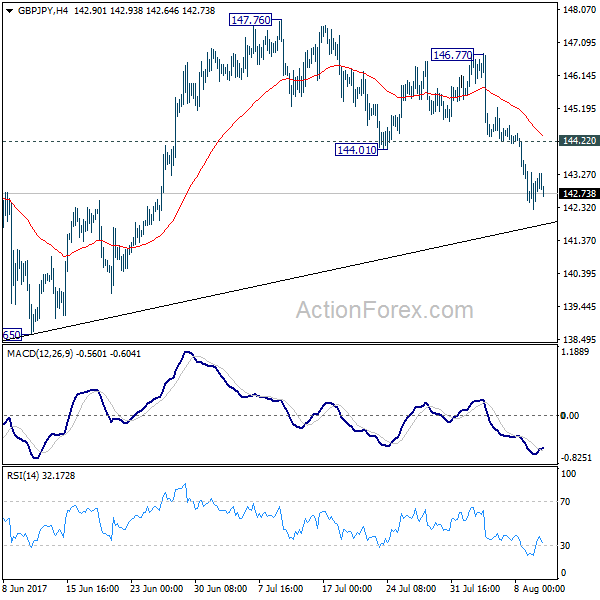
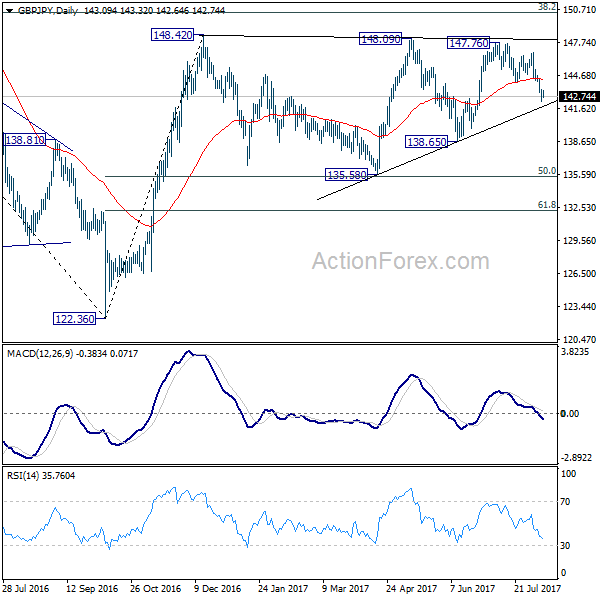
The GBP/JPY has been rejected from the W L4 level and at this point we see an intraday downtrend in the GBP/JPY with clear double bottom support. Price action shows both up and down movement but to me it looks like a potential momentum change especially because the price is below W L4 that makes a POC zone 146.05-28 (D H3/H4, trend line, EMA 89, ATR pivot, 50.0) and M pattern below. If the price re-enters the zone, it should be rejected again. if we don't see another retracement, pay attention to M pattern breakout below 145.26. Targets are 144.85 and 144.60.

Technical Outlook: WTI Oil – Bulls Probe Above Key Barrier At $47.3

WTI Oil has eventually cracked strong resistance at $47.30 (former high of 04 July and strong upside rejection / base of thickening daily cloud), in extension of Wednesday's strong rally, sparked by better than expected US weekly crude stocks data.

Bullishly aligned daily studies are supportive for further advance which requires break and close above $47.30 pivot to generate signal for extension of bull-leg from $43.63 (10 July trough).

Bullish continuation would open targets at $48.18 (falling 100SMA / Fibo 61.8% of $51.98/$42.04) and daily cloud top at $48.74. Lift above cloud would open way for recovery extension towards $49.50 (200SMA) and psychological $50.00 barrier.

Meanwhile, the price may enter extended consolidation on hesitation at key $47.30 barrier, as well as overbought slow stochastic on daily chart.

Broken 55SMA ($46.66) is expected to ideally contain dips and keep intact lower pivots at $45.95/$45.54 (rising 10 & 20 SMA's) loss of which would generate bearish signal.

Res: 48.18, 48.74, 49.50, 50.00
Sup: 47.13, 46.66, 45.95, 45.54

Dollar Direction Depends On ECB Rhetoric

Thursday July 20: Five things the markets are talking about

Investors are trying to calculate whether company earnings will be strong enough to warrant such lofty equity prices, and if their own domestic economies can handle higher interest rates.

Overnight, the Bank of Japan (BoJ) pushed back its forecast for reaching +2% inflation while keeping its policy settings on hold (see below), further highlighting Japan's struggle to achieve stable price growth. The next clues come from the ECB's policy rate announcement this morning (07:45 am EST).

The market is not expecting any changes from the ECB interest rate policy, but is looking for any signs of the outlook for the bank's quantitative easing (QE).

Its +€60B a month asset program expires at the end of the year and everyone wants to know what comes next. An announcement regarding the next steps is more likely in September when Euro policy makers will also release their new macro-economic projections, however, ECB's Draghi may provide further insight at today's press conference (08:30 am EST).

The not so 'mighty' dollar continues to trade atop of its 10-month low as the U.S health-care reform bill crashed this week, casting further doubt on President Trump's policy agenda.

The pound is under pressure following this week's demise on yesterday's disappointing U.K inflation print, while the Aussie dollar strengthens on the go-to 'carry' trade and overnight job numbers (+14K). Global bond prices have weakened, while gold and oil trade lower.

1. Stocks get the green light

Stateside yesterday, stocks continued their rally; bypassing the markets concerns on timely implementation of U.S economic reform policies. The Nasdaq and S&P hit new all-time highs. This momentum was carried through to Asia and Europe.

Note: investor volume is lagging again for the NYSE, -17% below its three-month average, while the Nasdaq volumes remain in line. The VIX index continues to fall, dropping -2%, to 9.70 Wednesday.

In Japan, the Nikkei ended +0.6% higher, while the broader Topix rose +0.7%, its highest closing level since August 2015.

In Hong Kong, stocks finished higher for a ninth straight session, its longest winning streak since April 2015, as technology stocks powered through. The benchmark Hang Seng index ended up +0.3%, its highest level since June 2015. The Hang Seng China Enterprises Index was -0.1% lower.

In China, their major stock indexes rose for a third consecutive day, led by the blue-chip CSI300 index reaching a fresh 18-month high (+0.5%), with sentiment lifted by expectations of robust first-half corporate earnings. The Shanghai Composite Index added +0.4%.

In Europe, most indices trade modestly higher, led by the DAX. Corporate earnings and the ECB are expected to set the tone for their afternoon session.

U.S stocks are set to open little changed.

Indices: Stoxx600 +0.2% at 368, FTSE +0.4% at 7457, DAX +0.4% at 12506, CAC-40 +0.3% at 5233, IBEX-35 flat at 10590, FTSE MIB flat at 21481, SMI -0.1% at 9018, S&P 500 Futures flat

2. Oil steady after big drop in U.S. fuel stocks, gold lower

Oil prices are holding steady ahead of the U.S open, hanging on to yesterday's gains when falling U.S crude inventories supported the market.

Note: Crude oil prices are still capped below the psychological $50-per-barrel mark on concerns about high production from the OPEC despite its pledge to cut output along with some other producers.

Brent crude futures is at +$49.68 per barrel, just -2c down from yesterday's close, while U.S West Texas Intermediate (WTI) crude futures are at +$47.09 per barrel, -3c below their last nights close.

Prices for both crudes jumped more than +1.5% in yesterday's session after the EIA's report showed U.S crude and fuel stocks fell last week.

Note: U.S crude inventories dropped by -4.7m barrels in the week to July 14, against the markets expectations for a decrease of -3.2m barrels. Inventories still remain near the upper half of the average for this time of the year.

Crude 'bears' believe that climbing U.S output and high inventories, as well as the increased production from some OPEC members, will prevent prices from rising much further.

Gold prices are a tad lower ahead of the ECB meeting; a stronger USD is weighing on the precious metal. Spot gold has fallen -0.2% to +$1,237.86 per ounce.

3. Yields back up to flatten some Central Bank Curves

The Bank of Japan (BoJ) left its policy steady (as expected). The Interest Rate on Excess Reserves (IOER) was unchanged at -0.10%. Governor Kuroda and fellow policy makers maintained their policy framework of 'QQE with Yield Control (YCC) ' with 10-year JGB's yield around +0% and annual pace of QE at ¥80T.

The vote again was 7-2 and their outlook had the BoJ again delaying reaching their desired +2% inflation target by another year, pushing it out to 2019 from 2018 – its now the sixth such delay in achieving the target.

Elsewhere, U.S Treasuries have lost some ground given the markets interest in equities. Yields have firmed across the U.S curve, which continues to flatten. The benchmark 10's has backed up +1bps to +2.27%, with 30-year yield unchanged and the 10/30s spread flattening by -1bp to +58.

New supply is also providing some pressure this week – new government bond sales in Germany and the U.K, along with U.S corporate debt issuance have also put some selling pressure on Treasuries. Germany's 10-year yield has rallied +1 bps to +0.55%, the first advance in a week, while U.K 10-year Gilt yield has backed up +2 bps to +1.212%.

4. Dollar direction depends on ECB rhetoric

EUR/USD (€1.1502) continues to hover near its recent high this week on hopes of an ECB tapering hint this morning, which could lay the groundwork for an autumn policy shift. The recent run-up in investors 'long' EUR currency positions will be scaled back aggressively if ECB's Draghi is less hawkish than expected. First round of support appears at €1.1475 and then €1.1440.

GBP/USD (£1.2960) was soft ahead of U.K retail sales numbers this morning (see below) after yesterday's lower than expected U.K inflation print. Despite sales rebounding in Q2, the pound has been unable to gain any traction. Sterling remains weak due to Brexit uncertainty.

Note: U.K data has been very volatile recently with +1-2% monthly rises and falls have become the new norm, making it difficult to determine an underlying trend.

USD/JPY (¥112.35) is fractionally higher following the BoJ's post-rate decision press conference as Governor Kuroda again reiterated his pledged do more 'easing' if necessary.

5. U.K Retail Sales Rebounded in Q2

U.K retail sales rebounded in Q2, growing +1.5%, a gain that is expected to contribute an approximate +0.09% to Q2 GDP growth.

Note: Retail sales were a drag on growth in Q1, shrinking -1.4%.

Digging deeper, sales were driven by spending in drug stores and on computers, sporting equipment and furnishings; food stores saw sales volumes increase only modestly amid rising prices.

The market is expecting a stronger contribution to growth from business investment and exports as the U.K consumer struggles with higher inflation and inadequate wage growth.