

Sample Category Title
EUR/USD Daily Outlook
Daily Pivots: (S1) 1.1769; (P) 1.1792 (R1) 1.1816; More...
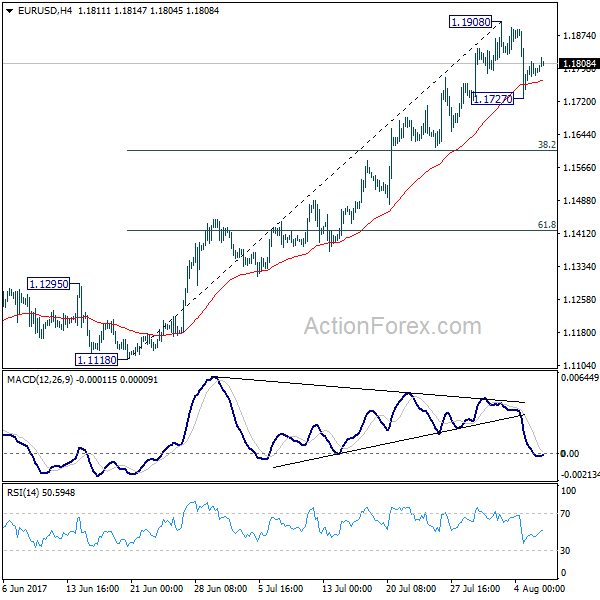
EUR/USD is staying in range of 1.1727/1908 and intraday bias remains neutral at this point. As noted before, a short term top is formed at 1.1908 on divergence condition in 4 hour MACD. Deeper correction is expected as long as 1.1908 holds. Below 1.1727 minor support will turn bias to the downside for 38.2% retracement of 1.1119 to 1.1908 at 1.1606. We'd expect strong support there to bring rebound.
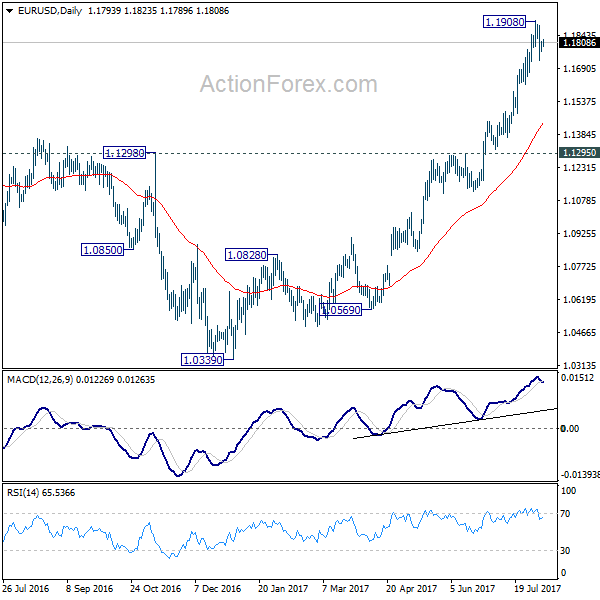
In the bigger picture, an important bottom was formed at 1.0339 on bullish convergence condition in weekly MACD. Sustained break of 55 month EMA (now at 1.1760) will pave the way to key fibonacci level at 38.2% retracement of 1.6039 (2008 high) to 1.0339 (2017 low) at 1.2516. While rise from 1.0339 is strong, there is no confirmation that it's developing into a long term up trend yet. Hence, we'll be cautious on strong resistance from 1.2516 to limit upside. But for now, medium term outlook will remain bullish as long as 1.1295 support holds, in case of pull back.
GBP/USD Daily Outlook
Daily Pivots: (S1) 1.3011; (P) 1.3034; (R1) 1.3056; More...
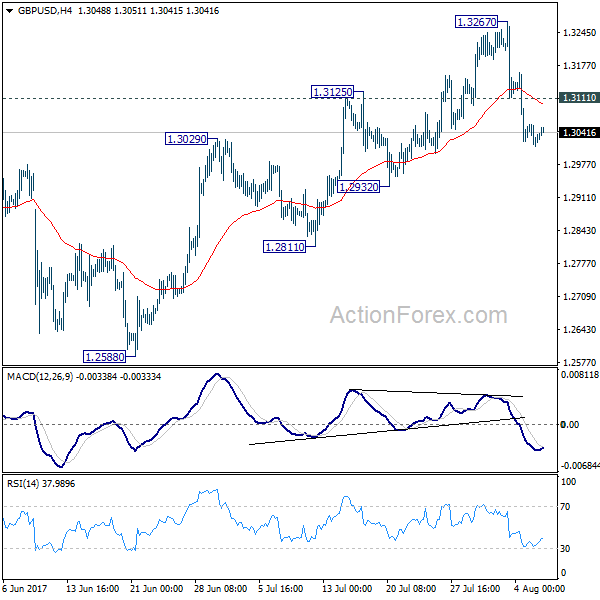
Intraday bias in GBP/USD remains on the downside for 1.2932 support first. Price actions from 1.1946 are seen as a corrective pattern, no change is this view. Such correction could have completed at 1.3267 already. Break of 1.2932 will affirm this bearish case and target 1.2588 key near term support for confirmation. On the upside, however, above 1.3111 minor resistance will turn bias back to the upside for 1.3267 instead.
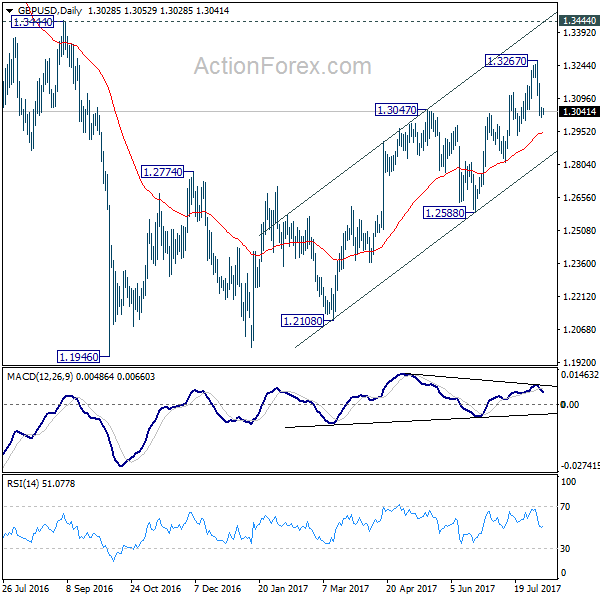
In the bigger picture, overall, price actions from 1.1946 medium term low are seen as a corrective pattern that is still in progress. While further upside is expected, larger outlook remains bearish as long as 1.3444 key resistance holds. Down trend from 1.7190 (2014 high) is expected to resume later after the correction completes. And break of 1.2588 will indicate that such down trend is resuming.
USD/CHF Daily Outlook
Daily Pivots: (S1) 0.9713; (P) 0.9729; (R1) 0.9748; More...
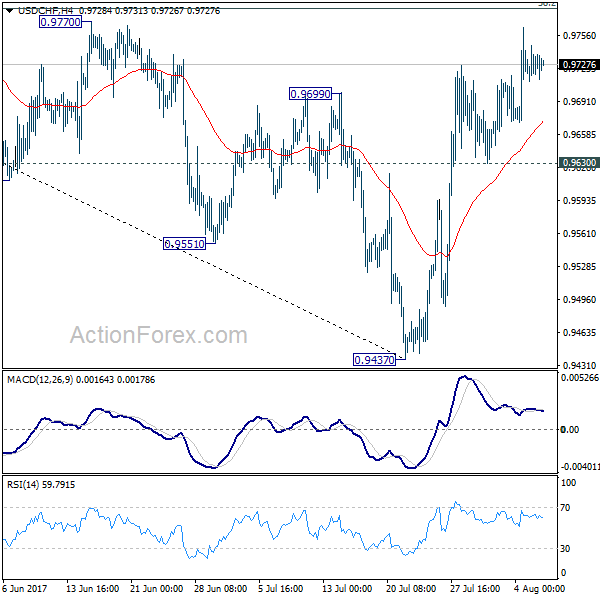
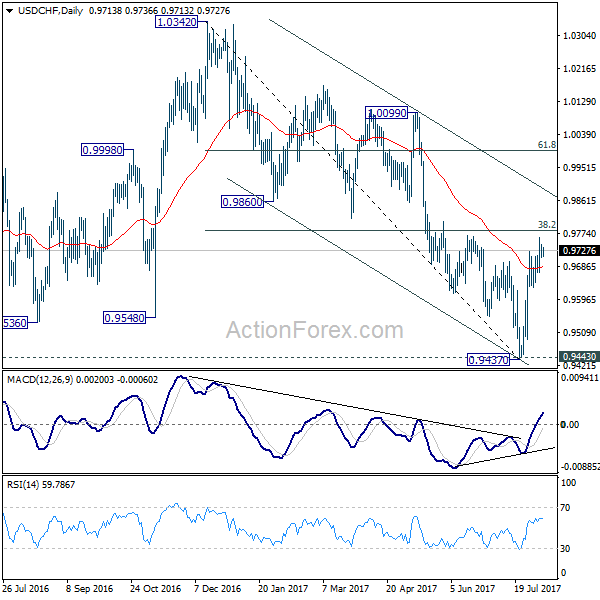
USD/CHF's is losing some upside momentum again as seen in 4 hour MACD. But with 0.9630 support intact, further rise is expected to 38.2% retracement of 1.0342 to 0.9437 at 0.9783 first. As noted before, prior break of 0.9699 resistance suggests near term reversal after defending 0.9443 key support. Break of 0.9783 will target channel resistance (now at 0.9887). On the downside, break of 0.9630, however, will indicate completion of the rebound and turn bias back to the downside for 0.9437.
In the bigger picture, current development argues that USD/CHF has successfully defended 0.9443 key support level. And long term range trading in 0.9443/1.0342 is extending with another rise. At this point, there is no sign of an up trend yet. Hence, while further rise is expected in USD/CHF, we'll start to be cautious on loss of momentum above 61.8% retracement of 1.0342 to 0.9437 at 0.9996.
European Open Briefing: Asian Stocks Opened On A Flat Note Today
Global Markets:
- Asian stock markets: Nikkei fell 0.34 %, Shanghai Composite down 0.20 %, Hang Seng rose 0.05 %, ASX 200 dropped 0.57 %
- Commodities: Gold at $1266.13 (+0.11 %), Silver at $16.25 (+0.05 %), WTI Oil at $49.20 (-0.38 %), Brent Oil at $52.15 (-0.42 %)
- Rates: US 10 year yield at 2.25, UK 10 year yield at 1.14, German 10 year yield at 0.46
News & Data:
- NAB Business Confidence Index 12 vs 8 previous
- CNY Trade Balance 321 B vs 294 B expected
- USD Consumer Credit m/m 12.4 B vs 15.6 B expected
- GBP BRC Retail Sales Monitor (YoY) 0.9% vs 1.2% expected
- JPY Current Account 1.52 T vs 1.52 T expected
Markets Update:
Asian stocks opened on a flat note today after a disappointing Chinese trade data, although the surplus was higher both exports and imports missed on expectations.
The US Dollar tried to keep a grip on the gains made after upbeat U.S. jobs data last week., EUR/USD from it’s opening price of 1.17954 popped towards 1.1820 with a steady grind higher at first and then quickly above 1.1810.
AUD/USD had been moving a little higher in the morning ahead of the NAB business confidence index release and it subsequently climbed a little more, reaching the high of 0.79393.
The cable had a better run in the Asian session, GBP/USD opened at 1.30343 and was up almost 25 odd points on the day so far (at its high). Whereas, the USD/JPY fell from it’s opening at around 110.75 to below 110.60
Upcoming Events:
- 05:45 GMT – (CHF) Unemployment Rate
- 14:00 GMT – (USD) Jolts Job Openings
- 22:35 GMT – (AUD) RBA Assist Gov Kent Speaks
Elliott Wave View: FTSE 100 Nearing pullback
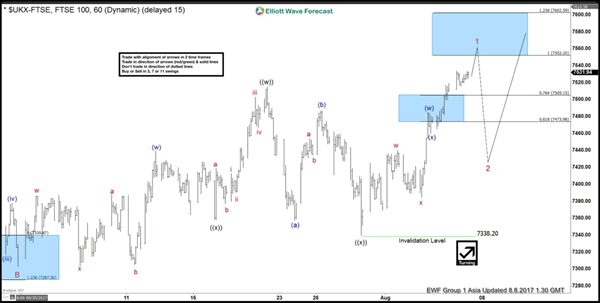
Short term FTSE 100 ( UKX-FTSE ) Elliott Wave view suggests that Minor wave B ended on 6/30 low 7302.7 and the rally from there is unfolding as a double three Elliott wave structure. Index has made a new high above Minute wave ((w)) peak 7515.1 and it’s now showing incomplete 5 swings bullish sequence from 6/30 low. As far as pivot at 7338.2 holds, expect FTSE to extend higher towards 100% Fibonacci extension area at 7552.2 – 7602.59.
FTSE would be then ending the first leg of the move to the upside in Minor wave 1. From there, a pullback can take place in Minor wave 2 which should then find buyer’s again in sequence of 3, 7 or 11 swings for further upside provided the pivot at 7302.7 low remains intact. If pivot at 7302.7 low fails during later pullback, the Index would be still remain in the same cycle from 6/2 peak. Index should then extend the correction to the downside.We don’t like selling the Index.
FTSE 1 Hour Elliott Wave Chart
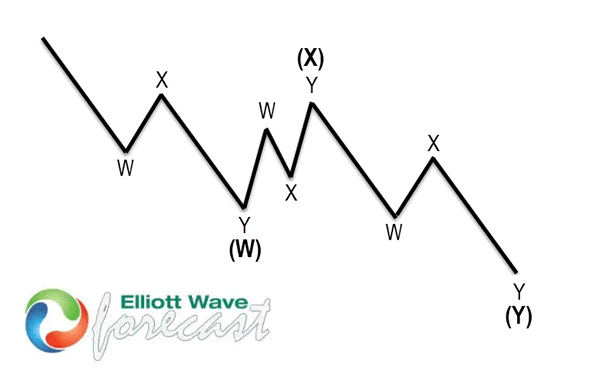
7 swings structure is one of the most common patterns in the theory of New Elliott Wave & it is also mainly know as double three Elliott Wave pattern. Market find that very often nowadays in many instruments in almost all time frames. It is a very reliable structure by which we can make a good analysis and what is more important is giving us good business inputs with clearly defined levels invalidation and destination areas.
The image below shows what Elliott wave pattern Double Three looks like. It has (W), (X), (Y) and 3,3,3 internal structure, which means that all these 3 legs are corrective sequences. Each (W), (X) and (Y) are made of three waves, which are having the structure W, X, Y in lesser degree as well. Elliott Wave principle is a form of technical analysis that traders use to analyze the cycles of financial markets and market trends forecast by identifying extremes in investor psychology, high and low prices, and other collective factors. Important to Note that 3 waves could also be labeled ABC (5-3-5) structure as well. How are labeled 3 waves it depends on the internal price structure subdivisions waves i.e. whether the price action is corrective or motive.
USD/JPY Daily Outlook
Daily Pivots: (S1) 110.60; (P) 110.76; (R1) 110.88; More....
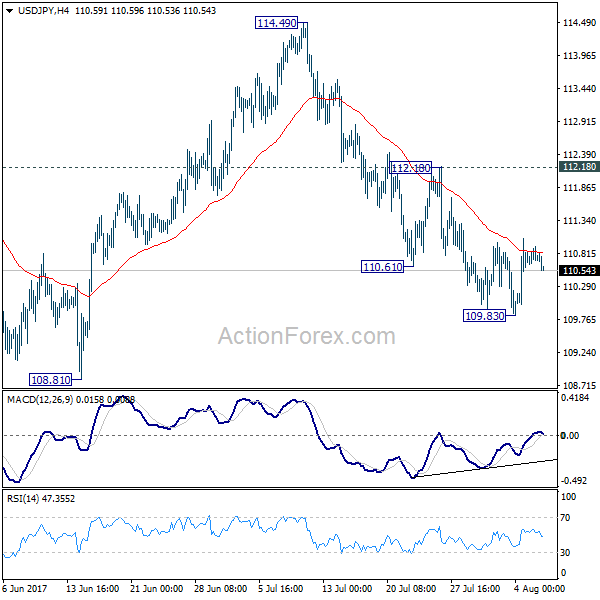
USD/JPY's recovery was limited by 4 hour 55 EMA and retreated. But it's staying above 109.83 temporary low and intraday bias stays neutral first. The consolidation from 109.83 might extend and another rise cannot be ruled out. But after all, near term outlook stays bearish as long as 112.18 resistance holds and deeper fall is expected. Break of 109.83 will target 108.81 support first. Break there will resume whole correction from 118.65 and target 61.8% retracement of 98.97 to 118.65 at 106.48. Nonetheless, break of 112.18 resistance will dampen our bearish view and turn focus back to 114.49 resistance instead.
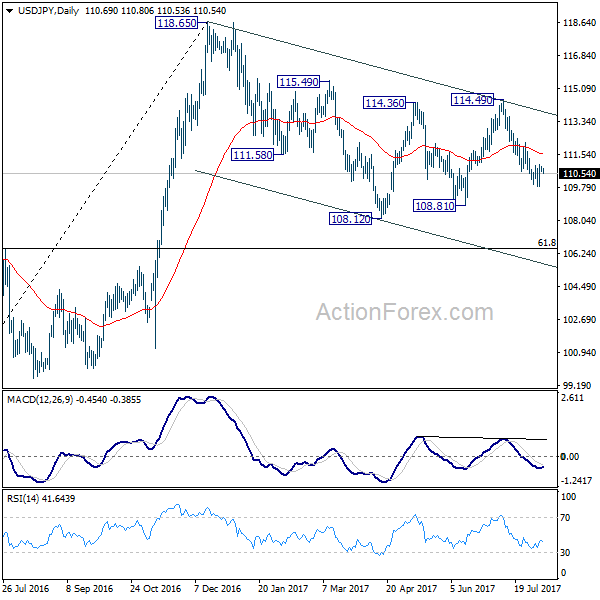
In the bigger picture, the corrective structure of the fall from 118.65 suggests that rise from 98.97 is not completed yet. Break of 118.65 will target a test on 125.85 high. At this point, it's uncertain whether rise from 98.97 is resuming the long term up trend from 75.56, or it's a leg in the consolidation from 125.85. Hence, we'll be cautious on topping as it approaches 125.85. If fall from 118.65 extends lower, down side should be contained by 61.8% retracement of 98.97 to 118.65 at 106.48 and bring rebound.
Dollar Trading Soft on Cautious Fed Comments, Euro Firm
Dollar trades generally lower today after cautious comments from Fed officials. But New Zealand Dollar is even weaker as markets are preparing themselves for a dovish RBNZ rate statement later in the week. At the same time, weak China data is weighing on Aussie. Canadian Dollar also continues to pare back recent gains and as oil consolidates ahead of the release of the OPEC/non-OPEC meeting statement. Euro, Yen and Sterling are so far the relatively firmer ones, with Euro having an upper hand. The economic calendar is rather light for today and trading could remain subdued in summer mood.
Fed Bullard: Current interest rate appropriate over the near term
St. Louis Fed President James Bullard said that he is "ready to get going in September" regarding unwinding Fed's balance sheet". But he emphasized that it is going to be "very slow" and there won't be a lot of impact on the markets. On the other hand, Bullard believes that "the current level of the policy rate is likely to remain appropriate over the near term." Minneapolis Fed President Neel Kashkari said that "inflation has been coming up short, a little low, relative to our two percent target." And, "it actually matters that investors believe the Fed can achieve its goals, because then if there's a future crisis and we really need people to believe in us, we've earned and established that credibility."
Brexit bill a hot topic this week
The size of the Brexit "divorce bill" has suddenly become a hot topic this week after the Sunday Telegraph reported that UK is ready to pay GBP 36b to EU. It was then denied by various UK officials. Also, it's reported that Prime Minister Theresa May has quickly ruled that out as she was warned by Tory MPs that the GBP 36b amount could not get through parliament. There are talks in that EU's position for the Brexit bill is EUR 60b while UK's bottom line is close to EUR 30b. And eventually, the so called "landing zone" is at around "EUR 40b". The third round of Brexit talks will be held in the week of August 28. And it's uncertain whether any progress could be made at that meeting.
Former BoJ Iwata urged halving asset purchase to JPY 40T annually
In Japan, former BoJ Deputy Governor Kazumasa Iwata said that the central bank's current price forecasts are too optimistic. And based on recent batch of weak inflation data, it would be challenging to hit 1% inflation. Regarding the asset purchases under the yield curve control framework, Iwata said that "the BOJ should slow its annual bond buying to around 40 trillion yen ($362 billion) from the current 80 trillion yen" to make the program more "sustainable". Also, once inflation can stay around 1%, BoJ should "modify its long-term interest rate target".
Australia business conditions jumped to 9 year high
Australia NAB business confidence jumped to 12 in July, up from 8. Business conditions index rise 1 point to 15, hitting the highest level since early 2008. The business conditions index also sit at three times the long-run average of 5. NAB chief economist Alan Oster noted that "the persistent strength in employment conditions has made us a little more optimistic about the near-term outlook for the labor market." And the result was consistent with annual job growth of around 240k. Nonetheless, "price and wage measures in the survey generally weakened again in the month, partly a reflection of elevated rates of underemployment." For RBA, the "signs of inflation pressures remain elusive."
China trade data point to downward trend
From China, trade surplus widened to USD 46.7b in July. Exports rose 7.2% yoy, slowest pace since February and notably lower than 11.3% yoy rise in the prior month. Exports growth was also well below market expectation of 10.9% yoy. Imports rose 11.0% yoy, slowest since December and sharply lower from 17.2% yoy in the prior month. Import growth was also well below market expectation of 16.6% yoy. Some economists noted that the trade data points to a downward trend in both external and domestic demand.
Elsewhere
Japan current account surplus widened to JPY 1.52T in June. UK BRC retail sales monitor rose 0.9% yoy in July. Swiss unemployment rate, German trade balance and Canada housing starts are the main featured today.
USD/JPY Daily Outlook
Daily Pivots: (S1) 110.60; (P) 110.76; (R1) 110.88; More....
USD/JPY's recovery was limited by 4 hour 55 EMA and retreated. But it's staying above 109.83 temporary low and intraday bias stays neutral first. The consolidation from 109.83 might extend and another rise cannot be ruled out. But after all, near term outlook stays bearish as long as 112.18 resistance holds and deeper fall is expected. Break of 109.83 will target 108.81 support first. Break there will resume whole correction from 118.65 and target 61.8% retracement of 98.97 to 118.65 at 106.48. Nonetheless, break of 112.18 resistance will dampen our bearish view and turn focus back to 114.49 resistance instead.
In the bigger picture, the corrective structure of the fall from 118.65 suggests that rise from 98.97 is not completed yet. Break of 118.65 will target a test on 125.85 high. At this point, it's uncertain whether rise from 98.97 is resuming the long term up trend from 75.56, or it's a leg in the consolidation from 125.85. Hence, we'll be cautious on topping as it approaches 125.85. If fall from 118.65 extends lower, down side should be contained by 61.8% retracement of 98.97 to 118.65 at 106.48 and bring rebound.
Economic Indicators Update
| GMT | Ccy | Events | Actual | Forecast | Previous | Revised |
|---|---|---|---|---|---|---|
| 23:01 | GBP | BRC Retail Sales Monitor Y/Y Jul | 0.90% | 0.60% | 1.20% | |
| 23:50 | JPY | Current Account (JPY) Jun | 1.52T | 1.51T | 1.40T | |
| 1:30 | AUD | NAB Business Confidence Jul | 12 | 9 | 8 | |
| 2:00 | CNY | Trade Balance (USD) Jul | 46.7B | 45.3B | 42.8B | |
| 2:00 | CNY | Trade Balance (CNY) Jul | 321.2B | 292B | 294B | |
| 5:00 | JPY | Eco Watchers Survey Current Jul | 49.7 | 50 | ||
| 5:45 | CHF | Unemployment Rate Jul | 3.20% | 3.20% | ||
| 6:00 | EUR | German Trade Balance (EUR) Jun | 22.3B | 20.3B | ||
| 12:15 | CAD | Housing Starts Jul | 206K | 213K | ||
| 14:00 | USD | JOLTS Job Openings Jun | 5.66M | 5.67M |
Australia’s NAB Business Conditions Improved To A 9-Year High Level In July
For the 24 hours to 23:00 GMT, the AUD declined 0.4% against the USD and closed at 0.791.
LME Copper prices rose 0.05% or $3.0/MT to $6333.0/MT. Aluminium prices rose 1.6% or $30.0/MT to $1920.0/MT.
In the Asian session, at GMT0300, the pair is trading at 0.793, with the AUD trading 0.25% higher against the USD from yesterday's close, following upbeat Australian economic data.
Early morning data showed that Australia's NAB business conditions index rose to a level of 15.0 in July, hitting its highest level since January 2008, thus suggesting that businesses are growing increasingly optimistic about the nation's growth prospects. The index had registered a revised reading of 14.0 in the prior month. Moreover, the nation's NAB business confidence index jumped to a level of 12.0 in July, following a revised reading of 8.0 in the prior month.
Elsewhere in China, Australia's largest trading partner, trade surplus surprisingly widened to CNY321.2 billion in July, from a revised trade surplus of CNY294.3 billion in the prior month. Market participants had envisaged the nation's trade surplus to narrow slightly to CNY293.6 billion.
The pair is expected to find support at 0.7904, and a fall through could take it to the next support level of 0.7878. The pair is expected to find its first resistance at 0.7951, and a rise through could take it to the next resistance level of 0.7972.
Going ahead, Australia's Westpac consumer confidence index for August, slated to release in the early hours tomorrow, will be on investors' radar.
The currency pair is trading above its 20 Hr moving average and showing convergence with its 50 Hr moving average.

Euro-Zone’s Investor Confidence Slipped In August, German Industrial Production Surprisingly Fell In June
For the 24 hours to 23:00 GMT, the EUR traded flat against the USD and closed at 1.1794.
On the macro front, the Euro-zone's Sentix investor confidence index dropped to a three-month low level of 27.7 in August. The index had registered a reading of 28.3 in the prior month, while markets expected it to nudge down to a level of 27.6.
Separately, Germany's seasonally adjusted industrial production unexpectedly eased 1.1% on a monthly basis in June, dropping for the first time in six months and confounding market expectations for a rise of 0.2%. In the previous month, industrial production had registered a rise of 1.2%.
In the US, data showed that consumer credit rose less-than-expected by $12.39 billion in June, after increasing by a revised $18.29 billion in the previous month, while markets were anticipating it to advance $15.75 billion.
Meanwhile, St. Louis Fed President, James Bullard, reiterated that low interest rates are “likely to remain appropriate” over the near-term, as inflation is set to remain at the current low levels even if the US job market continues to improve.
In the Asian session, at GMT0300, the pair is trading at 1.1815, with the EUR trading 0.18% higher against the USD from yesterday's close.
The pair is expected to find support at 1.1787, and a fall through could take it to the next support level of 1.1760. The pair is expected to find its first resistance at 1.1833, and a rise through could take it to the next resistance level of 1.1852.
Moving ahead, investors will look forward to Germany's trade balance figures for June, slated to release in a while. Additionally, the US NFIB small business optimism index for July, scheduled to release in a few hours, will be eyed by traders.
The currency pair is trading above its 20 Hr moving average and showing convergence with its 50 Hr moving average.

Britain’s Halifax House Prices Sharply Rebounded In July
For the 24 hours to 23:00 GMT, the GBP declined 0.11% against the USD and closed at 1.3034.
On the data front, UK's seasonally adjusted Halifax house price index rebounded more-than-expected by 0.4% on a monthly basis in July, rising at its fastest pace this year. In the preceding month, the index had registered a revised drop of 0.9%, while markets were expecting for a gain of 0.3%. Meanwhile, on an annual basis, the index climbed 2.1% in the three months to July, in line with market expectations, advancing at its slowest pace in more than four years. In the April-June period, the index had risen 2.6%.
In the Asian session, at GMT0300, the pair is trading at 1.3051, with the GBP trading 0.13% higher against the USD from yesterday's close.
Overnight data showed that the nation's BRC retail sales across all sectors advanced 0.9% in July, at par with market expectations. Retail sales had increased 1.2% in the previous month.
The pair is expected to find support at 1.3024, and a fall through could take it to the next support level of 1.2996. The pair is expected to find its first resistance at 1.3069, and a rise through could take it to the next resistance level of 1.3086.
The currency pair is trading between its 20 Hr and 50 Hr moving averages.
