Sample Category Title
Brent Oil Breakout in Play, Buying Opportunity?
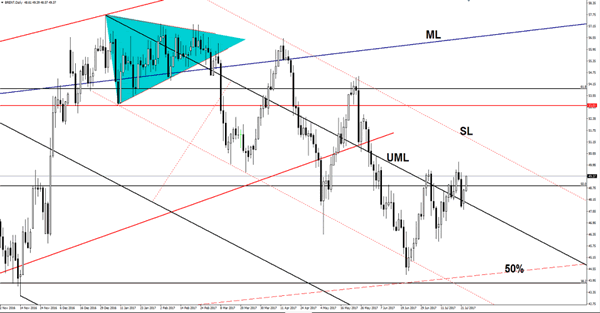
Brent edges higher and is trading much above the 50% retracement level, a retest of this level will give us a very good buying opportunity, the next upside target will be at the sliding line (SL). A larger rebound will be confirmed after a valid breakout from the descending channel's body.
Is on a declining path as long as is trading within the descending channel's body, technically was expected to drop further after the failure to stay above the ML and above the 61.8% retracement level. The current bounce back is natural as the rate failed to reach the downside targets from the 38.2% retracement level and the 50% Fibonacci line.
NZD/USD Losing Altitude
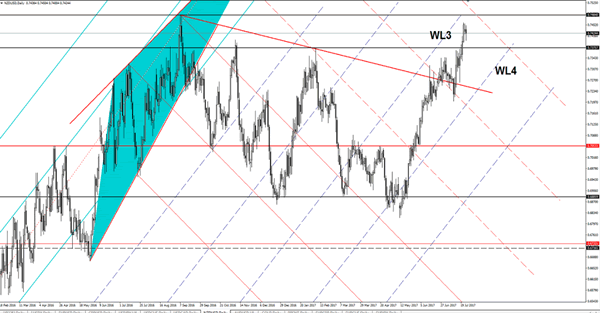
The Kiwi is going down versus the greenback on the short term, even if the dollar index stays below the 94.00 psychological level. Price found resistance at the 0.7458 level and now could correct after the impressive rally.
Could decrease in the upcoming days after another failure to reach the warning line (WL3) of the former major ascending pitchfork. Has also failed to reach and retest the 0.7484 major static resistance, so a retreat towards the 0.7375 static support is favored on the short term.
Maintains a bullish perspective as long as is trading above the fourth warning line (WL4), a only a valid breakdown below this level will confirm a larger drop.
GBP/USD Poised for More Gains
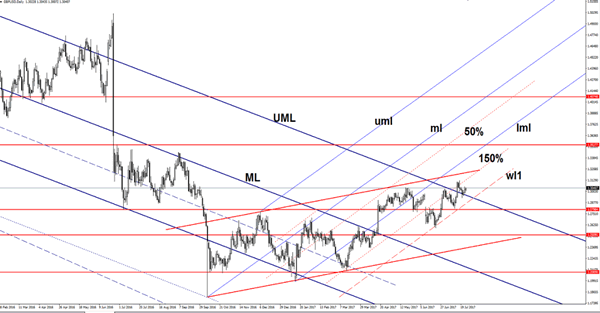
Price posted little gains today and stays below the 1.3057 yesterday's high, technically is expected to increase further in the upcoming period. Is still shy on the short term and is waiting support from the fundamental factors, the US data could bring some action on this pair.
You should be careful in the afternoon as the US is to release the CB Consumer Confidence indicator, which could decrease from 118.9 to 116.5 points in July, while the Richmond Manufacturing Index is expected to remain steady at 7 points for the second month in July.
Price has come down to retest the upper median line (UML) of the major descending pitchfork and now is struggling to extend the latest gains. Technically should climb much higher in the upcoming period if will stay much above the UML and above the 1.2932 previous low.
Personally, I would like the price to come down to retest also the first warning line (wl1) of the ascending pitchfork before will climb towards new highs, well have a perfect buying opportunity if will retest the confluence between the UML and the wl1.
The next upside target will be at the 150% Fibonacci line (ascending dotted line), resistance can be found at the upside line of the ascending pitchfork as well.
Oil Rebounds after Saudis Promise Export Cuts
Oil prices rebounded on Monday, following the outcome of the OPEC and non-OPEC ministerial meeting in Russia. In an interesting turn of events, Nigeria volunteered to join May's output-cut deal and cap its oil production at 1.8 mbpd once it reaches that level in a stable manner, from around 1.7mbpd in May. No similar deal has been struck with Libya, at least so far. Perhaps the most important development though, was that Saudi Arabia agreed to limit its oil exports at 6.6 mbpd in August, something that would mark a reduction of almost 1 mbpd from a year ago. In our view, this is a notable step towards rebalancing the market from the world's largest exporter, as it demonstrates the nation's commitment to supporting prices.
WTI traded higher yesterday, breaking above the resistance (now turned into support) barrier of 46.25 (S1) and now looks to be headed for a test near 46.85 (R1). The price rebounded after it hit support near the prior downside resistance line taken from the peak of the 25th of May, which keeps the short-term picture somewhat positive. A clear break above 46.85 (R1) is possible to target the key resistance zone of 47.55 (R2).
However, even though oil prices could remain supported over the next few days on the back of this positive sentiment, we doubt that this will develop into a longer-term healthy uptrend. Continued gains in prices would probably invite more US shale producers back into the market, something that could increase supply even further and thereby, put a lid on prices. The technical picture also supports that any recovery may be short lived. On the daily chart, we see that WTI is still trading within the downside channel that has been containing the price action since the beginning of February. As such, we would treat the short-term uptrend, or any possible extensions of it, as a corrective phase for now.
AUD consolidates ahead of key data and a speech by RBA's Lowe
During the Asian morning Wednesday, Australia's CPI data for Q2 will be in focus, while RBA Governor Lowe will speak a few hours later. The forecast is for the nation's inflation rate to have ticked up to +2.2% yoy from 2.1% yoy in Q1, something supported by the Melbourne Institute inflation gauge, which rose to +2.3% yoy in June. Such an acceleration may enhance speculation regarding a rate hike by the RBA in the foreseeable future and thereby, bring the Aussie under renewed buying pressure on the news.
AUD/USD traded in a consolidative manner yesterday, staying within the sideways range between the support of 0.7900 (S1) and the psychological zone of 0.8000 (R1). However the prevailing path remains positive in our view and as such we would expect the rate to challenge once again the 0.8000 (R1) zone soon, where a decisive break could set the stage for extensions towards our next resistance of 0.8070 (R2). The catalyst for another leg north may be tonight's CPI data. As for the bigger picture, as long as the rate is trading above 0.7800 (S3), which acted as the upper bound of the sideways range that had been containing the price action since the beginning of March 2016, the longer-term picture is positive as well, in our view.
Even though the outlook for AUD remains broadly positive, we would stay cautious for a possible correction overnight on Lowe's remarks. If the RBA chief echoes similar comments to Deputy Governor Debelle and signals that the Bank is becoming uncomfortable with the recent rise in Australian yields as well as AUD appreciation, the Aussie could pull back.
Today's highlights:
During the European day, Germany's Ifo survey for July is due out. The forecast is for both the current conditions and the expectations indices to have declined slightly, something supported by similar declines in the ZEW prints for the month, as well as the drop in the nation's preliminary PMIs. Even though a small tumble in the Ifo figures may be seen as somewhat discouraging news for the ECB, we doubt that such modest drops will be enough to materially alter the Bank's policy plans.
From the US, we get the Conference Board consumer confidence and the Richmond Fed business activity indices, both for July. We also get the S&P/Case-Shiller house price index for May. However, none of these indicators is usually a major market mover.
Market Update – European Session: German July IFO Survey Hits Another Post-German Reunification High
Notes/Observations
German July IFO survey hits another post-German reunification high; Business Climate: 116.0 v 114.9e)
Earnings season shifting into higher gear
Fed meeting in focus
New BOJ members hold 1st press conference and show that are a team player (rhetoric in-line with Kuroda stance)
Overnight
Asia:
BOJ June 15th and 16th Monetary Policy Meeting Minutes: Japan's economy had been turning toward a moderate expansion. Many members agreed to keep policy easy since their 2% inflation target remains distant. Premature exit communication may confuse the market
Japan PM Abe adviser Hamada: BOJ Kuroda should be appointed for second term
Europe:
Swiss National Bank (SNB) chief Jordan reiterated CHF currency (Franc) was still significantly overvalued and that it still had room to maneuver with the balance sheet, if necessary
Americas:
White House Advisor Kushner: all my actions were proper and I did not collude with Russia; does not know of anyone else in campaign who did so
Fitch affirmed Canada sovereign rating at AAA; outlook Stable
Economic Data
(DE) Germany Jun Import Price Index M/M: -1.1% v -0.7%e; Y/Y: 2.5% v 2.9%e
(FI) Finland Jun Unemployment Rate: 8.9% v 10.7% prior
(NO) Norway Q2 Industrial Confidence: 3.8 v 1.5 prior
(FR) France July Business Confidence: 108 v 106e; Manufacturing Confidence: 109 v 108e
(FR) France Jun PPI M/M: -0.4% v -0.6% prior; Y/Y: 1.4 v 2.2% prior
(ES) Spain Jun PPI M/M: 0.1% v 0.1% prior; Y/Y: 3.2 v 5.2% prior
(ZA) South Africa May Leading Indicator: 95.8 v 95.8 prior
(SE) Sweden Jun PPI M/M: -0.8% v 0.0% prior; Y/Y: 4.8% v 7.2% prior
(DE) Germany July IFO Business Climate: 116.0 v 114.9e (post-German reunification high); Current Assessment: 125.4 v 123.8e, Expectation Survey: 107.3 v 106.5e
(PL) Poland Jun Unemployment Rate: 7.1% v 7.1%e
Fixed Income Issuance:
(GR) Greece Debt Agency (PDMA) opened its book to sell EUR-denominated 5-year notes (Maturity in Apr 2022); yield guidance seen 4.875% (**Note: 1st tap in markets since 2014)
(ID) Indonesia sold total IDR21.1T vs. IDR15T target in 5-year, 10-year and 15-year Bonds
(ZA) South Africa sold total ZAR2.65B vs. ZAR2.65B indicated in 2023, 2030 and 2040 bonds
SPEAKERS/FIXED INCOME/FX/COMMODITIES/ERRATUM
Equities
Indices [Stoxx600 -+0.5% at 381.0, FTSE +0.8% at 7433, DAX +0.3% at 12248, CAC-40 +0.6% at 5159, IBEX-35 +1.1% at 10556, FTSE MIB +0.7% at 21478, SMI +0.6% at 8955, S&P 500 Futures flat]
Market Focal Points/Key Themes: European Indices trade higher across the board led higher bu the Spanish Ibex and the FTSE100, which is rebound after sharp falls yesterday. Sentiment was further boosted following strong IFO reading for July marking a post reunification high. Earnings continue to be at the forefront with stong results from Randstad, Luxittoica and Logitech, whilst Lindt and Akzo Nobel trade lower after missing estimates. In the M&A space Jimmy Choo trades sharply higher after a take over approach by Michael Kors, whilst Refresco trades lower after acquiring Cott Corp Beverage Manufacturing business. Looking ahead notable earners include McDonald's, Dupont, United Technologies, Caterpillar and General Motors.
Equities
Consumer discretionary [Jimmy Choo [CHOO.UK] +17% (To be acquired by Michael Kors) , Luxottica [LUX.IT] +2% (Earnings), Lindt [LISP.CH] -1.5% (Earnings, cuts outlook), Intertrust [INTER.NL] -20% (Cuts outlook)]
Consumer Staples [Refresco [RFRG.NL] -1.9% (Acquisition) ]
Materials: [Akzo Nobel [AKZA.NL] -0.8% (Earnings)]
Financials: [Randstad [RAND.NL] +7% (Earnings) , Virgin Money [VM.UK] -6.6% (Earnings)]
Technology: [Dassault Systems [DSY.FR] +1.0% (Earnings), Logitech [LOGN.CH] +1.5% (Earnings)]
Speakers
ECB's Mersch (Luxembourg): Reiterates Council view that Monetary accommodation is still required as cost pressures remain subdued- German IFO Economists noted that sentiment among business was euphoric and never more satisfied with situation. EUR exchange rate was no impediment to economy
EU's Moscovici: Positive that Greece was returning to the bond market; country was at a turning point. Country had made significant effort to fix its deficits and would successfully conclude its bailout program. Greece must continue with reform efforts while creditors must respect the debt relief measures from the latest Eurogroup meeting
China PBOC reiterated view that monetary policy to be prudent and neutral; to strengthen economic controls. To strictly regulate financial trading. Reiterated to keep appropriate growth in money and credit supply; to keep basic liquidity stable. Reiterated to steadily promote CNY currency (Yuan) internationalization and keep the basic exchange rate stable
BOJ's Kataoka (new member) inaugural press conference stated that he would help achieve the 2% inflation target and do whatever it take. Would make efforts through monetary policy to achieve the 2% inflation target and that BOJ policy was not only looking at rates or quantity
BOJ's Suzuki (new member) inaugural press conference stated that domestic economy was improving. Lots of headwinds had contributed to low price growth thus taken longer than expected to ward off deflationary mindset
Currencies
FX markets still saw the USD on soft footing ahead of Wed's FOMC rate decision.
EUR/USD near fresh 2-year highs aided by another stellar performance by the German IFO survey. The recent optimism in Euro Area growth was highlighted by the Business Climate Survey which rose to another post-German reunification high. Pair around 1.1650 just ahead of the NY morning.
USD/JPY hit 5-week lows below 110.85 before rebounding. The two new BOJ Board members (Kataoka and Suzuki) showed that they are a team player under Kuroda and helped the pair regain a foothold above the 111 level. **Note: The two new BOJ members replace Kiuchi and Sato (dissenters). Believed the incoming members on the BOJ board to bolster the camp of proponents for quantitative easing
Fixed Income
Bund futurestrade at 162.37 down 7 ticks after German business sentiment surged to a record high in July. Resistance lies near the 162.75 level followed by 163.50. A break of the 160.00 support level could see lows target 159.25 followed by 157.50.
Gilt futures trade at 126.38 lower by 4 ticks ahead of the DMO's 2047 Gilt auction. Price finds key support at the 125.42 support level. An acceleration lower could test the 122.88 region. Resistance remains the noted 126.51 region, followed by 127.50.
Tuesday's liquidity report showed use of the marginal lending facility rose to €250M from €196M prior.
Corporate issuance saw $3.4B come to market via 3 issuers headlined by Cox Communications Inc $2.6B 3-part senior note offering and Colgate-Palmolive $0.5B senior note offering.
Looking Ahead
(AR) Argentina July Consumer Confidence: No est v 42.0 prior
(NG) Nigeria Central Bank Interest Decision:
(PT) Portugal YTD Budget Report
(NG) Nigeria Central Bank Interest Rate Decision; Expected to leave Interest Rates unchanged at 14.00%
05.30 (UK) Weekly John Lewis LFL sales data
05:30 (ZA) South Africa Q2 Unemployment Rate: 27.7%e v 27.7% prior
05:30 (EU) ECB allotment in 7-Day Main Refinancing Tender
05:30 (HU) Hungary Debt Agency (AKK) to sell 3-month Bills
05:30 (UK) DMO to sell £2.5B in 1.5% 2047 conventional Gilts
06:00 (UK) July CBI Industrial Trends Total Orders: 12e v 16 prior, Selling Prices: 20e v 23 prior, Business Optimism: 0e v 1 prior
06:45 (US) Daily Libor Fixing
07:00 (BR) Brazil July FGV Construction Costs M/M: 0.2%e v 1.4% prior
07:00 (BR) Brazil July FGV Consumer Confidence: No est v 82.3 prior
07:30 (TR) Turkey July Real Sector Confidence (Seasonally Adj): No est v 108.8 prior; Real Sector Confidence (unadj): No est v 112.4 prior
07:30 (TR) Turkey July Capacity Utilization: No est v 79.0% prior
07:45 (US) Weekly Goldman Economist Chain Store Sales
08:00 (UK) Baltic Dry Bulk Index
09:00 (US) May S&P/Case-Shiller 20-City M/M: 0.30%e v 0.28% prior; Y/Y: 5.80%e v 5.67% prior; House Price Index (HPI): No est v 197.19 prior, Case-Shiller (overall) HPI Y/Y: No est v 5.50% prior, House Price Index (HPI): No est v 188.50 prior
09:00 (US) May FHFA House Price Index M/M: 0.5%e v 0.7% prior
09:00 (MX) Mexico May Retail Sales M/M: -0.3%e v +1.2% prior; Y/Y: 3.4%e v 1.4% prior
09:00 (BE) Belgium July Business Confidence: -2.0e v -2.0 prior
09:00 (RU) Russia announces weekly OFZ bond auction
10:00 (US) July Consumer Confidence: 116.0e v 118.9 prior
10:00 (US) July Richmond Fed Manufacturing Index: 7e v 7 prior
11:00 (BR) Brazil to sell I/L 2022, 2026, 2035 and 2055 Bonds
11:30 (US) Treasury to sell 4-Week Bills
12:00 (FR) France Jun Net Change in Jobseekers: No est v 22.3K prior; Total Jobseekers: No est v 3.494M prior
13:00 (US) Treasury to sell 2-Year Notes
13:00 (UK) BOE Haldane (chief economist) in London
15:00 (AR) Argentina Jun Trade Balance: -$0.4Be v -$0.6B prior
15:00 (AR) Argentina May Economic Activity Index (Monthly GDP) M/M: No est v 0.0% prior; Y/Y: 3.2%e v 0.6% prior
CAC Shows Strong Gains As Bank Shares Jump
The CAC index has posted strong gains in the Tuesday session. Currently, the index is trading at 5183.50, up 1.07% on the day. It’s a quiet day on the release front, with no events out of France or the eurozone. On Wednesday, the Federal Reserve will publish its rate statement.
After a quiet start to the week, the CAC is on the move on Tuesday. Bank stocks have led the way, posting strong gains. BNP Aribas has gained 1.93%, while Credit Agricole is up 2.48%. BNP Aribas will be in the spotlight on Friday, as the bank releases its interim 2017 earnings report. The week started out in fine fashion, as French Manufacturing PMI improved to 55.4, its highest level in three months. Although Eurozone Manufacturing PMI was softer in July, dropping from 57.3 to 56.8, it still pointed to solid expansion, so the markets are unlikely to fret over this reading. The eurozone and French manufacturing sectors have received a boost from stronger exports as well as increased consumer demand. Improved economic conditions in the eurozone have boosted the euro, which has jumped 9.8% against the dollar since March 1. This has weighed on export The high exchange rate has weighed on exporters’ shares, and the CAC has shown only marginal gains since April 1.
The Federal Reserve will be back in the spotlight this week, as policymakers meet for the monthly policy meeting on Tuesday and Wednesday, With the odds of a rate hike at just 3%, the markets will be focused on the Fed’s rate statement, which will be released on Wednesday. US numbers in the second quarter have been mixed, and inflation remains well below the Fed target of 2%. Given these economic conditions, investors are unsure if the Fed will raise rates in December, with the odds currently at 47%, according to the CME Group. Analysts will be looking for nuances in the language of the statement, and a dovish tilt from the Fed could hurt the dollar and boost the red-hot euro. In addition to interest rate policy, policymakers will be discussing the $4.2 trillion bond balance sheet, a result of the aggressive quantitative easing program which was put in place after the financial crisis in 2008. In June, the Fed outlined plans to reduce its bloated balance sheet, with experts circling September as the start date of the reduction. Any hints in the rate statement about a starting time for the reductions could boost the US dollar.
USDJPY Bearish In Descending Channel
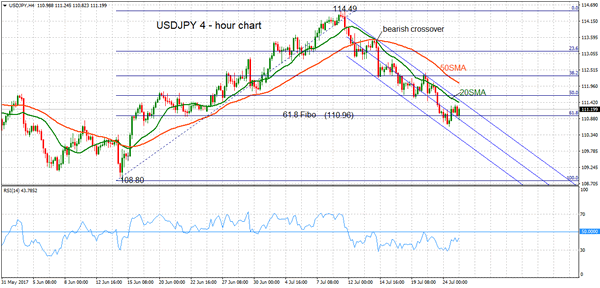
USDJPY has turned increasingly bearish on the 4-hour chart. The pair has been falling in a descending channel since the July 11 high of 114.49.
Support was found at 110.96, which is the 61.8% Fibonacci retracement level of the upleg from 108.80 to 114.49 (June 14 to July 11). This is now an important area around which the pair has been pivoting. Consolidation is expected in the near term, unless there is a break below this support, in which case prices could accelerate their decline towards 108.80.
The technical picture is looking very bearish and the 4-hour chart is showing clear signs of a reversal of the previous June to July uptrend. There was a bearish crossover of the 20 SMA with the 50 SMA on July 14. These moving averages are negatively aligned and downward sloping, which further highlights the bearish bias. Meanwhile, RSI is below 50 in bearish territory, although it appears to have lost downside momentum, suggesting consolidation in the near term.
USDJPY would have to rise above 111.64, which is a key resistance level provided by the 50% Fibonacci in order to see a weakening in the bearish bias. This resistance level was previously a support level and would be quite challenging to break. From here, another resistance level comes in at 112.30, the 38.2% Fibonacci, which also acted as resistance recently and support in the past.
The short-term outlook for USDJPY is bearish as long as prices remain in the descending channel. The intra-day bias is neutral as consolidation is expected around the 61.8% Fibonacci level.
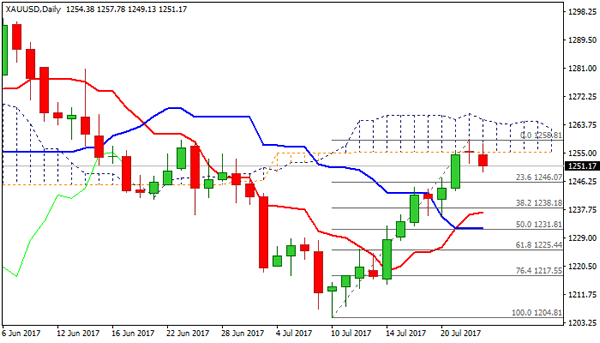
Technical Outlook: Spot Gold – Formation Of Reversal Pattern Risks Deeper Pullback
Spot Gold price eases on fresh recovery of dollar on Tuesday and cracked initial support at $1250 (broken 50% retracement of $1296/$1204 descend).
Steep ascend from $1204 (10 July low) showed initial signal of stall as Monday’s action ended in long-legged Doji after posting fresh recovery high at $1258.
Thick daily cloud (spanned between $1255 and $1265) marks strong barrier and weighs on near-tem action, as price was unable to sustain break into cloud on Monday.
Evening Doji Star reversal pattern is forming on daily chart and needs close below $1250 for confirmation.
Slow stochastic is about to emerge from overbought territory on daily chart and boost bearish signal.
Extension below next support at $1247 (converged 55/100SMA) would increase risk of deeper pullback towards $1238 (double-Fibonacci support – Fibo 38.2% of $1204/$1258 upleg / broken Fibo 38.2% of $1296/$1204 downtrend).
Res: 1255, 1258, 1261, 1265
Sup: 1249, 1247, 1243, 1238
USD/JPY: US Manufacturing PMI
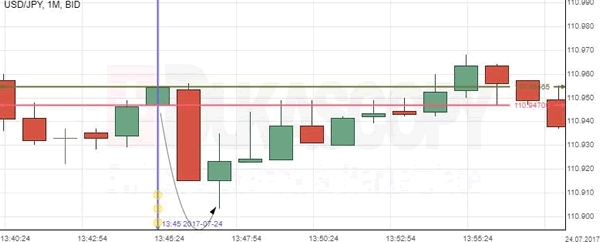
Monday's Markit survey showed that the preliminary PMIs for the US manufacturing and services sectors almost matched analysts' forecasts and had little initial impact on the USD/JPY currency pair. Just after the data were released, the US Dollar edged slightly higher against the Yen to 110.954. Markit revealed that the index for services activity in the United States came in at 54.2 in July, unchanged from the previous month, while the Manufacturing PMI rose to 53.2, above forecasts for a 52.3 reading. Sufficiently strong figures suggested that the country's pace of economic growth gained momentum, pointing to some signs for further expansion.
EUR/USD: EZ Manufacturing PMI
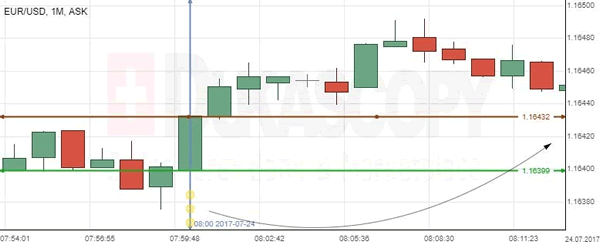
Markit's report on the Manufacturing PMI for the Euro zone came in slightly weaker than anticipated in July and had a small impact on the EUR/USD exchange rate. As soon as the release was published, the 19-country currency strengthened against the Greenback by 0.03% to reach 1.6432. The survey showed that the Euro zone's index for manufacturing activity dipped to 56.8, falling short of expectations for 57.3 points. The modest fall in July's data indicated that the economic expansion in the Euro zone lost its momentum for the second straight month, but remained noticeable.