

Sample Category Title
AUD/JPY Resistance Zone In Play
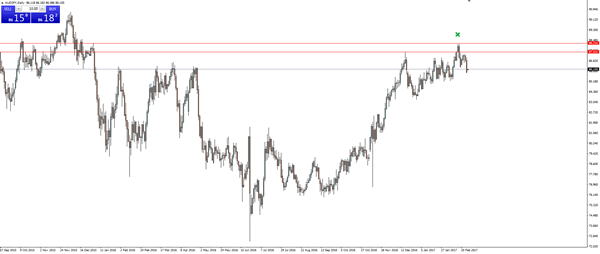
'Here is the zone once again. It doesn't really get much clearer that this.'
It really doesn't get much clearer than this indeed. Again.
Resistance turned support and then back to resistance again. A clear zone reactivated again and again by both the bulls and the bears.
Just take a look at the chart inside that old blog I've reposted here:
AUD/JPY Daily:
Now back to the present and take a look at the way price moved down, but also failed to make a new low, before ripping back up to that same resistance zone:
AUD/JPY Daily:
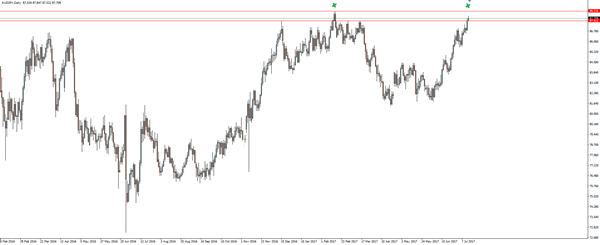
As long as price is within this zone, whichever direction you decide to trade is essentially a guess. You have no confirmation of resistance holding or breaking out and no momentum to jump aboard. All we know is that the level is in play.
USD/CAD Canadian Dollar Higher After Yellen Testimony
Fed's Yellen said one time factors are suppressing US inflation
The Canadian dollar rose on Thursday continuing the trend that started on Wednesday by the Bank of Canada (BoC) raising interest rates by 25 basis points. With few economic indicator released on the calendar the market was focused on the testimony of Fed Chair Janet Yellen to the Senate Banking Committee. The head of the US central bank did not add anything new to the line the Fed has following since March. Rate hikes when appropriate and a soon to start reduction of the balance sheet. Inflation in the US remains low and by her estimate is due to temporary factors. If those factors are not one-time as the Fed economists believe it could mean a less aggressive rate hike path. Inflation expectations are subdued in the US and tomorrow's release of the Consumer Price Index (CPI) will validate those concerns if the core reading is near the forecasted 0.2 percent and adding the volatile food and energy the gains are a mere 0.1 percent.
The loonie rose on a combination of USD weakness due to political uncertainty, Yellen's remarks on inflation and a surge in oil prices following better than expected demand out of China.
The International Monetary Fund (IMF) warned Canada about the housing bubble and NAFTA renegotiation risks even though the economy has shown to be on a recovery track. The IMF suggested the Bank of Canada (BoC) remain on an accommodative track, suggesting the decision to raise rates was premature and urged the central bank to remain cautious and vigilant.
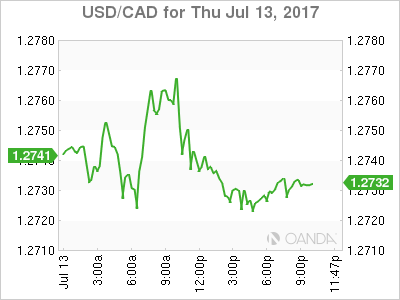
The USD/CAD lost 0.027 on Thursday. The currency pair is trading at 1.2729 while caught in a tight range after the Bank of Canada (BoC) hiked the benchmark rate on Wednesday. The 25 basis point is the follow up to hawkish comments from senior policy makers at the central bank. The BoC cut rates twice in 2015 to proactively prepare the economy to endure the fall in oil prices. Now those cuts are supposed to have done their job and with oil prices stable Governor Stephen Poloz is now expected to raise rates once more before the end of the year with the October meeting being priced in at a 70 percent probability.
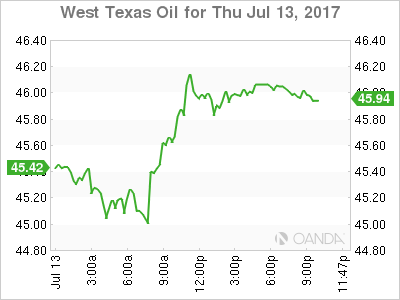
The price of oil rose 1.162 percent in the last 24 hours. The West Texas Intermediate is trading at $45.97 following a fourth session of gains. The large drawdown of US crude inventories boosted oil prices while at the same times there were signs of growing demand around the world. Crude stockpiles fell 7.6 million barrels, with the previous report also showing a 6.3 million barrel drop.
The Organization of the Petroleum Exporting Countries (OPEC) deal with other major producers to limit production has been the biggest factor keeping prices stable. There are concerns that compliance with the deal that was near 100 percent this year, has fallen to 78 percent as some producers like Saudi Arabia have seasonal rises this time of year.
Market events to watch this week:
Friday, July 14
8:30am USD CPI m/m
8:30am USD Core CPI m/m
8:30am USD Core Retail Sales m/m
8:30am USD Retail Sales m/m
Dollar Flat Ahead Of US Retail Sales And Inflation Data
Fed's Yellen said one time factors are suppressing US inflation
The US dollar is mixed against the majors on Thursday. The greenback has bounced back against the EUR, JPY and CHF but has depreciated against commodity currencies ( NZD, AUD and CAD) and the GBP. With little action on the economic calendar traders focused on Fed Chair Janet Yellen's second day of testimonies. This time the Fed Chair was addressing the Senate Banking Committee, but stuck to the assessment that the economy is on the mend. Focusing on US employment to prove her point and once again dismissing low inflation as the result of temporary factors. Once those one time issues pass low unemployment will push inflation near the 2 percent target.
The release of the Consumer Price Index (CPI) by the Bureau of Labor Statistics on Friday, July 14 at 8:30 am EDT will be the main release with traders hoping to gauge how “temporary” are current inflation issues. Monthly inflation is expected to have gained 0.1 percent and the core reading, excluding food and energy is anticipated to have risen by 0.2 percent. The US Census Bureau will also publish retail sales with similar subdued gains expected as the paradox of confident consumers and lack of spending still plagues the US economy. Appropriately the University of Michigan will release the flash consumer sentiment at 10:00 am with a forecast of the reading matching the revised 95.1, pointing to a high confidence from surveyed consumers.
Political risk and lack of data gave investors little guidance on Thursday. Friday's data points will help the market price inflation expectations and the state of consumer spending. Although Fed Chair Janet Yellen stuck to a hawkish rhetoric on rates and balance sheet reduction there were some dovish undertones during her testimony as she doesn't believe the US can reach the 3 percent growth promised by the Trump administration.
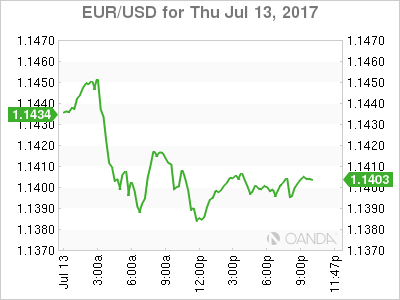
The EUR/USD lost 0.148 percent in the last 24 hours. The single currency is trading at 1.1401 after Chair Yellen's testimony in Washington. There was little new from the Head of the Federal reserve that hasn't been said before via a statement or comments from other Federal Open Market Committee (FOMC) members. The central bank will not announce a set schedule for rate hikes as it all depends on the incoming data. Balance sheet reduction could start this year with a gradual cap on reinvesting until holdings are normalized.
The euro has risen this year on the back of rising political stability in the Euro zone after the French elections ended with the victory of Emmanuel Macron while at the same time the Russian probe has rocked the White House. The Trump administration has not been able to gain momentum and is still negotiating the healthcare reform policy that could hold up pro-growth policies from being introduced this year.
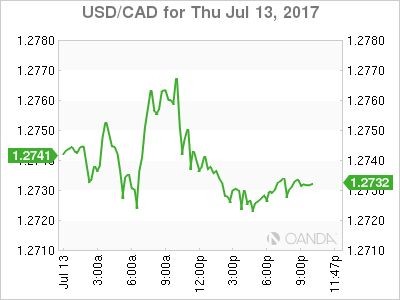
The USD/CAD lost 0.027 on Thursday. The currency pair is trading at 1.2729 while caught in a tight range after the Bank of Canada (BoC) hiked the benchmark rate on Wednesday. The 25 basis point is the follow up to hawkish comments from senior policy makers at the central bank. The BoC cut rates twice in 2015 to proactively prepare the economy to endure the fall in oil prices. Now those cuts are supposed to have done their job and with oil prices stable Governor Stephen Poloz is now expected to raise rates once more before the end of the year.
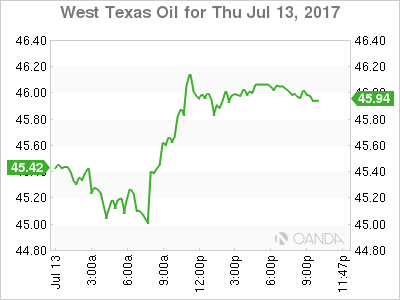
The price of oil rose 1.162 percent in the last 24 hours. The West Texas Intermediate is trading at $45.97 following a fourth session of gains. The large drawdown of US crude inventories boosted oil prices while at the same times there were signs of growing demand around the world. Crude stockpiles fell 7.6 million barrels, with the previous report also showing a 6.3 million barrel drop.
The Organization of the Petroleum Exporting Countries (OPEC) deal with other major producers to limit production has been the biggest factor keeping prices stable. There are concerns that compliance with the deal that was near 100 percent this year, has fallen to 78 percent as some producers like Saudi Arabia have seasonal rises this time of year.
Market events to watch this week:
Friday, July 14
8:30am USD CPI m/m
8:30am USD Core CPI m/m
8:30am USD Core Retail Sales m/m
8:30am USD Retail Sales m/m
A Complete Guide to Fundamental Analysis in Forex
Fundamental analysis in forex is one of the ways to analyze the currency markets. As the name suggests, fundamental analysis is completely different to technical analysis.
While technical analysis deals with price and historical price behavior, fundamental analysis focuses on the factors that are driving the prices in the market.
Fundamental analysis is widely used in the stock markets and primarily among investors. But it can also be used in a number of other markets, including forex and futures.
What does fundamental analysis do?
The fundamental analysis aims to look at the underlying factors in the security being analyzed. In the forex markets, fundamentals analysis looks at the effect of the economic indicators which can eventually determine the exchange rate.
There are a number of ways one can analyze the forex markets fundamentally.
Economic factors
The economic indicators play a major role in determining the market sentiment. There are a number of economic reports that are released over the month. Typically, the busiest part of the month is the first two weeks. During this period, key economic indicators are released.
Economic indicators include gross domestic product (GDP), consumer price index (CPI) and the unemployment or jobs report such as the US nonfarm payrolls report.
These three are the top economic indicators that directly have an influence on the currency pair. They are however lagging. During the rest of the month and especially in the last two weeks of the month, most of the economic releases made are based on surveys which are forward-looking indicators.
These types of releases can influence the market sentiment but only to a certain extent.
A fundamental analyst will need to go through the leading and lagging indicators in order to understand what is happening in the markets.
Central bank decisions
The central bank policy meetings are one of the most important events in the forex markets. After all, if you scratch the surface, the forex markets move because of interest rates and interest rate expectations.
The interest rates are set by central bank officials based on the policy-makers assessment of the economy. Most central banks have a mandate which is inflation targeting. (The Federal Reserve has a dual mandate of both unemployment and inflation).
Understanding this will help forex traders to focus on the economic reports that matter or will influence inflation and GDP for example.
The central bank decisions also give out forward guidance. This helps the markets to prepare for any eventual policy action from the central bank.
The forward guidance can play an important role. Markets tend to typically rally or fall based on forward guidance. Sometimes, these strong market moves can come purely based on a misinterpretation of the forward guidance or at times the markets align correctly to the central banker speeches.
Take the example of the EURUSD chart below.
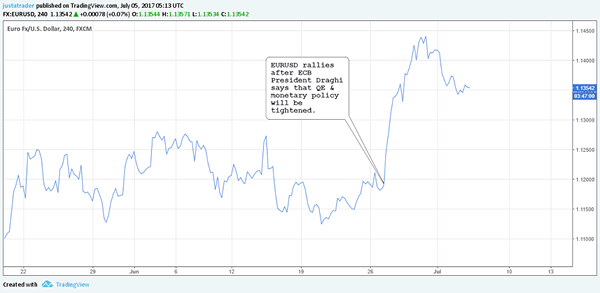
In the above example, you can see the strong rally in EURUSD following the hawkish comments from the ECB president Mario Draghi that monetary policy could be tightened.
This was just a forward guidance from Draghi about what the central bank could do. As a result, traders started to buy the euro as a result in hopes that monetary policy will be tightened.
Such strong moves can often not be explained by technical analysis, and therefore traders also need to focus on the fundamental analysis aspect as well.
How to combine fundamental analysis with technical analysis?
Relying purely on just fundamental analysis or technical analysis can be similar to trading half blind. If you refer back to the above example, the sudden and sharp movements in EURUSD makes more sense when you combine both these aspects of analysis.
When looking to trade a currency pair, the first step is for the trader to build up the technical landscape, including potential target levels and invalidation or stop loss levels. Once this is done, traders need to focus on the fundamental aspects and also make a note of any events or speeches that could impact the markets.
Sometimes, it can be easy, and at times you will find that fundamental and technical analysis does not agree with each other. While it can get a bit complex, the bottom line is the fact that traders need to have a full understanding of the market before they can trade successfully.
Reading up on financial news websites and forums can be a great place to begin understanding how fundamental analysis can fit in with your trading. More importantly, you will then be able to trade with more confidence in the markets.
Greed and Fear in Trading
Financial markets are driven by two powerful emotions - greed and fear'. This is an old Wall Street saying we've heard more times than we care to remember, but still holds true today.
Whether one admits it or not, greed and fear are two drivers that have a big impact on our lives. Unfortunately, these emotions carry over to our trading, which, if not controlled, can have a detrimental effect on your account.
What is greed?
The term 'greedy' has a powerfully negative undertone. As a child, we're sure you've all been called greedy at some point. Keeping one's chocolate-covered fingers out of the cookie jar was just too hard to resist for most children.
Greed, as per The Free Dictoniary, is defined as: an excessive desire to acquire or possess more than what one needs or deserves, especially with respect to material wealth.
A clear-cut example of this was the US subprime mortgage crisis, which eventually led to a financial meltdown. Most of the blame is said to be at the hands of the mortgage lenders. It was these lenders who ultimately approved the mortgage agreements for clients with poor credit history and a high risk of default. An example of greed that doesn't include financial gain or material wealth, however, can be as trivial as a family member who scoffs all the cookies without sharing, even though they know others in the house usually want a cookie or two with desert.
So, is greed ever considered a good thing? From our perspective, yes it can be, as without greed, humans may lack the motivation required to build and achieve new things. A good example of this is when a company puts together an incentivised compensation program for their sales team, allowing sales employees to earn as much money as possible. When the company makes money, the sales executives make money. Good greed at its finest.
What is fear?
Fear, as per Dictionary.com, is defined as a distressing emotion aroused by impending danger, evil, pain etc., whether the threat is real or imagined; the feeling or condition of being afraid.
Fear is an intensely evolutionary characteristic in human beings that triggers us to avoid danger. It's likely that some of our readers here are afraid of heights, the ocean, spiders, snakes etc. Our prehistoric ancestors had the very same fears, and this is the reason we are alive today. Luckily for us, we do not have to deal the threat of being eaten anymore!
Like most things related to emotion and instincts, fear is both good and bad according to the situation. It all depends on how you respond to that fear. If we think about it, the fear itself is just a thought. You have the ultimate deciding power on how you let it affect your actions.
So, when is fear good and when it is bad?
If the fear of failure or rejection holds you back from doing something that could ultimately benefit you (a common fear nowadays), then we'd have to argue that this is considered a 'bad fear'. In this case, you would be letting fear create exactly what you're afraid of.
If the fear of failure pushes you to work harder to avoid failing, nevertheless, then we'd argue that this is a 'good fear'.
Fear, quite simply, is ubiquitous. And there is very little one can do to avoid it. Of course, we understand that everyone has different opinions on this widely-discussed subject, so do take the above as simply one view.
Does greed and fear have a place in your trading?
Unless you're a robot coated with human-looking skin, dealing with greed and fear is inevitable in trading, as it is in life. Greed, for many, is often actually one of the motivations to initially get involved in trading. Quite frankly, we don't feel there's anything wrong with this, since, as we explained above, without greed little would be accomplished in life.
As trading is a relatively solitary job, especially for the majority of retail traders/investors, we're often left thinking that we're the only ones who experience greed and fear on the charts. This couldn't be further from the truth. Let's remember that large sums of money are filtered through the markets on a daily basis from large commercial banks, mutual funds and pension funds. We're pretty sure that these guys and gals are human too, and, as such, are also susceptible to these emotions. Greed and fear is universal!
Now, let's take this a step further and look at greed and fear through the eyes of a trader named Gary. He has two year's experience in the industry and is relatively content with his trading methodology. However, he admitted that he still struggles with the emotional side of things.
In recent hours, Gary happened to come across a 'bread and butter setup' of his around the London open. He calculated his position size, double checked the setup to make sure it was in line with his trading plan and entered the trade. These trades rarely fail, according to Gary so he was naturally confident it would work out.
Ten minutes later, price was seen within shouting distance of his stop and there was no economic news scheduled on the docket. As his trading psychology books advised, he tried to remain calm and composed, but fear continued to tap away at him. He can felt his heart thud against his chest, as he contemplated moving the stop to avoid a loss. He rationalized that if he gave the trade more room to breathe, it would highly likely work out. The other side of his brain, the logical side, told him to stick to his plan. A loss is a loss, nothing to be concerned about.
If we just pause this scenario here, we're sure that most of us have experienced this: it's the fear of loss and being wrong!
Now let's look at the same trade setup, but assume that Gary's trade rallied in favour.
… Ten minutes later, price is seen within striking distance of the take-profit target. A rush of joy flooded through Gary. It was at this point in the trade, he began thinking what if this trade is a runner. So, he started looking for other places to move his take-profit order to. Meanwhile, price continued to move in his favour. Five pips ahead of the take profit (according to the trading plan), he couldn't resist the urge and moved the order thirty pips above the next resistance.
Was this in the plan? Heck NO! His plan was formed using the logical side of his brain, and by sweeping this logic under the carpet, he left himself in a very awkward position.
His eyes alternated between his profit/loss figure and the candles like his life depended on it - he was engrossed!
Was there a plan for if price did not achieve the new target? No! So, what does Gary do when price begins trading against him? Of course, he panicked.
By not following his plan, he forgot to move his stop-loss order to breakeven when he should have. And due to a recent news event, that was supposed to be low impact, the position is now trading in the red. Gary switches from greed to fear and is cursing himself for not sticking to his plan!
This is a common theme among traders, hence why learning to control one's emotions is paramount.
How does one look at controlling these emotions?
While we feel it is impossible to completely remove greed and fear from trading, here are some methods one can utilize to help minimize the impact.
- Risk what you feel comfortable with. If that is .5% of your account, then so be it. This helps one remain objective.
- We know it's difficult, but try to limit your expectations. What we mean by this is avoid thinking that this trade or that trade should win. An individual trade, if sized correctly, has very little effect on the overall results if one thinks in probabilities.
- Trade with money you can afford to lose. Trading beyond your means is a sure-fire way to make one emotional. Trading with money needed for food or housing is reckless.
- Treat trading as a business. Have a business plan in place with specific goals.
- Consider taking a break after three consecutive wins or losses. A losing streak can make you feel, well, like a loser, which can promote revenge trading. And a consecutive number of wins can make you feel like you're untouchable. Learn to recognise these signs. Take a day or two to gather your thoughts after such an event, as trading to revenge your losses will not likely do your account any favours, and trading when you think you're George Soros could have you over leveraging.
- Try to avoid looking at your profit/loss during the trade. By removing this from view, you're partially eliminating the financial element from the trade. Try to focus on pips/points.
Traits of a Successful Trader
Trading, especially to the unaware, is generally intimidating. Some would even go as far to say that it's frightening! Over time we've heard it all: 'participating in the market is a sure-fire way to lose your shirt', 'the market is rigged', 'it's gambling' - the list is endless! So why, if all the above is true, are there traders that seem to almost effortlessly pull money out of the markets on a consistent basis? Is it luck, insider knowledge or were they just born with a trading gift?
Years ago, we had the opportunity to sit down with a successful trader from the UK, England. During our chat, he said something we'll never forget: 'trading, after time, should be as easy as making a good cup of tea'. So, what is it that sets him apart from those who struggle? His response to this question was humble: 'education and psychology'. He spent time learning what makes him tick, and invested 1000s of hours into studying different methods.
In our experience, we believe that there are four core characteristics that make a successful trader: a solid education, patience, discipline and persistence.
Education
This is a crucial element. Without it, you will fail. It is as simple as that. There is a plethora of trading systems to choose from, as well as online trading schools and dedicated forums which can easily overwhelm. If you're looking to join an online trading school, do your research. Does the school back up what it claims, are there results to prove this? Also, what are other students saying about the service. Ultimately, a good school will offer unlimited access and provide continual support through your journey.
A consistently successful trader has paid this price. Some are self-taught, learning from online forums and spending countless hours in front of the charts, while others have paid for a mentor in an attempt to shorten the learning curve. Either way, commitment to learning the art of trading is crucial. Some would even say you need to be obsessed - a 'do or die attitude'.
Tip: if you're in the beginning stages of your journey, you may want to start by studying our educational resources: IC Markets Education for free. In addition to this, consider following our experienced analysts who scour the markets for opportunities on a daily basis: IC Markets Market Analysis
Patience
Patience is one of, if not the most important, trait a trader needs to possess. The majority of traders, especially those new to the industry, are what we like to call: 'eager beavers'. They enter into setups that are not considered valid (according to their trading plan [assuming they have one]) which, quite simply, is reckless. Successful traders wait for the right setup to form before pulling the trigger, exercising patience. This is why trading is, or should be, relatively repetitious once consistency has been achieved.
Tip: We know that trying to avoid taking those mediocre trades is easier said than done, so here's a handy tip that has helped traders over the years. Over the course of your next ten trades, stick to your plan religiously. That's it. Just ten trades! Only trade setups you have recorded in your trading plan. By completing this task, you'll have accomplished far more than most traders have. Try to rinse and repeat this process. Soon it'll become second nature. Trade the plan - plan the trade.
Discipline
There's no two ways about it. You have to be disciplined to be a trader. Building a trading methodology is relatively straightforward, albeit extremely time consuming. Having the discipline to follow and not second guess your method, however, is not.
Having the discipline to honour your stops, to not overtrade and to not use leverage in excess is easy in hindsight, but difficult for a lot of traders in reality. Successful traders recognise that in order to trade well they have to relentlessly follow their rules. Not doing so will likely lead to a faded account!
Tip: Follow your plan and do NOT deviate. Think about it like this... If you were managing a million dollars for a group of investors, would you deviate from your plan that's proven over time to make money? Highly unlikely! Think like a professional and have the discipline to stick to your rules.
Persistence
The definition of persistence is: 'the act of persisting or persevering; continuing or repeating behaviour'. Learning to overcome obstacles is key not only this business, but in any business. A successful trader knows that losses are inevitable. Persevering after a losing streak is difficult, even for the most experienced.
Successful traders also understand that they'll always be students of the game. Persevering to reach new levels of understanding, be it psychologically or technically, should always be a priority. It's said that: 'everything in life that is worth achieving has a price that must be paid'. Consistently successful traders are aware that sometimes they will second-guess their method, get a bad fill, miss trades, undergo losing streaks and suffer power cuts at just the wrong time. All of these, and more, can drain a trader, hence why traders need to possess a healthy dose of perseverance.
Tip: Accepting that there will be pitfalls along the way and overcoming these adversities is key!
Are Your Trades Thriving or Just Surviving?
Some traders across the planet...no, actually, millions of traders across the planet are not fairing very well. They are imploding in trade after trade because they are unable to do what it takes to be consistently successful traders. They are failing to follow-through in some of the most fundamental ways, by lacking the discipline to stop violating trading rules and keep their promises. Regrettably, most of these traders will not last. On the other hand, there are a group of traders who are hanging on by the thinnest of margins and clutching their life-support vests as they barely navigate the mine fields of minutia that are their trading plans, and through sheer will power they are breaking even.
Unfortunately, consistent profit is eluding them. In other words, they are just getting by; they are surviving. This, of course, is not necessarily a bad thing. As pointed out above, the number of traders that are blowing up accounts on a regular basis is quite a bit higher; but when you are simply surviving there is little consolation in the fact that you are losing at a slightly lower rate than those who are washing out. Then there is the trader who, though trading for only a short time is getting extraordinary results. They have gone well beyond just surviving to trade another day and, in fact, are trading in an exemplary fashion by maintaining a fierce focus on what-matters-most, preparing their mindset to remain in the Now of the trade, executing the process solely and not emotionally investing in the outcome. They also have a stranglehold on the fact that markets are random and cannot be predicted.
What exactly is "surviving"? The Oxford Dictionary defines surviving as, "the ability to continue to exist, especially in spite of danger or hardship." Actually, surviving can be a fine quality; that is, to be diligent despite the issues and challenges that abound in the trade; to never give up and maintain a scrappy attitude in the face of drawdowns. Being in a survival mode can provide you the time interval that you need to engage your trading plan and eventually take you from just surviving, to posting the trading results that you want on a consistent basis. So, let me be clear there is no shame in surviving.
However, what does this mean for you? Is that all that you're doing? Are you simply hanging on while doing the same things over and over while expecting a different result? In such an instance, you are not truly helping yourself. Since trading is so personal and reliant upon individual skill sets and mind states, by all accounts you are the only thing standing between you and consistent trading success.
So, let's take a closer look at what it means to "thrive" in the trade. The definition of thrive according to the Oxford Dictionary is to "grow or develop well or vigorously." In other words, to thrive means you are taking advantage of every challenge and comfort zone compromise to go a little further, to learn a little more, to raise your performance standards a little higher.
Free Trading WorkshopThriving means that you are continuously monitoring your mindset Tweet: Thriving means you are continuously monitoring your mindset. https://ctt.ec/qetrd+ in order to flush out discordant thoughts and feelings so you are aligned in body, mind and emotions going in the same direction and for the same goals. It also means that you are, each day and in every way, searching for new ways to maximize your trading EQ (emotional intelligence -managing fear, greed and other debilitating negative emotions) and IQ (mental intelligence - managing errant negative thinking that eventually leads to bad behaviors) so that you remain on purpose, on task and on top of each step of your trading plan and execution. To thrive means that you are documenting all of the issues that emerge in your trading process and that you are deconstructing that documentation to identify patterns of thinking, feeling and doing that are presenting the roadblocks to consistent outcomes. This is what we teach in Mastering the Mental Game online and on-location courses. Ask your Online Trading Academy representative for more information. Also, get my book, From Pain to Profit: Secrets of the Peak Performance Trader.
Gold Dips Lower, US Consumer Data Ahead
Gold has reversed directions in the Thursday session and posted small losses. In North American trade, spot gold is trading at $1217.85 per ounce. In economic news, PPI posted a weak gain of 0.1%, above the forecast of 0.0%. Unemployment claims ticked lower to 247 thousand, above the estimate of 245 thousand. On Friday, the US releases CPI and retail sales numbers, so we could see some movement from gold prices in the North American session.
Janet Yellen's testimony on Capitol Hill was a non-event, and her testimony before a Senate Committee on Thursday will likely be more of the same. Yellen's cautious message didn't veer from what the markets have already heard from other Fed policy makers. Yellen reiterated that the Fed planned to raise rates "gradually", and added that the Fed would begin trimming its balance sheet before the end of the year. The Fed chair didn't provide any timelines, but many analysts are circling September for a balance sheet reduction, with a rate hike to follow in December. However, despite Yellen's assurances, the markets remain lukewarm about a rate hike before the end of the year. Investors are concerned that the US economy has slowed down in 2017 and may not need another rate hike. In her testimony, Yellen reiterated said that she believes the factors weighing on inflation are temporary. However, she acknowledged that with inflation well below the Fed's target of 2%, adding that there could be more going on there". For their part, the markets remain skeptical about a rate hike. The CME Group has pegged a December rate increase at just 47%, while other forecasts are pointing to odds as low as 40%. Hints from the Fed will not suffice to bring investors on board – unless growth and inflation numbers move higher, the markets are likely to remain lukewarm about the likelihood of a third rate hike in 2017.
With global economic conditions improving, major central banks are looking at tightening policy. The Fed is looking at a rate hike in December, while the BoE and ECB are both considering tightening policy. On Wednesday, the Bank of Canada raised rates by 25 basis points to 0.75%, the first rate increase in 7 years. One notable exception is the Bank of Japan, which has no plans to withdraw from its aggressive stimulus program. Still, the trend towards tightening could have significant ramifications for gold prices, as the metal is inversely linked to interest rate moves. Both the euro and the pound recorded sharp rallies in June, sparked by comments from the heads of the ECB and BoE. These developments show that investors are closely monitoring comments from central bankers, and any hints of tighter policy could send gold prices lower. Gold prices are down 4.0% since June 1, and if investors' appetite for risk continues to grow, gold prices could head below the $1200 level.
Pound Punches Above 1.29, Markets Eye US Inflation and Retail Sales
GBP/USD has posted slight gains in the Thursday session. In North American trade, the pair is trading at 1.2930. On the release front, the BoE released its quarterly Credit Conditions Survey. In the US, PPI posted a weak gain of 0.1%, above the forecast of 0.0%. Unemployment claims ticked lower to 247 thousand, above the estimate of 245 thousand. On Friday, the US releases CPI and retail sales numbers, so we could see some movement from GBP/USD in the North American session.
Janet Yellen's testimony on Capitol Hill was a non-event, and her testimony before a Senate Committee on Thursday will likely be more of the same. Yellen's cautious message didn't veer from what the markets have already heard from other Fed policy makers. Yellen reiterated that the Fed planned to raise rates "gradually", and added that the Fed would begin trimming its balance sheet before the end of the year. The Fed chair didn't provide any timelines, but many analysts are circling September for a balance sheet reduction, with a rate hike to follow in December. However, despite Yellen's assurances, the markets remain lukewarm about a rate hike before the end of the year. Investors are concerned that the US economy has slowed down in 2017 and may not need another rate hike. In her testimony, Yellen reiterated said that she believes the factors weighing on inflation are temporary. However, she acknowledged that with inflation well below the Fed's target of 2%, adding that there could be more going on there". For their part, the markets remain skeptical about a rate hike. The CME Group has pegged a December rate increase at just 47%, while other forecasts are pointing to odds as low as 40%. Hints from the Fed will not suffice to bring investors on board – unless growth and inflation numbers move higher, the markets are likely to remain lukewarm about the likelihood of a third rate hike in 2017.
Recent British numbers have looked weak, and that is raising concerns that the UK economy may be in a downturn. Last week's PMI reports, key gauges of the services, manufacturing and construction sectors, all pointed to weaker growth in June. Wednesday's employment numbers were not all that bad, but nevertheless were not as strong as previous readings. Wage growth dipped to 1.8% in May, compared to 2.1% a month earlier. This marked the first reading below the 2.0% level since February 2016. Unemployment rolls expanded by 6.0 thousand, better than the forecast of 10.5 thousand. Despite softer wage growth, inflation climbed to 2.9%, its highest level in almost 4 years. The BoE is divided on whether to raise rates before the end of the year, and policymakers are in an unenviable position – the economy is showing some signs of weakness, but inflation is running at 3%, well above the BoE's target. A weak British currency has contributed to high inflation, while at the same reducing the purchasing power of the British consumer.
Dollar Firms up Against Yen; Sterling Gains; Oil and Gold Up
The dollar gained against the yen ahead of the US session, supported by encouraging data releases, and continued strengthening as Federal Reserve Chair Janet Yellen started her second-day testimony to Congress. The dollar index, a broad measure of the greenback's strength, was up 0.07% towards the end of the European session.
The number of people seeking unemployment benefits fell last week, confirming labor market strength in the US. Initial claims for state unemployment benefits declined by 3,000 to 247,000 for the week ending July 8. This is below the upwardly revised number for the prior week (250K), but more than economists' expectations (245K).
The Labor Department also released data for US producer prices in June that unexpectedly rose as sustained increases in the cost of services offset declining energy prices. PPI for final demand edged up 0.1% in June, month-on-month, after being unchanged in May. This may suggest that the pace of the inflation rate will pick up. Closely monitored US CPI data for June is set to be released tomorrow at 12:30 GMT.
Both data sets provided support to the dollar against the yen. Dollar/yen rose above the 113 handle during late European trading hours and continued strengthening as the US session started and Fed Chair Janet Yellen started her second day testimony to Congress.
The Australian and New Zealand dollars rose significantly during the European session, with the kiwi hitting a five-month high of $0.7368.
The euro was broadly flat against the greenback. Euro/dollar recovered above the 1.1400 handle as the Wall Street Journal reported that the European Central Bank would announce it plans to start tapering from next year, at its policy meeting in September.
Sterling was one of the better performing currencies against the dollar today. In the absence of significant economic data, one of the main drivers for pound traders was a hawkish speech by Bank of England policymaker Ian McCafferty. Pound/dollar gained 0.33% to last trade at 1.2928 as the European session was about to end.
The loonie has given up some of yesterday's significant gains as the dollar was recovering during the day. Dollar/loonie rose to 1.2758.
Both closely watched commodities, oil and gold rose during the European session. Despite pessimistic comments from the International Energy Agency, oil prices remained above the $45 level. IEA noted that global oil supply rose in June as compliance of production cuts was at the lowest level in six months. WTI was up on the day, last trading at $45.76 a barrel and Brent at $47.95.
Inversely related to the US currency, gold prices came under pressure as the US session was starting. The precious metal is broadly flat on the day, last trading at $1,218.58 an ounce.