Sample Category Title
EUR/USD Dips Further While USD/CHF Turns Green
EUR/USD extended losses and traded below the 1.0775 support. USD/CHF is rising and might aim a move toward the 0.8850 resistance.
Important Takeaways for EUR/USD and USD/CHF Analysis Today
- The Euro struggled to clear the 1.0935 resistance and declined against the US Dollar.
- There is a key bearish trend line forming with resistance at 1.0680 on the hourly chart of EUR/USD at FXOpen.
- USD/CHF is showing positive signs above the 0.8745 pivot zone.
- There was a break above a short-term bullish continuation pattern with resistance at 0.8770 on the hourly chart at FXOpen.
EUR/USD Technical Analysis
On the hourly chart of EUR/USD at FXOpen, the pair failed to clear the 1.0935 resistance. The Euro started a fresh decline below the 1.0825 support against the US Dollar, as mentioned in the previous analysis.
The pair declined below the 1.0775 support and the 50-hour simple moving average. Finally, the pair tested the 1.0630 level. A low was formed at 1.0628 and the pair is now consolidating losses. The pair is showing bearish signs, and the upsides might remain capped.
Immediate resistance on the upside is near the 23.6% Fib retracement level of the downward move from the 1.0825 swing high to the 1.0628 low at 1.0680.
There is also a key bearish trend line forming with resistance at 1.0680 and the 50-hour simple moving average. The next major resistance is near the 1.0725 zone. The main resistance sits near the 76.4% Fib retracement level of the downward move from the 1.0825 swing high to the 1.0628 low at 1.0775.
An upside break above the 1.0775 level might send the pair toward the 1.0825 resistance. Any more gains might open the doors for a move toward the 1.0935 level.
On the downside, immediate support on the EUR/USD chart is seen near 1.0630. The next major support is near the 1.0600 level. A downside break below the 1.0600 support could send the pair toward the 1.0565 level.
USD/CHF Technical Analysis
On the hourly chart of USD/CHF at FXOpen, the pair started a decent increase from the 0.8615 support. The US Dollar climbed above the 0.8700 resistance zone against the Swiss Franc.
There was a break above a short-term bullish continuation pattern with resistance at 0.8770. The bulls were able to pump the pair above the 50-hour simple moving average and 0.8770. Finally, the pair tested the 0.8815 zone.
A high was formed near 0.8817 and the pair is still showing signs of more upsides. On the upside, the pair is now facing resistance near 0.8820.
The main resistance is now near 0.8840. If there is a clear break above the 0.8840 resistance zone and the RSI remains above 50, the pair could start another increase. In the stated case, it could test 0.8920.
If there is a downside correction, the pair might test the 0.8790 level or the 23.6% Fib retracement level of the upward move from the 0.8701 swing low to the 0.8817 high.
The first major support on the USD/CHF chart is near the 0.8770 level. The next key support is near the 61.8% Fib retracement level of the upward move from the 0.8701 swing low to the 0.8817 high at 0.8745.
A downside break below 0.8745 might spark bearish moves. The next major support is near the 0.8700 pivot level. Any more losses may possibly open the doors for a move toward the 0.8615 level in the near term.
Trade over 50 forex markets 24 hours a day with FXOpen. Take advantage of low commissions, deep liquidity, and spreads from 0.0 pips. Open your FXOpen account now or learn more about trading forex with FXOpen.
This article represents the opinion of the Companies operating under the FXOpen brand only. It is not to be construed as an offer, solicitation, or recommendation with respect to products and services provided by the Companies operating under the FXOpen brand, nor is it to be considered financial advice.
Dollar Sets the Pace in FX Markets
Markets
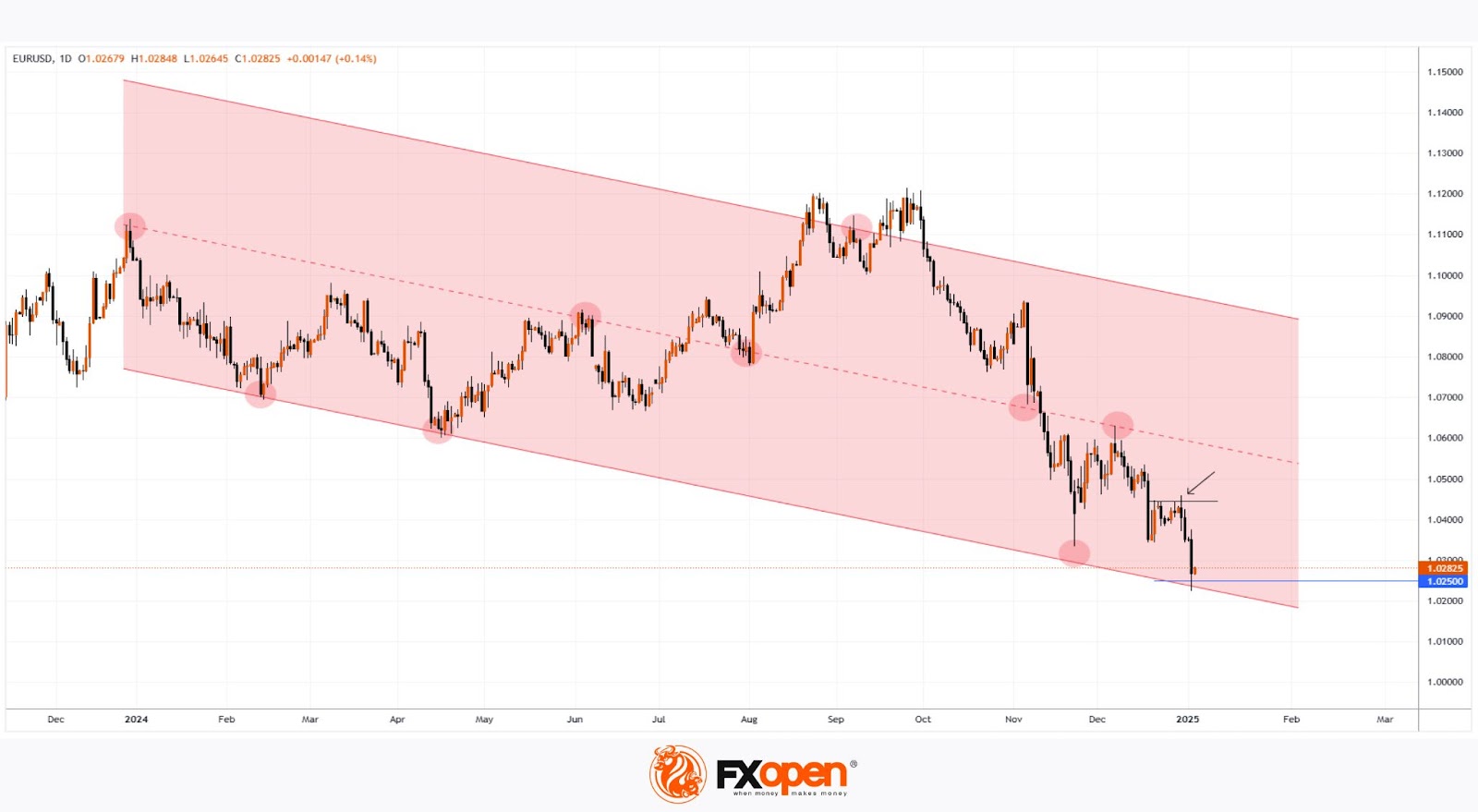
US markets were closed yesterday in observance of Veteran’s Day, thinning trading conditions at the start of the week. For now, the by default trading mechanisms are the ones put in place after US Republicans secured their hattrick last week. The dollar sets the pace in FX markets with the trade-weighted greenback (DXY) closing in on 106.13 June top (currently 105.70). It’s the first of a set of mediocre resistance levels on the way to the upper band of the sideways trading channel in place since the start of 2023. Via 106.52 (2024 top) and 107.11 (Nov 23 high), we arrive at the 2023 top of 107.35 which is still our preferred scenario. EUR/USD sets a new short-term low at 1.0630 this morning and is equally looking at 1.0601 (2024 low) as final support ahead of the range bottom of the past two years (1.0448). The People Bank of China fixed the yuan at its weakest since September (USD/CNY now 7.2350), suggesting that a weaker currency will become part of the policy mix. Regulators are also planning to cut taxed for home purchases as the government drives up its fiscal spending efforts to revive the economy.
The underlying trend in (long-term) bond yields is still up as markets gear up for more fiscal stimulus on a global level. These short term growth and inflationary boosting measures come with a higher credit premium as well. Last week’s first ever positive Bund/swap spread is a point in case with the German government heading to early elections as the coalition collapsed over breaking up the debt brake. Such fiscal strategies have implications for monetary policy as well with BoE governor Bailey’s call for activism making way for “not too many and not too much” after calculating the impact of Chancellor Reeves’ 2025 budget. A higher growth and inflation peak in 2025 call for a careful monetary approach given that inflation remains stick above the 2% targets.
News & Views
An article in the Financial Times suggests that the European Union is preparing a change in its spending policies that can potentially redirect tens of billions of euro to defense and security. According to the reporting, the policy shift could apply to about a third of the EU’s common budget mentioning an amount of about €392bn over the 2021 to 2027 budget period as only about 5% of these cohesion funds have been spend. For now, the funds can’t be used to fund the military, but according to the FT referring to EU officials, more flexibility will be allowed to support the defense industry and to support military mobility projects. The FT quotes a spokesman of the European Commission saying that cohesion funds could be used for the defense industry as they contribute to the overall mission to enhance regional development, including military mobility. According to the FT analysis, this shift in spending might also be supported by net payers of the EU budget who see it as preferable to issuing joined debt or providing additional EU funding.
Czech inflation accelerated further to 0.3% M/M and 2.8% Y/Y in October. The outcome was in line with expectations but shows a further rise from September (-0.4% M/M and 2.6% Y/Y). The monthly increase was mainly due to of housing, water, electricity, gas another solid fuels (0.4%). Food and non-alcoholic beverages rose 0.3% M/M. Price of goods in total increased by 0.2% M/M and 1.3% Y/Y. Prices of services were 0.5% higher in a monthly perspective and 5.3% compared to the same period last year. Core inflation at 2.4% Y/Y was in line with the forecast of the Czech national Bank (CNB). While still within the CNB tolerance band, the gradual rise in inflation comes as the CNB and its governor Michl recently indicated that they were considering a halt to its rate cutting cycle after the policy rate was reduced to 4% at last week’s policy meeting. In this respect, Michl indicated that he prefers core inflation to decline slightly below the 2% target. After a temporary rebounding last week, the Czech koruna currently again trades slightly weaker near EURCZK 25.34.
Trumpforia
Bitcoin added another 10% yesterday and came just shy of the $90K per coin, while Ethereum flirted with the $3400 mark. The crypto-friendly Donald Trump – who says that the US should become the center of the digital assets – will probably remove the crypto-sceptics of the government institutions from their position and replace them by crypto-friendly regulators who will let the crypto industry ‘thrive’ in the US. And when there is a comprehensive and solid policy ground, the banks could more comfortably integrate cryptocurrencies on their platforms and attract more institutional money on board. More demand should push the price of Bitcoin – which has a limited supply – higher. Eyes are on the $100K mark and above. High volatility will be on the menu for Xmas.
Elsewhere, the S&P 500 consolidated gains near ATH level, while small caps extended rally by 1.5% despite the rising US yields – which should become a challenge for the US small caps as the post-election euphoria settles.
In the traditional currencies, the US dollar index is pushing higher along with the US yields on expectation that Trump’s pro-growth policies and tariffs would lead to higher inflation and softer-than-otherwise policy easing from the Federal Reserve. That’s in contrast with the worsening economic and political outlook for the Eurozone, with Germany preparing for a snap election on government’s inability to tackle the financial difficulties and revive growth. The euro tanked to 1.0628 against the US dollar, and to 0.8260 against the pound yesterday. The German and the Eurozone economic sentiment indicators are due this morning and are somehow expected to print a slight improvement in November, but a slight improvement per se won’t be enough to lift mood in Europe while Trump’s tariff threat is taking a toll. The Stoxx 600 rebounded yesterday, probably on the expectation that a softer European Central Bank (ECB) policy could boost valuations, but the ECB will probably remain more cautious than many expect when it comes to easing policy because a rapid appreciation of the US dollar will have a boosting effect on global (and euro area) inflation and could eventually limit the ECB’s ability to cut wholeheartedly.
In Japan, the likelihood of further policy normalization is melting by the day. There is still hope – for the yen bulls – that the Bank of Japan (BoJ) will deliver another rate hike in December or January, but to me, the December meeting is probably off the table, and January is on a very slippery ground. One of the new PM Ishiba’s closest allies, Economic Revitalization Minister Akazawa, attended the BoJ meeting for the first time and he said that it’s important for the BoJ to continue monetary easing to ensure a complete end of deflation. Of course, this man is responsible for Economic Revitalization, and of course he has appetite for favourable monetary policy, but the BoJ has more doves on board than hawks, and the rising global uncertainties look increasingly supportive of the yen bears until a new FX intervention is triggered. Soft yen, combined with the government’s pledge to support growth – especially in tech space – remain supportive of the Nikkei.
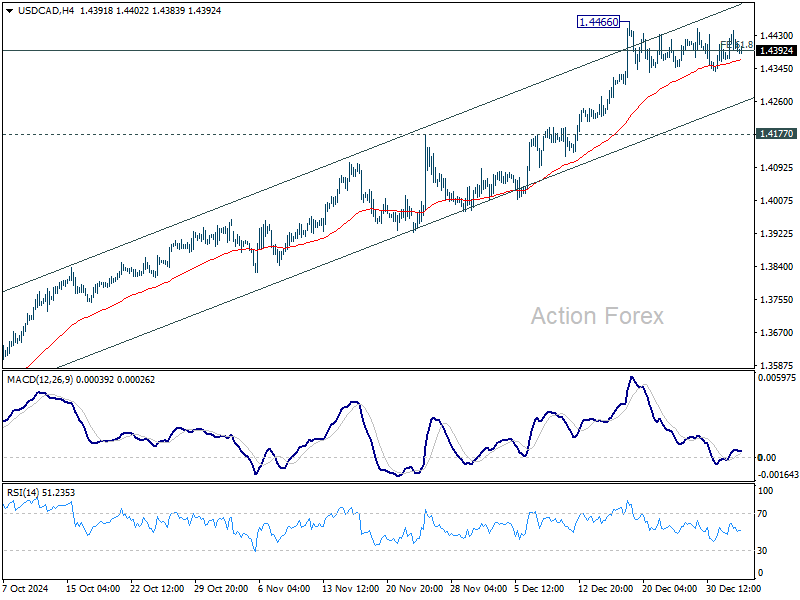
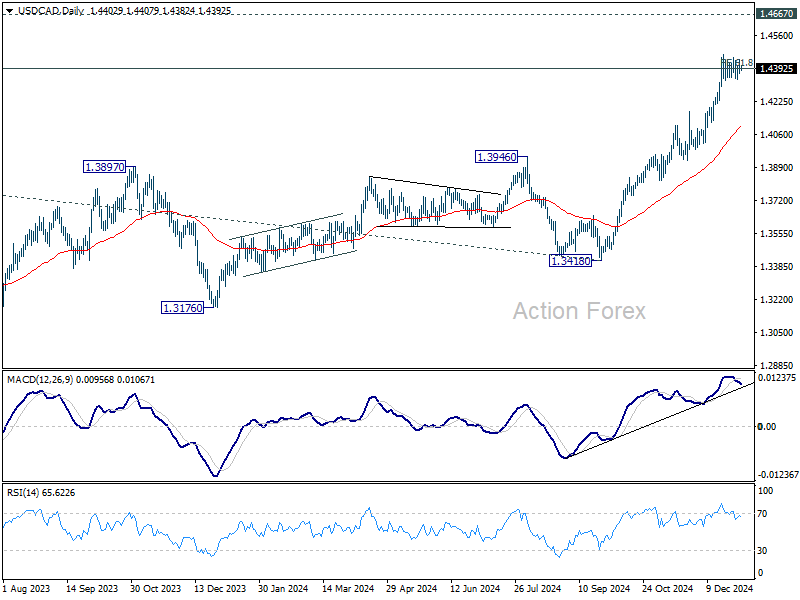
In energy, the barrel of US crude kicked off the week on a negative note. Gloomy outlook for China both due to the sluggish fundamentals and Trump threat, the Chinese authorities’ inability to meet the market’s demand in terms of fiscal stimulus and the idea that the Trump administration will ‘drill baby drill’ sent the barrel of US crude below the $68pb this morning. Trend and momentum indicators have turned negative and the RSI suggests that there is room for further selloff before the market hits the oversold conditions. Next natural target for the bears stands at $65pb. As such, it’s probably just a matter of time for the USDCAD to reach the 1.40 psychological mark.
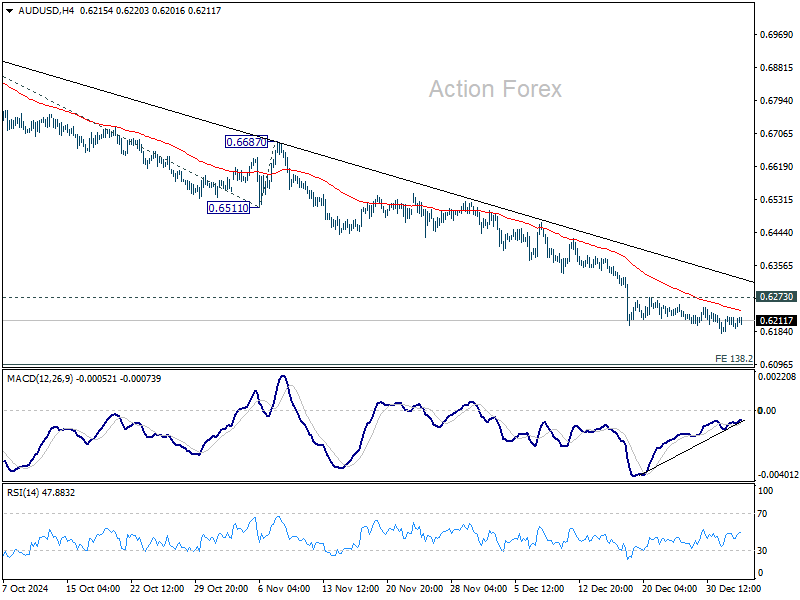
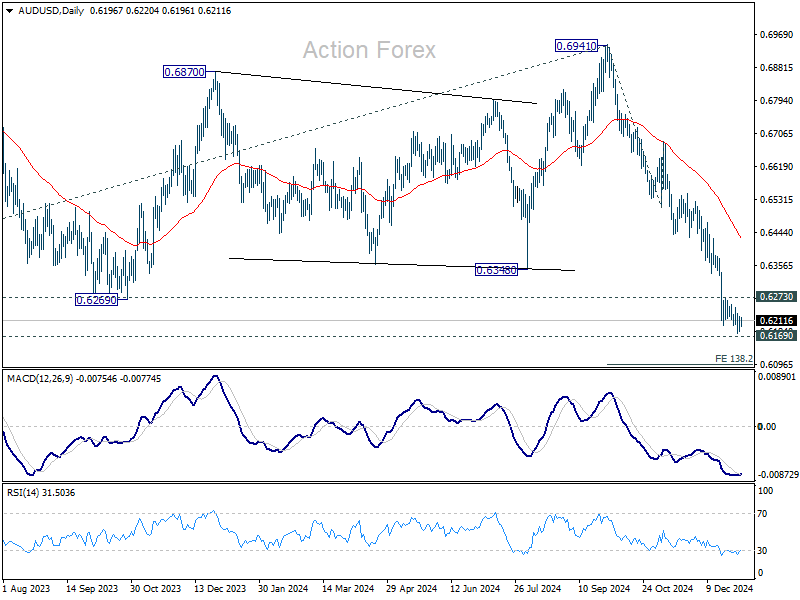
Elsewhere, the AUDUSD is bearing the brunt of falling iron ore prices on sluggish Chinese growth outlook and the energy and mining heavy FTSE 100 was better bid yesterday and should benefit from a broad-based USD strength, but a softer pound alone won’t enough to keep the FTSE 100 in the actual bullish trend. The sluggish China and the prospects of higher-than-otherwise global yields – as the US is expected to exports its Trumpflation – look unpromising. The major support to the past year’s rebound stands a few points above the 8000p psychological mark.
GBP/JPY Daily Outlook
Daily Pivots: (S1) 197.03; (P) 197.75; (R1) 198.57; More...
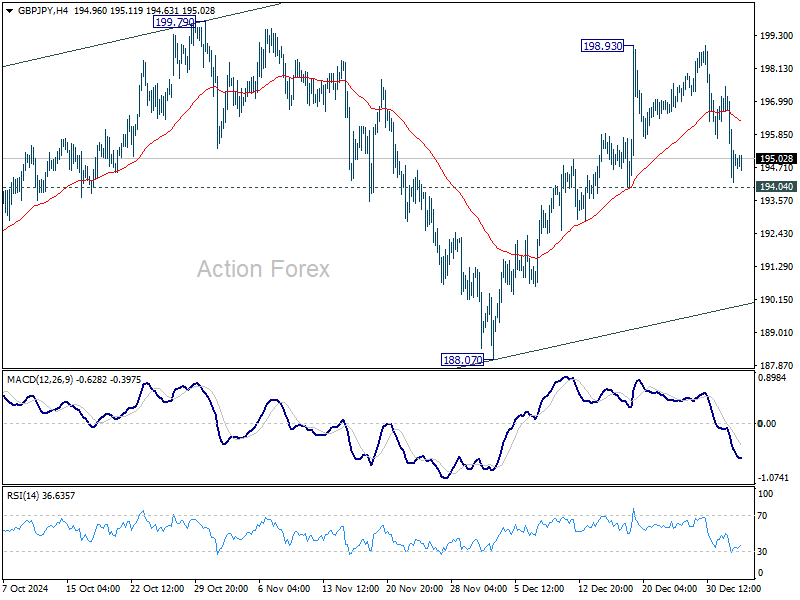
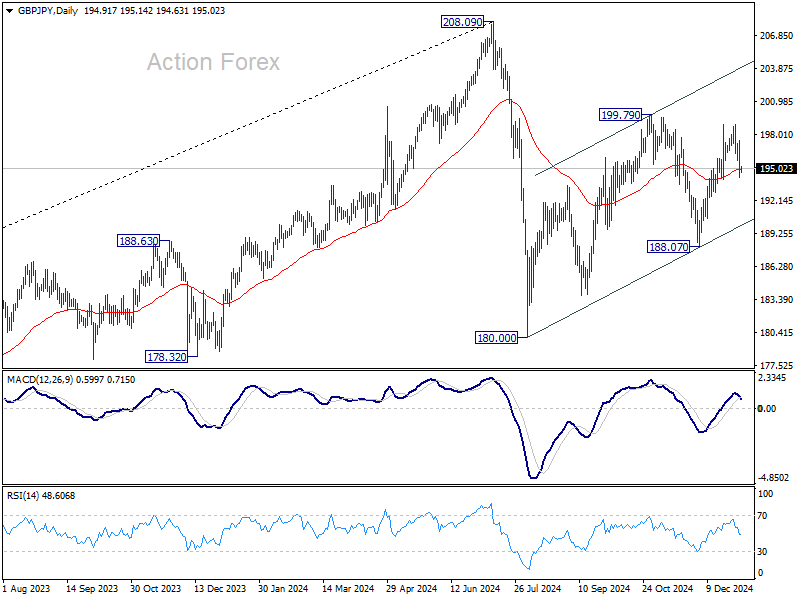
Range trading continues in GBP/JPY and intraday bias stays neutral for the moment. Further rally is expected as long as 55 D EMA (now at 194.99) holds. Above 199.79 will resume the rebound from 180.00 to retest 208.09 high. However, sustained break of 55 D EMA will argue that the corrective rise has completed already, and turn near term outlook bearish for 180.00/183.70 support zone.
In the bigger picture, price actions from 208.09 are seen as a correction to whole rally from 123.94 (2020 low). The range of consolidation should be set between 38.2% retracement of 123.94 to 208.09 at 175.94 and 208.09. However, decisive break of 175.94 will argue that deeper correction is underway.
EUR/JPY Daily Outlook
Daily Pivots: (S1) 163.33; (P) 163.99; (R1) 164.50; More....
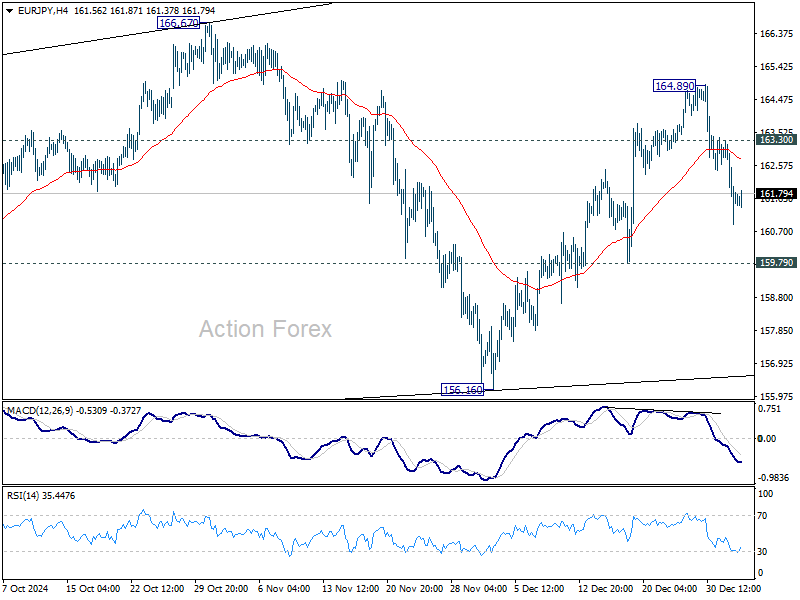
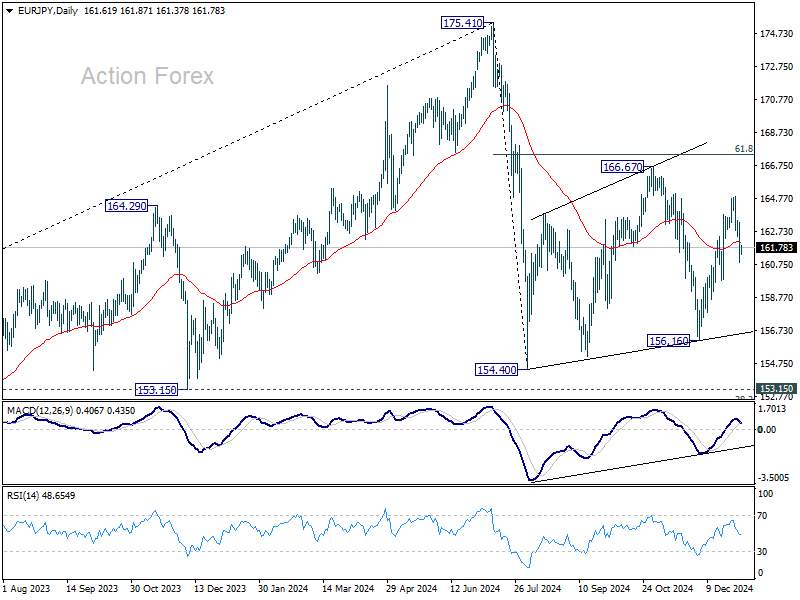
Intraday bias in EUR/JPY remains on the downside. Sustained trading below 55 D EMA (now at 163.34) will argue that whole corrective rise from 154.40 has completed with three waves up to 166.67. Deeper decline should then be seen back to 154.40/155.14 support zone. On the upside, break of 166.67 will target 61.8% retracement of 175.41 to 154.40 at 167.38 instead.
In the bigger picture, price actions from 175.41 are seen as correction to rally from 114.42 (2020 low). The range of consolidation should have been set between 38.2% retracement of 114.42 to 175.41 at 152.11 and 175.41 high. However, decisive break of 152.11 would argue that deeper correction is underway.
EUR/GBP Daily Outlook
Daily Pivots: (S1) 0.8259; (P) 0.8281; (R1) 0.8301; More...
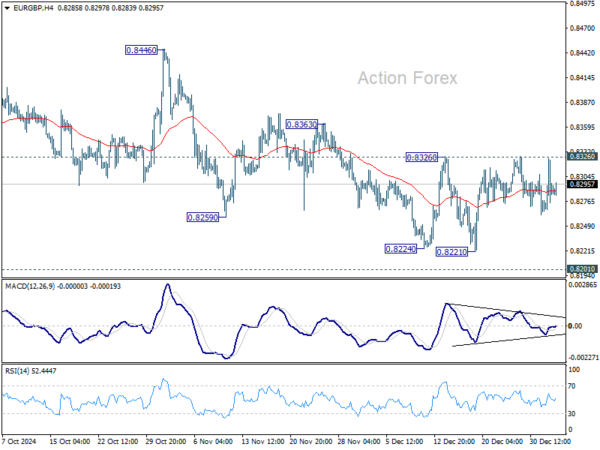
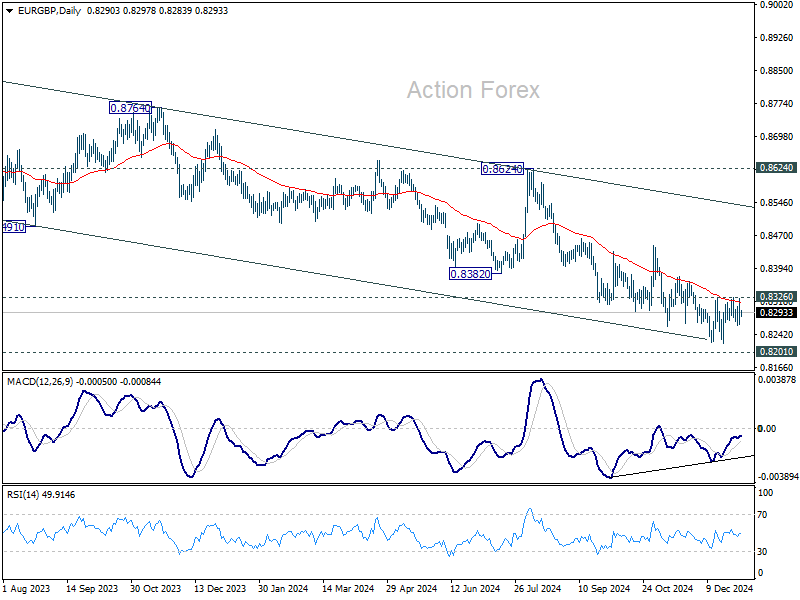
Intraday bias in EUR/GBP remains on the downside for 61.8% projection of 0.8624 to 0.8294 from 0.8446 at 0.8242. Break there will target 0.8201 key support. On the upside, above 0.8324 minor resistance will turn intraday bias neutral first. But outlook will stay bearish as long as 0.8446 resistance holds, in case of rebound.
In the bigger picture, down trend from 0.9267 (2022 high) is in progress. Next target is 0.8201 (2022 low), but strong support should be seen there to bring rebound. However, outlook will remain bearish as long as 0.8624 resistance holds even in case of strong rebound. Decisive break of 0.8201 will indicate long term bearish reversal.
EUR/AUD Daily Outlook
Daily Pivots: (S1) 1.6165; (P) 1.6226; (R1) 1.6267; More...
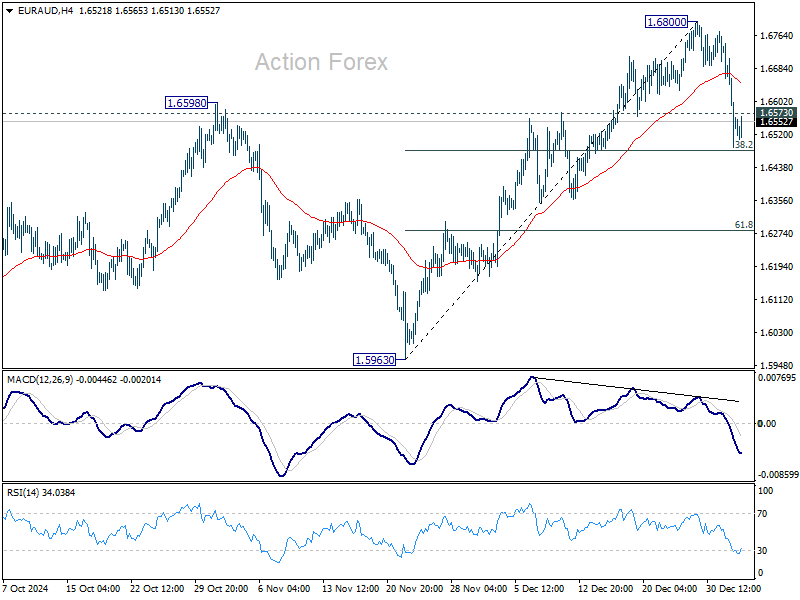
Intraday bias in EUR/AUD stays neutral at this point. For now, risk will stay mildly on the downside as long as 1.6598 holds, in case of stronger rebound. On the downside, break of 1.6161 will resume the decline from 1.6590 to target a test on 1.5996/6002 key support zone.
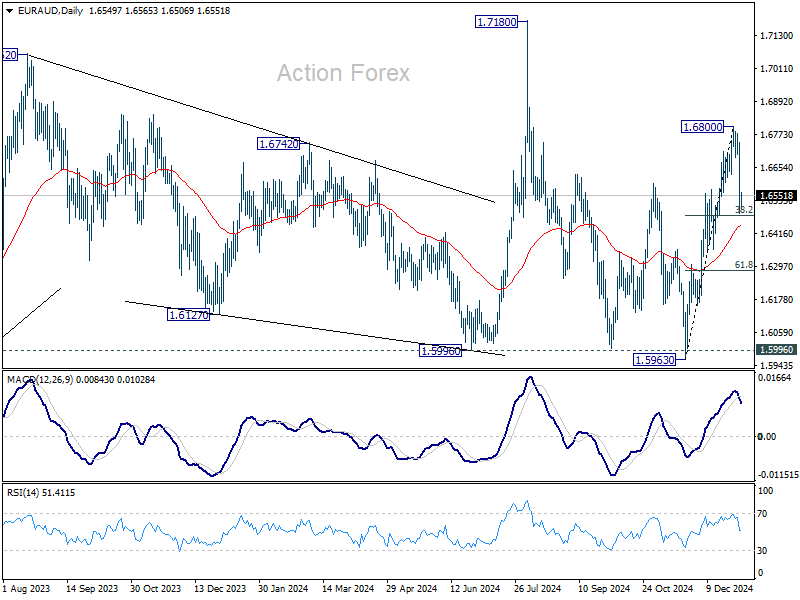
In the bigger picture, as long as 1.5996 cluster support , up trend from 1.4281 (2022 low) is still expected to resume through 1.7180 at a later stage. However decisive break of 1.5996 will argue that the medium term trend might have reversed. Deeper fall would be seen to 61.8% retracement of 1.4281 (2022 low) to 1.7180 at 1.5388, even as a correction.
Mixed UK labor data as unemployment rate and earnings growth climbs
In October, UK employment data indicated slight weakening in the labor market, with payrolled employees decreasing by -5k or -0.0% mom to a total of 30.4m. Comparing to the same month a year ago, payrolled employment rose 95k or 0.3% yoy. However, the claimant count for job-related benefits rose by 26.7k to reach 1.806mn, smaller than expectations of a 30.5k increase.
In the three months to September, unemployment rate climbed from 4.0% to 4.3%, higher than the anticipated 4.1%. On the earnings front, total average earnings, including bonuses, rose by 4.8% yoy, outpacing both the previous 3.9% growth and market forecasts. Excluding bonuses, average earnings grew by 4.8% yoy, marginally down from 4.9% yoy in the prior period but still above the projected 4.7% yoy.
Will ZEW for November Match October’s Improvement?
In focus today
Today will be light on the data front, with the German ZEW indicator for November only. It will be interesting to see if the improvement in expectations recorded in October continued in November.
Economic and market news
What happened overnight
In Sweden, the Public Employment Service (PES) released their latest unemployment statistics at 06:30 CET which showed an increase in the unemployment rate to 6.9%. According to PES's figures, the unemployment rate has been increasing for the past year, but the pace of said increase is less dramatic than what is implied by the often officially quoted figures from LFS. Still, the PES press release note that the labour market is clearly weak.
What happened yesterday
In Denmark, inflation increased to 1.6% y/y in October from 1.3% y/y in September, with higher electricity prices in particular driving the uptick. While inflation increased slightly, underlying price pressure remains modest, with the substantial wage growth not acting as an inflationary force in Denmark.
In Norway, October core inflation dropped to 2.7% y/y (cons: 2.7%), while the monthly figure fell to 0.2% m/m (cons: 0.3%). Details reveal a broad-based fall with lower price pressure in all main components apart from clothing/shoes - albeit much of it is base effects. Heading into this print it was widely expected that inflation once again would undershoot Norges Bank's projections at 2.9% y/y (September monetary policy report). That said, at this point, markets have widely understood Norges Bank's revealed preferences for waiting until March 2025 before delivering the first rate cut - also reiterated at last week's interim meeting last week. Given their preferences, the bar for a December cut has seemed high for some time, and we would likely have to see the real economy, particularly capacity utilisation, turn over sharply before a cut could come back into play. Hence, yesterday's print changed nothing in that regard.
In China, the credit data came in yesterday, showing a moderate improvement in October, but data remains soft in general. At the same time, money supply growth also rebounded (M1 from -7.4% y/y to -6.1% y/y, M2 from 6.8% y/y to 7.5% y/y), though coming from weak levels. With the stimulus taking hold, we project credit growth to pick up in the coming quarters. The big uncertainty now, however, is when and how much the impact will be of Trump's expected tariffs hikes on Chinese products - and the tit-for-tat trade war that may follow.
In Japan, the Lower House convened on Monday to select a new prime minister. As expected, the LDP retained power, re-electing PM Ishiba despite his scandal-hit coalition losing its parliamentary majority in last month's election. We will keep an eye on what the DPP's (whose support is critical to Ishiba) opposition to rate hikes might mean to the government's stance on monetary policy.
In commodities space, Oil prices were down almost 3% in yesterday's session amid China's stimulus plan disappointing investors hoping for stronger Chinese demand growth, a stronger USD and expectations of increased supply due to Trunp's pro-drilling stance. Later today, OPEC publishes its Monthly Oil Market Report, which includes major issues affecting the oil market and an outlook for oil market developments for the year to come.
In crypto space, Bitcoin continued its journey north. As of this morning, the world's biggest crypto currency is hovering around USD 88,600.
Equities: Global equities were higher yesterday; however, it is worth highlighting the calmness in the markets and the massive drop we have seen in implied volatility measures such as the VIX and Move indices. Yesterday was also devoid of significant fundamental events, with no important key economic figures or monetary policy developments. Therefore, it was a day when investors had the opportunity to reflect thoroughly following the immediate reaction to the US election. The largest disturbance was the US Veterans Day holiday, which meant that there was no trading of treasuries. In terms of sector rotation, we observed precisely what we anticipated, with cyclicals performing exceptionally well, led by financials, consumer discretionary, and industrials. That being said, one should not expect Tesla's post-election frenzy to continue. We even argue that there is a risk of it backfiring if Trump initiates a tariff war against Europe and Europe begins to retaliate. Materials underperformed, which we attribute to the disappointing messages emanating from China. Style-wise, small caps performed excellently yesterday, particularly in the US.
In the US yesterday: Dow +0.7%, S&P 500 +0.1%, Nasdaq +0.1%, Russell 2000 +1.5%.
Markets in Asia are lower this morning. China H-shares, along with Taiwan, are experiencing declines. The two major drivers here are the post-US election effects and the disappointing Chinese stimulus measures. In Taiwan, TSM, accounting for more than one-third of the main index, is leading the index lower after reportedly being ordered by the US to stop shipping chips used for AI to Chinese customers. Futures in Europe and the US are also lower this morning, with the Euro Stoxx 50 down by almost 1%.
FI: Yesterday, European government bond yields declined and extended the rally from Friday. 10Y German government bond yields have declined almost 20bp from the peak last week and are back below levels before the US election. The US bond market was closed yesterday, but we have seen a modest rise in US yields this morning in Asian Trade after a solid decline last week, where 10Y US Treasuries fell some 13bp on Thursday and Friday. Furthermore, after a long period with curve steepening the curves are flattening once again.
FX: Limited activity after the European close due to US holiday (Veteran's Day), but EUR/USD held on to the move below 1.07 from earlier in the session. The EUR was one of yesterday's biggest losers, not only vs USD but also against Scandies. The Brent oil price fell close to 3% but NOK/SEK barely moved, currently trading just above 0.98.
EUR/CHF Daily Outlook
Daily Pivots: (S1) 0.9367; (P) 0.9383; (R1) 0.9405; More....
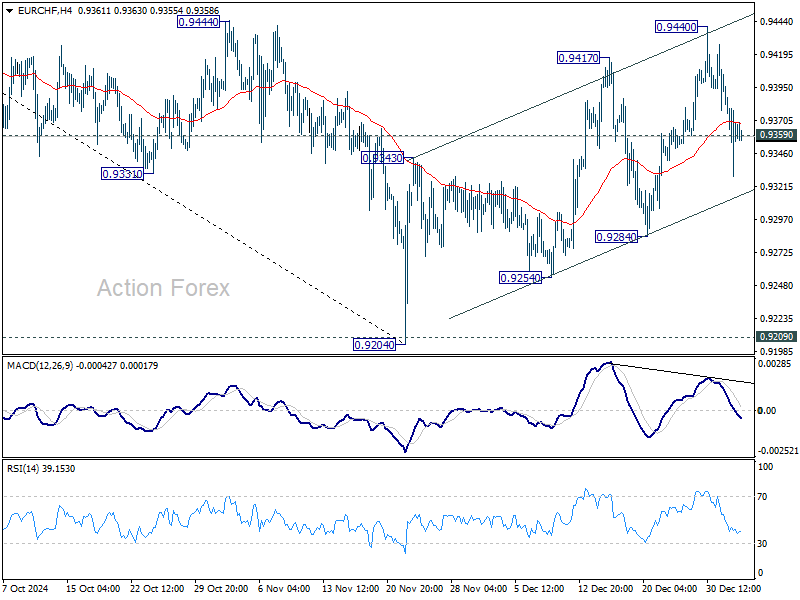
EUR/CHF continues to trade inside converging triangle and intraday bias remains neutral. On the downside, break of 0.9331 will target 0.9305 support first. Firm break there will bring retest of 0.9209 low. On the upside, break of 0.9444 will bring stronger rally to 0.9506 resistance next.
In the bigger picture, fall from 0.9928 is seen as part of the long term down trend. Repeated rejection by 55 D EMA (now at 0.9419) keeps outlook bearish for breaking through 0.9209 low at a later stage. Nevertheless, sustained trading above 55 D EMA will confirm medium term bottoming at 0.9209 and bring stronger rebound back towards 0.9928 key resistance.