Sample Category Title
Switzerland’s Real Retail Sales Dropped In May, SVME–PMI Jumped In June
For the 24 hours to 23:00 GMT, the USD rose 0.46% against the CHF and closed at 0.9635.
On the data front, Switzerland's real retail sales slid 0.3% on an annual basis in May, after recording a revised drop of 0.9% in the previous month. On the other hand, the nation's SVME manufacturing PMI rose more-than-anticipated to a level of 60.1 in June, compared to market expectations of a rise to a level of 56.3.
In the prior month, the PMI had registered a reading of 55.6. In the Asian session, at GMT0300, the pair is trading at 0.9635, with the USD trading flat against the CHF from yesterday's close.
The pair is expected to find support at 0.9600, and a fall through could take it to the next support level of 0.9566. The pair is expected to find its first resistance at 0.9656, and a rise through could take it to the next resistance level of 0.9678.
The currency pair is showing convergence with its 20 Hr moving average and trading above its 50 Hr moving average.

Loonie Trading Higher, Ahead Of Canada’s Manufacturing PMI Data
For the 24 hours to 23:00 GMT, the USD rose 0.23% against the CAD and closed at 1.3005.
In the Asian session, at GMT0300, the pair is trading at 1.2993, with the USD trading 0.09% lower against the CAD from yesterday's close.
The pair is expected to find support at 1.2967, and a fall through could take it to the next support level of 1.2942. The pair is expected to find its first resistance at 1.3016, and a rise through could take it to the next resistance level of 1.3040.
Ahead in the day, traders would focus on Canada's Markit manufacturing PMI for June, to gauge strength in the nation's manufacturing sector.
The currency pair is showing convergence with its 20 Hr and 50 Hr moving averages.

(RBA) Statement by Philip Lowe, Governor: Monetary Policy Decision
At its meeting today, the Board decided to leave the cash rate unchanged at 1.50 per cent.
The broad-based pick-up in the global economy is continuing. Labour markets have tightened further in many countries and forecasts for global growth have been revised up since last year. Above-trend growth is expected in a number of advanced economies, although uncertainties remain. In China, growth is being supported by increased spending on infrastructure and property construction, with the high level of debt continuing to present a medium-term risk. The rise in commodity prices over the past year has boosted Australia's national income.
Headline inflation rates, having moved higher over the past year, have declined recently in response to lower oil prices. Wage growth remains subdued in most countries, as does core inflation. Further increases in US interest rates are expected and there is no longer an expectation of additional monetary easing in other major economies. Financial markets have been functioning effectively and volatility has been low.
As expected, GDP growth slowed in the March quarter, partly reflecting temporary factors. The Australian economy is expected to strengthen gradually, with the transition to lower levels of mining investment following the mining investment boom almost complete. Business conditions have improved and capacity utilisation has increased. Business investment has picked up in those parts of the country not directly affected by the decline in mining investment. At the same time, consumption growth remains subdued, reflecting slow growth in real wages and high levels of household debt.
Indicators of the labour market remain mixed. Employment growth has been stronger over recent months. The various forward-looking indicators point to continued growth in employment over the period ahead. Wage growth remains low, however, and this is likely to continue for a while yet. Inflation is expected to increase gradually as the economy strengthens.
The outlook continues to be supported by the low level of interest rates. The depreciation of the exchange rate since 2013 has also assisted the economy in its transition following the mining investment boom. An appreciating exchange rate would complicate this adjustment.
Conditions in the housing market vary considerably around the country. Housing prices have been rising briskly in some markets, although there are some signs that these conditions are starting to ease. In some other markets, prices are declining. In the eastern capital cities, a considerable additional supply of apartments is scheduled to come on stream over the next couple of years. Rent increases are the slowest for two decades. Growth in housing debt has outpaced the slow growth in household incomes. The recent supervisory measures should help address the risks associated with high and rising levels of household indebtedness. Lenders have also announced increases in mortgage rates for investor and interest-only loans.
Taking account of the available information, the Board judged that holding the stance of monetary policy unchanged at this meeting would be consistent with sustainable growth in the economy and achieving the inflation target over time.
Elliott Wave View: EURJPY Ending Impulse
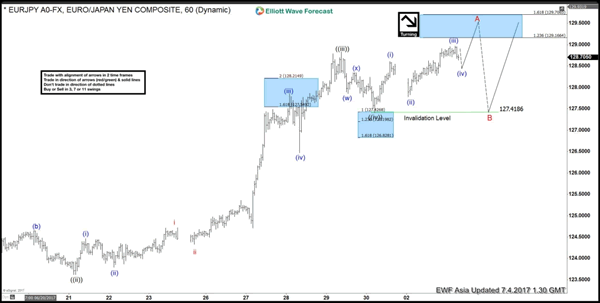
Short term EURJPY Elliott Wave view suggests the decline to 122.35 on 6/15 low ended Intermediate wave (X). Rally from there is unfolding as an impulse Elliott Wave structure with extension. This 5 wave move could be Minor wave A of an Elliott wave zigzag structure structure, where Minute wave ((i)) ended at 124.46 and Minute wave ((ii)) ended at 123.62. Minute wave ((iii)) ended at 127.84, Minute wave ((iv)) at 126.46 and Minute wave ((v)) of A is in progress towards 129.16 – 129.7.
Near term, while pair stays above 127.41, expect further upside towards the mentioned target. Afterwards, pair should pull back in larger degree 7 or 11 swings to correct cycle from 6/15 low before the rally resumes again. We don’t like selling the Index and expect buyers to appear after 7 or 11 swings pull back for extension higher. This view remains valid as far as pivot at 6/15 low 122.35 remains intact.
EURJPY 1 Hour Elliott Wave Chart
Daily Technical Analysis: EURUSD, GBPUSD, USDJPY, USDCHF
EURUSD
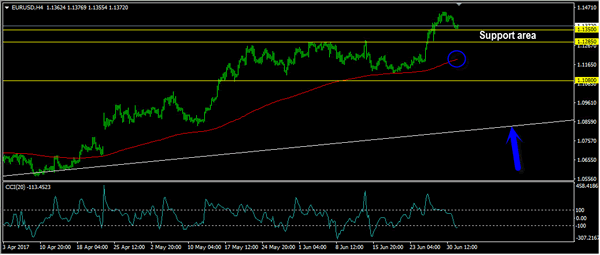
The EURUSD was corrected lower yesterday bottomed at 1.1355. The bias is neutral in nearest term probably with a little bearish bias testing 1.1285 area but overall I remain bullish and any downside pullback should be seen as a good opportunity to buy. Immediate resistance is seen around 1.1425. A clear break and daily close above that area could end the bearish correction phase testing 1.1500 – 1.1530 region. On the downside, a clear break and daily close back below 1.1285 would expose 1.1180 region but key support remains at 1.1080.
GBPUSD
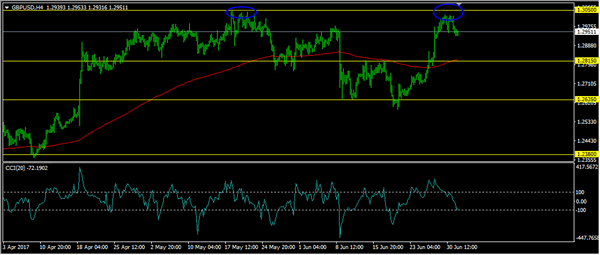
The GBPUSD had a bearish momentum yesterday bottomed at 1.2932. It’s clear to me that price respects 1.3050 key resistance which need to be clearly broken to the upside to activate my bullish mode. The bias is bearish in nearest term testing 1.2900 – 1.2875 area. Immediate resistance is seen around 1.3000. A clear break above that area could trigger further bullish pressure retesting 1.3050 key resistance. On the downside, a clear break and daily close back below 1.2875 would expose 1.2815/00 region.
USDJPY
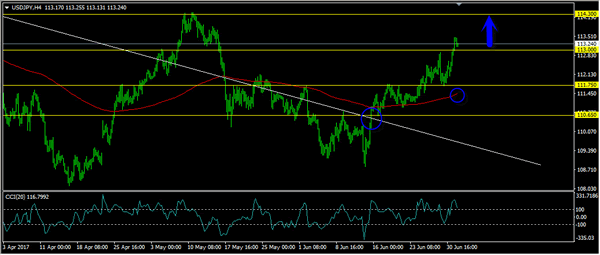
The USDJPY continued its bullish momentum yesterday topped at 113.47. The bias is bullish in nearest term testing 114.30 region. Immediate support is seen around 112.60. A clear break below that area could lead price to neutral zone in nearest term testing 112.00 region but overall I remain bullish and any downside pullback should be seen as a good opportunity to buy. On the upside, a clear break and daily close above 114.30 would expose 115.50 region this week.
USDCHF
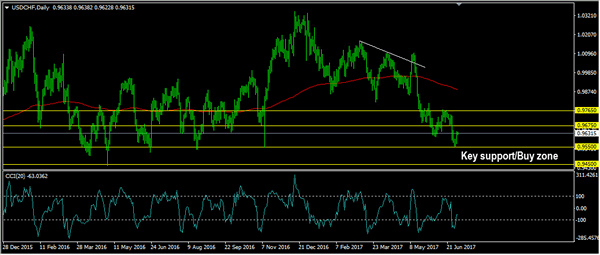
The USDCHF was corrected higher yesterday topped at 0.9642. The bias is bullish in nearest term testing 0.9675. A clear break above that area could trigger further bullish pressure testing 0.9765. Immediate support is seen around 0.9600. A clear break below that area could lead price to neutral zone in nearest term testing 0.9550 – 0.9450 key support area which remains a good place to buy with a tight stop loss below 0.9450 as a clear break below that area would expose 0.9250 region.
Market Morning Briefing: Aussie Has Registered A Low At 0.7641
STOCKS
Almost all major indices except Shanghai have seen a sharp up move yesterday, contrary to our expectation that the corrective phase may continue for some more time.
Dow (21479.27, +0.61%) rose sharply yesterday coming up almost 130points to test the crucial resistance near 21500-22000. We need a confirmed break above 22000 to further continue the rally upwards; else the current rise could be considered as an initiation of false hope for the near term and the index may come off again in the next few sessions.
Dax (12475.31, +1.22%) bounced back to levels above 12400 and while it remains above 12400, we may expect a rise back towards 12600 levels. But in case it fails to sustain above 12400 just now, we would have to consider a fall towards 12000 in the medium term.
Shanghai (3182.16, -0.43%) came off yesterday to close at lower levels. A test of 3160 on the downside still seems possible in the near term but could be delayed if the index remains sideways for a few more sessions.
Nikkei (20141.21, +0.43%) opened with a gap up but is trading low. A rise towards 20300 is possible in the next couple of sessions. .
Nifty (9615.00, +0.99%)closed at important levels yesterday. Only if it manages to rise past 9615-9625 zone and sustains, can we consider that the immediate correction might be over and target levels near 9700-9800 for the near term. A fall back from 9615-9625 region, if seen (less preferred) could see a fall back towards 9500. Today’s movement could decide the further course of direction.
COMMODITIES
Crucial support of 1230 had been broken and Gold (1222) is trading within the range of 1190-1230. In the smaller time frame, Gold is oversold and needs a pause before attempting sub 1193 levels. But we will remain bearish while Gold is trading below 1250 levels.As we had mentioned yesterday" A failure to rise above 16.70 levels may trigger a sharp fall towards 16.20 regions", we have seen that Silver (15.98) had collapsed. The scrip is also oversold in near term time frame with an immediate trading range of 15.50-16.20 and the overall bias will remain bearish while it is trading below 16.50 levels.
Copper (2.66) failed to move higher due to its overbought condition and trading within the range of 2.66-2.78. It could fall further towards 2.55 levels, which is a strong area of support.
There is 30-35% probability that Brent (47.92) and WTI (46.25) could rise a bit more towards 50 and 48 regions respectively but this recent bounce hasn’t affected their midterm bearishness much. We think that the immediate resistances of 50 (Brent) and 48 (WTI) are expected to hold as the they are in overbought territory and may see range trade between 46-50 in Brent and 44-48 in WTI, but a failure to hold above 46 and 44 may push them towards 43 and 40 levels respectively. We have U.S weekly crude oil inventory data tomorrow, which could be a decisive factor to determine the future course of action.
FOREX
We expect Dollar to stage a turnaround to the upside soon but we are still waiting for confirmation. Till now, most of the majors are in a normal correction and further break of major supports are required before the downtrend can be confirmed.
With Euro (1.1367) weakening after failing to rally above 1.1450-70, the expected bounce in Dollar Index (96.15) has materialized but the major weakness of Euro still needs a confirmation in the form of a break below the support area of 1.1320-1.1290 and the confirmation of Dollar strength comes on a break above the resistance of 96.50-65. Please note, as long as the support of 95.50 holds, the chances of Dollar rising further remains strong.
Dollar Yen (113.22) has not only met our upside target of 113.00 but rallied above it. If it can sustain above 113.00-112.60 for a couple of sessions, then the rally may extend to 114.30-115.00.
Pound (1.2943) has corrected from 1.3029, very close to the 10-month high of 1.3047 but the larger uptrend may weaken only below 1.2880. Till then, the current decline remains just a normal correction.
Aussie (0.7670) has registered a low at 0.7641, close to our downside target of 0.7630. It remains in a normal correction and if it manages to stay above 0.7630-20, then it may retest the long term resistance band of 0.7700-0.7800 which is expected to hold. The RBA policy announcement today may determine the near term path.
Contrary to expectations, Dollar Rupee (64.88) rallied and closed above the resistance of 64.80. if 64.80 holds in the next couple of sessions, then 65.00-20 may be tested in the next few sessions. Immediate support at 64.60-55.
INTEREST RATES
The US yields have risen sharply. The 5Yr (1.93%), 10Yr (2.35%) and the 30YR (2.87%) are all up from previous levels near 1.89%, 2.30% and 2.84% respectively. The 30Yr is heading towards resistance near 2.9% while the 10YR could rise to 2.4% before coming off again by the end of the week.
The US-Japan 10YR (2.26%) has risen sharply and could pull up Dollar Yen to higher levels in the near term if the yield spread continues to rise towards 2.3% and higher.
The German-US 2Yr (-2.01%) and the 10Yr (-1.87%) have come off as expected bringing down Euro with itself. The yield spreads look bearish for the coming sessions.
SPI200 Old Top Forms New Resistance
We had been looking to trade around this SPI200 top, that has since been chopped through.
What has caught my eye today however is the way that price has tucked back underneath the level as resistance once again. This has essentially reactivated the old level and even though it has been broken in between, becomes just as significant as if it was a cleanly tested level.
SPI 200 Daily:
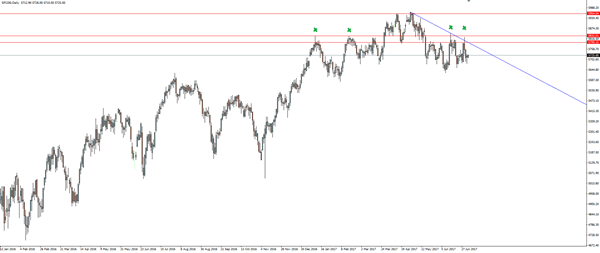
As you can see, price has once again held here at the green 'x', giving us an opportunity to try to build a short position. Zoom into the intraday charts and try to identify pullbacks into previous short term support that could be used as resistance. If that doesn't do it for you, then take a step back and I'm sure you can find a head and shoulders pattern of a four armed man.
USD: The Comeback Kid
The US came back from the dead as Tuesday's independence day celebrations came a day early for the US dollar bulls
After yesterday's innocuous Asia session the USD turned bid en masse as the Pound gave way on the weaker UK manufacturing PMI. The weaker print makes a case for the data not supporting the Bank of England hawkish tilt.
And USDJPY bounced after a stronger than expected Tankan survey attenuated any lingering fallout from the LDB trouncing in the July 2 Tokyo metropolitan assembly election.But it was the robust US ISM data which propelled USDJPY above the critical 113 level fueled by rising US Treasury yields all but supporting the current Fed narrative to look through the recent US economic soft patch
In US equity markets, the Dow posted a new record backed by energy stocks while the Nasdaq fell as sector rotation out of tech -stock lingers. The tech sector has reaped the benefits of the low-interest rate low volatility environment, and with the real prospects of rising US interest rates, tech investors are feeling the pain
On commodity markets, Oil prices had a buoyant overnight session as WTI prices didn't look back from the opening bell on US futures. Some dated headlines in circulation but I suspect the primary catalyst is the US rig count posted its first weekly fall since January fuelling speculation that the rigorous supply of oil from US shale oil producers is not sustainable below $45.00 per barrel
The lustre came off gold overnight in a big way on the stronger US dollar narrative driven by the expectancy of higher US interest rates.
However, the big story on currency markets remains the shifting central bank policy narrative. We've seen an aggressive pullback from last week's speculative bets fuelled by the hawkish chorus of central bankers. The USD recovered in part due to the ISM manufacturing report which surprised with the highest print since August 2014. But concerns that central banks may temper the hawkish lean for fear of creating unwanted volatility remain in the back of traders minds. Overnight the mystery sources from the ECB were back at it again hitting the airwaves stating ECB officials were “unnerved” by the market's reaction to Draghi's speech. I think it's safe to say the ECB members are scared of their hawkish shadow and may try to reel in the markets overzealous reaction to Draghi's Sintra comments. But headlines aside, the ECB has opened the door to tightening it's a matter of how wide they're willing to leave it ajar.
There will be no rest for the weary on the central bank narrative as the RBA, the Riksbank warrant considerable attention and are likely to keep traders hoping despite the US holiday-thinned trading conditions
Gold Slide Continues As US Manufacturing PMI Sparkles
Gold has started the week with considerable losses. Spot gold is trading at $1222.08 per ounce, down 1.56% on the day. On the release front, today’s key event is ISM Manufacturing PMI. The index climbed to 57.8 in June, beating the estimate of 55.0. On Tuesday, US markets are closed for the Fourth of July holiday.
Gold prices continue to sag, and the metal dropped to $1220 earlier in the day, its lowest level since May 11. Gold is down 4.4% since Thursday, when the metal appeared headed to break above the symbolic $1300 level. The week started with good news from the manufacturing sector, as ISM Manufacturing PMI improved to 57.8, its highest level since November 2014. Global economic conditions have improved, and a stronger demand for US exports has boosted the manufacturing sector.
The US economy did indeed slow down in the first quarter, but the downturn was not as bad as feared. On Thursday, revised GDP reading was raised to 1.4%, better than the initial estimate of 1.2% in May. The improvement was attributed to stronger consumer spending and an increase in exports. Earlier in the year, the markets were braced for a very poor quarter, with the first estimate in April projecting a gain of only 0.7%. Inflation remains stubbornly low, and consumer spending is also soft, despite high consumer confidence levels. In May, Personal Spending softened to 0.1%, down from 0.4% a month earlier. If inflation levels don’t show some improvement, the Federal Reserve may have second thoughts about a December rate hike.
ISM Manufacturing Index Jumps to 3-Year High in June
Factories indicate that production was strong in June, and the orders pipeline suggests that production will remain solid in coming months. Cost pressures appear to have eased recently.
Subcomponents of Index Signal Strength in Coming Months
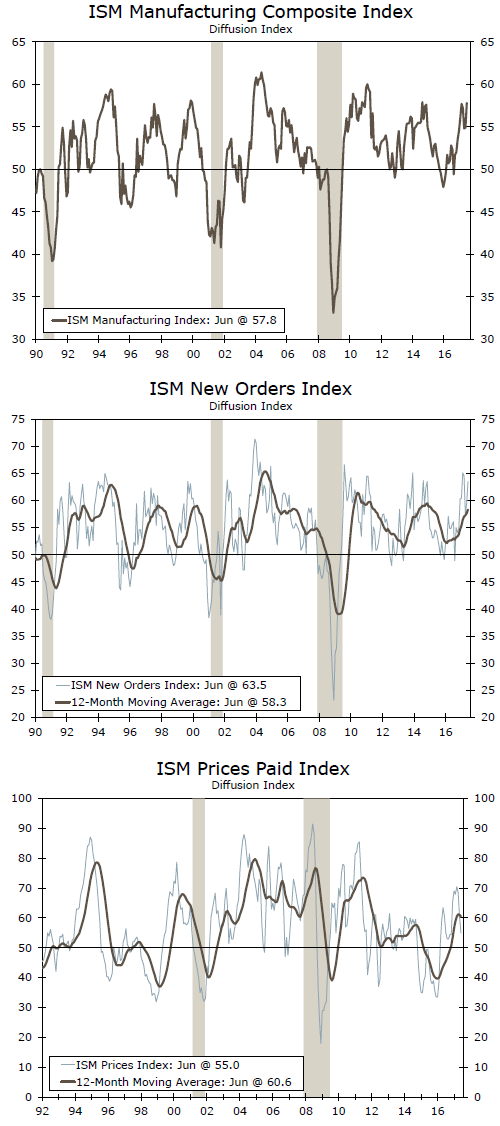
The ISM manufacturing index jumped from 54.9 in May to 57.8 in June (top chart). Not only was the headline index much stronger than expected - the consensus had centered on a reading of 55.3 - but the outturn marked the tenth consecutive month in which the index has been above the demarcation line separating expansion from contraction. It was also the highest reading in the index since August 2014.
Drilling down reveals broad based strength in the factory sector in the subcomponents that measure the current state of the sector. For starters, the production subcomponent rose to 62.4 from 57.1. Fourteen industries reported growth in production in June, while only two industries (apparel, leather & allied products and textile mills) indicated that production declined last month. In addition, the employment subcomponent of the overall index rose to a 3-month high of 57.2 in June. The outturns on these subcomponents mean that manufacturing production likely rebounded in June from the 0.4 percent monthly decline that it registered in May.
Moreover, the forward-looking indicators also were strong, suggesting that manufacturing production should continue to expand in coming months. The subcomponents measuring new orders rose from an already strong reading of 59.5 in May to 63.5 in June (middle chart). Foreign sources of demand contributed to the overall strength in orders as the new export orders subcomponent came in at 59.5 in June. Not only did factories report a strong stream of new orders, but their orders backlog is also quite robust. (The "backlog of orders" subcomponent increased from 55.0 in May to 57.0 in June.) The decline in the inventories subcomponent to 49.0 in June is also "good news" for production going forward. That is, factories may need to rebuild inventories in coming months.
Cost Pressures Appear to Have Eased
Rising commodity prices earlier this year had led to some cost pressures in the nation's factory sector. However, the "prices paid" subcomponent fell to a 7-month low of 55.0 in June (bottom chart) This drop in the index is consistent with recent behavior in many commodity prices, which have moved more or less sideways over the past few months. Petroleum prices moved significantly lower in June.
The only caveat we would note to the generally upbeat news from this morning's ISM report is that the index has tended to overstate strength in the factory sector in recent years. For example, manufacturing production was up 1.4 percent on a year-ago basis in May, a solid number to be sure but hardly a "boom." That said, the index generally does a good job of telegraphing the direction of change. Therefore, we would look for activity in the factory sector to pick up in coming months.