

Sample Category Title
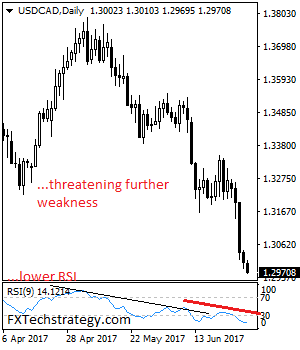
USDCAD Bearish, Weakens Further
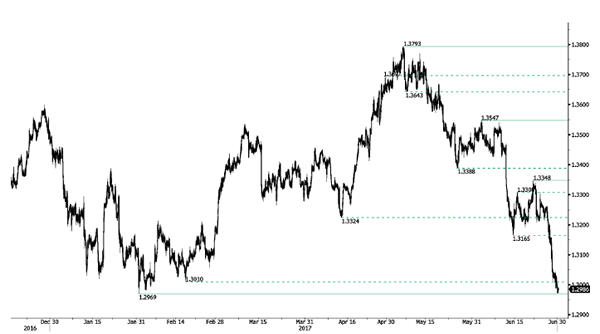
USDCAD: The pair continues to weaken extending further on Friday and opening the door more declines. Support stands at the 1.2950 level where a break will aim at the 1.2900 level. Further down, support comes in at the 1.2850 level where a turn lower may occur. But if further weakness is triggered support comes in at the 1.2800 level. Its daily RSI is bearish and pointing lower suggesting further weakness. Conversely, resistance lies at the 1.3050 level where a violation will target the 1.3100 level. Further up, resistance resides at the 1.3150 level and then the 1.3200 level. All in all, USDCAD looks to weaken further.
Market Update – European Session: European Bonds Rebound On Month End Flows As Eurozone CPI Comes In Line With...
Notes/Observations
European June CPI nudges lower month on month but in line with forecasts, whilst French CPI was flat
German Unemployment rises for the first time in 8 months
Germany 10 year Bund trades at 6 week lows before retracing sharply on short covering flows.
Overnight
Asia:
China official PMIs hit 3-month high
Japan core CPI reaches 2-year high and recorded the fifth monthly increase, Industrial Output fell at fastest pace since Mar 2011.
South Korea President Moon and US President Trump promise to make joint efforts to denuclearize North Korea
Europe:
Eurozone Flash CPI comes in line with forecasts but dips slightly from the prior month, French prelim CPI flat y/y.
German unemployment recorded first rise in 8 months and 2nd rise in the past 14 months while unemployment rate remained unchanged.
Bayer shares fall sharply after announcing it expects negative earnings impact from Its Brazilian Crop Science Business
BoE Haldane noted policy makers are watching for signs of wage growth pickup, reiterates any policy tightening will be limited & gradual
UK consumer confidence hits 11 month low with higher inflation and weaker wage growth cited
Americas:
Fed's Bullard (non-voter, dovish): Sees more sympathy at the Fed for view that inflation is not coming back to target as quick as first thought
Economic Data
(EU) EURO ZONE JUN CPI ESTIMATE Y/Y: 1.3% V 1.3%E; CPI CORE Y/Y: 1.1% V 1.0%E
(DE) GERMANY JUN UNEMPLOYMENT CHANGE: +7K V -10KE; UNEMPLOYMENT RATE: 5.7%E V 5.7%E (First rise in unemployment in 8 months)
(DE) GERMANY MAY RETAIL SALES M/M: 0.5% V 0.3%E; Y/Y: 4.8% V 2.8%E
(FR) FRANCE JUN PRELIMINARY CPI M/M: 0.0% V 0.0%E; Y/Y: 0.7% V 0.7%E
(UK) JUNE GFK CONSUMER CONFIDENCE: -10 V -7E (11-month low)
(UK) Q1 FINAL GDP Q/Q: 0.2% V 0.2%E; Y/Y: 2.0% V 2.0%E
(UK) Q1 FINAL TOTAL BUSINESS INVESTMENT Q/Q: 0.6% V 0.6% PRELIM; Y/Y: 0.7% V 0.8% PRELIM
(CH) SWISS JUN KOF LEADING INDICATOR: 105.5 V 102.2E
(NO) NORWAY JUN UNEMPLOYMENT RATE: 2.6% V 2.6%E
(AT) Austria May PPI M/M: -0.4% v 0.2% prior; Y/Y: 2.0% v 2.8% prior
(NO) Norway May Retail Sales W/Auto Fuel M/M: 1.3% v 0.0%e
Fixed Income Issuance:
(IT) ITALY DEBT AGENCY (TESORO) SELLS TOTAL OF €6.35B V €5.5-6.5B INDICATED IN 5-YEAR AND 10-YEAR BTP BONDS
SPEAKERS/FIXED INCOME/FX/COMMODITIES/ERRATUM
Equities
Indices [Stoxx50 +0.3% at 3,479, FTSE -0.1% at 7,343, DAX +0.2% at 12,438, CAC-40 +0.4% at 5,178, IBEX-35 +0.3% at 10,559, FTSE MIB +0.3% at 20,766, SMI +0.3% at 8,975, S&P 500 Futures +0.1%]
Market Focal Points/Key Themes: European stocks opened down in line with Asia, but rebounded during the session; more hawkish tone from central bankers kept sentiment depressed; oil continued to support energy stocks; German healthcare sector dragged down by Bayer; UK stocks weighed down by strong pound; Delivery Hero debuts at €26.90/shr; attention shifting to core PCE deflator out later today; few companies reporting in US session with Kingtone and Terraform
Equities
Consumer discretionary [Technicolor TCH.FR -8.4% (cuts outlook), Trinity Mirror (TNI.UK) +5.8% (trading update), Adidas ADS.DE +3.3% (Nike reported)]
Energy [Vopak VPK.NL -2.3% (analyst action)]
Healthcare [Bayer BAYN.DE -3.9%, (cuts outlook)]
Financials [Uniplol UNI.IT +2.9% (restructuring)]
Industrials [Subsea 7 SUBC.NO +2.5% (acquisition)]
Materials [Polyus Gold PGIL.UK -1.3% (placement)
Technology [Soitec SOIT.FR +0.3% (placement)]
Speakers
Non seen
Currencies
EURUSD trades below 1.14 giving back some ground after the recent strong run up this week as prelim Eurozone CPI came in line with forecasts, EURYEN slips to new daily low trading below 127.50.
GBPUSD falls after the UK current account widened in the first quarter, falling to 1.2984 with immediate support seen at 1.2975.
Fixed Income
Bund futures trade at 162.51 up 34 ticks bouncing sharply of 161.88 which marked new 6 week lows as the downward momentum continued. The bounce higher has been put down to short covering with continued upside eyeing 162.58, a move lower looks to retest 161.88.
Friday’s liquidity report showed Thursday’s excess liquidity fell to €1.612T a fall of €22B from €1.634T prior. Use of the marginal lending facility rose to €126M from €100M prior.
Corporate issuance was quiet entering into the US holidays. Issuance for the first 6 months of the year posted a record high of 718.7B slightly ahead of the $718.2B posted in 2015. January was the biggest month with over $176B.
For the week ending June 28th, Lipper US Fund flows reported IG funds net inflows of $724.3M bringing YTD inflows to $66.6B, High Yield funds reported outflows of $1.74B bringing YTD outflows to $6.57B.
Looking Ahead
05:30 (SL) Sri Lanka Jun CPI Y/Y: No est v 6.0% prior
06:00 (PT) Portugal May Retail sales M/M: No est v 1.5% prior; Y/Y: No est v 4.9% prior
06:00 (PT) Portugal May Industrial Production M/M: No est v 0.2% prior; Y/Y: No est v -1.2% prior
07:30 (IN) India Weekly Forex Reserves
08:00 (PL) Poland Jun Preliminary CPI M/M: 0.1%e v 0.0% prior; Y/Y: 1.9%e v 1.9% prior
08:00 (BR) Brazil May National Unemployment Rate: 13.7%e v 13.6% prior
08:00 (ZA) South Africa May Trade Balance (ZAR): No est v 5.1B prior
08:00 (ZA) South Africa May Budget Balance (ZAR): No est v -30.7B prior
08:15 (UK) Baltic Dry Bulk Index
08:30 (US) May Personal Income: 0.3%e v 0.4% prior; Personal Spending: 0.1%e v 0.4% prior, Real Personal Spending (PCE): 0.2%e v 0.2% prior
08:30 (US) May PCE Deflator M/M: -0.1%e v 0.2% prior; Y/Y: 1.5%e v 1.7% prior
08:30 (US) May PCE Core M/M: 0.0%e v 0.2% prior; Y/Y: 1.4%e v 1.5% prior
08:30 (CA) Canada Apr GDP M/M: No est v 0.5% prior; Y/Y: No est v 3.2% prior
08:30 (CA) Canada May Industrial Product Price M/M: No est v 0.6% prior; Raw Materials Price Index M/M: No est v 1.6% prior
09:00 (RU) Russia Q1 Final Current Account: No est v $22.8B prior
09:00 (CL) Chile May Unemployment Rate: No est v 6.7% prior
09:00 (CL) Chile May Manufacturing Production Y/Y: No est v -7.5% prior, Industrial Production Y/Y: No est v -4.2% prior
09:00 (CL) Chile May Total Copper Production: No est v 429.2K prior
09:30 (BR) Brazil May Primary Budget Balance (BRL): No est v 13.0B prior; Nominal Budget Balance: NO est v -15.4B prior, Net Debt % GDP: No est v 47.7% prior
09:45 (US) Jun Chicago Purchasing Manager: 58.0e v 59.4 prior
10:00 (MX) Mexico May Net Outstanding Loans (MXN): No est v 3.73T prior
10:00 (US) June Final Michigan Confidence: 94.5e v 94.5 prelim
10:30 (CA) Bank of Canada (BOC) Q2 Senior Loan Officer Survey: No est v -1.9 prior; Business Outlook Future Sales: No est v 21 prior
11:00 (CO) Colombia May Urban Unemployment Rate: 10.2%e v 10.7% prior; National Unemployment: No est v 8.9% prior
13:00 (US) Weekly Baker Hughes Rig Count data
15:00 (CO) Colombia Central Bank Interest Rate Decision: Expected to cut Overnight Lending Rate by 50bps to 5.75%
GOLD Sideways, SILVER Bullish Bounce Fades, CRUDE OIL Continued Bullish Consolidation.
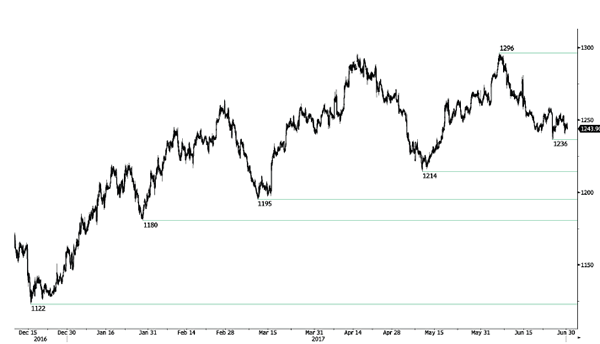
GOLD Sideways.
Gold's is trading sideways above key support. Hourly support is located at 1236 (26/06/2017 low). Stronger support is given at 1214 (09/05/2017 low). Hourly resistance can be found at 1247 (intraday high) then 1258 (23/06/2017 high). Expected to show renewed bullish pressures.
In the long-term, the technical structure suggests that there is a growing upside momentum. A break of 1392 (17/03/2014) is necessary ton confirm it, A major support can be found at 1045 (05/02/2010 low).
SILVER Bullish bounce fades.
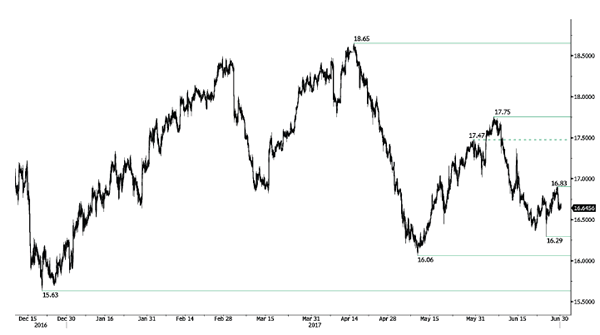
Silver's bullish bounce quickly faded. Closest support is given at 16.29 (26/06/2017 low). Strong support is given at 16.06 (09/05/2017 low). Key resistance is given at a distance at 17.75 (06/06/2017 high). The road seems wide open for further decline.
In the long-term, the death cross indicates that further downsides are very likely. Resistance is located at 25.11 (28/08/2013 high). Strong support can be found at 11.75 (20/04/2009).
CRUDE OIL Continued bullish consolidation.
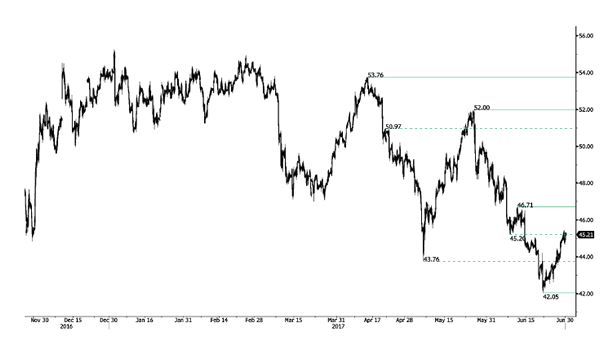
Crude oil is now consolidating higher since the commodity hit 11-month low. Support is given at 42.05 (21/06/2017 low). Expected to show renewed weakness.
In the long-term, crude oil has recovered after its sharp decline last year. However, we consider that further weakness are very likely. Strong support lies at 35.24 (05/04/2016) while resistance can now be found at 55.24 (03/01/2017 high).
EUR/JPY Bullish Consolidation, EUR/GBP Selling Pressure Increases, EUR/CHF Recovery Gains Strength.
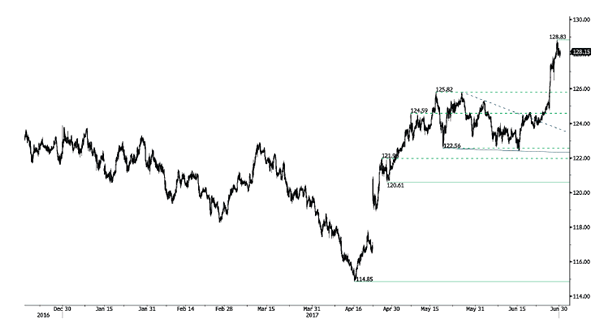
EUR/JPY Bullish consolidation.
EUR/JPY is now consolidating after its recent rally. Key resistance is located at 128.83 (30/06/2017). Hourly support can be found at 127.10 (30/06/2017). Next support is given at 122.56 (18/05/2017 low). Further upside is favored.
In the longer term, the technical structure validates a medium-term succession of lower highs and lower lows. As a result, the resistance at 149.78 (08/12/2014 high) has likely marked the end of the rise that started in July 2012. Strong support at 94.12 (24/07/2012 low) looks nonetheless far away.
EUR/GBP Selling pressure increases.
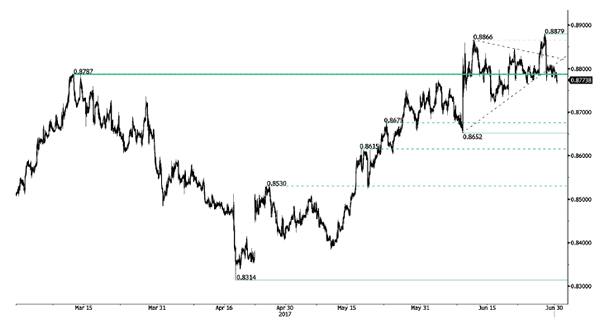
EUR/GBP has broken downtrend resistance triggering a move towards 1.0987. Hourly support can be located at Support can be found at 0.8652 (08/06/2017 low). Expected to show further consolidation.
In the long-term, the pair has largely recovered from recent lows in 2015. The technical structure suggests a growing upside momentum. The pair is trading above from its 200 DMA. Strong resistance can be found at 0.9500 psychological level
EUR/CHF Recovery gains strength.
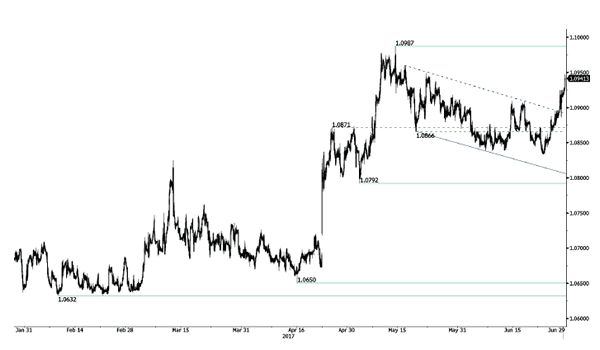
EUR/CHF's short-term bullish pressures are definitely on after clear break of downtrend channel. Hourly support is located at a distance at 1.0792 (03/05/2017 low) while the pair is heading towards resistance given at 1.0987 (12/05/2017 high).
In the longer term, the technical structure is mixed. Resistance can be found at 1.1200 (04/02/2015 high). Yet,the ECB's QE programme is likely to cause persistent selling pressures on the euro, which should weigh on EUR/CHF. Supports can be found at 1.0184 (28/01/2015 low) and 1.0082 (27/01/2015 low).
USD/CHF Weak Bounce, USD/CAD Retesting Key Support, AUD/USD Recovery Gains Strength.
USD/CHF Weak bounce.
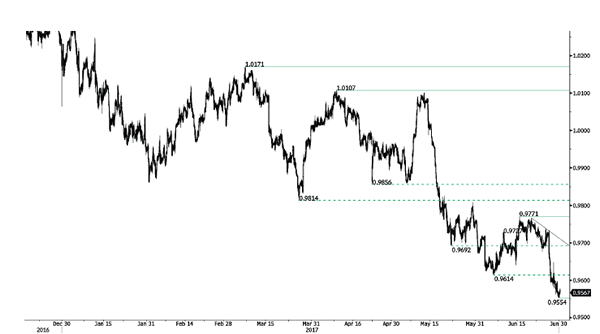
USD/CHF remains weak as long as prices remain below the key resistance at 0.9614. Hourly resistance can be found at 0.9771 (09/06/2017 high). Strong resistance is given at 1.0107 (10/04/2017 high). Hourly support is given at 0.9561 (intraday low). Expected to show continued bearish pressures.
In the long-term, the pair is still trading in range since 2011 despite some turmoil when the SNB unpegged the CHF. Key support can be found 0.8986 (30/01/2015 low). The technical structure favours nonetheless a long term bullish bias since the unpeg in January 2015.
USD/CAD Retesting key support.
USD/CAD is way into bearish mode. Strong support is given at 1.2969 (31/01/2017 low). Resistance is located at 1.3010 (02/15/2017). Expected to show continued downside pressures.
In the longer term, the pair lies in a bullish channel since a year. Strong resistance is given at 1.4690 (22/01/2016 high). Long-term support can be found at 1.2461 (16/03/2015 low)
AUD/USD Recovery gains strength.
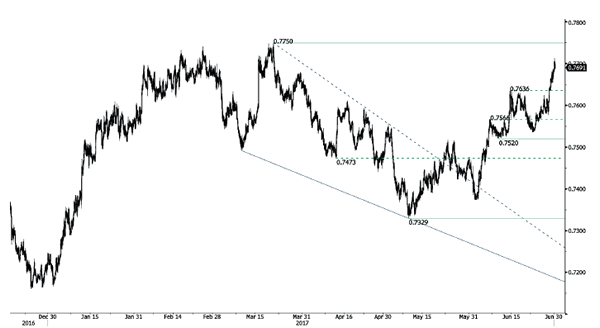
AUD/USD's technical structure is bullish since early May. Recovery bounce near the support at 0.7636 is gaining momentum. The pair is heading towards strong resistance at 0.7750 (21/03/2017 high).
In the long-term, we are waiting for further signs that the current downtrend is ending. Key supports stand at 0.6009 (31/10/2008 low) . A break of the key resistance at 0.8295 (15/01/2015 high) is needed to invalidate our long-term bearish view.
EUR/USD Bullish Conditions Remain, GBP/USD Bullish, USD/JPY Minor Correction.
EUR/USD Bullish conditions remain.
EUR/USD is now consolidating after its recent rally. The pair is trading above former strong resistance given at 1.1300 (09/11/2017 high). Hourly support can be found at 1.1076 (18/05/2017 low). Stronger support lies at 1.0842 (11/05/2017 low). Expected to show continued short-term strength.
In the longer term, the momentum is clearly negative. We favour a continued bearish bias towards parity. Key resistance holds at 1.1714 (24/08/2015 high) while strong support lies at 1.0341 (03/01/2017 low).
GBP/USD Bullish.
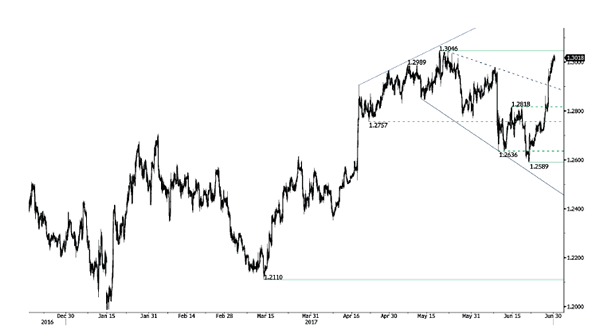
GBP/USD's momentum is higher than expected and the pair is now targeting key resistance give at 1.3046 (18/05/2017 high). Hourly support is given at 1.2589 (21/06/2017 low). Hourly resistance at 1.2818 (14/06/2017 high) has been broken. Expected to show further continued buying pressures.
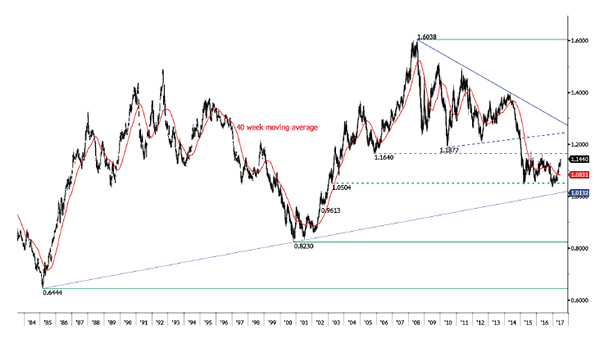
The long-term technical pattern is even more negative since the Brexit vote has paved the way for further decline. Long-term support given at 1.0520 (01/03/85) represents a decent target. Long-term resistance is given at 1.5018 (24/06/2015) and would indicate a long-term reversal in the negative trend. Yet, it is very unlikely at the moment.
USD/JPY Minor correction.
USD/JPY has pullback after strong bullish rally while remaining within an uptrend channel. Hourly support can be found at 110.65 (16/06/2017 low). Stronger support is located at 108.13 (17/04/2017 low). Expected to show continued pressures.
We favor a long-term bearish bias. Support is now given at 96.57 (10/08/2013 low). A gradual rise towards the major resistance at 135.15 (01/02/2002 high) seems absolutely unlikely. Expected to decline further support at 93.79 (13/06/2013 low).
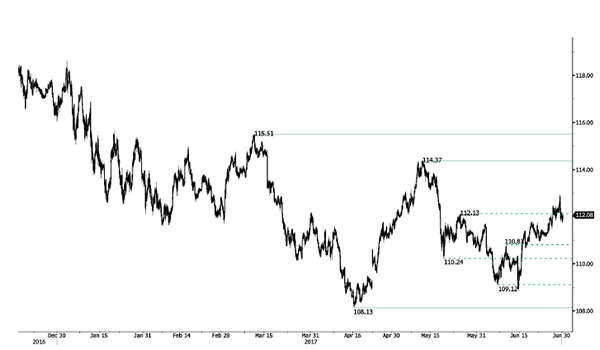
Technical Outlook: WTI OIL – further upside favored
WTI oil regained strength and is pressuring fresh two-week high at $45.43, after shallow pullback from $45.43 was contained by rising 4-hr Tenkan-sen at $44.64.
Recovery leg from $42.04 (21 June low) was boosted by data showing a decline in US oil output and along with improving technical studies and weaker dollar, keep oil price supported.
Oil is looking for strong bullish signal on close above cracked $44.91 pivot (Fibo 61.8% of $46.69/$42.04 downleg / 20SMA) which would signal bullish acceleration towards key near-term support at $46.69 (12 June lower top).
Crude oil is on track for strong bullish weekly close, the first bullish close since mid-May that also underpins bulls.
Supports at $44.91/64 are expected to hold dips and keep immediate bulls intact. Break here would risk deeper pullback and expose support at $43.73 (daily Tenkan-sen).
Res: 45.43, 45.59, 46.46, 46.69
Sup: 44.91, 44.64, 44.42, 43.73

Chinese Data Surprises To The Upside, EUR Consolidates
China data improves on domestic and external factors
Unexpectedly, China's NBS PMI surprised higher providing evidence that the China growth story remains undervalued and there is still solid external demand. China's June NBA manufacturing PMI increased to 51.7 above 51.0. The good data was driven by new orders and higher production readings. Production index increased to 54.4 from 53.4 in May while new orders rose to 53.1 from 52.3 in May.
Clearly, rumours of a domestic collapse is far from reality, as China's domestic activity remains resilient regardless of distant signals of decelerations. There has been some slowing due to softer investment activity indicating that the government's drive to shutdown areas of “shadow” banking has been effective. Chinese authorities, in our mind, are doing a decent job balancing the need to deleveraging and support the economy. Micro-tuning in credit availability will likely slow interest rate sensitive areas such as real estate and infrastructure financing but it is unlikely to derail growth broadly. We still anticipate 6.8% GDP growth for 2017.
The other bright spot of the data release was the exports orders index, which continued to improve to 52.0 - a five-year high. Solid export growth alongside general risk appetite should support investors' demand for regional EM FX currencies. From a relative value standpoint traders should be favouring Europe and Asia EM over the US. European growth has surprised to the upside, China's economy slowing is less than expected with plenty of bright spots while the US data has underperformed and political uncertainty makes outlook significantly challenging.
The euro stabilises amid sharp gains
Despite an upward shift in the German yield curve and better-than-expected inflation data (HICP printed at 1.5 y/y in June versus 1.3% median forecast) the single currency struggled to extend gains as it tumbled on the $1.1447 resistance (high from May 11th 2016).
On the short-end of the curve, German 2-year yields stabilised at -0.55% after rising more than 40bps since February. On the long-hand, 10-year yields kept on climbing higher - 0.46% compared to 0.18% in February - amid rising inflation expectation.
Indeed, the sharp pick-up in the 5y5y inflation swap forward rate (up 9bps to 1.61% in less than a week) shows that market participants have revised upwardly their inflation expectations, which naturally translated into higher nominal rates, helping the EUR to gain momentum.
In the US, the upside surprise in 1Q GDP failed to reverse the sell-off that has sent the USD to a multi-month low but it did at least help to stop the bleeding. The final revision of the first quarter GDP printed at 1.4% q/q (annualised), while personal consumption got some colour back and rose 1.1q/q (saar: seasonally adjusted annual rate). The dollar index fell to its lowest level since early November last year and hit 95.47, erasing completely the gains that followed the election of Donald Trump.
Given the quick and sharp debasement of the greenback, we think investors are eager to take those profits home and take time to reassess the situation, especially after the muddled comments from Carney and Draghi on Wednesday.
A return of EUR/USD to the 1.12 level (38.2% Fibonacci on April-June rally) cannot be ruled out; however the pair should take a pause at around 1.13 before any potential downside move. Given the recent brightening of the EU economic picture, we maintain our long EUR bias against the USD.
Swiss data improves, sell CHF
Switzerland's KOF Leading Indicator reversed the prior month’s weak read surging to 105.5 (from 102.0 in May). The jump nearly covered last month’s decline and highlighted that the upwards trend indicates near term outlook remains solid. This recovery should help alleviate some concern that the Swiss economy was decelerating quicker due to the stronger CHF. The strongest drive was manufacturing, which offset some of the negative pull of construction. As discussed in the piece on China, stronger external demand helped improve the Swiss outlook around incoming orders.
We suspect that the improvement in sentiment around business climate and competitiveness can be traced to the slightly weaker CHF against the Euro. Improvement in growth and low political uncertainty has sent capital back into Europe allowing the SNB to decelerate FX intervention preventing CHF appreciation.
We remain bearish on the CHF as the SNB monetary policy is not likely to shift any time soon while ECB, Fed and members of the BoE have increasingly signaled moves toward “normalisation” and tighter policy. We view the GBPCHF as the best way to manifest this policy divergent view.
Queen’s Speech Passes, May Stays As UK PM
Yesterday, the UK House of Commons voted in favor of the Queen's Speech by a majority of 14 MPs. This implies that Theresa May will remain as the UK Prime Minister and that she will be the one managing the Brexit negotiations. However, we must note that May will now be in charge of a minority government with a slim majority in Parliament, which implies that her position is fragile and that she could be politically paralyzed at any time by just a few rebellious Conservative MPs, or a potential mutiny by the DUP. The reaction in sterling on the vote was relatively muted, possibly because this outcome was widely anticipated by markets.
With UK domestic political uncertainty now dissipating somewhat, the focus is likely to turn to headlines surrounding the Brexit negotiations, as well as monetary policy developments. In our view, the short-term outlook for GBP is cautiously positive, mainly due to all of the attention a potential rate hike by the BoE has attracted recently. Further signs in the next weeks that a policy move may be on the cards this year could work in favor of the pound. What might add fuel to such speculation? From a data perspective, solid PMIs for June that are due out next week and/or a potential pickup in wage growth prints that we will get the week after. In addition, any hawkish comments from the two BoE MPC members that have not expressed their views recently (Broadbent and Vlieghe) could suggest that the hawks currently outnumber the doves within the MPC.
EUR/GBP traded in a consolidative manner on Thursday, staying supported by the 0.8775 (S1) barrier. On Wednesday, the pair failed to overcome the 0.8870 (R2) obstacle and following Carney's hawkish remarks, it fell below the short-term uptrend line taken from the low of the 10th of May. Therefore, we switch our view to flat for now. The pair shows signs that it may be establishing a sideways range between the 0.8870 (R2) resistance and the 0.8715 (S2). If the pair falls below its current support of 0.8775 (S1), then we may experience extensions towards the lower bound of the range, at 0.8715 (S2).
Nevertheless, a break below 0.8715 (S2) is needed to confirm a forthcoming lower low on the 4-hour chart and signal a short-term trend reversal.
The economic calendar is packed today:
From Eurozone, we get preliminary CPI data for June. The forecast is for the headline rate to have ticked down, but for the core rate to have held steady. We see the case for an upside surprise in the headline rate, considering that Germany's rate actually rose, against expectations of declining. Even though such a positive surprise could support EUR a bit, given that the ECB has repeatedly indicated it is “looking through” changes in the headline print, we think markets will focus primarily on any surprise in the core print.
In the UK, the final GDP for Q1 is due out, and expectations are for the final print to confirm the 2nd estimate. In its latest meeting minutes though, the BoE anticipated the final print to be revised up. If this is indeed the case, it may enhance somewhat the case for a BoE rate hike by the end of the year and thereby, support sterling.
From the US, we get personal income and spending data for May. Expectations are for both the income and spending rates to have slid somewhat. We also get the core PCE index for May, but no forecast is available. We see the risks surrounding the core PCE rate as tilted to the downside, given the unexpected decline in the core CPI rate for the month. Considering that all of these indicators will be released at the same time and are expected to be on the soft side, USD could come under renewed selling interest.
USD/JPY tumbled yesterday after it hit resistance at 112.90 (R2), slightly below the downside resistance line taken from the peak of the 11th of January. In our view, yesterday's slide shows that the latest recovery may be running out of steam and given our proximity to the aforementioned downside line, further declines may be on the cards. A clear dip below 111.80 (S1) is likely to challenge the 111.50 (S2) level, where a decisive break is possible to set the stage for more downside extensions, perhaps towards the 111.00 (S3) territory.
In Canada, GDP data for April are due out and the forecast is for a slowdown. However, given that retail sales for the same month surprisingly skyrocketed, we see the risks surrounding that forecast as skewed to the upside. Combined with potentially soft US data, a better-than-anticipated GDP print may encourage USD/CAD bears to drive the battle further below the psychological area of 1.3000.
We have only one speaker on the agenda: ECB Executive Board member Sabine Lautenschlager.
EUR/GBP
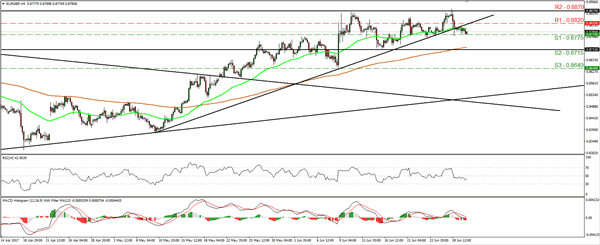
Support: 0.8775 (S1), 0.8715 (S2), 0.8640 (S3)
Resistance: 0.8820 (R1), 0.8870 (R2), 0.8945 (R3)
USD/JPY
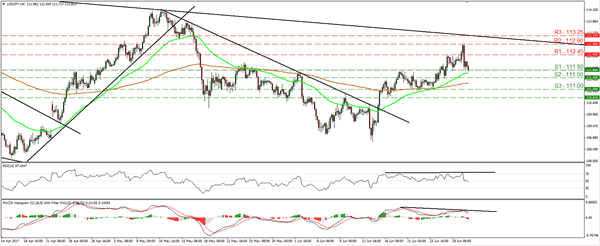
Support: 111.80 (S1), 111.50 (S2), 111.00 (S3)
Resistance: 112.45 (R1), 112.90 (R2), 113.25 (R3)
Positive Chinese Manufacturing PMI Provides A Boost To The Yuan
Chinese official manufacturing PMI numbers for the month of June positively surprised today, in a sign that the world's second largest economy remains resilient against threats on growth, such as high debt levels in the economy.
Delving into the numbers, the June manufacturing PMI came in at 51.7, beating expectations for a reading of 51.0 and exceeding May's 51.2. The official PMI figure for the services sector was released at 54.9, comfortably above the 50 threshold that separates expansion from contraction in the sector, as well as above May's 54.5.
Manufacturing PMI data are typically the ones attracting most attention, though with the rebalancing in the Chinese economy in recent years and household spending making up a greater portion of the economic pie, services PMI numbers are also becoming important for investors.
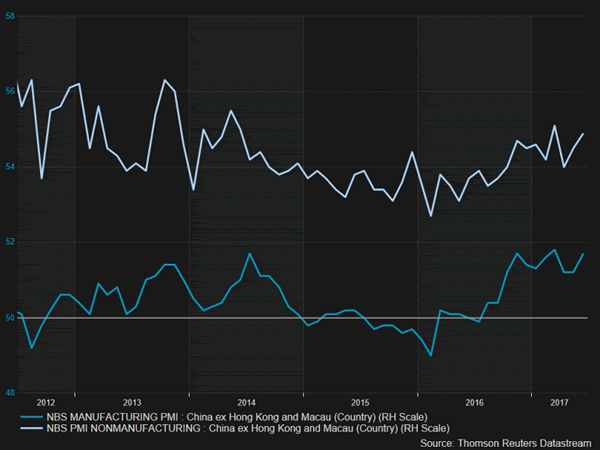
Looking at the details underpinning the figures, those suggest that the manufacturing sector was supported by demand from abroad as export orders strongly increased, while there are signs for a pickup in household demand as well. On the negative side, traditional sectors, such as crude oil and chemicals, did not manage to reverse the downtrend they've entered.
Turning to the forex market's reaction, dollar/yuan declined on the data, eventually falling to 6.758 which constitutes a three-week low for the pair. It traded at 6.791 before the data became public. The pair later recovered a significant part of its losses but was still last down on the day, looking set to record its fourth straight day of declines.
To conclude, it should be noted that the June Caixin manufacturing PMI will be released on Monday. This report covers private companies, as opposed to the official figures which largely focus on big and often state-owned enterprises. The release of the Caixin report will give a clearer picture of the state of the manufacturing sector. The Chinese economy grew by 6.9% on an annual basis during the first quarter of the year. The government's target for the year is at 6.5%