

Sample Category Title
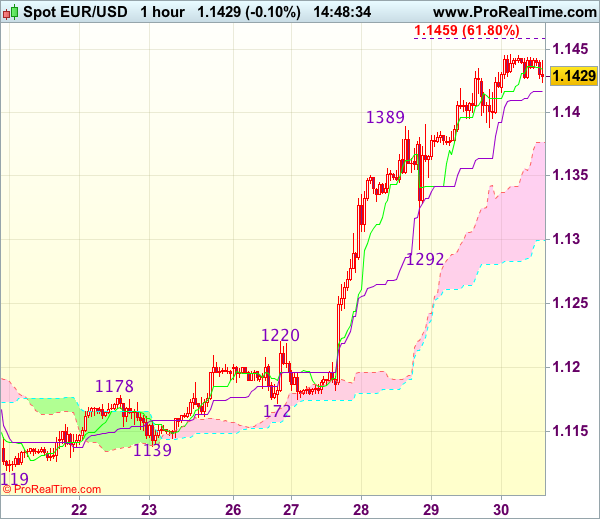
Trade Idea : EUR/USD – Buy at 1.1350
EUR/USD - 1.1423
Most recent candlesticks pattern : N/A
Trend : Near term up
Tenkan-Sen level : 1.1433
Kijun-Sen level : 1.1417
Ichimoku cloud top : 1.1376
Ichimoku cloud bottom : 1.1300
Original strategy :
Buy at 1.1335, Target: 1.1435, Stop: 1.1300
Position : -
Target : -
Stop : -
New strategy :
Buy at 1.1350, Target: 1.1450, Stop: 1.1315
Position : -
Target : -
Stop : -
As the single currency has maintained a firm undertone after recent rally, adding credence to our bullish view that recent rise is still in progress and may extend further gain to 1.1455-60 (61.8% projection of 1.1119-1.1389 measuring from 1.1292), then 1.1480, however, overbought condition should prevent sharp move beyond 1.1500, risk from there has increased for a retreat later.
In view of this, would not chase this rise here and would be prudent to buy euro on pullback as 1.1350-55 should limit upside. Below 1.1315-20 would defer but only break of indicated support at 1.1292 would signal a temporary top is formed, bring correction to 1.1255-60 later.
Daily Technical Outlook And Review: EUR/USD, GBP/USD, AUD/USD, USD/JPY, USD/CAD, USD/CHF, DOW 30, GOLD
A note on lower timeframe confirming price action...
Waiting for lower timeframe confirmation is our main tool to confirm strength within higher timeframe zones, and has really been the key to our trading success. It takes a little time to understand the subtle nuances, however, as each trade is never the same, but once you master the rhythm so to speak, you will be saved from countless unnecessary losing trades. The following is a list of what we look for:
- A break/retest of supply or demand dependent on which way you're trading.
- A trendline break/retest.
- Buying/selling tails ... essentially we look for a cluster of very obvious spikes off of lower timeframe support and resistance levels within the higher timeframe zone.
- Candlestick patterns. We tend to only stick with pin bars and engulfing bars as these have proven to be the most effective.
We typically search for lower-timeframe confirmation between the M15 and H1 timeframes, since most of our higher-timeframe areas begin with the H4. Stops are usually placed 1-3 pips beyond confirming structures.
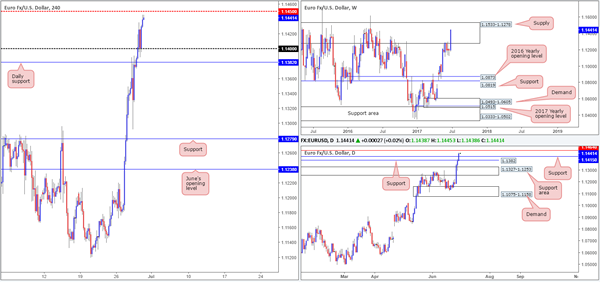
EUR/USD
The single currency, as you can see, continued to advance during yesterday's segment. Shaped by three near-full-bodied daily bullish candles, price is seen driving deeper into the upper limits of a major weekly supply at 1.1533-1.1278. On the daily timeframe, the unit is currently trading within touching distance of a major Quasimodo resistance level coming in at 1.1464.
Looking over to the H4 timeframe, it's clear to see that the 1.14 handle provided support and lifted price up to just ahead of the mid-level resistance at 1.1450 going into the close. 34 pips above this number sits a supply area drawn from 1.1529-1.1484, which along with the daily Quasimodo resistance level mentioned above at 1.1464, is the last remaining areas of structure within the aforementioned weekly supply.
Our suggestions: Although we believe the bears will react to the H4 supply area should the candles connect today, we're a tad wary of shorting given the bullish strength displayed over the past three days. With that in mind, our desk will humbly take a back seat and reassess price action going into the new month.
Data points to consider: German Retail sales figures at 7am, EUR CPI flash estimate at 10am. US Core PCE price index report at 1.30pm, followed by Chicago PMI at 2.45pm GMT+1.
Levels to watch/live orders:
- Buys: Flat (stop loss: N/A).
- Sells: Flat (stop loss: N/A).
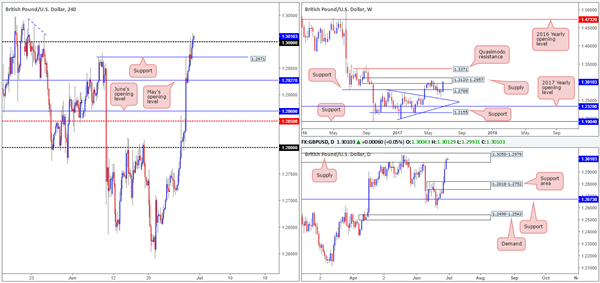
GBP/USD:
The GBP/USD is an interesting market at the moment, especially from a technical standpoint. The H4 timeframe shows that price recently crossed the large psychological boundary 1.30, which, as you can see, is currently being retested as support. To the left of current price, notice that we have drawn a mini down trendline. This is to represent what we believe to be consumed supply i.e. no active supply. So, with this, we should expect the pair to continue northbound? If only it were that easy!
On the bigger picture we have a weekly supply area at 1.3120-1.2957, and a partner supply seen on the daily timeframe at 1.3058-1.2979 in play right now. Therefore, although H4 price is showing potential to the upside, one has to remain cognizant of the surrounding environment.
Our suggestions: While a long is tempting from the 1.30 region today, we are going to hold fire. Buying into higher-timeframe supplies usually ends in tears!
Data points to consider: UK current account figures at 9.30am. US Core PCE price index report at 1.30pm, followed by Chicago PMI at 2.45pm GMT+1.
Levels to watch/live orders:
- Buys: Flat (stop loss: N/A).
- Sells: Flat (stop loss: N/A).
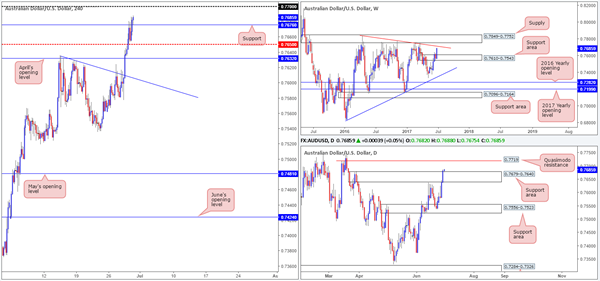
AUD/USD
In recent trading, the AUD/USD pushed higher for a second consecutive day, breaking through a H4 resistance at 0.7676 which is now being retested as support. The next upside target from this number is the 0.77 handle. While the bulls are displaying clear strength at the moment, there could be trouble ahead!
The weekly timeframe clearly shows the bulls heading into an oncoming trendline resistance extended from the high 0.7835. In addition to this, the daily timeframe reveals that a Quasimodo left shoulder at 0.7719 intersects beautifully with the said weekly trendline! Couple this with the nearby 0.77 psychological boundary and we have a feasible sell zone at hand.
Our suggestions: Basically, we will be watching the behavior of H4 price action once/if it connects with the 0.7719/0.77 area. Should a reasonably sized H4 bearish candle form within the walls of this zone, preferably in the shape of a full-bodied candle, then our team would certainly consider shorts and target H4 support at 0.7676 as an initial take-profit zone.
Data points to consider: Chinese manufacturing PMI at 2am. US Core PCE price index report at 1.30pm, followed by Chicago PMI at 2.45pm GMT+1.
Levels to watch/live orders:
- Buys: Flat (stop loss: N/A).
- Sells: 0.7719/0.77 ([waiting for a reasonably sized H4 bear candle – preferably a full-bodied candle – to form before pulling the trigger is advised] stop loss: ideally beyond the candle's wick).
USD/JPY:
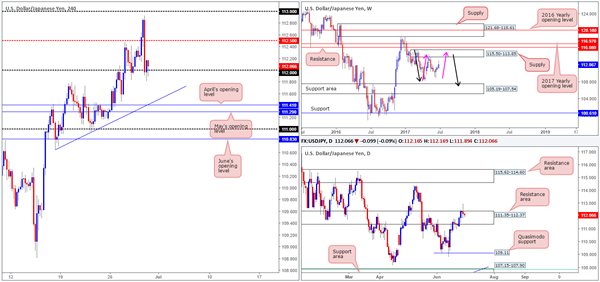
Along with the US equity market, the USD/JPY also tumbled lower going into the early hours of yesterday's US segment. This, as you can see on the daily timeframe, has possibly saved the resistance area at 111.35-112.37, which remains intact despite suffering an aggressive whipsaw.
While daily bears appear to have gained some traction, the H4 candles are currently seen testing the 112 handle. A break beyond this number could lead to a move down to April's opening level at 111.41, shadowed closely by May's opening level at 111.29. Note also that these monthly levels converge with a trendline support etched from the low 110.64.
Our suggestions: A close below 112, followed by a retest and a lower-timeframe sell signal (see the top of this report) could be something to consider today, targeting the said H4 monthly levels. Buying from these barriers, however, even though it boasts trendline confluence, is risky given the position of daily price at the moment. So, as much as we'd like to long from here, we'll pass.
Data points to consider: US Core PCE price index report at 1.30pm, followed by Chicago PMI at 2.45pm GMT+1.
Levels to watch/live orders:
- Buys: Flat (stop loss: N/A).
- Sells: Watch for H4 price to engulf 112 and then look to trade any retest seen thereafter ([waiting for a lower-timeframe sell signal to form following the retest is advised] stop loss: dependent on where one confirms this level).
USD/CAD
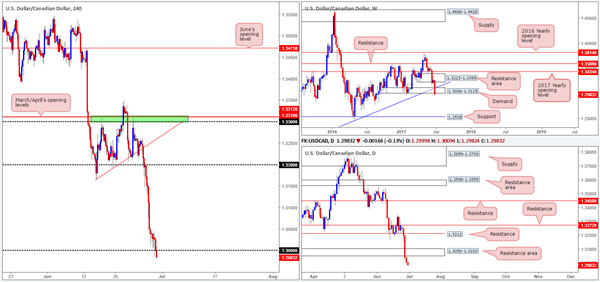
During the course of yesterday's sessions, H4 price challenged the 1.30 region and for the best part, held firm. However, in recent hours the unit has broken lower and is now trading at 1.2989. Beyond the 1.30 boundary, the next area of interest is a H4 demand base pegged at 1.2910-1.2923.
Moving over to the daily timeframe, we see little active demand in this market until we reach 1.2822-1.2883. On the weekly timeframe, however, the path south currently looks free all the way down to support coming in at 1.2538!
Our suggestions: When all three timeframes are trading in unison, our job is easy: follow the flow! Should H4 price close below 1.30 and then retest the underside of this number as resistance, as well as print a H4 bearish candle (preferably a full-bodied candle), we would have no hesitation in shorting this market, targeting the aforementioned H4 demand, and quite possibly much lower.
Data points to consider: US Core PCE price index report at 1.30pm, followed by Chicago PMI at 2.45pm. Canadian GDP m/m data at 1.30pm GMT+1.
Levels to watch/live orders:
- Buys: Flat (Stop loss: N/A).
- Sells: Watch for H4 price to engulf 1.30 and then look to trade any retest seen thereafter ([waiting for a H4 bearish candle to form following the retest is advised] stop loss: ideally beyond the candle's wick).
USD/CHF
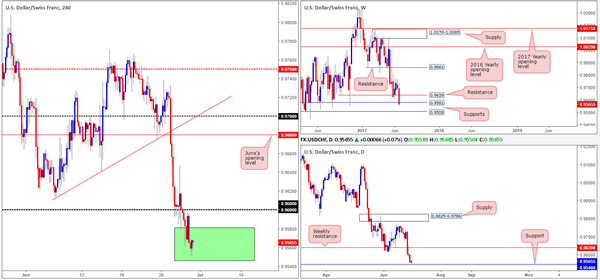
As highlighted in Thursday's report, the 0.9546/0.9581 green area painted on the H4 chart, which is comprised of weekly and daily support levels, continues to be a zone our desk favors for potential longs. However, what we also made clear was that in order to confirm buyer intent within the walls of this zone, a H4 bullish rotation candle in the shape of a full or near-full-bodied candle is needed.
As you can see from the H4 chart, a H4 bullish candle that closed near its highs was just recently penciled in. This, to us, is a valid buy signal, with the likelihood of price now rallying up to at least the 0.96 handle.
Our suggestions: Based on the notes above, our desk has entered long at 0.9567, with a stop positioned below the daily support (0.9546) at 0.9544.
Data points to consider: US Core PCE price index report at 1.30pm, followed by Chicago PMI at 2.45pm GMT+1.
Levels to watch/live orders:
- Buys: 0.9567 ([live] stop loss: 0.9544).
- Sells: Flat (stop loss: N/A).
DOW 30:
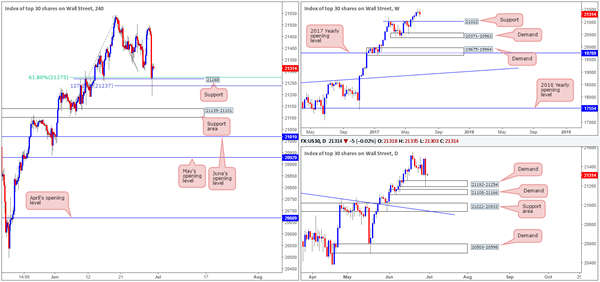
Trade update: long from 21164 was stopped out at 21298 for a handsome profit.
Despite suffering an aggressive whipsaw, the H4 support level coming in at 21268 has managed to remain in the game. We believe this was also likely because of the daily demand area seen below at 21192-21254, and a H4 61.8% Fib support level at 21275 taken from the low 21108 as well as a H4 127.2% Fib ext. point 21237 drawn from the high 21541.
Our suggestions: Following the large H4 bull candle that formed off the current H4 support, our team took another long position in this market at 21323, with the stop-loss order positioned at 21188. Ultimately, we do not have an immediate target, but will certainly be watching closely once/if price connects with the 21492 neighborhood, and possibly reduce risk to breakeven.
Data points to consider: US Core PCE price index report at 1.30pm, followed by Chicago PMI at 2.45pm GMT+1.
Levels to watch/live orders:
- Buys: 21323 ([live] stop loss: 21188).
- Sells: Flat (stop loss: N/A).
GOLD
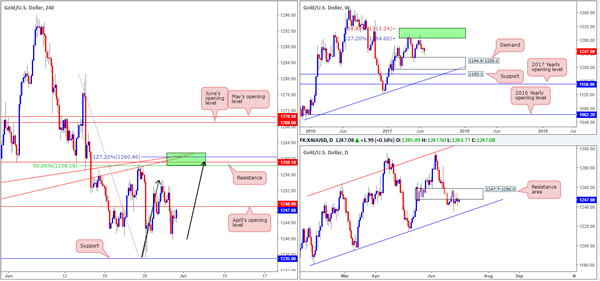
It's reasonably easy to see who's been in control on the weekly timeframe over the past few weeks. Since tapping the area comprised of two weekly Fibonacci extensions 161.8/127.2% at 1313.7/1285.2 taken from the low 1188.1 (green zone), the bears have, albeit apart from one week, put on a rather dominant performance. The next downside target in the firing range can be seen at 1194.8-1229.1: a demand zone.
On the other side of the field, however, the daily candles remain trading around a resistance area at 1247.7-1258.8. Yet, before the bears get too excited, the next area of concern can be seen nearby in the form of a channel support extended from the low 1180.4 that intersects with the said weekly demand base.
Yesterday's action on the H4 timeframe shows that price drove below April's opening level at 1248.0 and has remained there since. In recent hours, nonetheless, the metal has been seen trading within a few pips of this line and will eventually test this barrier's strength we believe. Shorting from here is not something we are interested in, since a far more appealing area exists above in green between 1261.4/1258.1.
Our suggestions: Comprised of the following structures, 1261.4/1258.1 is a reasonably strong area for shorts, which could eventually bring the unit all the way down to the top edge of weekly demand at 1229.1:
H4 resistance at 1259.1.
Two H4 trendline resistances taken from lows of 1245.9/1252.9.
H4 50.0% retracement value at 1258.1 taken from the high 1281.1.
H4 AB=CD (black arrows) 127.2% ext. at 1260.4.
Located within the upper limits of a daily resistance area at 1247.7-1258.8.
Levels to watch/live orders:
- Buys: Flat (stop loss: N/A).
- Sells: 1261.4/1258.1 ([waiting for a reasonably sized H4 bear candle – preferably a full-bodied candle – to form before pulling the trigger is advised if you want to help avoid a potential fakeout] stop loss: ideally beyond the candle's wick)
USD/CAD Daily Outlook
Daily Pivots: (S1) 1.2978; (P) 1.3010; (R1) 1.3035; More....
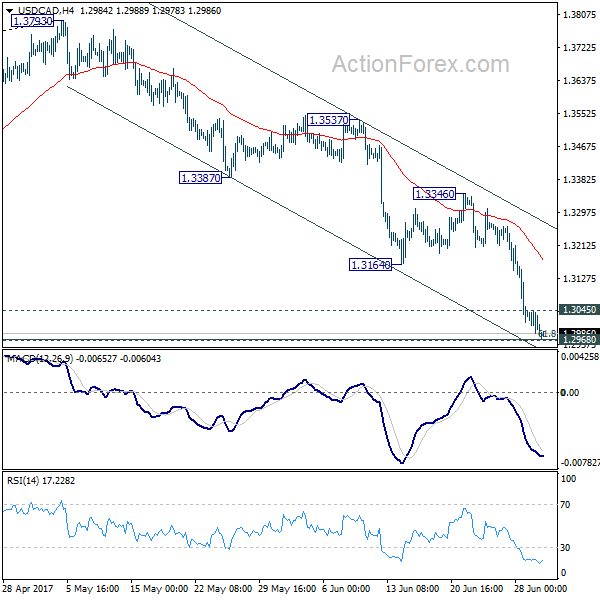
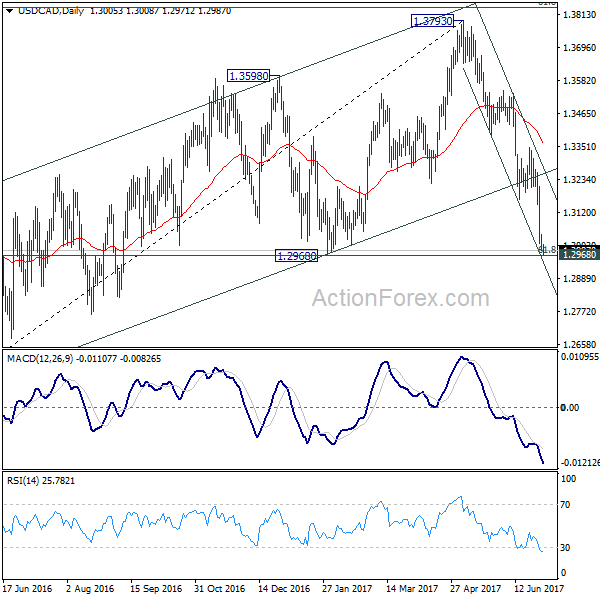
USD/CAD fall continues and reaches as low as 1.2971 so far, just inch above 1.2968 cluster support, 61.8% retracement of 1.2460 to 1.3793 at 1.2969. There is no sign of bottoming yet and intraday bias remains on the downside. As noted before, corrective rise from 1.2460 has completed at 1.3793. Sustained break of 1.2968/69 will pave the way to retest 1.2460 low. On the upside, above 1.3045 minor resistance will argue that a short term bottom could be in place after drawing support from 1.2968/69. In such case, intraday bias will be turned back to the upside for recovery back to 1.3164 support turned resistance.
In the bigger picture, price actions from 1.4689 medium term top are seen as a correction pattern. The first leg has completed at 1.2460. Rise from 1.2460 is seen as the second leg and has completed at 1.3793, ahead of 61.8% retracement of 1.4689 to 1.2460 at 1.3838. Break of 1.3222 should now indicate the start of the third leg while further break of 1.2968 should confirm. In that case, USD/CAD should decline through 1.2460 support to 50% retracement of 0.9406 to 1.4869 at 1.2048.
Global Equities Fell as World Entering into Policy Stimulus Removal Era, Yen and Dollar Stay Weakest
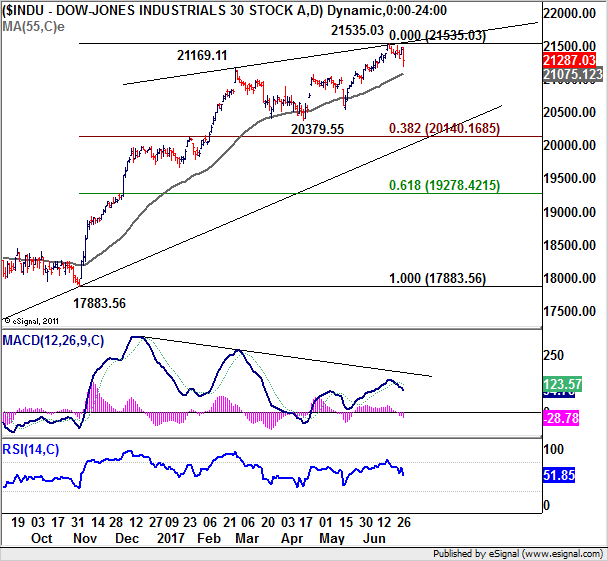
Global equities tumbled broadly while treasury yields surged as investors are preparing themselves to enter into an era of monetary stimulus removal. DOW lost -0.78% to close at 21287.03, S&P 500 down -0.86% to 2419.70, and NASDAQ dropped -1.44% to 6144.35. That was preceded by the -0.51% fall in FTSE, -1.83% fall in DAX and -1.88% fall in CAC. US 10 year yields followed global yields higher and closed up 0.046 at 2.267, breaking 2.229 near term resistance. In Asian markets, Nikkei followed by losing -1.06% to 20006.88, just barely hold on to 20000 handle. In currency markets, Yen and Dollar recovered mildly but are still set to end the week as the weakest major currencies. Sterling, Canadian and Euro remained the strongest ones and supported by respective hawkish central banks.
We've pointed out in Wednesday's report that NASDAQ is starting the third leg of the correction pattern from 6341.70. And it's happening now despite Thursday's recovery. Focus stays on 55 day EMA (now at 6119.60). Sustained break there will also have medium term channel support taken out. That will bring deeper fall to 38.2% retracement of 5034.31 to 6341.70 at 5842.31. Such development will also drag on other indices. DOW also looks vulnerable considering bearish divergence condition in daily MACD. Near term focus is also on 55 day EMA (now at 12075.12). Firm break there would bring deeper pull back to 20379.55 support.
US economy clouded by political drama
Outlook of the US economy and markets are clouded by political drama. There are just so many distractions that doubts are high on whether US President Donald Trump can push through his economic policies. The so called "watered-down" travel ban 2.0n took effect yesterday. But just an hour ahead of that, the state of Hawaii filed an emergency motion in the federal court to contest the plan. Meanwhile, it seems like Senate Republicans are still working on voting on the healthcare act before the Fourth of July recess. But, no good news is heard by the market regarding this so far. And businesses and investors are awaiting the completion of the healthcare act so that Trump administration can finally start working on passing the tax reforms.
On the data front
In Japan, National CPI core rose to 0.4% yoy in May, up from 0.3% yoy and met expectations. But that's still way off BoJ's 2% target. Tokyo CPI core, on the other hand, dropped to 0.0% yoy in June, down from 0.1% yoy and missed expectation of 0.2% yoy. Also from Japan, unemployment rate rose to 3.1% in May, household spending dropped -0.1% yoy, industrial production dropped -3.3% mom, housing starts dropped -0.3% yoy. Saying in Asia pacific, New Zealand building permits rose 7.0% mom in May.
Elsewhere, German retail sales rose 0.5% mom in May. UK Gfk consumer confidence dropped to -10 in June. Swiss KOF leading indicator, German unemployment and UK Q1 GDP final will be released in European session. But main focus will be on Eurozone CPI flash. Later in the day, Canada will release GDP, IPPI and RMPI. US will release personal income and spending and Chicago PMI.
USD/CAD Daily Outlook
Daily Pivots: (S1) 1.2978; (P) 1.3010; (R1) 1.3035; More....
USD/CAD fall continues and reaches as low as 1.2971 so far, just inch above 1.2968 cluster support, 61.8% retracement of 1.2460 to 1.3793 at 1.2969. There is no sign of bottoming yet and intraday bias remains on the downside. As noted before, corrective rise from 1.2460 has completed at 1.3793. Sustained break of 1.2968/69 will pave the way to retest 1.2460 low. On the upside, above 1.3045 minor resistance will argue that a short term bottom could be in place after drawing support from 1.2968/69. In such case, intraday bias will be turned back to the upside for recovery back to 1.3164 support turned resistance.
In the bigger picture, price actions from 1.4689 medium term top are seen as a correction pattern. The first leg has completed at 1.2460. Rise from 1.2460 is seen as the second leg and has completed at 1.3793, ahead of 61.8% retracement of 1.4689 to 1.2460 at 1.3838. Break of 1.3222 should now indicate the start of the third leg while further break of 1.2968 should confirm. In that case, USD/CAD should decline through 1.2460 support to 50% retracement of 0.9406 to 1.4869 at 1.2048.
Economic Indicators Update
| GMT | Ccy | Events | Actual | Forecast | Previous | Revised |
|---|---|---|---|---|---|---|
| 22:45 | NZD | Building Permits M/M May | 7.00% | -7.60% | -7.40% | |
| 23:01 | GBP | GfK Consumer Confidence Jun | -10 | -7 | -5 | |
| 23:30 | JPY | Jobless Rate May | 3.10% | 2.80% | 2.80% | |
| 23:30 | JPY | Household Spending Y/Y May | -0.10% | -0.50% | -1.40% | |
| 23:30 | JPY | National CPI Core Y/Y May | 0.40% | 0.40% | 0.30% | |
| 23:30 | JPY | Tokyo CPI Core Y/Y Jun | 0.00% | 0.20% | 0.10% | |
| 23:50 | JPY | Industrial Production M/M May P | -3.30% | -3.00% | 4.00% | |
| 1:00 | CNY | Manufacturing PMI Jun | 51.7 | 51 | 51.2 | |
| 1:00 | CNY | Non-manufacturing PMI Jun | 54.9 | 54.5 | ||
| 5:00 | JPY | Housing Starts Y/Y May | -0.30% | -0.70% | 1.90% | |
| 6:00 | EUR | German Retail Sales M/M May | 0.50% | 0.30% | -0.20% | |
| 7:00 | CHF | KOF Leading Indicator Jun | 102.5 | 101.6 | ||
| 7:55 | EUR | German Unemployment Change Jun | -10k | -9k | ||
| 7:55 | EUR | German Unemployment Rate Jun | 5.70% | 5.70% | ||
| 8:30 | GBP | Current Account (Pounds) Q1 | -16.5B | -12.1B | ||
| 8:30 | GBP | GDP Q/Q Q1 F | 0.20% | 0.20% | ||
| 8:30 | GBP | GDP Y/Y Q1 F | 2.00% | 2.00% | ||
| 8:30 | GBP | Index of Services 3M/3M Apr | 0.30% | 0.20% | ||
| 9:00 | EUR | Eurozone CPI Estimate Y/Y Jun | 1.20% | 1.40% | ||
| 9:00 | EUR | Eurozone CPI - Core Y/Y Jun A | 1.00% | 0.90% | ||
| 12:30 | CAD | GDP M/M Apr | 0.20% | 0.50% | ||
| 12:30 | CAD | Industrial Product Price M/M May | 0.60% | |||
| 12:30 | CAD | Raw Materials Price Index M/M May | 1.60% | |||
| 12:30 | USD | Personal Income May | 0.30% | 0.40% | ||
| 12:30 | USD | Personal Spending May | 0.10% | 0.40% | ||
| 12:30 | USD | PCE Deflator M/M May | -0.10% | 0.20% | ||
| 12:30 | USD | PCE Deflator Y/Y May | 1.50% | 1.70% | ||
| 12:30 | USD | PCE Core M/M May | 0.10% | 0.20% | ||
| 12:30 | USD | PCE Core Y/Y May | 1.40% | 1.50% | ||
| 13:45 | USD | Chicago PMI Jun | 58 | 59.4 | ||
| 14:00 | USD | U. of Michigan Confidence Jun F | 94.5 | 94.5 |
Trade Idea : USD/JPY – Sell at 112.40
USD/JPY - 112.06
Most recent candlesticks pattern : N/A
Trend : Near term up
Tenkan-Sen level : 111.95
Kijun-Sen level : 112.33
Ichimoku cloud top : 112.21
Ichimoku cloud bottom : 111.97
New strategy :
Sell at 112.40, Target: 111.40, Stop: 112.75
Position : -
Target : -
Stop : -
Although the greenback rose to as high as 112.93 yesterday, the subsequent sharp retreat signals top has been formed there and consolidation with downside bias is seen for weakness to 111.46 support, a firm break below there would add credence to this view, brig further fall towards 111.15-20 but support at 110.95 should remain intact, bring rebound later.
In view of this, we are looking to sell dollar on recovery as 112.40-45 should limit upside and bring another decline. Above 112.70-75 would risk retest of said resistance at 112.93 but break there is needed to confirm recent upmove has resumed for headway to 113.15-20.

European Open Briefing: The Dollar Weakness Continues
Global Markets:
- Asian stock markets: Nikkei down 1.20 %, Shanghai Composite fell 0.20 %, Hang Seng lost 0.95 %, ASX 200 declined 1.50 %
- Commodities: Gold at $1247 (+0.15 %), Silver at $16.65 (+0.35 %), WTI Oil at $45.20 (+0.60 %), Brent Oil at $47.90 (+0.60 %)
- Rates: US 10-year yield at 2.28, UK 10-year yield at 1.25, German 10-year yield at 0.44
News & Data:
- China Manufacturing PMI 51.7 vs 51.0 expected
- China Non-Manufacturing PMI 54.9 vs 54.5 previous
- Australia Housing Credit 0.6 % vs 0.5 % previous
- Australia Private Sector Credit 0.4 % vs 0.4 % expected
- Japan Unemployment Rate 3.1 % vs 2.8 % expected
- Japan Industrial Production -3.3 % vs -3.2 % expected
- Japan CPI 0.4 % vs 0.5 % expected
- Japan Household Spending 0.7 % vs 0.2 % expected
- New Zealand Building Consents 7.0 % vs -7.4 % previous
- Dollar sulky on hawkish central banks, Asia stocks join global slump – RTRS
Markets Update:
The Dollar weakness continues. EUR/USD rose to 1.1445 overnight, while GBP/USD is slowly approaching 1.3050 resistance. Meanwhile, USD/JPY came under pressure and declined to 111.70 in Asia. It was not just broad USD weakness that brought the pair under pressure. A decline in global equity markets added to the negative sentiment. Support is seen at 111.50, followed by 111.
AUD/USD broke above 0.77 resistance, but momentum slowed down in Asia. Nevertheless, the outlook remains positive and the pair is likely to test 0.7780 resistance soon.
USD/CAD is not getting any rest. It declined to 1.2970 in Asia and is down 350 pips in the past seven trading days. USD/CAD looks heavily oversold in the short-term, and it is likely that we will see a bounce before the downtrend continues. Resistance is noted at 1.3030 and strong at 1.3130/40. Today at 13:30 BST, Canada will publish its GDP numbers, which should lead to decent volatility in the CAD pairs.
Upcoming Events:
- 07:00 BST – German Retail Sales
- 08:55 BST – German Unemployment Rate
- 09:30 BST – UK GDP
- 10:00 BST – Euro Zone CPI
- 13:30 BST – Canadian GDP
- 13:30 BST – US Personal Income
- 13:30 BST – US Personal Spending
- 14:45 BST – US Chicago PMI
- 15:00 BST – US Michigan Consumer Sentiment
Australia’s Private Sector Credit Advanced As Expected In May
For the 24 hours to 23:00 GMT, the AUD rose 0.59% against the USD and closed at 0.7682.
LME Copper prices rose 1.4% or $83.5/MT to $5905.5/MT. Aluminium prices rose 0.6% or $11.5/MT to $1897.5/MT.
In the Asian session, at GMT0300, the pair is trading at 0.7701, with the AUD trading 0.25% higher against the USD from yesterday's close.
Early morning data showed that Australia's private sector credit rose 0.4% on a monthly basis in May, in line with market expectations and following a similar rise in the prior month.
Elsewhere in China, Australia's largest trading partner, the NBS manufacturing PMI unexpectedly advanced to a level of 51.7 in June, expanding at its quickest pace in three months and defying market expectations for a fall to a level of 51.0. The PMI had recorded a reading of 51.2 in the prior month. Further, the nation's NBS non-manufacturing PMI climbed to a level of 54.9 in June, hitting its highest level since March 2017 and following a reading of 54.5 in the previous month.
The pair is expected to find support at 0.7664, and a fall through could take it to the next support level of 0.7627. The pair is expected to find its first resistance at 0.7725, and a rise through could take it to the next resistance level of 0.7749.
The currency pair is trading above its 20 Hr and 50 Hr moving averages.

Germany’s Annual Inflation Topped Market Expectations In June
For the 24 hours to 23:00 GMT, the EUR rose 0.56% against the USD and closed at 1.1442, after Germany's preliminary consumer price index (CPI) advanced more-than-expected by 1.6% on an annual basis in June, suggesting that a healthy upswing in economic activity will help revive inflation in the Euro-zone's largest economy. The CPI had risen 1.5% in the previous month, while market participants had anticipated an increase of 1.4%. Additionally, the nation's GfK consumer confidence index strengthened to a nearly sixteen-year high level of 10.6 in July, while investors had envisaged the index to remain steady at 10.4.
Separately, the Euro-zone's final consumer confidence index improved to a level of -1.3 in June, confirming the preliminary estimate. In the prior month, the index had registered a level of -3.3. Further, the region's economic sentiment indicator jumped to a nine-year high level of 111.1 in June, following a level of 109.2 in the prior month.
The greenback lost ground against a basket of major currencies, as investors brushed off upbeat US gross domestic product (GDP) data.
The second estimate of annualised gross domestic product (GDP) in the US was surprisingly revised higher to 1.4% in 1Q 2017, compared to a preliminary print that had indicated an advance of 1.2%, aided by higher consumer spending and robust growth in exports. In the previous quarter, the GDP had risen 2.1%. On the other hand, the nation's initial jobless claims recorded an unexpected increase to a level of 244.0K in the week ended 24 June, defying market consensus for it to ease to a level of 240.0K and compared to a revised reading of 242.0K in the prior week.
In the Asian session, at GMT0300, the pair is trading at 1.1442, with the EUR trading flat against the USD from yesterday's close.
The pair is expected to find support at 1.1405, and a fall through could take it to the next support level of 1.1368. The pair is expected to find its first resistance at 1.1462, and a rise through could take it to the next resistance level of 1.1482.
Moving ahead, investors will look forward to the Euro-zone's flash inflation numbers for June along with Germany's unemployment rate for June and retail sales for May, all slated to release in a few hours. Additionally, the US personal income and spending for May as well as the final Michigan consumer confidence index for June, will garner a lot of market attention.
The currency pair is showing convergence with its 20 Hr moving average and trading above its 50 Hr moving average.

UK’s Consumer Credit Surged To Its Highest Level Since November 2016 In May
For the 24 hours to 23:00 GMT, the GBP rose 0.56% against the USD and closed at 1.3010, following upbeat economic data in the UK.
Data showed that Britain's net consumer credit advanced more-than-expected by £1.7 billion in May, notching its highest level in six months, thus suggesting that households remain confident enough to increase borrowing to help smooth consumption. In the previous month, net consumer credit climbed by £1.5 billion, while markets anticipated it to increase by £1.4 billion. Moreover, the number of mortgage approvals for house purchases in the UK unexpectedly rose to a level of 65.2K in May, confounding market consensus for a fall to a level of 64.0K. In the prior month, mortgage approvals had recorded a revised level of 65.1K.
In the Asian session, at GMT0300, the pair is trading at 1.3019, with the GBP trading 0.07% higher against the USD from yesterday's close.
Overnight data revealed that the nation's GfK consumer confidence index dropped more-than-expected to a level of -10.0 in June, as Britons remained concerned about spiking inflation and weakening wage growth. Markets anticipated the index to fall to a level of -7.0, after recording a level of -5.0 in the previous month. On the other hand, the nation's business barometer advanced to a level of 30.0 in June, following a level of 27.0 in the previous month.
The pair is expected to find support at 1.2970, and a fall through could take it to the next support level of 1.2921. The pair is expected to find its first resistance at 1.3049, and a rise through could take it to the next resistance level of 1.3079.
Moving ahead, traders would focus on UK's final 1Q GDP data, set to release in a few hours.
The currency pair is trading above its 20 Hr and 50 Hr moving averages.

Japan’s Jobless Rate Surprisingly Advanced To Its Highest Level Since December 2016 In May
For the 24 hours to 23:00 GMT, the USD declined 0.32% against the JPY and closed at 112.00.
In the Asian session, at GMT0300, the pair is trading at 111.83, with the USD trading 0.15% lower against the JPY from yesterday's close.
Overnight data indicated that Japan's unemployment rate recorded an unexpected rise to 3.1% in May, hitting its highest level since December 2016, while market participants expected it to remain steady at 2.8%. Moreover, the nation's national consumer price index (CPI) climbed 0.4% on an annual basis in May, undershooting market expectations for a rise of 0.5%. In the prior month, the CPI had registered a 0.4% rise. Additionally, the nation's preliminary industrial production eased more-than-anticipated by 3.3% on a monthly basis in May, compared to an advance of 4.0% in the prior month, while markets had anticipated for a decline of 3.0%.
The pair is expected to find support at 111.4, and a fall through could take it to the next support level of 110.96. The pair is expected to find its first resistance at 112.6, and a rise through could take it to the next resistance level of 113.36.
The currency pair is trading below its 20 Hr and 50 Hr moving averages.
