Sample Category Title
Sterling Steady as Markets Eye Trump Tax Talk
GBP/USD is showing little movement on Wednesday, as the pair trades at 1.2840. On the release front, there hasn't been much data for the markets to analyze. There are no British releases, and the sole US event was Crude Oil Inventories. The weekly indicator came in at -3.6 million barrels, compared to the estimate of -1.1 million. On Thursday the US releases two major indicators – Core Durable Goods Orders and unemployment claims.
The negotiations between Britain and the EU are expected to be lengthy and difficult, and EU leaders don't appear to be in a generous mood, as they met in Brussels on Monday to discuss a united front in the Brexit talks. Britain wants any deal to include financial services, but the Europeans are working on a draft that would exclude the financial sector unless it is governed by EU rules. There are also likely to be sharp disagreements over the size of Britain's debt to the EU, among other major issues. For now, the British government is concentrating on the June election, but after that things could get nasty between the sides. If the Brexit talks run into trouble, market sentiment could take a dive and that could spell trouble for the British pound.
One of President Trump's key campaign planks was tax reform, both for corporations and individuals. Trump is expected to make a key announcement about his tax proposal on Wednesday. Of particular interest to the corporate sector, Trump is expected to propose reducing the corporate tax rate from 35% to 15%, and lowering the tax on multinationals' overseas profits from 35% to 10%. Any tax reform proposals from the White House will require a stamp of approval from Congress, so Trump's proposal should be viewed as a blueprint that is a long way off from becoming law. It will be interesting to see the reaction to Trump's tax plan. Trump's first 100 days in office have been rocky, so it will be a significant step forward for the president if Congress and the stock markets give a thumbs-up to his plan. However, if the president is short on details, as has often been the case, the ensuing disappointment from investors could send the dollar downwards.
US consumer confidence levels remain high, but there was some disappointment as CB Consumer Confidence dropped to 120.3 in April, missing the estimate of 123.7. The softer than expected reading boosted the euro in the Monday session. What is troubling analysts is that strong consumer confidence numbers have not translated into increased consumer spending, a key component of economic growth. This trend has been labeled the "hard/soft discrepancy" (confidence being 'soft', while actual spending being 'hard'). This was underscored in March retail sales numbers, which came in at a flat 0.0%, shy of the forecast. Next up is Preliminary GDP on Thursday, which is expected at 1.3 percent. An unexpected GDP reading could have a sharp impact on EUR/USD.
Trump’s Latest Lumber Tariff Helps Little on US Deficit. Political Implication can be Huge
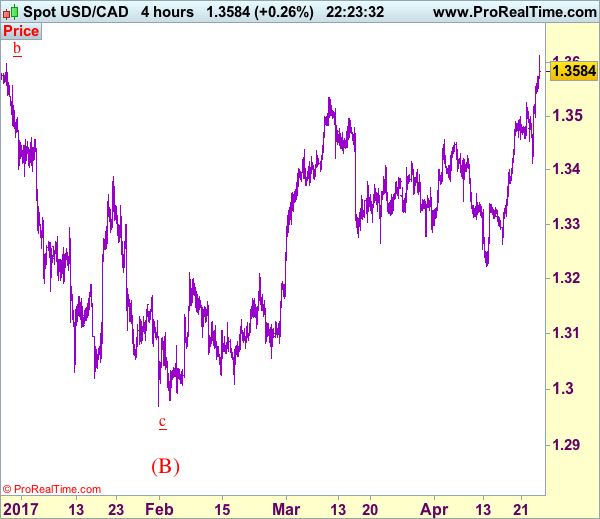
USDCAD consolidated after a brief break about 1.36, following US' announcement to impose anti-subsidy tariff on softwood lumber imports from Canada. US Commerce Secretary Wilbur Ross indicated that the "countervailing duties" would range from 3-24% and would be imposed on 5 Canadian lumber exporters including West Fraser Timber Co., after concluding that Canada subsidizes its industry in a way that hurts the US. Ross added that the move is a sign to other trading partners that the US is planning stricter enforcement of trade laws. Canada responded by saying that the tariff is "unfair and punitive". In a joint statement from Foreign Minister Chrystia Freeland and Natural Resources Minister Jim Carr, it was noted that Canada "will vigorously defend the interests of the Canadian softwood lumber industry, including through litigation". It reiterated that "a negotiated settlement is not only possible but in the best interests of both countries". Risk to the loonie is to the downside in the near-term on heightened possibility of a trade war. Canada's economy is more vulnerable to a US-Canada trade war as 75% of its exports go to the US and this contributes to about 20% of Canada's economy.
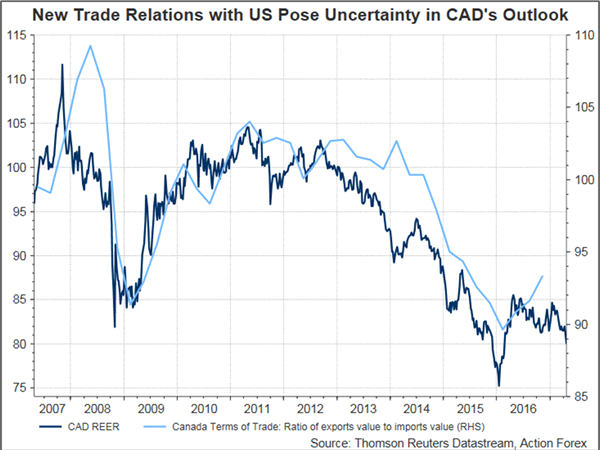
A Brief History of US-Canada Softwood Lumber Trade Dispute
While the softwood lumber trade dispute between the US and Canada can be dated back to as early as the 1800s, explicit agreements have not been made until 1982. The US was dissatisfied with the Canadian government's policy that private lumber firms in British Columbia, Ontario, Alberta and Quebec are allowed to source trees from public land. However, in the US, the majority of lumber is cut from private lands, thus increasing the production cost. Softwood lumber was not covered under NAFTA, a trade agreement that the US has indicated intention to renegotiate in coming months, but appeared under a side agreement that expired in October 2015.
More a Political than Trade/Economic Issue
The US' softwood lumber imports from Canada amounted to about US$5B last year, approximately 85% of total US lumber imports. Yet, this only contributed to less than 2% of Canada's exports to the US, at US$295B. Meanwhile, Canada has a trade surplus of US$5.5B in coniferous wood, of which the majority was softwood lumber, last time. The figure is also small when compared with the total trade balance of US$85.2. Assuming the tariff is 20%, it covers only about 0.3% of US total imports. The overall impacts on US GDP growth or inflation are minimal. Interestingly, the key destinations of Canada's lumber exports in the US are Washington, Texas, New York, Oregon, Michigan, Pennsylvania, Massachusetts, Minnesota, North Carolina and Illinois. Most these states are with great presence of the Democratic Party and are politically important in the 2018 midterm elections.
While denying that the softwood lumber tariff is the beginning of NAFTA negotiations, the market has turned nervous that the US would adopt a stricter trade policy in order to promote his "American First" rhetoric. Indeed, Trump mentioned last week that he would "address" the trade problem on dairy products, accusing that Canada's move to change the class of some milk products has "put farmers in Wisconsin and New York state out of business". Again, we are suspicious that Trump's move has political incentive. The US runs a US$110M surplus in milk and milk-related products with Canada last year, with Canada exporting US$58M whilst importing US$168M from the US. The 2 states mentioned by Trump are also running surpluses with Canada in this category. Wisconsin, the first congressional district represented by Republican Paul Ryan, has a US$20M milk and milk-related surplus with Canada. The current Speaker of the House is also the proposer of the controversial border tax arrangement. New York, the 16th congressional state represented by Chuck Schumer, the Senate minority leader, has a US$22M surplus.
Trade Idea Wrap-up: USD/CHF – Stand aside
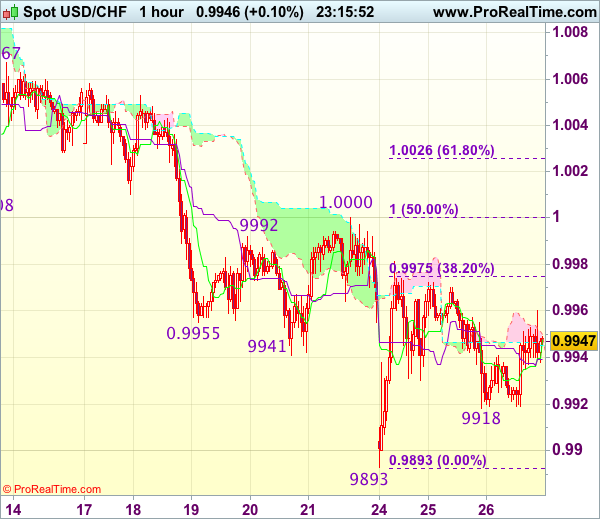
USD/CHF - 0.9943
Most recent candlesticks pattern : N/A
Trend : Near term down
Tenkan-Sen level : 0.9948
Kijun-Sen level : 0.9939
Ichimoku cloud top : 0.9950
Ichimoku cloud bottom : 0.9945
New strategy :
Stand aside
Position : -
Target : -
Stop : -
Although dollar retreated yesterday to as low as 0.9918, as the greenback has rebounded today, retaining our view that further sideways trading above this week’s low at 0.9893 would take place and another bounce to 0.9981 cannot be ruled out, however, break of 1.0000-08 resistance is needed to signal low is formed instead, bring rebound to 1.0025-30 (61.8% Fibonacci retracement of 1.0108-0.9893), however, price should falter below resistance at 1.0067.
As near term outlook is still mixed, would be prudent to stand aside in the meantime. Below said support at 0.9918 would bring retest of 0.9893 but break there is needed to confirm recent decline from 1.0108 has resumed and extend weakness to 0.9865-70 (2 times extension of 1.0108-1.0008 measuring from 1.0067), however, reckon support at 0.9831 would hold from here, bring rebound later.
Trade Idea Wrap-up: GBP/USD – Stand aside
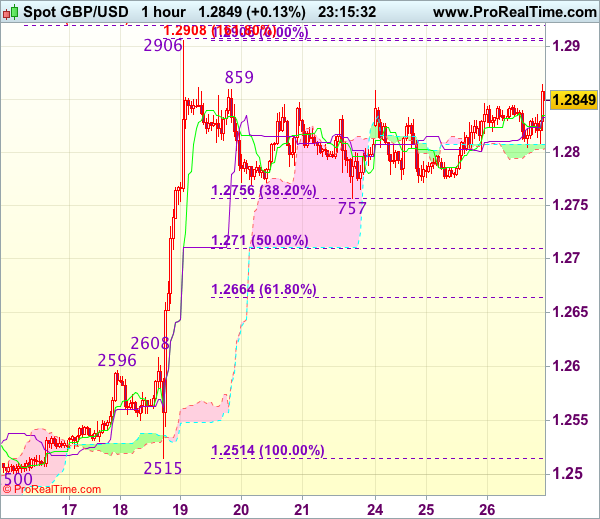
GBP/USD - 1.2840
Most recent candlesticks pattern : N/A
Trend : Near term up
Tenkan-Sen level : 1.2835
Kijun-Sen level : 1.2833
Ichimoku cloud top : 1.2808
Ichimoku cloud bottom : 1.2804
Original strategy :
Buy at 1.2710, Target: 1.2850, Stop: 1.2675
Position : -
Target : -
Stop : -
New strategy :
Stand aside
Position : -
Target : -
Stop : -
Despite intra-day brief bounce to 1.2864, lack of follow through buying on break of indicated resistance at 1.2859 suggests further sideways trading would be seen and pullback to 1.2805-10 cannot be ruled out, however, reckon Friday’s low at 1.2757 would limit downside and price should stay well above 1.2700-10 (50% Fibonacci retracement of 1.2515-1.2906), bring another rally. Above 1.2865-70 would signal the pullback from 1.2906 has ended, bring retest of this level, break there would extend recent upmove to 1.2920-30 (2 times extension of 1.2365-1.2575 measuring from 1.2500), then 1.2950 but reckon 1.2990-00 (1.236 times projection of 1.2109-1.2616 measuring from 1.2365 and psychological resistance) would hold.
In view of this, would not chase this rise here and would be prudent to buy cable on subsequent pullback as downside should be limited to 1.2710 (50% Fibonacci retracement of 1.2515-1.2906), bring another rise. Below 1.2700 would defer and signal top has been formed, risk correction to 1.2660-65 (61.8% Fibonacci retracement of 1.2515-1.2906) and price should stay well above 1.2608-16 (previous resistance now support).
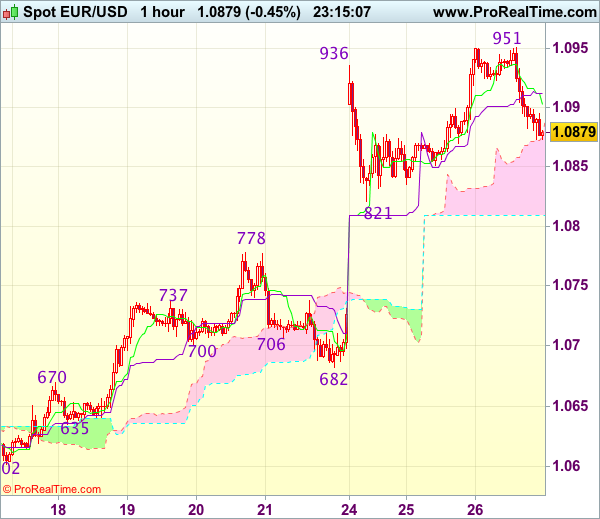
Trade Idea Wrap-up: EUR/USD – Stand aside
EUR/USD - 1.0880
Most recent candlesticks pattern : N/A
Trend : Near term up
Tenkan-Sen level : 1.0923
Kijun-Sen level : 1.0911
Ichimoku cloud top : 1.0865
Ichimoku cloud bottom : 1.0809
New strategy :
Stand aside
Position : -
Target : -
Stop : -
Despite intra-day marginal rise to 1.0951, lack of follow through buying and current retreat suggest consolidation below this level would be seen and downside risk remains for retracement to 1.0870, break there would suggest an intra-day top is formed, bring further fall to 1.0850 but reckon support at 1.0821 would hold from here, bring another rise later.
In view of this, would be prudent to stand aside for now. Only above said resistance at 1.0951 would extend recent upmove from 1.0340 low to 1.0975-80 and possibly towards 1.1000 which is likely to hold on first testing due to loss of momentum, risk from there is seen for a retreat later.
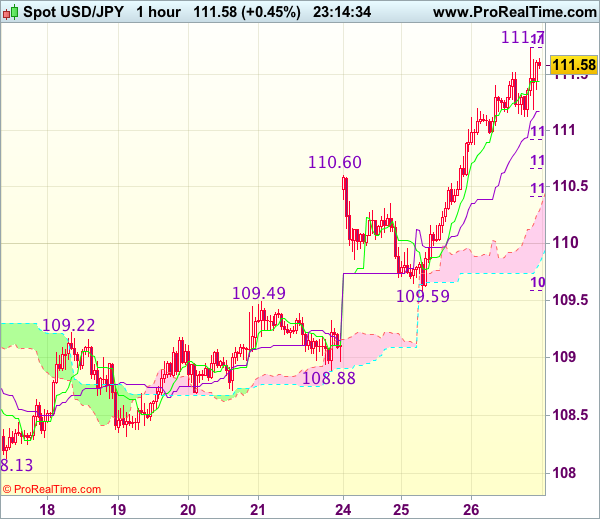
Trade Idea Wrap-up: USD/JPY – Buy at 110.70
USD/JPY - 111.60
Most recent candlesticks pattern : N/A
Trend : Near term up
Tenkan-Sen level : 111.43
Kijun-Sen level : 111.17
Ichimoku cloud top : 110.29
Ichimoku cloud bottom : 109.83
Original strategy :
Buy at 110.70, Target: 111.70, Stop: 110.35
Position : -
Target : -
Stop : -
New strategy :
Buy at 110.70, Target: 111.70, Stop: 110.35
Position : -
Target : -
Stop : -
The greenback surged after finding renewed buying interest at 109.59 and broke above previous resistance at 110.60, adding credence to our view that recent rise from 108.13 low is still in progress and bullishness remains for this move to bring at least a strong retracement of early downtrend, hence further gain to resistance at 111.75-80 would be seen, break would extend gain towards 112.00, however, overbought condition should prevent sharp move beyond another previous resistance at 112.20.
In view of this, would not chase this rise here and would be prudent to buy dollar on subsequent pullback as previous resistance at 110.60 should limit downside, bring another rally. Below 110.30-35 (61.8% Fibonacci retracement of 109.59-111.51) would defer and suggest top is possibly formed, risk weakness to 109.80 but break of support at 109.59 is needed to provide confirmation.
EUR/GBP Slightly off the Correction Top
Headlines
European equities cede marginally ground following their 2-day rally. US stock markets opened unchanged. Earnings included Boeing, which topped estimates and raised its profit outlook, and Twitter which announced better than expected earnings and revenues, and significantly increased its active user base on the platform.
US President Trump will release a tax plan today proposing some deep rate cuts, mostly for businesses, including a slashed corporate income tax rate and steeply discounted tax rate for overseas corporate profits brought into the United States, officials said.
The US Congress was moving closer to crafting a deal to avoid a government shutdown. Some lawmakers are optimistic they can hammer out a budget bill to take the government to the end of the current fiscal year on Sept. 30, while others see Congress putting a short-term spending resolution in place for a week, while talks continue.
NZD/USD dropped below 0.69, heading towards key support at 0.6862. The kiwi dollar faces selling pressure since US president Trump tweeted that he would take action against Canadian dairy farmers who compete with US farmers. With the recent lumber import tariffs in mind and given New Zealand's huge dairy export, NZD loses ground.
Turkey's central bank has kept its main interest rates unchanged in April, but continued to tighten monetary conditions by raising its liquidity lending rate by 50 bps to 12.25%, its highest level since 2015.
EC President Juncker urged euro zone countries to draw up more debt relief measures for Greece next month, saying Athens needed help after making "huge progress" in its economic reforms. EMU FM's will meet in Brussels on May 22 to discuss progress made in talks to conclude Greece's crucial bailout review which has been delayed for months.
Rates
After the stormy weather, bonds find their composure
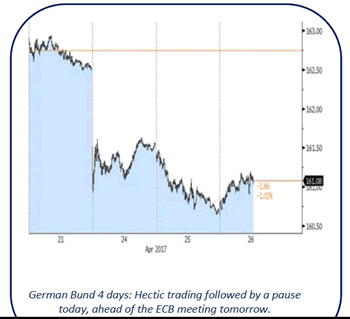
Following two days of hectic trading, markets, including the bond market, calmed down today. In most markets, only some bottom fishers/short coverers were active, meaning that the price action turned around compared to previous days. The Bund gradually moved higher, mostly recouping losses registered in yesterday's after-market trading. However, the Bund stayed near yesterday's official closure. A very temporary dip is visible on the charts when US Treasury Secretary Mnuchin spoke about the tax plan, but the dip was rapidly erased, given that no new details were unveiled. We shouldn't qualify today's price action as a real countermove, more a short covering ahead of tomorrow's ECB meeting. In this respect, it isn't strange that the US Treasuries stayed closed to yesterday's close, trading in a narrow range too. European equities traded sideways albeit slightly below yesterday's close.
At the time of writing, the German yield curve shifted 0.4 bps (30-yr) to 1.8 bps (5-yr) lower. Changes on the US yield curve were virtually zero (except for the 2- yr due to a benchmark change). On intra-EMU bond markets, 10-yr yield spreads widened for most credit with Spain (+4 bps) and Italy (+7 bps) underperforming, likely due to profit taking and upcoming supply.
Currencies
EUR/USD and USD/JPY fall prey to profit taking.
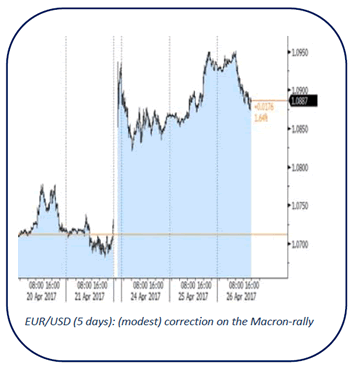
The combined rally of EUR/JPY, USD/JPY and EUR/USD still continued in Asia this morning, but the post-Macron risk-on trade slowed in Europe. This caused also some profit taking on the euro as investors reduced positions ahead of the Turmp tax plan and the ECB policy statement tomorrow. EUR/USD trades currently in the 1.0885 area. USD/JPY is holding in the mid 111 area, awaiting the details of the Trump tax plan. There were no data to guide trading.
Overnight, Asian markets equities eked out some additional follow-through gains on yesterday's risk rally. In line with the price action after the outcome of the first round of the French presidential election, the risk-on sentiment was supportive for EUR/USD and USD/JPY. USD/JPY filled offers in the mid 111 area. EUR/USD revisited yesterday's intraday top in the mid 1.09 area . The global picture for the dollar remained fragile. The trade-weighted dollar struggled to keep above the 99/110 support area.
The post-Macron risk rally finally slowed in Europe this morning. European equities showed only marginal profit taking. Even so, the risk rally took a breather and that inspired also incremental profit taking other markets that experienced a substantial repositioning earlier this week. In the currency market, EUR/JPY longs were the evident place to lock in some profits. In this move, EUR/USD also declined from the 1.0950 area to return below the 1.09 handle around noon. The USD/EMU interest rate differential moved slightly in favour of the dollar, but we doubt it was an important driver. We assume it was simple profit taking. Investors maybe avoided to be too much EUR/USD long ahead of double event of the Trump Tax plan and tomorrow's ECB meeting. The correction in USD/JPY was much more modest. The pair easily stayed north of 111.
Early in US dealings, the dollar spiked temporary higher against the yen and, to a less extent against the euro, as US Treasury Secretary Mnuchin confirmed that the Trump tax plan would include a reduction of the business tax to 15%. However, markets want to see the concrete details of the plan first. So USD/JPY trades slightly off the intraday highs (currently 111.45 area). EUR/USD hovers in the 1.0880/85 area. USD trading understandably is very nervous/volatile as long as the Trump tax plan isn't available yet. At least for now, markets are inclined to expect that it could be enough to put a floor for the dollar. To be confirmed....
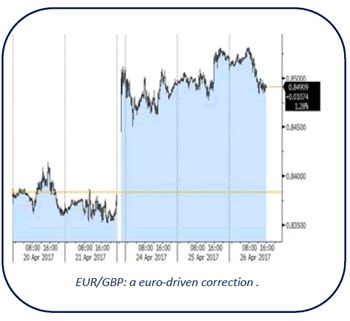
EUR/GBP slightly off the correction top
There were again no eco data in the UK today. The focus was on external factors, especially on the Trump tax plan. In an intraday perspective, the dollar traded stronger against both the euro and sterling. However, the decline of cable was more moderate than was the case for EUR/USD, pushing EUR/GBP back below the 0.85 big figure. After the recent euro rally, the single currency obviously was a more evident target to lock in some profits compared to sterling as cable held a rather tight range earlier this week. EUR/GBP trades currently in the 0.8495 area. Cable trades in the low 1.28 area.
JPY Slide Continues as Markets Eye Trump Tax Announcement
USD/JPY has posted gains in the Wednesday session, continuing the upward trend which marked Tuesday trading. In the North American session, the dollar is trading at 111.50. The Japanese yen has dropped 1.6 percent since Monday and is trading at 4-week highs. In economic news, the sole US event is Crude Oil Inventories, which is expected to post a decline of 1.1 million barrels. Later in the day, the BoJ releases its monetary policy statement. On Thursday, the US releases durable goods orders and unemployment claims, while Japan publishes key consumer data – Household Spending and Tokyo Core CPI.
The Bank of Japan is expected to hold the course and maintain interest rates at -0.10%. The negative rates are part of the BoJ's ultra-loose monetary policy, which is expected to continue until inflation levels move closer to the central bank's target of around 2 percent. Japan's economy has improved in recent months, as a weak yen and stronger global demand have boosted exports and revitalized the manufacturing sector. At the same time, consumer inflation and spending data remains weak, which has weighed on the economy. Household Spending and Tokyo Core CPI, which are key consumer indicators, are both expected to post declines. If these readings are softer than expected, the dollar's rally against the yen could continue.
President Donald Trump has set his sights on tax reform, and is expected to make a key announcement on Wednesday. Of particular interest to the corporate sector, Trump is expected to propose reducing the corporate tax rate from 35% to 15%, and lowering the tax on multinationals' overseas profits from 35% to 10%. Global markets are eagerly awaiting Trump's statement, but if the president is short on details, as has often been the case, the ensuing disappointment from investors could send the dollar downwards.
US consumer confidence levels remain high, but there was some disappointment as CB Consumer Confidence dropped to 120.3 in April, missing the estimate of 123.7. The softer than expected reading boosted the euro in the Monday session. What is troubling analysts is that strong consumer confidence numbers have not translated into increased consumer spending, a key component of economic growth. This trend has been labeled the "hard/soft discrepancy" (confidence being 'soft', while actual spending being 'hard'). This was underscored in March retail sales numbers, which came in at a flat 0.0%, shy of the forecast. Next up is Preliminary GDP on Thursday, which is expected at 1.3 percent. An unexpected GDP reading could have a sharp impact on EUR/USD.
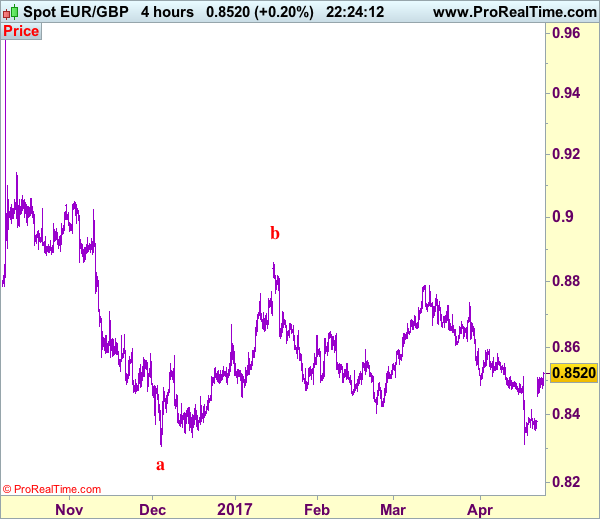
Trade Idea: EUR/GBP – Stand aside
EUR/GBP - 0.8482
Recent wave: Major double three (A)-(B)-(C)-(X)-(A)-(B)-(C) is unfolding and 2nd (A) has possibly ended at 0.6936.
Trend: Near term down
New strategy :
Stand aside
Position : -
Target : -
Stop : -
Despite yesterday’s brief breach of resistance at 0.8512, lack of follow through buying and current retreat suggest consolidation would be seen and pullback to 0.8450 cannot be ruled out, however, reckon previous resistance at 0.8415 (now support) should limit downside and bring another rebound later.
On the upside, above 0.8530-35 would add credence to our view that a temporary low has been formed at 0.8312, hence near term upside risk remains for the rebound from 0.8312 to bring retracement of recent decline to 0.8545-50, however, reckon resistance at 0.8580 would limit upside and 0.8600-10 would hold from here. As near term outlook is mixed, would be prudent to stand aside in the meantime.
Our preferred count is that, after forming a major top at 0.9805 (wave V), (A)-(B)-(C) correction is unfolding with (A) leg ended at 0.8400 (A: 0.8637, B: 0.9491 and 5-waver C ended at 0.8400. Wave (B) has ended at 0.9413 and impulsive wave (C) has either ended at 0.8067 or may extend one more fall to 0.8000 before prospect of another rally. Current breach of indicated resistance at 0.9043 confirms our view that the (C) leg has ended and bring stronger rebound towards 0.9150/54, then towards 0.9240/50.
Trade Idea: USD/CAD – Buy at 1.3500
USD/CAD - 1.3586
Recent wave: Only wave v of c has ended at 0.9407 and wave C of major A-B-C correction is underway for headway to 1.4700
Trend: Near term up
New strategy :
Buy at 1.3500, Target: 1.3650, Stop: 1.3440
Position: -
Target: -
Stop:-
As the greenback has maintained a firm undertone after this week’s anticipated rally, suggesting recent upmove is still in progress and bullishness remains for further gain to 1.3650-60, however, near term overbought condition should prevent sharp move beyond 1.3690-00 and reckon 1.3750-60 would hold on first testing, risk from there is seen for a retreat to take place later.
In view of this, would not chase this rise here and would be prudent to buy again on pullback as 1.3500 should limit downside. Below 1.3440-50 would defer and suggest top is possibly formed but break of indicated support at 1.3411 is needed to provide confirmation, bring further fall to 1.3350 later.
To recap, wave B from 1.3066 is unfolding as an a-b-c and is sub-divided as a: 1.2192, b: 1.2716 and wave c is a 5-waver with i: 1.1983, ii: 1.2506, extended wave iii with minor iii at 1.0206, wave iv ended at 1.0781 and wave v as well as wave iii has ended at 0.9931, hence the subsequent choppy trading is the wave iv which is unfolding as (a)-(b)-(c) with (a) leg of iv ended at 1.0854, followed by (b) leg at 1.0108 and (c) leg as well as the wave iv ended at 1.0674. The wave v is sub-divided by minor wave (i): 0.9980, (ii): 1.0374, (iii): 0.9446, (iv): 0.9913 and (v) as well as v has possibly ended at 0.9407, therefore, consolidation with upside bias is seen for major correction, indicated target at 1.3700 and 1.4000 had been met and further gain to 1.4700 would be seen later.