

Sample Category Title
Geopolitical Concerns Boost Save Havens
Investors are dumping risk assets early Tuesday as geopolitical tensions remained the key catalyst shaking the markets. The move by China to send 150,000 troops to North Korea border over fears that Trump may strike Pyongyang and comments from White House Press Secretary Sean Spicer that additional U.S. intervention could be triggered are putting investors on the defensive side.
The U.S. administration suggested earlier that there's no intention to remove Assad, but if going forward they respond to every barrel bomb attack, this will indicate a full-scale war against the regime. This will of course be considered as crossing the redline with Russia and will be seen asa severe blow to U.S.-Russian relations, which arealready not in their greatest state.
Today, the U.S. Secretary of State Rex Tillerson's visit to Moscow will provide an early indication on how the situation will evolve. If Putin decidesto withdraw the “Order of Friendship Award” once given to Tillerson, markets could become more jittery.
The U.S. dollar edged down slightly, as U.S. Treasury yields fell for the second day. Fed Chair Janet Yellen didn't provide any new catalyst to traders about the prospects for a June hike or how the Fed will proceed with shrinking the balance sheet. She expressed her confidence that the economy will continue to grow at a moderate pace and that rates will increase gradually; however, this was nothing new to investors.
The EURUSD is trading within 20 pips range early Tuesday, after rebounding from a one-month low yesterday. There are less than two weeks until the French votefor President kicks off and so far, opinion polls indicate that Marine Le Pen and Emmanuel Macron will come out ahead in the first round. They also show that Le Pen will lose badly in the 7 May runoff election against either Macron or FrancoisFillon. I will continue to price in some risk premium on "what if things went wrong" and Marine Le Pen became President.However, this risk remains below 10% and this is what's reflected in French government bonds.
Gold and Yen are as usual the primary beneficiaries of the heightened geopolitical tensions. Both are up 0.2% against the dollar today, but I'm more interested in the gold move as it's making a new attempt to close above the 200-day moving average. This marks the sixth attempt in a month gold has triedto break the long-term moving average, but all were unsuccessful in closing above it. If the precious metal was successful in closing above the 200-day moving average for the day and the week, we are likely to see additional upside momentum.
The Most Important Data Release Is The CPI Inflation Data For March Due Out Today
Market movers today
In the US, the NFIB small business opt imism for March is due out . Business opt imism soared after the elect ion of Donald Trump to President . However, given the increased uncertainty about how many of his policies Trump will actually be able to carry through with in pract ice, business opt imism may start to fade – for more informat ion see Strategy: Trumponomics postponed further, 24 March. Tonight , the Fed's Kashkari (voter, dovish) is due to speak.
Today, the euro area indust rial product ion figures for February are due out . January's product ion increased by 0.9% m/m and we est imate a 1.0% monthly increase in February after the very st rong increase in German indust rial product ion.
The German ZEW expectat ions are also due for release today. Like the Sent ix, the ZEW expectat ions should remain on an upward t rend given the st rength of economic data and st rong survey indicators. We believe ZEW expectat ions will rise to 13.7, thus showing lit t le react ion to Art icle 50 being t riggered by the UK and the imminent French elect ion.
In the UK, the most important data release is the CPI inflat ion data for March due out today. We est imate total CPI rose 0.4% m/m in March, implying an unchanged inflat ion rate at 2.3% (CPI core 0.5% m/m and 1.9% y/y).
Selected market news
Fed chief Yellen late evening sent the message that Feds monetary policy task has changed, it is now more a mat ter of get t ing to a neut ral stance. It is no longer necessary to push down the accelerator, but st ill giving some gas. Yellen said she expect s " t he economy t o grow at moderate speed and t hat gradual rat e hikes will t ake us where want t o be".
White House spokesman Sean Spicer's comment s t hat the US might act if the Syrian Government cont inues to use oil barrel bombs against civilians, possibly signalling an increased risk for US intervent ion.
On the Korean peninsula, North Korea crit icised US naval movements calling it a step closer to invasion. The left -oriented South Korean opposit ion leader Moon-Jae, who is leading polls ahead of president ial elect ion on May 9th, also said the US cannot take military act ion without South Korea agreeing.
Trade Idea : USD/JPY – Hold long entered at 110.60
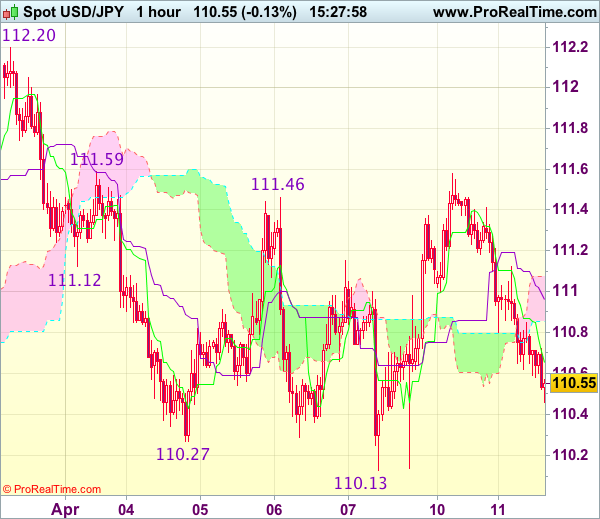
USD/JPY - 110.55
Most recent candlesticks pattern : N/A
Trend : Near term down
Tenkan-Sen level : 110.66
Kijun-Sen level : 110.96
Ichimoku cloud top : 111.08
Ichimoku cloud bottom : 110.86
Original strategy :
Bought at 110.60, Target: 111.60, Stop: 110.25
Position : - Long at 110.60
Target : - 111.60
Stop : - 110.25
New strategy :
Hold long entered at 110.60, Target: 111.60, Stop: 110.25
Position : - Long at 110.60
Target : - 111.60
Stop : - 110.25
Although dollar has remained under pressure after retreating sharp from yesterday’s high of 111.58 and marginal weakness from here cannot be ruled out, reckon 110.25-30 would contain downside and bring another rebound later, above 111.10-15 would suggest the retreat from 111.58 has ended, bring test of 111.58-59 resistance, break there would add credence to our view that further consolidation above recent low at 110.11 would be seen and signal the fall from 112.20 has ended, then a stronger rebound to 111.90-00 would follow but said resistance at 112.20 should hold and choppy trading within 110.11-112.20 would continue.
In view of this, we are holding on to our long position entered at 110.60 but one should exit on such rebound. Below 110.25-30 would risk test of said support at 110.11-13 but only break there would confirm medium term decline has resumed for further subsequent fall to 109.80-85 (1.618 times projection of 112.20-111.12 measuring from 111.59), however, price should hold above 109.50-55 (100% projection of 112.20-110.27 measuring from 111.46).
Currencies: Dollar Cannot Build On Friday’s Positive Price Action
Sunrise Market Commentary
- Rates: Risk aversion dominates thin agenda at start trading week
Overnight, risk sentiment deteriorated on most Asian stock markets. A stronger opening of the Bund will result in an immediate test of 0.2% support for the German 10-yr yield. We don't anticipate a sustained break lower even if risk aversion provides some short term safe haven flows. - Currencies: Dollar cannot build on Friday's positive price action
EUR/USD hovers listless close to 1.06, but USD/JPY is sliding back towards the key 110, helped by some risk-off sentiment in Asian session (lower equities and lower US yields). We nevertheless aren't convinced the Asian trend should infect European and US markets too much. That should keep USD/JPY north of 110
The Sunrise Headlines
- US equities flat lined in the first trading session of the week. Overnight Asian risk sentiment deteriorated with China underperforming (-1%).
- The Federal Reserve's plans to raise US interest rates gradually are aimed at sustaining full employment and near-2-% inflation without letting the economy overheat, Fed Chair Yellen said.
- ECB policy is "appropriate and a reassessment is not warranted at this stage," VP Constancio said. The risk of a regional (Portuguese) real estate bubble is limited, while advocating targeted measures to avoid potential problems.
- A Moody's report titled 'Credit Profiles Resilient to Rising Household Debt and Stretched Housing Affordability' focused on Australia, Canada, New Zealand and Sweden - all AAA rated countries where home prices and household debt have soared in the last three years.
- BoJ Governor Kuroda said the central bank aims for a moderate acceleration of inflation driven by increases in wages and corporate earnings. At this stage, they haven't increased as much as hoped for despite a tightening job market.
- South Africa's central bank said the scope for interest-rate cuts is limited as current policy should be enough to bring inflation to within target range. Price-growth expectations remain "uncomfortably close to 6%", SARB said.
- Today's eco calendar contains EMU industrial production, German ZEW, US NFIB small business optimism and UK inflation data. The Netherlands and the US tap the market ECB Visco and Fed Kashkari are scheduled to speak.
Currencies: Dollar Cannot Build On Friday's Positive Price Action
USD: Uneventful trading yesterday with poor close
The dollar traded fairly uneventful in a news-poor Monday session. Some follow through USD/JPY buying during the Asian session and some minor French election-related risk-off spiced the sideways trading session that ended with some marginal dollar weakening against euro and yen. EUR/USD hovered between about 1.0570 and 1.0608, closing at 1.0596. USD/JPY made a trip to 111.60 from 111.10 in Asian trading, but gradually eased to opening levels before a final down-move pushed it just below 111 with a 1.1094 close. Concluding, an uneventful session, but with a bit of a nasty taste as USD/JPY couldn't build on Friday's gains, despite US equities closing unchanged.
Overnight: Yen higher on risk off and Yellen
Overnight, Yellen said the Fed is shifting from its post-crisis exercise of healing the economy to one aimed at holding on to the progress made (see above). While her comments are quite neutral according to us, US yields are 2 to 3 bps lower overnight. Asian equities are mostly down with some close to flat. The yen is gaining ground together with other safe havens like US Treasuries and gold. USD/JPY slid from 110.95 to an intraday low at 110.60 and trades now slightly higher at 110.67. EUR/USD trades with a slight dollar positive bias, but at 1.0584 from 1.0595 at the opening that doesn't mean much. Calendar heats up, but most second tier data
EMU industrial production is expected to have risen 0.1% M/M and 1.9% Y/Y in February following a stronger 0.9% M/M (and 0.6% Y/Y in January. Risks remain on the downside of expectations. The German ZEW investors' sentiment (expectations) is expected to have risen slightly to 14.8 in April from 12.8 previously, while current conditions remain strong at 77.3. Given the advance of equities and the rise in the Sentix survey, we nevertheless dare to put the risks slightly on the upside of expectations. Finally the US NIFB small business sentiment is expected to have slid marginally in March to 104.7 from 105.3 in February. There may be some early disappointment on Trump's scorecard till now so, risks might be on the downside. The eco data are no strong market movers
No strong catalyst for today's trading
Friday's dollar price action was constructive, as was the rejection of key US yield supports (1.80% for the 5-yr and 2.30% for the 10-yr). This suggested that US yields and widening yield differentials may give the dollar again support. The proof of the pudding is in the eating though and yesterday's price action didn't really support the notion that the dollar is back on the winning side. EUR/USD stabilizes with election risk and geopolitical risk keeping the euro dollar balance intact. The dollar didn't get rate support. On the contrary, yields are down at the onset of European trading. We don't expect much of the eco data. So, sentiment and geopolitical issues will simmer at the background giving FX markets some intraday momentum. We don't see a catalyst for EUR/USD or USD/JPY to take out significant technical barrier, even if EUR/JPY remains dangerously close to the 110 level.
Technicals: Danger USD/JPY not away yet
From a technical point of view, USD/JPY failed to regain the 111.36/60 previous range bottom and approached three times the key 110 support area, but rebounded each time. A decline below 110 would signal more trouble ahead. Friday's price action is a slight positive for the dollar, but we remain cautious on USD/JPY as long as the pair doesn't trade sustainably above 112.20 (neckline ST double bottom). EUR/USD extensively tested the topside of the MT range (1.0874/1.0906 area) two weeks ago, but the test was rejected. EUR/USD returned lower in the 1.0875/1.05 trading range with the odds now for a test of the downside of the range.
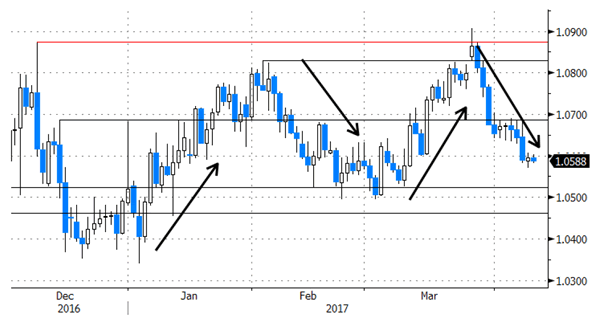
EUR/USD: Nice dollar move on payrolls suggesting the pair may slide towards 1.05 support area or even the cycle lows at 1.0340, but yields should go up
EUR/GBP
Sterling doing somewhat better
Today, the UK eco calendar is busy and interesting from a market point of view. Overnight, the BRC like for like sales disappointed as they dropped 1% Y/Y while a 0.3% M/M drop was expected. A further sign that consumer spending is losing momentum. However, it didn't impact sterling that remained fairly stable against euro and dollar. More important will be the CPI and PPI data for March. The market expects CPI at 0.3% M/M and 2.3% Y/Y unchanged from February, while the core CPI is expected to have eased slightly to 1.9% Y/Y from 2% previously. The weaker sterling is behind the trend increase in inflation, but that trend may pause in March due to some special factors like the late Easter and lower fuel prices. We side with consensus, but any stronger outcome may stimulate expectations on the timing of a rate hike and supports sterling. Similarly both input and output PPI are expected to have slowed in March, even as input prices remain at very high levels. Output price risks are on the upside. Sterling gradually gained ground versus the euro. If inflation surprises on the upside, some more gains are possible. However, EUR/GBP intermediate support looms at 0.8484, a level which won't be easily broken. Mid-March, sterling found a better bid after higher than expected UK inflation and a more hawkish tone from the BoE. We changed our short-term bias on EUR/GBP from positive to neutral. The EUR/GBP 0.88/0.84 range should guide trading for now. Last week, sterling rally/shortsqueeze ran into resistance, but we see no trigger for a real change in sentiment.
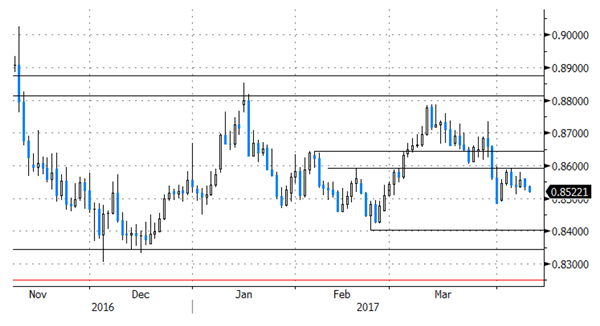
EUR/GBP sterling short-squeeze is easing, but no sustained sterling correction yet
Market Update – Asian Session: North Korea Saber-Rattling, Russian Role In Syria Continue To Spook Investors
US Session Highlights
(CA) CANADA MAR ANNUALIZED HOUSING STARTS: 253.7K V 215.5KE
(MX) Mexico Mar Nominal Wages Y/Y: 4.7% v 4.6% prior
(US) Mar Labor Market Conditions Index Change: 0.4 v 1.0e
Equities started the week with the same sentiment as they finished the last, with stocks trending mostly sideways and major indices closing flat to slightly higher. Markets are still treading cautious ground. Higher crude prices helped the S&P, with energy the best performing sector, gaining 0.9% on the day.
US markets on close: Dow flat, S&P500 +0.1%, Nasdaq +0.1%
Best Sector in S&P500: Energy
Worst Sector in S&P500: Telecom
Biggest gainers: WFM +10.0%; FSLR +4.3%; HES +4.0%
Biggest losers: MU -3.1%; NVDA -2.6%; INCY -2.3%
At the close: VIX 14.1 (+1.2pts); Treasuries: 2-yr 1.26% (-1bps), 10-yr 2.36% (-1bps), 30-yr 2.99% (-1bps)
US movers afterhours
SALE: Acquired for $11.60/shr in cash by Harland Clarke Holdings; +49.0% afterhours
SVU: To acquire Unified Grocers for $384M in cash and stock deal; +9.8% afterhours
SEAC: Reports Q4 -$0.06 v -$0.05e, R$23.8M v $23.1Me; -3.3% afterhours
Politics
(US) Alabama Gov Bentley (R) resigns after pleading guilty to campaign finance violations - press
(US) Full Virginia Court to hear Pres Trump's appeal of his overturned travel ban executive order - press
(FR) France IFOP daily presidential poll: Second round poll: Macron 58% (-1.0pts), Le Pen 42% (+1pts)
Key economic data
(AU) AUSTRALIA MAR NAB BUSINESS CONFIDENCE: :6 V 7 PRIOR; CONDITIONS: 14 V 9 PRIOR
(NZ) NEW ZEALAND MAR CARD SPENDING M/M: -0.3% V +0.5%E (2nd consecutive decline); TOTAL M/M: +0.5% V -0.7% PRIOR
Asia Session Notable Observations, Speakers and Press
Asian equity markets are largely lower, led by near 1% drop in Hong Kong where sentiment soured on energy, tech, and gaming sectors. Australia is resilient with a modest gain, as most mining and financials names turned higher. US and European futures are also lower, while FX majors appear to be succumbing to renewed risk-off flows - USD/JPY is down over 30pips from the highs below 110.60, while AUD and NZD were slightly lower against the greenback late in the day.
In the absence of regional catalysts, renewed profit-taking has been attributed to ongoing geopolitical uncertainty on the Korean peninsula and in the Middle East. In North Korea, Kim Jong Un said to have vowed the "toughest" counteraction against the United States in response to US dispatching USS Carl Vinson aircraft carrier over the weekend. In Syria, there is chatter that Russia may have known about Assad's intentions to carry out a chemical attack against the rebels. Note that US State Sec Tillerson is set to travel to Moscow this week, but will only meet with his counterpart since Putin did not extend his audience to US official.
Traders tuned in to Fed Chair Yellen's discussion at University of Michigan mostly to hear familiar rhetoric. Yellen said the Fed's estimate of neutral fed funds rate is not very high, reiterating intentions to continue to gradually raise interest rates. Fed chair added that unemployment of 4.5% is now below where most of her colleagues would consider to be full employment. On inflation she said she would prefer that it does not linger above or below the 2% target, adding that it is close to objective.
Ahead of Australia's critical employment report later this week, NAB Business Conditions data hit post-GFC highs, briefly sending AUD/USD about 0.75. NAB economist said "Conditions have improved almost across the board to levels that suggest a strong economy in the near term."
China
(CN) China Premier Li: China hopes for progress in investment treaty negotiations with US - Xinhua
(CN) China Q1 railway cargo volume +15.3% y/y
(CN) US may punish China companies that are involved with North Korea weapons
Japan
(JP) Bank of Japan (BOJ) Gov Kuroda: Japan is out of the deflationary situation of falling prices
(JP) Japan Fin Min Aso: Need to create economic conditions to allow sales tax hike
Australia/New Zealand
(NZ) New Zealand opposition Labour party's finance spokesman Robertson: Expanding RBNZ focus to inflation and employment would bring New Zealand in line with Australia and US - NZ Press
Korea
(KR) North Korea vows to take the "toughest" counteraction against the United States; We will hold the US wholly accountable for the catastrophic consequences to be entailed by its outrageous actions
(KR) South Korea acting President Hwang: Have asked military to expand monitoring over North Korea
(KR) US, South Korean and Japanese envoys to hold six-party talks - Japanese press
Asian Equity Indices/Futures (00:00ET)
Nikkei -0.6%, Hang Seng -0.8%, Shanghai Composite -0.5%, ASX200 +0.4%, Kospi -0.6%
Equity Futures: S&P500 -0.1%; Nasdaq -0.1%, Dax -0.2%, FTSE100 -0.1%
FX ranges/Commodities/Fixed Income (00:00ET)
EUR 1.0580-1.0605; JPY 110.60-110.90; AUD 0.7495-0.7515; NZD 0.6940-0.6970
June Gold +0.3% at 1,257/oz; May Crude Oil flat at $53.09/brl; May Copper +0.2% at $2.61/lb
SPDR Gold Trust ETF daily holdings rise 1.8 tonnes to 838.3 tonnes; highest since Mar 15th
(CN) PBoC skips open market operations for 12th straight session; drains net CNY20B
(CN) PBOC SETS YUAN MID POINT AT 6.8957 V 6.9042 PRIOR; first stronger setting in 4 sessions
(JP) Japan MoF sells 10-yr 0.1% inflation linked bonds; bid-to-cover 3.64x v 2.61x prior
(AU) Australia MoF (AOFM) sells A$150M in 3.0% 2025 Bonds; avg yield: 0.5408%; bid-to-cover: 3.00x
Asia equities / Notables / movers
Australia
AHY.AU Asaleo Care -8.0% (Credit Suisse downgrades)
SAR.AU Saracen Mineral Holdings -4.5% (Q3 result)
AAD.AUArdent Leisure Group -1.7% (UBS downgrades)
VLA.AU Viralytics +2.3% (Q3 result)
CDV.AU Cardinal Resources +1.7% (Namdini Gold Project)
Japan
6502.JP Toshiba -2.5% (may release earnings this week w/out auditor approval)
3769.JP GMO Payment Gateway -5.5% (Goldman Sachs downgrades)
6758.JP Sony -1.0% (To split off battery operations to Murata)
4631.JP DIC Corp -2.4% (Q1 results speculation)
Hong Kong
489.HK Dongfeng Motor -0.7% (Mar result)
1238.HK Powerlong Real Estate Holding -1.3% (Mar result)
568.HK Shandong Molong Petroleum Machinery +6.3% (to cut costs)
2611.HK Guotai Junan Securities Co -1.2% (H share debut)
China
300104.CN Leshi Technology -2.4% (to cut US jobs)
000725.CN BOE Technology Group Co -2.4% (annual result)
Australia’s Business Conditions Index Soared To Its Highest Level In 9 Years In February
For the 24 hours to 23:00 GMT, the AUD rose 0.27% against the USD and closed at 0.7511.
LME Copper prices declined 0.7% or $39.0/MT to $5731.0/MT. Aluminium prices declined 0.03% or $0.5/MT to $1929.0/MT.
In the Asian session, at GMT0300, the pair is trading at 0.7497, with the AUD trading 0.19% lower against the USD from yesterday's close.
Earlier in the session, Australia's NAB business conditions index jumped to a level of 14 in March, surging to its highest level since February 2008 and hinting that the economy could be strengthening. The index registered a level of 9 in the prior month. In contrast, the nation's NAB business confidence index eased to a level of 6.0 in March, compared to a level of 7.0 in the preceding month.
The pair is expected to find support at 0.7475, and a fall through could take it to the next support level of 0.7453. The pair is expected to find its first resistance at 0.7516, and a rise through could take it to the next resistance level of 0.7535.
Moving ahead, traders would keep a close watch on Australia's Westpac consumer confidence index for April, scheduled to release in the early hours' tomorrow.
The currency pair is showing convergence with its 20 Hr and 50 Hr moving averages.

Euro-Zone’s Sentix Investor Confidence Sharply Improved In April
For the 24 hours to 23:00 GMT, the EUR rose 0.2% against the USD and closed at 1.0598, after the Euro-zone's Sentix investor confidence index advanced to a level of 23.9 in April, strengthening to its highest level in almost a decade as investors emancipated themselves from uncertainty surrounding the French Presidential election. Markets were expecting the index to rise to a level of 21.0, after recording a level of 20.7 in the prior month.
The greenback traded higher lower against a basket of major currencies, after the Federal Reserve (Fed) Chairwoman, Janet Yellen, struck a cautious tone, stating that it would be appropriate to raise interest rates gradually if the economy continues to perform well. Nevertheless, she also added that the US economy is healthy and the Fed is close to reaching its policy objectives.
On the data front, the US labour market conditions index dropped more-than-anticipated to a level of 0.4 in March, compared to a revised level of 1.5 in the preceding month, while investors had envisaged the index to drop to a level of 0.8.
In the Asian session, at GMT0300, the pair is trading at 1.0583, with the EUR trading 0.14% lower against the USD from yesterday's close.
The pair is expected to find support at 1.0565, and a fall through could take it to the next support level of 1.0548. The pair is expected to find its first resistance at 1.0603, and a rise through could take it to the next resistance level of 1.0624.
Trading trend in the Euro today is expected to be determined by the release of ZEW expectations index for April across the Euro-zone accompanied with the region's industrial production data for February, slated in a few hours. Moreover, the US NFIB small business optimism index for March, due to release later in the day, will be closely watched by traders.
The currency pair is showing convergence with its 20 Hr moving average and trading below its 50 Hr moving average.

UK’s BRC Retail Sales Dropped To Its Lowest Level Since August 2015 In March
For the 24 hours to 23:00 GMT, the GBP rose 0.33% against the USD and closed at 1.242.
In the Asian session, at GMT0300, the pair is trading at 1.2419, with the GBP trading slightly lower against the USD from yesterday's close.
Overnight data indicated that UK's BRC like-for-like retail sales declined more-than-anticipated by 1.0% YoY in March, recording its sharpest decline since August 2015. Markets expected BRC retail sales to fall 0.3%, following a drop of 0.4% in the preceding month.
The pair is expected to find support at 1.2384, and a fall through could take it to the next support level of 1.2349. The pair is expected to find its first resistance at 1.2442, and a rise through could take it to the next resistance level of 1.2465.
Going ahead, investors will look forward to UK's consumer price inflation data for March, slated to release in a few hours.
The currency pair is showing convergence with its 20 Hr and 50 Hr moving averages.

Japan’s Eco Watchers Current Situation And Future Outlook Indices, Both Dropped Surprisingly In March
For the 24 hours to 23:00 GMT, the USD declined 0.65% against the JPY and closed at 110.73.
In economic news, Japan's Eco-watchers survey for current situation index surprisingly dropped to a level of 47.4 in March, defying market consensus for a rise to a level of 49.8, highlighting that investors are getting more pessimistic over the health of the nation's economy. The index registered a level of 48.6 in the previous month. Moreover, the nation's Eco-watchers survey for future outlook index unexpectedly declined to a level of 48.1 in March, compared to a level of 50.6 in the preceding month and compared to market expectations for a rise to a level of 50.7.
In the Asian session, at GMT0300, the pair is trading at 110.68, with the USD trading slightly lower against the JPY from yesterday's close.
The pair is expected to find support at 110.34, and a fall through could take it to the next support level of 110. The pair is expected to find its first resistance at 111.28, and a rise through could take it to the next resistance level of 111.88.
Looking ahead, market participants focus on Japan's flash machine tool orders for March, slated to release in some time.
The currency pair is trading below its 20 Hr and 50 Hr moving averages.

Swiss Franc Trading On A Weaker Footing This Morning
For the 24 hours to 23:00 GMT, the USD declined 0.17% against the CHF and closed at 1.0081.
On the data front, Switzerland’s total sight deposits advanced to a level of CHF564.1 billion in the week ended 07 April, from CHF561.7 billion reported in the previous week.
In the Asian session, at GMT0300, the pair is trading at 1.0088, with the USD trading 0.07% higher against the CHF from yesterday’s close.
The pair is expected to find support at 1.0072, and a fall through could take it to the next support level of 1.0055. The pair is expected to find its first resistance at 1.0106, and a rise through could take it to the next resistance level of 1.0123.
Amid no economic releases in Switzerland today, trading trend in the CHF is expected to be determined by global macroeconomic news.
The currency pair is showing convergence with its 20 Hr moving average and trading above its 50 Hr moving average.
