Sample Category Title
USD/JPY Technical: Recent Mean Reversion Eebound in US Dollar Strength May Have Hit a Ceiling
- The recent week of Japanese yen weakness is likely driven by “political jawboning”
- The current jump in the JPY implied volatility index has reached an overstretched condition that suggests a potential pause in the recent USD/JPY’s up move.
- A break below 143.60 intermediate support on the USD/JPY may trigger renew weakness.
Since our prior publication, the price actions of USD/JPY have shaped the expected mean reversion rebound and hit the lower limit of the 146.90/149.30 key medium-term resistance zone (printed a high of 147.24 on Thursday, 3 October).
The USD/JPY rebounded by 5.5% (766 pips) from its 16 September low of 139.58 to its 3 October high and on Wednesday, 2 October, its daily gain of 2% was the most on record in the past two years.
Political jawboning led to the recent JPY weakness
The recent week of Japanese yen weakness has been primarily driven by “political jawboning” rather than a major change in Japan and the US macro drivers.
The newly elected Liberal Democratic Party leader and Japanese Prime Minister Shigeru Ishiba, a known supporter of higher interest rates to boost Japan Inc’s profitability has “abruptly’ reversed his preference to advocate an accommodative monetary policy in a press interview conducted on Sunday, 29 September.
In addition, after his meet-up with the Bank of Japan (BoJ) Governor Ueda on Wednesday, 2 October, Ishiba reiterated to the media that Japan is not in a conducive environment for additional interest rate increases.
The main reason for Japanese Prime Minister Ishiba’s current dovish stance on monetary policy is likely to be seeking for a higher chance of winning the electorate’s support for his Liberal Democratic Party in the upcoming 27 October snap election.
Technical factors are suggesting a potential pause in JPY weakness
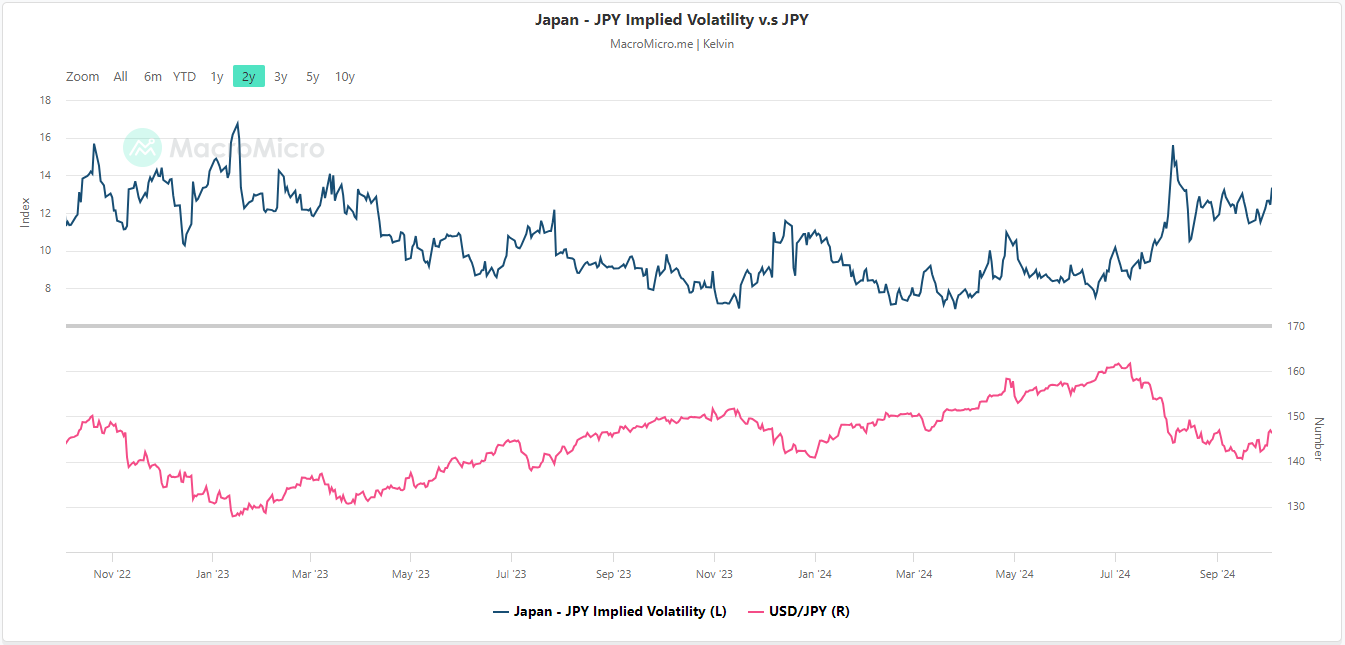
Fig 1: JPY implied volatility index with USD/JPY as of 4 Oct 2024 (Source: Macro Micro, click to enlarge chart)
The JPY implied volatility index has staged a steep push-up from 11.51 last Friday, 27 Friday to a current level of 13.34 at this time of the writing and broke above the recent peak of 13.22 printed on 5 September (see Fig 1).
Hence, the movement depicted in the JPY implied volatility index suggests that the recent corresponding bounce seen in the USD/JPY over the same period is likely to have reached an overstretched condition that in turn may reduce the odds of a further upside movement at this juncture.
Daily RSI of USD/JPY has flashed out a bearish condition
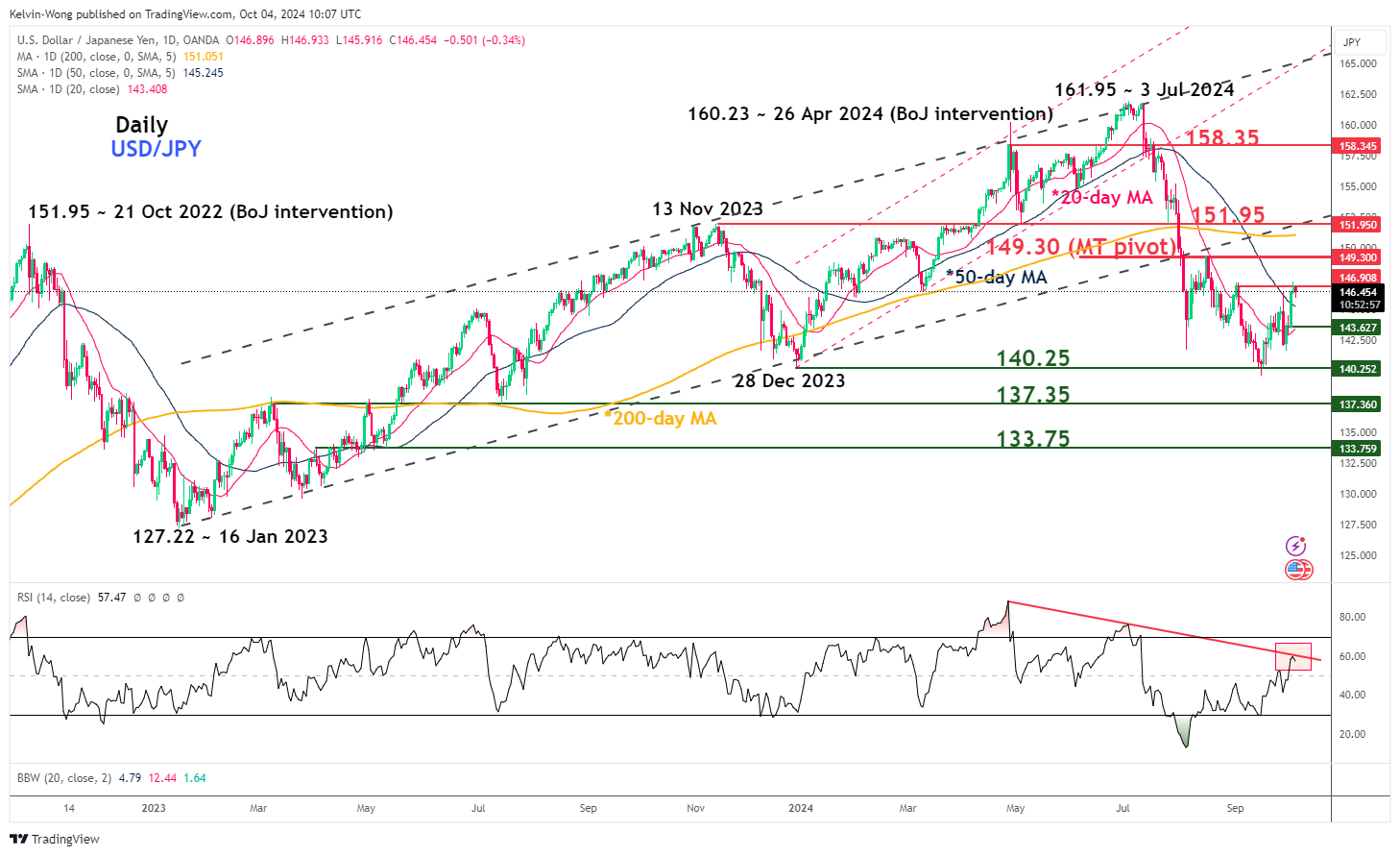
Fig 2: USD/JPY medium-term trend as of 4 Oct 2024 (Source: TradingView, click to enlarge chart)
The daily RSI momentum indicator of the USD/JPY has staged an intraday bearish reaction right at a corresponding trendline resistance in place since 26 April 2024 which suggests a potential pause in the upside momentum of the recent price actions rally from 30 September to 3 October (see Fig 2).
A break with a daily close below 143.60 key intermediate support (also the 20-day moving average) may trigger a new potential impulsive downside sequence of its medium-term downtrend phase to expose the medium-term supports at 140.25, and 137.35 in the first step.
On the other hand, a clearance above 149.30 key medium-term pivotal resistance invalidates the bearish scenario for an extension of the mean reversion rebound for the next medium-term resistance to come in at 151.95 (also close to the 200-day moving average).
NFP Preview – US Jobs Report and Potential Impact on S&P 500
- US Non-Farm Payroll (NFP) data release is highly anticipated amidst shifting expectations of a Fed rate cut.
- Market predictions for the NFP report vary, with analysts split on expected figures.
- S&P 500 technical analysis reveals a bullish triangle pattern, will the bulls finish the week strong?
NFP Preview: What to Expect
Market participants are waiting on today’s jobs report from the US in a week that has seen geopolitical risk take hold of market sentiment. The Iranian attack on Israel which came without much warning really seemed to spook markets and continues to play a role in Oil and Gold prices in particular. This begs the question… will the jobs report be overshadowed by the geopolitical risk?
Heading into the jobs report and market expectations have seen a significant shift this week following pushback from Fed Chair Powell and others around another 50 bps cut in November. This has seen markets aggressively price in a 25 bps cut which has led to a revival of sorts for the US Dollar.
The expected payroll figure is 150k, but more attention should be given to the unemployment rate, which is anticipated to remain steady at 4.2%. A slight miss of these expected figures is unlikely to change the Fed outlook but could lead to some short term spikes across a host of markets.
The data is likely to face scrutiny given that we have seen 16 of the last 19 job reports face a downward revision. This is unprecedented as the 2008 financial crisis did not result in as many downgrades as we have seen this year. Analysts already seem to be split on the print they expect, with UBS and Goldman Sachs predicting 180k and 165k respectively. Kalshi and Factset however are on the more moderate end of the prediction scale, eyeing a print of 148k and 140k respectively.
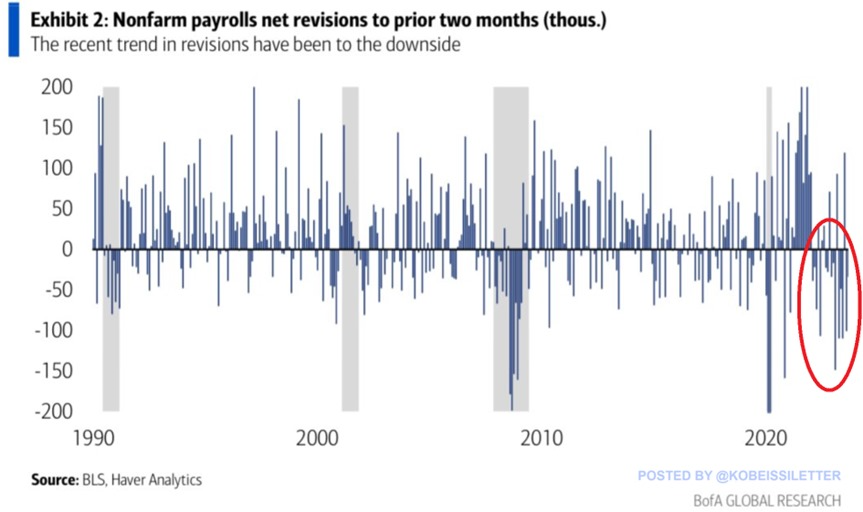
Source: BLS, Haver Analytics, BofA Research, Kobeissi Letter
My takeaway from all of this is that we would need to see a significant miss or downward revision to the jobs numbers for any significant movements to take place today. Anything else is likely to result in short-term spikes with little to no follow through.
There are a host of assets that are hovering near key areas of support and resistance which is why the NFP report is still being closely watched. The US Dollar Index (DXY), EUR/USD, GBP/USD and Gold are among those assets trading near or at key levels.
As for US Equities, the Nasdaq 100 and S&P 500 are also near recent highs and have also retreated following Powell’s comments this week. The threat of regional war in the Middle East and potential threats to supply chains and oil prices are also keeping markets on edge.
Potential Impact on the S&P 500
Looking at the data release, I have compiled a list of what the potential impact on the S&P 500 could be depending on the wage growth and NFP number. This is just my expectations and no guarantee that this is the reaction we may get from markets but could be a useful guide.
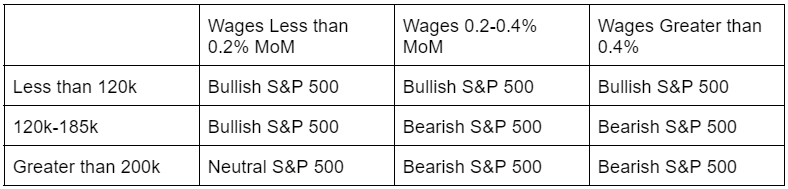
Table Created by Zain Vawda
Technical Analysis S&P 500
Looking at the S&P 500 chart below and the pullback this week has actually been a positive for potential bulls looking to get involved.
The technical triangle pattern which saw a breakout last week is still in play and following the pullback may be ready to continue its move higher. The NFP may just be the catalyst needed to give the S&P the impetus for further upside.
S&P 500 Daily Chart, October 4, 2024
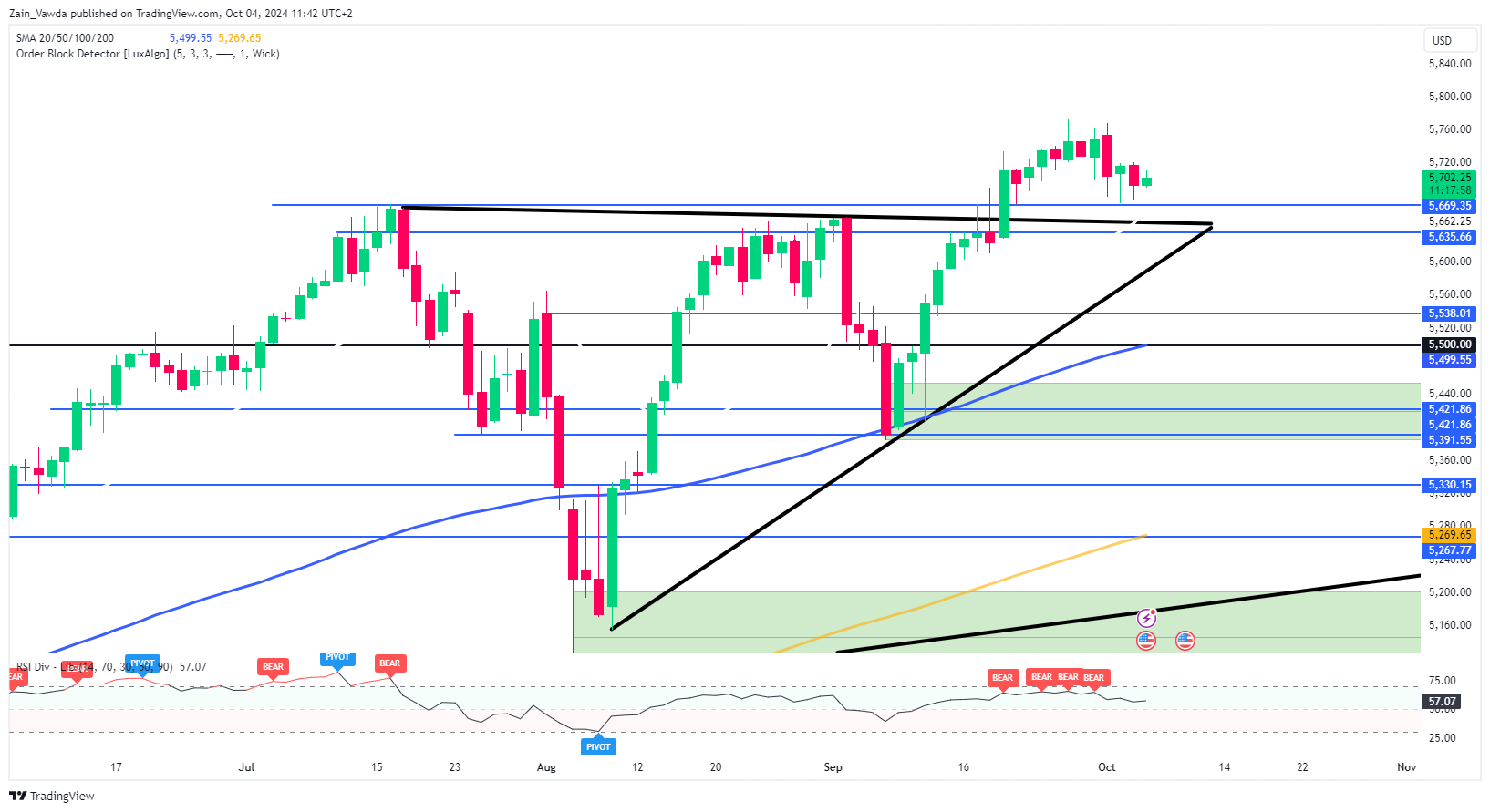
Source: TradingView (click to enlarge)
Support
- 5669
- 5635
- 5538
Resistance
- 5760
- 5910
- 6000
EUR/USD Outlook: Bears Hold Grip and Pressure Key 1.1000 Support Zone Ahead of US Labor Data
EURUSD remains firmly in red and trading near the lowest level in almost one month on Friday morning.
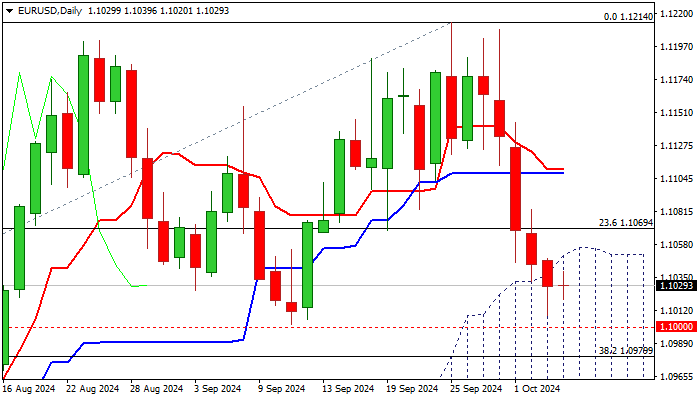
Bears eye key supports at 1.10 zone (psychological / Sep 11 higher low / Fibo 38.2% of 1.0601/1.1204 uptrend) break of which to generate reversal signal on breach of the floor of multi-week consolidation range and completion of a double-top pattern on daily chart.
Bears broke through initial Fibo support at 1.1069 (23.6%) and penetrated into ascending thick daily Ichimoku cloud (spanned between 1.1056 and 1.0933) with weekly close within the cloud to contribute to negative outlook.
Rising negative momentum and converging 10/20 MA’s in bearish setup and about to create a bear-cross, add pressure, but partially countered by oversold conditions and anticipated stronger headwinds from thick daily cloud and strong 1.10 support zone.
We look for firmer signals on sustained break below 1.10 zone or bounce and close above cloud top, which would ease immediate downside risk, further bullish signals to be expected on rally through converged daily Tenkan / Kijun-sen (1.1111/08).
Fundamentals work against Euro, as the ECB got more support for further rate cuts after inflation fell below 2% target, while EU composite PMI fell below 50 threshold in September, signaling contraction.
Release of US labor data for September is expected to play a key role today, with Nonfarm payrolls expected to rise moderately (Sep 147K f/c vs Aug 142K) average earnings to ease (Sep m/m 0.3% f/c vs Aug 0.4% and unemployment to remain unchanged at 4.2% in September).
If hiring in the US falls below expectations and particularly dips below 100K trigger, it will signal that US labor market is cooling and add to bets for another outsized Fed rate cut next month, providing strong support to the single currency.
Conversely, stronger than expected NFP numbers would inflate Dollar and increase pressure on Euro.
Res: 1.1056; 1.1069; 1.1110; 1.1144.
Sup: 1.1000; 1.0980; 1.0930; 1.0907.
USDCAD Holds on Recovery Action as NFP Report Awaited
- USDCAD returns above 20-day EMA and familiar constraining line
- Technical signals cannot warrant a meaningful rally
- September’s US nonfarm payrolls due at 12:30 GMT
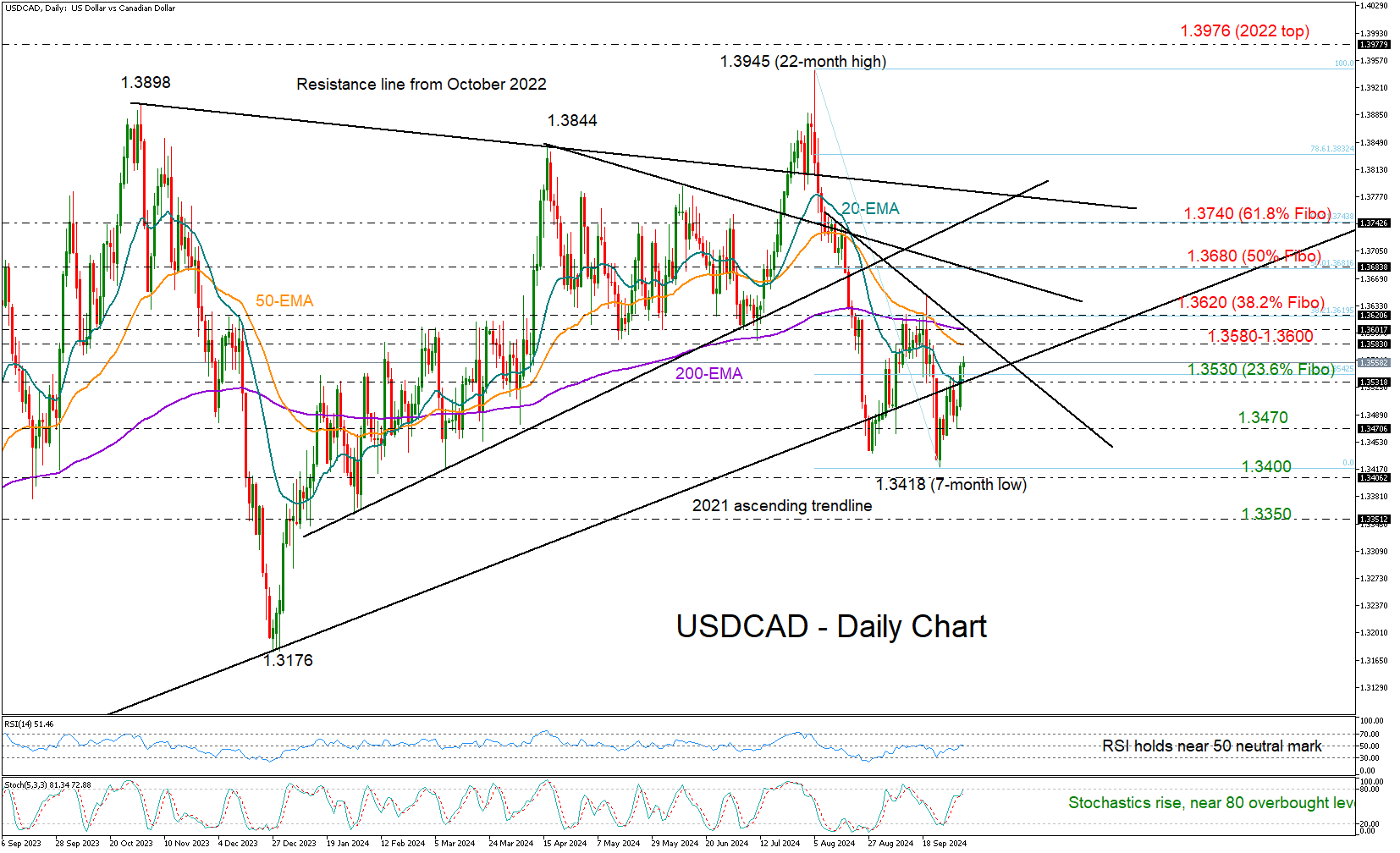
USDCAD continued its upward movement from a seven-month low of 1.3418, surpassing its 20-day exponential moving average (EMA) and the constraining ascending line from the 2021 low.
The range of 1.3580-1.3620, which encapsulates the 50- and 200-day EMAs as well as the 38.2% Fibonacci retracement of the latest downleg is the next target on the upside. A successful penetration higher could see an acceleration towards the 50% Fibonacci of 1.3680. Further up, the bulls may head for the 61.8% Fibonacci of 1.3740.
However, caution may be necessary based on the technical picture. There is no improvement in trend signals as the EMAs continue to point downwards. Moreover, the RSI has yet to step clearly above its 50 neutral mark and the stochastic oscillator is already very close to its 80 overbought level.
Nevertheless, sellers may stay on the sidelines until the price slips below the 20-day EMA at 1.3530. If this situation occurs, there could be immediate support around 1.3470, and then the bears may push for a close below 1.3400 with scope to reach the 1.3350 barrier from January 2024.
Briefly, there may be constraints on how much USDCAD can rise in the near future. For a decisive rally the pair may need to pierce through 1.3620, whilst a drop below 13530 might be enough to resume selling interest.
Crypto Market Awaits News
Market picture
The crypto market has significantly slowed its decline, losing 0.3% in the last 24 hours to $2.12 trillion. However, this calm is more due to a lull ahead of major news than a change in sentiment.
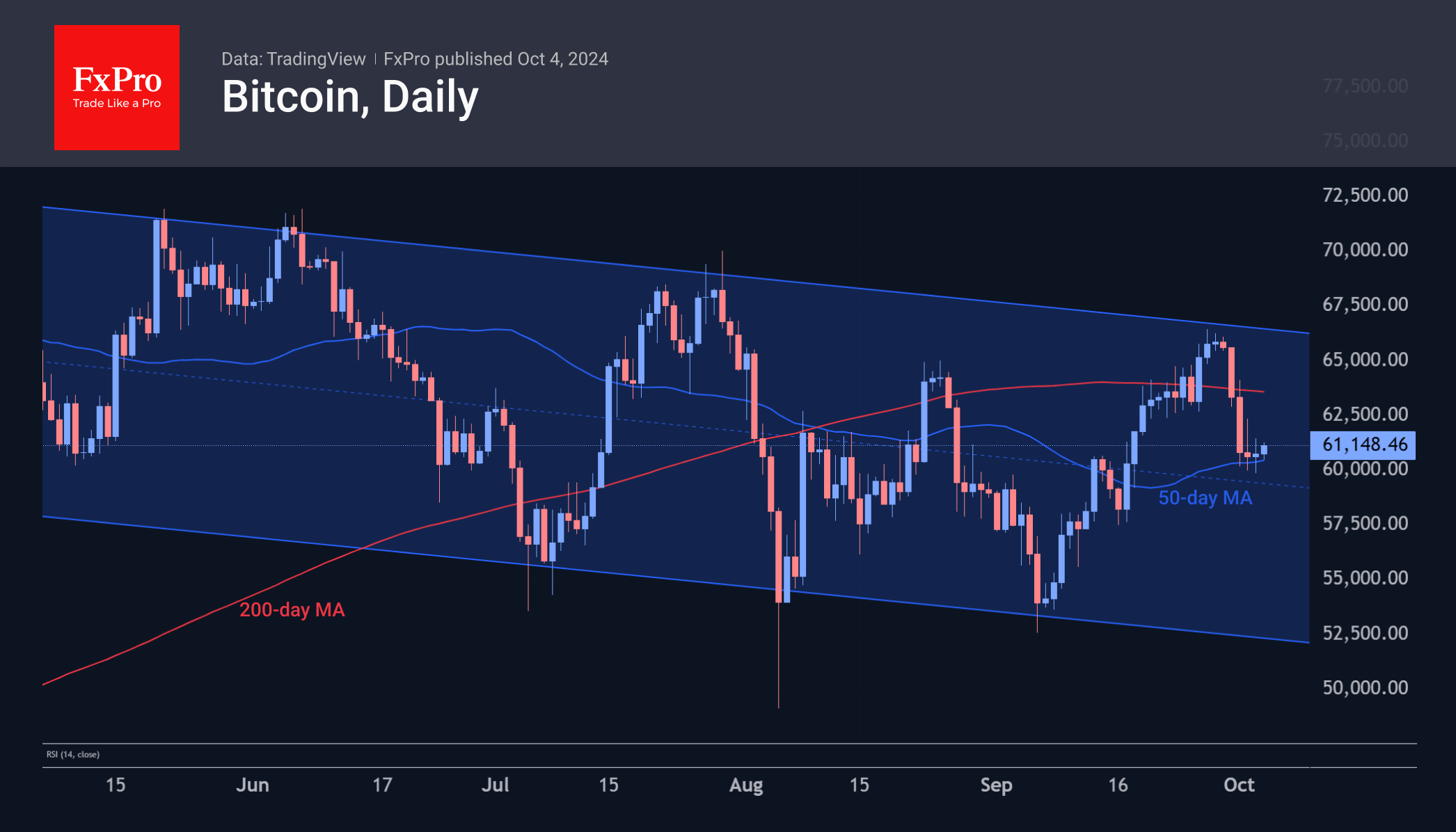
Bitcoin remains just above its 50-day moving average at $61,150 and is virtually unchanged for the day. The prolonged consolidation sets up a strong move in the event of a breakout or bounce from a key level. A local victory for the bulls can be declared on a break above $64K and for the bears on a failure below $60K.
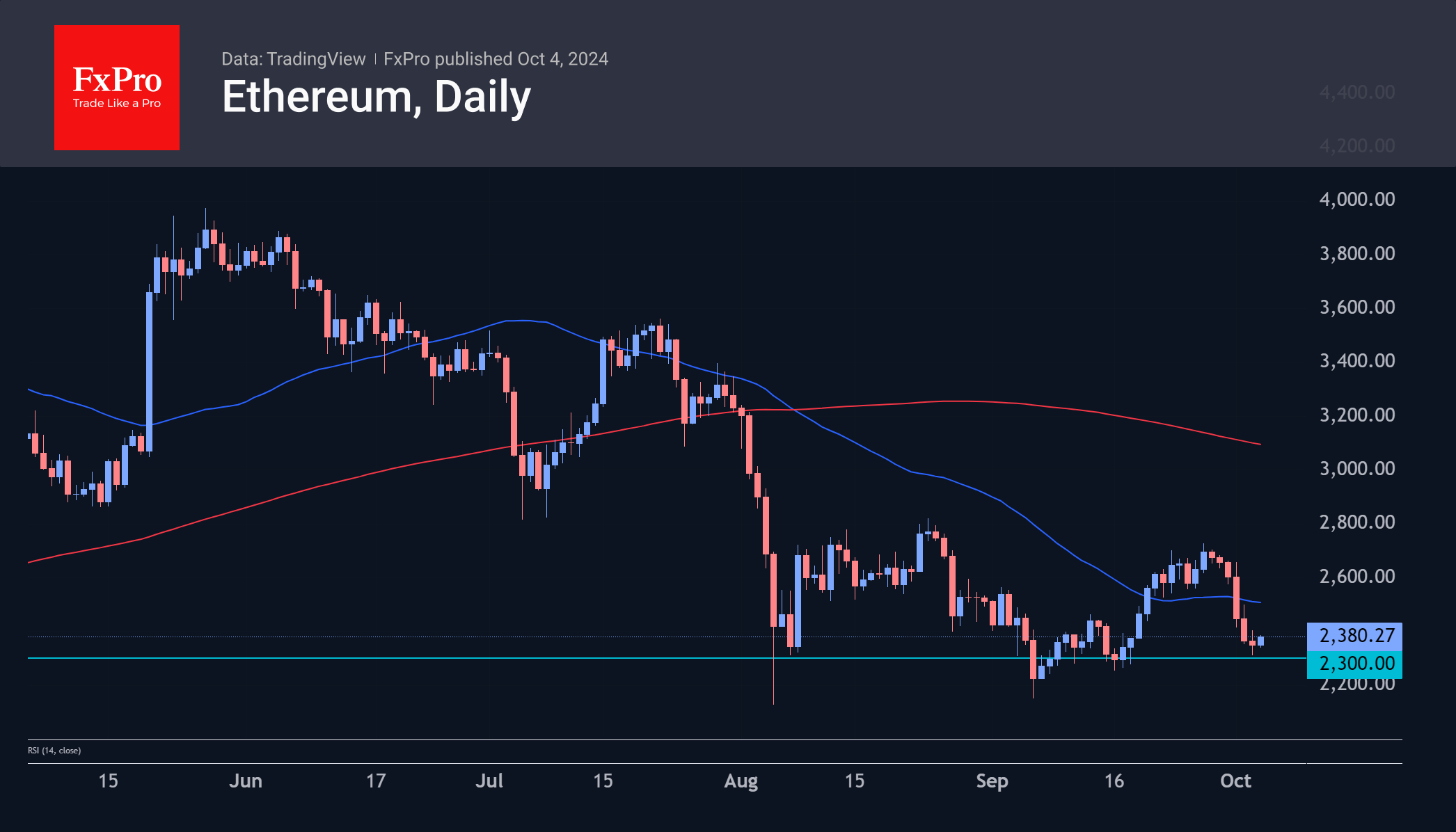
Ethereum is trading at $2,380 (-0.3% in 24 hours), near the bottom of its range since early August. The lacklustre performance of the second-largest cryptocurrency is perhaps indicative of the market’s true sentiment, as it is less tied to traditional finance.
News background
Investors remain confident in the long-term prospects of BTC-ETFs despite the correction. Issuers of spot bitcoin-ETFs have redeemed 911,000 BTC – 4.6 per cent of the available supply of digital gold, Glassnode calculated.
Bitcoin’s bullish phase has accelerated and is 100 days ahead of historical data, according to a CoinMarketCap report. Based on this assumption, BTC’s potential peak would come in mid-May or June 2025.
The U.S. SEC has appealed an August court ruling in a lawsuit against Ripple. CEO Brad Garlinghouse confirmed that Ripple has no concerns about the status of XRP and is prepared to continue its legal battle with the regulator.
The SEC announced Gurbir Grewal’s resignation as director of the Division of Enforcement after three years on the job. The crypto community called him the ‘mastermind behind the SEC’s attack’ on cryptocurrencies but questioned the change in policy after his departure.
The bankrupt FTX will sell 22.3 million blocked Worldcoin (WLD) tokens valued at approximately $36.1 million via auction at a significant discount. The discount to the current price of the asset could be 40%-75%.
EUR/USD Hits Three-Week Low Amid ECB Easing Expectations
The EUR/USD pair has descended to 1.1027, marking its lowest point in three weeks. The drop reflects market anticipation that the European Central Bank (ECB) will continue to ease monetary policy aggressively, spurred by sluggish economic growth and inflation rates falling below the ECB’s 2% target in the Eurozone.
Recent data revealed that the Eurozone’s annual Consumer Price Index decreased to 1.8% in September, the lowest since April 2021 and below the forecasted 1.9%. Moreover, core inflation dipped to 2.7% year-on-year from 2.8%, contrary to expectations of remaining steady. These weaker-than-expected inflation figures have reinforced the likelihood of a rate cut at the upcoming ECB meeting in October, which would mark the third reduction in borrowing costs this year. The market currently places a 95% probability on a 25-basis-point cut.
Robust statistics from the US services sector have further pressured the EUR/USD exchange rate, adding to the euro's woes.
With a significant day ahead, the focus is now on the US job market reports, including the unemployment rate, Nonfarm Payrolls (NFP), and average wages, which could further influence the pair’s movements.
EUR/USD technical analysis
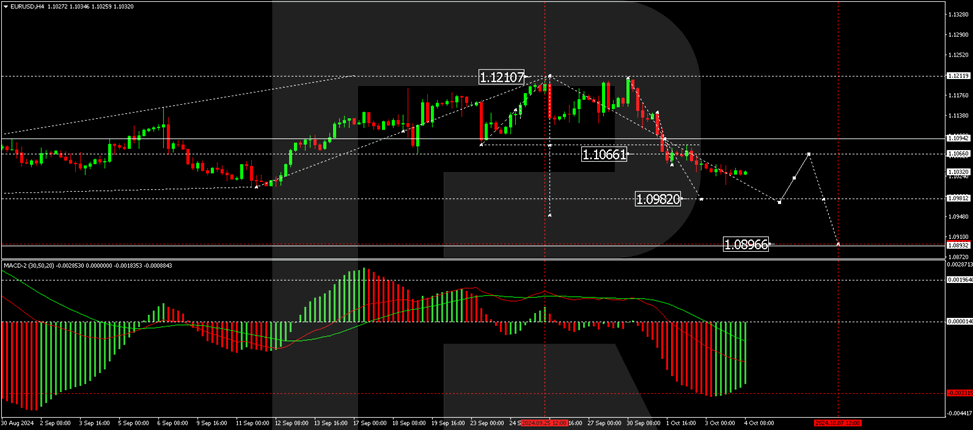
The EUR/USD pair recently completed a downward wave to 1.1008, followed by a corrective rise to 1.1039. Today, the expectation is for a decline to 1.0982. After reaching this target, a potential corrective movement to 1.1066 may occur. Following this correction, another downward wave to 1.0966 is anticipated. The MACD indicator supports this bearish outlook, with its signal line positioned below zero and trending downwards.
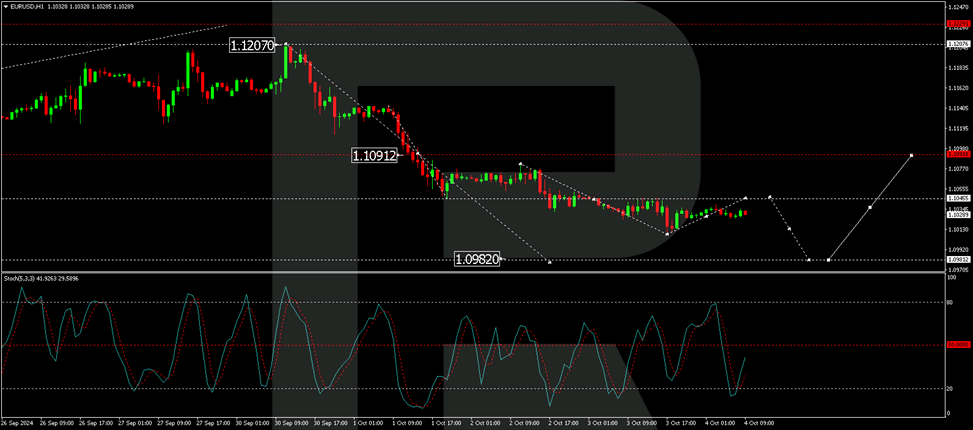
On the hourly chart, the EUR/USD continues to develop its third wave of decline towards 1.0982. The pair formed a consolidation range around 1.1046 and achieved a local target at 1.1008 with a downward exit. A corrective move up to 1.1045 is expected today, which will likely be tested from below. Following this correction, a continued decline to 1.0982 is anticipated. The Stochastic oscillator corroborates this bearish scenario, with its signal line below 50 and poised to descend towards 20.
BoE’s Pill warns against cutting rates too quickly
In a speech today, Bank of England Chief Economist Huw Pill urged "caution in" reducing monetary policy restrictions, emphasizing the need for a "gradual" approach to rate cuts.
Pill highlighted that his "modal outlook" aligns with a scenario of "continued disinflation," but warned that this depends on maintaining a "restrictive monetary policy stance to bear down on inflationary pressures."
He stressed the importance of caution, noting there is still "ample reason" to carefully assess whether inflationary persistence is fully dissipating. While further reductions in the Bank Rate are expected if the economic and inflation outlook remains on track, Pill warned against the risk of "cutting rates either too far or too fast."
Pill was one of the four dissenting members of the MPC who voted against BoE's rate cut in August, underscoring his preference for a more measured approach in unwinding monetary tightening.
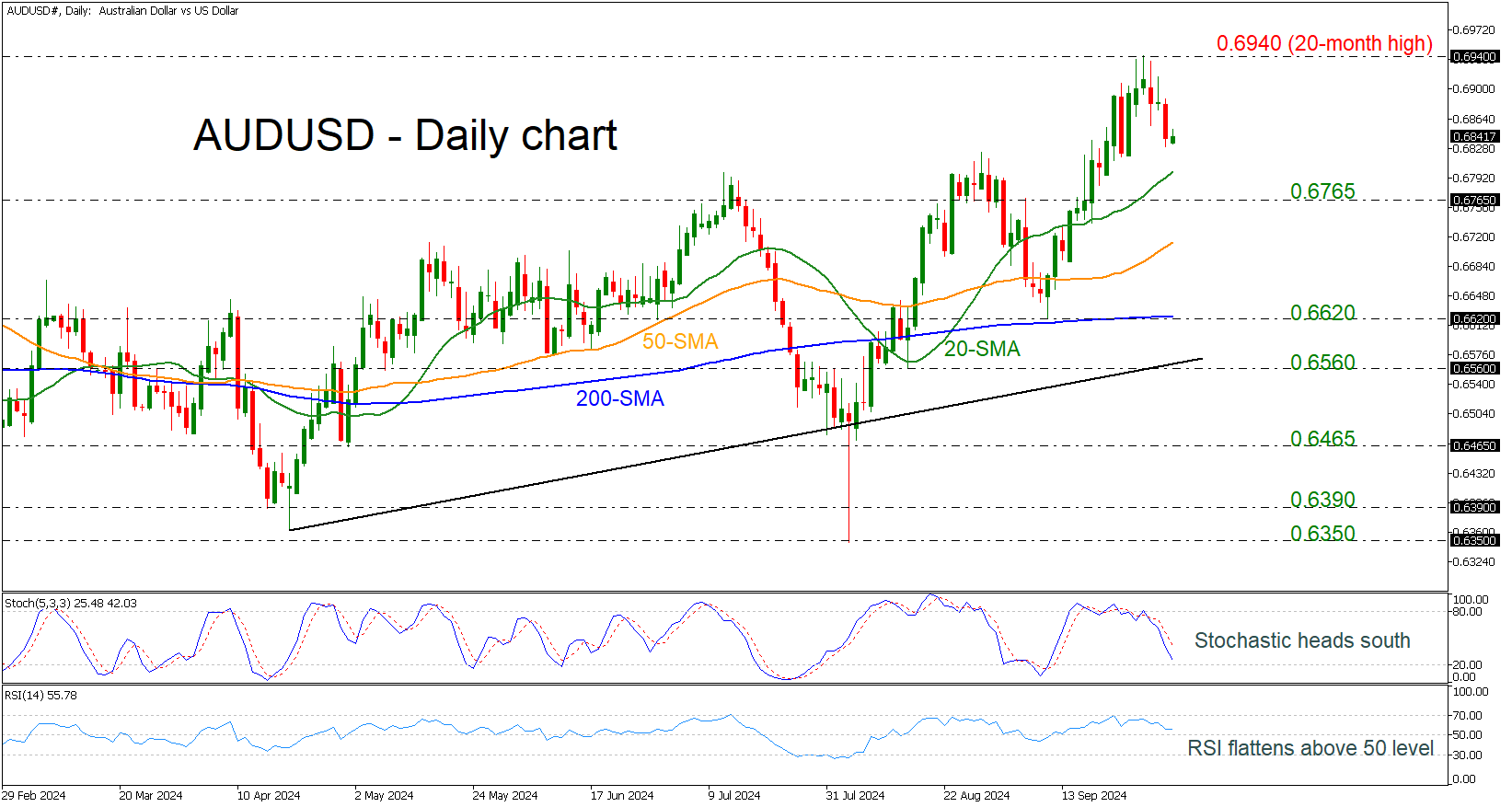
AUDUSD Pauses Bullish Rally for a While
- AUDUSD may find support at 0.6800
- Stochastic and RSI suggest more declines
AUDUSD has found strong resistance at the 20-month high of 0.6940 and is retreating towards the immediate 20-day simple moving average at 0.6800.
The technical oscillators currently confirm the recent bearish correction. Following the pullback from the overbought area, the stochastic oscillator is moving lower, while the RSI is moving horizontally slightly above the neutral threshold of 50.
A move to the downside could drive the markets towards the 20-day SMA at 0.6800, ahead of the 0.6765 support level. If the selling interest continues, then the pair may challenge the 50-day SMA at 0.6714 and the 200-day SMA at 0.6620.
Conversely, an upside recovery may pave the way for a retest of the 0.6940 barrier. Slightly higher, the 200-weekly SMA, which stands at 0.6960, may pause the bullish rally before it meets the next resistance at 0.7030, registered on February 23.
In a nutshell, AUDUSD is creating downside retracement but the broader outlook remains strongly positive.
US Payrolls Will Take Center Stage Today
Markets
This week’s US data was supposed to be key input for markets to make up their mind on the amount of Fed easing in November. Data released earlier this week (JOLTS, ISMs, jobless claims, ADP), except for a poor manufacturing ISM were not bad, but also not strong enough to already reject the option of another 50 bps step. Yesterday’s services ISM serves as an illustration. The overall report was much stronger than expected and suggests a solid rebound in services activity. The headline index jumped from 51.5 to 54.9, the best level since February last year. Details showed strong activity (59.9!) and new orders 59.4. Corporates also expect accelerating price growth (prices paid 59.4 from 57.3). However, employment falling back in contraction territory (48.1 from 50.2) was an important exception to the rule. US yields added between 7.5 bps (5-y) and 4.8 bps (30-y), but an important part of this rise already occurred before the ISM release. With two subsequent 25 bps ECB cuts in October and December discounted, the downside in European yields also became better protected. German yields added between 5.3 bps (5-y) and 4.1 bps (2-y). Good news didn’t help equities as geopolitical tensions linger (S&P 500 -0.14%). Brent oil jumped from sub-$75 p/b levels to the high $ 77 area. USD gains were again modest, maybe slightly disappointing (DXY from 101.64 to 101.98, USD/JPY from 146.5 to 146.9; EUR/USD 1.1045 from 1.103). Sterling fell off a cliff with EUR/GBP jumping from the 0.833 to close at 0.8405, but this was the result from BoE governor Bailey signaling potentially more activist easing.
The US payrolls will take center stage today. Consensus expects stable September job growth (150k from 142k). The unemployment rate is also expected unchanged at 4.2%. Average hourly earnings are seen at 0.3% M/M and 3.8% Y/Y. We assess the market positioning to be quite neutral with expectations for a 50 bps November step scaled back to 35%. The 2-y yield also is in the middle of a potential ST consolidation pattern between 3.50% and 3.90%. Aside from job growth, the unemployment rate might gain some importance as it is at what the Fed sees as a neutral level. A higher unemployment rate might rekindle expectations for a 50 bps step. Even so, plenty of data/news will come between now and the November 7 meeting. Recent action suggest sustained USD gains aren’t easy even if data and/or interest rates are supportive. For EUR/USD 1.1002 (September low) is a first interesting technical reference.
News & Views
Longshoremen at US east and gulf coast ports will resume work after the dockworkers’ union reached an agreement with their employers yesterday. The strike started on Tuesday and threatened to cost the US economy several billions a day through disruption of global supply chains, halted imports of fresh foods, pharmaceuticals and other consumer goods. The ports are estimated to handle a combined 25% of total US annual trade. Workers laid down activity over wages and concerns on the impact of automation on their jobs after the current labor contract expired on Tuesday. They now agreed to extend it until January 15 after the union accepted an offer that would increase wages 61.5% over the new six-year contract while insisting on other language to “protect [them] from automation”. The three-day strike is estimated to take around 12 days to fully clear.
The National Bank of Poland (NBP) earlier this week kept policy rates unchanged at 5.75%. NBP has been holding the same, hawkish line for several months now: high rates are necessary to counter inflation and contain inflation expectations. Inflation earlier this year returned to the central bank target but recently began to rise again as the government rolled back energy price subsidies. It is this fiscal policy uncertainty combined with sticky core inflation (>3.5%) that’s been guiding the NBP. That narrative still held in the official policy statement. At yesterday’s presser, though, governor Glapinski turned more dovish again. As recent as July he said rate cuts could only happen in 2026 before pivoting in the subsequent weeks to “Q2 of next year”. In September he did say that one rate cut doesn’t necessarily signal an entire easing cycle. Yesterday Glapinski noted that “a cycle” of cuts could happen “in March, April, or earlier”. It all boils down to the March meeting after which, if new projections show inflation stabilizing and then declining, the discussion at least may start. Most CE currencies lost ground yesterday with the zloty and the forint (EUR/HUF >400) underperforming. EUR/PLN closed north of 4.3 for the first time since mid-August. Polish swap yields deviated from peers through front-end outperformance.
Graphs
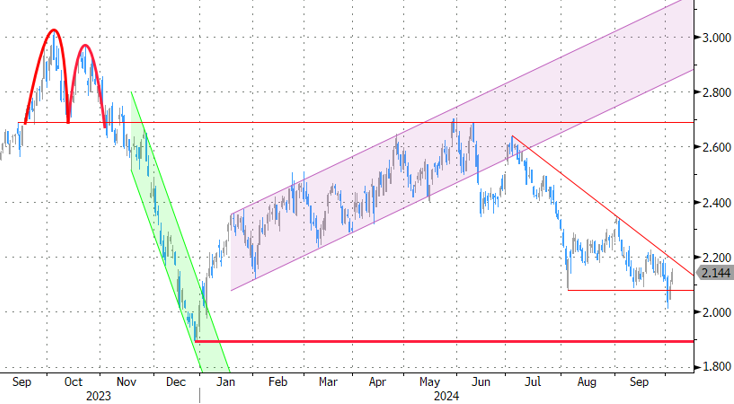
GE 10y yield
The ECB cut policy rates by 25 bps in June and in September. Stubborn inflation (core, services) make a follow-up move less evident in October, but very weak PMI’s and soft Lagarde comments hang in the balance. Disappointing US and unconvincing-to-outright-weak EMU activity data dragged the long end of the curve down with the 2023 low at 1.89% as key support.
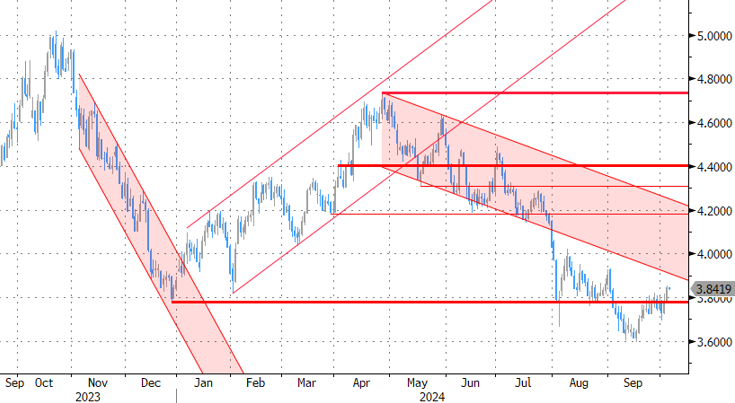
US 10y yield
The Fed kicked off its easing cycle with a 50 bps move. It is headed towards a neutral stance now that inflation and employment risks are in balance. Conservative SEP unemployment forecasts risk being caught up by reality and with it the dot plot (50 bps more cuts in 2024). We hold our call for two more 50 bps cuts this year. Pressure on the front of the curve and weakening eco data keeps the long end in the defensive for now as well.
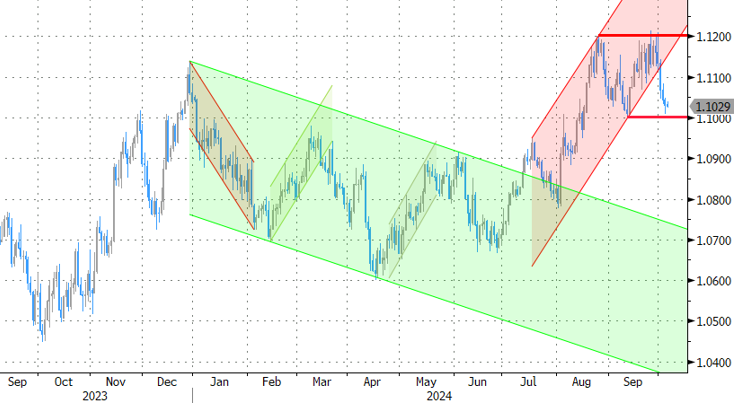
EUR/USD
EUR/USD moved above the 1.09 resistance area as the dollar lost interest rate support at stealth pace. US recession risks and bets on fast and large rate cuts trumped traditional safe haven flows into USD. An ailing euro(pean economy) partially offset some of the general USD weakness. EUR/USD’s dollar-driven rise bumped into 1.12 resistance. The 1.1002 September lows is first important support.
EUR/GBP
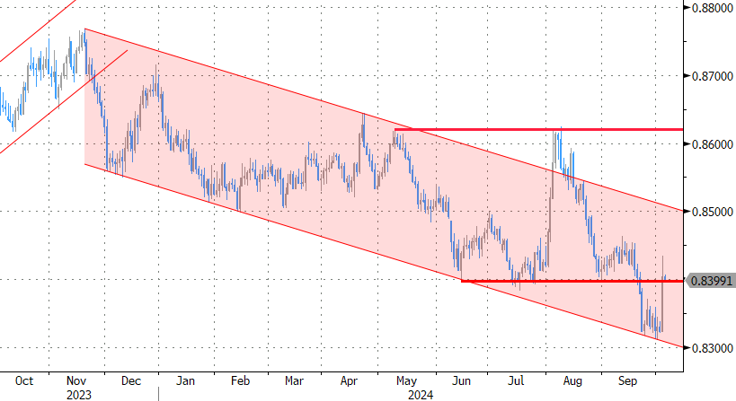
The BoE delivered a hawkish cut in August. Policy restrictiveness was indicated to be further unwound gradually on a pace determined by a broad range of data. The economic picture between the UK and Europe also was increasingly diverging to the benefit of sterling, pulling EUR/GBP below 0.84 support. Dovish comments by BoE Bailey ended by default GBP-strength.
GBP/JPY Daily Outlook
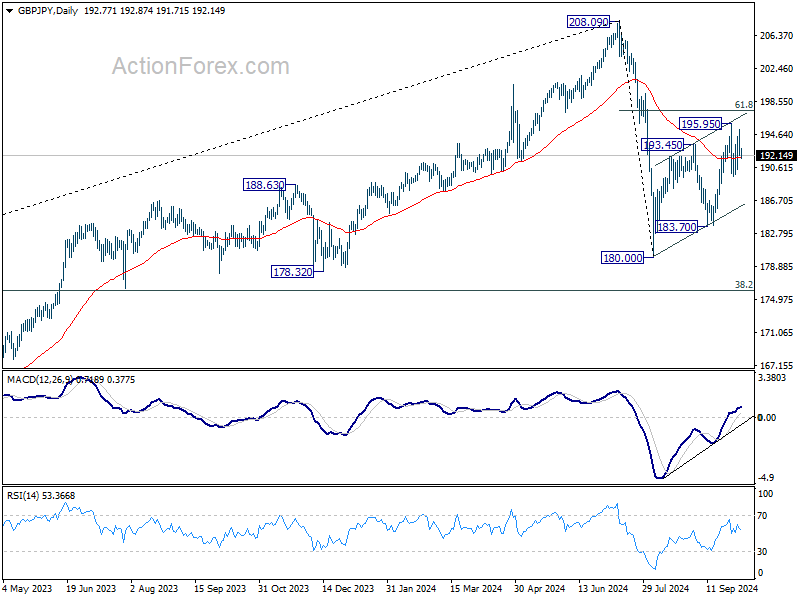
Daily Pivots: (S1) 191.60; (P) 193.39; (R1) 194.65; More...
Intraday bias in GBP/JPY stays neutral at this point. On the upside, above 195.95 will resume the rise from 180.00 to 61.8% retracement of 208.09 to 180.00 at 197.35. On the downside, below 189.54 will bring deeper fall to 183.70 support.
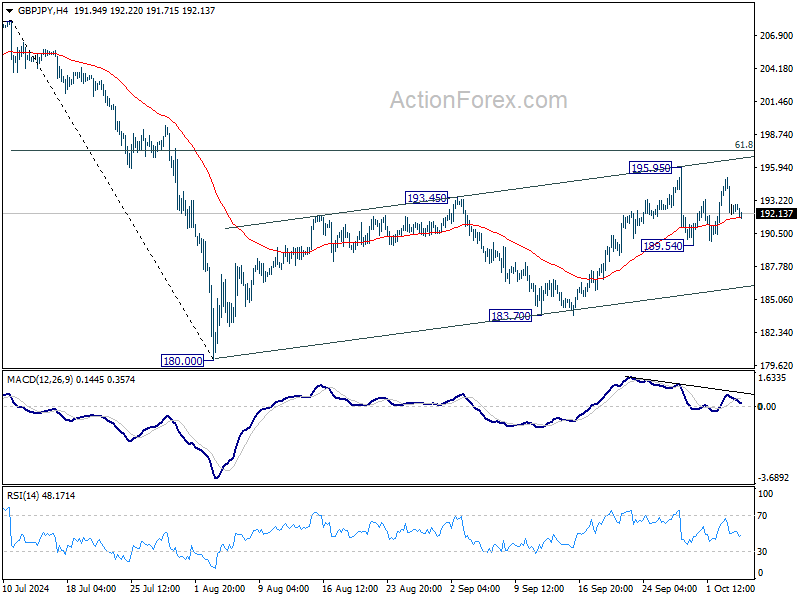
In the bigger picture, price actions from 208.09 are seen as a correction to whole rally from 123.94 (2020 low). The range of consolidation should be set between 38.2% retracement of 123.94 to 208.09 at 175.94 and 208.09. However, decisive break of 175.94 will argue that deeper correction is underway.