Sample Category Title
GBP/USD Daily Outlook
Daily Pivots: (S1) 1.2830; (P) 1.2847; (R1) 1.2873; More...
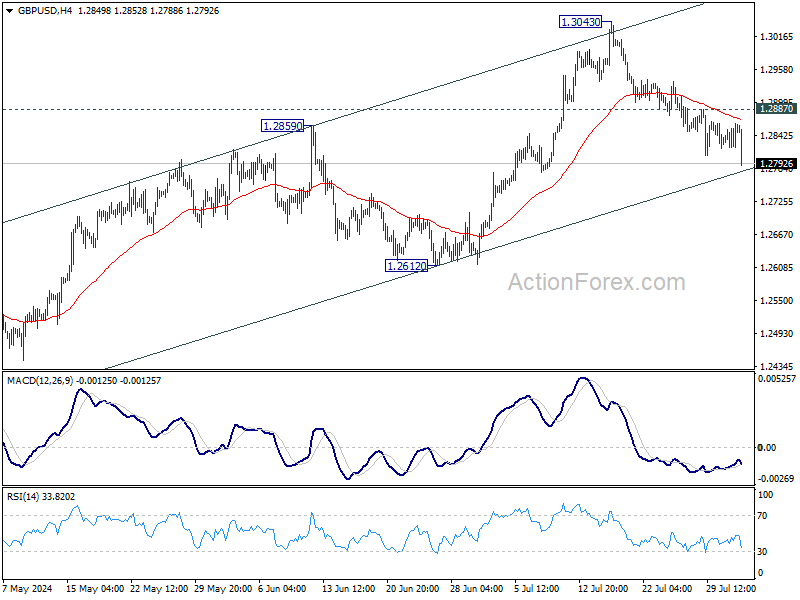
GBP/USD's fall from 1.3043 continues today despite slightly weak downside momentum as seen in 4H MACD. Decisive break of 55 D EMA (now at 1.2782) will suggest that rise from 1.2298 has completed with three waves up to 1.3043. Deeper fall would be seen to 1.2612 support and below. On the upside, above 1.2887 minor resistance will turn intraday bias back to the upside for stronger rebound.
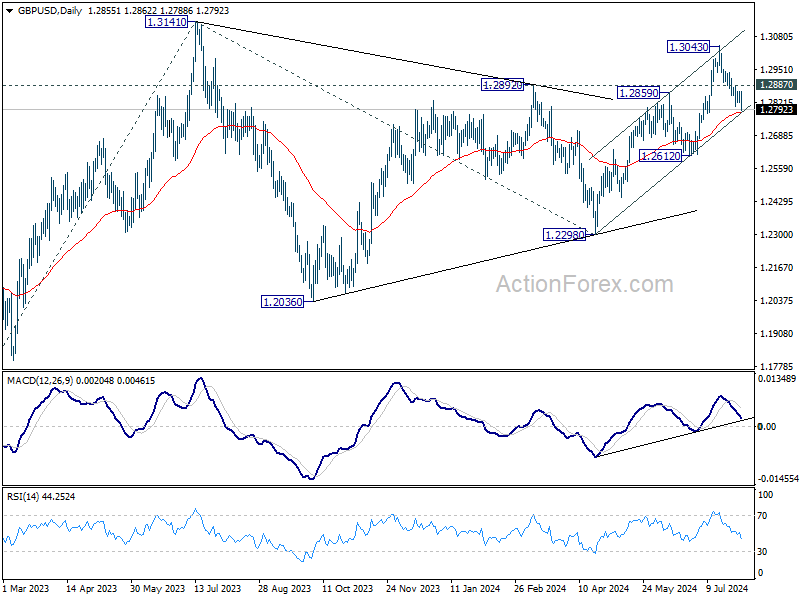
In the bigger picture, corrective pattern from 1.3141 medium term top (2023 high) could have completed with three waves to 1.2298 already. This will now remain the favored case as long as 1.2612 support holds. Firm break of 1.3141 will target 61.8% projection of 1.0351 (2022 low) to 1.3141 from 1.2298 at 1.4022. However, break of 1.2612 support argue that this corrective pattern is extending with another falling leg.
USD/CHF Daily Outlook
Daily Pivots: (S1) 0.8753; (P) 0.8797; (R1) 0.8823; More…
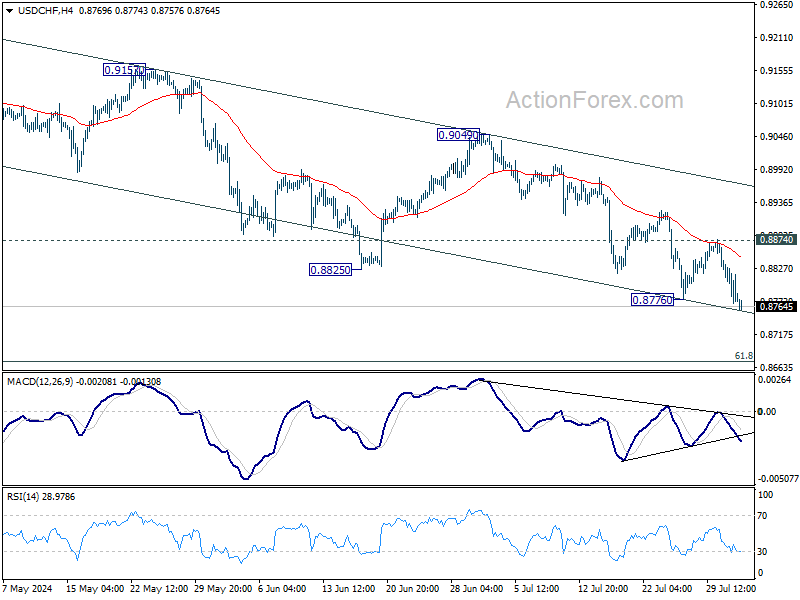
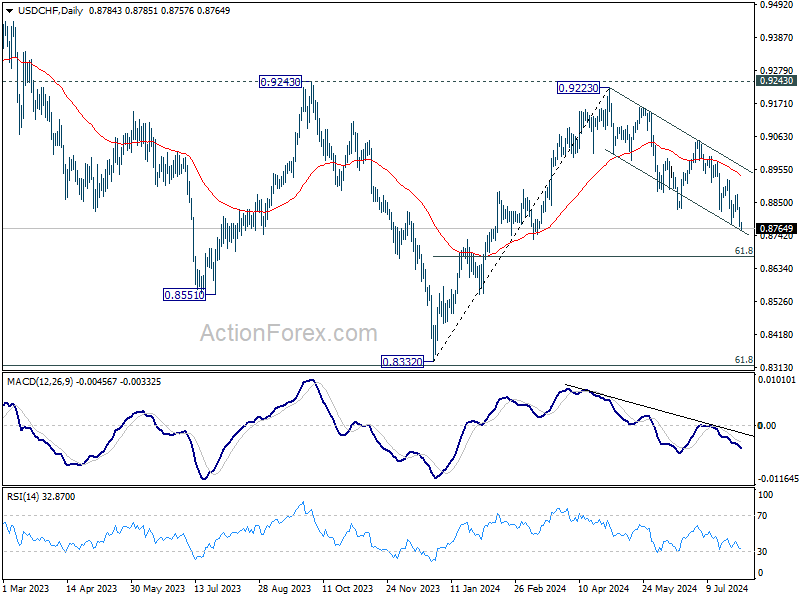
USD/CHF's decline from 0.9223 resumed by breaking 0.8776 and intraday bias is back on the downside. Deeper fall should be seen to 61.8% retracement of 0.8332 to 0.9223 at 0.8672 next. For now, risk will stay on the downside as long as 0.8874 resistance holds, in case of recovery.
In the bigger picture, with 0.9243 resistance intact, medium term outlook in USD/CHF is neutral at best. For now, more sideway trading is likely between 0.8332/9243. However, firm break of 0.9243 will indicate larger bullish trend reversal.
AUD/USD Daily Report
Daily Pivots: (S1) 0.6496; (P) 0.6526; (R1) 0.6572; More...
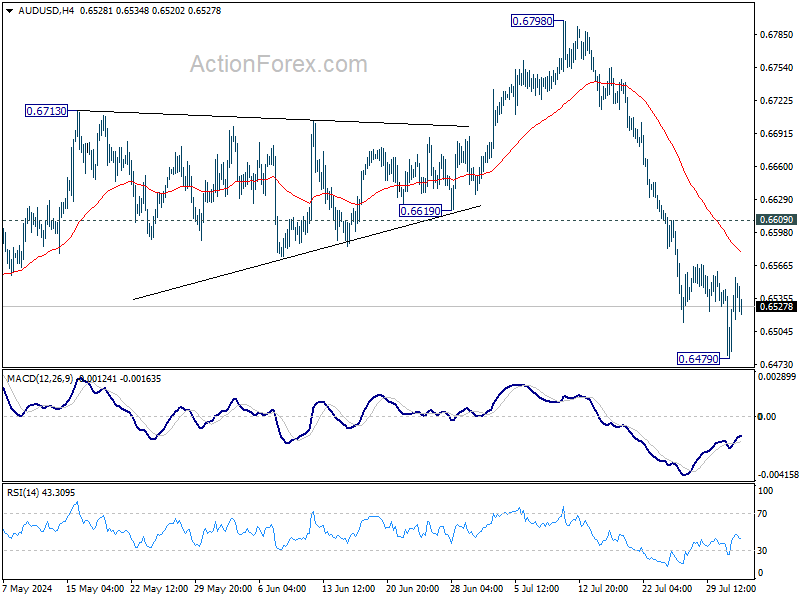
Intraday bias in AUD/USD is turned neutral first with current recovery, and some more consolidations would be seen above 0.6479. Further decline is expected as long as 0.6609 minor resistance holds. Below 0.6479 will resume the decline from 0.6798 to 0.6361 support first. Firm break there will target 0.6269 low.
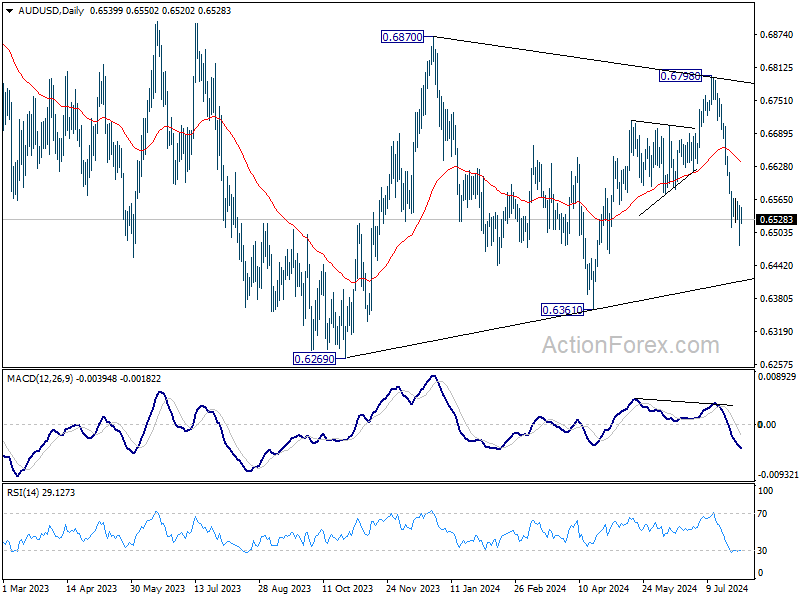
In the bigger picture, overall, price actions from 0.6169 (2022 low) are seen as a medium term corrective pattern, with fall from 0.6798 as another falling leg. Deeper fall could be seen to the lower side of the range between 0.6169/6361. But strong support should be seen there to contain downside. For now, risk will stay on the downside as long as 0.6798 resistance holds, in case of rebound.
Market Reacts Mildly to Fed Decision, Focus Shifts to NonFarm Payrolls
Late July and early August are packed with significant macroeconomic events. This week has already seen rate decisions from the Bank of Japan and the Federal Reserve, with the Bank of England meeting today and the U.S. monthly labour market report due tomorrow. As the U.S. regulator left the rate unchanged at 5.50% yesterday, market participants will now focus on incoming macroeconomic data for further clues on the Fed's future policy.
GBP/USD
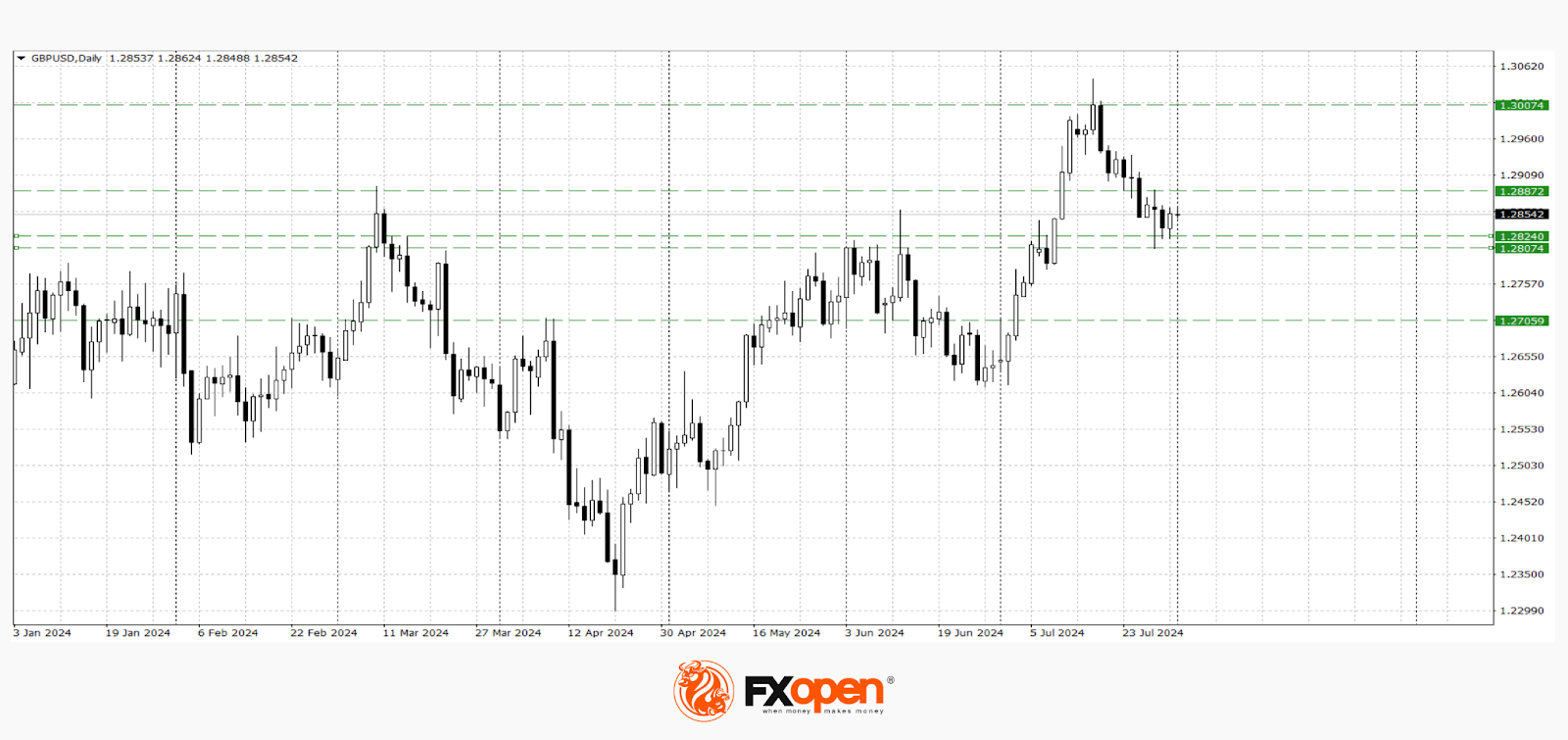
Ahead of today's Bank of England meeting, the GBP/USD pair remains firmly above the significant support level of 1.2820. The price has tested the 1.2820-1.2800 range three times in recent sessions, so far without breaking through.
Technical analysis of the GBP/USD pair indicates potential for continued growth towards June highs if it holds above 1.2900. A break below 1.2800 could lead to a downward correction towards the crucial range of 1.2700-1.2600.
Key events that could influence GBP/USD pricing:
- Today at 14:00 (GMT+3): Bank of England's interest rate decision (experts predict a 0.25% rate cut).
- Today at 15:30 (GMT+3): Release of the U.S. initial jobless claims.
- Today at 16:45 (GMT+3): Release of the U.S. Manufacturing PMI for July.
USD/JPY
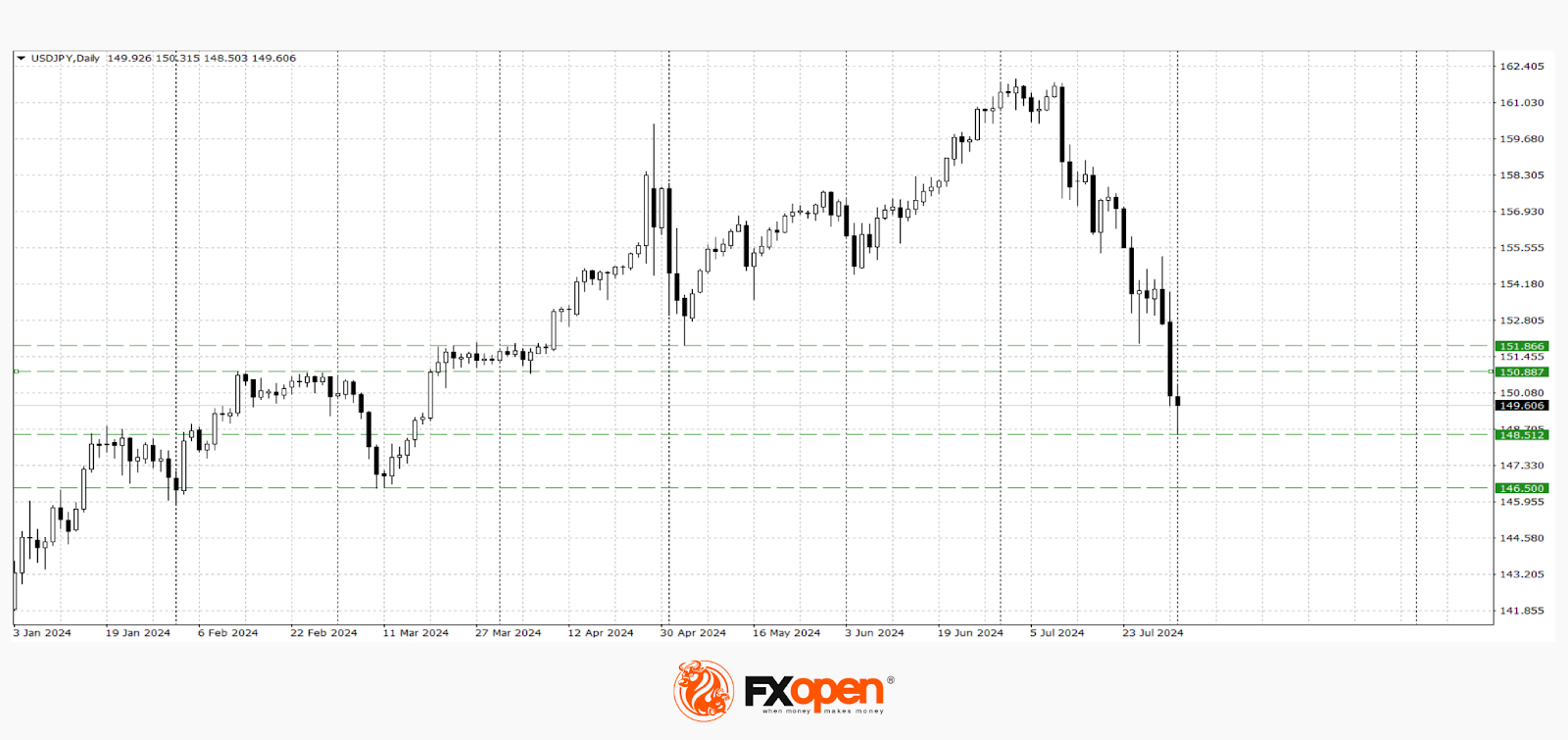
The Bank of Japan recently surprised the market by raising its base rate to 0.25%, deviating from its long-standing ultra-low rate policy. The market was unprepared for this development, and the USD/JPY pair broke several key supports throughout the day, now trading below 150.00.
Tomorrow's employment report could lead to the following scenarios:
- Positive NonFarm Payrolls could push the price up to 151.90-150.80.
- A break below 148.40 could intensify downward pressure on the pair, potentially leading to a test of the 147.00-146.50 range.
Trade over 50 forex markets 24 hours a day with FXOpen. Take advantage of low commissions, deep liquidity, and spreads from 0.0 pips. Open your FXOpen account now or learn more about trading forex with FXOpen.
This article represents the opinion of the Companies operating under the FXOpen brand only. It is not to be construed as an offer, solicitation, or recommendation with respect to products and services provided by the Companies operating under the FXOpen brand, nor is it to be considered financial advice.
Dollar Trades Remarkably Resilient Given Risk On and Yield Drop
Markets
The Fed kept the policy rate unchanged yesterday at 5.25-5.5%. The new statement featured some important changes compared to the June one, which are seen as paving the way towards a first, September rate cut. It noted that there was some further progress of inflation, which they now label as “somewhat” elevated, while striking a less upbeat tone on the labour market (“moderated” instead of “strong” job gains). The FOMC saw the risks of achieving its employment and inflation goals continue to move into better balance, culminating in what was the most important change: the committee turned from being “highly attentive to inflation risks” to “attentive to the risks to both sides of its dual mandate”. As such, the statement is now capturing what several Fed officials have been voicing in previous speeches, namely that the weight of the labour market in their assessment is currently as big (if not bigger) as inflation’s. Fed Chair Powell in the presser afterwards reiterated (as he did before Congress) that the labour market is no longer a source of inflation risk. The Fed did not cut yesterday because it eventually decided to first want further evidence of inflation returning to target sustainably. But Powell in the presser afterwards said they had “a real discussion” about it. So barring any accidents (eg. sharp inflation uptick), September looks like a done deal. Powell was reluctant to give any hints going forward but the lack of pushing back against current market pricing (two, close to three cuts this year and four in the next) suggests the FOMC is okay with it. The chair did note that larger-than-usual 50 bps cuts are not something they are considering right now. As such, Powell isn’t per se excluding a November cut. “Anything that we do before, during or after the election will be based on the data, the outlook and the balance of risks, and not on anything else.”, Powell said to dismiss the political sensitivity around such a decision. The FOMC’s pivot was a more explicit one than we and markets expected. US yields dropped between 9.2 and 12 bps across the curve. 4.33% support in the 2-yr broke & the 10-yr dropped out of the downward trading range to the March low. Some final data this week, including Q2 unit labor costs and the manufacturing ISM today and especially US payrolls tomorrow will have a last say on the fate of these technical levels. Money market odds for 75 bps of cuts this year rose to 95%, the highest since end-March. The expected terminal rate this cycle also edged slightly lower (end 2026). Wall Street rose up to 2.6% (Nasdaq). The US dollar traded remarkably resilient given the risk on and yield drop. EUR/USD eked out a small gain to 1.0826 after trading within a narrow 1.08/1.085 trading range all day. USD/JPY finished around 150 on both a stronger yen and weakish USD. The pair extended losses in Asian dealings this morning by dropping as low as 148.5 before snapping back intraday. The Bank of England comes into focus today. It’s a knife-edge decision between cutting or keeping the rate stable at 5.25%. We think odds for the former are slightly bigger. Updated forecasts are a good entry point. Meanwhile, the elections are out of the way and the BoE could be eager to capitalize the market momentum. The Fed now clearly hinting at cuts soon is an additional argument, though the UK central bank probably won’t mention it as such.
News & Views
The US is considering to impose unilateral restrictions on China’s access to the most advanced AI memory chips, known as HBM2 and HBM3(E), as well as equipment needed for making them. The measures could be implemented as soon as the end of this month as part of a broader package that also includes sanctions against more then 120 Chinese firms and (new) limits on other various types of chip equipment. Such a move would further escalate the tech rivalry between the two nations. The US Commerce Department in a statement substantiated the potential restrictions as needed to protect US national security and the technological ecosystem.
Oil prices rise for a second day straight today. After hitting the lowest since early June, Brent oil in recent days jumped from $78.6 per barrel to $81.57 this morning. The rebound follows amid geopolitical concerns flaring up again. After a Hezbollah attack against Israel in the Golan Heights July 27, the latter retaliated a few days later by killing a senior Hezbollah official near Beirut in Lebanon. A second (suspected) Israeli strike then killed the political leader of Hamas in Tehran. Iran is now said to have ordered a direct strike on Israel in response. While the likes of the US are still pushing for a cease-fire in Gaza, risks over the course of a few days have undoubtedly increased for the conflict to spread well beyond its borders.
Graphs
GE 10y yield
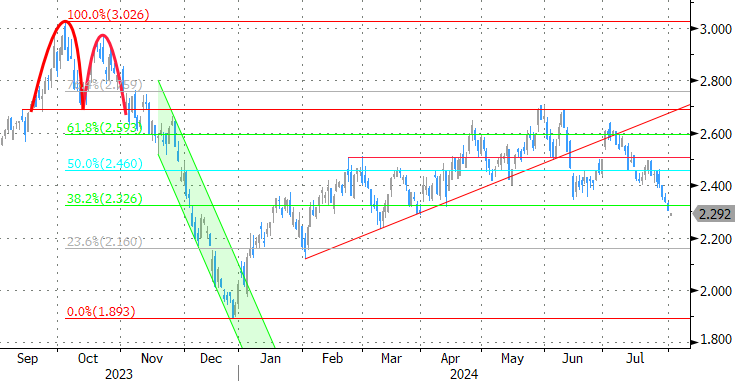
The ECB cut policy rates by 25 bps in June. Stubborn inflation (core, services) make follow-up moves less evident. Markets nevertheless price in two to three more cuts for 2024 as disappointing US and unconvincing EMU data rolled in, dragging the long end of the curve down. The 2.34%-2.4% support zone is being revisited and risks being broken under US (yield) pressure.
US 10y yield
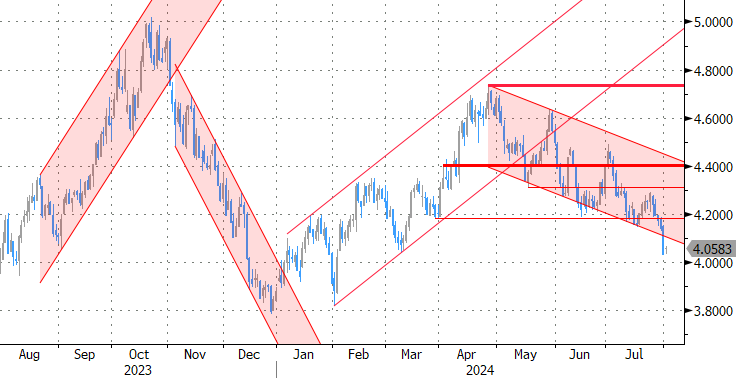
The Fed in its July meeting paved the way for a first cut in September. It turned attentive to risks to the both sides of its dual mandate as the economy is continuing to move better in to balance. There was no pushback against current market pricing (75 bps cuts in 2024, 100 bps in 2025). The pivot weakened the technical picture in US yields. The 10-yr is testing a final support zone north of 4% ahead of the 2024 low.
EUR/USD
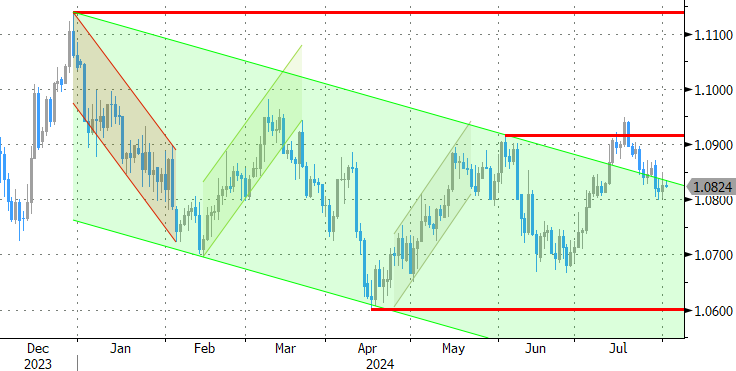
EUR/USD tested the topside of the 1.06-1.09 range as the dollar lost interest rate support at stealth pace. Markets consider a September rate cut a done deal. In the meantime, the euro got rid of the (French) political risk premium. EUR/USD recently evolved back to a more neutral positioning but is holding up rather well despite ongoing poor EMU data.
www.actionforex.com/wp-content/uploads/2024/08/kbc2024080113-600x302.png" alt="" width="600" height="302" class="aligncenter size-medium wp-image-561953" />
EUR/GBP
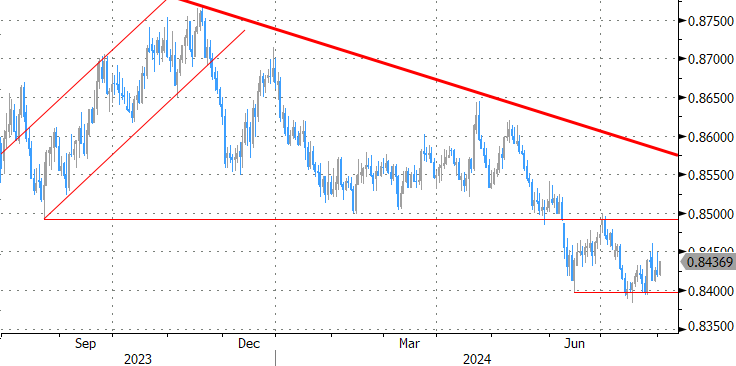
Debate at the BoE is focused at the timing of rate cuts. May & June headline inflation returned to 2%, but core measures do not align a sustainable return to target soon. Some BoE members at the June meeting nevertheless appeared moving closer to a rate cut. Labour revealed a near £22bn of unfunded commitments, setting the stage for a painful Budget release on October 30. EUR/GBP 0.84 support is being tested.
USD/CAD Daily Outlook
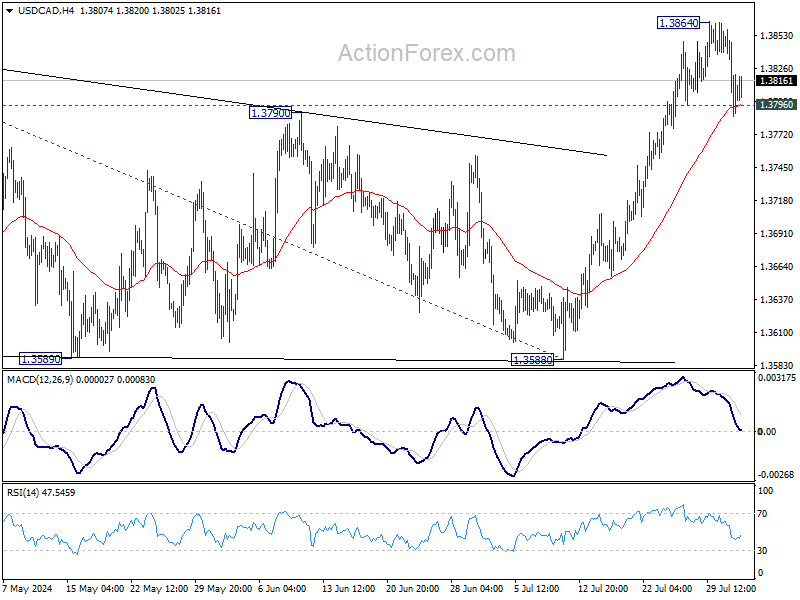
Daily Pivots: (S1) 1.3777; (P) 1.3818; (R1) 1.3849; More...
Intraday bias in USD/CAD remains neutral for the moment. Further rally is expected as long as 1.3796 support holds. Rise from 1.3176 should be resuming and next target is 61.8% projection of 1.3176 to 1.3845 from 1.3588 at 1.4025. On the downside, below 1.3796 minor support will delay the bullish case and bring deeper pullback first.
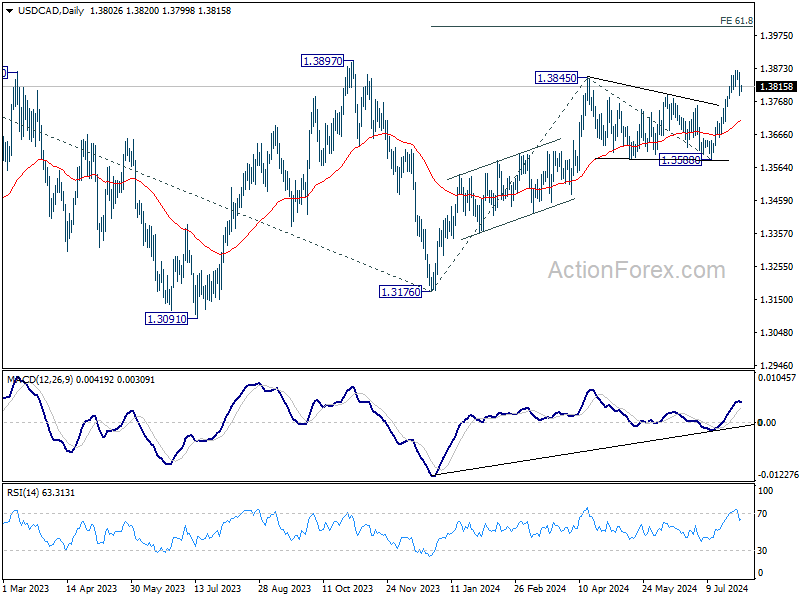
In the bigger picture, price actions from 1.3976 (2022 high) are viewed as a corrective pattern, that might have completed at 1.3176 (2023 low) already. Firm break of 1.3976 will confirm resumption of whole up trend from 1.2005 (2021 low). Next target is 61.8% projection of 1.2401 to 1.3976 from 1.3176 at 1.4149. This will be the favored case as long as 1.3588 support holds, in case of pullback.
Dollar Steady Following FOMC, BoE Rate Decision Looms
Dollar remained relatively steady following the balanced post-FOMC press conference, with notable exceptions against the stronger yen and Swiss franc. Fed Chair Jerome Powell explicitly mentioned the possibility of a rate cut in September but refrained from making any firm commitments or providing extended guidance. While markets are aggressively betting on three Fed cuts this year, some economists view this as overly optimistic. The greenback's next moves will likely be influenced by today's ISM manufacturing data and tomorrow's non-farm payroll data.
For the week, Yen remains the strongest currency with no clear signs of a sustainable pullback. Swiss Franc is currently the second strongest, with its strength partially attributed to rising tensions in the Middle East, which have also driven up gold and oil prices. Canadian Dollar is the third strongest, benefiting from a lack of significant selling pressure.
Conversely, Euro and Sterling are at the bottom of the weekly performance chart alongside the Australian dollar. The selloff against Swiss franc is adding pressure on these two European majors. Sterling is now focused on BoE rate decision, where uncertainty about a potential rate cut looms large. The decision could trigger significant volatility in Pound and shift its position notably.
In Asia, Nikkei fell -2.49%, more than reversing yesterday's gains. Hong Kong HSI is up 0.07%. China Shanghai SSE is down -0.17%. Singapore Strait Times is down -0.91%. Japan 10-year JGB yield is down -0.0248 at 1.036. Overnight, DOW rose 0.24%. S&P 500 rose 1.58%. NASDAQ rose 2.64%. 10-year yield fell -0.034 to 4.109.
Fed's Powell opens door to Sep rate cut, markets price In 75% chance of three cuts by year-endd
US stocks closed higher overnight as investors cheered Fed Chair Jerome Powell's suggestion that a September rate cut is "on the table." Nevertheless, he emphasized that any decision would hinge on the "totality" of incoming economic data.
In the post-FOMC meeting press conference, Powell highlighted that recent Q2 inflation data has "added to our confidence," and continued positive data would further solidify this confidence that inflation is moving towards the 2% target.
He explained that the committee's "broad sense" is that the economy is nearing a point where reducing the policy rate could be appropriate. The decision will depend on whether the overall data, evolving economic outlook, and balance of risks align with increased confidence in controlling inflation while maintaining a robust labor market.
"If that test is met, a reduction in our policy rate could be on the table for as soon as the next meeting in September," Powell stated. Meanwhile, he clarified that a 50bps rate cut is "not something we're thinking about right now."
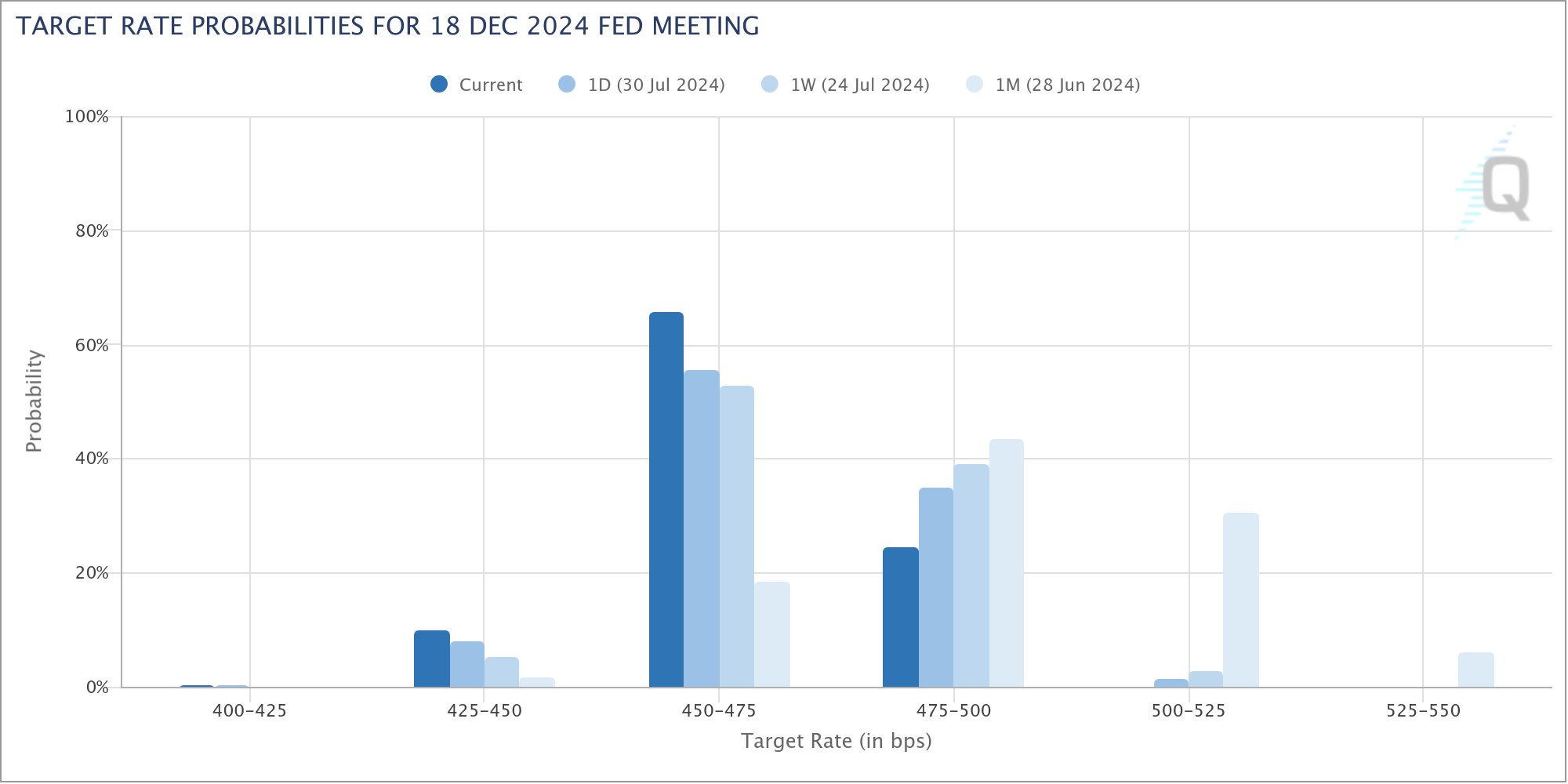
Market reactions were immediate. Fed funds futures are now pricing in over a 100% probability of a 25bps cut in September. More strikingly, the likelihood of three rate cuts by the end of this year has surged to over 75%, up from less than 60% a week ago.
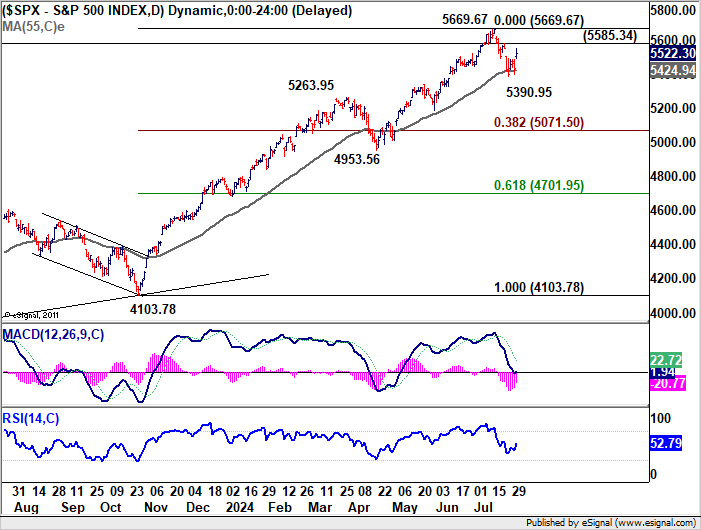
Technically, it appears that 55 D EMA is providing enough support for S&P 500 for now. Focus is back on 5585.34 resistance. Break there will argue that correction from 5669.67 has already completed at 5390.95. Larger up trend would then be ready to resume for new record highs.
Japan confirms JPY5.53T intervention, AUD/JPY slide persists
Japan confirmed its intervention in the currency market last month following Yen's drop to a 38-year low against Dollar. This intervention marked the turning point for Yen's massive month-long rally, which continues this week following BoJ's second interest rate hike this year. Governor Kazuo Ueda has indicated that further tightening remains a possibility.
The Japanese Ministry of Finance disclosed on Wednesday that authorities spent JPY 5.53T, or USD 36.8B, on market intervention between June 27 and July 29. This amount aligns with market expectations and underscores the significant effort to stabilize the yen.
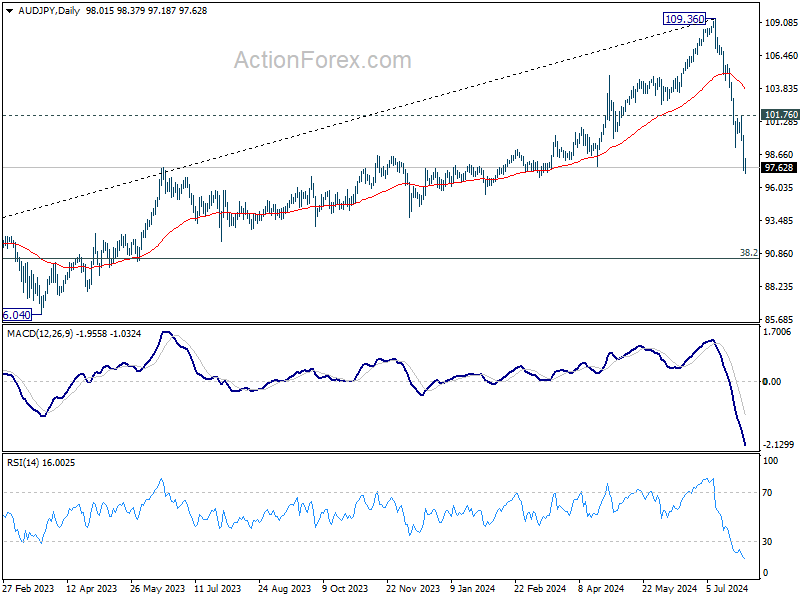
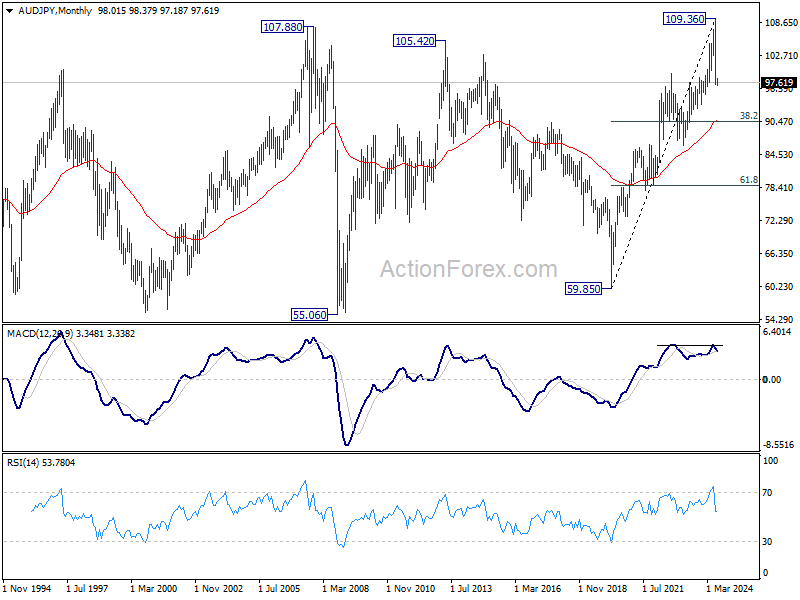
The AUD/JPY pair has been one of the biggest losers, dropping more than 3% this week alone. Technically, the near-term outlook remains bearish as long as the 101.76 resistance holds, even if there is a rebound. The fall from 109.36 is viewed as a correction to the uptrend that started from the 2020 low of 59.85. A deeper decline is anticipated towards the 38.2% retracement level of 59.85 to 109.36 at 90.44. Strong support is likely at this level, considering its proximity to the 55-month EMA (currently at 90.83) and the psychological 90 level, which could provide a floor to the downside on the first attempt.
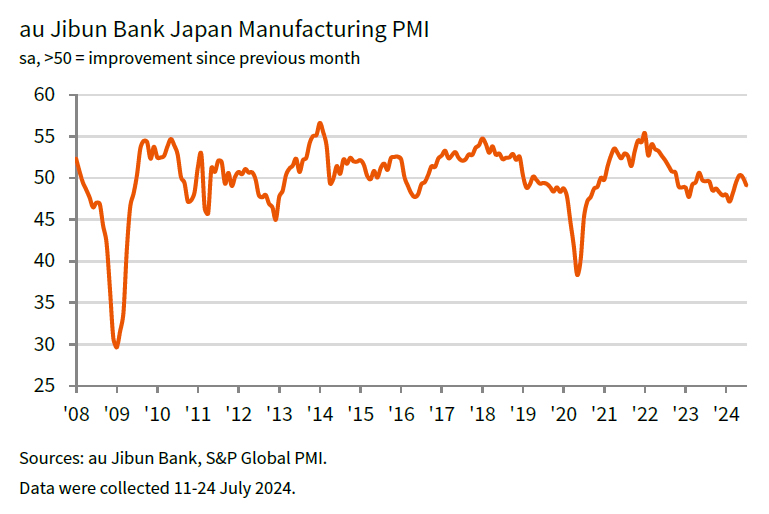
Japan's PMI manufacturing finalized at 49.1 in Jul, back in contraction
Japan's PMI Manufacturing was finalized at 49.1 in July, down from June's 50.0, indicating that the sector is back in contraction streak since early 2023.
Usamah Bhatti of S&P Global Market Intelligence described the sector's performance as "downbeat" at the start of Q3. The decline was driven by a stronger reduction in new orders, leading to a renewed fall in production levels.
Inflationary pressures remained high, with input price inflation reaching a 15-month peak. Despite this, firms raised their selling prices more cautiously to stay competitive.
The near-term outlook appears "muted" due to the lack of new order inflows, allowing firms to clear outstanding business at the fastest rate since March. However, firms are optimistic that this period will pass within the coming year, expecting business expansion and new product launches to coincide with a broader economic recovery.
China's Caixin PMI manufacturing drops to 49.8, below expectations
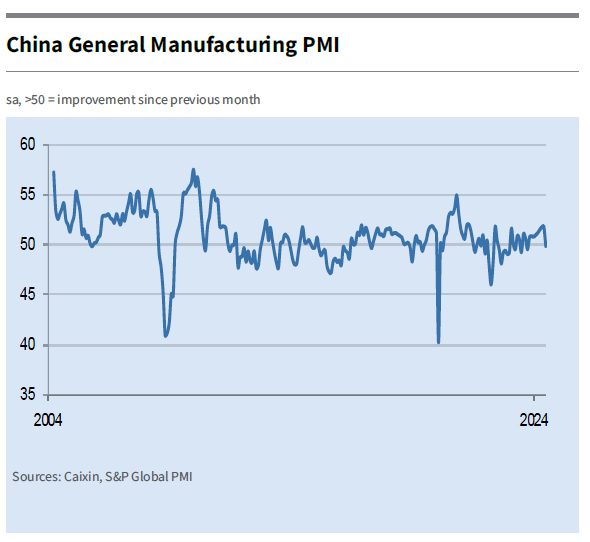
China's Caixin PMI Manufacturing dropped from 51.8 to 49.8 in July, falling below the expected 51.6. S&P Global noted that output expanded at the slowest pace in nine months, average selling prices declined, and input cost inflation eased. However, business confidence showed improvement.
Wang Zhe, Senior Economist at Caixin Insight Group, commented, "Overall, the manufacturing sector largely stabilized in July. Supply expanded slightly, while domestic demand declined and external demand was steady. The reduction in business purchases was coupled with decreases in raw material stocks. The job market contraction was steady. Price levels faced pressure while market optimism improved slightly."
BoE faces uncertainty over first rate cut decision amid divided MPC
Today's focus is squarely on BoE's rate decision, with significant uncertainty surrounding whether the first rate cut will be initiated to kick-start the policy easing cycle.
Communications from various MPC members have shown no clear consensus. Known dove Swati Dhingra is expected to continue pushing for a rate reduction, urging BoE to stop squeezing living standards. Conversely, hawkish members like Catherine Mann are likely to guard against resurgence of inflation pressures, viewing the dip to 2% as "touch and go."
Chief Economist Huw Pill has stated that it's still an "open question" on whether rate cuts should start now. Adding to the uncertainty, Deputy Governor Clare Lombardelli, who is voting for the first time, remains a big unknown factor in today's decision.
Markets are currently pricing in around a 60% chance of a quarter-point cut today.
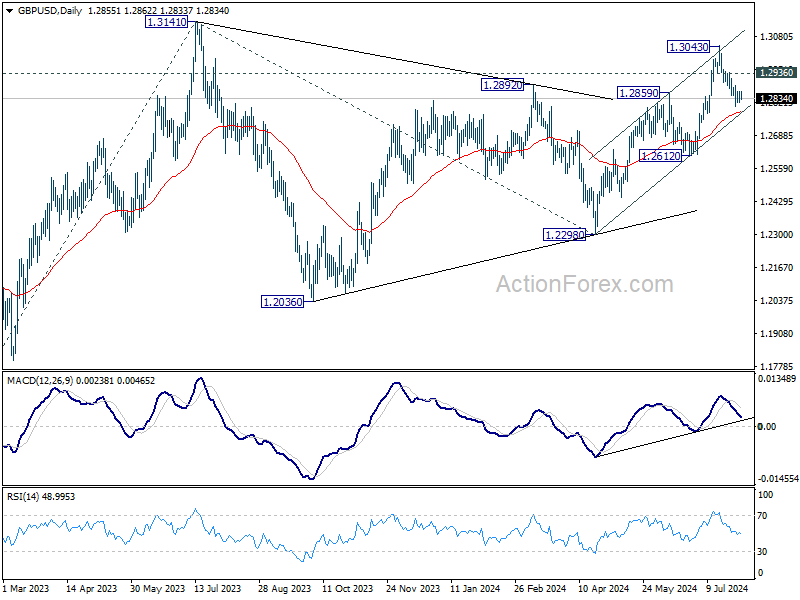
GBP/USD has been in steady but slow downward spiral since hitting 1.3043 in mid-July. For now, risk will stay on the downside as long as 1.2936 resistance holds. Sustained trading below 55 D EMA (now at 1.2783) as well as near term channel support (now at 1.2781) will argue that whole rally from 1.2298 might be over. Deeper fall would then be seen back to 1.2612 support. Nevertheless, break of 1.2936 will suggest that the pull back from 1.3043 has completed, and rise from 1.2998 is ready to resume. We'll know very soon.
Elsewhere
Eurozone PMI manufacturing final and unemployment rate, as well as UK PMI manufacturing final will be released in European session. later in the day, US ISM manufacturing is the main event while jobless claims will also be featured.
USD/CAD Daily Outlook
Daily Pivots: (S1) 1.3777; (P) 1.3818; (R1) 1.3849; More...
Intraday bias in USD/CAD remains neutral for the moment. Further rally is expected as long as 1.3796 support holds. Rise from 1.3176 should be resuming and next target is 61.8% projection of 1.3176 to 1.3845 from 1.3588 at 1.4025. On the downside, below 1.3796 minor support will delay the bullish case and bring deeper pullback first.
In the bigger picture, price actions from 1.3976 (2022 high) are viewed as a corrective pattern, that might have completed at 1.3176 (2023 low) already. Firm break of 1.3976 will confirm resumption of whole up trend from 1.2005 (2021 low). Next target is 61.8% projection of 1.2401 to 1.3976 from 1.3176 at 1.4149. This will be the favored case as long as 1.3588 support holds, in case of pullback.
Economic Indicators Update
| GMT | Ccy | Events | Actual | Forecast | Previous | Revised |
|---|---|---|---|---|---|---|
| 00:30 | JPY | Manufacturing PMI Jul F | 49.1 | 49.2 | 49.2 | |
| 01:30 | AUD | Trade Balance (AUD) Jun | 5.59B | 4.95B | 5.77B | 5.05B |
| 01:30 | AUD | Import Price Index Q/Q Q2 | 1.00% | -0.70% | -1.80% | |
| 01:45 | CNY | Caixin Manufacturing PMI Jul | 49.8 | 51.6 | 51.8 | |
| 07:45 | EUR | Italy Manufacturing PMI Jul | 46.2 | 45.7 | ||
| 07:50 | EUR | France Manufacturing PMI Jul F | 44.1 | 44.1 | ||
| 07:55 | EUR | Germany Manufacturing PMI Jul F | 42.6 | 42.6 | ||
| 08:00 | EUR | Italy Unemployment Jun | 6.80% | 6.80% | ||
| 08:00 | EUR | ECB Economic Bulletin | ||||
| 08:00 | EUR | Eurozone Manufacturing PMI Jul F | 45.6 | 45.6 | ||
| 08:30 | GBP | Manufacturing PMI Jul F | 51.8 | 51.8 | ||
| 09:00 | EUR | Eurozone Unemployment Rate Jun | 6.40% | 6.40% | ||
| 11:00 | GBP | BoE Interest Rate Decision | 5.00% | 5.25% | ||
| 11:00 | GBP | MPC Official Bank Rate Votes | 0--6--3 | 0--2--7 | ||
| 11:30 | USD | Challenger Job Cuts Y/Y Jul | 19.80% | |||
| 12:30 | USD | Initial Jobless Claims (Jul 26) | 239K | 235K | ||
| 12:30 | USD | Nonfarm Productivity Q2 P | 1.50% | 0.20% | ||
| 12:30 | USD | Unit Labor Costs Q2 P | 1.60% | 4.00% | ||
| 13:30 | CAD | Manufacturing PMI Jul | 49.3 | |||
| 13:45 | USD | Manufacturing PMI Jul F | 49.5 | 49.5 | ||
| 14:00 | USD | ISM Manufacturing PMI Jul | 48.8 | 48.5 | ||
| 14:00 | USD | ISM Manufacturing Prices Paid Jul | 52.5 | 52.1 | ||
| 14:00 | USD | ISM Manufacturing Employment Index Jul | 49.3 | |||
| 14:00 | USD | Construction Spending M/M Jun | 0.20% | -0.10% | ||
| 14:30 | USD | Natural Gas Storage | 22B |
BoE faces uncertainty over first rate cut decision amid divided MPC
Today's focus is squarely on BoE's rate decision, with significant uncertainty surrounding whether the first rate cut will be initiated to kick-start the policy easing cycle.
Communications from various MPC members have shown no clear consensus. Known dove Swati Dhingra is expected to continue pushing for a rate reduction, urging BoE to stop squeezing living standards. Conversely, hawkish members like Catherine Mann are likely to guard against resurgence of inflation pressures, viewing the dip to 2% as "touch and go."
Chief Economist Huw Pill has stated that it's still an "open question" on whether rate cuts should start now. Adding to the uncertainty, Deputy Governor Clare Lombardelli, who is voting for the first time, remains a big unknown factor in today's decision.
Markets are currently pricing in around a 60% chance of a quarter-point cut today.
GBP/USD has been in steady but slow downward spiral since hitting 1.3043 in mid-July. For now, risk will stay on the downside as long as 1.2936 resistance holds. Sustained trading below 55 D EMA (now at 1.2783) as well as near term channel support (now at 1.2781) will argue that whole rally from 1.2298 might be over. Deeper fall would then be seen back to 1.2612 support. Nevertheless, break of 1.2936 will suggest that the pull back from 1.3043 has completed, and rise from 1.2998 is ready to resume. We'll know very soon.
China’s Caixin PMI manufacturing drops to 49.8, below expectations
China's Caixin PMI Manufacturing dropped from 51.8 to 49.8 in July, falling below the expected 51.6. S&P Global noted that output expanded at the slowest pace in nine months, average selling prices declined, and input cost inflation eased. However, business confidence showed improvement.
Wang Zhe, Senior Economist at Caixin Insight Group, commented, "Overall, the manufacturing sector largely stabilized in July. Supply expanded slightly, while domestic demand declined and external demand was steady. The reduction in business purchases was coupled with decreases in raw material stocks. The job market contraction was steady. Price levels faced pressure while market optimism improved slightly."
Japan’s PMI manufacturing finalized at 49.1 in Jul, back in contraction
Japan's PMI Manufacturing was finalized at 49.1 in July, down from June's 50.0, indicating that the sector is back in contraction streak since early 2023.
Usamah Bhatti of S&P Global Market Intelligence described the sector's performance as "downbeat" at the start of Q3. The decline was driven by a stronger reduction in new orders, leading to a renewed fall in production levels.
Inflationary pressures remained high, with input price inflation reaching a 15-month peak. Despite this, firms raised their selling prices more cautiously to stay competitive.
The near-term outlook appears "muted" due to the lack of new order inflows, allowing firms to clear outstanding business at the fastest rate since March. However, firms are optimistic that this period will pass within the coming year, expecting business expansion and new product launches to coincide with a broader economic recovery.