

Sample Category Title
EUR/GBP Weekly Outlook
EUR/GBP stays in established range last week and outlook is unchanged. Initial bias remains neutral this week first. On the downside, firm break of 0.8529 support will argue that the corrective recovery from 0.8497 has completed at 0.8601. Intraday bias will be back on the downside for retesting 0.8497 low next. On the upside, break of 0.8601 will resume the rebound instead.
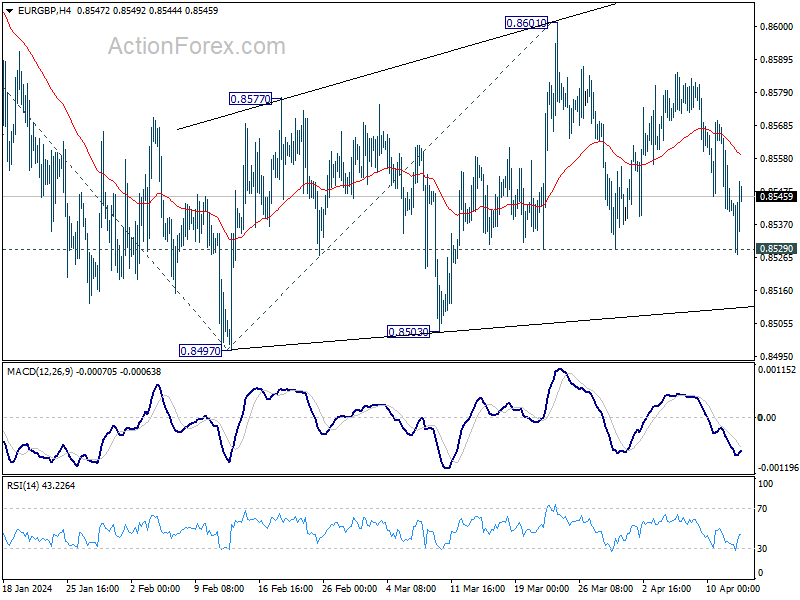
In the bigger picture, there is no clear sign that down trend from 0.9267 has completed, despite loss of downside momentum as seen in D MACD. As long as 0.8601 resistance holds, the down trend will remain in favor to resume through 0.8491 low at la later stage.
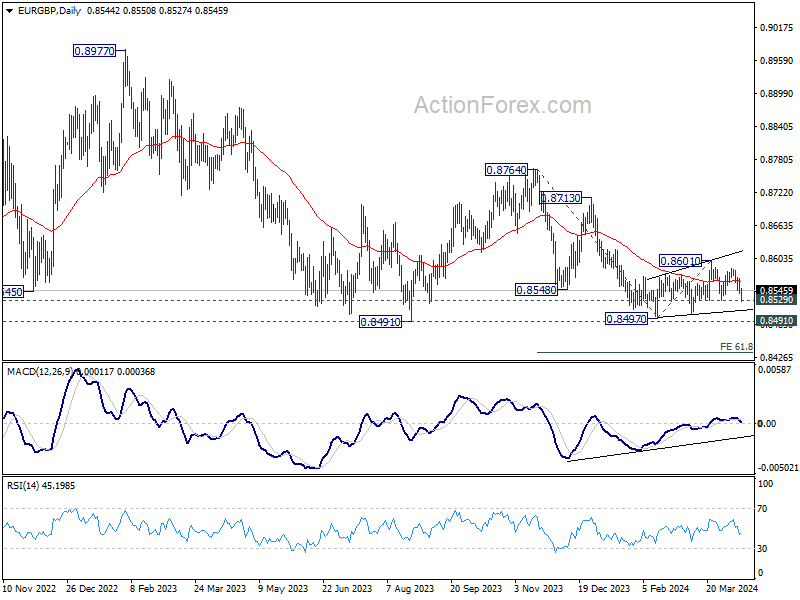
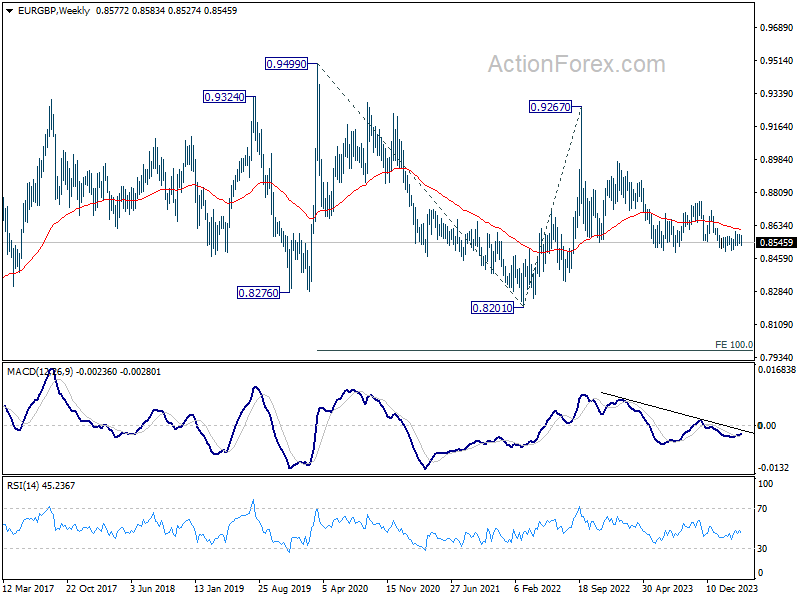
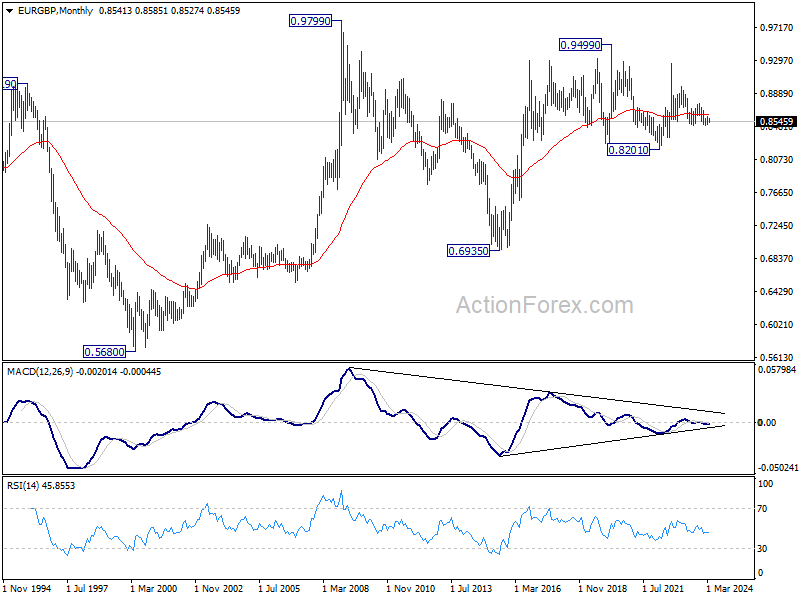
In the long term picture, price action from 0.9499 (2020 high) is seen as part of the long term range pattern from 0.9799 (2008 high). Fall from 0.9267 is the third leg of the pattern from 0.9499. Break of 0.8201 (2022 low) will target 100% projection of 0.9499 to 0.8201 from 0.9267 at 0.7969.
EUR/AUD Weekly Outlook
EUR/AUD's fall from 1.6742 extended to 1.6368 last week before turning sideway. Initial bias stays neutral this week first, but risk will stay on the downside as long as 1.6516 resistance holds. On the downside, below 1.6368 will resume the fall from 1.6742 towards 1.6127 low. Nevertheless, break of 1.6516 will turn bias back to the upside for stronger rebound.
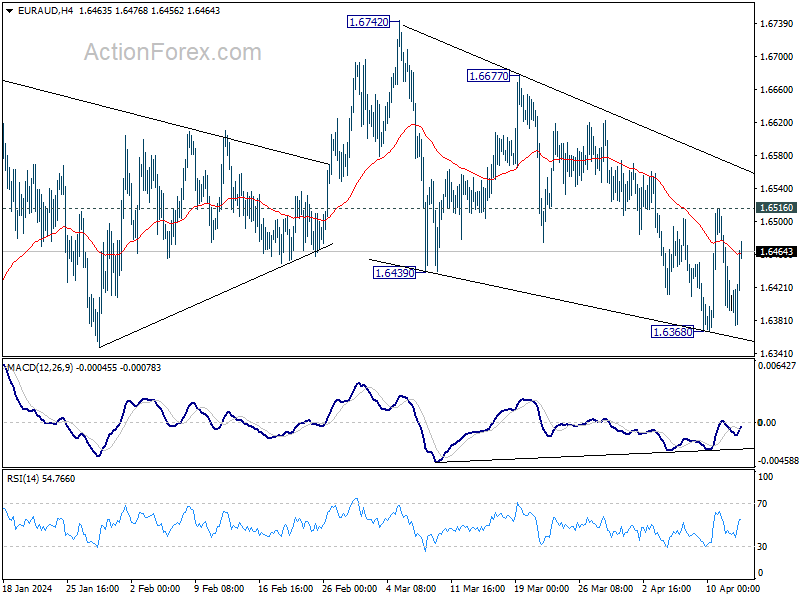
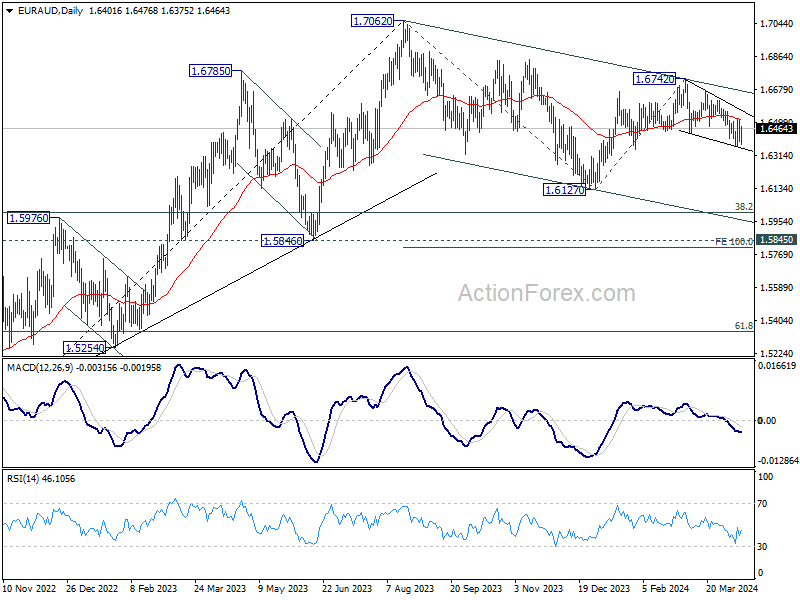
In the bigger picture, fall from 1.7062 medium term top is seen as a correction to the up trend from 1.4281 (2022 low). The correction is probably still in progress with fall from 1.6742 as the third leg. Strong support is expected around 1.5846 and 38.2% retracement of 1.4281 to 1.7062 at 1.6000 to bring rebound.
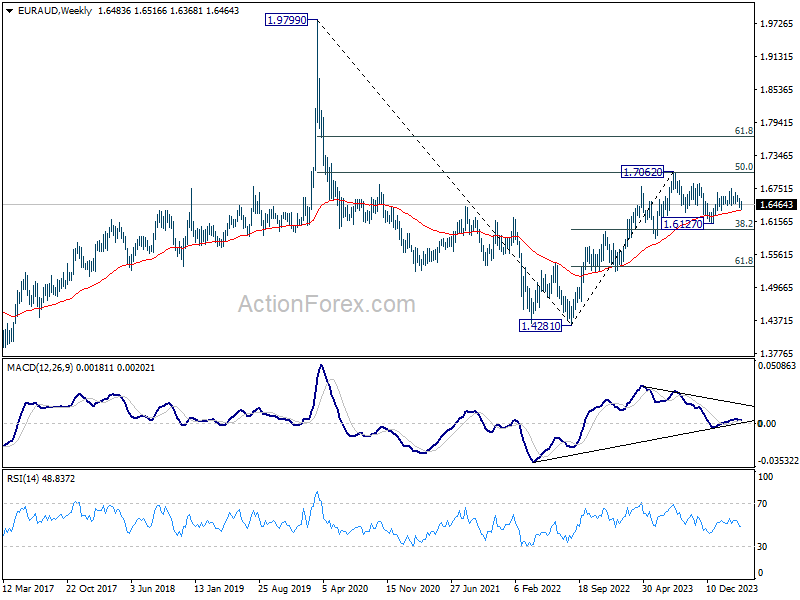
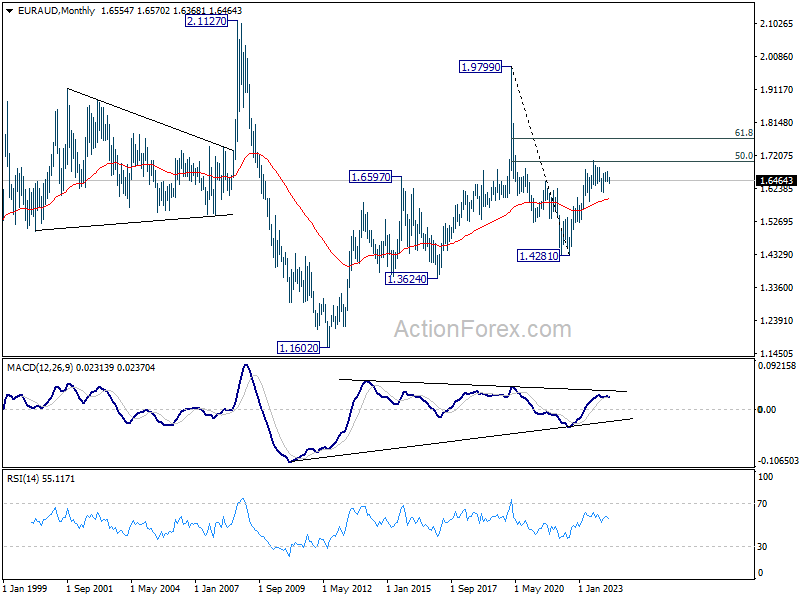
In the longer term picture, price actions from 1.9799 (2020 high) are seen as a long term decline at the same scale as the rise from 1.1602 (2012 low). Rebound from 1.4281 is seen as the second leg. As long as 55 M EMA (now at 1.5950) holds, this second leg could still extend higher. However, sustained trading below 55 M EMA will open up the bearish case for extending the decline through 1.4281 low.
EUR/CHF Weekly Outlook
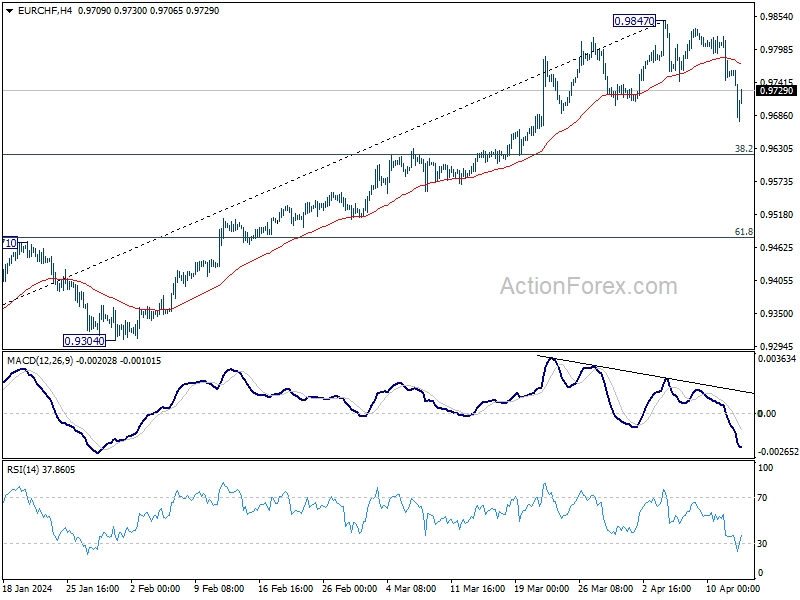
EUR/CHF's decline last week indicates short term topping at 0.9847, on bearish divergence condition in 4H MACD. Initial bias is mildly on the downside for 38.2% retracement of 0.9252 to 0.9847 at 0.9620. But strong support is expected from there to contain downside to bring rebound, and set the range for sideway trading. Nevertheless, for now, risk will stay on the downside as long as 0.9847 resistance holds, in case of recovery.
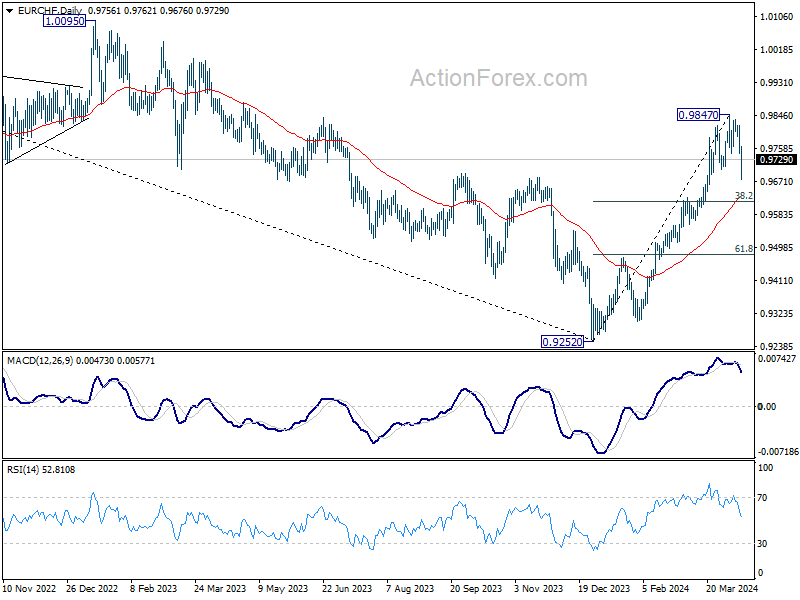
In the bigger picture, a medium term bottom should be in place at 0.9252 already, on bullish convergence condition in W MACD. Rise from there now target 38.2% retracement of 1.2004 (2018 high) to 0.9252 (2023 low) at 1.0303, even as a correction to the down trend from 1.2004. This will remain the favored case as long as 55 D EMA (now at 0.9633) holds.
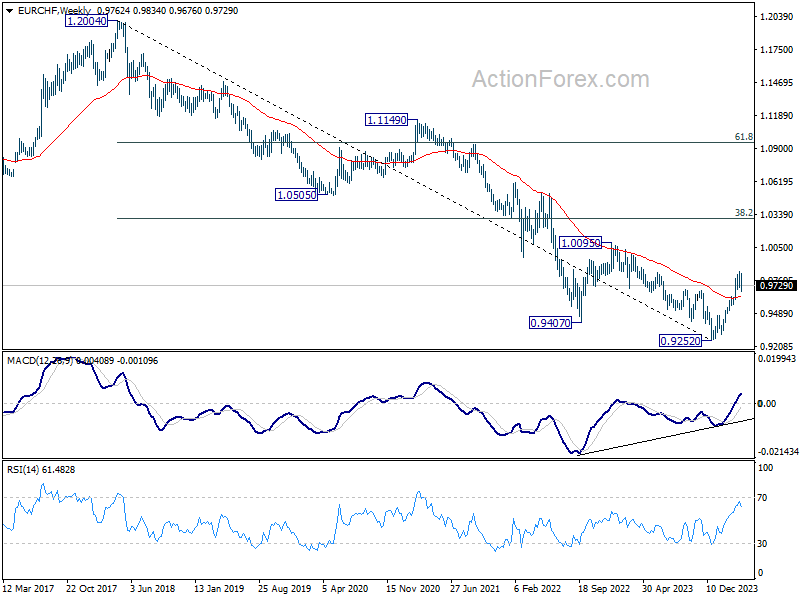
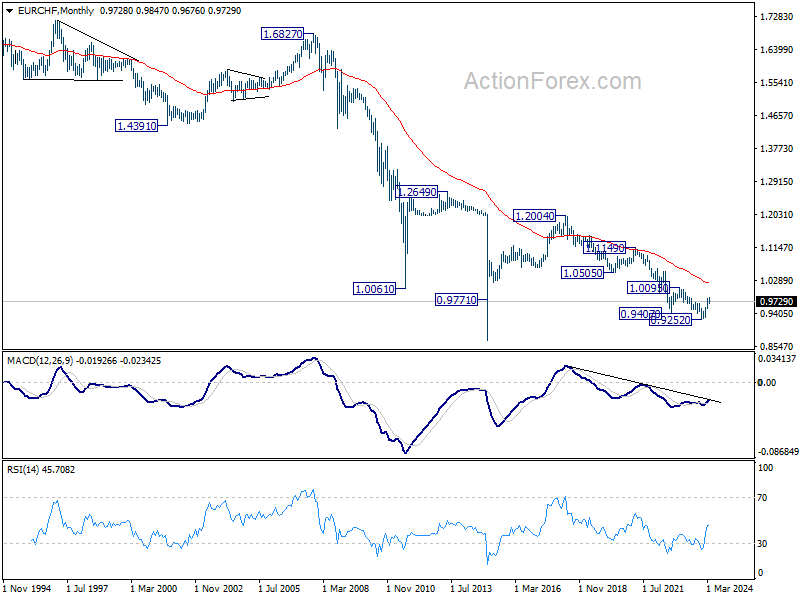
In the long term picture, fall from 1.2004 (2018 high) is part of the multi-decade down trend. Firm break of 1.0095 resistance is needed to be the first sign of long term bottoming. Otherwise, outlook will remain bearish.
Summary 4/15 – 4/19
Monday, Apr 15, 2024
| GMT | Ccy | Events | Consensus | Previous |
|---|---|---|---|---|
| 22:30 | NZD | Business NZ PSI Mar | 53 | |
| 23:50 | JPY | Machinery Orders M/M Feb | 0.80% | -1.70% |
| 06:30 | CHF | Producer and Import Prices M/M Mar | 0.20% | 0.10% |
| 06:30 | CHF | Producer and Import Prices Y/Y Mar | -2% | |
| 09:00 | EUR | Eurozone Industrial Production M/M Feb | 0.80% | -3.20% |
| 12:30 | CAD | Manufacturing Sales M/M Feb | 0.70% | 0.20% |
| 12:30 | CAD | Wholesale Sales M/M Feb | 0.80% | 0.10% |
| 12:30 | USD | Empire State Manufacturing Index Apr | -9 | -20.9 |
| 12:30 | USD | Retail Sales M/M Mar | 0.40% | 0.60% |
| 12:30 | USD | Retail Sales ex Autos M/M Mar | 0.50% | 0.30% |
| 14:00 | USD | Business Inventories Feb | 0.30% | 0.00% |
| 14:00 | USD | NAHB Housing Market Index Apr | 52 | 51 |
| GMT | Ccy | Events | |
|---|---|---|---|
| 22:30 | NZD | Business NZ PSI Mar | |
| Forecast: | Previous: 53 | ||
| 23:50 | JPY | Machinery Orders M/M Feb | |
| Forecast: 0.80% | Previous: -1.70% | ||
| 06:30 | CHF | Producer and Import Prices M/M Mar | |
| Forecast: 0.20% | Previous: 0.10% | ||
| 06:30 | CHF | Producer and Import Prices Y/Y Mar | |
| Forecast: | Previous: -2% | ||
| 09:00 | EUR | Eurozone Industrial Production M/M Feb | |
| Forecast: 0.80% | Previous: -3.20% | ||
| 12:30 | CAD | Manufacturing Sales M/M Feb | |
| Forecast: 0.70% | Previous: 0.20% | ||
| 12:30 | CAD | Wholesale Sales M/M Feb | |
| Forecast: 0.80% | Previous: 0.10% | ||
| 12:30 | USD | Empire State Manufacturing Index Apr | |
| Forecast: -9 | Previous: -20.9 | ||
| 12:30 | USD | Retail Sales M/M Mar | |
| Forecast: 0.40% | Previous: 0.60% | ||
| 12:30 | USD | Retail Sales ex Autos M/M Mar | |
| Forecast: 0.50% | Previous: 0.30% | ||
| 14:00 | USD | Business Inventories Feb | |
| Forecast: 0.30% | Previous: 0.00% | ||
| 14:00 | USD | NAHB Housing Market Index Apr | |
| Forecast: 52 | Previous: 51 | ||
Tuesday, Apr 16, 2024
| GMT | Ccy | Events | Consensus | Previous |
|---|---|---|---|---|
| 02:00 | CNY | GDP Y/Y Q1 | 5.00% | 5.20% |
| 02:00 | CNY | Retail Sales Y/Y Mar | 5.10% | 5.50% |
| 02:00 | CNY | Industrial Production Y/Y Mar | 6.00% | 7.00% |
| 02:00 | CNY | Fixed Asset Investment YTD Y/Y Mar | 4.30% | 4.20% |
| 06:00 | GBP | Claimant Count Change Mar | 17.2K | 16.8K |
| 06:00 | GBP | ILO Unemployment Rate (3M) Feb | 4.00% | 3.90% |
| 06:00 | GBP | Average Earnings Including Bonus 3M/Y Feb | 5.50% | 5.60% |
| 06:00 | GBP | Average Earnings Excluding Bonus 3M/Y Feb | 6.10% | |
| 09:00 | EUR | Eurozone Trade Balance (EUR) Feb | 27.3B | 28.1B |
| 09:00 | EUR | Germany ZEW Economic Sentiment Apr | 35.1 | 31.7 |
| 09:00 | EUR | Germany ZEW Current Situation Apr | -80.5 | |
| 09:00 | EUR | Eurozone ZEW Economic Sentiment Apr | 37.2 | 33.5 |
| 12:30 | CAD | CPI M/M Mar | 0.70% | 0.30% |
| 12:30 | CAD | CPI Y/Y Mar | 2.80% | |
| 12:30 | CAD | CPI Median Y/Y Mar | 3.00% | 3.10% |
| 12:30 | CAD | CPI Trimmed Y/Y Mar | 3.20% | 3.20% |
| 12:30 | CAD | CPI Common Y/Y Mar | 3.10% | 3.10% |
| 12:30 | USD | Building Permits Mar | 1.51M | 1.52M |
| 12:30 | USD | Housing Starts Mar | 1.48M | 1.52M |
| 13:15 | USD | Industrial Production M/M Mar | 0.40% | 0.10% |
| 13:15 | USD | Capacity Utilization Mar | 78.50% | 78.30% |
| 22:45 | NZD | CPI Q/Q Q1 | 0.60% | 0.50% |
| 22:45 | NZD | CPI Y/Y Q1 | 4.70% | |
| 23:50 | JPY | Trade Balance (JPY) Mar | -0.28T | -0.45T |
| GMT | Ccy | Events | |
|---|---|---|---|
| 02:00 | CNY | GDP Y/Y Q1 | |
| Forecast: 5.00% | Previous: 5.20% | ||
| 02:00 | CNY | Retail Sales Y/Y Mar | |
| Forecast: 5.10% | Previous: 5.50% | ||
| 02:00 | CNY | Industrial Production Y/Y Mar | |
| Forecast: 6.00% | Previous: 7.00% | ||
| 02:00 | CNY | Fixed Asset Investment YTD Y/Y Mar | |
| Forecast: 4.30% | Previous: 4.20% | ||
| 06:00 | GBP | Claimant Count Change Mar | |
| Forecast: 17.2K | Previous: 16.8K | ||
| 06:00 | GBP | ILO Unemployment Rate (3M) Feb | |
| Forecast: 4.00% | Previous: 3.90% | ||
| 06:00 | GBP | Average Earnings Including Bonus 3M/Y Feb | |
| Forecast: 5.50% | Previous: 5.60% | ||
| 06:00 | GBP | Average Earnings Excluding Bonus 3M/Y Feb | |
| Forecast: | Previous: 6.10% | ||
| 09:00 | EUR | Eurozone Trade Balance (EUR) Feb | |
| Forecast: 27.3B | Previous: 28.1B | ||
| 09:00 | EUR | Germany ZEW Economic Sentiment Apr | |
| Forecast: 35.1 | Previous: 31.7 | ||
| 09:00 | EUR | Germany ZEW Current Situation Apr | |
| Forecast: | Previous: -80.5 | ||
| 09:00 | EUR | Eurozone ZEW Economic Sentiment Apr | |
| Forecast: 37.2 | Previous: 33.5 | ||
| 12:30 | CAD | CPI M/M Mar | |
| Forecast: 0.70% | Previous: 0.30% | ||
| 12:30 | CAD | CPI Y/Y Mar | |
| Forecast: | Previous: 2.80% | ||
| 12:30 | CAD | CPI Median Y/Y Mar | |
| Forecast: 3.00% | Previous: 3.10% | ||
| 12:30 | CAD | CPI Trimmed Y/Y Mar | |
| Forecast: 3.20% | Previous: 3.20% | ||
| 12:30 | CAD | CPI Common Y/Y Mar | |
| Forecast: 3.10% | Previous: 3.10% | ||
| 12:30 | USD | Building Permits Mar | |
| Forecast: 1.51M | Previous: 1.52M | ||
| 12:30 | USD | Housing Starts Mar | |
| Forecast: 1.48M | Previous: 1.52M | ||
| 13:15 | USD | Industrial Production M/M Mar | |
| Forecast: 0.40% | Previous: 0.10% | ||
| 13:15 | USD | Capacity Utilization Mar | |
| Forecast: 78.50% | Previous: 78.30% | ||
| 22:45 | NZD | CPI Q/Q Q1 | |
| Forecast: 0.60% | Previous: 0.50% | ||
| 22:45 | NZD | CPI Y/Y Q1 | |
| Forecast: | Previous: 4.70% | ||
| 23:50 | JPY | Trade Balance (JPY) Mar | |
| Forecast: -0.28T | Previous: -0.45T | ||
Wednesday, Apr 17, 2024
| GMT | Ccy | Events | Consensus | Previous |
|---|---|---|---|---|
| 01:00 | AUD | Westpac Leading Index M/M Mar | 0.10% | |
| 06:00 | GBP | CPI M/M Mar | 0.60% | |
| 06:00 | GBP | CPI Y/Y Mar | 3.10% | 3.40% |
| 06:00 | GBP | CPI Core Y/Y Mar | 4.10% | 4.50% |
| 06:00 | GBP | RPI M/M Mar | 0.80% | |
| 06:00 | GBP | RPI Y/Y Mar | 4.50% | |
| 06:00 | GBP | PPI Input M/M Mar | 0.00% | -0.40% |
| 06:00 | GBP | PPI Input Y/Y Mar | -2.70% | |
| 06:00 | GBP | PPI Output M/M Mar | 0.20% | 0.30% |
| 06:00 | GBP | PPI Output Y/Y Mar | 0.40% | |
| 06:00 | GBP | PPI Core Output M/M Mar | 0.20% | |
| 06:00 | GBP | PPI Core Output Y/Y Mar | 0.30% | |
| 09:00 | EUR | Eurozone CPI Y/Y Mar F | 2.90% | 2.90% |
| 09:00 | EUR | Eurozone CPI Core Y/Y Mar F | 2.40% | 2.40% |
| 14:30 | USD | Crude Oil Inventories | 5.8M | |
| 18:00 | USD | Fed's Beige Book |
| GMT | Ccy | Events | |
|---|---|---|---|
| 01:00 | AUD | Westpac Leading Index M/M Mar | |
| Forecast: | Previous: 0.10% | ||
| 06:00 | GBP | CPI M/M Mar | |
| Forecast: | Previous: 0.60% | ||
| 06:00 | GBP | CPI Y/Y Mar | |
| Forecast: 3.10% | Previous: 3.40% | ||
| 06:00 | GBP | CPI Core Y/Y Mar | |
| Forecast: 4.10% | Previous: 4.50% | ||
| 06:00 | GBP | RPI M/M Mar | |
| Forecast: | Previous: 0.80% | ||
| 06:00 | GBP | RPI Y/Y Mar | |
| Forecast: | Previous: 4.50% | ||
| 06:00 | GBP | PPI Input M/M Mar | |
| Forecast: 0.00% | Previous: -0.40% | ||
| 06:00 | GBP | PPI Input Y/Y Mar | |
| Forecast: | Previous: -2.70% | ||
| 06:00 | GBP | PPI Output M/M Mar | |
| Forecast: 0.20% | Previous: 0.30% | ||
| 06:00 | GBP | PPI Output Y/Y Mar | |
| Forecast: | Previous: 0.40% | ||
| 06:00 | GBP | PPI Core Output M/M Mar | |
| Forecast: | Previous: 0.20% | ||
| 06:00 | GBP | PPI Core Output Y/Y Mar | |
| Forecast: | Previous: 0.30% | ||
| 09:00 | EUR | Eurozone CPI Y/Y Mar F | |
| Forecast: 2.90% | Previous: 2.90% | ||
| 09:00 | EUR | Eurozone CPI Core Y/Y Mar F | |
| Forecast: 2.40% | Previous: 2.40% | ||
| 14:30 | USD | Crude Oil Inventories | |
| Forecast: | Previous: 5.8M | ||
| 18:00 | USD | Fed's Beige Book | |
| Forecast: | Previous: | ||
Thursday, Apr 18, 2024
| GMT | Ccy | Events | Consensus | Previous |
|---|---|---|---|---|
| 01:30 | AUD | NAB Business Confidence Q1 | -6 | |
| 01:30 | AUD | Employment Change Mar | 7.2K | 116.5K |
| 01:30 | AUD | Unemployment Rate Mar | 3.90% | 3.70% |
| 01:30 | AUD | RBA Bulletin Q1 | ||
| 04:30 | JPY | Tertiary Industry Index M/M Feb | 0.80% | 0.30% |
| 06:00 | CHF | Trade Balance (CHF) Mar | 3.22B | 3.66B |
| 08:00 | EUR | Eurozone Current Account (EUR) Feb | 45.2B | 39.4B |
| 12:30 | USD | Initial Jobless Claims (Apr 12) | 214K | 211K |
| 12:30 | USD | Philadelphia Fed Manufacturing Survey Apr | 0.8 | 3.2 |
| 14:00 | USD | Existing Home Sales Mar | 4.20M | 4.38M |
| 14:30 | USD | Natural Gas Storage | 24B | |
| 23:30 | JPY | National CPI Y/Y Mar | 2.80% | |
| 23:30 | JPY | National CPI core Y/Y Mar | 2.70% | 2.80% |
| 23:30 | JPY | National CPI core-core Y/Y Mar | 3.20% |
| GMT | Ccy | Events | |
|---|---|---|---|
| 01:30 | AUD | NAB Business Confidence Q1 | |
| Forecast: | Previous: -6 | ||
| 01:30 | AUD | Employment Change Mar | |
| Forecast: 7.2K | Previous: 116.5K | ||
| 01:30 | AUD | Unemployment Rate Mar | |
| Forecast: 3.90% | Previous: 3.70% | ||
| 01:30 | AUD | RBA Bulletin Q1 | |
| Forecast: | Previous: | ||
| 04:30 | JPY | Tertiary Industry Index M/M Feb | |
| Forecast: 0.80% | Previous: 0.30% | ||
| 06:00 | CHF | Trade Balance (CHF) Mar | |
| Forecast: 3.22B | Previous: 3.66B | ||
| 08:00 | EUR | Eurozone Current Account (EUR) Feb | |
| Forecast: 45.2B | Previous: 39.4B | ||
| 12:30 | USD | Initial Jobless Claims (Apr 12) | |
| Forecast: 214K | Previous: 211K | ||
| 12:30 | USD | Philadelphia Fed Manufacturing Survey Apr | |
| Forecast: 0.8 | Previous: 3.2 | ||
| 14:00 | USD | Existing Home Sales Mar | |
| Forecast: 4.20M | Previous: 4.38M | ||
| 14:30 | USD | Natural Gas Storage | |
| Forecast: | Previous: 24B | ||
| 23:30 | JPY | National CPI Y/Y Mar | |
| Forecast: | Previous: 2.80% | ||
| 23:30 | JPY | National CPI core Y/Y Mar | |
| Forecast: 2.70% | Previous: 2.80% | ||
| 23:30 | JPY | National CPI core-core Y/Y Mar | |
| Forecast: | Previous: 3.20% | ||
Friday, Apr 19, 2024
| GMT | Ccy | Events | Consensus | Previous |
|---|---|---|---|---|
| 06:00 | GBP | Retail Sales M/M Mar | 0.30% | 0.00% |
| 06:00 | EUR | Germany PPI M/M Mar | 0.00% | -0.40% |
| 06:00 | EUR | Germany PPI Y/Y Mar | -4.10% |
| GMT | Ccy | Events | |
|---|---|---|---|
| 06:00 | GBP | Retail Sales M/M Mar | |
| Forecast: 0.30% | Previous: 0.00% | ||
| 06:00 | EUR | Germany PPI M/M Mar | |
| Forecast: 0.00% | Previous: -0.40% | ||
| 06:00 | EUR | Germany PPI Y/Y Mar | |
| Forecast: | Previous: -4.10% | ||
The Weekly Bottom Line: One Hundred Days into 2024, Rate Cuts Remain on the Horizon
U.S. Highlights
- Inflation, as measured by the Consumer Price Index, accelerated to 3.5% year-on-year in March – the highest reading in six months.
- Minutes from the Federal Reserve meeting in March showed that officials remained in favor of exercising patience amid persistent inflationary pressures.
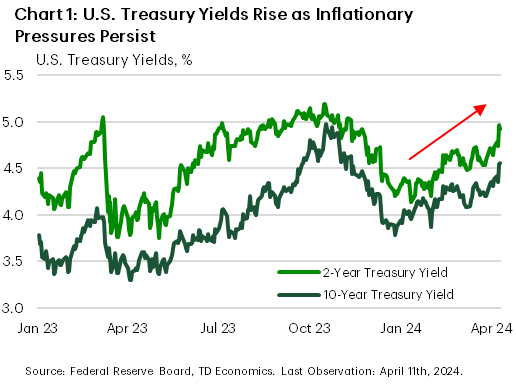
- U.S. Treasury yields spiked roughly 15 basis-points as market expectations for lower interest rates were pushed back into the second half of the year.
Canadian Highlights
- The Bank of Canada held its policy rate at 5%, while comments from Governor Macklem indicated that a rate cut is “within the realm of possibilities” at the June meeting.
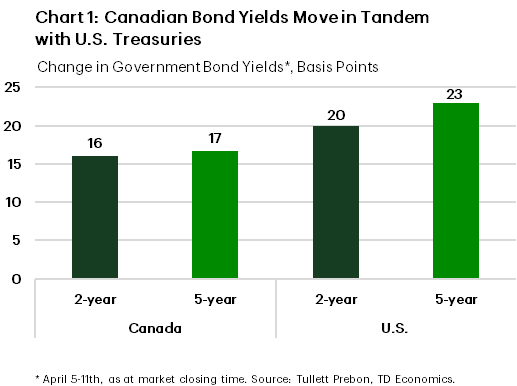
- Canadian Government bond yields moved higher in tandem with U.S. Treasuries. This may slow the Canadian housing market, reducing the extent of relief from expected rate cuts.
- The Federal government’s housing plan will increase the Home Buyers Plan withdrawal limit and extend amortization for some borrowers but will likely have a limited impact on the housing market.
U.S. – One Hundred Days into 2024, Rate Cuts Remain on the Horizon
Financial markets were caught off-guard this week as slightly hotter than expected inflation data prompted a spike in U.S. Treasury yields and a modest retreat in equity prices. As of the time of writing, the ten- and two-year Treasury yields finished the week up roughly 15 basis-points (Chart 1), while the S&P 500 fell 0.9%. While the deviation relative to expectations for the March Consumer Price Index (CPI) inflation was marginal, the underlying details proved to be more concerning.
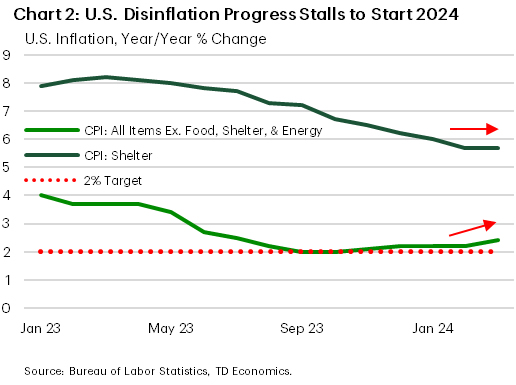
Headline inflation in March jumped to 3.5% year-on-year, with energy prices seeing positive price growth in annual terms for the first time in over a year. Excluding energy and food prices, core inflation remained unchanged relative to February at 3.8%. The reason why the disinflation process stalled in the first quarter is related to two factors. The first is that disinflation in the heavily weighted shelter subcategory moderated relative to the previous quarter. While this offered less support to the Fed’s mission to reattain price stability, the measurement of shelter prices is lagged relative to market trends by several months, and thus the direction of shelter inflation is still expected to be downward moving forward.
The second factor keeping inflation elevated was the acceleration in price growth for categories excluding food, energy, and shelter – aggregately referred to as supercore inflation. Inflation pressures within this subcategory were broad-based in the first quarter (Chart 2) which has not gone unnoticed by the Federal Reserve. In the March meeting minutes released this week, FOMC participants noted they were reluctant to discount the inflation data of the first quarter and emphasized that they would require greater confidence that inflation was on a sustainable trajectory back to the 2% target before considering less restrictive policy options.
This lined up with the even-toned statements made by Federal Reserve officials this week, including Vice Chair and New York Fed President John Williams who stated that he expects “inflation to continue its gradual return to 2 percent, although there will likely be bumps along the way, as we’ve seen in some recent inflation readings”. In a speech this week, Boston Fed President Susan Collins also stated “Overall, the recent data have not materially changed my outlook, but they do highlight uncertainties related to timing, and the need for patience”. Market pricing for the first Federal Reserve cut this year shifted from June to July this week, although market confidence remains weak with the balance of risks skewed towards the potential for a later commencement date.
Looking to next week, we receive an update on retail sales for March on Monday, which are expected to show slower growth relative to the prior month, in part owing to a moderation in auto sales. Next week also marks the start of the Spring IMF meetings, which will include meetings between the Fed and the U.S. Treasury and their international counterparts, in addition to the publication of the IMF’s updated World Economic Outlook.
Canada – A Week of Celestial Events
Two events garnered widespread attention in Canada this week: the solar eclipse and the Bank of Canada’s (BoC) monetary policy meeting. Both have implications for the economy – the former by boosting demand for astro-tourism, the latter by capping demand for almost everything else. As widely anticipated, the Bank held its policy rate at 5%, while comments from Governor Macklem indicated that a rate cut is “within the realm of possibilities” at the June meeting. This had no major impact on the market expectations, where a full rate cut remains priced for the July meeting.
Several takeaways emerged from the Monetary Policy Report – a fresh set of forecasts, accompanying the BoC’s announcement. Namely, the near-term GDP forecast was upgraded reflecting higher population growth and some recovery in consumer spending. Despite the upgrade to the growth outlook, the BoC marked down its inflation forecast by two tenths of a percentage point and now expects its measure of core inflation to reach 2.2% by year-end. In his speech following the announcement, Governor Macklem maintained a cautious tone, stating he would rather err on the side of over-tightening policy to avoid any setbacks in lowering inflation.
Another ‘celestial’ announcement was a 25-basis point (bp) increase in the estimated neutral rate – the policy rate consistent with the economy operating at its full capacity with stable inflation. The Bank justified this increase by citing a higher global neutral rate (using the U.S. as a proxy) and “key Canadian domestic factors” like growth in total hours worked and a younger population of savers. Simply put, the Bank signaled the end point of its upcoming easing cycle will likely be a bit higher than previously thought.
While hard to quantify, an increase in neutral rate likely had only a marginal effect on long-term rates this week. A stronger gravitational pull was exerted by the sharp rise in U.S. Treasury yields following another higher-than-expected inflation reading which resulted in one of the largest weekly moves in yields over the past two years (Chart 1).
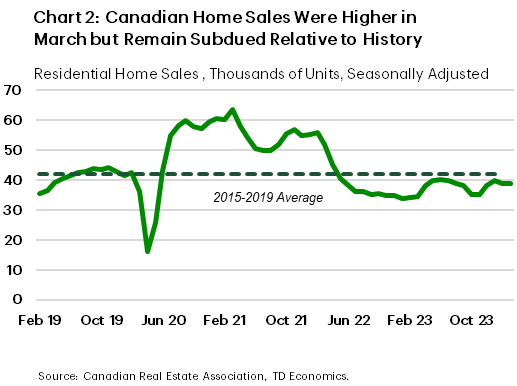
This backup in yields casts a shadow over the Canadian housing market. On the one hand, existing home sales for March were up 0.5% on the month, and, according to CREA, new listings for April are tracking stronger, which could support higher sales activity this month. On the other hand, sales remain below their historical average while higher bond yields will exert additional pressure on affordability, signaling a period of slower activity in the months ahead (Chart 2).
From that perspective, today’s release of the government’s housing plan is timely. Based on Chrystia Freeland’s speech, the government will be increasing the Home Buyers Plan withdrawal limit from $35k to $60k and lifting amortization for insured mortgages from 25 to 30 years for newly built homes and first-time buyers. Our initial assessment suggests that these measures will have a limited impact on the housing market but stay tuned for our comprehensive analysis of the Federal Government Budget next week.
Weekly Economic & Financial Commentary: No, No, After You
Summary
United States: Are We There Yet?
- The March consumer price data dominated the economic discussion this week and are the latest to support that the timing and degree of Fed easing will be later and smaller than many of us previously expected. We're not yet there. We now expect the FOMC won't begin to ease policy until its Sept. 18 meeting.
- Next week: Retail Sales (Mon.), Industrial Production (Tue.), Existing Home Sales (Thu.)
International: Major Central Banks Readying Markets for Rate Cuts
- The European Central Bank (ECB) held monetary policy steady this week, though we view the accompanying statement as laying the groundwork for easing in June. We expect the ECB to deliver an initial 25 bps rate cut at its June meeting. The Bank of Canada (BoC) also held steady and said “we are seeing what we need to see” to lower policy interest rates, but that “we need to see it for longer.” We also lean toward an initial 25 bps policy rate cut from the BoC at its June meeting.
- Next week: China GDP (Tue.), Canada CPI (Tue.), U.K. CPI (Wed.)
Interest Rate Watch: No, No, After You
- The not-quite synchronized actions of the world's central banks came into better focus this week. We explore how that is impacting the rates market in the United States and abroad, particularly as expectations shift in the foreign exchange market.
Credit Market Insights: Consumer Fear of Delinquency on the Rise
- Earlier this week, the New York Fed released its Survey of Consumer Expectations for March. While inflation expectations were largely stable, cracks in household financial well-being were evident in consumers’ responses.
Topic of the Week: Biden Unveils New Plan to Cancel Student Debt
- The Biden administration moved this week to propose new student loan debt relief that would affect millions of Americans. The new proposal would cancel up to $20,000 in debt for borrowers whose balances have grown as a result of unpaid interest. Overall, the macroeconomic impact looks to be muted for the policy, even if the impact could be significant for affected households.
Canadian Inflation to Tick Higher as BoC Considers Rate Cuts
The Bank of Canada will be focused on the March Canadian consumer price index report next Tuesday after another upward surprise in U.S. price growth created doubt about the U.S. Federal Reserve’s rate-cutting plans this year.
Slower price growth in Canada in recent months and a sharply underperforming Canadian economy have “increased confidence” among BoC policymakers that inflation will continue to slow. But the central bank wants to see more evidence before shifting to interest rate cuts.
We expect year-over-year price growth in March to tick higher to 3% from 2.8% in February largely due to higher gasoline prices pushing energy costs further above year-ago levels. Food price growth should be little changed—still above 3% but slower than the 10% plus peak increases in late 2022.
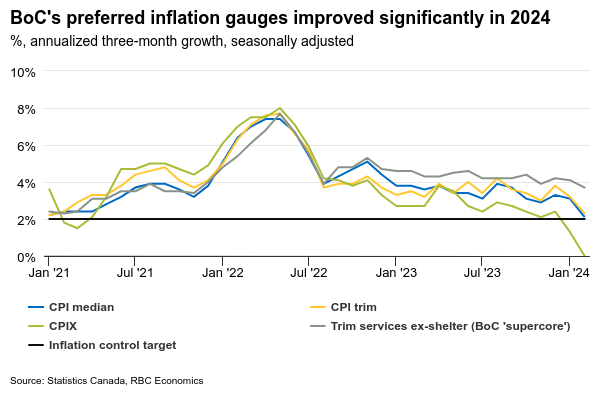
The CPI data is often volatile and clothing prices, in particular, could rebound in the spring after milder-than-usual temperatures slowed demand and prices over the winter. The BoC will be more focused on its preferred list of core measures—which are designed to look through volatility in any one subcomponent—for signs that broader inflation pressures continue to ease. We look for growth in the BoC’s preferred trim and median measures to hold close to the February pace both on a year-over-year and three-month rolling average basis. The latter slowed to a 2.2% average annualized rate in February.
Week ahead data watch
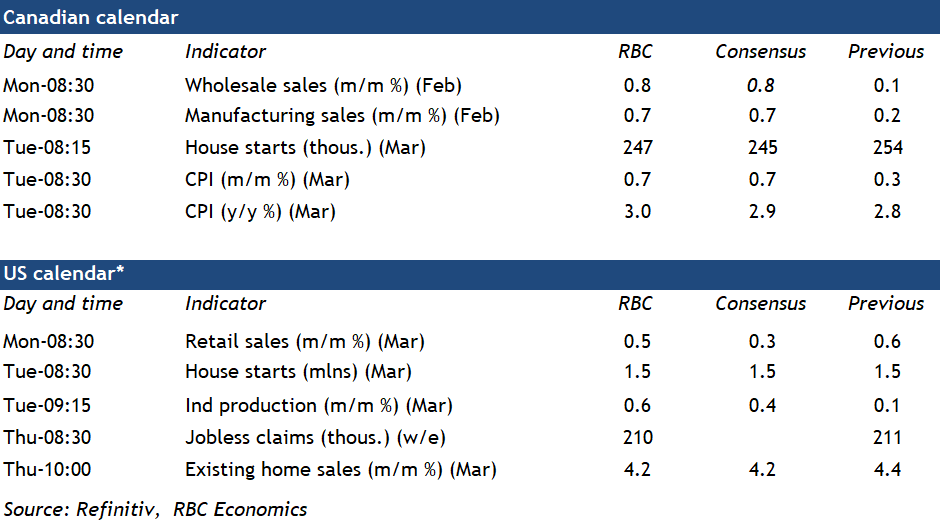
We expect Canadian manufacturing sales to tick up 0.7% in February in line with Statistics Canada’s advance indicator. Much of that growth was driven by higher sales in the petroleum and coal subsector. Sales volumes likely dipped given the industrial product price index edged up 0.7% in February.
StatCan’s early estimate of “core” wholesale sales increased by 0.8% in February with sales in machinery, equipment and supplies, motor vehicles and parts and accessories and building material and supplies subsectors going up during that month.
March housing starts likely stood at 247,000, given that building permits grew at a slower pace (8%) in February, down from 13% in January.
U.S. retail sales likely ticked up 0.5% in March, following 0.6% growth in February led by price-related sales increase at gas stations. But auto sales dipped during that month, partially offsetting some of the growth.
EURUSD Has Bucked the Trend, Threatening to Fall Below Parity
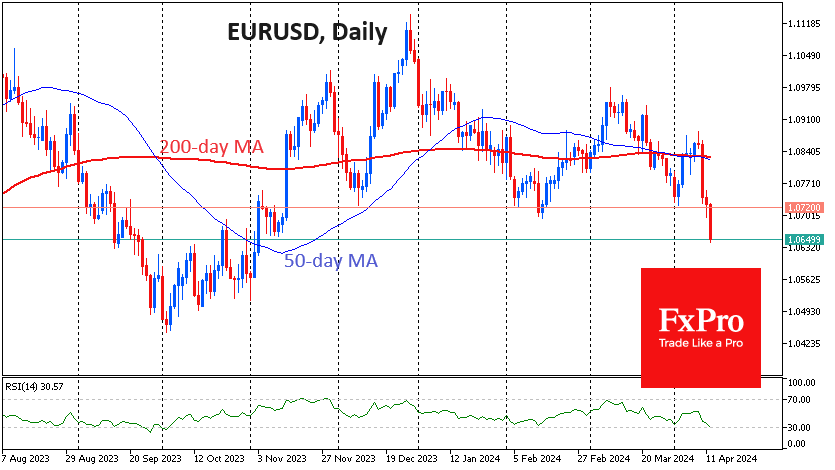
EURUSD is losing 1.9% from Wednesday’s peak to a five-month low at 1.0650. US inflation data and ECB comments highlight the divergence of Fed and ECB monetary policy.
Wednesday’s US inflation report appears to have set the trend for the dollar, taking it out of a more than four-month wander around its 200-day moving average. And the biggest contributor to this pullback is the EURUSD dynamics.
The pressure on the key currency market pair comes from several directions at once. On the US side, markets have continued to receive pro-inflationary data since the beginning of the month: acceleration in manufacturing activity, strong new job growth, and stronger CPI acceleration than expected. This data continued to push back the date of the expected Fed’s rate cut and the number of these moves.
On the European side, by contrast, data releases and comments from ECB officials are supporting the sentiment for the first cut in June. And this is a divergence that markets can no longer ignore.
The EURUSD dynamics during this week emphasise the serious bearish bias in the pair. The pair crossed the 50- and 200-day moving averages in a sharp move on Wednesday and closed well below them. Neither on Thursday nor on Friday did the Euro make any noticeable attempts to rebound.
Moreover, we don’t even see the typical Friday thrust of short-term profit-taking with an ongoing sell-off. EURUSD slid to 1.0650, having fallen out of its trading range since late December.
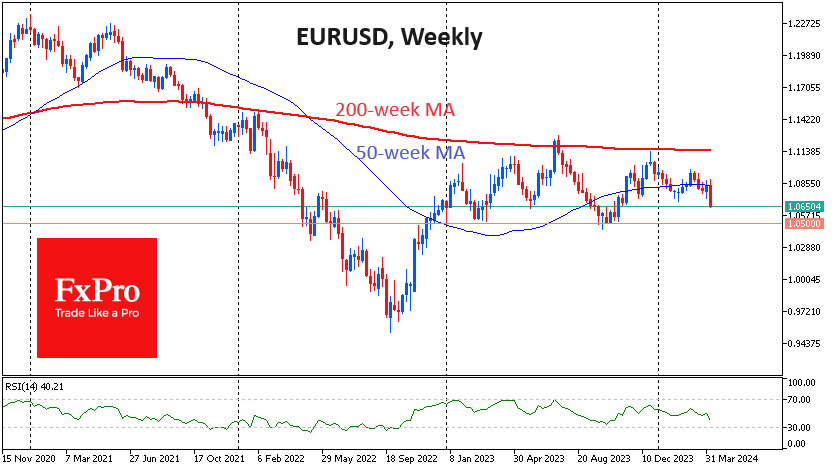
EURUSD has been receiving support on dips towards 1.05 in 2023, spending only a few days below that level. The pair will likely test the strength of this support again very soon, and the accumulating difference in Fed and ECB policy reinforces the chances that the pair will not stop there this time.
If indeed EURUSD falls below 1.05 in April, the pair could fall to the next leg, finding support only near 0.95.
Will US Retail Sales Add Juice to the Dollar’s Rally?
- US retail sales will hit the markets at 12:30 GMT Monday
- Early Easter holiday likely boosted consumer spending
- Another solid dataset could put more wind in the dollar’s sails
US economy outperforms
By most indications, the US economy finished the first quarter on a high note. Incoming data point to a robust labor market, which has helped bolster consumer demand and in the process, reignited inflationary pressures.
The Atlanta Fed estimates real economic growth hit an annualized pace of 2.4% in the first quarter, something reaffirmed by incoming business surveys. Heavy government spending and a surge in population growth amid an influx of immigration appear to be the driving forces behind this economic resilience.
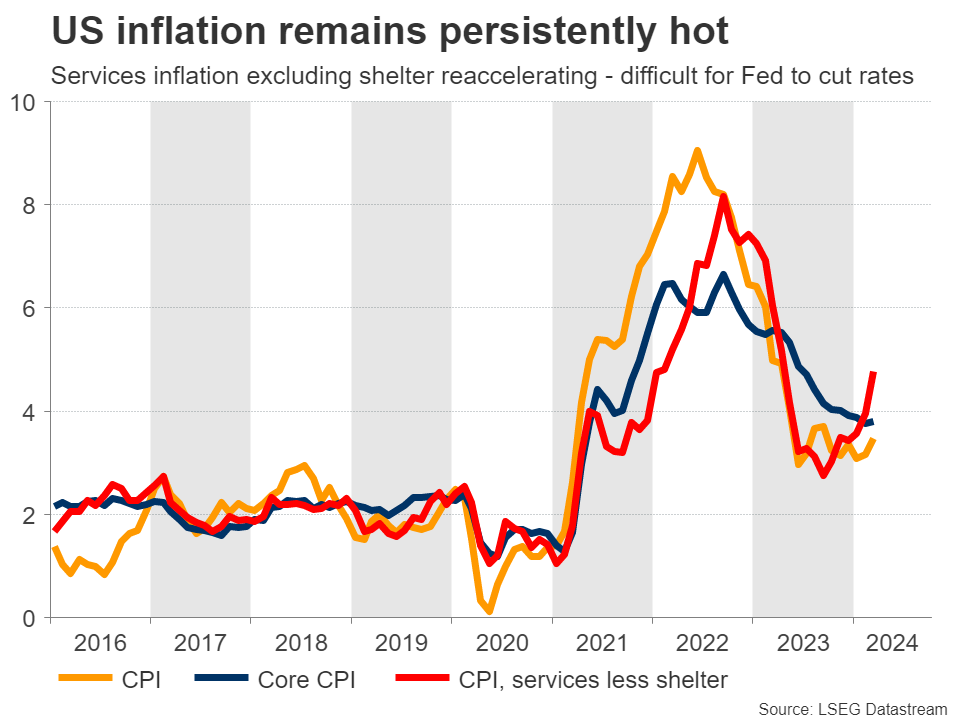
With mounting signs that growth and inflation are not cooling down, traders have continued to unwind bets of Fed rate cuts. Market pricing currently points to less than two cuts for this year, down from six just a few months ago.
This sharp Fed repricing has propelled US yields higher, lending strength to the US dollar.
Retail sales enjoy Easter boost
Turning to the upcoming dataset, retail sales are forecast to have risen by 0.3% on a monthly basis in March, a slowdown from the 0.6% in the previous month but still a solid print overall.
It seems that the early Easter holiday pulled forward some spending into March, giving an artificial boost to retail sales, at the expense of April’s print.
That said, some early indicators on card spending painted a mixed picture. Bank of America data pointed to a soft month for consumption, whereas Visa’s spending momentum index continued to rise, signaling stronger demand.
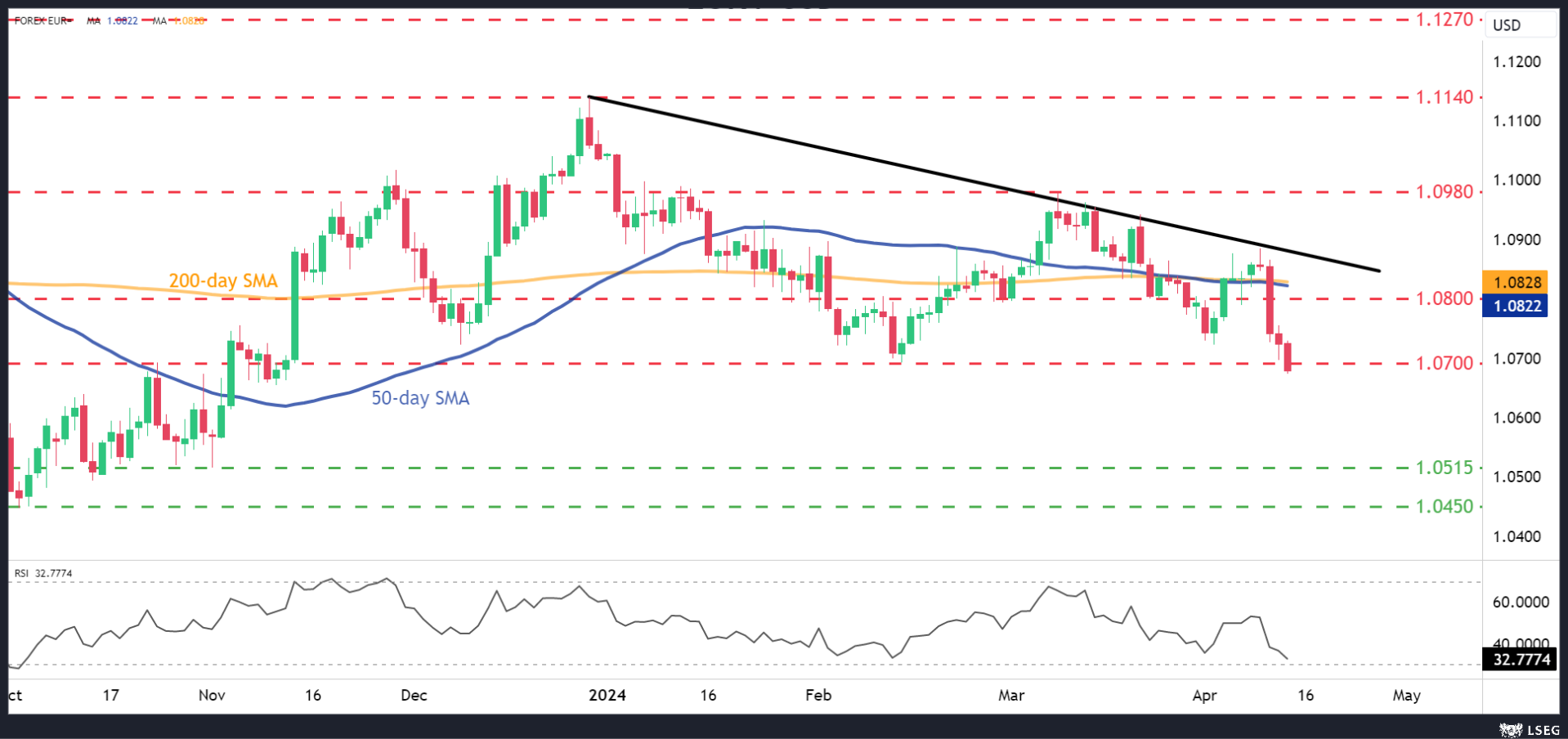
Given these conflicting signals, there is some scope for surprises in this dataset. Taking a look at the euro/dollar chart, a stronger-than-expected retail sales print could push the pair even lower, with the next major cluster of support likely to be found near the 1.0515 zone.
On the flipside, a disappointment could help euro/dollar correct higher. A potential move back above the 1.0700 region could open the door for further upside extensions towards the 1.0800 area.
Dollar outlook remains positive
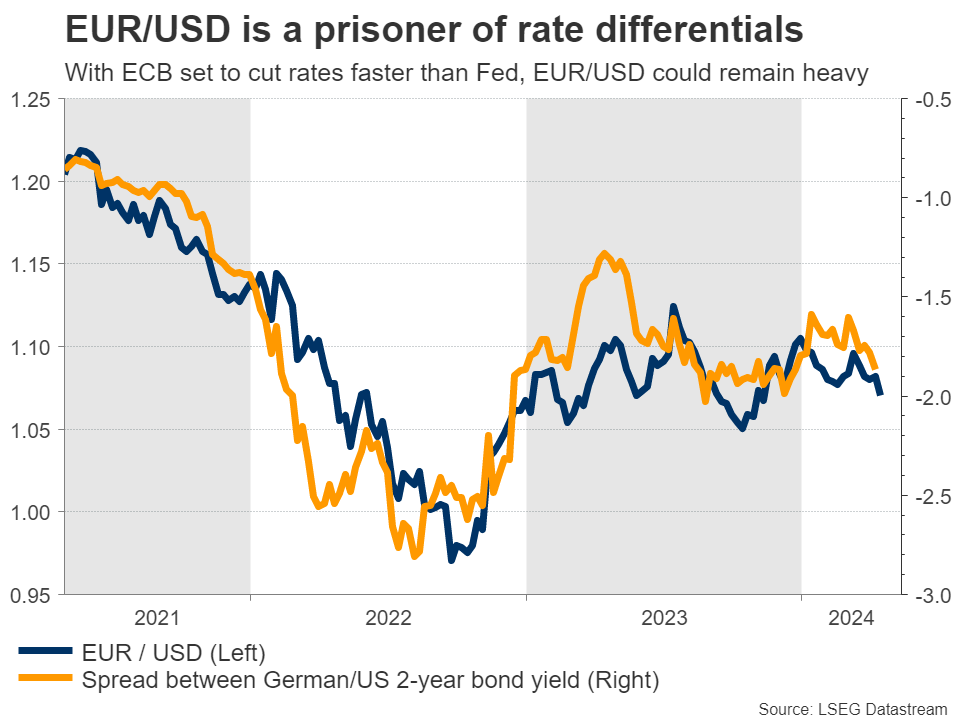
In the big picture, the US economy seems stronger than other major regions at this stage, especially Europe. This economic divergence points to a situation where the European Central Bank might cut interest rates faster and deeper than the Fed does, which in turn could keep downside pressure on euro/dollar.
Still, for the dollar to truly shine, it might also need some assistance from the risk sentiment channel. Given the dollar’s safe haven qualities, a period of risk aversion in the markets could go a long way in helping the reserve currency stage a more fierce rally.
Indeed, with stock market valuations being stretched in an environment where US yields are rising, the risk of a correction in equities seems to be growing.
Week Ahead – More Inflation Data on the Way as Rate Cut Bets Thrown into Disarray
- CPI numbers due in the UK, Japan, Canada and New Zealand
- China to also come into the spotlight as Q1 GDP eyed
- US retail sales to kickstart the week as earnings season gets underway
CPI figures to headline UK data flurry
After yet another hot CPI report in the United States, inflation data will remain at the forefront of the upcoming week’s releases, including in the United Kingdom. But first up on the UK agenda will be the February employment report on Tuesday.
Employment declined in the three months to January, pushing up the jobless rate to 3.9%. The UK labour market has slowed down substantially over the past year amid a slight contraction in GDP. The economy appears to be rebounding but jobs growth could remain weak for some time yet. From a wage inflation perspective, a cooling labour market can only be good news.
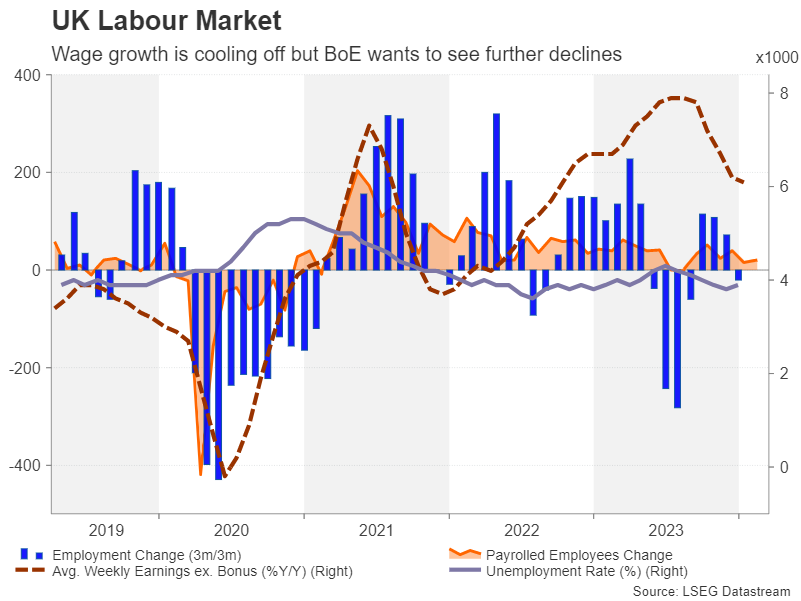
Growth in average weekly earnings excluding bonuses has moderated from a peak of 8.9% y/y last summer to 6.1% in January. A further deceleration is likely in February – a trend underscored by a Bank of England survey showing that wage growth expectations have fallen to the lowest in two years.
However, softer wage growth won’t be the whole story for sterling next week as investors will also be dissecting the latest CPI readings on Wednesday. UK inflation fell to 3.4% in February and another drop is expected for March to 3.1%. The core figure is also forecast to decline again.
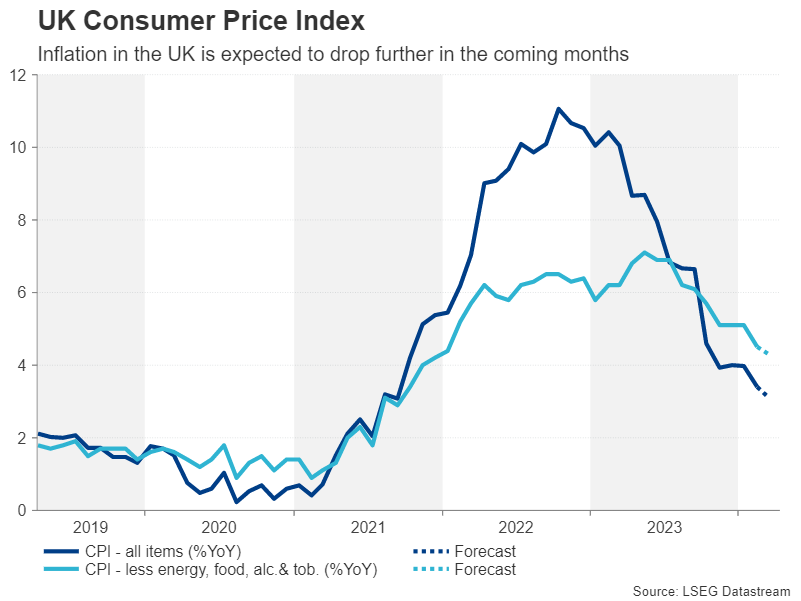
Finally, on Friday, retail sales numbers for March will be watched for clues on whether consumer spending is picking up or not.
Cable is currently testing the floor of the sideways range it’s been trading in since December and the incoming data pose a downside risk should they suggest that the Bank of England is still on track to start cutting rates in August, while the Fed’s timeline has started to shift to September.
If the UK’s inflation outlook continues to improve, the pound might struggle to hold above $1.25 and traders will either want to see Britain’s economy recovering more strongly or US growth losing steam to defend that key level.
Euro to take backseat after ECB
Across the channel, it’s going to be a fairly quiet week for the euro in the aftermath of the ECB decision, with only the final estimate of March CPI and second-tier releases to keep traders busy.
The European Central Bank left interest rates unchanged as expected at its April policy meeting while signalling that a rate cut could be on the cards at its next gathering in June. Inflation in the Eurozone has been much more tamed than in the US this year. Coupled with a weaker economy, the ECB can afford to gradually start loosening its restrictive stance.
The headline rate of the consumer price index eased to 2.4% in March and no revisions are expected in the final estimate due on Wednesday.
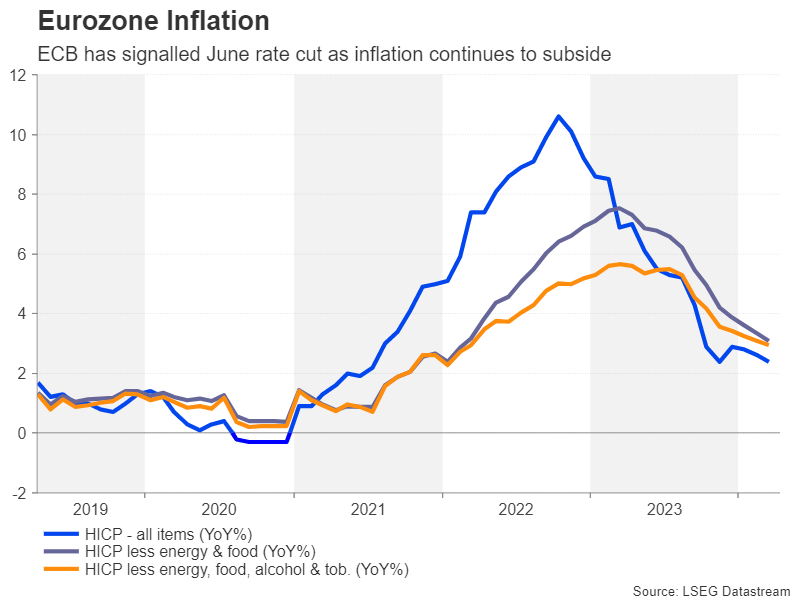
Earlier in the week, industrial production numbers might attract some attention on Monday, while the ZEW economic sentiment out of Germany comes out Tuesday.
Barring any surprise upward revisions to the CPI prints, the euro will likely stay on the backfoot against the US dollar over the next few days.
Can Japanese CPI lift the downtrodden yen?
Inflation in Japan edged up sharply in February after a year-long decline. Core CPI that excludes fresh food prices and which the Bank of Japan targets for achieving 2% inflation rose to 2.8% from 2.0%. However, whilst there was probably a further modest uptick in overall CPI, the core figure, out on Friday, is forecast to have eased to 2.6%.
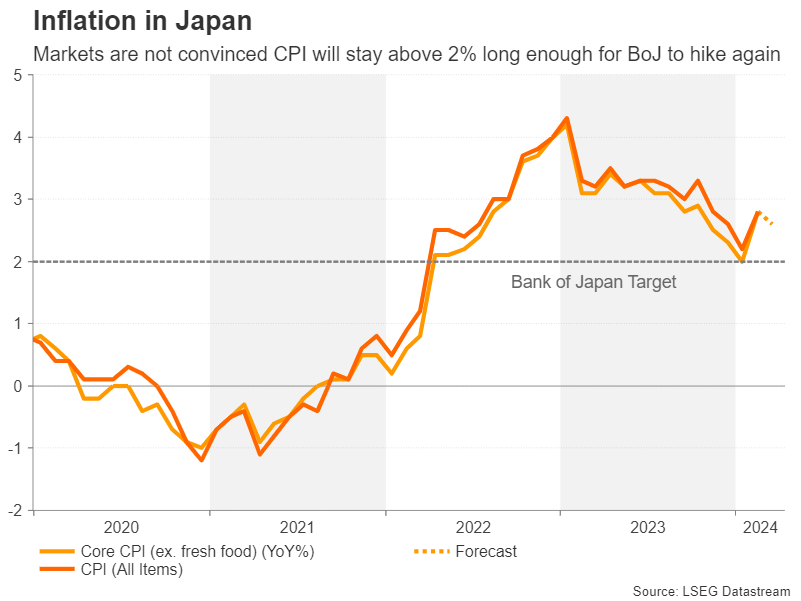
Nevertheless, investors are questioning whether inflationary pressures in Japan can re-accelerate much from hereon and thus, expectations for additional rate hikes remain muted – something that has been weighing heavily on the yen.
Yet, the Bank of Japan seems to be subtly paving the way for a second rate hike towards the end of the year and Governor Ueda has hinted as much. There are also reports that the bank will revise up its inflation forecasts at its next meeting on April 26. Policymakers are hopeful that bumper pay deals in this year’s spring wage negotiations and an end to energy subsidies at the end of May will keep inflation above 2% in the medium-term horizon.
But until this is reflected in the CPI data, the yen is unlikely to find much love.
A mixed picture for China’s economy
China is set to publish GDP estimates on Tuesday as optimism about its economic recovery improves. The world’s second largest economy probably expanded by 1.4% quarter-on-quarter in the three months to March, quickening from a 1% pace in the prior quarter. However, markets might focus more on the annual rate that’s expected to have slowed from 5.2% to 4.6%.
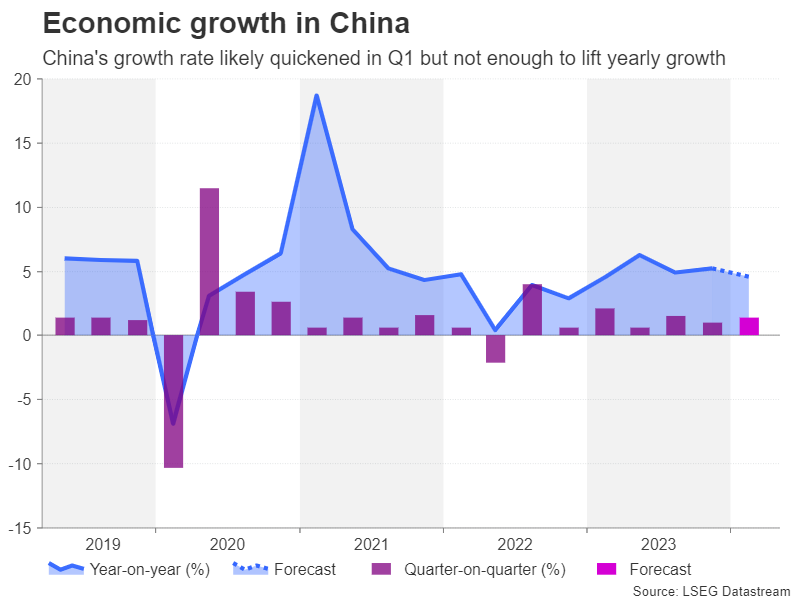
The March figures for industrial output and retail sales could also leave investors unimpressed as both are anticipated to have eased year-on-year compared to February.
Any disappointment from the GDP stats could add to the aussie’s and kiwi’s woes, which have been swimming in choppy waters lately amid the constant swings in Fed rate cut bets. For the Australian dollar, traders will also be keeping an eye on domestic jobs numbers on Thursday, while for the New Zealand dollar, Wednesday’s CPI prints will be crucial.
The Reserve Bank of New Zealand maintained a very neutral stance at its April policy meeting, signalling that a rate cut is some time away. But should CPI rise by less than the expected rate of 4.1% y/y in the first quarter, investors might become more confident about an August cut.
Canadian inflation eyed
Another country reporting CPI data next week is Canada, due Tuesday. A June rate cut is still in play for the Bank of Canada despite heightened caution globally about sticky inflation. Canada’s headline CPI rate eased to 2.8% in February and underlying measures fell too.
A continuation of that trend in March could boost the odds of a rate cut in June, which currently stand at less than 50%, piling more pressure on the Canadian dollar.
The loonie has already shed about 3.5% against the US dollar this year so any further signs of a possible divergence in monetary policy between the Fed and the BoC could increase those losses.
Retail sales only threat for dollar bulls
South of the border, the US schedule is looking relatively light, with Monday’s retail sales numbers being the top release.
The latest NFP and CPI reports both dented expectations of a summer rate cut by the Fed so investors will be hoping for some softer data next, and they could well get that.
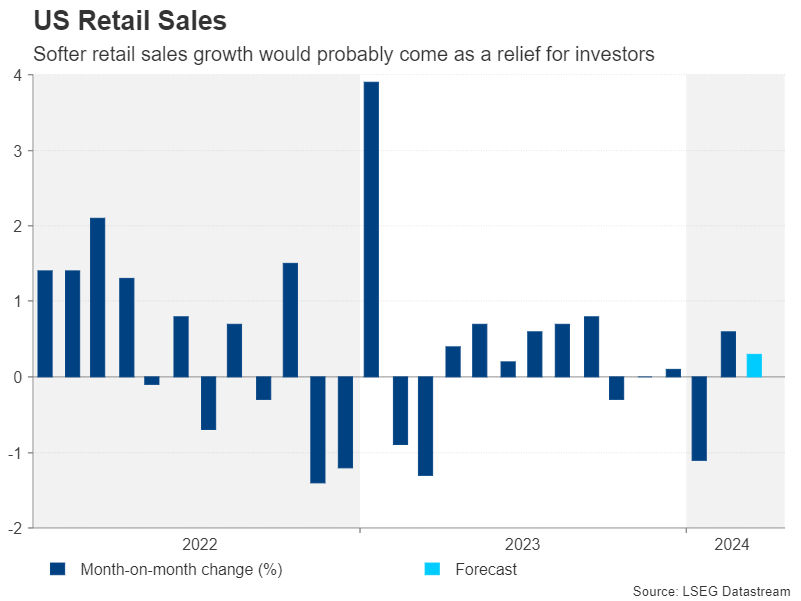
Retail sales are forecast to have risen by 0.3% m/m in March, slowing from the prior 0.6% rate. Other indicators to watch out of the US are the Empire State Manufacturing index, also on Monday, building permits and housing starts along with industrial production on Tuesday, to be followed by the Philly Fed manufacturing index and existing home sales on Thursday.
With markets still reeling from the setback to early rate cut hopes, the dollar will likely hold firm. But shares on Wall Street stand a chance of staging a rebound if the Q1 earnings season gets off to a strong start. The spotlight next week will fall on Netflix, which announces its results on Thursday.