Sample Category Title
BoC to Put June Rate-Cut on the Map-Tentatively
- BoC monetary report due on Wednesday 13:45 GMT, press conference at 14:30 GMT
- Interest rates to remain steady this time, but policymakers might support a June rate cut
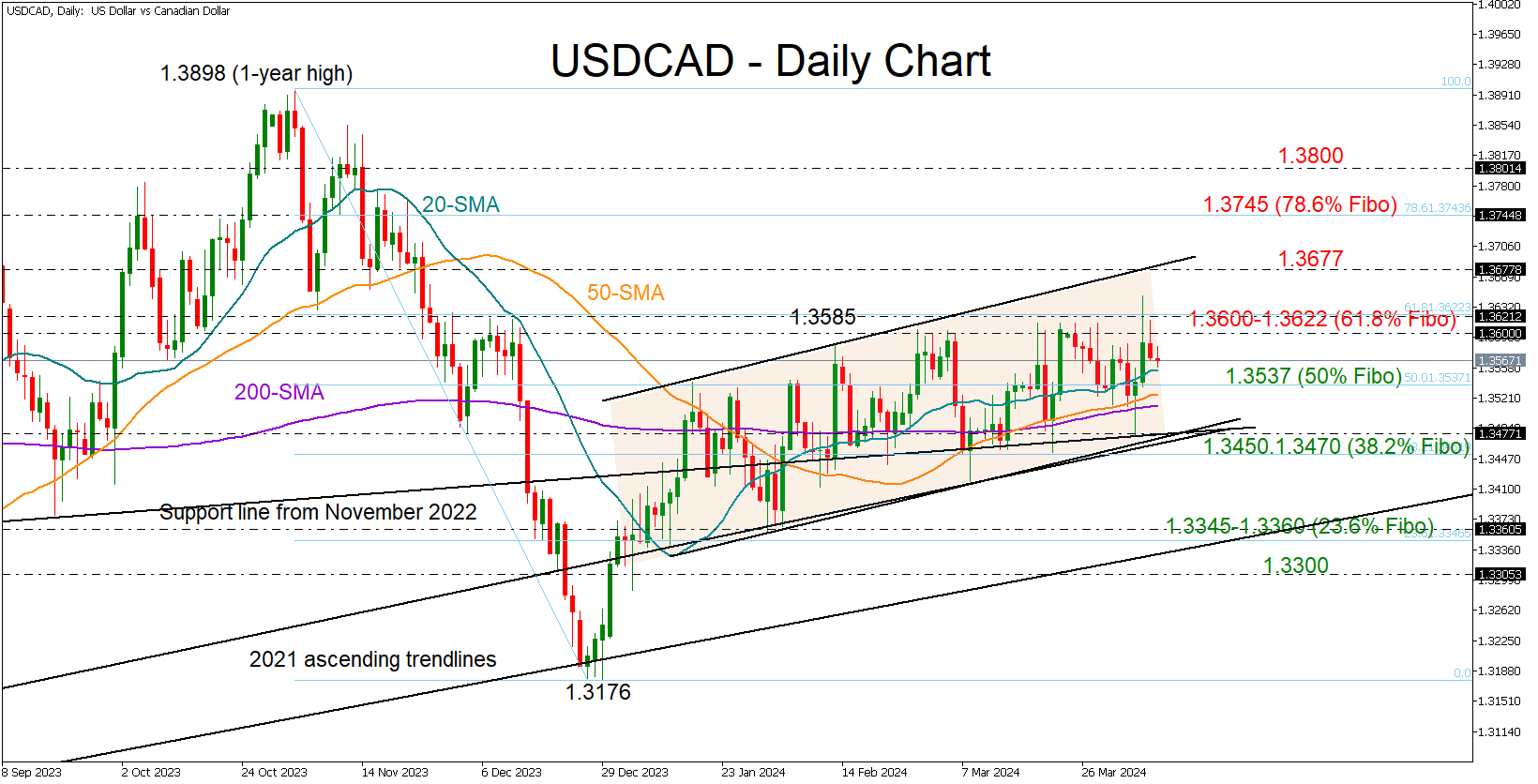
- USDCAD maintains soft uptrend, needs a clear close above 1.3600 to rally
BoC closer to its inflation goal than its major peers
The Bank of Canada (BoC) will probably stick to the sidelines during its coming policy meeting on April 10, leaving interest rates unchanged at 5.0%. Like its peers, the central bank believes that it will be able to slash borrowing costs later this year, but policymakers still have different opinions on the timing. Nevertheless, the base scenario is for major central banks to start the easing cycle in June and there is reason to believe that the BoC is less likely to diverge from that path compared to its US counterpart.
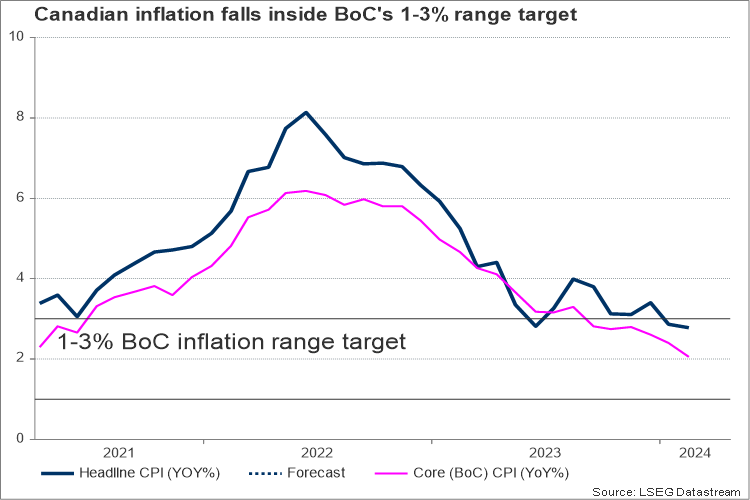
First of all, inflation data has been more favorable since the March meeting. Headline inflation slowed down to a 2.8% year-on-year; faster than analysts expected, further easing within the BoC target zone of 1-3%. Remarkably, the core measure, which excludes volatile items like energy and food, declined to 2.1%, almost reaching the central bank’s 2.0% target, while the eurozone and US equivalents remain consistently higher. The monthly CPI readings have been subdued so far in 2024, reflecting weak price dynamics in the first quarter of the year too. Due to this, the monetary policy report released with the rate decision might contain lower inflation projections.
Labor market shows cracks, but real wages still high
As regards the labor market, conditions have returned to pre-pandemic levels. The economy lost 2.2k jobs in March, while on average, jobs growth was below 40k over the past year. What is more striking is that the unemployment rate continued to ascend in March, hitting a 26-month high of 6.1% from 5.8%. There are arguments that if the US methodology was applied to the Canadian labor data, the unemployment rate could still be elevated at 5.2%, reflecting the increased slack in the Canadian employment conditions.
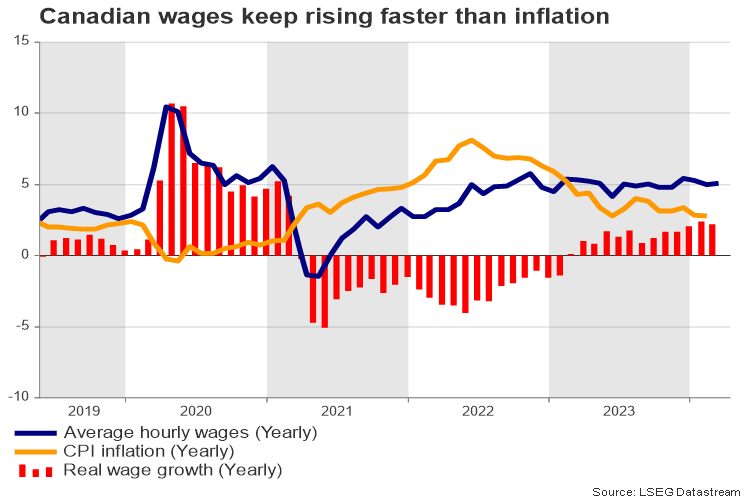
Growth in population backed by rising migration has been the tailwind behind the rising jobless rate and the resilient wage growth. Canadian average hourly earnings are running hot and faster than the US ones at 5.0% despite changing trajectory to the downside in 2024. Policymakers argue that this level does not align with the central bank’s price stability objective, particularly when combined with low labor productivity, as is currently the case. In other words, if companies cannot increase the value of produced goods per worker, they will increase consumer prices to compensate for higher wages.
BoC might cut rates in June but under certain conditions
Consequently, even though a rate reduction could have positive effects on business motivations and alleviate growth restrictions, the central bank may need to take some time to ensure a sustainable return to its inflation target, considering the recent increase in oil prices and elevated real wage growth. Besides, cutting rates to see inflation turning up again in the coming months could harm its credibility.
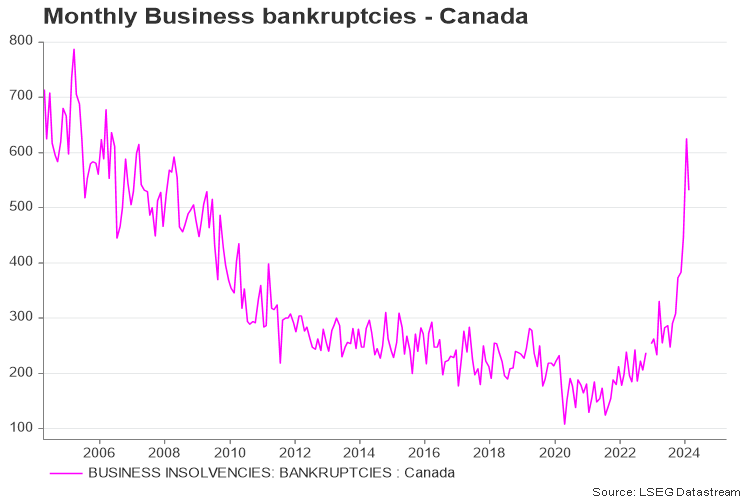
Moreover, while business bankruptcies have surged to the highest level since 2006, household debt relative to disposable income has gradually reverted to pre-pandemic levels, offering some relief for a potential delay. Hence, an immediate rate cut this week will be avoided, but clearer communication on the next policy steps is possible since there is no other meeting before June, although the BoC provides no guidance on its future policy decisions. Overall, policymakers could avoid any confusion by saying that a June rate cut could take place if the next inflation prints stay favorable.
How USDCAD might react?
According to futures markets, there is a 65% probability of a quarter percentage rate cut in June. If policymakers play down the odds, the loonie could gain fresh positive momentum, driving USDCAD down to the lower band of the two-month-old bullish channel at 1.3470-1.3450. A close lower would motivate a sharper decline to 1.3345-1.3360, unless the March low of 1.3418 adds a strong footing under the price.
Otherwise, if the central bank opens the door to a June rate cut, the pair could break the wall at 1.3600-1.3622 and climb to 1.3677. Above the latter, the recovery could continue towards the 1.3745-1.3800 region.
Sunset Market Commentary
Markets
Core bounds found some reprieve in this week’s second transitory trading session bridging Friday’s payrolls and tomorrow’s US CPI data. German Bunds outperforms US Treasuries after the ECB’s quarterly Bank and Lending Survey provided some more backing for the flagged June policy rate cut. Demand for loans from firms declined substantially, contrary to banks’ expectations of a recovery. A small net decline was reported for housing loans. Credit standards for loans to firms tightened slightly and that trend is set to continue in Q2. Standards eased moderately for housing loans with no profound changes expected in the next quarter. German yields currently cede 2.2 bps (2-yr) to 6.5 bps (30-yr). Changes on the US yield curve vary between -3 bps (30-yr) and -4.5 bps (7-yr). The dollar continues to struggle even as oil prices (Brent) steady above $90/b and risk sentiment is also clueless (Europe -0.5%; WS +0.5%). DXY moves back below 104 for the first time since the March FOMC meeting. EUR/USD similarly eyes 1.09 for the first time since then. Sterling is today’s (odd) outperformer with EUR/GBP a tad softer at 0.8565 and cable moving above 1.27.
The Japanese yen still hovers dangerously close to the USD/JPY 152 level considered line in the sand for officials. People familiar with the matter today suggested that the Bank of Japan will likely consider raising its inflation forecast later this month (Apr 26). The outcome of the annual Shunto wage negotiations (5.24% average; most in over 30 years) is the key driver. Rising energy prices and JPY weakness are other compelling factors. Compared with January, sources suggest that the current fiscal year’s 2.4% (CPI ex fresh food) might be upwardly revised with the first FY 2026 forecast to be around the 2% inflation target. Question remains whether such higher inflation prognosis will speed up the BoJ’s normalization plans after last month’s inaugural dovish rate hike. Markets rightly so didn’t interpret it as being the start of a genuine hiking cycle, putting JPY immediately with the back against the wall. Failure to give clear backing at the April policy meeting risks bringing the currency rapidly into tailspin with possible FX interventions in such scenario likely in vain.
News & Views
The Italian government expects the country to grow 1% this year. That would mark a slight acceleration from the 0.9% in 2023 but a slight downward revision from the 1.2% projected last year. PM Meloni’s cabinet pencilled in 1.2% for 2025. The budget deficit isn’t anticipated to drop below the 3% EU limit until 2026. Last year’s whopping 7.2% shortfall as a result of the so-called “superbonus” for home renovations has heavily impacted the budget update, a government official explained. Because of the large deficits in coming years, the debt-to-GDP ratio would now rise through 2026 and hit a peak at 139.8%. This marks a change in direction from the October projections, which forecasted a decline.
The Kingdom of Belgium successfully launched a €7bn 5y bond (OLO102, October 22, 2029), priced at MS-1 bp compared to initial guidance of MS+1 bp. Books totaled more than €46bn. Based on the 2024 budget plan this was the third and final syndicated sale of the year with the other two carrying a 10-year and 30-year tenor. Today’s syndication included, the Belgium Debt Agency completed just over 60% of its €41bn OLO funding need.
The European Round Table for Industry, a lobby group consisting of around 60 of Europe’s largest companies in the industrial and technology sector, in a new report said there’s a need for €800bn of investments in energy infrastructure alone to meet the 2030 climate targets. Looking further into time and considering Europe’s net zero ambitions by 2050, the price tag rises to a massive €2.5tn, to be channeled to the power grid, energy storage and carbon capture facilities. The Financial Times citing leading industry bodies reported that the private sector alone cannot carry such large investments alone. Government finances, however, are also under strain following the pandemic, energy crisis and a shift in spending priorities towards defense and other industries deemed too critical to be outsourced.
U.S. Small Business Optimism Index Edges Lower in March, Falling to the Lowest Level Since 2012
NFIB's Small Business Optimism Index fell 0.9 points to 88.5 in March, disappointing market expectations for a modest increase to 89.7. This marked the lowest level in the headline index since 2012.
Six of the ten subcomponents deteriorated on the month, two improved and two remained unchanged. Leading the decline was an 8-point drop in the share of firms expecting higher real sales to -18%. Expected credit conditions (-2 points to -8%), capital outlay plans (-1 point to 20%) and the belief that now is a good time to expand (-1 point to 4%) all edged lower, but earnings trends managed to tick higher (+2 points to -29%).
The net share of businesses planning to increase employment fell for the fourth month in a row, ticking down 1 point to 11% – almost half the level in the pre-pandemic period. The share of firms with unfilled job openings held steady at 37%, a level that's in line with the pre-pandemic average. Quality of labor concerns rose by 2 points to 18%, marking only a partial recovery after falling 5 points in the month prior. However, inflation was the top concern, with 25% of business owners identifying it as their top business problem.
The share of firms increasing compensation increased 3 points to 38%, while the share of firms planning to raise compensation over the next three months rose 2 points to 21%, recovering only a small portion of the 7-point drop in the month prior. The share of businesses 'raising' average selling prices rose 7 points to 28% in March, while the share of those 'planning’ to raise average selling prices rose 3 points to 33%.
Key Implications
Sales expectations deteriorated in March and small business confidence ended the first quarter on a sour note, with the index falling to 2012 lows. Looking underneath, while the U.S. labor market is showing continuous signs of resilience, today's survey results point to a cooling in conditions among smaller firms, with job openings and quality of labor concerns trending lower, and plans to increase employment falling to late-2016 levels.
Inflation remains a top concern for small business owners, a sentiment that was echoed in the pricing metrics. The sharp back-up in the share of firms raising average selling prices and a moderate increase in the share of those that plan raise prices in the next three months reinforce the notion that we're not out of the woods yet with respect to inflation. This latest data works in favor of a more patient Federal Reserve when it comes to lowering the policy rate.
NZ Dollar Climbs Ahead of RBNZ Rate Decision
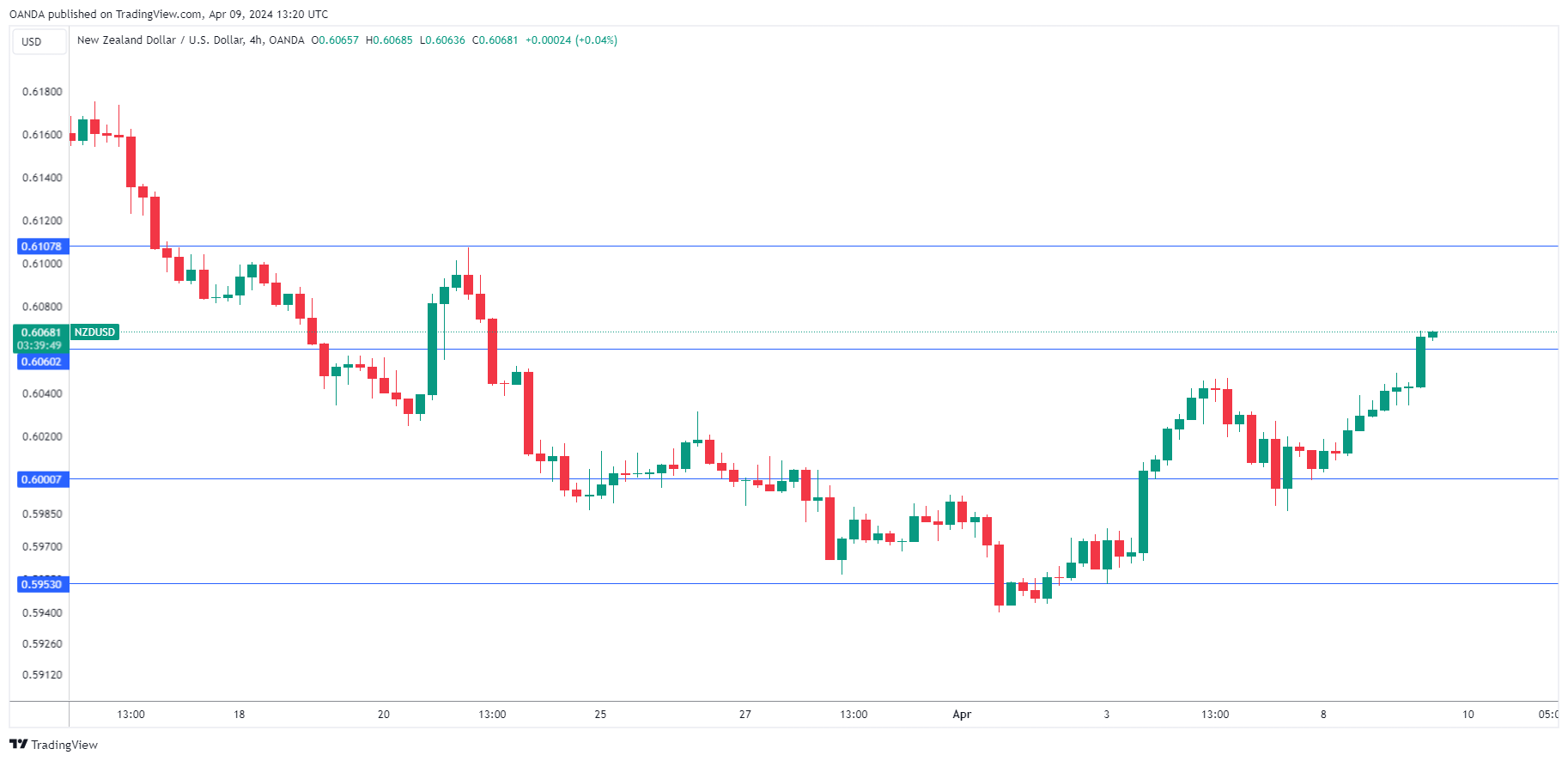
The New Zealand dollar has posted considerable gains on Tuesday. In the North American session, NZD/USD is trading at 0.6065, up 0.54% and its highest level since March 21.
RBNZ widely expected to hold cash rate
The Reserve Bank of New Zealand meets early on Wednesday and it’s practically a given that it will hold the cash rate at 5.5%. This would mark the sixth straight time that the RBNZ maintains rates and prolongs its “higher for longer stance”.
Investors will be interested in whether the RBNZ pushes back against market expectations of rate cuts – investors have priced in two cuts with a 70% probability of a third this year. The decision will not include updated economic forecasts or a news conference with Governor Orr, which could limit New Zealand dollar volatility around the meeting.
The markets are being aggressive in their pricing of rate cuts, mainly due to a weak economy, as GDP has contracted in four of the past five quarters. However, high inflation is a key reason why the RBNZ is hesitant to signal rate cuts are coming. In the fourth quarter, the inflation rate was 4.7%, well above the upper limit of the 1-3% target band. New Zealand releases first-quarter CPI next week, and the release will be a key factor in the central bank’s rate policy.
The RBNZ would prefer to have the Federal Reserve cut rates first, as this would boost the New Zealand dollar and weigh on inflation. The Fed has signaled rate cuts are coming but stronger than expected data, such as last week’s nonfarm payrolls, may lead the Fed to delay lowering rates.
NZD/USD Technical
- NZD/USD is testing resistance at 0.6060. Above, there is resistance at 0.6107
- 0.6000 and 0.5953 are providing support
Gold Temporarily Ignores Negative News
Gold has been hitting all-time highs almost daily for the past two weeks, reaching $2365 in the spot market on Tuesday before the start of US trading. The ability to rise above $2070 per ounce, which gold found in late February, has signalled a break of resistance that has kept gold above since August 2020.
Gold is now rising more actively than it did in the previous long-term bull cycle. In 2011, years of gains were followed by a two-year consolidation, which was replaced by a three-year bear market.
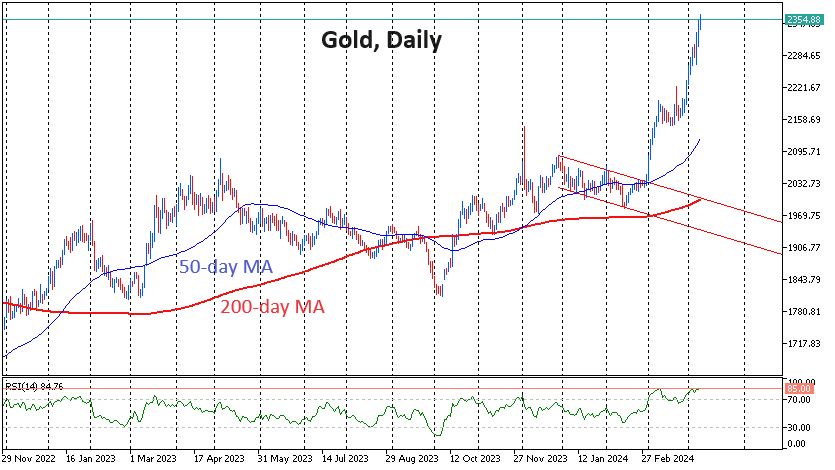
Gold has been increasing, reacting to positive news and mostly ignoring the negative. The price reversed sharply to the upside in the final quarter of last year on signals from the Fed that the next step would be a rate cut, not a rate hike. At the same time, the revision of expectations from six or seven to two rate cuts in 2024 did not hinder the rise at all.
It seems that any news on the US is a reason to buy. Signals of a strong economy and inflation – highlight gold’s property of retaining value. Weakness in inflation – fuels expectations that the Fed will be cutting rates soon, which favours demand for risk assets.
There are risks that bulls are now ignoring the commodity mix looming over them in the form of US bond yields. 10-year treasuries have seen yields rise from 3.8% at the end of January to 4.45% on Monday. The reversal came from the lower boundary of the long-term rising channel, indicating that the smart money is wagering on a high rate scenario for the long haul.
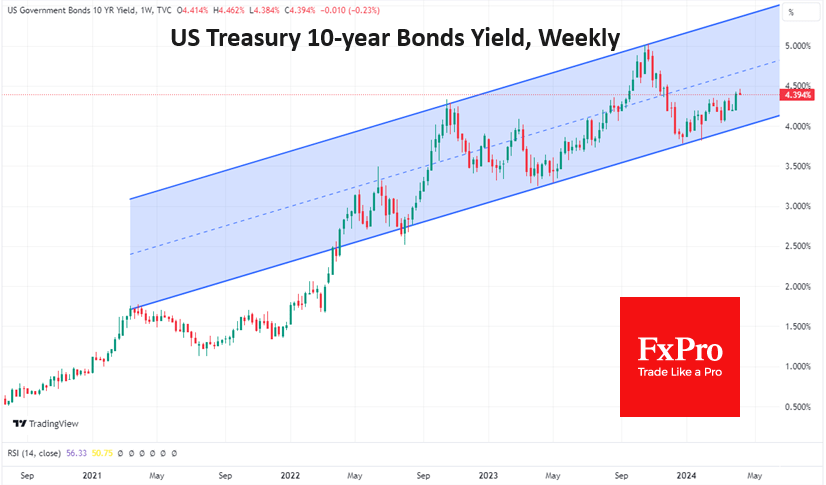
Other markets can’t ignore what’s going on in the government debt market for long. Stock indices are already starting to notice it, forming a smooth downtrend in early April and repeatedly testing previous trading channels.
Meanwhile, gold has been overbought, according to RSI, in daily and weekly timeframes to the maximum since early August 2020. Back then, an eight-week rise was followed by a multi-month pullback.
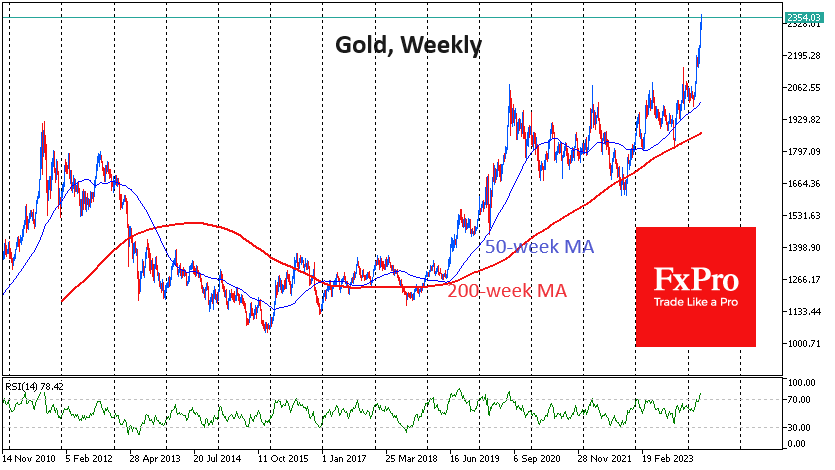
The US inflation report scheduled for Wednesday has a chance to hurt gold soon. If the outcome for the markets is a further rise in government bond yields, global markets could become more synchronised, triggering a more active sell-off in equity markets and affecting gold and other commodities. In this case, it could take months before we see further price retracement of historical highs.
EUR/AUD Mid-Day Outlook
Daily Pivots: (S1) 1.6398; (P) 1.6456; (R1) 1.6500; More..
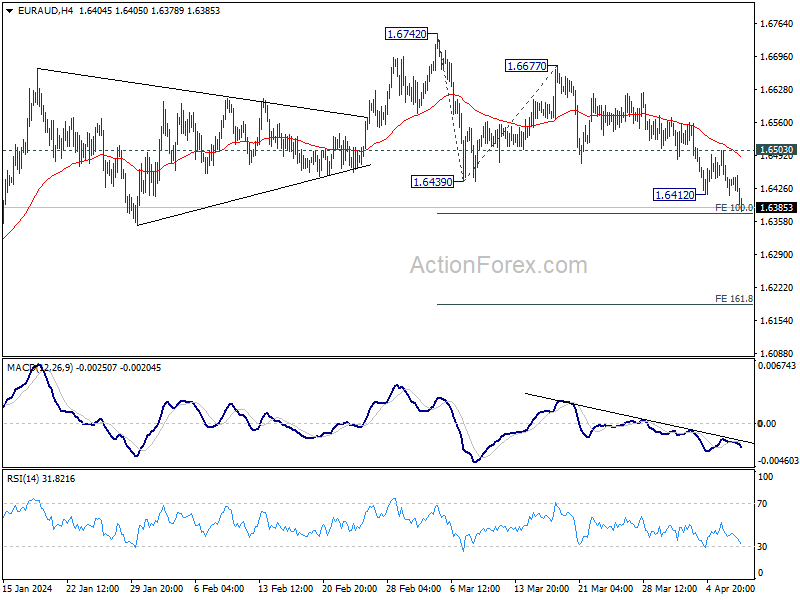
EUR/AUD's decline from 1.6742 resumed by breaking through 1.6412 support and intraday bias is back on the downside. Current development suggests that rebound from 1.6127 has completed. Break of 100% projection of 1.6742 to 1.6439 from 1.6677 at 1.6374 will pave the way to 161.8% projection at 1.6187 next. For now, risk will stay on the downside as long as 1.6503 resistance holds, in case of recovery.
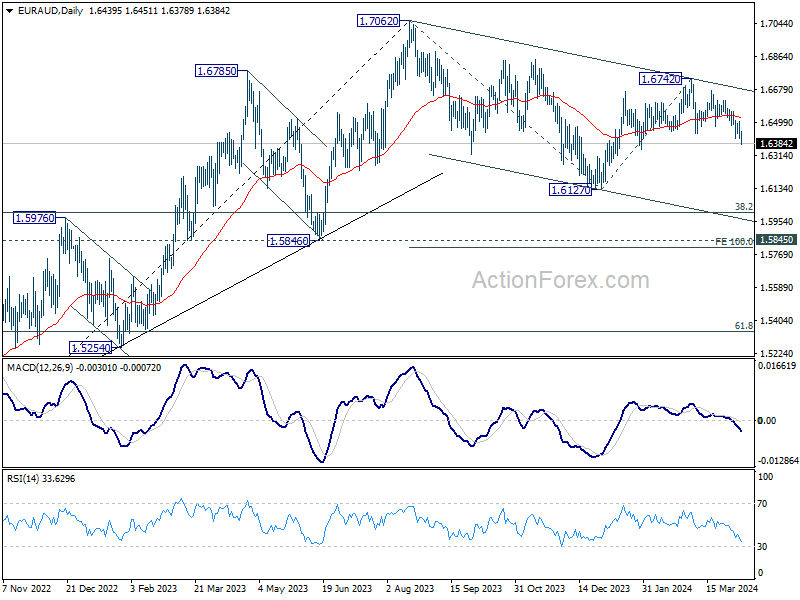
In the bigger picture, fall from 1.7062 medium term top is seen as a correction to the up trend from 1.4281 (2022 low). The correction is still in progress with fall from 1.6742 as the third leg. Strong support is expected around 1.5846 and 38.2% retracement of 1.4281 to 1.7062 at 1.6000 to bring rebound.
AUD/USD Mid-Day Report
Daily Pivots: (S1) 0.6573; (P) 0.6592; (R1) 0.6623; More...
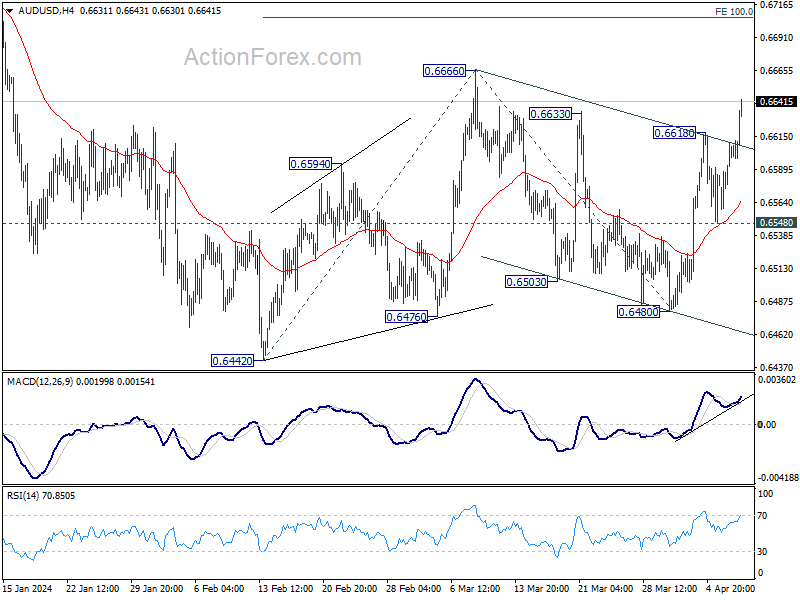
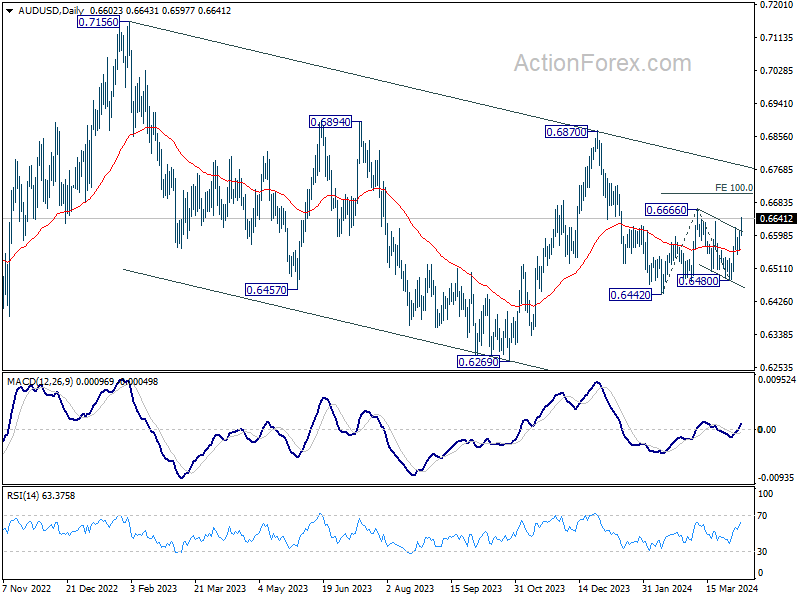
AUD/USD's rise from 0.6480 resumed by breaking through 0.6618 resistance and intraday bias is back on the upside. Current development affirms that case pattern from 0.6442 is now in is third leg. Further rise would be seen to 0.6666 and then 100% projection of 0.6442 to 0.6666 from 0.6480 at 0.6704. Nevertheless, break of 0.6548 support will turn bias back to the downside instead.
In the bigger picture, price actions from 0.6169 (2022 low) are seen as a medium term corrective pattern to the down trend from 0.8006 (2021 high). Fall from 0.7156 (2023 high) is seen as the second leg, which might still be in progress. Overall, sideway trading could continue in range of 0.6169/7156 for some more time. But as long as 0.7156 holds, an eventual downside breakout would be mildly in favor.
USD/JPY Mid-Day Outlook
Daily Pivots: (S1) 151.61; (P) 151.77; (R1) 152.02; More...
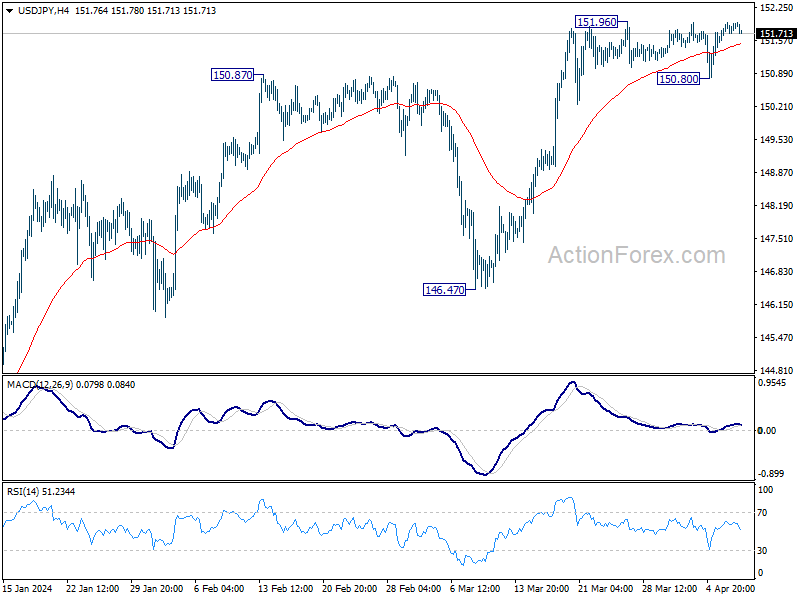
Intraday bias in USD/JPY stays neutral and outlook is unchanged. On the downside, break of 150.80 will turn bias back to the downside for deeper pull back to 55 D EMA (now at 149.73). On the upside, however, sustained break of 151.93 key resistance will confirm long term up trend resumption.
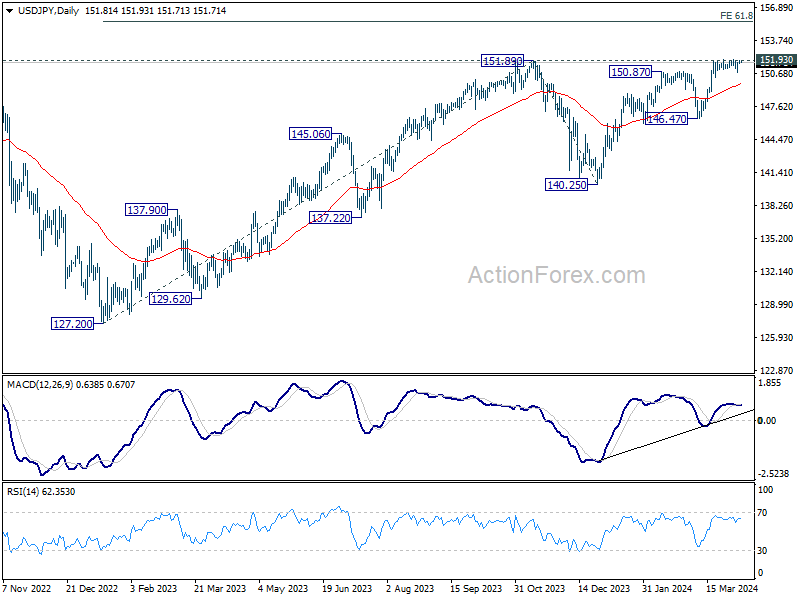
In the bigger picture, correction from 151.87 (2023) high could have completed at 140.25 already. Rise from 127.20 (2023 low), as part of the long term up trend, is probably ready to resume. Decisive break of 151.93 resistance (2022 high) will confirm this bullish case. Next medium term target will be 61.8% projection of 127.20 to 151.89 from 140.25 at 155.20. This will remain the favored case as long as 146.47 support holds, in case of another pullback.
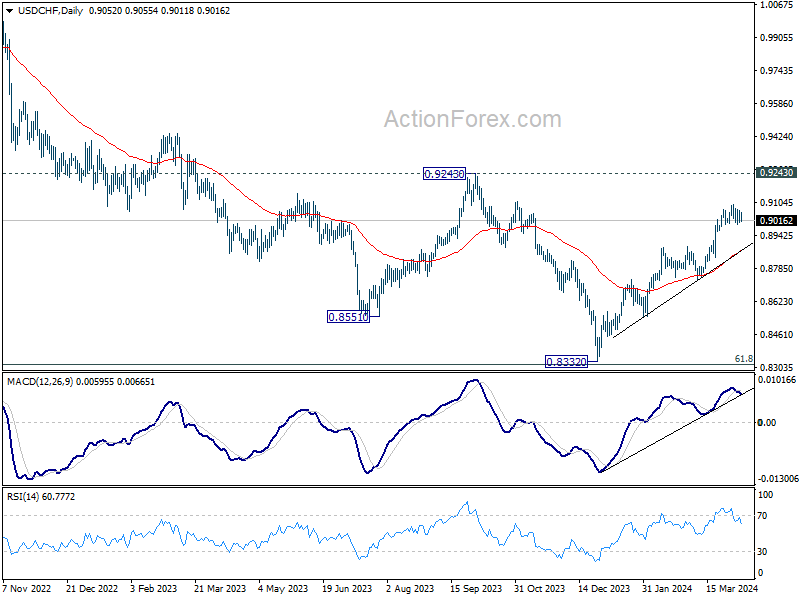
USD/CHF Mid-Day Outlook
Daily Pivots: (S1) 0.9016; (P) 0.9041; (R1) 0.9079; More....
No change in USD/CHF's outlook as consolidation from 0.9094 is extending. Intraday bias stays neutral at this point. Deeper decline cannot be ruled out, but outlook will stay bullish as long as 0.8884 resistance turned support holds. On the upside, break of 0.9094 will resume larger rise from 0.8332 to 0.9243 key resistance.
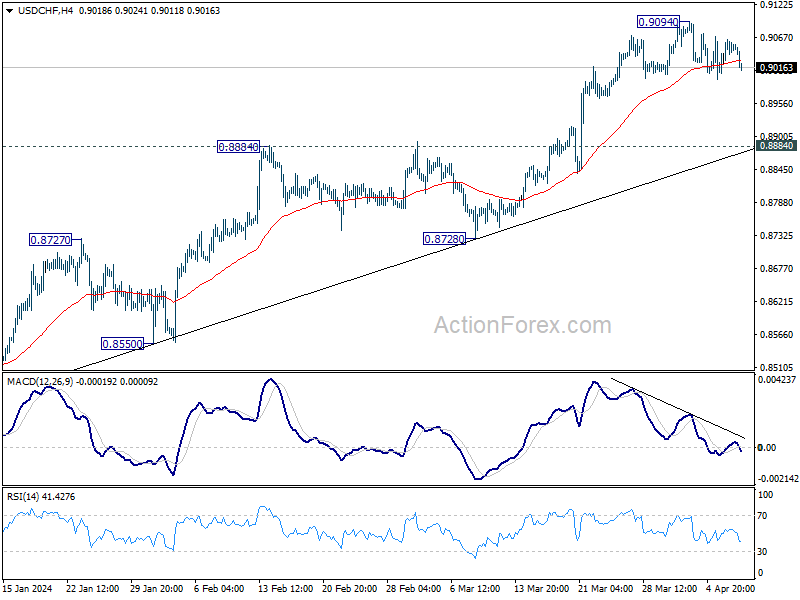
In the bigger picture, price actions from 0.8332 medium term bottom as tentatively seen as developing into a corrective pattern to the down trend from 1.0146 (2022 high). Further rise would be seen as long as 0.8728 support holds. But upside should be limited by 0.9243 resistance, at least on first attempt.