Sample Category Title
BoJ Ueda’s Rate Hike Musings Propel Yen, Dollar Regains Ground on Risk Aversion
Japanese Yen rebounded broadly in Asian session today, shot up by comments from BoJ Governor Kazuo Ueda regarding the conditions for future interest rate hikes. Ueda's discussion, while not immediately setting the stage for rate increases, could be taken as a sign to prepare the markets for such a possibility. Importantly, he underscored that an excessively weak Yen could trigger a monetary policy response, a statement that has provided considerable support to the currency.
This rally in Yen was also supported in the background by risk aversion stemming from the sharp selloff in US stock markets overnight, which extended into the Asian markets. The risk-off mood has not only favored Yen but has also contributed to rebound in Dollar, which managed to regain some of the ground it lost over the past two days.
Besides while there were varying views on the path of monetary easing from the chorus of comments from Fed officials, they have collectively emphasized the need for more data before commencing a cycle of interest rate reductions. The financial markets will now look into today's US non-farm payroll report for guidance for the next move.
Overall for the week so far, Aussie is staying as the strongest one with help from surges in precious and industrial metal prices. Kiwi is in the second place, followed by Euro. Canadian Dollar is the worst performer, followed by Swiss Franc and Dollar. Yen and Sterling are positioned in the middle.
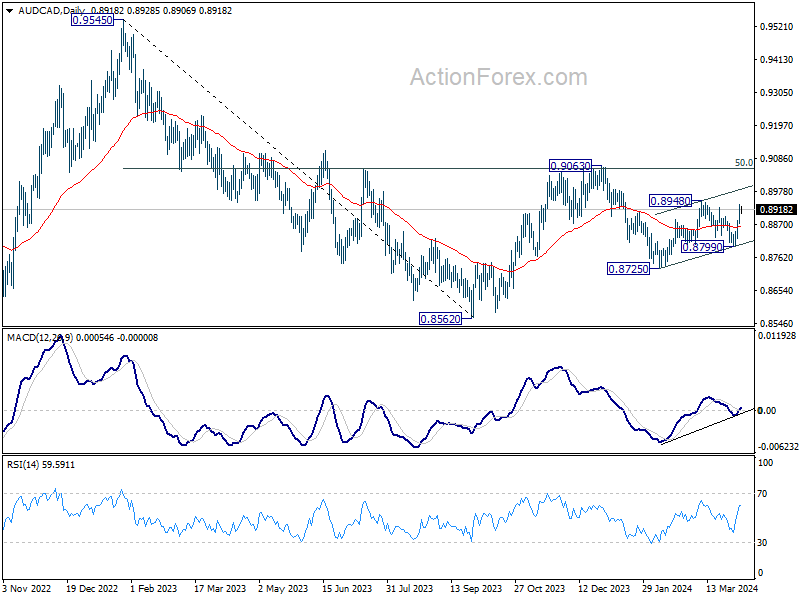
Technically, AUD/CAD is currently the top mover of the week with strong rebound from 0.8799. Further rise is mildly in favor for 0.8948 resistance and possibly above. Nevertheless, price actions from 0.8725 are currently seen as a corrective move only. Thus, AUD/CAD should start to lose momentum above 0.8948, and strong resistance should emerge below 0.9063 to limit upside. Break of 0.8799 support will argue that the fall from 0.9063 is ready to resume through 0.8725 to retest 0.8562 low.
In Asia, at the time of writing, Nikkei is down -2.03%. Hong Kong HSI is down -0.71%. China Shanghai SSE is on holiday. Singapore Strait Times is down -0.69%. Japan 10-year JGB yield is down -0.0006 at 0.777. Overnight, DOW fell -1.35%. S&P 500 fell -1.23%. NASDAQ fell -1.40%. 10-year yield fell -0.046 to 4.309.
Dow registers steepest decline in a year pre-NFP, a medium-term top established already?
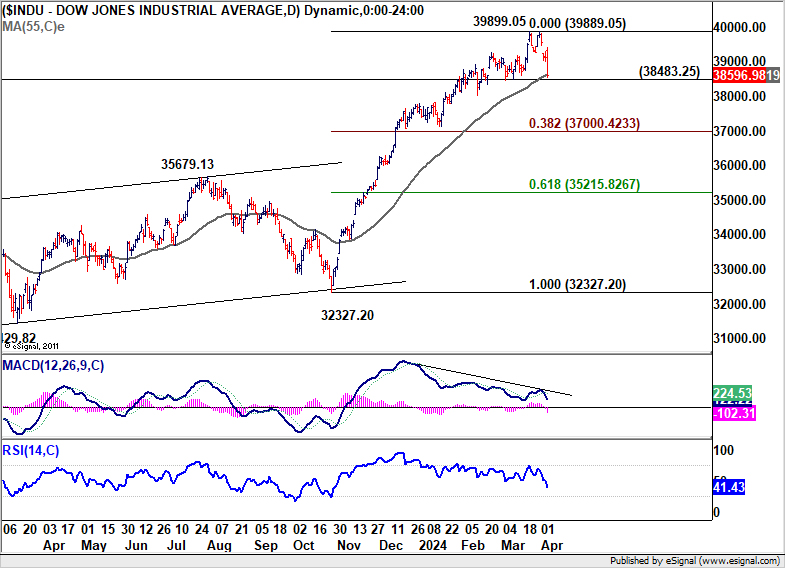
DOW tumbled sharply overnight, shedding -530 points or -1.35%, marking its most pronounced session drop since March 2023 and its fourth consecutive day of losses. This sharp decline seems a natural reaction after the index's robust bullish run since last November, which propelled it to new record highs, lost steam. It's also a logical area for some profit-taking and consolidations, just ahead of 40k psychological level.
The strong rally was largely fueled by anticipations of forthcoming interest rate cuts, even with delays. Nevertheless, there is little, but growing skepticism among investors on whether the policy easing cycle would really start this year. The recent surge in commodity prices has also served as a stark reminder of the challenges in curbing inflation.
The selloff also come just ahead of the crucial non-farm payroll report from the US today. Markets are expecting 205k job growth in March. Unemployment rate is expected to be unchanged at 3.9% while average hourly earnings are expected to rise 0.3% mom. Any upside surprises in today's report, in particular wages growth, could prompt further shift in Fed expectations, and hut overall risk sentiment in the stock markets.
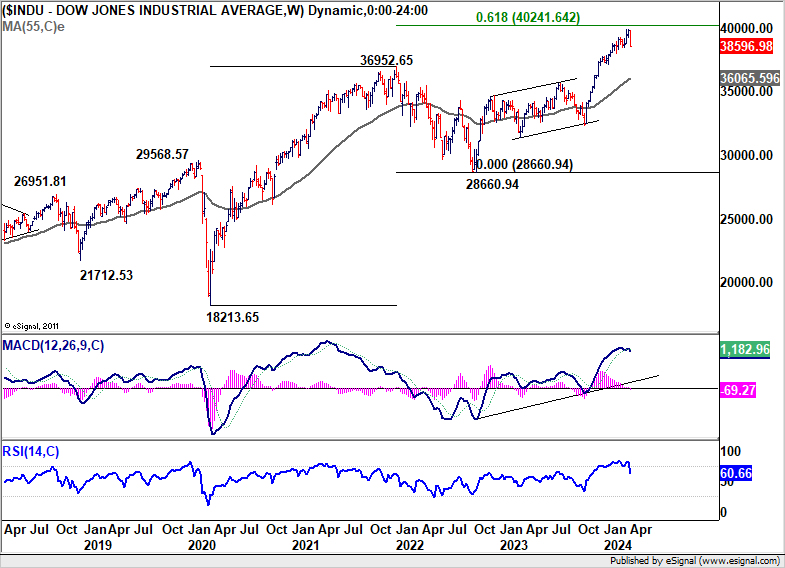
Technically, considering bearish divergence condition in D MACD, 39899.05 could be a medium term top in DOW already, just ahead of 40k psychological level, and 61.8% projection of 18213.65 to 35962.65 from 28660.94 at 40241.64.
Decisive break of 38483.23 support should confirm this bearish case, and bring deeper correction back to 38.2% retracement of 32327.20 to 39889.05 at 37000.42.
Nevertheless, strong rebound from the current level would push DOW for another take on 40k before topping.
Fed officials want more evidence before considering rate cuts
A wave of comments from several Fed officials overnight highlighted a consensus on the need for patience before initiating interest rate reductions. While the higher than expected inflation readings in January and February were "concerning", they're not seen as derailing the broader disinflation process yet. Nevertheless, the sentiment is clear: more evidence is required to confirm inflation's downward path towards 2% target before any policy easing is initiated.
Cleveland Fed President Loretta Mester emphasized the necessity of observing "a couple more months of data" to verify if the recent inflationary trends are indeed reversing. Mester pointed out the need for "more evidence" that supports the continuation of inflation's decline. Meanwhile, Fed is in a "policy position" to adjust policy "more swiftly and sooner" if labor markets were to "deteriorate significantly"
Minneapolis Fed President Neel Kashkari on penciled in two "rate cuts" this year back in March, predicated on inflation's decline towards target." Yet, if inflation is "moving sideways", he would question "whether we needed to do those rate cuts at all."
Chicago Fed President Austan Goolsbee said the inflation in the first two months of the year "should not knock us off the path back to target". He views housing inflation as the "most valuable indicator" now. "If it does not come down, we will have a very difficult time getting overall inflation back to the 2% target."
Richmond Fed President Thomas Barkin emphasized the strategic patience afforded by a "strong labor market," suggesting that Fed has the time needed for the economic "clouds to clear" before commencing with rate adjustments.
BoJ's Ueda: Excessive Yen weakness could prompt monetary policy response
In an interview with The Asahi Shimbun newspaper, BoJ Governor Kazuo Ueda highlighted extended Yen weakness could prompt further rate hikes by the central bank.
"If exchange rate trends have an effect on the cycle between wages and prices that cannot be ignored, that would become a reason for responding to the situation through monetary policy," he explained.
Ueda also outlined other conditions under which BoJ might consider additional rate hikes, after the landmark shift in March which exited negative interest rates.
The decision to end negative interest rates was made with a certain level of confidence, quantified by Ueda as "75 percent." He indicated that an increase in this confidence level to "80 percent or 85 percent" could prompt further adjustments
Governor also touched on factors likely to boost personal consumption, including the government's planned income tax cut in June, expected wage increases, and a slowdown in consumer price inflation. These developments, if they materialize as anticipated, could pave the way for a higher interest rate as early as between summer to autumn.
Moreover, Ueda acknowledged the impact of a "excessively weak yen" on Japan's economy and consumer prices, suggesting that significant currency weakness could influence future decisions regarding interest rate hikes.
Looking ahead
Germany factory orders and import prices, France industrial production, Swiss foreign currency reserves and SECO consumer climate, UK PMI construction, Eurozone retail sales will be released in European session.
Later in the day, Canada will also release employment report, together with US non-farm payrolls.
USD/JPY Daily Outlook
Daily Pivots: (S1) 151.06; (P) 151.41; (R1) 151.71; More...
USD/JPY's breach of 151.02 support suggests short term topping at 151.96. Intraday bias is now mildly on the downside for deeper pullback to 55 D EMA (now at 149.56). On the upside, however, sustained break of 151.93 key resistance will confirm long term up trend resumption.
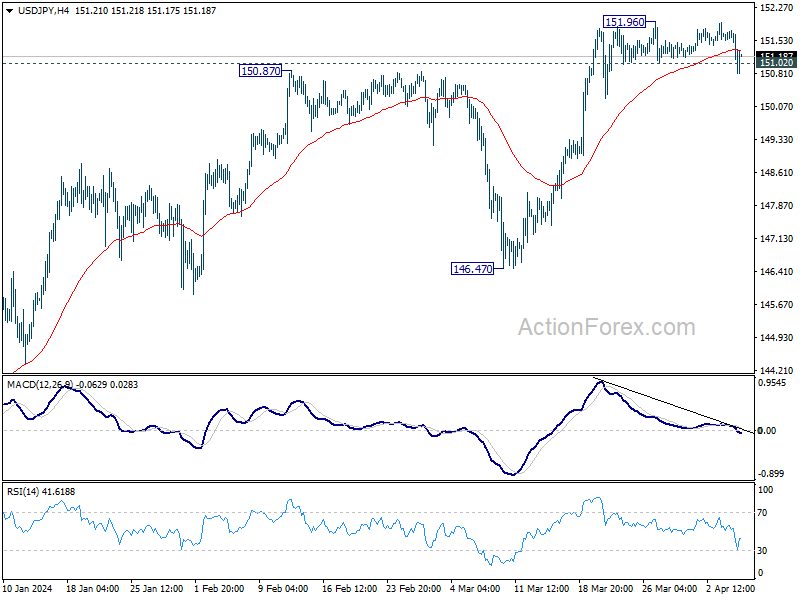
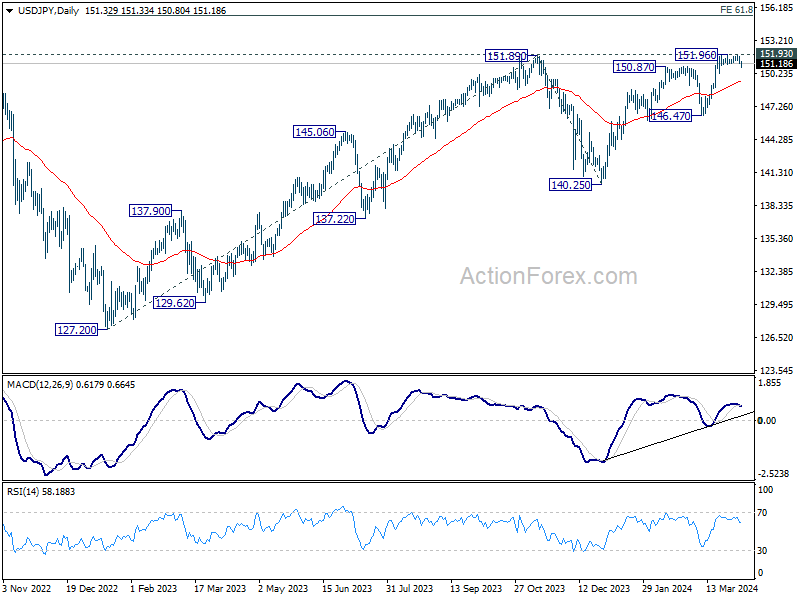
In the bigger picture, correction from 151.87 (2023) high could have completed at 140.25 already. Rise from 127.20 (2023 low), as part of the long term up trend, is probably ready to resume. Decisive break of 151.93 resistance (2022 high) will confirm this bullish case. Next medium term target will be 61.8% projection of 127.20 to 151.89 from 140.25 at 155.20. This will remain the favored case as long as 146.47 support holds, in case of another pullback.
Economic Indicators Update
| GMT | Ccy | Events | Actual | Forecast | Previous | Revised |
|---|---|---|---|---|---|---|
| 23:30 | JPY | Household Spending Y/Y Feb | -0.50% | -2.80% | -6.30% | |
| 00:30 | AUD | Trade Balance (AUD) Mar | 7.28B | 10.50B | 11.03B | 10.06B |
| 05:00 | JPY | Leading Economic Index Feb P | 111.8 | 111.6 | 109.9 | 109.5 |
| 06:00 | EUR | Germany Factory Orders M/M Feb | 0.60% | -11.30% | ||
| 07:00 | EUR | Germany Import Price Index M/M Feb | -0.10% | 0.00% | ||
| 06:45 | EUR | France Industrial Output M/M Feb | 0.50% | -1.10% | ||
| 07:00 | CHF | Foreign Currency Reserves (CHF) Mar | 678B | |||
| 08:30 | GBP | Construction PMI Mar | 49.8 | 49.7 | ||
| 09:00 | EUR | Eurozone Retail Sales M/M Feb | -0.30% | 0.10% | ||
| 12:30 | CAD | Net Change in Employment Mar | 34.5K | 40.7K | ||
| 12:30 | CAD | Unemployment Rate Mar | 5.90% | 5.80% | ||
| 12:30 | USD | Nonfarm Payrolls Mar | 205K | 275K | ||
| 12:30 | USD | Unemployment Rate Mar | 3.90% | 3.90% | ||
| 12:30 | USD | Average Hourly Earnings M/M Mar | 0.30% | 0.10% | ||
| 14:00 | CAD | Ivey PMI Mar | 54.2 | 53.9 |
Dow registers steepest decline in a year pre-NFP, a medium-term top established already?
DOW tumbled sharply overnight, shedding -530 points or -1.35%, marking its most pronounced session drop since March 2023 and its fourth consecutive day of losses. This sharp decline seems a natural reaction after the index's robust bullish run since last November, which propelled it to new record highs, lost steam. It's also a logical area for some profit-taking and consolidations, just ahead of 40k psychological level.
The strong rally was largely fueled by anticipations of forthcoming interest rate cuts, even with delays. Nevertheless, there is little, but growing skepticism among investors on whether the policy easing cycle would really start this year. The recent surge in commodity prices has also served as a stark reminder of the challenges in curbing inflation.
The selloff also come just ahead of the crucial non-farm payroll report from the US today. Markets are expecting 205k job growth in March. Unemployment rate is expected to be unchanged at 3.9% while average hourly earnings are expected to rise 0.3% mom. Any upside surprises in today's report, in particular wages growth, could prompt further shift in Fed expectations, and hut overall risk sentiment in the stock markets.
Technically, considering bearish divergence condition in D MACD, 39899.05 could be a medium term top in DOW already, just ahead of 40k psychological level, and 61.8% projection of 18213.65 to 35962.65 from 28660.94 at 40241.64.
Decisive break of 38483.23 support should confirm this bearish case, and bring deeper correction back to 38.2% retracement of 32327.20 to 39889.05 at 37000.42.
Nevertheless, strong rebound from the current level would push DOW for another take on 40k before topping.
USD/JPY Consolidates Gains, US NFP Report Next
Key Highlights
- USD/JPY rallied toward 152.00 before it started a consolidation phase.
- A major bullish trend line is forming with support at 151.20 on the 4-hour chart.
- Gold prices rallied further and tested the $2,300 resistance.
- The US nonfarm payrolls could decline from 275K to 200K in March 2024.
USD/JPY Technical Analysis
The US Dollar started a major increase above the 148.80 resistance against the Japanese Yen. USD/JPY cleared the 150.00 level to move further into a positive zone.
Looking at the 4-hour chart, the pair even settled above the 150.50 level, the 100 simple moving average (red, 4-hour), and the 200 simple moving average (green, 4-hour). Finally, the pair tested the 152.00 resistance zone.
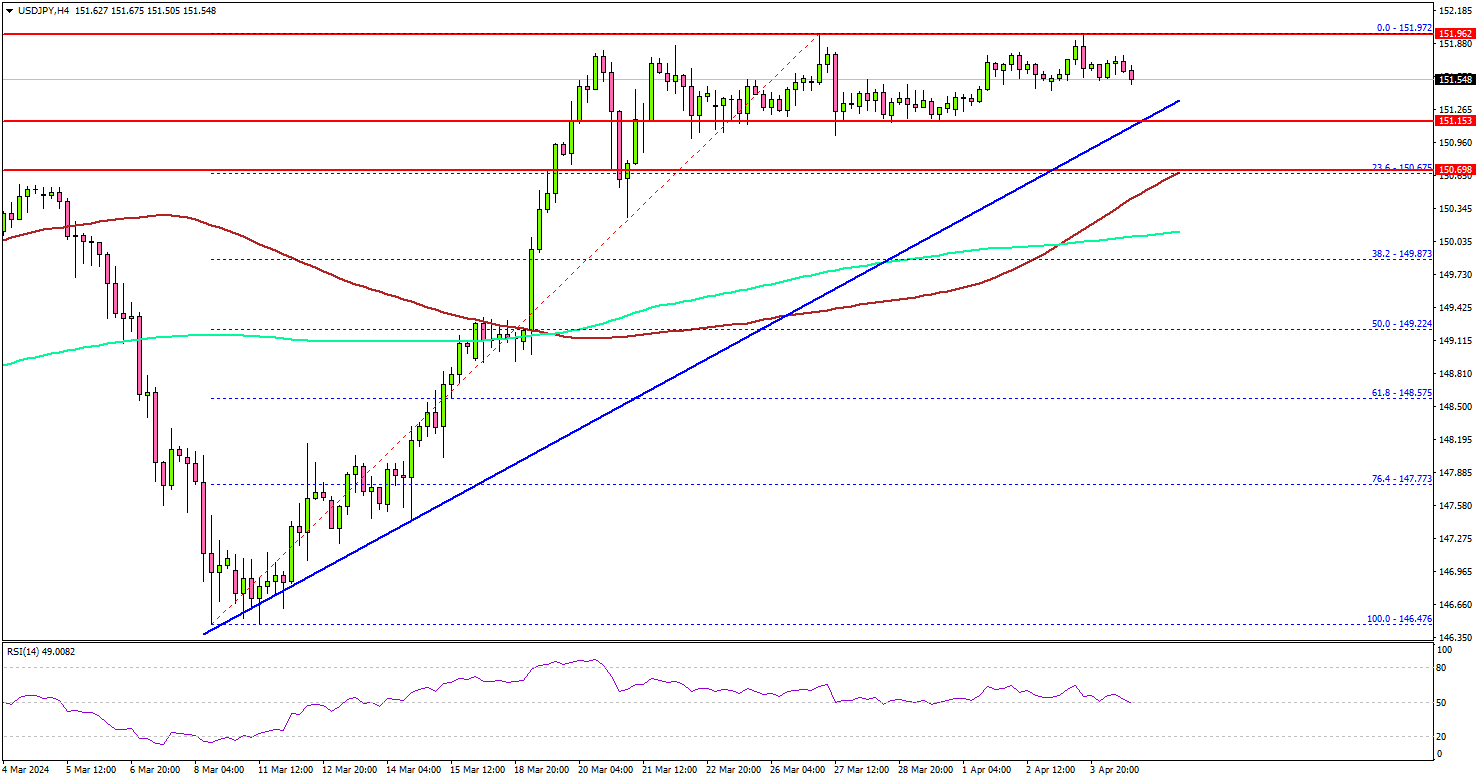
A high was formed near 151.97 before the pair started a consolidation phase. On the upside, the pair could face resistance near the 151.80 level.
The first major resistance is now forming near 152.00. A close above the 152.00 zone could open the doors for more upsides. The next stop for the bulls might be 153.20. If not, the pair might start a downside correction.
Immediate support is near the 151.20 level. There is also a major bullish trend line forming with support at 151.20 on the same chart. The next major support is at 150.65 or the 23.6% Fib retracement level of the upward move from the 146.47 swing low to the 151.97 high.
If there is a downside break below the 150.65 support, the pair could decline toward the 150.00 support. Any more losses might send the pair toward the 148.50 level in the near term.
Looking at Gold, the bulls were able to push the price toward the $2,300 level and now there are chances of a consolidation phase.
Economic Releases
- US nonfarm payrolls for March 2024 – Forecast 200K, versus 275K previous.
- US Unemployment Rate for March 2024 - Forecast 3.9%, versus 3.9% previous.
BoJ’s Ueda: Excessive Yen weakness could prompt monetary policy response
In an interview with The Asahi Shimbun newspaper, BoJ Governor Kazuo Ueda highlighted extended Yen weakness could prompt further rate hikes by the central bank.
"If exchange rate trends have an effect on the cycle between wages and prices that cannot be ignored, that would become a reason for responding to the situation through monetary policy," he explained.
Ueda also outlined other conditions under which BoJ might consider additional rate hikes, after the landmark shift in March which exited negative interest rates.
The decision to end negative interest rates was made with a certain level of confidence, quantified by Ueda as "75 percent." He indicated that an increase in this confidence level to "80 percent or 85 percent" could prompt further adjustments
Governor also touched on factors likely to boost personal consumption, including the government's planned income tax cut in June, expected wage increases, and a slowdown in consumer price inflation. These developments, if they materialize as anticipated, could pave the way for a higher interest rate as early as between summer to autumn.
Moreover, Ueda acknowledged the impact of a "excessively weak yen" on Japan's economy and consumer prices, suggesting that significant currency weakness could influence future decisions regarding interest rate hikes.
Fed officials want more evidence before considering rate cuts
A wave of comments from several Fed officials overnight highlighted a consensus on the need for patience before initiating interest rate reductions. While the higher than expected inflation readings in January and February were "concerning", they're not seen as derailing the broader disinflation process yet. Nevertheless, the sentiment is clear: more evidence is required to confirm inflation's downward path towards 2% target before any policy easing is initiated.
Cleveland Fed President Loretta Mester emphasized the necessity of observing "a couple more months of data" to verify if the recent inflationary trends are indeed reversing. Mester pointed out the need for "more evidence" that supports the continuation of inflation's decline. Meanwhile, Fed is in a "policy position" to adjust policy "more swiftly and sooner" if labor markets were to "deteriorate significantly"
Minneapolis Fed President Neel Kashkari on penciled in two "rate cuts" this year back in March, predicated on inflation's decline towards target." Yet, if inflation is "moving sideways", he would question "whether we needed to do those rate cuts at all."
Chicago Fed President Austan Goolsbee said the inflation in the first two months of the year "should not knock us off the path back to target". He views housing inflation as the "most valuable indicator" now. "If it does not come down, we will have a very difficult time getting overall inflation back to the 2% target."
Richmond Fed President Thomas Barkin emphasized the strategic patience afforded by a "strong labor market," suggesting that Fed has the time needed for the economic "clouds to clear" before commencing with rate adjustments.
Why Does 10-year US Yield Remain so High?
- The 10-year US yield is a key determinant of FX moves
- It tends to drop when the Fed prepares to cut its interest rates
- Despite market expectations about the Fed, the 10-year US yield remains high
- A stock market correction could be a catalyst for a sizeable drop in US yields
The 10-year US yield is the barometer of the US economy. It is the basis for pricing both sovereign and corporate debt and it also determines US mortgage rates and savings rates. Along with the market risk appetite and underlying inflation, these are the chief determinants of FX rates.
In a recent special report, the market performance in the period between the last rate hike and the first rate cut was analysed. One of the key findings was than the 10-year US treasury yield recorded sizeable decreases in anticipation of the Fed's rate cutting cycle.
The 10-year US yield reached 5% in mid-October but quickly dropped lower on the back of weaker economic data. This allowed the market to freely speculate about around six possible rate cuts announced by the Fed in 2024.
However, following the recent mixed data releases, the market looks convinced that the Fed will be announcing its first rate cut at the July 31 meeting, assigning a 60% chance of a surprise of a June move, exactly one year after the last rate hike. And only three rate cuts could take place in 2024.
As a result, the 10-year US yield remains north of 4.3%, around 45bps above the July 26, 2023 level when the Fed announced its last rate hike, which defied the aforementioned historical analysis. What is then keeping the 10-year US yield elevated? Is the market defying its own expectations?
Stickier inflation than anticipated
The US inflation continues to hover in the 3%+ region since November 2023 with most survey-based inflation indicators also pointing to decent inflation pressures, surprising the market. All in all, stronger wage increases, the recent pick up in energy prices and geopolitical uncertainty appear to have contributed to this continued inflation stickiness.
Decent growth in place
Similarly, growth remains decent and consistently above 2% per annum despite the obvious dampening effect of 525bps of rates hikes announced over the past two years. Financial conditions are mostly restrictive, strongly impacting the housing sector, but they do not appear to have choked growth yet.
Uncertainty matters for yields
The 10-year US yield also reflects risk sentiment. In periods of severe market angst, funds flow in the bond market for protection, pushing bond prices higher and yields lower. Considering that stock markets are close to their recent all-time highs and the VIX index remains relatively muted, the market appears to be enjoying a rather calm period, thus limiting demand for the lower-yielding US bonds.
In addition, the countdown to the November US election has already started. The market is preparing for a barrage of commentary especially about fiscal policy, which could open the door to an even larger budget deficit and an accompanying increase in US Treasury issuance, especially in a period that the Fed is reducing its bond holdings.
In the meantime, the continued gold rally is confirming that certain large US bond holders are trying to diversify their portfolio holding away from US assets.
Putting everything together, higher uncertainty means higher volatility and therefore bond holders demand higher compensation. This is one of the key reasons keeping yield elevated and could act as a barrier when the Fed finally decides to commence its rate cutting cycle.
A strong equities correction could lead to lower yields
The S&P500 index stands around 50% and 28% higher from the October 2022 and October 2023 troughs respectively. This pace of these moves is not unheard off, but it has obviously been very aggressive, raising questions about the viability of this rally.
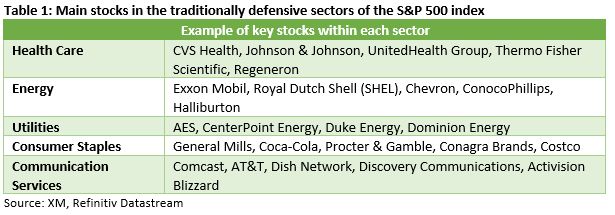
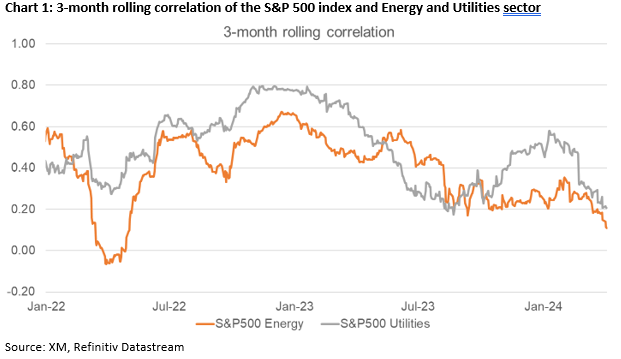
Should a correction in US equities take place, we could see safe haven flows materialize and pushing the 10-year US yield lower. In this case, defensive stocks could feature again in the headlines due to their historical performance in risk averse periods. As shown in Chart 1, the Energy and Utility sectors appear to enjoy the smallest correlation with the S&P 500 index.
GBPCHF Wave Analysis
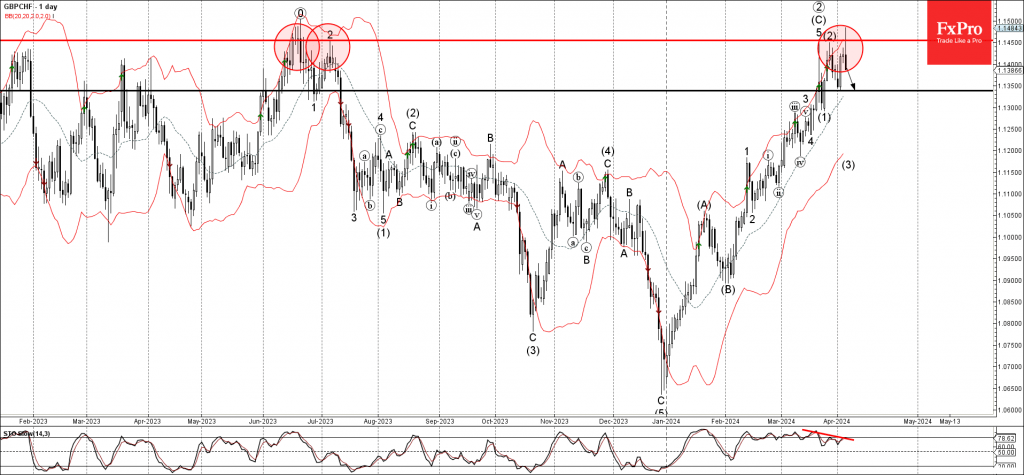
- GBPCHF reversed from resistance zone
- Likely to fall to support level 1.1340
GBPCHF recently reversed down from the major resistance zone located between the resistance level 1.1450 (which has been reversing the pair from last June) and the upper daily Bollinger Band.
The downward reversal from this resistance zone continues the active downward impulse wave (3).
Given the strength of the resistance level 1,1450, strong Swiss franc inflows and the bearish divergence on the daily Stochastic indicator, GBPCHF can be expected to fall further to the next support level 1.1340 (low of the previous minor correction).
CHF Renewed Its Decline on Weak Inflation
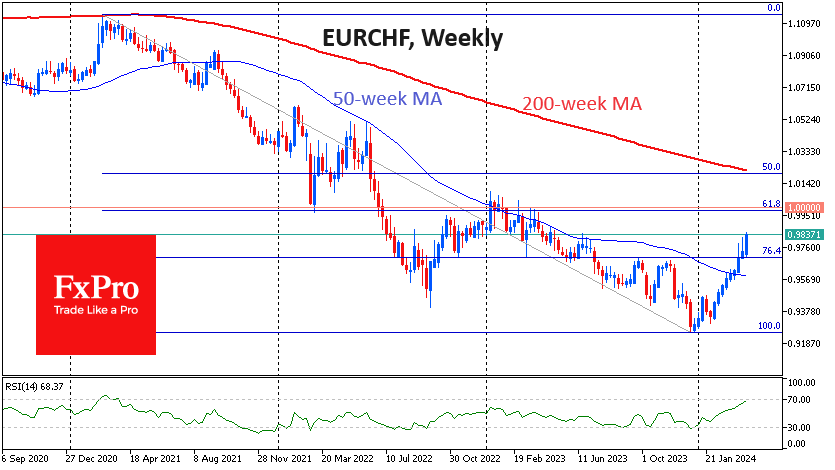
Weak Swiss inflation renewed the downward momentum of the franc, which is losing over 0.5% against the euro, sending EURCHF to highs last seen in May 2023.
The Swiss Consumer Price Index was virtually unchanged for March, with annual inflation slowing to just 1.0% – the lowest since September 2021. The Swiss National Bank has already unofficially celebrated a victory over inflation by unexpectedly cutting rates last month.
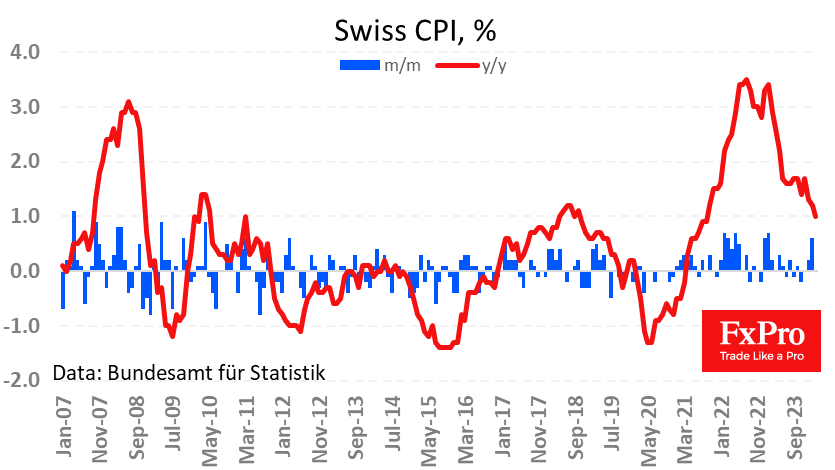
Fresh inflation data reinforces expectations of further policy easing. The franc has fallen for the past nine consecutive weeks, losing over 6% against the euro from extremes late last year. This is a significant move for a low-volatility pair like EURCHF, which has already returned to levels at the start of 2023. A further fall in the franc against the euro would work to inflate inflation, which is unlikely to please the SNB.
On balance, this means that the inertial upward movement in EURCHF could continue in the coming days or weeks, bringing the pair closer to parity. However, a subsequent depreciation of the franc against the euro or dollar has the potential to force the SNB to reconsider the soft approach. This is well within their power, as this CB is very active in forex and has room for policy tightening.
EUR/USD Surges Following Powell’s Remarks on Interest Rates
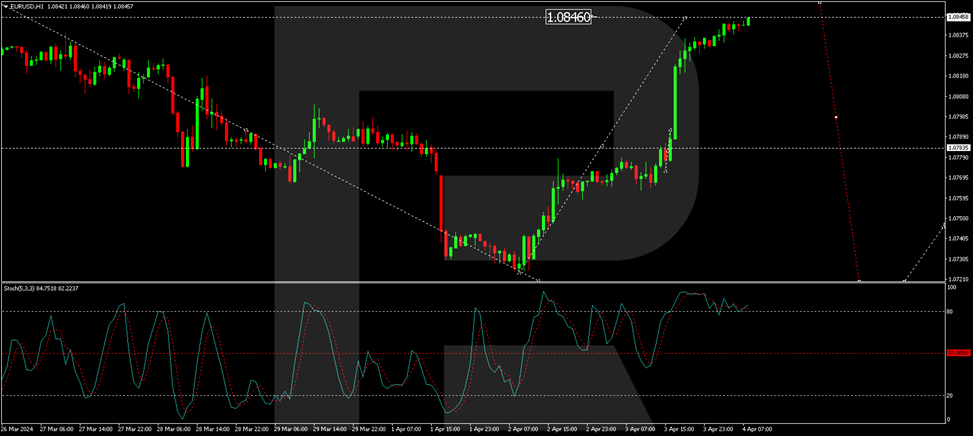
The EUR/USD pair moved upward to 1.0844 on Thursday, marking an unexpected shift following a period of strong US dollar performance. This change in dynamics can be attributed to investors' positive response to comments made by US Federal Reserve Chair Jerome Powell regarding the future of interest rates. Powell's remarks led to a surge in risk appetite, resulting in the dollar's decline.
Powell indicated that economic indicators would heavily influence the Federal Reserve's decisions on interest rate adjustments. Traders interpreted his comments as suggesting that, given the recent modest nature of US economic data, the anticipated forecast of three rate cuts in 2024, starting in June, remains on the table. The expectation is for the Federal Reserve to reduce interest rates by 75 basis points by the year's end, which aligns with earlier statements from the Fed. These hinted at a majority consensus among monetary policy committee members to commence rate cuts within the year, contingent on economic data.
Powell's reaffirming the Fed's trajectory towards lower interest rates, with specific timing depending on upcoming data, sets the stage for March's closely watched US employment market reports. The focus will be on whether the unemployment rate has remained steady and whether there has been any deceleration in the growth of average wages.
Technical analysis of EUR/USD
On the H4 chart, the EUR/USD pair has completed a correction to 1.0783, with a narrow consolidation range now established around this level. An upward breakout from this range could lead to a continuation of the correction to 1.0847, potentially followed by a new downward wave to 1.0694. This scenario is supported by the MACD indicator, where the signal line is below zero and the histogram peaks, suggesting a potential sharp decline.
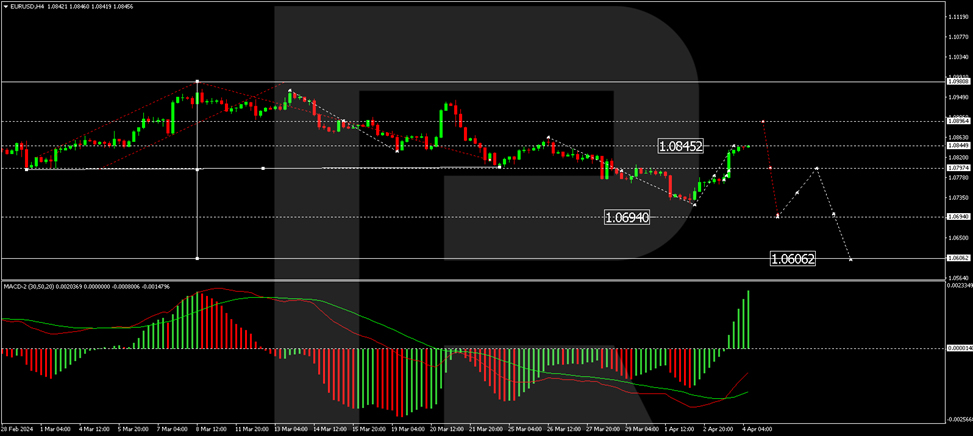
The H1 chart reveals a corrective pattern towards 1.0847, with an expected shift towards 1.0783 to commence a decline phase. A new consolidation range at these levels could lead to further correction to 1.0888 or a downward wave to 1.0694 upon a breakout. The Stochastic oscillator, positioned above 80, anticipates a significant drop to the 50 mark, potentially leading to further declines.