Sample Category Title
(SNB) Swiss National Bank Eases Monetary Policy and Lowers SNB Policy Rate to 1.5%
The Swiss National Bank is lowering the SNB policy rate by 0.25 percentage points to 1.5%. The change applies from tomorrow, 22 March 2024. Banks' sight deposits held at the SNB will be remunerated at the SNB policy rate up to a certain threshold, and at 1.0% above this threshold. The SNB also remains willing to be active in the foreign exchange market as necessary.
The easing of monetary policy has been made possible because the fight against inflation over the past two and a half years has been effective. For some months now, inflation has been back below 2% and thus in the range the SNB equates with price stability. According to the new forecast, inflation is also likely to remain in this range over the next few years.
With its decision, the SNB is taking into account the reduced inflationary pressure as well as the appreciation of the Swiss franc in real terms over the past year. The policy rate cut also supports economic activity. Today's easing thus ensures that monetary conditions remain appropriate.
The SNB will continue to monitor the development of inflation closely, and will adjust its monetary policy again if necessary to ensure inflation remains within the range consistent with price stability over the medium term.
Inflation has declined further since the beginning of the year, and stood at 1.2% in February. This decrease was attributable to lower goods inflation. Inflation is currently being driven above all by higher prices for domestic services.
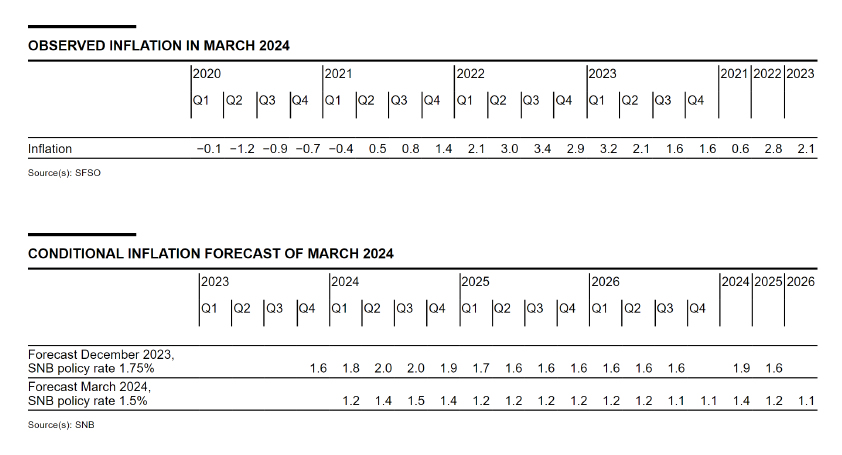
The new conditional inflation forecast is significantly lower than that of December. In the short term, this is above all due to the fact that price momentum in the case of some categories of goods has slowed more quickly than had been expected in December. In the medium term, lower second-round effects are leading to a downward revision. Over the entire forecast horizon, the conditional inflation forecast is within the range of price stability (cf. chart). The forecast puts average annual inflation at 1.4% for 2024, 1.2% for 2025 and 1.1% for 2026 (cf. table). The forecast is based on the assumption that the SNB policy rate is 1.5% over the entire forecast horizon.
The global economy grew moderately in the fourth quarter of 2023. Having declined rapidly in many countries in 2023, inflation has decreased at a somewhat slower pace in recent months. Inflation in many countries remains above central banks' targets. Against this background, many central banks have left their restrictive monetary policy unchanged for the time being.
Global economic growth is likely to remain moderate in the coming quarters. Inflation is likely to decline further, not least due to the restrictive monetary policy.
This scenario for the global economy is still subject to significant risks. Inflation could remain elevated for longer in some countries, necessitating a tighter monetary policy there than expected in the baseline scenario. Equally, geopolitical tensions could increase. It therefore cannot be ruled out that global economic activity will be weaker than assumed.
Swiss GDP growth was moderate in the fourth quarter of last year. The services sector expanded again, while value added in manufacturing stagnated. Unemployment rose somewhat further, and the utilisation of overall production capacity was normal.
Growth is likely to remain modest in the coming quarters. The weak demand from abroad and the appreciation of the Swiss franc in real terms over the past year are having a dampening effect. Overall, Switzerland's GDP is likely to grow by around 1% this year. In this environment, unemployment is likely to continue to rise gradually, and the utilisation of production capacity is likely to decline somewhat further.
Our forecast for Switzerland, as for the global economy, is subject to significant uncertainty. The main risk is weaker economic activity abroad.
Momentum on the mortgage and real estate markets has weakened noticeably in recent quarters. However, the vulnerabilities in these markets remain.
WTI Crude Oil Futures Slip from 4-Month Peak
- WTI crude oil looks positive despite the latest drop
- 20- and 200-day SMAs post bullish cross
- MACD and RSI show positive signs
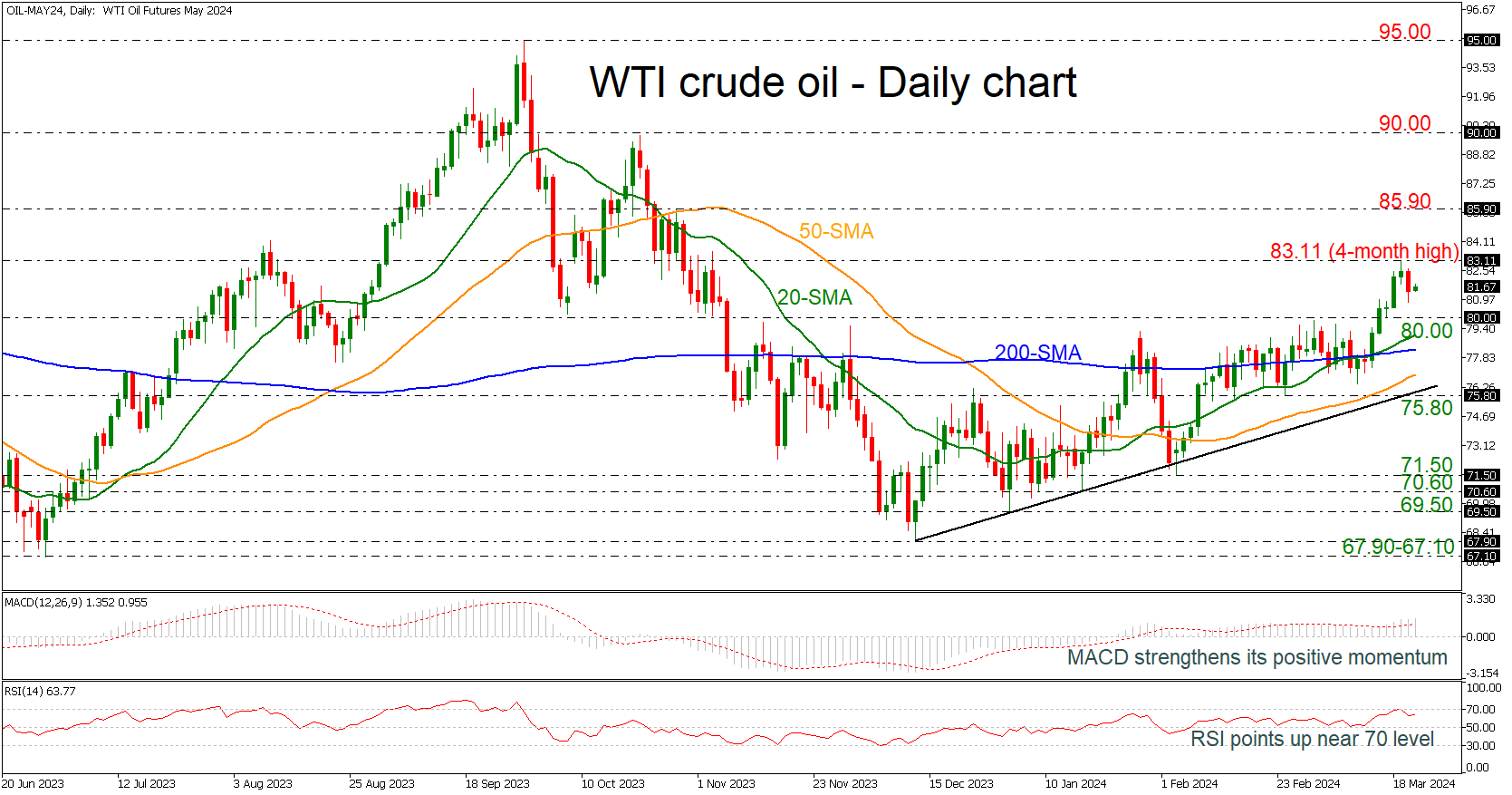
WTI crude oil futures are easing after the climb towards the new four-month high of 83.11 but the broader outlook remains bullish, especially after the rally above the 80.00 round number.
According to technical oscillators, the MACD is extending its positive momentum above its trigger and zero lines, while the RSI is pointing slightly up near the 70 threshold. Also, the 20- and the 200-day simple moving averages (SMAs) posted a golden cross, confirming the upside structure.
If the market continues to fall, immediate support for traders to have in mind is the 80.00 mark ahead of the 20- and the 200-day SMAs currently at 79.00 and 78.20 respectively. Beneath these lines, the 50-day SMA at 76.87 and the short-term uptrend line around the 75.80 support may halt bearish actions.
In the positive scenario, a jump beyond the 83.11 resistance may drive the price towards the 85.90 barricade before meeting the 90.00 handle, switching the medium-term outlook to a more bullish one.
To sum up, WTI crude oil has been developing in an ascending tendency since December 13 and only a dive below the rising trend line may change the current trend.
Interesting Divide Between Markets’ and Our Interpretation on Fed
Markets
Let’s dive right into yesterday’s Fed meeting. There’s an interesting divide between markets’ and our interpretation. For the former it was nothing but an outright dovish, cuts-are-coming-soon tribute. The three major US stock indices simultaneously closed at record highs. US yields turned south, slipping more than 8 bps at the front. The dollar tanked. EUR/USD bounced of an intraday low around 1.084 to finish around 1.092. DXY returned sub 104 to 103.38. USD/JPY aborted the test of the 2022-multi-decade high while still closing the day with net gains (151.26). This sharp reaction was mainly rooted in the March dot plot confirming the three 2023 rate cuts from December. After two CPI beats, ongoing strong hiring and broad economic resilience, some feared the Fed would have backtracked. Chair Powell also downplayed the consensus-topping inflation outcomes, saying “they haven’t really changed the overall story, which is that of inflation moving down gradually on a sometimes bumpy road toward 2%.” The updated forecasts tell us a completely different story. Growth was revised upwards across the policy horizon, especially for this year (2.1% from 1.4%). Unemployment rate saw some minor downward revisions from already low levels. Core PCE was lifted from 2.4% to 2.6% this year before easing to 2.2% and 2% in the years thereafter with FOMC participants in a shift with December seeing upside (instead of balanced) risks. The 2024 policy rate median prognosis indeed reflects three cuts. But the Fed removed one rate cut for both 2025 (3.75-4%) and 2026 (3-3.25%). In addition: the neutral rate gently nudged higher. It’s marginal (from 2.5% to 2.6%) but highly symbolical. The forecast distribution has generally shifted higher with the one for the equilibrium rate in particular catching the eye. There are now 7 out of 18 members seeing a neutral rate of at least 3% compared to 4 in December and only one member (down from 3) believes the neutral rate is <2.5%. Gut feeling tells us that yesterday’s market reaction won’t last very long. It takes one good labour market report, consensus-topping inflation outcome or other high-profile data point for markets to reconsider. Fortunately for the Fed, these won’t show up on the eco calendar for at least another week. There are, however, the PMIs today. The US edition is usually of secondary importance (compared to the ISMs), but a strong reading may already challenge yesterday’s market view. Those for the euro area are expected to further bottom out. The services series in particular is seen edging further north of 50. Bear in mind, though, that the EMU wide figure has been dramatically weighed down by the German and to a lesser extent the French malaise. EMU PMIs ex Germany and France already suggested moderate expansion. Barring a major upside surprise, however, we don’t expect them to alter ECB-forged expectations for a June rate cut. Breaking above EUR/USD 1.0981 (March interim high) looks implausible, especially should US Treasuries underperform in some counteraction today.
News & Views
The Czech National Bank cut its policy rate by 50 bps to 5.75% in a split decision. Two out seven governors voted in a favour of a 75 bps rate cut. Czech inflation declined to the CNB’s 2% inflation target, but risks to the outlook remain modestly inflationary. Therefore, the CNB will continue with a cautious approach when it comes to further rate cuts taking into account FX developments, the effect of fiscal policy on the economy, the labour market situation and the evolution of domestic and external demand as well. EUR/CZK ticked lower from 25.30 to 25.20 after the expected CNB meeting outcome. CZK swap rates added 3 to 4 bps.
Australian employment growth surged by 116.5k in February (vs 40k expected). Both full-time occupations (78.2k) and part-time jobs (38.3k) contributed. January figures were upwardly to 15.3k. The unemployment rate dropped from 4.1% to 3.7% (vs 4% consensus) though the participation rate only slightly advanced from 66.6% to 66.7%. The large increase in employment in February followed larger-than-usual numbers of people in December and January who had a job that they were waiting to start or to return to. This translated into a larger-than-usual flow of people into employment in February and even more so than February last year. Seasonally adjusted monthly hours worked rose by 2.8%. Following today’s labour market data, money markets pushed their expected start to a rate cut cycle lower from August to September. AUD swap rates add 6 to 8 bps across the curve this morning, pushing AUD/USD from the low 0.65 area yesterday morning to 0.6630 currently, approaching first resistance at 0.6639.
Silver (XAGUSD) Should Continue to Extend Higher
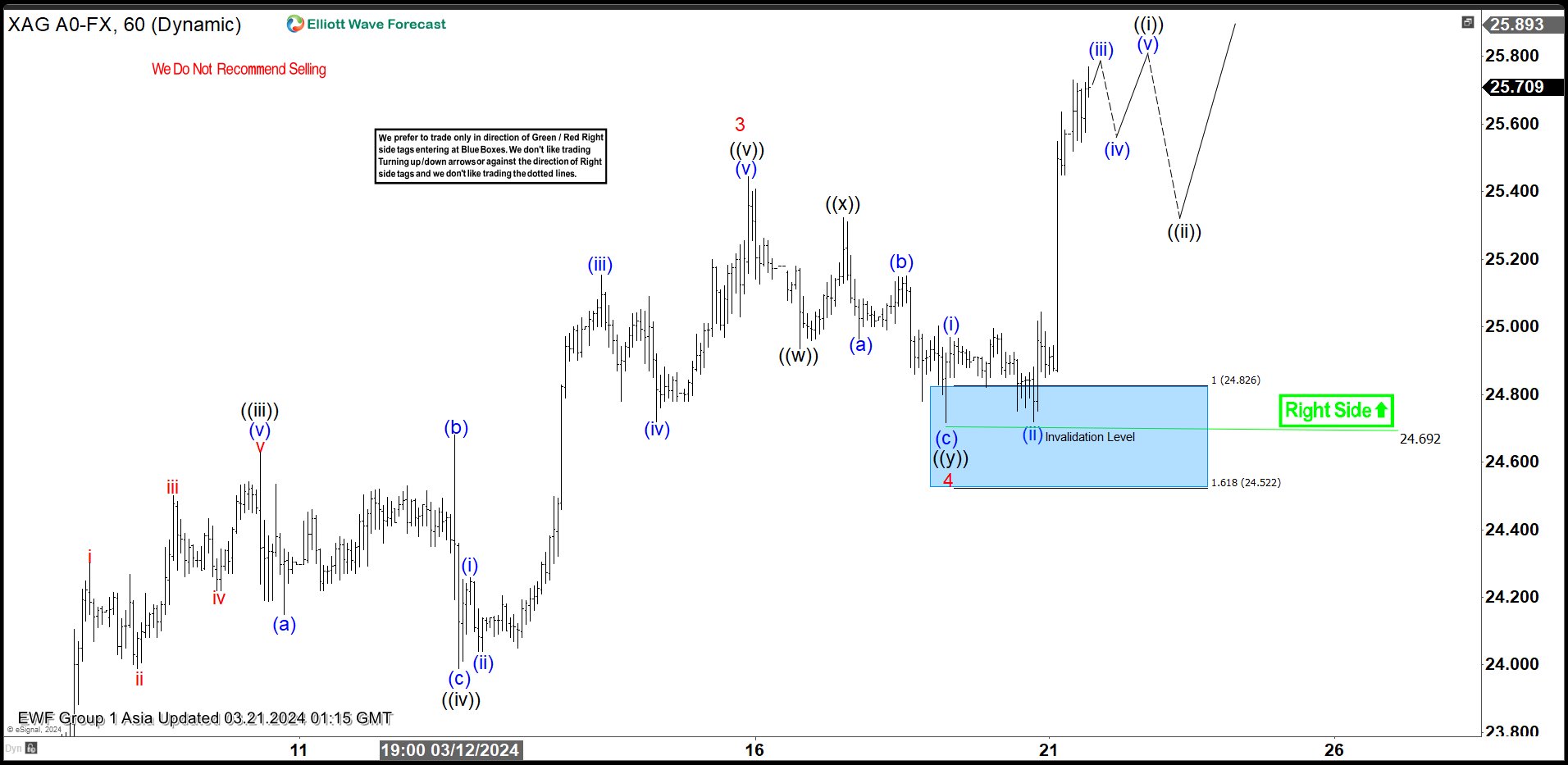
Short Term Elliott Wave view in Silver (XAGUSD) suggests that rally from 1.22.2024 low is in progress as a 5 wave impulse. Up from 1.22.2024 low, wave 1 ended at 23.32 and pullback in wave 2 ended at 21.94. Up from there, wave ((i)) ended at 23.49 and wave ((ii)) ended at 22.25. Wave ((iii)) higher ended at 24.62 and pullback in wave ((iv)) ended at 23.98. Final leg wave ((v)) ended at 25.44 which completed wave 3.
Wave 4 pullback unfolded as a double three Elliott Wave structure as the 1 hour chart below shows. Down from wave 3, wave ((w)) ended at 24.93 and wave ((x)) ended at 25.32. The metal then extended lower in wave ((y)) towards 24.69 which completed wave 4. The metal then turns higher in wave 5. Up from wave 4, wave (i) ended at 24.96 and wave (ii) ended at 24.72. Silver should end wave (iii) soon, then pullback in wave (iv) before turning higher again in wave (v) to end wave ((i)). Afterwards, it should pullback in wave ((ii)) to correct cycle from 3.19.2024 low in 3, 7, or 11 swing before it resumes higher again. Near term, as far as pivot at 24.69 low stays intact, expect dips to find support in 3, 7, 11 swing for further upside.
Silver (XAGUSD) 60 Minutes Elliott Wave Chart
XAGUSD Elliott Wave Video
https://www.youtube.com/watch?v=aOuLWp1yc98
How Dovish
The Federal Reserve (Fed) meeting went better than many expected. The Fed left interest rates unchanged as planned, but Chair Jerome Powell repeated that the rate cuts will begin ‘sometime this year’ and that it would be appropriate to slow the pace of QT ‘fairly soon’. There is no particular time regarding when the Fed will start giveaways, but we know that the recent uptick in inflation, the strong NFP figures, or the above-target growth don’t seem to be a concern for most Fed members. 10 of them plotted three or more rate cuts for this year, and 9 of them plotted two rate cuts or fewer. The median forecast is three rate cuts, unchanged from the December plot. The only hawkish tilt was for 2025. In 2025, the Fed members expect three cuts and not four. Voila.
Yesterday’s Fed decision was such a relief for the market, where the fear of seeing the Fed turn hawkish was reigning. The probability of a June rate cut spiked past 75% after the meeting from around 60% on Monday. The US 2-year yield sank below 4.60% after having approached the 4.80% earlier this week. The 10-year yield retreated below 4.30%, the dollar index gave back last week’s gains, and returned to February to March descending channel. Equities soared, of course, the S&P500 rallied past the 5200 mark and closed at a fresh ATH, while Nasdaq jumped more than 1% as well following such a dovish surprise from the Fed.
Ouch, Gucci
In Europe, mood was much less cheery, as the 11% plunge of Kering, the owner of Gucci, raised questions regarding the health of the rest of the European luxury stocks. Kering revealed that Gucci sales will fall 34% in Asia and about 20% worldwide versus a 4% dip predicted by analysts. Gucci makes up around 60% of the company’s total profit, hence Kering now expects global sales to fall by around 10% this quarter, versus only 3% penciled in by analysts. No wonder the news is quite a shocker for Kering and a strong warning for other luxury brands like LVMH, Hermes and Richmond. LVMH lost more than 1.50% yesterday, while Hermes remained near flat.
On the central bank front, European Central Bank (ECB) head Christine Lagarde didn’t enchant Europeans when she said that the ECB can’t commit to rate cuts beyond a first cut in June. She repeated that they ‘will know a bit more by April and a lot more by June’. The EURUSD jumped on the back of more dovish Fed and more hawkish ECB news, should extend gains above the 1.10 level and steady within 1.10/1.12 range as the US dollar should extend losses across the board, unless a big surprise derails the dovish Fed expectations. For now, there is no reason to doubt the Fed’s determination to cut in summer.
BoE decides following soft inflation report
Today, it’s the Bank of England’s (BoE) turn to announce decision. Yesterday’s softer-than-expected inflation figures and last week’s softer-than-expected jobs data are supportive of the BoE doves. Of course, the BoE is not expected to change rates today, but the MPC members’ votes will be the key takeaway from today’s announcement. If more MPC members vote in favour of a rage cut, we will likely see the BoE rate cut expectations pulled earlier this summer. For now, a 25bp cut is fully priced in for August – unchanged after yesterday’s inflation report. Cable jumped yesterday despite a soft inflation report as the selloff in the US dollar weighed heavier on the balance. And the same reasoning than with the EURUSD applies here. Cable is set to extend gains further, and the bulls could eye a rise to 1.30 if the US dollar remains under pressure on the back of strongly dovish Fed expectations.
Swiss can act earlier than European peers
The Swiss National Bank (SNB) also gives its policy decision today. The Swiss will likely follow in the footsteps of the ECB, but they could act slightly earlier than European peers given that inflation is now below target and letting the franc giveaway some strength wouldn’t be bad for the Swiss economy and exporters – especially after the Kering’s warning that Asian customers are not necessarily hungry for expensive European brands right now. The EURCHF rebounded more than 4% since the beginning of the year, but the pair has not even reached the minor 23.6% Fibonacci retracement on 2021 to 2024 selloff - the period where the SNB decided to let the franc strengthen to fight inflation. Therefore, there is a good upside opportunity for the EURCHF, if of course, the SNB remains convinced that inflation in Switzerland is under control. For now, it is.
Reddit starts trading today
Reddit will start trading on NYSE today after having raised $748 million priced at $34 per share – which is the top marketed range. Fundamentally, Reddit is not Nvidia – huh – they haven’t had a profitable year since the 2005 launch and the user growth has stalled near 500 mio for the past three years. Therefore, Redditers should give a supportive hand to make buzzy headlines. Note that the weather conditions are ideal for a first day facing the public – especially for speculative trades. The Fed has been accommodative, risk appetite is strong and there are no clouds in the sky. So, the Redditers could enjoy the ride.
Busy Day With Rate Reviews and PMI Pulse Check
In focus today
It is rate review day for several central banks, as we look to both the Swiss National Bank (SNB, 9.30 CET), Norges Bank (10.00 CET), and Bank of England (BoE, 13.00 CET) to publish their decisions.
We believe that inflation within the target rate (and below the SNB's forecast), a strong CHF, and quarterly meetings favour a 25bp rate cut from the SNB.
The BoE should keep the policy rate unchanged in line with both consensus and market pricing (for more details, see our Bank of England Preview, 15 March).
We expect Norges Bank to keep the policy rate unchanged at 4.50% and reiterate the signals that the first rate cut will most likely come in September. Most tension is linked to whether the low inflation figures for February imply that Norges Bank can open the possibility for an earlier cut.
We also receive a slew of March PMIs from the US and euro area. In the US we broadly expect to see signs of gradually cooling services growth and modest recovery in manufacturing. Euro area PMIs will also be very interesting as February service PMIs rose above the 50 mark, which indicates positive growth, for the first time since July. We expect that services remained above 50 in March as rising real wages and a strong labour market set the scene for decent services consumption. Manufacturing PMIs unexpectedly declined to 46.5 in February. However, this was entirely driven by Germany, whereas euro area manufacturing PMIs excluding Germany increased to 49.1. Based on inventory dynamics and leading indicators from Asia, we anticipate manufacturing PMIs increased in March. Yet, the German industry likely remained a drag on the euro area PMI.
Overnight, Japanese CPI inflation for February is released. Tokyo inflation indicated that price pressures remain aligned with an annual 2% inflation.
Economic and market news
What happened overnight
Dovish signals from Asia, with China's central bank deputy governor saying there was "room" to cut the reserve requirement ratio, and BoJ governor Ueda saying the BoJ would maintain "accommodative" monetary policy to support the economy.
Japanese PMIs improved with services at 54.9 (prior: 52.9) and manufacturing at 48.2 (prior: 47.2). A tourism rebound has provided benign demand conditions for services despite domestic consumers' loss of purchasing power. Manufacturing remains in contraction, but the decline seems to be slowing, with firms helped along by the weak yen. Since the BoJ hike earlier this week the yen has weakened further, especially vis-á-vis the euro, although price action against the dollar reversed slightly after yesterday's FOMC meeting.
What happened yesterday
As expected, the Fed kept its monetary policy unchanged, with the updated dot-plot still showing three 25bp rate cuts for 2024. Markets took this as a dovish signal, as recent upside surprises in inflation and growth have sown doubt whether the US is on its way to target inflation. The EUR/USD traded higher as of this morning and US equity markets rallied with several indices hitting record highs.
UK headline CPI printed slightly lower than expected at 3.4% (cons: 3.5%) and core at 4.5% (cons: 4.6%). EUR/GBP was a touch higher on release, but the price action reversed again as service inflation printed slightly higher than expected and in line with BoE forecasts.
Lagarde reiterated that we will know much more by June about monetary policy and highlighted wage growth, profit margins and productivity growth as key factors in assessing when the ECB can exit the "holding" phase and enter the "dialing-back" phase of monetary policy.
Equities: Global equities were higher yesterday with yet another set of all-time-high closings. FOCM and not least a dovish, very positive, joking, and importantly "higher for longer" Powell was the big driver behind the increase. It was no surprise that it resulted in a strong cyclical rotation where maybe the most surprising part was growth stocks doing fairly well and small caps outperforming. In US yesterday, Dow +1.0%, S&P 500 +0.9%, Nasdaq +1.3% and Russell 2000 +1.9%. Asian markets are sharply higher this morning led by South Korea up almost 3%. Flash PMI out of Japan boosting the already positive sentiment following FOMC. US and not least European futures are higher this morning.
FI: The US curve bull steepened yesterday as the FOMC stuck with the median projection of 75bp worth of rate cuts in 2024, though the policy rate trajectory for 2025 and beyond was lifted slightly. Markets added 8bp to the front-end pricing of US rate cuts in 2024, now standing at 82bp. 2Y UST yields dropped 7bp throughout the session, while the 10Y point slipped 2bp. EGB markets were in a waiting mode ahead of the FOMC with only marginal changes throughout the day.
FX: A dovish Fed sent US rates lower and EUR/USD higher yesterday. EUR/USD climbed back above 1.09. JPY dropped further yesterday - in particular vis-à-vis the EUR with EUR/JPY rising above 165. The big central bank week continues today, where we look for a rate cut from the SNB to weigh on CHF.
GBP/JPY Daily Outlook
Daily Pivots: (S1) 192.29; (P) 192.91; (R1) 194.02; More.....
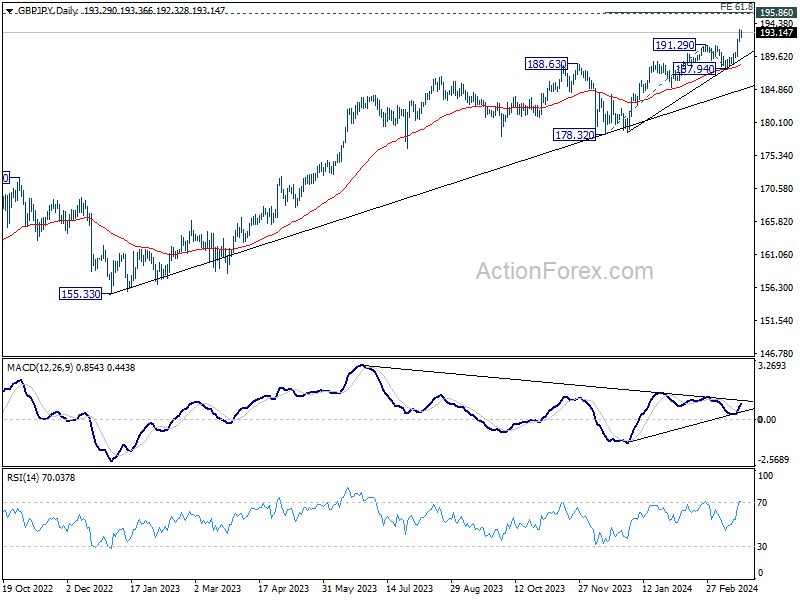
Intraday bias in GBP/JPY remains on the upside for the moment. Current up trend should target 61.8% projection of 178.32 to 191.29 from 187.94 at 195.95, which is close to 195.86 long term resistance. On the downside, below 191.78 minor support will turn intraday bias neutral and bring consolidations first, before staging another rally.
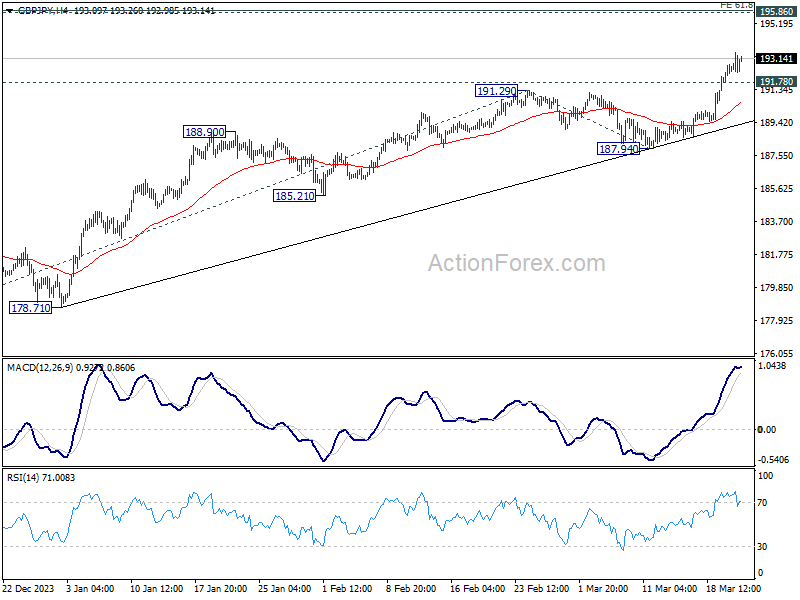
In the bigger picture, current rally is part of the uptrend from 123.94 (2020 low), and is in progress for long term resistance (2015 high). Break of 187.94 support is needed to be the first sign of medium term topping. Otherwise, outlook will remain bullish in case of retreat.
EUR/JPY Daily Outlook
Daily Pivots: (S1) 164.21; (P) 164.79; (R1) 165.77; More...
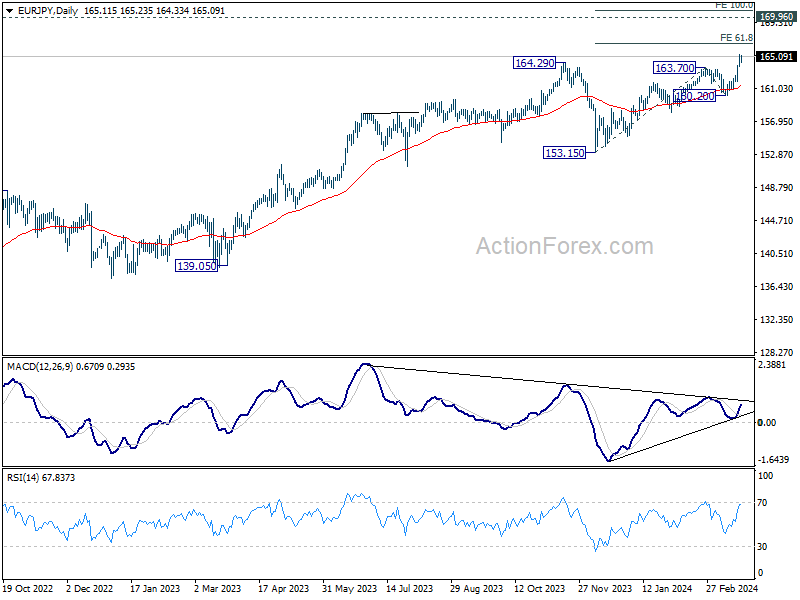
Intraday bias in EUR/JPY remains on the upside for the moment. Current rally should target 61.8% projection of 153.15 to 163.70 from 160.20 at 166.71. On the downside, Below 163.81 minor support will turn intraday bias neutral and bring consolidations first, before staging another rally.
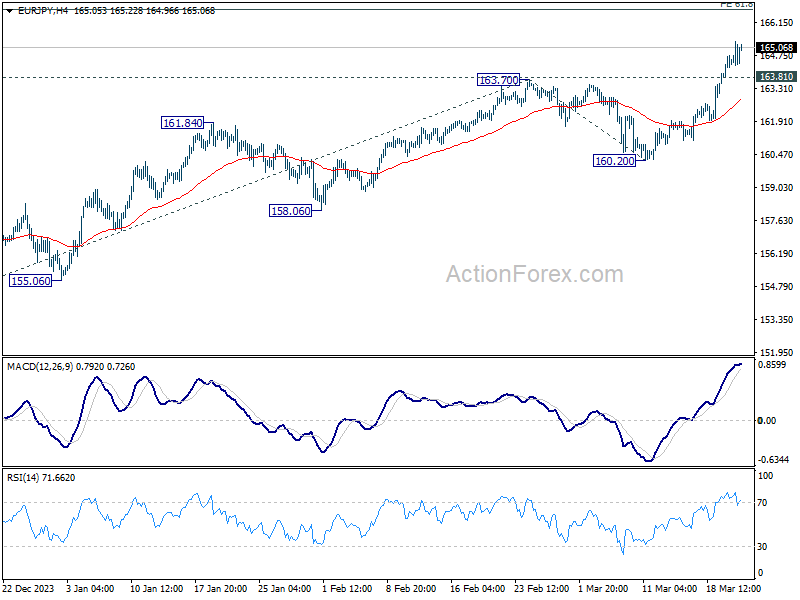
In the bigger picture, current rally is part of the up trend from 114.42 (2020 low), which is still in progress. Next target is 169.96 (2008 high). Break of 160.20 support is needed to be the first sign of medium term topping. Otherwise, outlook will stay bullish in case of retreat.
EUR/GBP Daily Outlook
Daily Pivots: (S1) 0.8532; (P) 0.8546; (R1) 0.8555; More...
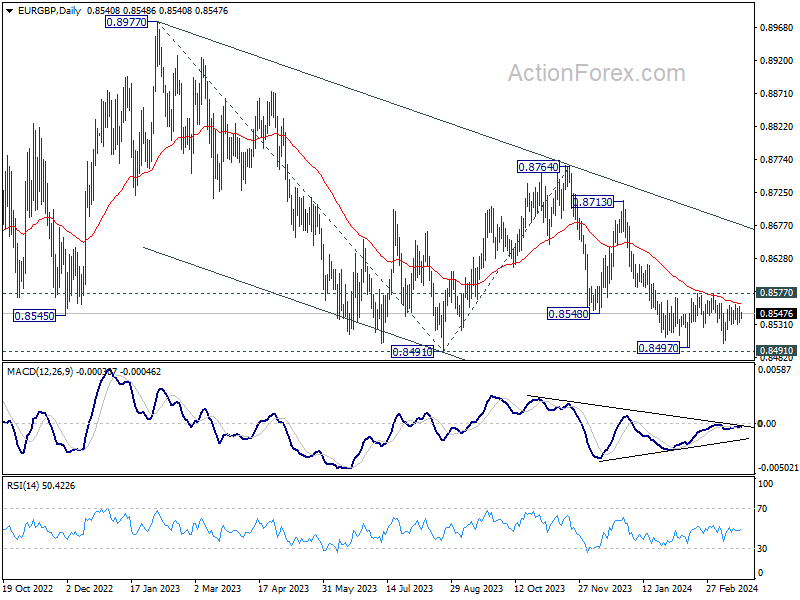
Range trading continues in EUR/GBP and intraday bias remains neutral. On the downside, decisive break of 0.8491/7 support zone will confirm larger down trend resumption and target 0.8464 projection level first. However, firm break of 0.8577 will turn bias back to the upside for stronger rebound.
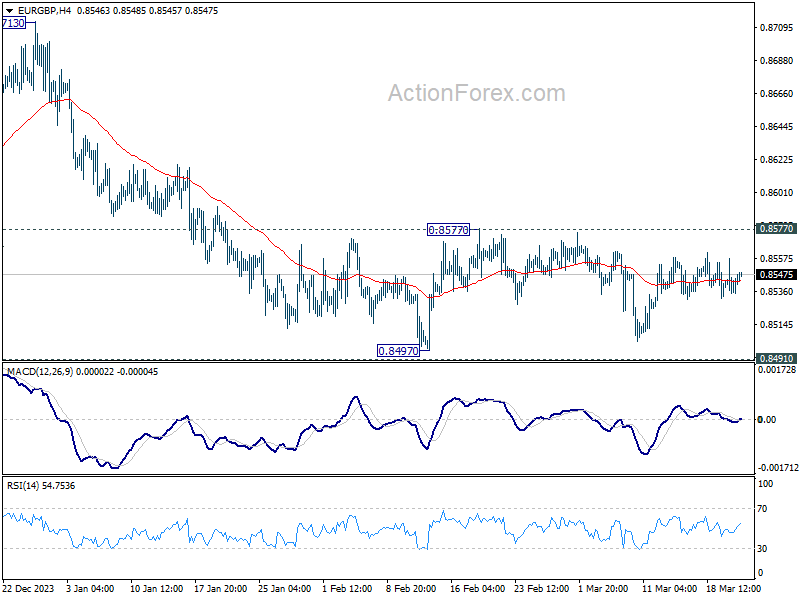
In the bigger picture, fall from 0.8764 is seen as another leg in the whole down trend from 0.9267 (2022 high). Outlook will stay bearish as long as 0.8713 resistance holds. Break of 0.8491 will target 61.8% projection of 0.8977 to 0.8491 from 0.8764 at 0.8464.
EUR/AUD Daily Outlook
Daily Pivots: (S1) 1.6558; (P) 1.6607; (R1) 1.6634; More...
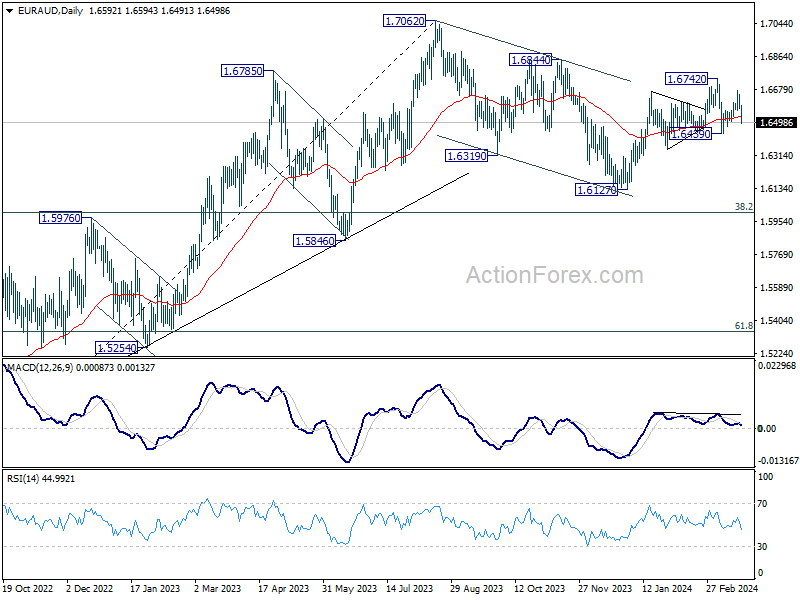
EUR/AUD reversed after hitting 1.6677 and intraday bias is turned neutral first. Near term outlook will stay cautiously bullish as long as 1.6439 support holds. On the upside, above 1.6677 will target 1.6742 first. Decisive break there will resume whole rise from 1.6127 and target 1.6844 resistance next.
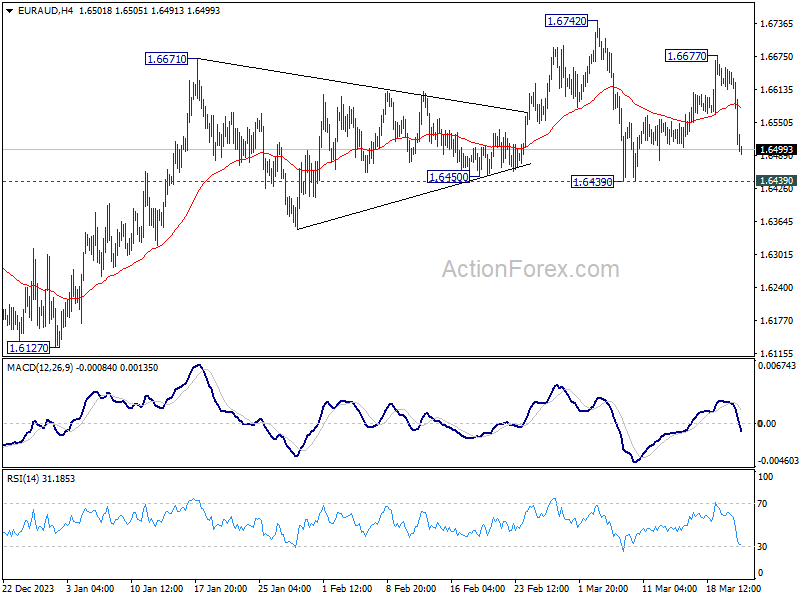
In the bigger picture, fall from 1.7062 medium term top is seen as a correction to the up trend from 1.4281 (2022 low). Break of 1.6844 resistance will argue that this up trend is ready to resume through 1.7062 high. In case of another fall, strong support should be seen around 1.5846 and 38.2% retracement of 1.4281 to 1.7062 at 1.6000 to bring rebound.