Sample Category Title
EURJPY Wave Analysis
- EURJPY broke resistance level 161.80
- Likely to rise to resistance level 164.00
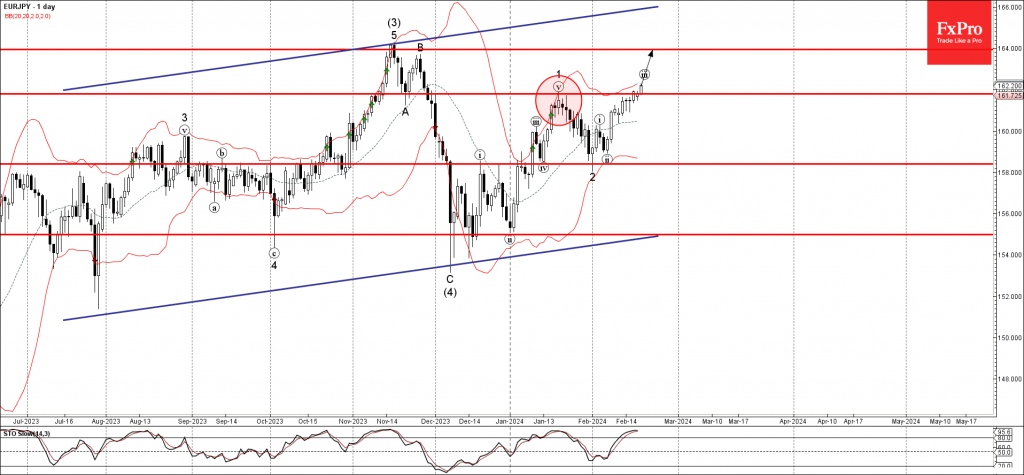
EURJPY currency pair continues to rise steadily after the price broke the resistance level 161.80 (which stopped the previous minor impulse wave 1 in the middle of January).
The breakout of the resistance level 161.80 accelerated the active short-term impulse wave iii of the higher order intermediate impulse wave (5).
Given the predominant daily uptrend, EURJPY currency pair can be expected to rise further to the next resistance level 164.00, which stopped sharp wave (3) in November.
WTI Crude Oil Wave Analysis
- WTI crude oil reversed from resistance level 78.20
- Likely to fall to support level 76.00
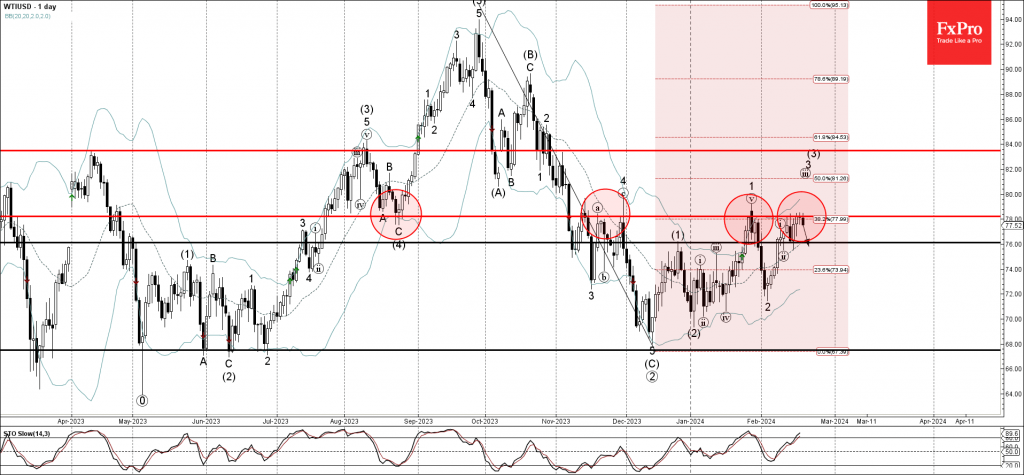
WTI crude oil recently reversed down from the key resistance level 78.20 (former support from August, which has been reversing the price from the start of November).
The resistance level 78.20 was strengthened by the 38.2% Fibonacci correction of the previous downward impulse from September.
Given the strength of the resistance level 78.20, WTI crude oil can be expected to fall further to the next support level 76.00, which stopped the earlier downward correction.
Dollar Turns to Fed Minutes for More Fuel
- Minutes of latest Fed meeting will be released at 19:00 GMT Wednesday
- Given strength of US economy, Fed has warned against early rate cuts
- If the minutes echo this view, dollar could extend its winning streak
Traders recalibrate Fed rate path
The US economy continues to fire on all cylinders. Economic growth is on track to hit 3% this quarter, the labor market is historically tight, and inflation readings have been persistently hot in recent months.
Reflecting this economic resilience, investors have been forced to dial back bets of imminent Fed rate cuts. Market pricing currently points to less than four cuts in total for 2024, down from six previously.
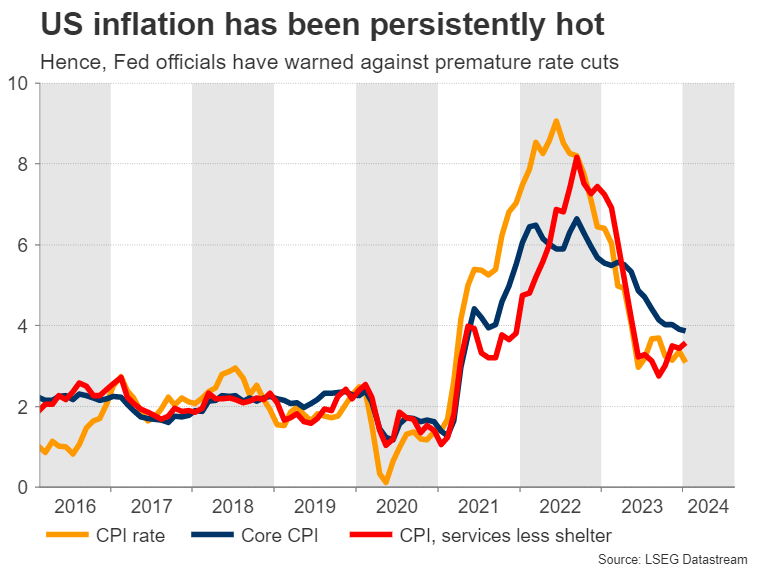
With traders increasingly adopting the view that US interest rates will remain higher for a longer period of time, the dollar has sprung back to life. The greenback is the best-performing major currency of 2024, having gained a whopping 6% against the Japanese yen already this year.
Fed minutes could endorse this shift
We have heard from several Fed officials since their latest meeting in January. Most of them have preached patience, warning against cutting interest rates too early, as that would raise the risk of inflation becoming stickier.
Incoming data since that meeting has also added credence to this view. Consumer and producer prices came in hotter than expected in January, while survey-based inflation expectations measures ticked higher, signaling that inflation is not cooling down as quickly as investors had hoped.
Even though Fed officials did not have access to this data when they met, the minutes are often "massaged" after the event to highlight certain points the central bank wants to convey to investors. In this case, the underlying message might be that the US economy is simply too hot for the Fed to cut interest rates in the near future.
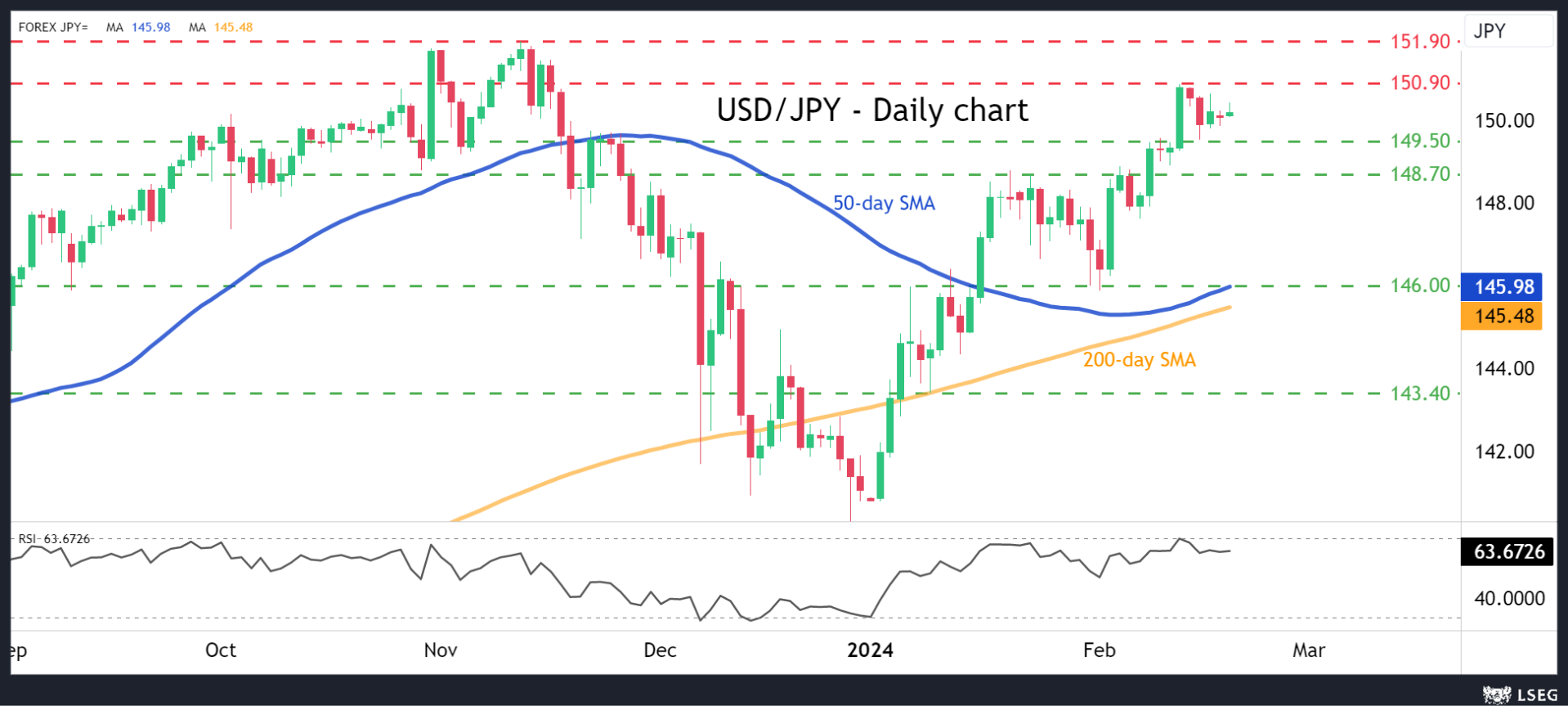
Therefore, the minutes could help the dollar resume its recent rally. Taking a look at the dollar/yen chart, the recent high of 150.90 could be the first barrier on the upside if the minutes indeed dispel speculation of imminent rate cuts. On the flipside, a more cautious tone could push the pair lower, turning the focus towards the 149.50 region.
Dollar outlook is still bright
In the bigger picture, the dollar has scope to run even higher. The United States is currently the bright spot in the global economy, enjoying healthy growth at a time when every other major economy is struggling.
Economic growth in the Eurozone has been stagnant for a year now, the United Kingdom and Japan have already fallen into technical recessions, and China is slashing interest rates to deal with the fallout in its property sector.
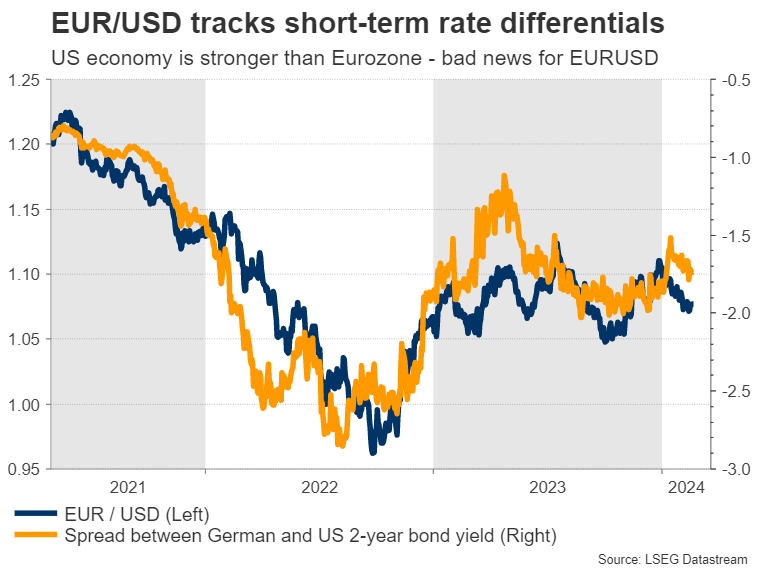
Purely in terms of economic performance, the US is miles ahead of the competition. This has started to translate into an interest rate advantage that benefits the dollar. From a historical perspective as well, the dollar often does some of its 'best work' in this type of environment - when the global economy is weakening but the US is still in good shape.
One factor that has prevented the dollar from appreciating more significantly is the cheerful tone in stock markets, which has dampened demand for safe haven assets. As such, a correction in equities might be the missing ingredient for the dollar to shine brighter.
ETHUSD Unlocks 21-month High Just Shy of 3,000
- ETHUSD extends structure of higher highs
- Posts 21-month peak a tad below 3,000 psychological mark
- Momentum indicators point to overbought conditions
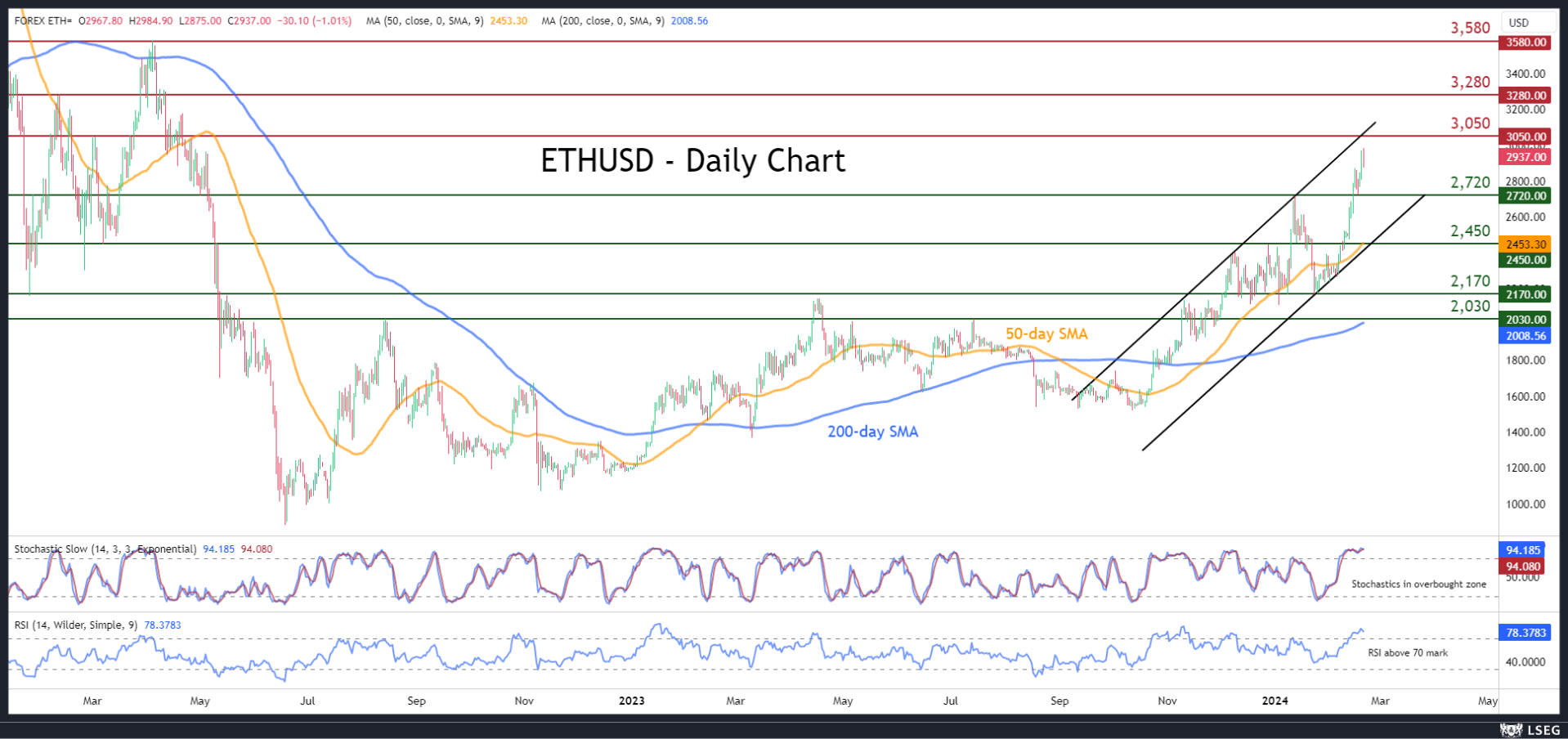
ETHUSD (Ethereum) has been developing within a bullish channel since late October, surging to consecutive higher highs. On Tuesday, the price leaped to a fresh 21-month peak of 2,984, but traders should be cautious as the momentum indicators are hinting at overbought conditions .
If buying pressures persist and the price storms to fresh highs, the bulls might attack the 2022 hurdle of 3,050. A break above that zone could open the door for the February 2022 peak of 3,250. Failing to halt there, Ethereum may advance towards the April high of 3,580.
Alternatively, in case of a pullback, the price may slide towards the January peak of 2,720, which could serve as support in the future. Further declines might cease at 2,450, a region that acted as support in March 2022 and coincides with the 50-day simple moving average (SMA). Even lower, the January bottom of 2,170 could provide downside protection.
In brief, ETHUSD’s rally has accelerated after the profound break above the 50-day SMA, with the price jumping to its highest since April 2022. However, the risk of a pullback is increasing as the short-term oscillators are starting to warn of an overstretched advance.
Sunset Market Commentary
Markets
This morning, the PBOC surprised markets with a much bigger than expected 25 bps cut of the 5-year prime loan rate (3.95%) aiming to support the real estate market and hopefully also helping to provide some oxygen (and confidence) for broader economic activity. However, the market reaction in China and abroad was lukewarm. For now, markets clearly maintain their doubts on a sustained recovery of the Chinese economy. European equities mostly didn’t go anywhere (Eurostoxx currently -0.2%). US indices open in red, suggesting some tentative risk-off sentiment (S&P 500 -0.6%). In the absence of other high profile data, European markets today kept a closer eye on the ECB quarterly indicator of negotiated wages. The Q4 2023 figured eased from 4.7% to 4.5%. This should give the ECB some comfort. In its December staff projections the ECB still upwardly revised its 2024 forecast for compensation per employee to 4.6% from 4.3%. ECB policy makers recently pinpointed too high wage growth as a major risk for a smooth continuation of the disinflationary process. However, as many of the key collative wage negotiations are taking place in the first quarter, it probably will take until the May report for the ECB to get some real clarity in this topic. For 2023 as a whole, the ECB saw 4.5% of negotiated wage growth compared to 2022. The impact of the release on European interest rate markets remains modest. German yields are easing between 3.5 bps (5-y) and 2.0 bps (30-y). US yields change between -5.5 bps (2-y) and +1.0 bps (30-y).
On FX markets, the dollar still can’t find its composure, even as last week’s inflation data postponed markets’ expectations for a first Fed rate cut to June. DXY slips below the 104 big figure. EUR/USD ‘easily’ cleared the early February ST top at 1.0806 (currently 1.082) breaking out of a ST downtrend chancel. The yen underperforms the global USD decline, but the USD/JPY also struggles to hold the 150 barrier. EUR/GBP initially extended its return higher in the 0.85 big figure, but ceded most of the initial gains in afternoon trading. Still, the EUR/GBP 0.8493 support looks ever more solid. In a hearing before the UK Treasury committee, BoE governor Bailey sounded rather dovish as he said that market expectations on a BOE pivot to rate cuts are ‘not unreasonable’. He also signaled that inflation doesn’t have to fall to the 2.0% target before the BOE can start cutting rates. UK gilts outperform Bunds today, easing between 6 bps (5-y) and 4 bps (30y).
News & Views
The Belgian debt agency announced that it will open two retail issues on Thursday with the subscription period running from February 22 to March 01. The retail notes are one with a 1y maturity (3% Mar2025) and one with a 3y maturity (2.5% Mar2027). It will only be tomorrow clear whether the 1y note will enjoy a preferential withholding tax regime (15% instead of 30%) like the stellar retail note launched in August of last year (€21.9bn raised). If granted the exemption, the 1y Note will yield 2.55% instead of 2.10% after withholding tax. This compares with a net yield of 2.81% for the August retail note. The 3y issue will have a 1.75% yield after taxes. The combined issue size is this time capped, at €6bn.
Canadian inflation was flat in January whereas markets feared a new acceleration to 0.4% M/M. Y/Y-inflation slowed more than hoped, from 3.4% to 2.9%. The largest contributor to headline deceleration was lower Y/Y-prices for gasoline in January (-4%) compared with December (+1.4%). Prices growth for food purchased from stores and lower prices for airfares and travel fares also contributed to the deceleration. Mortgage interest costs (27.4% Y/Y) and rent (7.9% Y/Y) remained the biggest positive contributors. Since Q1 2022, headline inflation was only lower in June of last year (2.8% Y/Y). Underlying price gauges improved more than expected as well with the trimmed mean core CPI – the Bank of Canada’s preferred measure - slowing from 3.7% Y/Y to 3.4%, matching the lowest level since August 2021. Excluding shelter costs, CPI rose 1.5% from a year ago. At its January policy meeting, the BoC switched a tightening bias to a neutral approach, with the key question being how long the policy rate must be kept at the current level (5%). Money markets discount a first rate cut in June, in line with the Fed. The Canadian dollar loses out again USD after today’s CPI print (USD/CAD>1.35). CAD swap rates drop up to 13 bps at the front end of the curve.
Canadian January CPI Growth Edged into BoC’s Target Range
CPI growth decelerated to 2.9% year-over-year from 3.4% in December – back under the top end of the Bank of Canada’s (BoC) 1% to 3% target range for the first time since June 2023.
Energy and food price growth continued to slow, but the Bank of Canada’s preferred ‘core’ measures of broader inflation pressures also unexpectedly slowed.
Energy prices fell 2.7% from a year ago on lower gasoline prices (1.0% lower than in December, and 4.0% lower than they were a year ago) and a drop in residential natural gas prices in Alberta and Saskatchewan (the latter due to the provincial government dropping the carbon tax from natural gas billing).
Food inflation also slowed on ‘base-effects’, from 5.0% to 3.9% (year-over-year). Much of that slowdown came from food purchased in stores, where price growth slowed to 3.4% from 4.7% in December. Price growth for dining out also dipped to 5.1% in January.
Excluding food and energy components, inflation slowed to 3.1%. The Bank of Canada’s preferred core median and trim measures also slowed, to 3.3% and 3.4% above year-ago levels, respectively. The more recent (and closely watched by the BoC) 3-month annualized growth rates for both also decelerated.
Airfare prices declined by -14.3% from the prior year. That also marked the tenth consecutive decline. Prices for clothing and footwear were 1.3% lower than levels from a year ago, potentially reflecting discounting of winter clothing after a milder than usual winter in much of the country.
The scope of inflationary pressures was little changed on a monthly basis, but still much narrower than peak pandemic levels. The share of CPI basket growing at more than 5% has declined from the peak of 68% in May 2022 to 28% in January 2024.
The effect of past rate hikes feed into consumer prices persistently with a lag. Year-over-year growth in mortgage interest costs edged lower in January were still up 27.4% from a year ago, and account for about a quarter of total price growth. Home rent prices continue to rise but another component under shelter – homeowners’ replacement costs inched lower on slower house price growth.
Bottom Line: The first CPI report in 2024 came in softer than expected with the breadth of inflation still showing signs of gradual easing, but also still wider than would be consistent with the Bank of Canada’s 2% inflation target. Shelter inflation will remain sticky as higher interest rates feed through to mortgage interest costs with a lag and undersupply of housing continues to boost rent prices. The most likely path for inflation going forward is still lower with per-capita GDP and consumer spending continuing to decline. But a strong start to 2024 for labour markets gives the BoC more leeway to wait for firmer signs that inflation is getting back under control before pivoting to interest rate cuts. As of now, our base case assumes the BoC starts to lower interest rates around mid-year.
USD/JPY Mid-Day Outlook
Daily Pivots: (S1) 149.93; (P) 150.09; (R1) 150.30; More...
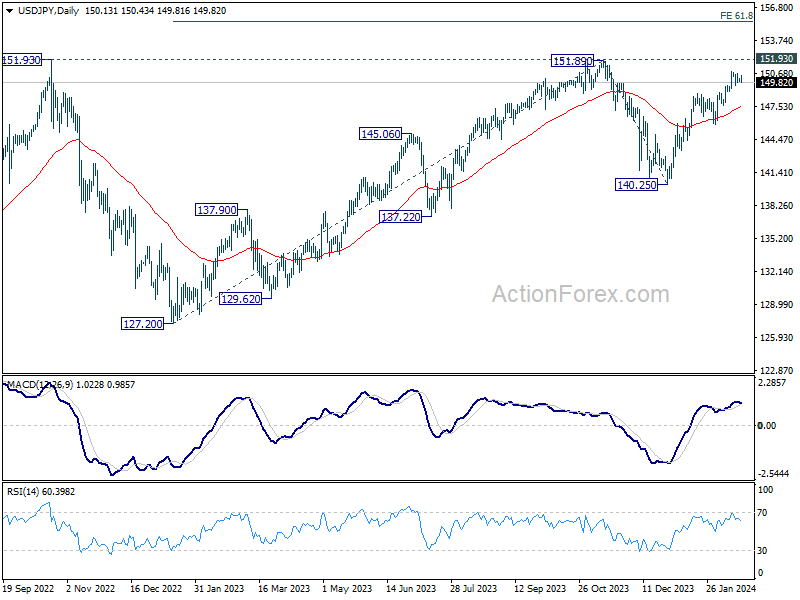
USD/JPY is still bounded in consolidation from 150.87 and intraday bias stays neutral. In case of another retreat, downside should be contained by 148.79 resistance turned support to bring another rally. Above 150.87 will resume the rise from 140.25 to 151.89/93 key resistance zone. Decisive break there will confirm larger up trend resumption of 155.50 projection level next. However, firm break of 148.79 will turn bias to the downside for 145.88 support.
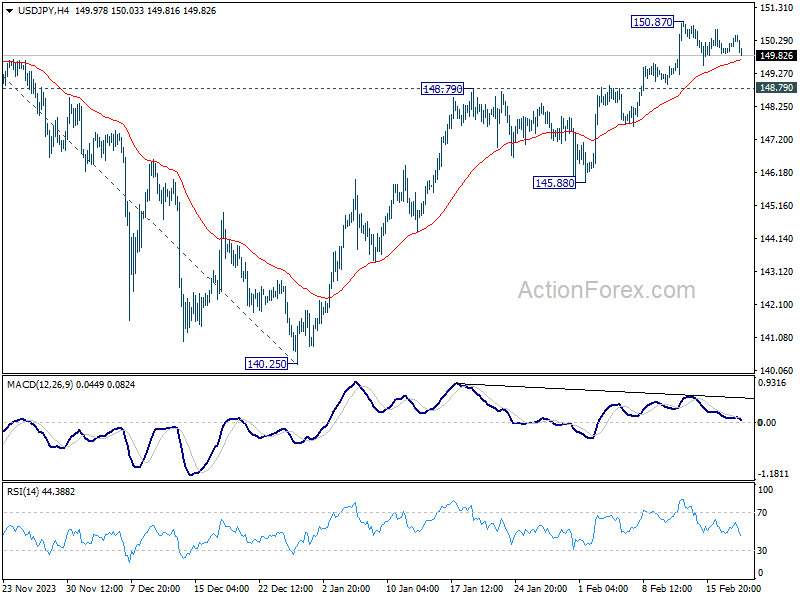
In the bigger picture, fall from 151.89 is seen as a correction to the rally from 127.20, which might have completed at 140.25 already. Firm break of 151.89/93 resistance zone will confirm up trend resumption, and next target will be 61.8% projection of 127.20 to 151.89 from 140.25 at 155.50. This will now remain the favored case as long as 140.25 support holds.
USD/CHF Mid-Day Outlook
Daily Pivots: (S1) 0.8802; (P) 0.8819; (R1) 0.8841; More....
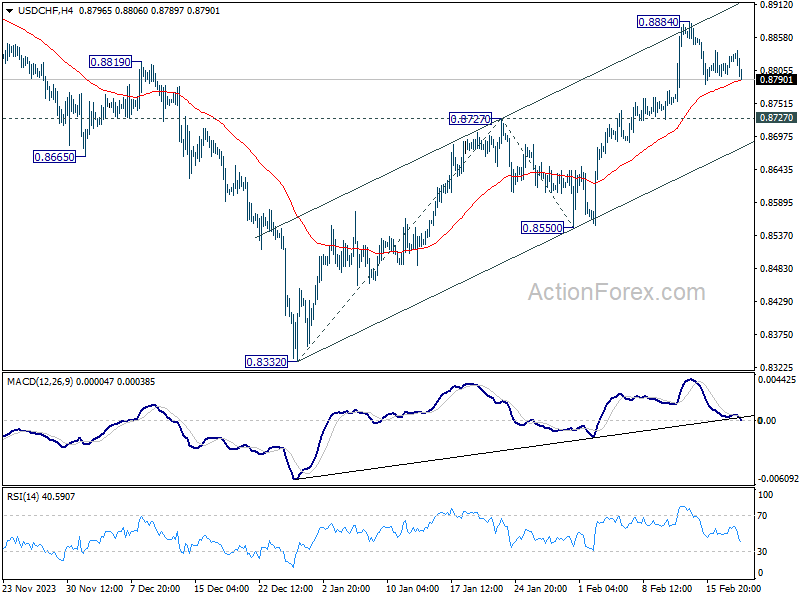
USD/CHF is staying in consolidation from 0.8884 and intraday bias stays neutral. Further rally is expected as long as 0.8727 resistance turned support holds. On the upside, break of 0.8885 will resume the rise from 0.8332 and target and 100% projection of 0.8332 to 0.8727 from 0.8550 at 0.8954. However, sustained break of 0.8727 will dampen this bullish view, and turn bias back to the downside for 0.8550 support instead.
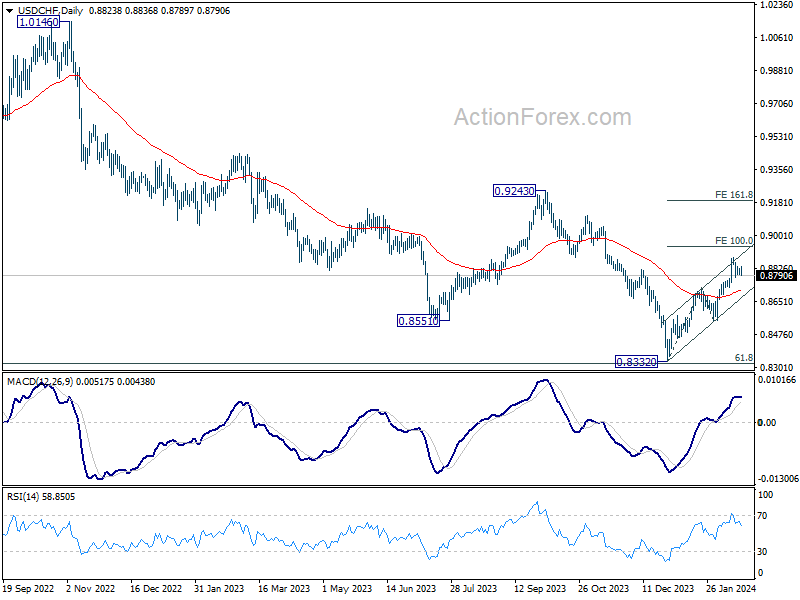
In the bigger picture, a medium term bottom should be formed at 0.8332, on bullish convergence condition in W MACD, just ahead of 0.8317 long term fibonacci support. It's still early to decide if the larger down trend from 1.0146 (2022 high) is reversing. But further rise should be seen to 0.9243 resistance even as a correction.
GBP/USD Mid-Day Outlook
Daily Pivots: (S1) 1.2577; (P) 1.2604; (R1) 1.2623; More...
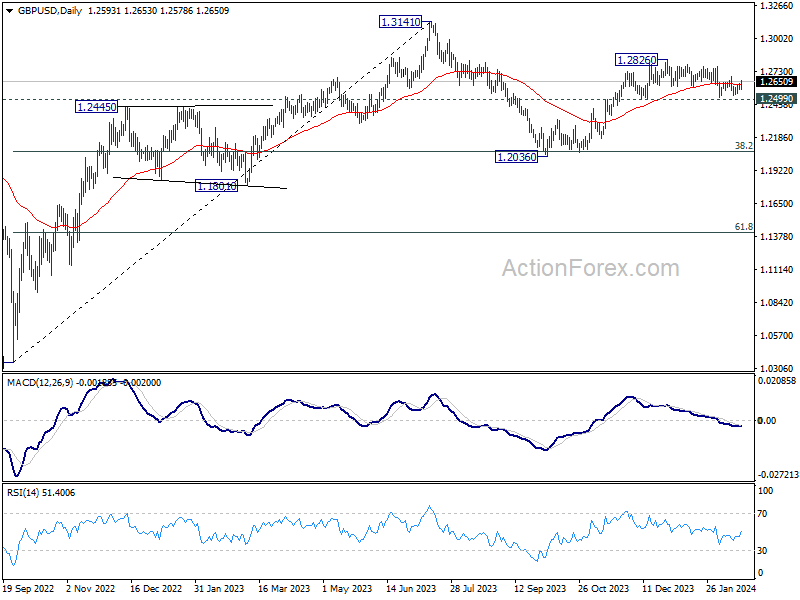
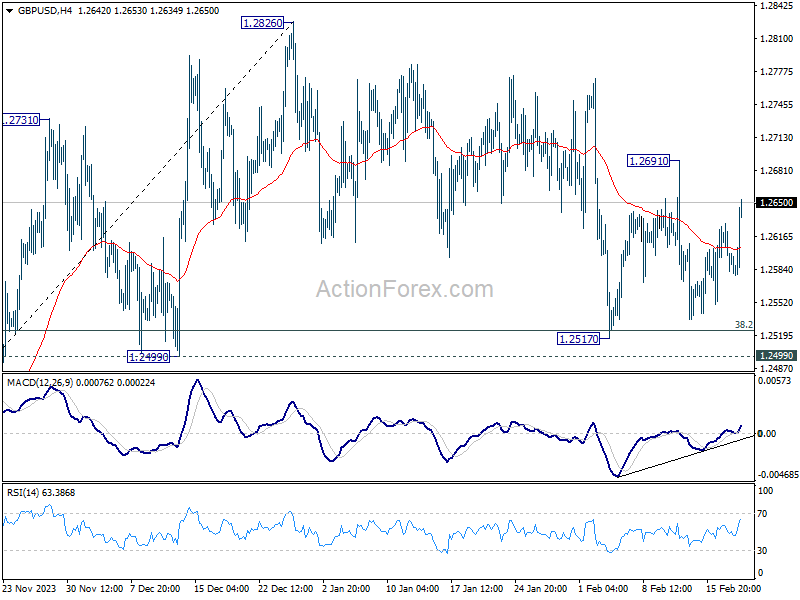
Despite today's rebound, GBP/USD is staying below 1.2691 resistance and intraday bias remains neutral first. On the upside, break of 1.2691 resistance will indicate that correction from 1.2826 has completed. Intraday bias will be back on the upside for retesting 1.2826. Nevertheless, decisive break of 1.2499 will argue that whole rise from 1.2036 has completed and turn near term outlook bearish.
In the bigger picture, price actions from 1.3141 medium term top are seen as a corrective pattern to up trend from 1.0351 (2022 low). Rise from 1.2036 is seen as the second leg, which could be still in progress. But upside should be limited by 1.3141 to bring the third leg of the pattern. Meanwhile, break of 1.2499 support will argue that the third leg has already started for 38.2% retracement of 1.0351 (2022 low) to 1.3141 at 1.2075 again.