Sample Category Title
Gold Opens Week Higher But Not Bullish Yet
- Gold rises, but technical signals keep sentiment in balance
- Needs a break above bearish channel at 2,035
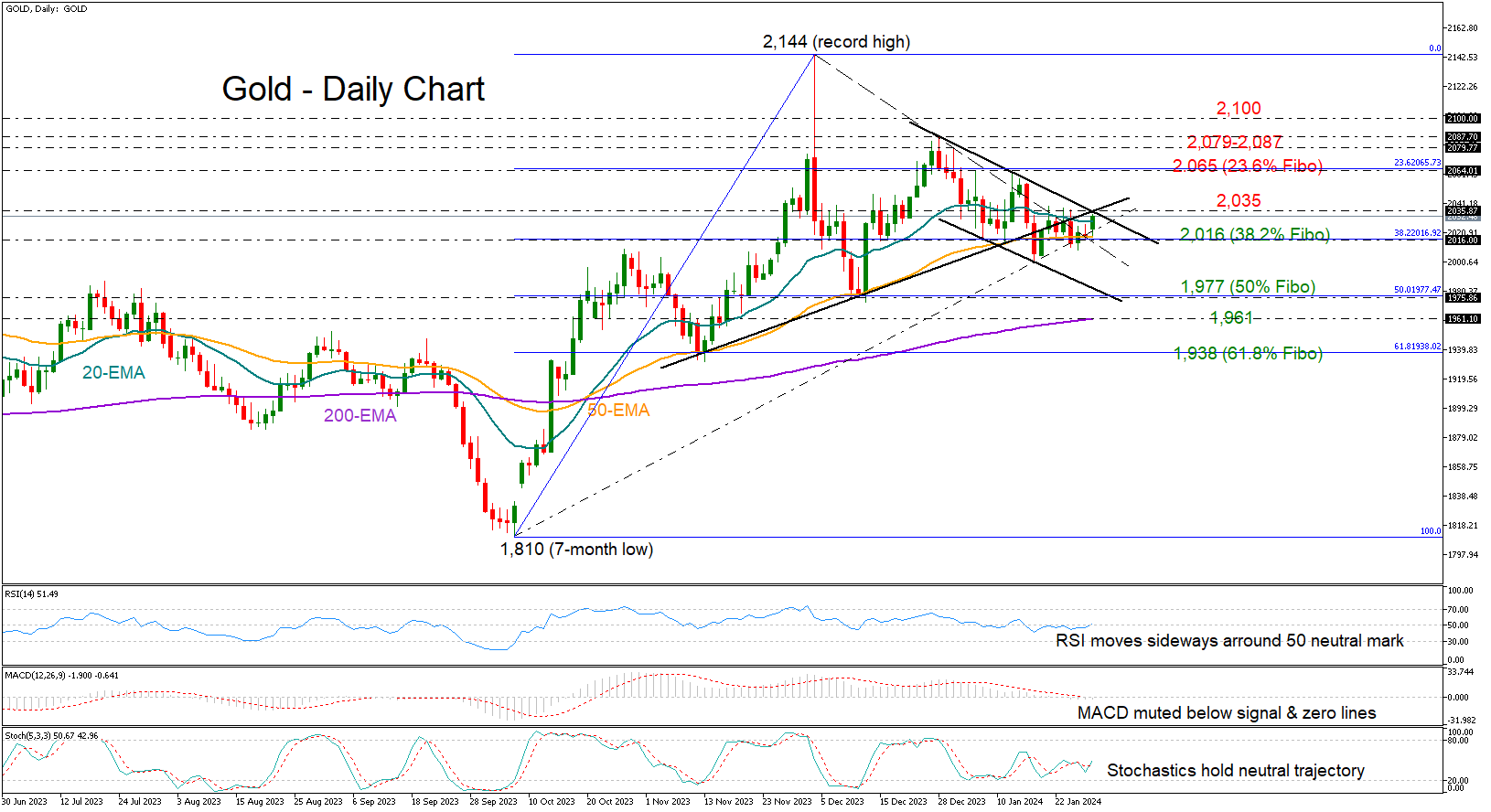
Gold started the week on a positive note, aiming to exit last week’s sideways trajectory above its 20-day exponential moving average (EMA) and the 2,035 trendline area after a couple of failed attempts.
Although the horizontal move in the RSI and the stochastic oscillators are balancing hopes for a bullish breakout, upside pressures could stay in play if the 2,016 floor stays intact.
A clear close above the 2,035 border and the short-term bearish channel could cheer buyers, lifting the price straight up to the key 2,065 region, which overlaps with the 23.6% Fibonacci retracement of the October-December upleg. Another success there could see a retest of December’s tough resistance region of 2,079-2,087 before the 2,100 psychological mark comes on the radar.
Otherwise, a slide beneath the 2,016 base, where the 50-day EMA is currently flattening, may cause a sharp decline towards the 50% Fibonacci of 1,977. The 200-day EMA is also in the neighborhood at 1,961. If the bears overpower that barricade, the door will open for the 61.8% Fibonacci level of 1,938 and November’s low of 1,931.
All in all, the precious metal keeps fluctuating within a well-defined area despite starting the week with positive momentum. An extension above 2,035 could confirm a new bullish wave, whereas a slide below 2,016 could activate fresh selling orders.
Brent Oil Price Faces Key Resistance Zone Amid Geopolitical Tensions
The reasons for the rise in Brent oil prices are a drone attack on an American military base in Jordan, as well as an attack on an oil tanker in the Red Sea. These events cause concerns about the safety of oil transportation through the Red Sea and the potential escalation of the conflict in the Middle East. Bloomberg writes that President Biden is under pressure, and the response can be decisive.
The Brent crude oil chart today shows that:
→ The price strengthened higher than the zone of consolidation (shown by narrowing black lines), having completed its bullish break at the psychological level of 80 US dollars per barrel.
→ The price forms an ascending channel (shown in blue).
→ The price rose to the USD 83.00-85.00 zone, which previously served as a support area, but changed its role in November.
→ The market is overbought, judging by the readings of the RSI indicator.
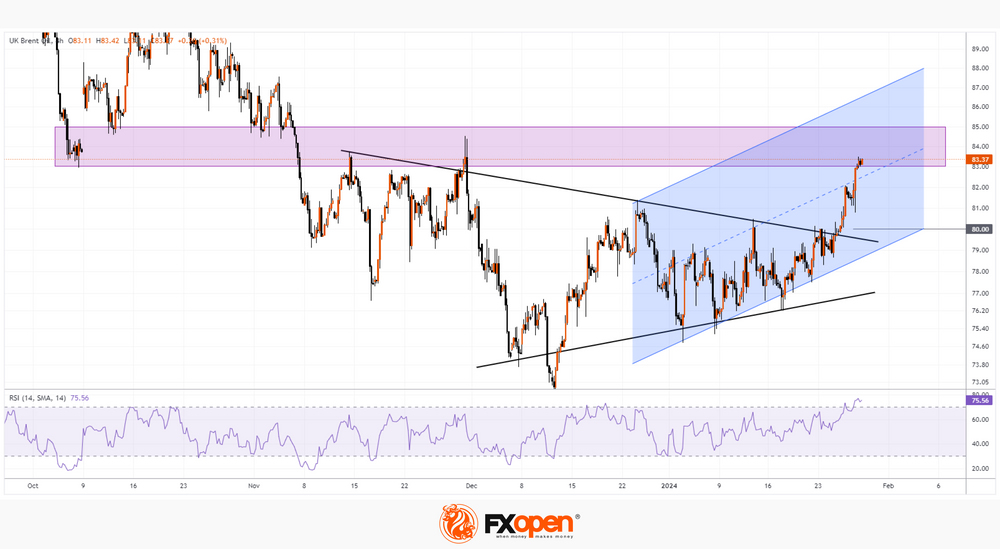
If the geopolitical tension increases, then the bulls can try to raise the price of Brent oil through the specified zone - it is possible that it will reach the upper border of the channel.
On the other hand, if the fundamental background indicates a decrease in the degree of threats in the Middle East, the price can form a pullback from the resistance zone so that the RSI drops closer to values around 50.
This article represents the opinion of the Companies operating under the FXOpen brand only. It is not to be construed as an offer, solicitation, or recommendation with respect to products and services provided by the Companies operating under the FXOpen brand, nor is it to be considered financial advice.
WTI Oil: Enters Corrective Phase But Remains Supported by Growing Supply Disruption Concerns
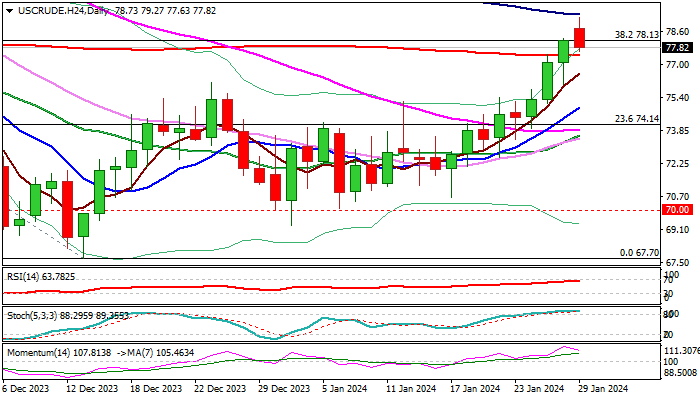
WTI oil eases in early Monday trading after opening with a gap higher and price rose new two-month high ($79.27).
Growing tensions in the Middle East and fall in Russian refined products export, continue to fuel fears of supply disruption and lift oil prices.
Last week’s 6.3% rally (the biggest weekly gain since the last week of November) registered a marginal close above pivotal Fibo barrier at $78.13 (38.2% retracement of $95.00/$67.70 downtrend).
Monday’s rise probed briefly above the top of thick daily Ichimoku cloud ($78.75) but gains were capped by falling 100DMA ($79.73).
Strongly overbought daily studies and fading bullish momentum contributed to current pullback, which accelerated during European session on Monday.
Broken 200DMA offers initial support at $77.43, followed by $76.91 (Fibo 23.6% of $69.27/$79.27 upleg) and $76.16 (former recovery top of Dec 26).
Extended pullback should find firm ground at $75.00 zone (near Fibo 38.2% of $69.27/$79.27 / rising 10DMA) to mark a healthy correction ahead of fresh push higher and attack of pivotal barriers at $79.73/$80.00 (100DMA / psychological).
Res: 78.13; 78.75; 79.37; 80.00.
Sup: 77.42; 76.91; 76.16; 75.45.
Oil Prices Spiked to Their Highest Levels Since Early November
Markets
European equities on Friday rallied like there was no tomorrow. The Eurostoxx50 added more than a percent to finish the week at the highest level since the 00s. US indices including the S&P500 rose to a new record high but struggled in the aftermath before closing at virtually unchanged levels. US yields recovered intraday with strong income & spending data outweighing media headlines of an outdated PCE core deflator dropping sub 3% for the first time since 2021. Gains amounted up to 5.5 bps at the front. German yields added about 1.5 bps across the curve. The first ECB speeches since the policy meeting on Thursday from the likes of Simkus, Kazaks and Vujcic sounded more hawkish. Knot and Villeroy over the weekend weighed in as well. Both highlighted the importance of wage growth to adapt to slower inflation before cutting rates. The latter said a pace of 2.5% is needed for sustainable price stability. That compares to the latest figure of 5%. Balanced as ever, he did keep the door open for rate cuts “at any time this year”. EUR/USD whipsawed with stocks dictating the intraday moves. The pair eventually closed a tad higher in the mid 1.08/1.09 region. Sterling ended a strong week on softer footing, allowing a slight uptick in EUR/GBP to 0.854.
This week kicks off quietly with few data scheduled for release. That changes quickly though. European Q4 growth will be published tomorrow. Individual EU member states release January inflation figures tomorrow and Wednesday as an appetizer to the European reading on Thursday (seen at 2.7% from 2.9% headline and at 3.2% from 3.4% for the core gauge). The US gets a whole lot of attention as well. The Fed gathers on Wednesday and will have a most recent update on the Employment Cost Index at its disposal just a few hours before making the decision public. Powell didn’t make much of bond correction (higher) in the run-up to the December policy meeting. Markets since then priced in one more additional rate cut for 2024, bringing the total at 135 bps starting in May. Powell probably won’t alter current market sentiment. The economy is holding up very well but inflation is evolving favourably as well. The Fed chair against that background probably isn’t in the mood for being outright hawkish. We think that anything bar the latter will prolong the dovish tide in markets. Following the Fed meeting, the US manufacturing ISM is due on Thursday with payrolls on Friday ending a busy week. We are also on the lookout for the Bank of England gathering this Thursday. Bailey sounded more hawkish than Powell in December and the recent CPI uptick gave no reason to change that tone.
News & Views
The Financial Times reports that according to a document drawn up by EU officials, Brussels is preparing a strategy to convince Hungary into supporting the use of the EU budget to provide €50bn in financial aid to Ukraine. If Hungarian PM Orban doesn’t back down on its verbal threat to block the support at Thursday’s Summit, other EU leaders should publicly vow to permanently shut off all EU funding to Budapest. The document point out that without this EU money; “financial markets and European and international companies might be less interested to invest in Hungary which could quickly trigger a further increase in the cost of funding of the public deficit and a drop in the currency.” It’s unseen that the EU wants to target and exploit economic vulnerabilities of a member state (“very high public deficit”, “very high inflation”, “highest debt servicing payments as a % of GDP”…) in order to strongarm it into a decision. Hungary’s EU Minister Boka said that his country will continue to participate constructively in the negotiations. The forint is already sliding in illiquid Asian dealings (EUR/HUF 388; weakest HUF since October) with more weakness likely during European trading hours.
Oil prices spiked to their highest levels since early November 2023 this morning on reports that three US service members were killed and at least 34 were injured in an Iran-backed militia’s drone strike on a base in northeast Jordan. It marks another escalation in region apart from the Hamas-Israeli conflict in Gaza and the Houthi-backed attacks in the Red Sea. Brent crude currently trades around $84/b, coming from $79/b only a week ago.
Gold: Pivotal Week After Being Sandwiched by Opposing Factors
- Higher US 10-year Treasury real yield and rising geopolitical risk premium have created a floor and cap for Gold (XAU/USD) at US$2,000 and US$2,040 respectively.
- Historical volatility of Gold (XAU/USD) has slipped to a 4-month low, increasing the odds of an impending volatility breakout scenario.
- The direction of the volatility breakout is likely to be reinforced by this Wednesday’s FOMC monetary policy guidance.
- Positive momentum has started to emerge ahead of FOMC.
In the past two weeks, Gold (XAU/USD) has reintegrated below its 20-day moving average but still managed to hold above the US$2,001 low printed on 17 January. Overall, its price actions have been sandwiched by opposing fundamental factors.
Negative factor – Higher US 10-year Treasury real yield
A slew of recent US economic data releases has indicated that the US economy has remained resilient, especially on consumer sentiment and spending where retail sales in December surged to an 11-month high at 5.6% y/y as well as a significant recovery in consumer sentiment at the start of the new year. The flash University of Michigan Consumer Sentiment survey data soared to 78.8 in January 2024, its highest level since July 2021, and surpassed expectations pegged at 70.
Given that the US economy appears to be still in a goldilocks-liked environment, there will be less justification for the US Federal Reserve to enact its first interest rate cut in the upcoming March FOMC meeting. Based on the CME FedWatch Tool inferred from 30-day Fed funds futures pricing data, the odds of a 25-basis point (bps) cut on the Fed funds rate in March have decreased to 47% at this time of the writing from around 70% chance recorded a month ago.
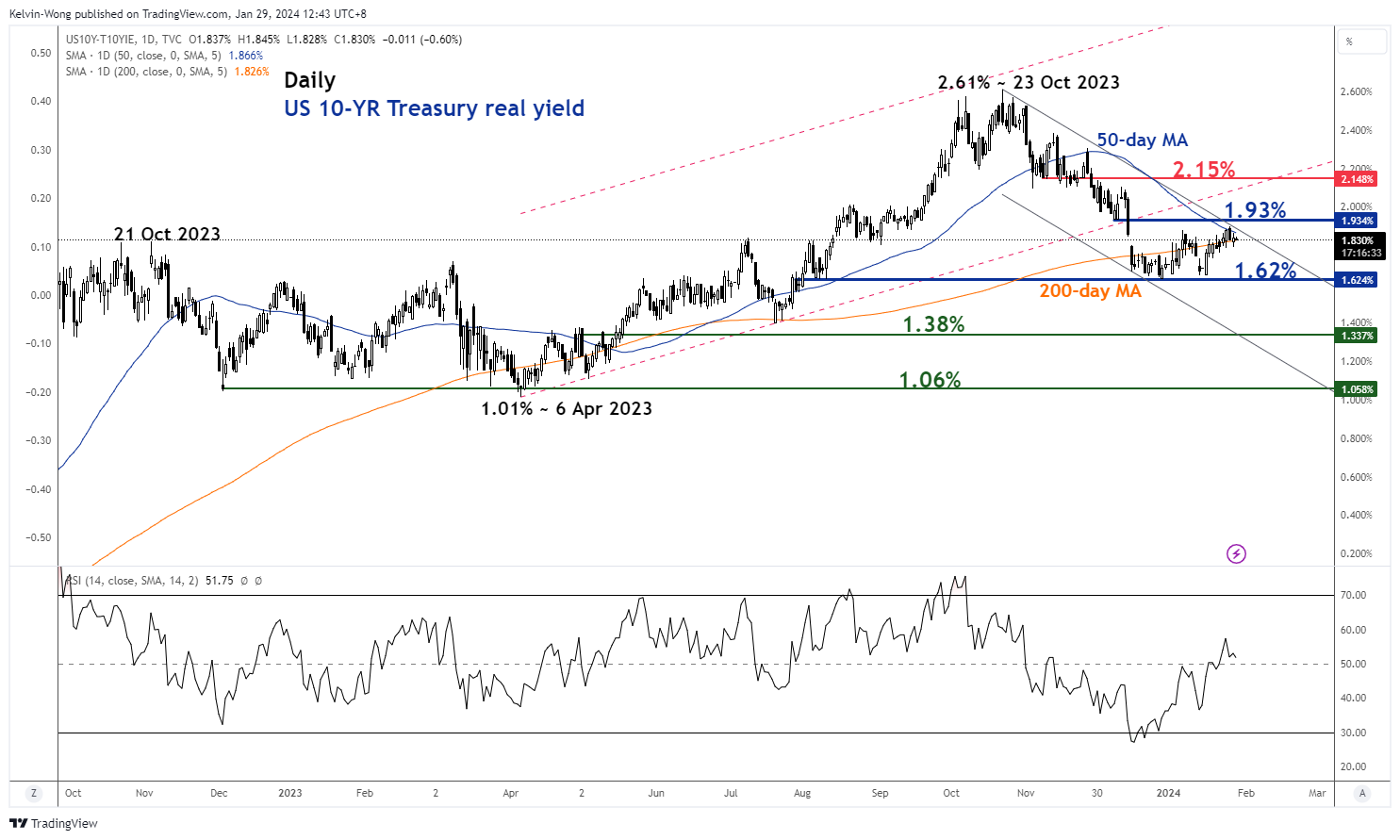
Fig 1: US 10-year Treasury real yield medium-term trend as of 29 Jan 2024 (Source: TradingView, click to enlarge chart)
This reduction in the pricing odds of the first Fed fund rate cut in March has led to an uptick in the US 10-year Treasury real yield which rose by 25 bps to hit almost a 1-month high of 1.90% on last Thursday, 25 January 2023. So far, the rally has been capped by its 50-day moving average which confluences with a near-term range resistance at 1.93%.
A firmer US 10-year Treasury real yield increases the opportunity cost of holding gold which in turn puts a cap on Gold (XAU/USD).
Positive factor – Rising geopolitical risk premium
The ongoing hostilities in the Middle East region and the Red Sea shipping route that are related to the ongoing Israel-Hamas war are showing no clear signs of abating.
Iran-backed militants have attacked and killed US troops stationed in Jordan via a drone assault and hit a fuel tanker in the Red Sea over the weekend marking a further escalation of tensions among the respective stakeholders.
Hence, a support or floor has been created at the US$2,000 psychological level for Gold (XAU/USD).
Impending volatility breakout, coiling up ahead of Fed FOMC
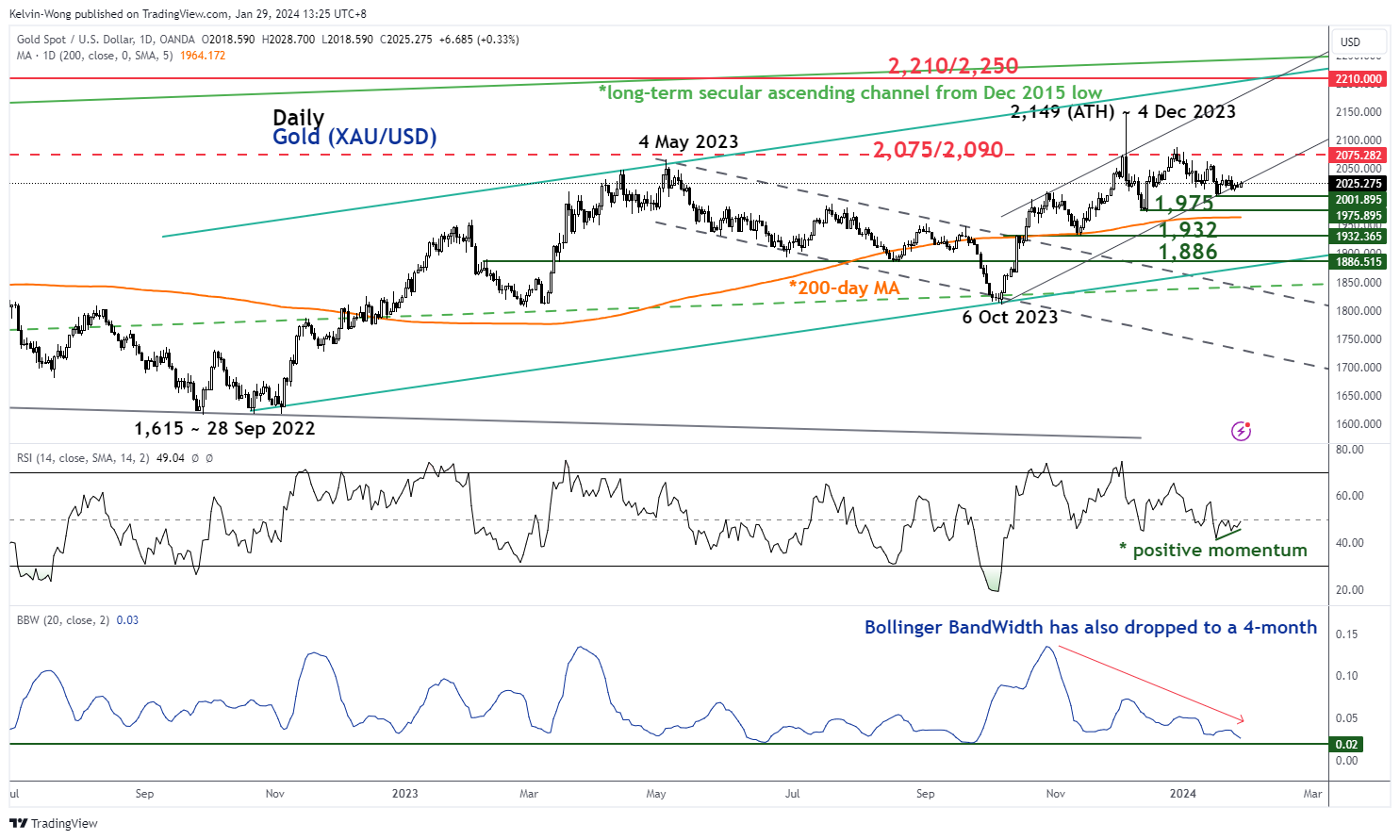
Fig 2: Gold (XAU/USD) medium-term & major trends as of 29 Jan 2024 (Source: TradingView, click to enlarge chart)
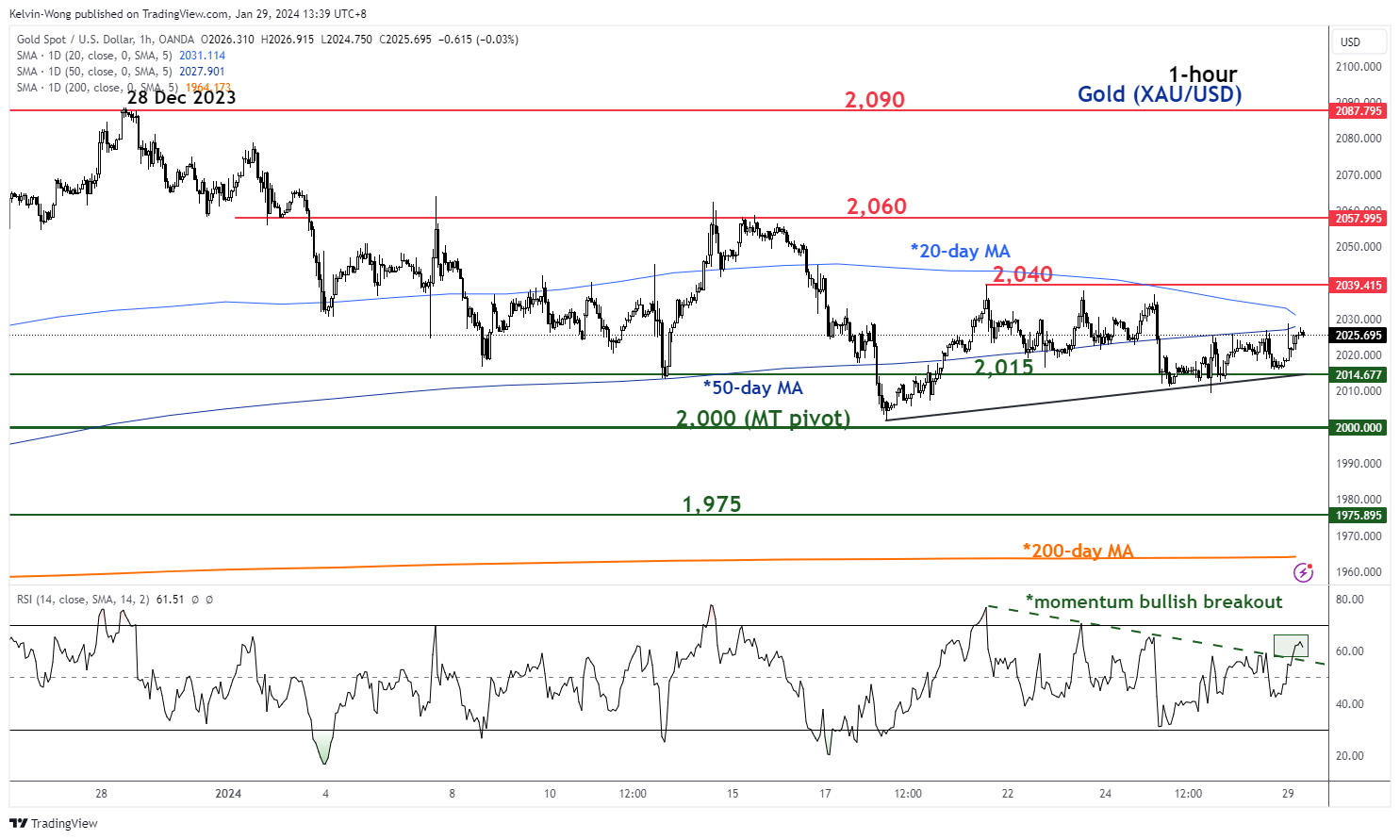
Fig 3: Gold (XAU/USD) minor short-term trend as of 29 Jan 2024 (Source: TradingView, click to enlarge chart)
In the lens of technical analysis, the 20-day rolling historical volatility in Gold (XAU/USD) has dropped to almost a 4-month low since late September 2023 as indicated by the Bollinger BandWidth which suggests that the price actions of Gold (XAU/USD) have compressed into a relatively low volatility environment that is ripe for a volatility breakout scenario.
The direction of the volatility breakout is likely to be reinforced by the Fed’s monetary policy guidance this coming Wednesday, 31 January via its policy statement and Fed Chair Powell’s press conference as the market has already fully priced in a stand pat outcome on its Fed funds rate at 5.25% to 5.50%.
Interestingly, positive momentum seems to be creeping back ahead of this week’s FOMC where the daily RSI momentum indicator has formed a higher low since 17 January 2024 at around the 50 level.
Therefore, there is a potential chance of a bullish volatility breakout scenario for Gold (XAU/USD) as long as US$2,000 key medium-term pivotal support holds and a break above US$2,040 sees the next intermediate resistances coming in at US$2,060 and US$2,090.
On the other hand, failure to hold at US$2,000 invalidates the bullish scenario for an extension of the corrective decline within its major uptrend phase to expose the next intermediate support at US$1,975 (close to the 200-day moving average).
Rising Oil About to Become An Issue
US crude jumped past the $79b level this morning on escalating tensions in the Red Sea. The European and American futures are slightly in the negative at the time of writing, and stocks in Hong Kong and China were better bid on Monday as China imposed ban on short sellers, but the gains remained short-lived after a HK court ordered Evergrande’s liquidation. Globally, we see a limited risk appetite at the start of a week packed with economic data, central bank decisions and corporate earnings.
In Europe
European stocks ended last week on a cheerful sentiment. The dovish European Central Bank (ECB) statement nourished appetite. LVMH jumped 9% on strong quarterly sales, and ASML soared after announcing that its orders tripled – as Chinese rushed in to order chips before the export ban became effective. The EURUSD consolidated in the bearish consolidation zone – below the major 38.2% retracement on its latest rebound, and is testing the 200-DMA to the downside. How far the weakness will continue depends on the US dollar. And the direction the dollar will take will depend on… the Federal Reserve (Fed).
In the US
US stocks traded mixed on Friday but ended last week on a positive note, with the S&P500 near a record, as many good news popped into the headlines throughout the week. The US growth numbers came to enchant investors while inflation numbers looked encouragingly set for further easing: The US economy grew more than 3% last quarter and the Fed’s favorite inflation gauge, the core PCE index fell below 3%.
Resilient growth and lower inflation mean the world to the Fed, a dream come true, the holy grail, the proof that Jay Powell and his team have beaten the economic theory and won over inflation without pushing the US economy into a recession.
And since the Fed signaled that there could be 6 rate cuts this year, which is a fair number of rate cuts to be squeezed into a year for an economy that does - pretty - well, all investors care about is: when will the first cut happen. The probability of a march cut is 50-50, a May cut is priced in at about 90%. The Fed will keep rates unchanged this week, and Powell will likely say the same thing than Lagarde last week: that inflation looks on path toward 2% goal, that soft landing is no longer a daydream and that the Fed will relax rates, but the timing will be data dependent. If that’s the case, the natural response of currency traders could be to sell the dollar.
Overall, note that because the Fed is insistently expected to cut the rates regardless of strong economic figures, the dollar bears resist to upside pressures. But any dovish euphoria is increasingly likely to hit a road bump with oil prices on the rise again.
While everyone expects the dollar to soften moving forward, there are a few scenarios that could lead to a stronger dollar.
1. If inflation numbers make a U-turn and interfere with the Fed’s plan to cut rates, the dollar would see higher demand. Note that among major central banks, the Fed is the one that could delay rate cuts thanks to its strong economic growth.
2. The US dollar could gain if other major economies perform even more poorly than they are expected to - because faltering economies would require faster rate cuts outside the US and lead to a stronger US dollar.
3. An economic shock in the US, or globally, could trigger a rush to the safe haven U.S. dollar and leave the dollar bears on the backfoot.
Elsewhere
The Bank of England (BoE) decision, euro area growth and inflation numbers, Australian inflation update, Canadian GDP and the US jobs numbers will be closely watched.
On the corporate calendar, Microsoft, Alphabet, Apple, AMD, and US big oil companies are among the names that are due to announce their latest earnings this week. A major part of the investor focus will be on Microsoft and its AI announcements. Any positive surprise should keep investors on their cloud.
But note that, overall, 25% of the companies in the S&P500 have reported results for Q4. Of these companies, 69% have reported actual EPS above estimates, yes but that’s below the 5-year average of 77%, according to FactSet.
Fed, Bank of England and Riksbank Policy Meetings This Week
In focus today
The week starts off with the publication of the Swedish preliminary GDP statistics for Q4 and the full GDP development of 2023. Strong GDP indicators in October and November (+1.0% and 0.2%) promise a relatively strong ending of 2023. We also receive data for Swedish retail sales for December. The sentiment in the retail sector is improving and may support Swedish growth.
The main event this week is the FOMC meeting on Wednesday. We expected the Fed to hold policy rates unchanged at this week's meeting but deliver its first interest rate cut of 25bp at the March meeting. Thursday, both the Bank of England and the Swedish Riksbank announce their rate decision, where we expect both to keep policy rates unchanged.
Economic and market news
What happened overnight
Iran backed militants performed a drone attack against a US military base in northeastern Jordan, the White House announced late Sunday. The attack killed three US servicemen. President Joe Biden said that the US will "hold all those responsible to account at a time and in a manner of our choosing." On the back of this, oil futures rose with brent crude rising as much as 1.5% in the early hours of Monday, hitting 84.80 USD/barrel.
A Hong Kong court has ordered China Evergrande to be wound up. The liquidation order came after the developer was not able to come up with a restructuring plan that would satisfy international creditors.
What happened the weekend
In the US, core PCE index rose 2.9% y/y, down from a 3.2% pace in November just slightly below expectations. Real spending remained very strong with November revised higher. On headline level, all the figures were fairly well in line with expectations, and hence the market reaction was muted. That said, they still underscore how US economy remains solid.
In the euro area, monetary aggregate statistics showed that M3 rose 0.1% in December (from -0.9% in November). Importantly, loans to households were 0.3% (down from 0.5% in November) and to non-financial corporations 0.4% (up from 0% in November). The credit growth numbers coupled with the BLS out last week point to the credit impulse having bottomed. In Germany, consumer confidence declined to -29.7 in February (cons: -24.6, prior: -25.1). The past months, consumer confidence has declined in tandem with the service PMIs from Germany, which means we are likely in for another weak quarter or two in Germany before rising real wages, a strong labour market, and a possible rebound in the manufacturing sector should increase private consumption and service sector growth.
In Norway, retail sales dropped 0.9 % m/m in December, as Christmas shopping was worse than signalled by short-term card data, which could be a seasonal adjustment problem. Note that service consumption is currently slowing, so overall consumption will be weak.
In Israel, prime minister Benjamin Netanyahu said that Israel vows to continue the war on Hamas after the UN's International Court of Justice ordered Israel to take steps to safeguard Palestinians.
In the Red Sea the Houthi rebels on Friday hit a British oil carrier transporting products for Trafigura.
In China, restrictions were made to effectively limit shorts selling. Starting from Monday, investors who buy shares will not be allowed to lend them out for short selling within an agreed lock-up period, the Shenzhen and Shanghai stock exchanges said on Sunday. It is seen as an attempt to try to stop the stock sell-out fuelled by uncertainty over China's economic growth prospects.
Equities: Global equities were higher for the seventh consecutive day on Friday. Once again, the reason was the combination of decent inflation data and strong macroeconomic indicators, with the positive data emerging from the US. However, on Friday, defensives outperformed on the sector side, while Europe continued to outperform within the regions. As mentioned last week, this is the peak of earnings season, and some disappointing guidance from US tech companies was the reason behind the US cyclicals' underperformance on Friday. In the US, Dow rose by 0.2%, S&P 500 dropped by 0.1%, Nasdaq declined by 0.4%, and Russell 2000 increased by 0.1%. Asian markets are mostly higher this morning though with China going against the trend. US and European futures are lower.
FI: Global yields started Friday's session 5bp lower than Thursday's close, however by the end of Friday it was broadly unchanged as the enthusiasm of the UST overnight rally faded. The ECB speak on Friday saw a broad consensus and reflected the ECB's guidance on Thursday. This weekend, Villeroy said that ECB will cut the rates this year at that 'the exact date, not one is excluded, and everything will be open at our next meetings.' This will keep markets zooming in on the April meeting as a live meeting, with 22bp priced (cumulative). We currently still like our call for the first cut in June. Markets are pricing 143bp of rate cuts by year end.
FX: USD was in for a whirlwind of a week, as US macro data came in to the strong side, with EUR/USD ending the week around the 1.0850 mark. Last week saw NOK gain on relative rate differentials with the market perception that NB is set to deliver rate cuts among the last central banks and also deliver fewer rate cuts than peers in the coming years. This week focus turns to European inflation data and further central bank meeting from the Fed, Riksbanken and the Bank of England.
GBP/JPY Daily Outlook
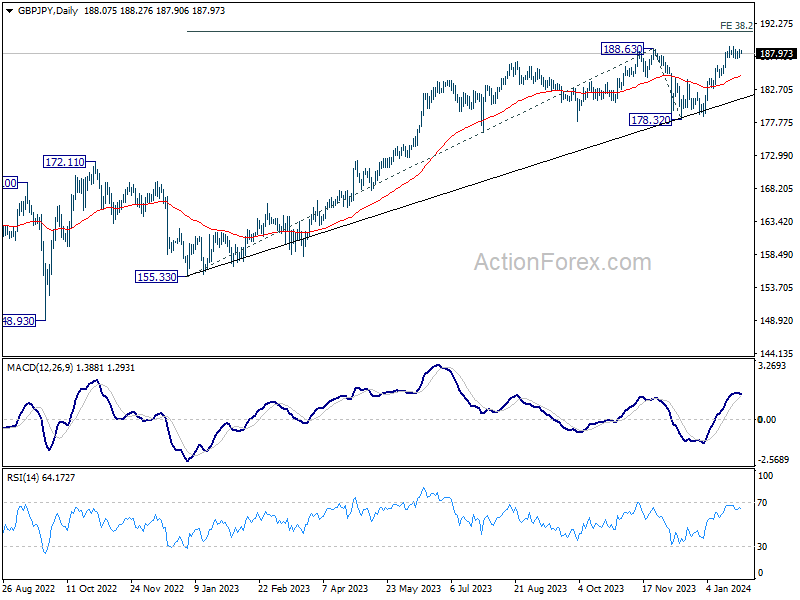
Daily Pivots: (S1) 187.50; (P) 188.04; (R1) 188.73; More...
Intraday bias in GBP/JPY remains neutral at this point. Further rally is expected as long as 186.14 support holds. Break of 188.90, and sustained trading above 188.63, will confirm up trend resumption. Next target is 38.2% projection of 155.33 to 188.63 from 178.32 at 191.04. However, break of 186.14 will turn bias to the downside for deeper pullback.
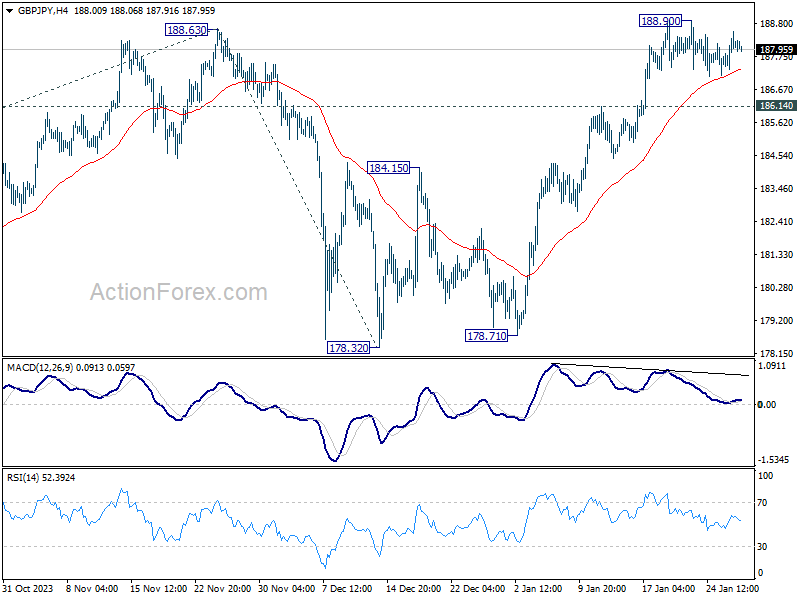
In the bigger picture, up trend from 123.94 (2020 low) in in progress. Medium term outlook will stay bullish as long as 178.32 support holds. Next target is 195.86 long term resistance (2015 high).
EUR/JPY Daily Outlook
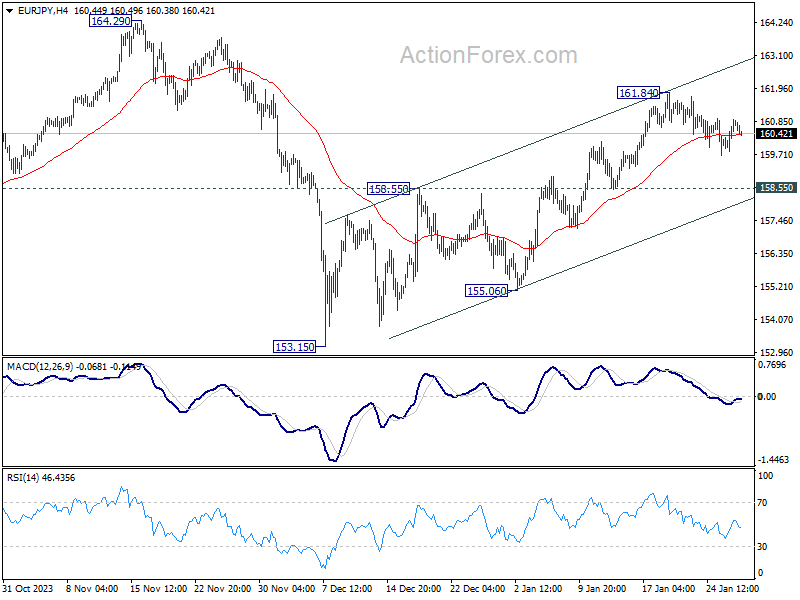
Daily Pivots: (S1) 160.12; (P) 160.52; (R1) 161.22; More...
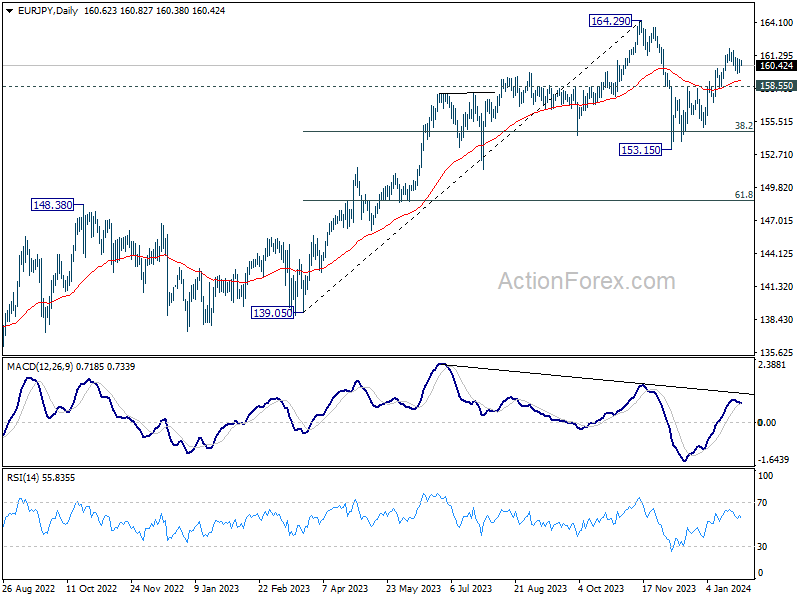
Intraday bias in EUR/JPY remains neutral as consolidation from 161.84 is extending. While another dip cannot be ruled out, further rally is expected as long as 158.55 resistance turned support holds. Break of 161.84 will resume the rebound from 153.15 to retest 164.29 high.
In the bigger picture, price actions from 164.29 medium term top are seen as a correction to rise from 139.05 only. As long as 148.48 resistance turned support holds (2022 high), larger up trend from 114.42 (2020 low) is expected to resume through 164.29 at a later stage.
EUR/GBP Daily Outlook
Daily Pivots: (S1) 0.8531; (P) 0.8540; (R1) 0.8554; More...
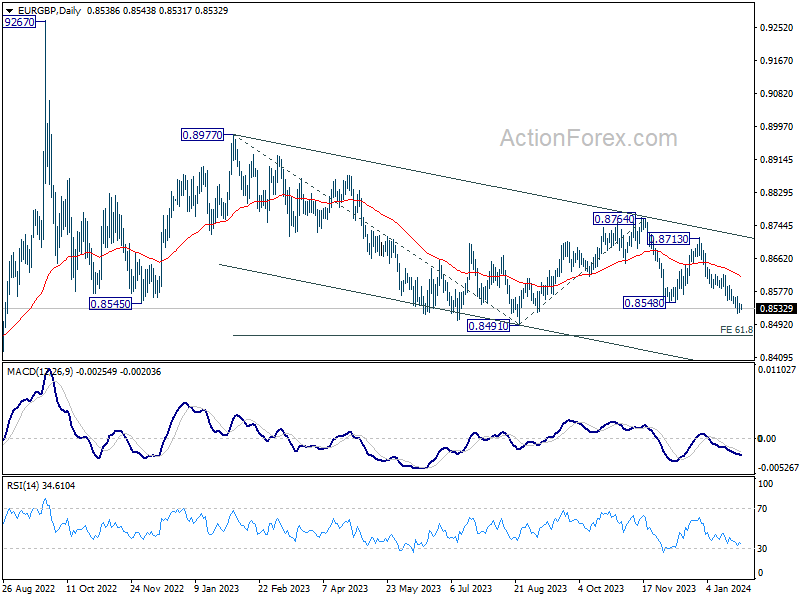
While downside momentum in EUR/GBP isn't too convincing, further decline is still expected with 0.8563 resistance intact. Next target is 0.8491 low and break will resume larger down trend to 0.8464 projection level. On the upside, above 0.8563 minor resistance will turn intraday bias neutral and bring consolidations again.
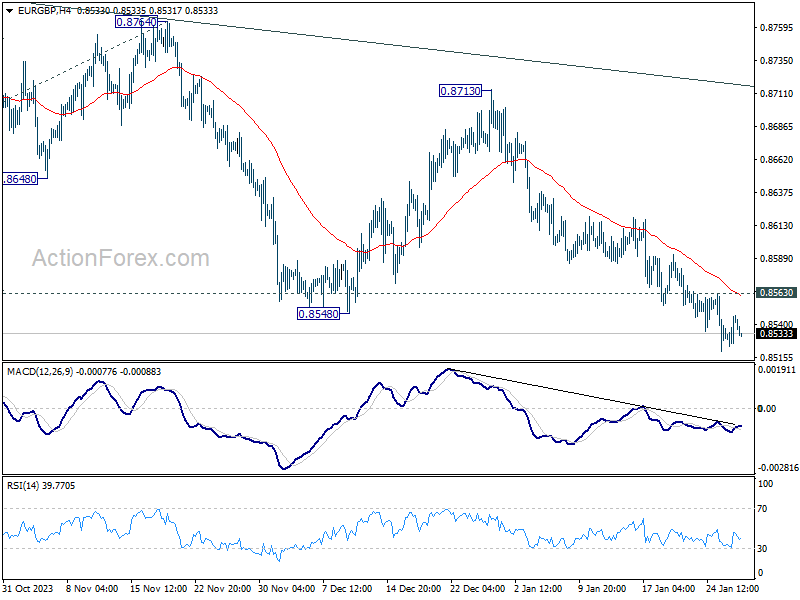
In the bigger picture, fall from 0.8764 is seen as another leg in the whole down trend from 0.9267 (2022 high). Outlook will stay bearish as long as 0.8713 resistance holds. Break of 0.8491 will target 61.8% projection of 0.8977 to 0.8491 from 0.8764 at 0.8464.