Sample Category Title
XAUUSD: Traders Await Breakout
Gold prices, currently near $2,030, saw a modest decrease of 1% over the past week and a 2% dip since the start of 2024. Meanwhile, silver surpassed $22 per ounce, experiencing a 4% drop in the week and a 6.5% decline in the year so far. Upcoming scrutiny of economic data, particularly the Q4 US GDP report on Thursday, will influence metal markets. Projections indicate a 2.4% growth, potentially allowing the Federal Reserve to maintain higher US interest rates amidst economic flexibility.
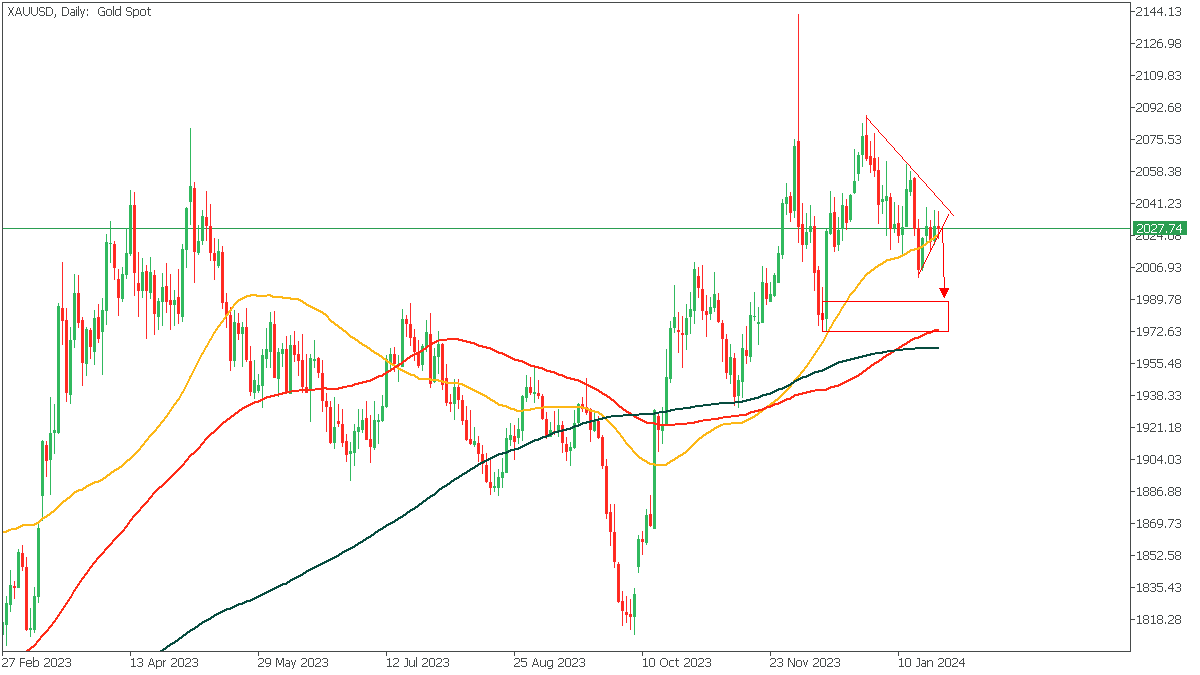
XAUUSD - D1 Timeframe
The overall market structure on the Daily timeframe of XAUUSD appears to be largely bullish, however, since price failed to create a higher high before the onset of the retracement, I think that we may get to see a new lower low being formed. The 100-day moving average is my target.
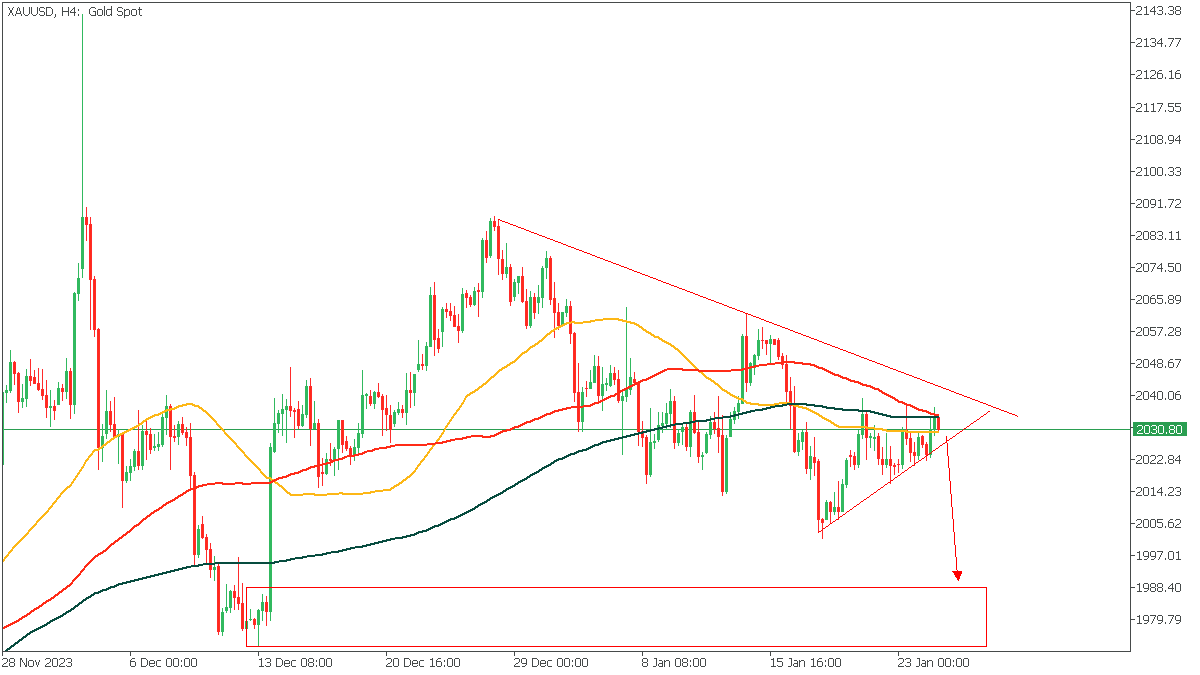
XAUUSD - H4 Timeframe
On the 4-hour timeframe of XAUUSD, price is set to break out of the wedge pattern. I expect price to break out lower since the three moving averages converge together to form a united resistance level whilst maintaining their bearish array. Overall, I will wait for the breakout of the trendline in other to position properly for a short entry.
Analyst’s Expectations:
- Direction: Bearish
- Target: $1997.55
- Invalidation: $2037.14
CONCLUSION
The trading of CFDs comes at a risk. Thus, to succeed, you have to manage risks properly. To avoid costly mistakes while you look to trade these opportunities, be sure to do your due diligence and manage your risk appropriately.
EURUSD Displays Volatility in Advent of First ECB Meeting of 2024
Tomorrow marks a poignant day for those observing the European economy as the European Central Bank is scheduled to hold its first monetary policy meeting of this year.
The European Union's central bank has continued to maintain a conservative approach in recent months, rather similar to that of the Bank of England and the Federal Reserve; however, perhaps it could be suggested that the European Central Bank has been a bit less aggressive with its interest rate rises than those of the United Kingdom and the United States over the past two years.
Tomorrow's meeting is being widely anticipated by financial markets participants as the first European Central Bank meeting in which a pause or potential reduction in interest rates could be announced, along with possible timescales relating to any such reduction if such a move is on the table.
Just one day before the meeting takes place, it is clear that some analysts within investment banks and fund managers are considering that the deposit rate will remain at 4.0% within European Union member states, and the general consensus among market participants to hint toward reductions of approximately 50 basis points in June and more than 125 base points during the course of the latter part of 2024.
In this regard, all ears will be focused on tomorrow's meeting.
In terms of currency price movements in the advent of this important economic policy-related event concerning the second most important major currency in the world, there has been a degree of volatility during the early hours of trading today.
It is not necessarily clear as to what has caused this. However, the US dollar's strong position in the light of the stellar performances of the stocks of some major publicly-listed companies included in prestigious indices is one factor alluding to the favourable position of the US economy overall despite the inflation, high interest rates and bank demises that have made high profile news over the past two years.
Therefore, a good US position rather than a weak European position may be a factor. However, there are some industrial concerns relating to potential supply chain issues due to the geopolitical situation in the Red Sea, which has caused many firms to cancel cargo ship operations transporting items through that major shipping route.
Indicative pricing only
Today, the EURUSD pair began the morning in the European session by trading around the mid-1.08 range, according to the FXOpen price chart, which is quite a difference from the 1.11 mark that the pair traded on December 28. Moving into 2024, the EURUSD has been experiencing an overall downward direction. Therefore, tomorrow's monetary policy meeting may provide further insight and clarity on the euro's medium-term position.
This article represents the opinion of the Companies operating under the FXOpen brand only. It is not to be construed as an offer, solicitation, or recommendation with respect to products and services provided by the Companies operating under the FXOpen brand, nor is it to be considered financial advice.
GBPCHF Wave Analysis
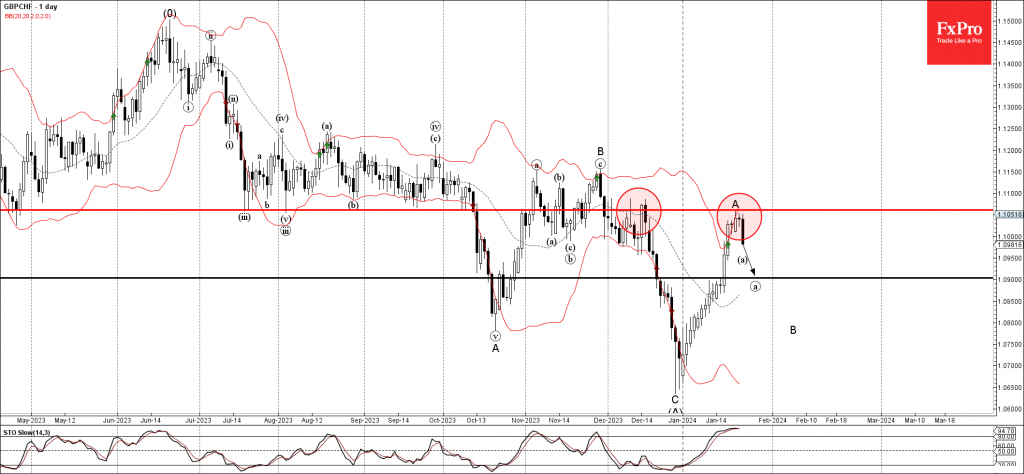
- GBPCHF falling inside minor impulse wave a
- Likely to fall to support level 1.0900
GBPCHF continues to fall inside the minor impulse wave a of the B-wave which started earlier from the key resistance level 1.1060 (which reversed the pair multiple times in December).
The resistance level 1.1060 was further strengthened by the upper daily Bollinger Band.
Given the strength of the active downtrend and the overbought daily Stochastic, GBPCHF currency pair can be expected to fall further to the next support level 1.0900 (target for the completion of the active wave a).
Silver Wave Analysis
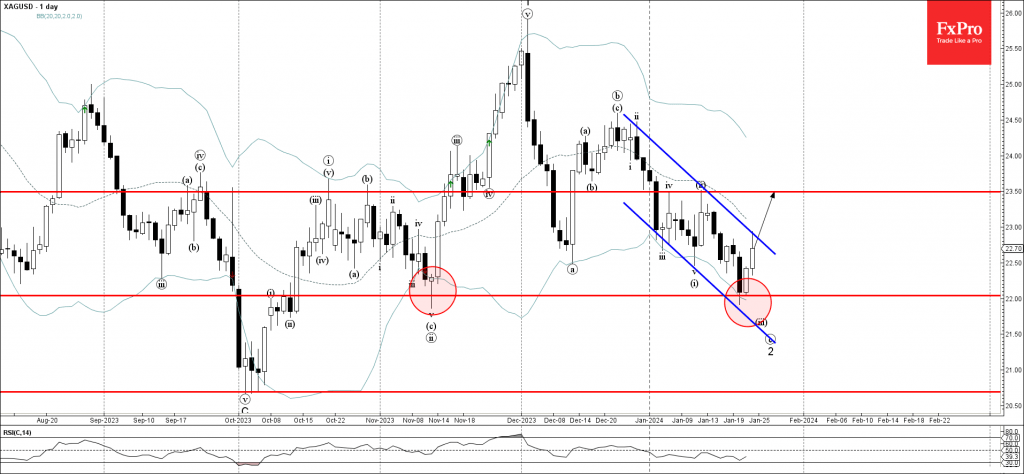
- Silver reversed from support level 22.00
- Likely to rise to resistance level 23.500
Silver recently reversed up from the key support level 22.00 (which reversed the daily Morning Star in November as can be seen below).
The support level 22.00 was strengthened by the lower daily Bollinger Band and by the support trendline of the daily down channel from December.
Silver can be expected to rise further to the next resistance level 23.500 (top of the previous correction is and ii).
Can Rate Cuts and Geopolitics Propel Gold to Fresh Record Highs?
- Gold’s uptrend hits a snag; 2024 characterized by consolidation phase
- But ingredients for a rally are still there
- Geopolitical risks and Fed rate cuts hold key to rekindling the bulls
Scaling new heights as world goes from crisis to crisis
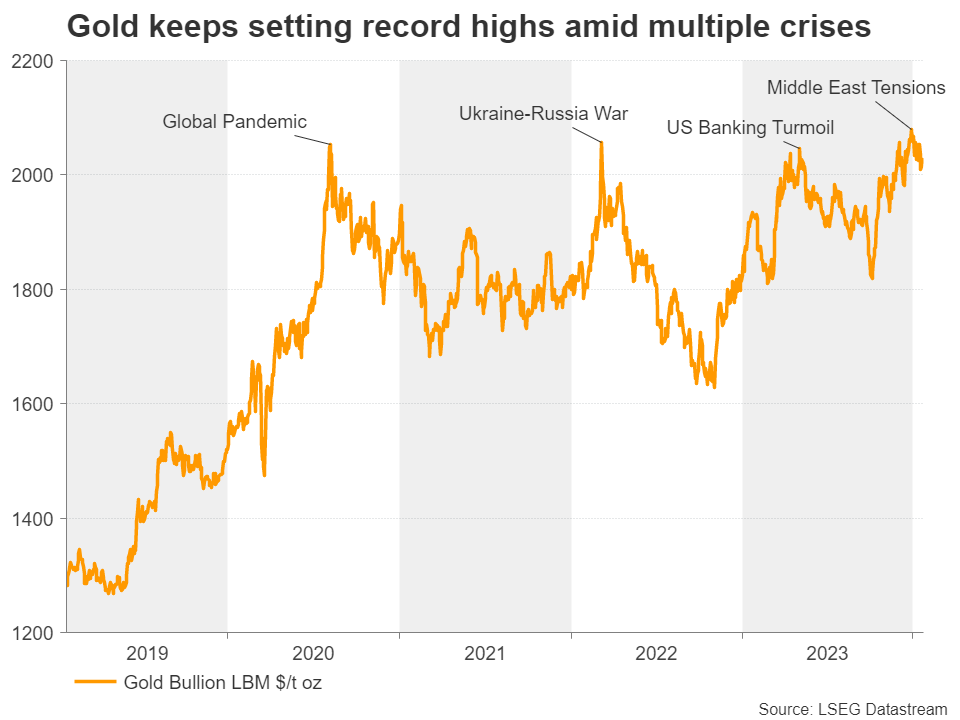
Since 2020, the world has been stumbling from one crisis onto another, creating the perfect ground for a massive rally in gold prices. From the Covid pandemic in 2020, to the Russia-Ukraine war in 2022, to the mini-banking crisis in the US in 2023, there’s been no shortage of turmoil over the past few years to boost demand for the world’s traditional safe haven.
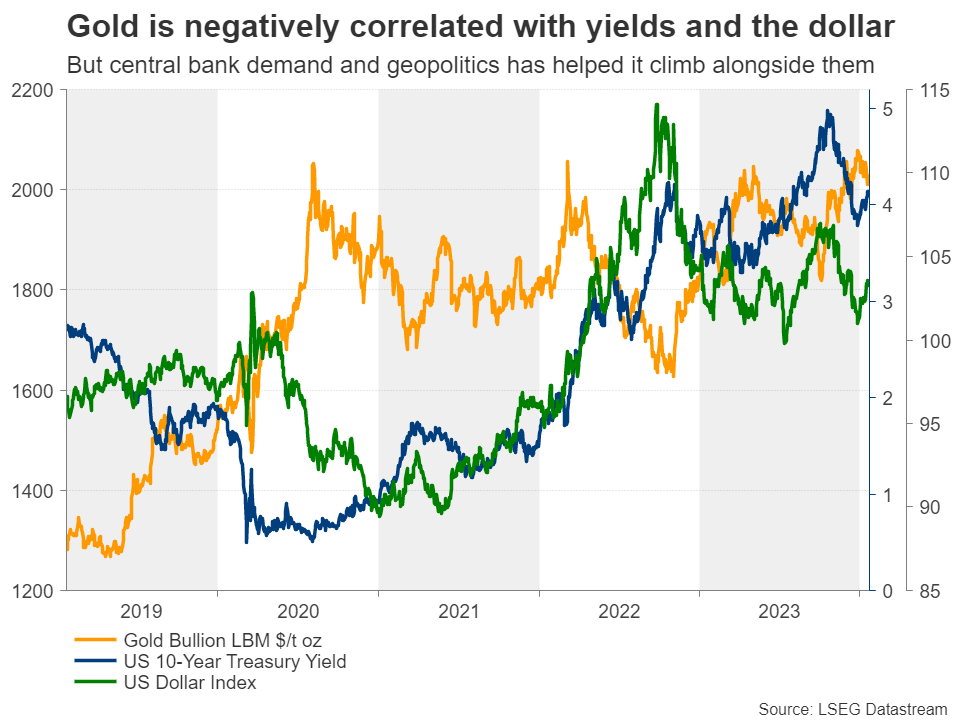
Gold is the world’s oldest store of value as well as one of the safest assets to own, which is why investors rush to gold whenever financial markets are overrun by uncertainty. However, aside from geopolitical events and panic in financial markets, gold also has a long-established relationship with government bonds and the US dollar. Both are also considered to be safe havens so are in direct competition with gold.
Are gold and yields still inversely related?
When bond yields rise, this makes investing in government bonds more attractive, and thus, negatively impacting the price of gold. But rising yields, specifically US Treasury yields, can be a double whammy for the precious metal because not only does gold lose out due to its a non-yielding attribute, but higher bond yields also increase the attractiveness of the US dollar.
As gold is priced in US dollars, it becomes more expensive for non-US investors whenever the greenback appreciates, which is why gold has such a strong negative correlation with the currency.
Whilst these relationships have always been the primary drivers for gold, they’ve become more prominent than ever now that geopolitical risks and interest rate speculation are both so elevated. After all, it is not often that gold climbs to record highs at the same time as US yields are rallying to multi-year peaks.
The geopolitical risk premium
When gold first soared above $2,000/oz in the aftermath of the pandemic in 2020, interest rates and yields were at rock bottom as central banks around the world were engaged in money printing. In the last rally when bullion hit a new all-time high of $2,135.40, borrowing costs had surged by around 500 basis points during this period, completely disobeying the negative correlation rule between the two.
This goes to show the scale at which the geopolitical risk premium has risen amid multiple hotspots around the world that could erupt at any moment. However, there is an additional element that’s also been lifting gold prices lately.
Soaring demand by central banks
Central banks have been purchasing gold in record amounts over the last few years - a trend that’s been primarily driven by China and is motivated by the desire to reduce reliance on the US dollar.
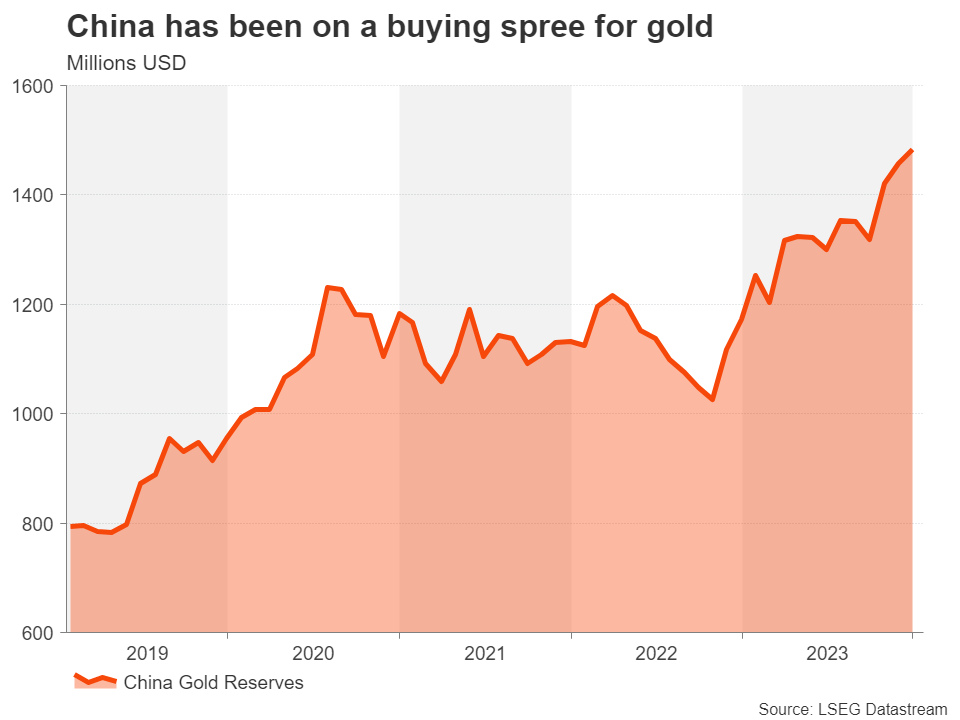
Both geopolitics and the ‘de-dollarization’ trend are expected to remain major contributors of demand in 2024, supporting the bulls’ side of the story. But the bears may not be so fortunate this year as central banks like the Fed are highly anticipated to embark on a rate-cutting cycle within the next few months, potentially leading to a substantial pullback in yields and a weaker dollar.
How risky is the inflation bet?
So does this mean that it is only a win-win scenario for gold? Not necessarily. Although there can be no disputing that the bullish case for the yellow metal is quite strong at the moment, there are risks attached to the dovish outlook for the Fed.
Neither the rhetoric from Fed officials nor the economic data support the argument for hefty rate cuts in 2024. Whilst a recession cannot be totally ruled out, all the evidence indicates a soft landing for the US economy, diminishing the need for a large reduction in borrowing costs. Those pointing to the drop in inflation as the main reason why the Fed will slash rates are right, but only to an extent.
Fed vs the markets
As long as growth stays positive and the labour market remains tight, the Fed will have limited scope to cut rates as looser policy under such conditions can easily overstimulate the economy. Markets have already scaled back some of their dovish bets for the Fed but still anticipate at least five 25-bps rate cuts versus the three projected by FOMC members. Subsequently, Treasury yields have reversed some of their decline, with the halt in the slide of oil prices underpinning the rebound.
With central bank easing fully priced in and the possibility of more dialling back of expectations, the prospect of gold receiving a further boost from lower yields and a weaker dollar doesn’t look particularly great as things stand now. What could change this picture, however, is a deterioration in the labour market.
Is the US outlook too rosy?
So far, despite the surge in layoffs in 2023, there’s been no notable jump in unemployment. But there is a danger that businesses will step up layoffs this year to safeguard their profit margins in a low growth environment. Senior Fed policymakers have already signalled that with inflation falling, the focus in 2024 will likely shift to the central bank’s employment mandate.
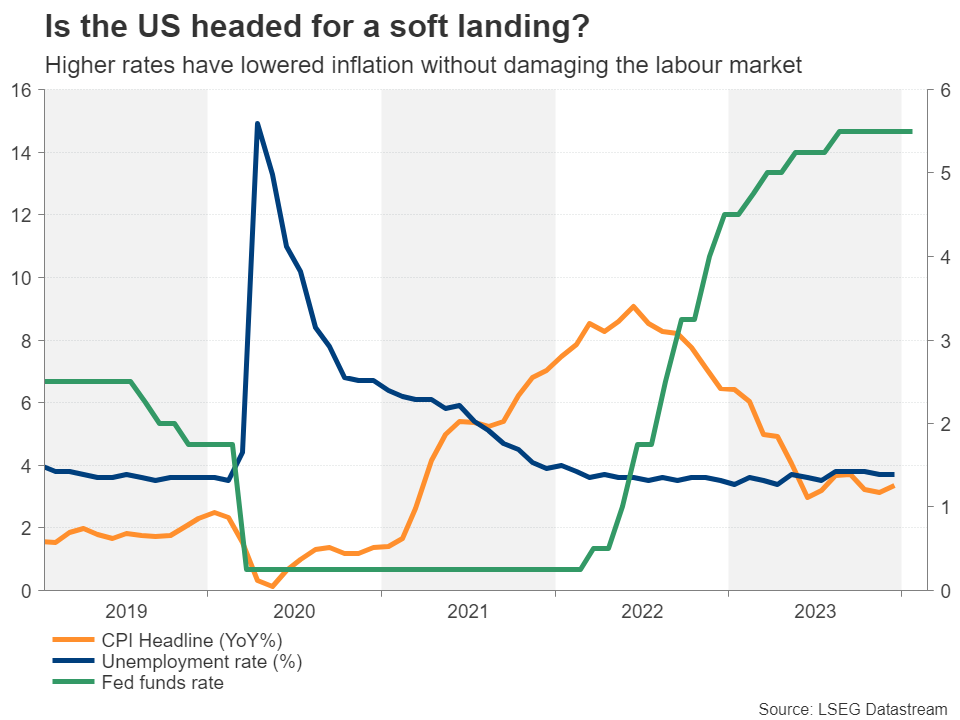
But there’s the possibility that inflation even surprises to the upside, especially following the latest developments in the Middle East. The threat of a major flare-up has risen following the attacks on Red Sea shipping by Houthi rebels in Yemen as well as the recent cross-border missile strikes by both Israel and Iran.
No let-up in geopolitical frictions
An escalation would not only push up energy prices, but additionally create a permanent pause in Red Sea journeys, sparking a broader supply chain shock for the global economy. This would have a two-way effect on gold prices as higher inflation would boost interest rates, while heightened tensions would increase safe-haven demand for gold.
Another positive risk for gold is the dollar side of the equation acting independently of bond yields. This could occur in a scenario where the outlook for the major economies improves, bolstering currencies like the euro and yen, lessening the appeal for the greenback.
In a nutshell, there seem to be an equal number of factors that can go right as well as wrong for gold in 2024, with a Fed repricing being the biggest downside risk and a new geopolitical crisis being the largest upside risk. The thing to note here is that investors are probably less prepared for the former than the latter, but nevertheless, there has been some caution brewing in the market lately.
Gold appears to be in wait-and-see mode
Gold prices have been consolidating after spiking to a record high in December. There seems to be ample support around the 50-day moving average (MA) for the time being but should this support weaken and the focus shifts to the $2,000 mark, it will then be up to the 200-day MA to defend gold’s bullish structure.
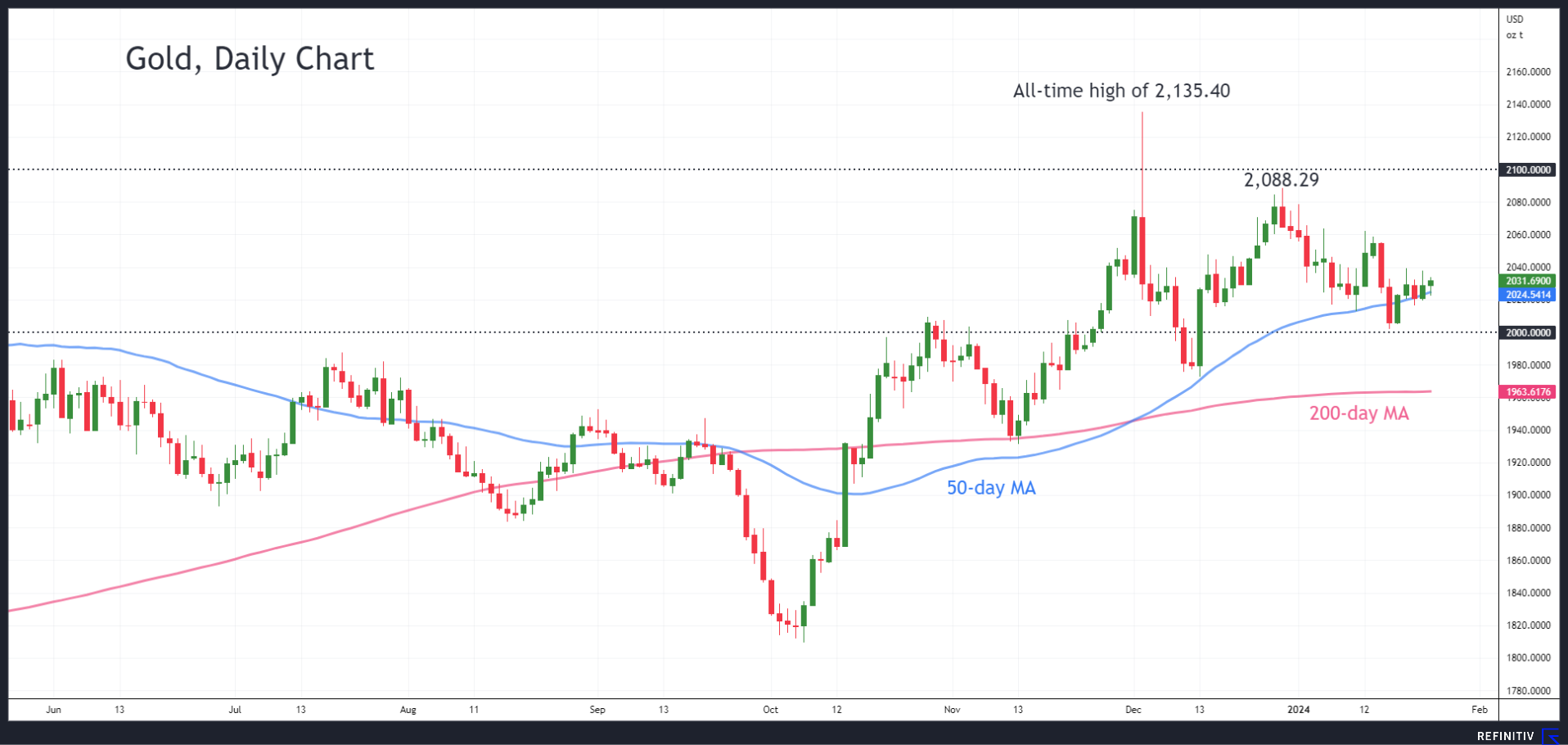
If the bulls successfully hold onto to the 50-day MA, a revisit of the all-time peak of $2,135.40 could be on the cards, although there may be a battle between the late December high of $2,088.29 and the $2,100 level to get there.
Either way, a fresh attempt into uncharted territory is probably sometime away as investors will want to tread carefully until the Fed has laid out a clearer path for interest rates, something that is unlikely to happen before the spring.
EUR/USD Outlook: Rises to One-Week Gigh on Renewed Risk Appetite
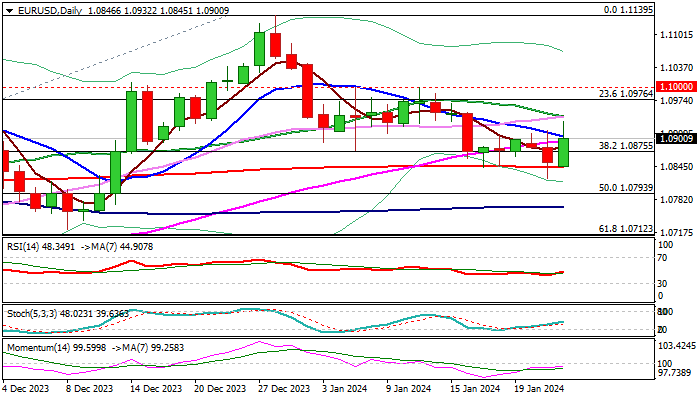
Fresh bulls emerged after top of rising daily cloud and 200DMA (1.0851/43) contained dips for the fourth consecutive day, leaving a higher base at this zone and generating an initial signal that pullback from 1.1139 (Dec 28 peak) has bottomed.
Renewed strength requires sustained break above 1.0943 pivot (20DMA/Fibo 38.2% of 1.1139/1.0821) to sideline downside risk and open way for attack at key 1.10 resistance zone (Jan 11 lower top/psychological.
Also, repeated weekly close above cracked Fibo support at 1.0875 (Fibo 38.2% retracement of 1.0448/1.1139) would add to the upside prospects.
Only violation of 200DMA/cloud top, would negate and shift near-term focus to the downside.
Res: 1.0943; 1.0967; 1.0980; 1.1000.
Sup: 1.0875; 1.0843; 1.0821; 1.0793.
Bank of Canada Holds Steady, Recognizing that Shelter Inflation is the Issue
- The Bank of Canada maintained the overnight rate at 5.0%, while stating that it will continue with quantitative tightening (QT).
- The Bank highlighted the slowing in economic momentum stating, "the economy has stalled since the middle of 2023 and growth will likely remain close to zero through the first quarter of 2024". The Bank also noted that the labour market has cooled, "with job vacancies returning to near pre-pandemic levels and new jobs being created at a slower rate than population growth."
- On the inflation outlook, it "expects inflation to remain close to 3% during the first half of this year before gradually easing, returning to the 2% target in 2025." It highlighted that "while the slowdown in demand is reducing price pressures in a broader number of CPI components and corporate pricing behaviour continues to normalize, core measures of inflation are not showing sustained declines."
- On the future path of policy, the Bank is still concerned about the "persistence in underlying inflation (and the) Governing Council wants to see further and sustained easing in core inflation."
Key Implications
- The Bank of Canada held the line today, but is starting to shift its tone in stronger acknowledgement of the problematic forces of shelter costs. Since the spring, BoC rhetoric has focused on the clear signs of weakness within the economy and this was feeling long in the tooth, now complemented by the dichotomy occurring between shelter costs and the opposing price dynamics elsewhere in the economy. What we know is that Canadians have cut spending over the last year (on a per person basis) as high rates have tightened consumers’ purse strings. Normally this would cause inflation to decelerate quickly, but structural imbalances in the real estate sector are keeping the BoC’s preferred inflation gauges elevated. Importantly, this factor was a big focus of today's policy statement and had its own section in the MPR – an issue we called out in our early-January report.
- While the Bank isn’t yet ready to signal a change in policy, markets are taking the lead. Odds are pointing to the first rate cut happening in April/June. We echo this sentiment. The BoC’s tight policy has caused the economy to flatline since last summer, which has quickly pushed the job market back into balance. Even the BoC's quantitative tightening policy looks to have potentially gone too far with market overnight rates continuing to drift from the Bank's target rate. With this alongside the realization that the BoC can't set policy just based on elevated shelter inflation, it is clear that the central bank is getting ready to signal a rate cut in the coming months.
Sunset Market Commentary
Markets
European January PMI surveys failed to really inspire trading. A disappointing outcome for the French services PMI – releases ahead of German and aggregate EMU data – caused a spike higher in German Bunds, but lack of follow-through buying rapidly pulled German bonds back to opening levels. The EMU composite PMI improved marginally from 47.6 to 47.9, broadly in line with expectations (48). A sectoral breakdown showed a less dire situation in the export-oriented manufacturing sector (46.4 from 44.4 vs 44.7 forecast) while the malaise in the domestic services sector again became a little worse (48.4 from 48.8 vs 49 forecast). The composite PMI points to (mild) recession since June 2023 though this month’s figure is the best since July 2023, suggesting a bottoming out process. The manufacturing PMI recorded the best level since March 2023, but remains sub-50 for an 18th consecutive month now. The services PMI is going nowhere (47.8-48.8 range) for 6 months now. Details strengthened the feeling of a moderating downturn at the start of the new year, but price pressures intensified. The overall contraction of new orders was the smallest recorded since last June, helping stabilise employment levels and lift business optimism about the year ahead to an eight-month high. Companies still relied on backlogs of work to help sustain current operating levels though. Disruptions to shipping in the Red Sea caused supply chains to lengthen for the first time in a year, but manufacturing input costs still fell on average. Service sector cost growth accelerated in January, contributing to the steepest overall rise in prices charged for goods and services since last May. The latter sharply contrasts with markets pricing aggressive rate cuts by the ECB; a view which we expect to be shared by ECB President Lagarde at tomorrow’s press conference. Daily changes on the German yield curve range between -3.5 bps and -4 bps across the curve. US Treasury yields slip slightly more (up to 5 bps). EUR/USD advances (1.0930), but that’s mainly because of the bullish sentiment on stock markets. European bourses arise by up to 2% for EuroStoxx50 with US gauges opening up to 0.75% higher. Chinese stimulus (see below) and strong Q4 corporate earnings are at play. Sterling attacked EUR/GBP 0.8550 support on Gilt underperformance, but the move failed. UK PMI’s showed the recovery in private sector output gaining momentum, but the Red Sea crisis hit manufacturing supply chains and pushed up input costs. The latter adds to evidence (together with sticky inflation) that the BoE isn’t in the position to even start contemplating rate cuts yet. US PMI’s – just released – beat consensus, boosting the goldilocks feeling. Output grew at the fastest pace for seven months while prices charged rose at the slowest rate since May 2020. US Treasuries and EUR/USD lose some ground in a first reaction.
News & Views
Chinese assets roar today. Bourses ended between 1.25-1.8% higher in China and even added 3.50% in Hong Kong. USD/CNY eases to 7.15 compared to 7.20 two days ago. The rally follows a Bloomberg report that Chinese authorities are considering the creation of a state-baked stabilization fund to prop up a slumping stock market. Policymakers are seeking to mobilize some CNY 2tn, or $278bn. That news was followed by additional monetary easing. PBOC governor Pan this morning said the central bank will cut the reserve requirement ratio for banks within two weeks while hinting at more support to come. The cut would amount to 50 bps, unleashing about CNY 1tn of extra liquidity in the market. Both the size as well as the fact that Pan pre-announced the rate cut is very unusual and suggests there’s a growing sense of urgency with policymakers to help the economy and property market to stabilize as well as to stem the market rout. Because even as Chinese assets bounce back today, the likes of the CSI 300 index are still down 45% from the post-pandemic high while the yuan is trading less than 3% above a 15y low.
January bond sales hit a new record in Europe today. Total sales already grew to €300bn. Apart from corporations, the huge offering is concentrated in the SSA debt segment. The likes of Italy and Spain each raised €15bn in their first syndicated sale of the year. Belgium already amassed a lofty €7bn two weeks ago while the EU just yesterday tapped €8bn. January is typically a busy month but this time additional factors are at play. Borrowers across the spectrum seek to profit from big investor demand who want to lock in higher rates now before major central banks starts cutting rates. The end-2023 yield correction is providing countries and companies alike an excellent moment to enter the market. Borrowers are also trying to get ahead of (geo)political events, including US presidential elections.
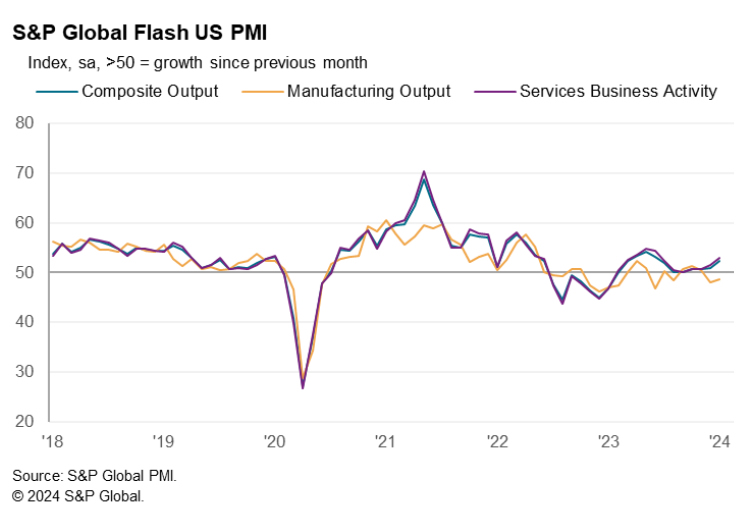
US PMI composite rises to 52.3, marked growth acceleration and sharp inflation cooling
US PMI Manufacturing rises from 47.9 to 50.3 in January, back in expansion, and the highest level in 15 months. PMI Services rose from 51.4 to 52.9, a 7-month high. PMI Composite rose from 50.9 to 52.3, a 7-month high.
Chris Williamson, Chief Business Economist at S&P Global Market Intelligence, highlights this as an "encouraging start" to the year, with companies reporting "marked acceleration of growth" alongside "sharp cooling of inflation pressures".
Growth momentum has notably intensified, driven by improved demand conditions and steady increase in new orders over the past three months, which has in turn enhanced business confidence to its most optimistic level since May 2022.
Furthermore, there's an air of optimism regarding lower inflation in 2024, anticipated to ease the cost of living pressures and potentially pave the way for lower interest rates.
Notably, the rate of price increases has slowed to its lowest since the early pandemic lockdowns of 2020. Companies report that the current pace of selling price inflation has fallen to "below the pre-pandemic average," aligning with projections of consumer price inflation descending below Fed's 2% target.