

Sample Category Title
BoC hold rates steady, still concerned about risks to inflation outlook
BoC kept overnight rate unchanged at 5.00% as widely expected. In the accompanying statement, BoC expressed that it's "still concerned about risks to the outlook for inflation", in particular the "persistence in underlying inflation". The central bank's focus remains squarely on the equilibrium between demand and supply within the economy, closely monitoring inflation expectations, wage growth, and corporate pricing behaviors.
BoC's assessment of the economy suggests a phase of stagnation, projecting growth to "likely remain close to zero" through Q1. However, gradual strengthening in growth is anticipated around mid-year, predicated on the expectations of pickup in household spending and boost in exports and business investment, spurred by a recovery in foreign demand. Government spending is also expected to play a significant role.
For 2024, BoC forecasts GDP growth at 0.8%, a figure that aligns with its October projection. Looking further ahead, the bank anticipates a more robust growth rate of 2.4% in 2025.
Inflation, a critical concern for the BoC, ended the year at 3.4%. Shelter costs continue to be a significant factor in driving inflation above the target. The central bank's projections indicate that inflation will hover around 3% during the first half of the year, with expectations of a gradual decline, ultimately returning to the 2% target by 2025.
(BOC) Bank of Canada maintains policy rate, continues quantitative tightening
The Bank of Canada today held its target for the overnight rate at 5%, with the Bank Rate at 5¼% and the deposit rate at 5%. The Bank is continuing its policy of quantitative tightening.
Global economic growth continues to slow, with inflation easing gradually across most economies. While growth in the United States has been stronger than expected, it is anticipated to slow in 2024, with weakening consumer spending and business investment. In the euro area, the economy looks to be in a mild contraction. In China, low consumer confidence and policy uncertainty will likely restrain activity. Meanwhile, oil prices are about $10 per barrel lower than was assumed in the October Monetary Policy Report (MPR). Financial conditions have eased, largely reversing the tightening that occurred last autumn.
The Bank now forecasts global GDP growth of 2½% in 2024 and 2¾% in 2025, following 2023's 3% pace. With softer growth this year, inflation rates in most advanced economies are expected to come down slowly, reaching central bank targets in 2025.
In Canada, the economy has stalled since the middle of 2023 and growth will likely remain close to zero through the first quarter of 2024. Consumers have pulled back their spending in response to higher prices and interest rates, and business investment has contracted. With weak growth, supply has caught up with demand and the economy now looks to be operating in modest excess supply. Labour market conditions have eased, with job vacancies returning to near pre-pandemic levels and new jobs being created at a slower rate than population growth. However, wages are still rising around 4% to 5%.
Economic growth is expected to strengthen gradually around the middle of 2024. In the second half of 2024, household spending will likely pick up and exports and business investment should get a boost from recovering foreign demand. Spending by governments contributes materially to growth through the year. Overall, the Bank forecasts GDP growth of 0.8% in 2024 and 2.4% in 2025, roughly unchanged from its October projection.
CPI inflation ended the year at 3.4%. Shelter costs remain the biggest contributor to above-target inflation. The Bank expects inflation to remain close to 3% during the first half of this year before gradually easing, returning to the 2% target in 2025. While the slowdown in demand is reducing price pressures in a broader number of CPI components and corporate pricing behaviour continues to normalize, core measures of inflation are not showing sustained declines.
Given the outlook, Governing Council decided to hold the policy rate at 5% and to continue to normalize the Bank's balance sheet. The Council is still concerned about risks to the outlook for inflation, particularly the persistence in underlying inflation. Governing Council wants to see further and sustained easing in core inflation and continues to focus on the balance between demand and supply in the economy, inflation expectations, wage growth, and corporate pricing behaviour. The Bank remains resolute in its commitment to restoring price stability for Canadians.
Information note
The next scheduled date for announcing the overnight rate target is March 6, 2024. The Bank will publish its next full outlook for the economy and inflation, including risks to the projection, in the MPR on April 10, 2024.
EUR/USD – Rallies Despite Continued Weakness in Eurozone PMIs
- Eurozone data remains recessionary
- EURUSD rebounds after surveys
- Is it just a corrective rally?
The data from the eurozone isn’t improving early in the new year, with the latest PMI surveys all remaining firmly in contraction territory.
While we’re continuing to see improvements in the manufacturing survey, that comes from a very low base and still some way from the 50 threshold that separates growth from contraction. And it doesn’t appear on course to breach that threshold any time soon.
The services sector is arguably more problematic as it’s a far more important segment of the economy and it’s showing little sign of recovering. This may aid the case for the ECB to consider cutting rates in the coming months if demand remains soft and the economy is either in or on the brink of recession but we’ll need to see more evidence of that over the next six weeks to make March a live prospect. Assuming, of course, inflation doesn’t enable that all on its own.
EURUSD rebounds after brief divergence
Despite this morning’s data, the euro is rallying against the dollar today but is there more to come?
EURUSD Daily
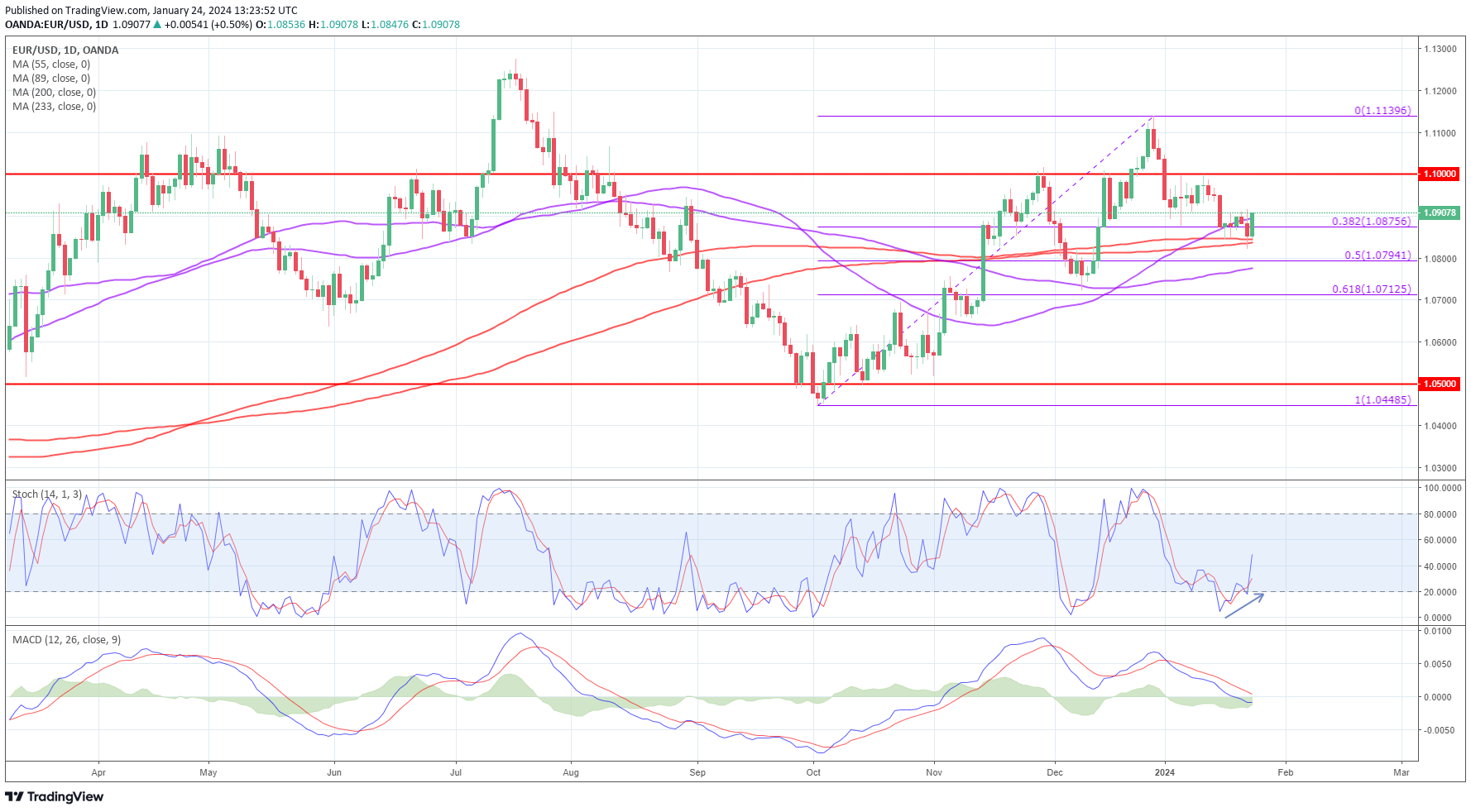
Source – OANDA
Before today’s move, the pair had been falling in the opening weeks of the year but in recent days, momentum had been waning. That was evident in the stochastic which clearly made higher lows on the most recent descent in price. But it’s clearer again on the 4-hour chart below on both the stochastic and MACD.
EURUSD 4-Hour
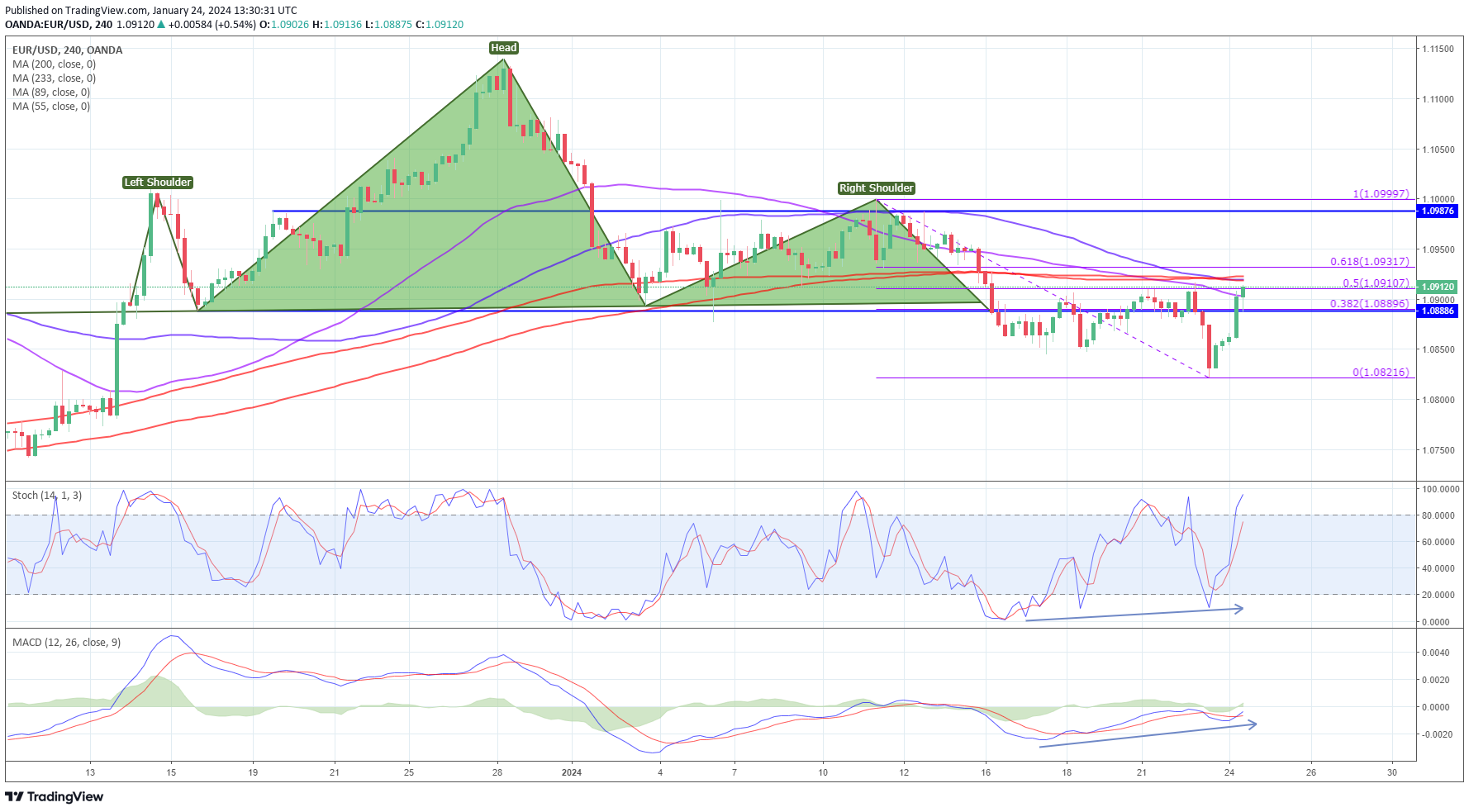
What’s also clear though is that we’ve only seen a small decline since the break of the head and shoulders neckline a week ago. So either this rally is corrective, something Fib levels could help identify, or something has fundamentally changed in that time.
USD/CHF Mid-Day Outlook
Daily Pivots: (S1) 0.8659; (P) 0.8694; (R1) 0.8737; More....
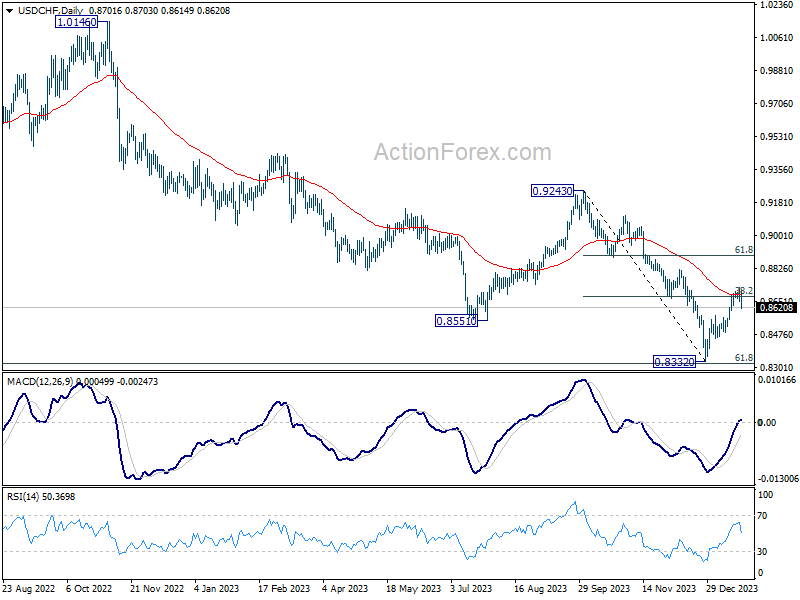
USD/CHF's break of 0.8632 minor support suggests initial rejection by 38.2% retracement of 0.9243 to 0.8332 at 0.8680 and 55 D EMA (now at 0.8686). Intraday bias is back on the downside for 0.8487 support. On the upside, though, break of 0.8727, and sustained trading above 0.8680 will turn near term outlook bullish for 61.8% retracement 0.8995.
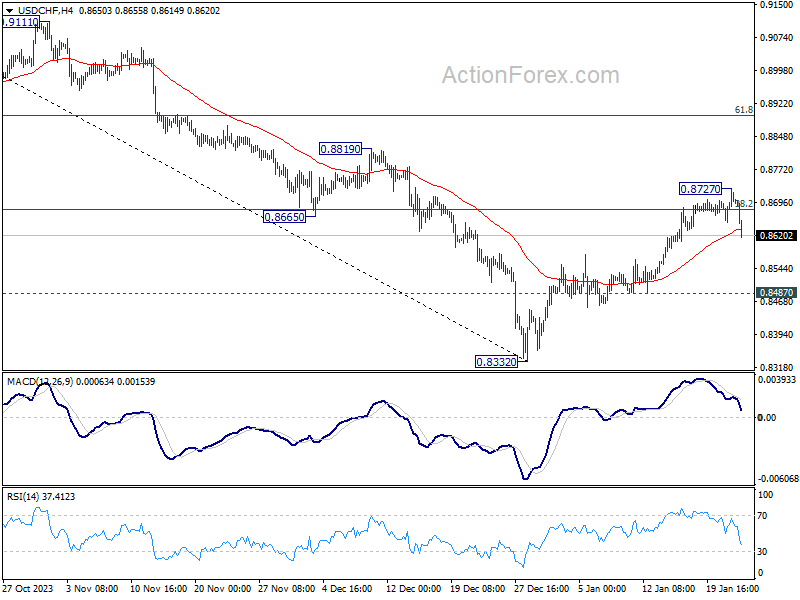
In the bigger picture, while rebound from 0.8332 could be strong, there is no clear sign of medium term bottoming yet. This rebound is tentatively seen as a corrective move for now. Also, outlook will stay bearish as long as 0.9243 resistance holds. Larger down trend from 1.0146 (2022 high) should resume through 0.8332 low at a later stage.
USD/JPY Mid-Day Outlook
Daily Pivots: (S1) 147.34; (P) 148.02; (R1) 149.05; More...
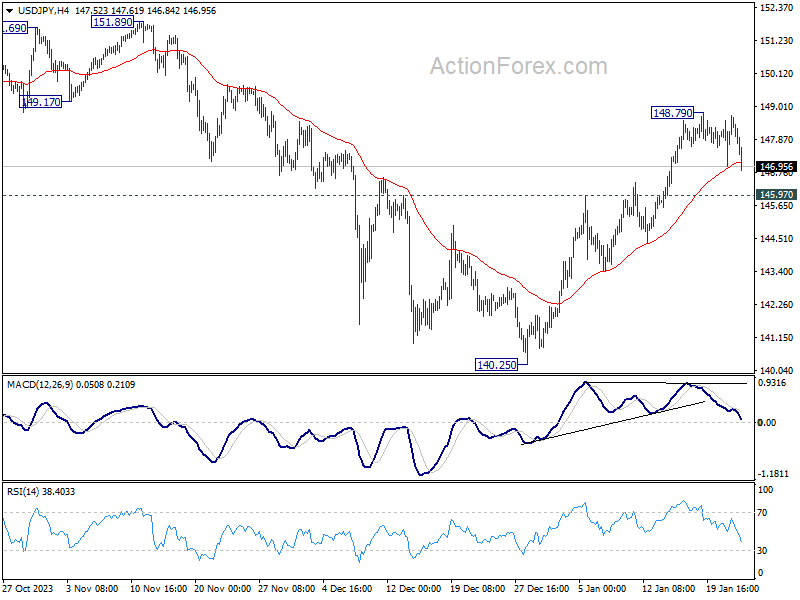
USD/JPY's retreat from 148.79 extends lower today but stays well above 145.97 resistance turned support. Intraday bias remains neutral at this point, and further rally remains in favor. Corrective fall from 151.89 should have completed at 140.25 already. Break of 148.79 will resume the rise from there for retesting 151.89/93 key resistance zone.
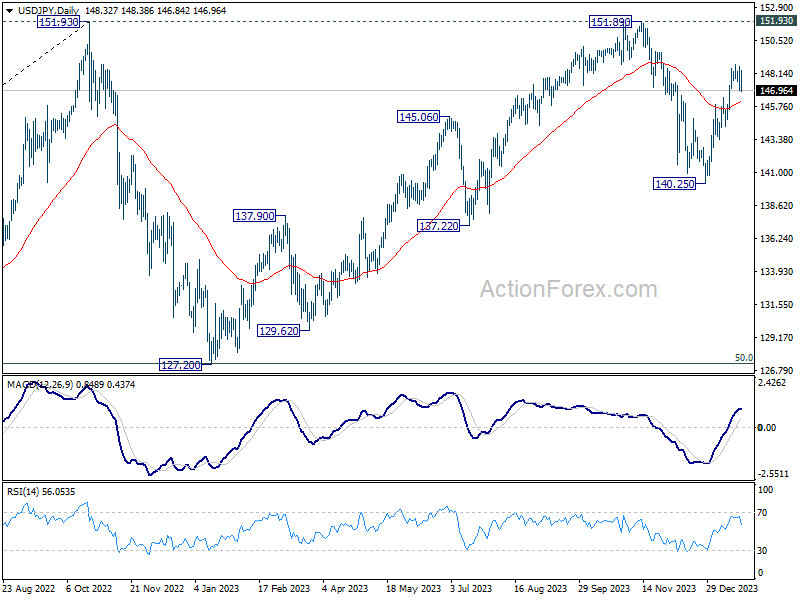
In the bigger picture, stronger than expected rebound from 140.25 dampened the original bearish review. Strong support from 55 W EMA (now at 141.89) is also a medium term bullish sign. Fall from 151.89 could be a correction to rise from 127.20 only. Decisive break of 151.89/93 will confirm resumption of long term up trend. This will now be the favored case as long as 140.25 support holds.
EUR/USD Mid-Day Outlook
Daily Pivots: (S1) 1.0812; (P) 1.0864; (R1) 1.0906; More...
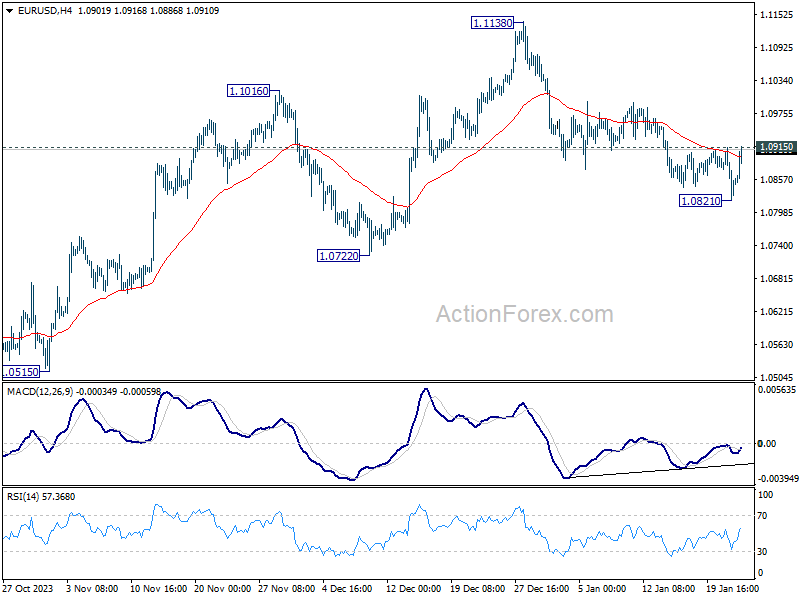
Intraday bias in EUR/USD is turned neutral with current recovery. On the upside, firm break of 1.0915 minor resistance will indicate short term bottom at 1.0821, on bullish convergence condition in 4H MACD. Intraday bias will be back on the upside for stronger rebound towards 1.1138 high. On the downside, though, below 1.0821 will resume the fall from 1.1138 to 1.0722 support next.
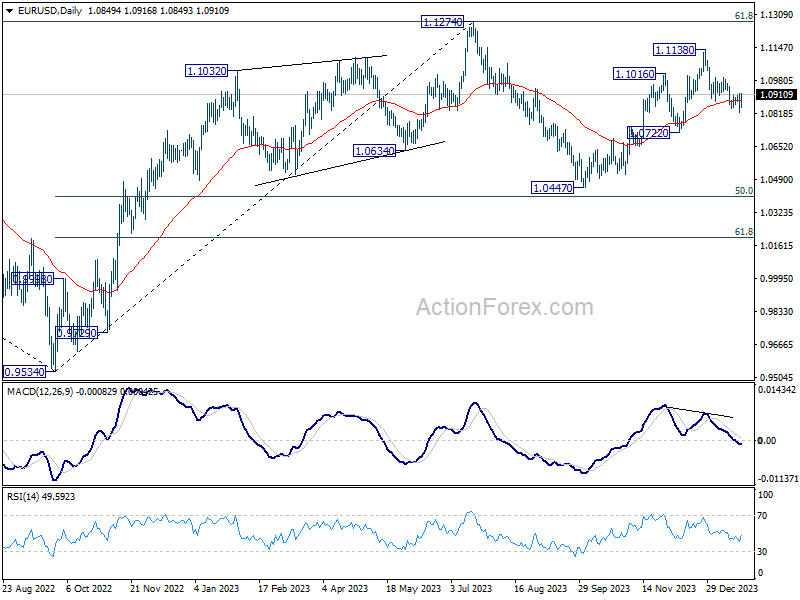
In the bigger picture, price actions from 1.1274 are viewed as a corrective pattern to rise from 0.9534 (2022 low). Rise from 1.0447 is seen as the second leg. While further rally could cannot be ruled out, upside should be limited by 1.1274 to bring the third leg of the pattern. Meanwhile, sustained break of 1.0722 support will argue that the third leg has already started for 1.0447 and below.
GBP/USD Mid-Day Outlook
Daily Pivots: (S1) 1.2642; (P) 1.2694; (R1) 1.2740; More...
Immediate focus is now on 1.2784 minor resistance in GBP/USD. Decisive break there will suggest that consolidation pattern from 1.2826 has completed. Further rise should be seen through 1.2826 to resume the rise from 1.2036. Next target will be 1.3141 high. in case of another fall, downside should be contained above 1.2499 support to bring rebound.
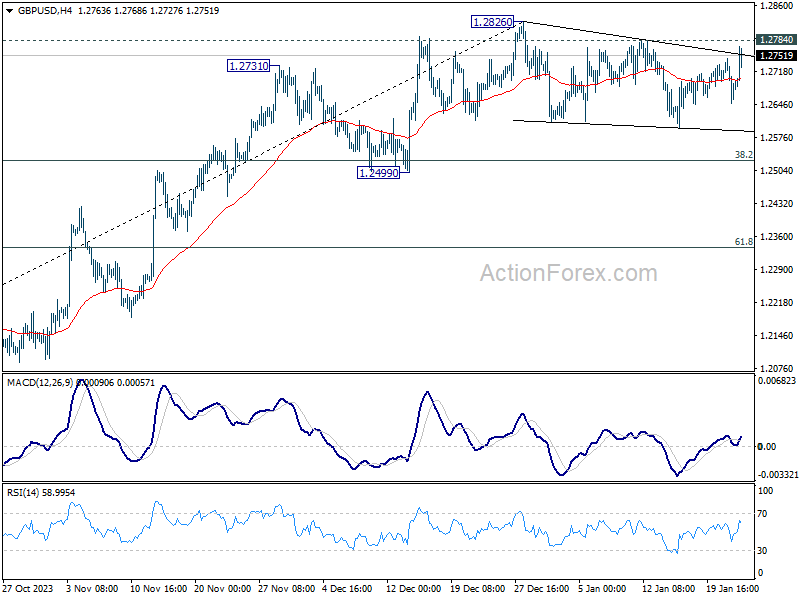
In the bigger picture, price actions from 1.3141 medium term top are seen as a corrective pattern to up trend from 1.0351 (2022 low). Rise from 1.2036 is seen as the second leg that's in progress. Upside should be limited by 1.3141 to bring the third leg of the pattern. Meanwhile, break of 1.2499 support will argue that the third leg has already started for 38.2% retracement of 1.0351 (2022 low) to 1.3141 at 1.2075 again.
Sterling Rises Following Encouraging UK PMI Data, Dollar Weakens Across the Board
Sterling rises notably against Euro and Dollar today, buoyed by encouraging UK PMI data that pointed to a strong start for the year with renewed growth momentum. More importantly, this data suggests that BoE might need to delay its rate cut plans, as inflationary pressures could potentially resurge due to supply disruptions in the Red Sea. Simultaneously, Eurozone's PMI data, while less optimistic, also supports ECB hawks' stance against premature rate cuts, with price indicators suggesting sustained inflationary pressures.
Conversely, Dollar softens broadly in the wake of slump in US 10-year yield. This decline comes amidst an uptick in market sentiment in Asia, following the People's Bank of China's decision to cut the reserve ratio requirement by 50 basis points. This move is set to inject approximately CNY 1T into the economy, aiming to bolster long-term capital. Nevertheless, Australian and New Zealand Dollars have not shown significant responses to this development. Meanwhile, Canadian Dollar is trading softly as market participants await BoC interest rate decision, where maintaining the current rate is widely anticipated.
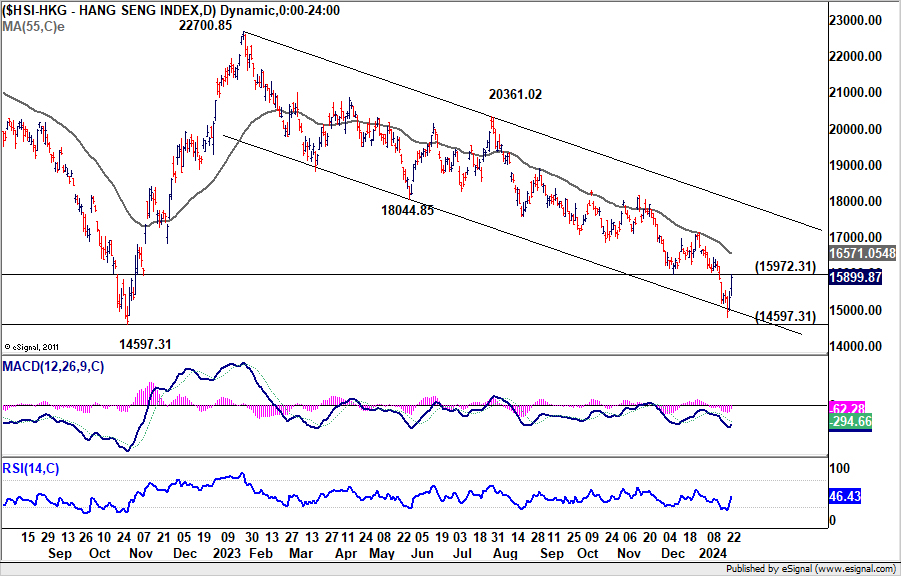
From a technical perspective, a key focus for the remainder of the week will be the durability of the shift in sentiment in Hong Kong and China. The immediate point of interest lies at 15972.31 support-turned-resistance in HSI after today's 3.56% gain. Decisive break there will raise the chance of bottoming ahead of 14597.31 (2022 low). That would at least set up further rebound to 55 D EMA (now at 16571.05), or even further to channel resistance at around 18000 later in the quarter.
In Europe, at the time of writing, FTSE is up 0.35%. DAX is up 1.41%. CAC is up 0.88%. UK 10-year yield is up 0.0192 at 4.006. Germany 10-year yield is down -0.0247 at 2.330. Earlier in Asia, Nikkei fell -0.80%. Hong Kong HSI rose 3.56%. China Shanghai SSE rose 1.80%. Singapore Strait Times rose 0.58%. Japan 10-year JGB yield rose 0.0856 to 0.723.
UK PMI composite rises to 52.5, may delay BoE rate cut
UK PMI Manufacturing rose from 46.2 to 47.3 in January, a 9-month high. PMI Services rose from 53.4 to 53.8, an 8-month high. PMI Composite rose from 52.1 to 52.5, a 7-month high.
Chris Williamson, Chief Business Economist at S&P Global Market Intelligence, noted that UK business activity growth has "accelerated for a third straight month". He described this as a "promising start" to the year.
According to the survey data, UK economy is expected to grow at a quarterly rate of 0.2% after a flat fourth quarter, thereby "skirting recession and showing signs of renewed momentum".
However, Williamson highlighted a crucial implication of this unexpected growth strength in January, which could lead BoE to reconsider the timing of any anticipated interest rate cuts.
This reassessment is particularly pertinent in light of supply disruptions in the Red Sea, which have reignited inflationary pressures in the manufacturing sector. Williamson indicated that inflation is expected to remain stubbornly in the 3-4% range in the near term.
Bundesbank report warns of German economy's vulnerability to China's economic woes
In its latest monthly report, Bundesbank issued a cautionary message about China's current economic struggles and their potential impact on Germany. The report notes that China is grappling with "significant economic problems," and the relationship between China and Western industrial nations has "noticeably deteriorated recently." Such geopolitical risks, if they materialize, could have severe repercussions for the German economy.
The Bundesbank essay posits that "an economic crisis in China of the kind that has occurred in other countries in the past following a correction of excessive credit growth would probably be bearable for the German economy." However, the impact would not be negligible, with projections indicating that Germany's real GDP could be -0.7% lower in the first year of a potential crisis in China, and then -1% in the second year.
The report also highlights a more severe scenario: "However, an abrupt decoupling, for example as a result of a geopolitical crisis, would have a significantly greater impact on German industry in particular." In such an event, German companies with direct involvement in China could face considerable losses in sales and profit. Industries like automotive, mechanical engineering, electronics, and electrical engineering are particularly reliant on Chinese demand.
Moreover, Bundesbank emphasizes the broader risks associated with the close economic ties between Germany and China: "the close real economic ties between Germany and China also pose considerable risks for the German financial system."
Eurozone's PMI composite climbs to 47.9, price data echo ECB hawks' caution
Eurozone PMI Manufacturing rose from 44.4 to 46.6 in January, a 10-month high. However, PMI services fell from 48.8 to 48.4. PMI Composite rose from 47.6 to 47.9, a 6-month high.
Cyrus de la Rubia, Chief Economist at Hamburg Commercial Bank, noted that Eurozone's manufacturing sector is experiencing a "widespread easing of the downward trajectory witnessed in the past year". He highlights that this positive trend is "evident across key indicators such as output, employment, and new orders."
While the services sector is contracting, de la Rubia points out that the contraction is "currently moderate". He also notes a "silver lining," as there is an increase in companies expanding their workforce, which indicates a degree of optimism in the market.
De la Rubia's observation that PMI price indicators are in line with the sentiments of the hawks within ECB. He states they are "all about shouting 'hold your horses'", emphasizing a need for a measured approach and advising against rushing into early rate cuts.
Germany PMI Manufacturing rose from 43.3 to 45.4 in January, an 11-month high. PMI Services fell from 49.3 to 47.6, a 5-month low. PMI Composite fell from 47.4 to 47.1, a 3-month low.
France PMI Manufacturing rose from 42.1 to 43.2 in January. PMI Services fell from 45.7 to 45.0. PMI Composite fell from 44.8 to 44.2.
Japan's PMI shows modest growth, manufacturing still in contraction
Japan's PMI Manufacturing rose fractionally from 47.9 to 48.0 in January, below expectation of 48.2. Manufacturing remained in contraction for the eighth consecutive months. PMI Services rose from 5.15 to 52.7. PMI Composite rose from 50.0 to 51.1.
Usamah Bhatti, Economist at S&P Global Market Intelligence, noted that while "modest" the private sector is having the strongest growth since September. However, there was disparity between the sectors, with services reaching a four-month high, while manufacturing marked its eighth consecutive month of contraction.
Regarding inflation, Bhatti said input price inflation "remains high historically". But output inflation eased to its "lowest since February 2022". This indicates that while input costs are still elevated, businesses are not passing these costs fully onto consumers.
Japan's exports exceed JPY 1T in 2023, US reclaims top export destination
Japan's exports rose 9.8% yoy to JPY 9648B in December, marking the biggest increase in a year. This boost was largely driven by 20.4% yoy jump in exports to US, predominantly from the automotive sector, while exports to Europe climbed by 10.3% yoy. Notably, shipments to China saw 9.6% yoy rise, registering their first growth in 13 months, primarily led by chip-making equipment. In contrast, imports declined -6.8% yoy to JPY 9586B. Consequently, trade balance turned positive, recording JPY 62.1B surplus.
Analyzing the whole year, Japan's trade deficit in 2023 more than halved to JPY -9.29T from the previous year. The country's total exports rose by 2.8% to reach JPY 100.89T , surpassing the JPY 100T mark for the first time ever. Meanwhile, total imports saw -7.0% decrease to JPY 110.18T.
A significant shift was observed in Japan's export destinations in 2023. US reclaimed its position as the largest recipient of Japanese exports by value for the first time in four years, surpassing China. Exports to US reached JPY 20.27T, showing 11.0% increase, while exports to China decreased by -6.5% to JPY 17.76T.
New Zealand CPI slows to 0.5% qoq, 4.7% yoy in Q4
New Zealand CPI rose 0.5% qoq in Q4, down from 1.8% qoq in Q3, matched expectations. Tradeable inflation turned negative to -0.2% qoq, from 1.8% qoq. Non-tradeable inflation slowed to 1.1% qoq, down from 1.7% qoq.
Annually, CPI slowed from 5.6% yoy to 4.7% yoy, matched expectations. Tradeable inflation slowed from 4.7% yoy to 3.0% yoy. non-tradeable inflation also slowed from 6.3% yoy to 5.9% yoy.
"While this is the smallest annual rise in the CPI in over two years, it remains above the Reserve Bank of New Zealand's target range of 1 to 3 percent," consumers prices senior manager Nicola Growden said.
Australia's PMI manufacturing Hits 11-month high, services Lagging
Australia PMI Manufacturing rose from 47.6 to 50.3 in January, back in expansion, and a 11-month high. PMI Services rose slightly from 47.1 to 47.9, a 3-month high. PMI Composite rose from 46.9 to 48.1, a 4-month high, but still in contraction.
Warren Hogan, Chief Economic Advisor at Judo Bank noted the PMI data indicates a that the economy remains on RBA's "narrow path" for soft landing. He highlights the manufacturing sector's rebound as a key factor in mitigating broader economic downturn risks.
Despite the general economic slowdown, Hogan observes that labor demand remains unexpectedly robust, differing from past economic cycles. However, he cautions that inflation pressures are still high, pointing out, "Input and output price indexes remain at levels suggesting CPI inflation is above the RBA's target range."
GBP/USD Mid-Day Outlook
Daily Pivots: (S1) 1.2642; (P) 1.2694; (R1) 1.2740; More...
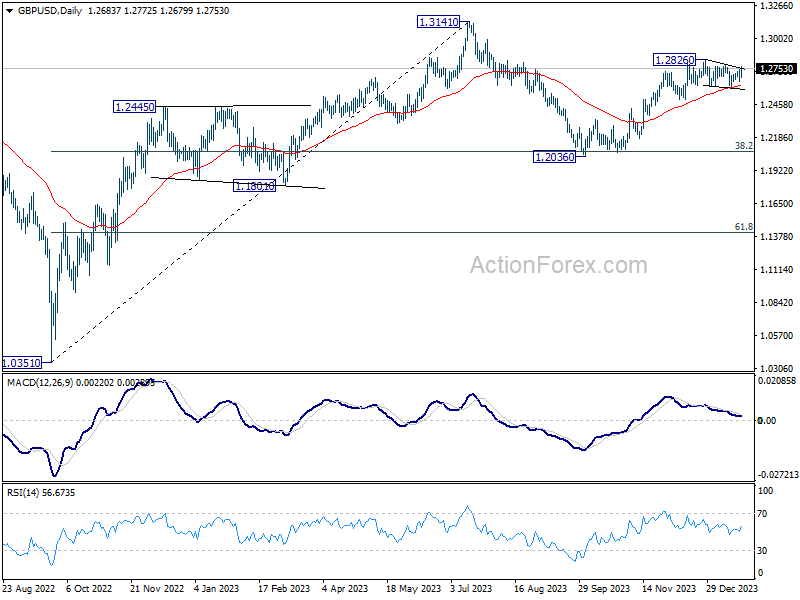
Immediate focus is now on 1.2784 minor resistance in GBP/USD. Decisive break there will suggest that consolidation pattern from 1.2826 has completed. Further rise should be seen through 1.2826 to resume the rise from 1.2036. Next target will be 1.3141 high. in case of another fall, downside should be contained above 1.2499 support to bring rebound.
In the bigger picture, price actions from 1.3141 medium term top are seen as a corrective pattern to up trend from 1.0351 (2022 low). Rise from 1.2036 is seen as the second leg that's in progress. Upside should be limited by 1.3141 to bring the third leg of the pattern. Meanwhile, break of 1.2499 support will argue that the third leg has already started for 38.2% retracement of 1.0351 (2022 low) to 1.3141 at 1.2075 again.
Economic Indicators Update
| GMT | Ccy | Events | Actual | Forecast | Previous | Revised |
|---|---|---|---|---|---|---|
| 21:45 | NZD | CPI Q/Q Q4 | 0.50% | 0.50% | 1.80% | |
| 21:45 | NZD | CPI Y/Y Q4 | 4.70% | 4.70% | 5.60% | |
| 22:00 | AUD | Manufacturing PMI Jan P | 50.3 | 47.6 | ||
| 22:00 | AUD | Services PMI Jan P | 47.9 | 47.1 | ||
| 23:30 | AUD | Westpac Leading Index M/M Dec | 0.00% | 0.10% | ||
| 23:50 | JPY | Trade Balance (JPY) Dec | -0.41T | -0.45T | -0.41T | -0.35T |
| 00:30 | JPY | Manufacturing PMI Jan P | 48 | 48.2 | 47.9 | |
| 00:30 | JPY | Services PMI Jan P | 52.7 | 51.5 | ||
| 08:15 | EUR | France Manufacturing PMI Jan P | 43.2 | 42.5 | 42.1 | |
| 08:15 | EUR | France Services PMI Jan P | 45 | 46 | 45.7 | |
| 08:30 | EUR | Germany Manufacturing PMI Jan P | 45.4 | 43.7 | 43.3 | |
| 08:30 | EUR | Germany Services PMI Jan P | 47.6 | 49.5 | 49.3 | |
| 09:00 | EUR | Eurozone Manufacturing PMI Jan P | 46.6 | 44.8 | 44.4 | |
| 09:00 | EUR | Eurozone Services PMI Jan P | 48.4 | 49.1 | 48.8 | |
| 09:30 | GBP | Manufacturing PMI Jan P | 47.3 | 46.7 | 46.2 | |
| 09:30 | GBP | Services PMI Jan P | 53.8 | 53.5 | 53.4 | |
| 14:45 | CAD | BoC Interest Rate Decision | 5.00% | 5.00% | ||
| 14:45 | USD | Manufacturing PMI Jan P | 47.7 | 47.9 | ||
| 14:45 | USD | Services PMI Jan P | 51.1 | 51.4 | ||
| 15:30 | USD | Crude Oil Inventories | -1.2M | -2.5M | ||
| 15:30 | CAD | BoC Press Conference |
CADJPY Pulls Below 2-Month High Ahead of BoC Rate Decision
- CADJPY leans to the downside after two-month high
- 2024 uptrend remains intact above 109.50
- BoC policy announcement due at 15:00 GMT
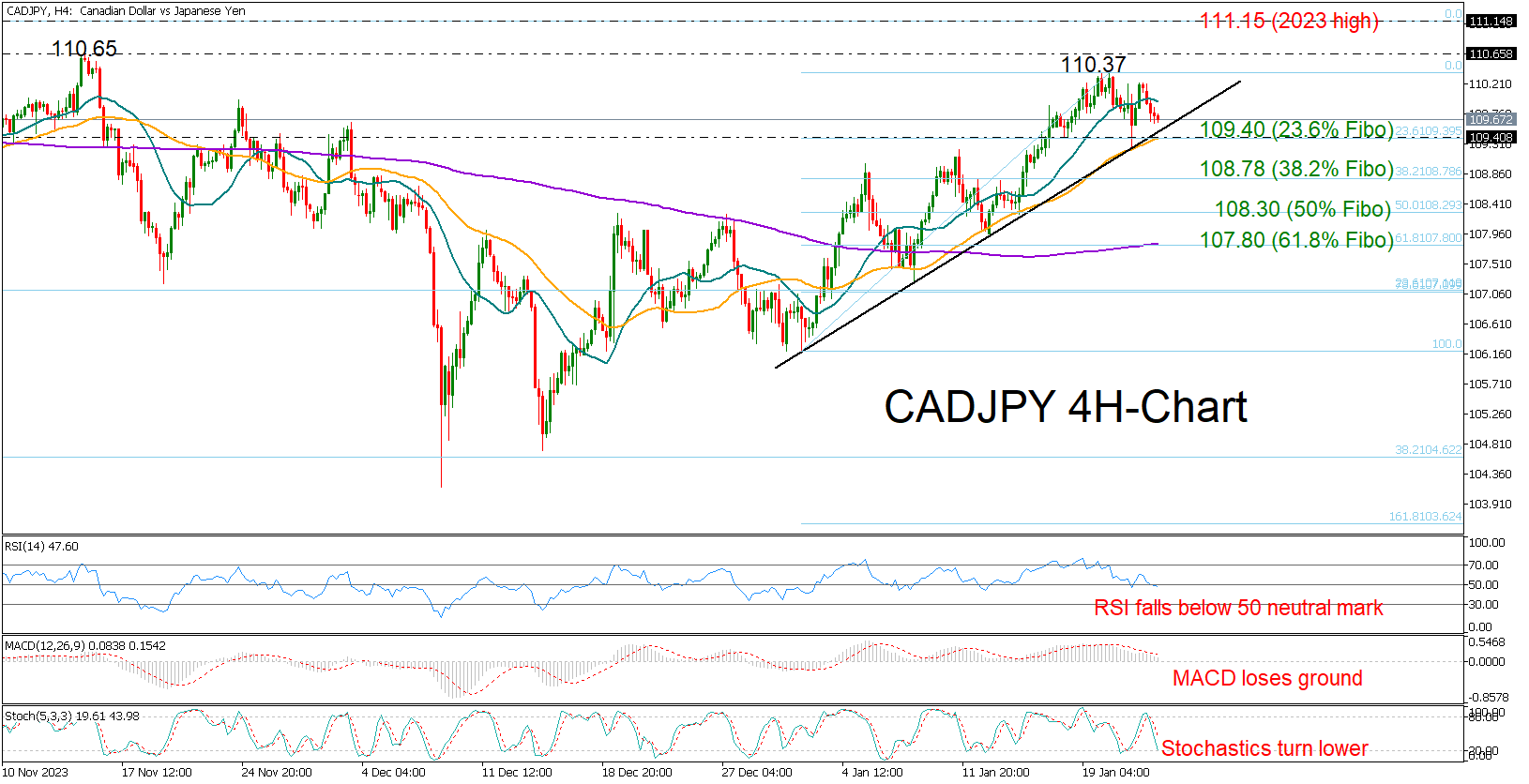
CADJPY lost momentum after the peak at a two-month high of 110.37 on Monday, but January’s series of higher highs and higher lows on the four-hour chart remain intact and only a break below the 50-period simple moving average (SMA) and the support trendline at 109.40 would put the upward trajectory in doubt.
The technical indicators favor the bearish scenario as the RSI is crossing below its 50 neutral mark and the stochastic oscillator is shifting southwards. The MACD keeps decelerating below its red signal line, adding to the discouraging signals.
If the price drops below the ascending trendline and the 50-period SMA, which coincides with the 23.6% Fibonacci retracement of the 2024 uptrend, it could meet the 38.2% Fibonacci mark of 108.78. The 50% Fibonacci of 108.30 could next come into view ahead of the 61.8% Fibonacci of 107.80 and the 200-period SMA.
Should the upward pattern strengthen above November’s high of 110.65, the door will open for the 2023 top of 111.15. The 112.00-112.50 area last seen during 2007-2008 could be the next obstacle.
In summary, CADJPY is facing a weakening bias, but sellers may stay patient until they see a close below 109.40.
European PMIs weaker than analysts’ forecasts but didn’t disappoint markets
Preliminary January PMIs for Germany showed a worsening of the situation contrary to the expected improvement. The composite PMI in January was at 47.1 against 47.4 a month earlier, and there are forecasts of an increase to 47.8.
The reason for the deterioration was a dip in the services sector. The index of activity in this sector fell to 47.6 – the lowest since August – instead of the expected 49.3. Activity in Germany’s services sector has been contracting since August despite relatively low energy prices. And this could be an indication that the weight of interest rates is spreading through the economy.
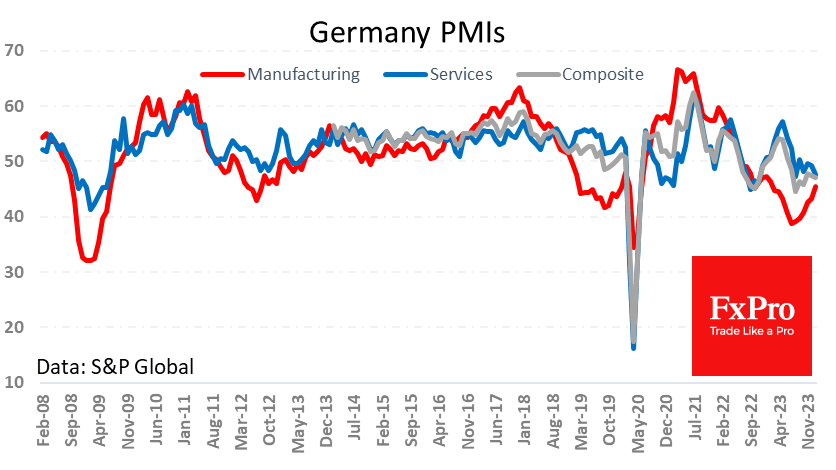
Earlier, Germany’s Ifo Institute lowered its forecast for economic growth in 2024 from 0.9% to 0.7%. Some forecasters expect GDP to decline this year. These expectations and weak economic indicators reinforce expectations that the ECB will soon move to ease monetary policy, as weakness in the national economy may soften Germany’s traditionally very hawkish stance.
Indicators for the whole eurozone came out slightly weaker than expected. The composite PMI rose from 47.6 to 47.9 despite Germany’s failure. That said, the index remains in contractionary territory, i.e. below the 50 level.
The manufacturing sector, although presenting a relatively small share of the economy, acts as a reliable leading indicator. Both Germany and the Eurozone have seen a steady rise in Manufacturing PMI, setting the mood for an acceleration in the economy over the next couple of quarters.
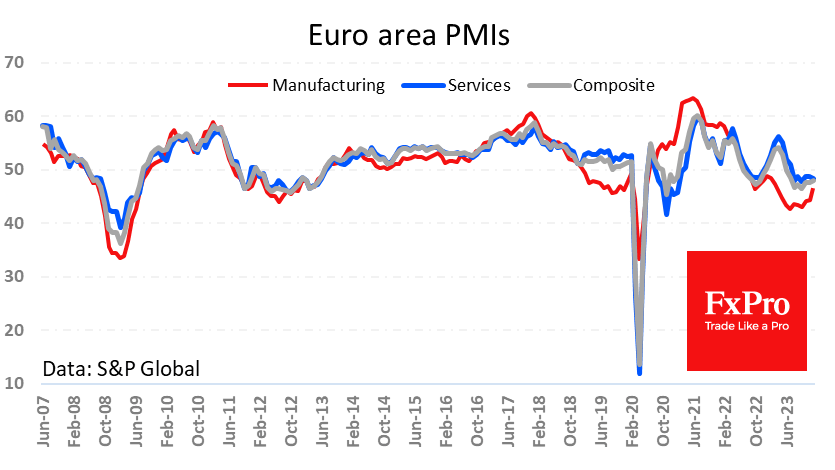
The currency market was more influenced by the strength of the rest of the Eurozone data than by the disappointment with the German statistics. Optimism on the stock markets, also supported today by the positive dynamics of China, has played its role in the Euro’s purchases and return to 1.09.