Sample Category Title
Forecast 2024: Bitcoin Yesterday, Tomorrow, and the Day After
The main question, just a few years ago, was when the crypto bubble would burst. Over time, bitcoin gradually earned its place in the minds and portfolios of traders and investors. Competing actively with physical gold and other investment and defensive assets, digital gold emerged as a formidable contender.
In the past year, the merits and drawbacks of bitcoin have been a topic of frequent discussion, encompassing analysis of its rises and falls and presenting views from seasoned Wall Street experts and pseudonymous social network analysts. It's important to note that many predictions from both groups proved quite accurate, despite the ultra-high volatility of this flagship asset. Today's focus is on recalling the 2023 predictions for bitcoin, their forecasts for 2024 and beyond, with a particular emphasis on those specialists who offered specific figures rather than general, vague phrases.
2023: Those Who Hit the Mark or Came Close
Let's recall that the past year was undoubtedly successful for bitcoin. Despite all its highs and lows, BTC/USD, starting the year at $16,515, reached a peak of $44,694 on December 8, demonstrating a 2.7-fold increase. Among the reasons for the coin's bull rally, experts cite the growing network hash rate, anticipation of the Federal Reserve's policy easing, and, of course, the approval by the Securities and Exchange Commission (SEC) of the launch of spot bitcoin ETFs and the bitcoin halving in April 2024. It should be noted that all these events began to influence market sentiment only in the second half of 2023. Therefore, the forecasts made in the first half of the year are particularly interesting.
Alistair Milne, IT Director of Altana Digital Currency Fund, made a nearly bullseye prediction by stating, "By the end of 2023, we should see bitcoin at a minimum of $45,000," which he declared already in January.
Mark W. Yusko, the head of Morgan Creek, in February, precisely identified that the next bull market could start as early as the second quarter of 2023, due to favourable macroeconomic conditions. He noted that it was unlikely for the U.S. Federal Reserve to reduce the key interest rate during this period. However, a slowdown or pause in rate adjustments would be seen as a positive sign for risk assets, including cryptocurrencies. Yusko, emphasizing the upcoming halving, pointed out that the digital asset market's recovery usually starts nine months prior to such events, indicating that this rally should have commenced by the end of summer 2023.
Experts at Matrixport, comparing January's BTC quotes with historical data and anticipating a deceleration in the U.S. Consumer Price Index (CPI) growth, accurately predicted that the flagship cryptocurrency's rate might reach $29,000 by summer and $45,000 by Christmas. This precise hit on the target was made evident by their analysis.
Trader, analyst, and founder of venture company Eight, Michael Van De Poppe, released a video review predicting the coin's rise to $40,000 by year-end, a forecast made at the start of March. Similarly, Mike Novogratz, CEO of Galaxy Digital, projected a rise to $40,000, with the caveat that this level would be achieved only when the U.S. Federal Reserve started reducing the key interest rate. Dave the Wave, a trader known for several accurate predictions, voiced the same $40,000 target in May, emphasizing that this was his conservative estimate.
BTC/USD fell below $25,000 in the first half of June, and the market was yet to learn that in just a few days, major financial institutions would start submitting applications to the SEC for entering the cryptocurrency market through spot bitcoin ETFs. Among the contenders for launching these funds were global asset managers like BlackRock, Invesco, Fidelity, and others. At this point, Business Insider took an interest in expert predictions. Let's look at a few opinions gathered from their survey.
Jagdeep Sidhu, President of Syscoin Foundation, believed that despite several crypto storms, the ecosystem's resilience had become evident. The market had recovered from the ashes of FTX, and if inflation in the U.S. decreased, bitcoin could reach $38,000 by year-end, Sidhu stated. David Uhryniak, Director of Ecosystem Development at TRON, along with Benjamin Cowen, was confident that bitcoin would end the year above $35,000.
A consensus forecast from another survey conducted by Finder.com among 29 analysts pointed to a price of $38,488 by year-end, with bitcoin's peak values in 2023 expected to be around $42,000. Naturally, individual expert predictions varied. Overall, most survey participants (59%) were optimistic about BTC, considering summer a good time to enter the market, 34% advised holding existing cryptocurrency, and 7% recommended selling it.
2023: Above or Below the Target
Certainly, not all predictions were as close to the year's outcomes. Another frequently cited target in forecasts was the $50,000 mark, which, according to the analyst known as CryptoYoddha, experts at TradingShot, and former Goldman Sachs top manager and CEO of Real Vision Raoul Pal, BTC/USD was expected to reach. Legendary trader and analyst Peter Brandt, who accurately predicted BTC's 2018 correction, set his sights even higher this time. He believed the coin would reach its previous highs near $68,000 in the second half of 2023, followed by another correction and a new all-time high.
In late January 2023, the analyst under the pseudonym Plan B predicted that the flagship currency would rise to $100,000 by year-end. Moreover, he estimated that bitcoin could test the $42,000 level as early as March, citing the stock-to-flow (S2F) model he developed, which measured the relationship between an asset's available supply and its production rate. However, as we now know, the $42,000 test occurred only nine months later, in December, and $100,000 remained an unattainable height.
Felix Zulauf, founder of Zulauf Asset Management, speculated that bitcoin would enter a clear bull rally around late spring 2023 and did not rule out the possibility of the asset reaching $100,000 on a sharp upward trend. Credible Crypto experts also issued an optimistic forecast, suggesting that the flagship crypto asset had a good chance of renewing its historical maximum in the $69,000 zone. A CNBC survey among influential industry figures revealed expectations of retesting $69,000 by Tether's CTO Paolo Ardoino, while Marshall Beard, the Strategy Director of cryptocurrency exchange Gemini, pointed to $100,000. Investor and author of the famous book "Rich Dad Poor Dad," Robert Kiyosaki, named an even larger figure, claiming that by the beginning of 2024, bitcoin would reach $120,000.
The market isn't driven solely by bulls. Roaming its expanse, one can encounter bears and even "crypto-gravediggers." For instance, Bloomberg analyst Mike McGlone, in May, anticipated a bitcoin price collapse to a support level of $7,366. This was a stark contrast to his view at the end of the previous year, 2022, when McGlone predicted bitcoin would soar to $100,000.
Strategists from the British multinational financial conglomerate Standard Chartered expected that a liquidity crisis would lead to new bankruptcies of crypto exchanges and companies, resulting in BTC potentially plummeting to $5,000 in 2023. An analyst known as Grinding Poet even declared that "a retest of the 2018 lows is inevitable" and set a new target of $3,150.
2024: Optimism and Super Optimism
Bloomberg Intelligence analyst Jamie Coutts has forecasted a rise in bitcoin's price to $50,000 before the halving in April 2024. Eric Balchunas, a senior analyst at Bloomberg, explained that the SEC's approval of BTC-ETF applications would open up bitcoin to a capital market of $30 trillion. Bloomberg anticipates that the approval will occur very soon, around January 8-10. According to predictions by the analytical firm Fundstrat, this could increase daily demand for bitcoin by $100 million. In this scenario, even before the planned halving, the price of BTC could reach up to $180,000.
Adam Back, CEO of Blockstream and one of the earliest developers of BTC, likened the past few years to a biblical plague epidemic. "There was COVID-19, central banks' quantitative easing, wars affecting energy costs, inflation driving people and companies to bankruptcy," he explained. As 2023 came to a close, the effects of many of these events had diminished, according to Back. "The bankruptcies linked to Three Arrows Capital, Celsius, BlockFi, and FTX... all of that is mostly over. I don't think we're in for many big surprises." Back believes 2024 will be a year of recovery for bitcoin, responding to the upcoming halving in April and potentially reaching $100,000 before the event.
Samson Mow, former colleague of Back at Blockstream and now CEO of Jan3, agreed with this assessment. Experts at Seeking Alpha also echoed a similar figure, suggesting that the cryptocurrency should be valued around $98,000 to keep miners afloat post-halving.
Standard Chartered experts, particularly Geoff Kendrick, speak of a similar outlook. According to the bank's economists, the current situation indicates the end of the "crypto winter." However, their forecast is slightly more conservative, with the main cryptocurrency reaching the $100,000 mark only by the end of 2024. Apple co-founder Steve Wozniak also settled on this round figure. Pascal Gauthier, CEO of Ledger, David Marcus, head of Lightspark, and Vijay Ayyar, a top manager at CoinDCX, also anticipate bitcoin's price rise to $100,000.
Investor and bestselling author of "Rich Dad Poor Dad," Robert Kiyosaki, believes that the U.S. economy is on the brink of a serious crisis, and cryptocurrencies, particularly bitcoin, offer investors a safe haven in these turbulent times. Kiyosaki predicts that the halving will be a key event, potentially driving BTC's price to soar to $120,000. Markus Thielen, head of research at the crypto-financial service Matrixport, suggests a similar figure of $125,000. Renowned blogger and analyst Lark Davis believes that this event could lead to bitcoin's price rising to about $150,000, or even up to $180,000. Tom Lee, co-founder of Fundstrat, estimates a rise to $185,000.
According to calculations by Dave the Wave, BTC, post the April 2024 halving, will only rise slightly above its previous high of around $69,000 by mid-2024, but could escalate to $160,000 by year-end. Alistair Milne predicts that by the end of 2024, the BTC rate should reach $150,000-$300,000. However, he cautions, "this may well be the peak opportunity for bulls." Analysts from LookIntoBitcoin advise locking in profits when the coin appreciates to at least $110,000.
And finally, let's consider the fresh perspective of Artificial Intelligence (AI): an increasingly integral voice in such discussions. The experts at Finbold consulted Google Bard, a machine learning system, about the likely value of the flagship cryptocurrency after the much-anticipated 2024 halving. The AI predicted that bitcoin would likely reach a new all-time high, attributing this not only to the halving but also to broader BTC adoption and interest from institutional investors. Google Bard specifically noted that after the halving, bitcoin could surge to $100,000. However, the AI also highlighted factors that could limit the cryptocurrency's growth, not ruling out the possibility of a continued crypto winter in 2024.
In contrast, a scenario from Google Bard's competitor, ChatGPT, developed by OpenAI, appears more optimistic. It suggests that the main cryptocurrency could climb as high as $150,000. (Interestingly, the illustration accompanying this article was also created using AI, in this case, Microsoft Bing)
2024: Moderate Optimism and Moderate Pessimism
Consolidating all the aforementioned scenarios into a consensus forecast, with certain allowances, yields a range from $100,000 to $180,000. While this range is undoubtedly encouraging for investors, there are more conservative and even pessimistic predictions.
Analyst PlanB, having missed his target in 2023, significantly lowered his expectations. "Expect $32,000 for bitcoin before the halving," he writes, "rising to $55,000 during the halving, and then, by the end of the year, the main cryptocurrency might climb to $66,000." Arthur Hayes, former CEO of the cryptocurrency exchange BitMEX, also stated that the first cryptocurrency's quotes would reach only a "modest" goal of $70,000.
A sobering perspective comes from the company CryptoVantage, whose employees surveyed 1,000 crypto investors in the USA. Only 23% of them believe that bitcoin will reach its historical maximum of $68,917 in the upcoming year. 47% think that the coin's price will rise to this mark within five years. 78% are confident that BTC will eventually return to its historical maximum, but at an undefined future date. However, 9% believe this will never happen again.
BBC World analyst Glen Goodman joined the chorus of sceptics. He commented that the $120,000 figure "seems more like a number plucked out of thin air than a realistically grounded prediction." Goodman argues that authors of such predictions favor market bulls and overlook several key factors. The most crucial, according to him, is that U.S. financial regulators are relentlessly targeting the crypto industry with lawsuits and investigations. Against this backdrop, experts from JP Morgan believe that in 2024 the main cryptocurrency will trade around $45,000, considering this price as an upper limit indicating the asset's limited potential.
2025 and Beyond: $1,000,000 to $10,000,000. Who Predicts Higher?
"Looking too far into the future is not far-sighted," a saying attributed to Sir Winston Churchill, the Prime Minister of the United Kingdom during 1940-1945 and 1951-1955. While we might heed the advice of the esteemed British leader, some influencers still dare to make long-term predictions without fearing being seen as short-sighted.
An average result from a survey of 29 experts conducted by Finder.com indicates that BTC's price may reach $100,000 not in 2024, but only by the end of 2025, and could ascend to $280,000 by the end of 2030. An analyst known as Trader Tardigrade believes that bitcoin is following the same price structure as it did from 2013 to 2018. If his model is accurate, the beginning price "boom" could lead to bitcoin rising to $400,000 by 2026.
Venture capitalist Tim Draper, a third-generation venture capitalist and co-founder of Draper Fisher Jurvetson, is optimistic about 2025. He believes that the halving will significantly impact the main cryptocurrency's price, eventually reaching $250,000. Previously, he predicted that BTC would hit this mark by the end of 2022. When his prediction did not materialize, he extended the timeline to mid-2023. Now, Draper has revised his forecast again, stating with certainty that the main cryptocurrency will reach the targeted price by the end of June 2025. According to him, one of the growth drivers will be the adoption of BTC by women, suggesting that housewives using bitcoin for shopping could become a significant factor in the coin's widespread adoption.
Mike Novogratz, CEO of Galaxy Digital, believes that the demand for alternative financial instruments will continue to grow, with bitcoin being one of these instruments. He predicts that in the long term, bitcoin's price could reach $500,000. Doubling this estimate, Arthur Hayes, former CEO of the cryptocurrency exchange BitMEX, and Max Keiser, a former trader and TV host who is now an advisor to the president of El Salvador, have both cited a figure of $1 million per coin. Michael Saylor, the founder of MicroStrategy, has a more polarized view, stating that "bitcoin will either plummet to zero or skyrocket to $1 million."
Cathy Wood, CEO of ARK Invest, forecasts a significant increase in the total market capitalization of cryptocurrencies, reaching $25 trillion by 2030, which is an increase of more than 2100%. ARK Invest's baseline scenario envisages bitcoin's price rising to $650,000 during this period, while a more optimistic scenario projects a climb to $1,500,000. Yassine Elmandjra, an analyst at ARK Invest and a colleague of Wood, acknowledged that such a prediction for the coin's growth may seem improbable, but added that it is "quite reasonable" when considering the history of cryptocurrency development.
Larry Lepard, Managing Partner at the Boston-based investment company Equity Management Associates, has also provided a long-term forecast. He believes that over the next decade, the dollar will devalue, and people will increasingly invest in cryptocurrencies, gold, and real estate. Given bitcoin's limited supply, the digital asset will become a highly sought-after investment tool and will benefit from the collapse of fiat currency. "I believe the price of bitcoin will rise sharply. I think it will first reach $100,000, then $1 million, and eventually rise to $10 million per coin. I'm confident that my grandchildren will be shocked at how wealthy people who own just one bitcoin will become," Lepard stated.
The Artificial Intelligence ChatGPT offers a slightly more modest scenario. It suggests that the main cryptocurrency might rise to $500,000 by 2028, reach $1 million by 2032, and escalate to $5 million by 2050. However, this AI prediction comes with several conditions. Such growth is possible only if: cryptocurrency is widely adopted; bitcoin becomes a popular means for capital saving; and the coin is integrated into various financial systems. If these conditions are not met, then, according to AI calculations, by 2050, the value of the coin could range from $20,000 to $500,000.
Funeral Squad for Bitcoin: $0.0000. Who Predicts Lower?
According to Newton's Third Law, every action has an equal and opposite reaction. Although this law was formulated in 1689, it seems to apply even to 21st-century cryptocurrencies. If there are those eager to drive up the value of bitcoin, there will inevitably be others prepared to bury it deeper.
Warren Buffett, the billionaire and stock market legend, famously described bitcoin as "rat poison squared." His steadfast partner, Charles Munger, Vice Chairman of the holding company Berkshire Hathaway, is equally critical. Despite turning 100 years old on January 1, 2024 (congratulations to him), he continues to actively oppose this digital "evil."
Munger has called on the U.S. authorities to destroy bitcoin, equating investment in it to gambling. In an interview with The Wall Street Journal, he stated that the cryptocurrency industry undermines the stability of the global financial sector and argued that BTC cannot be considered an asset class as it holds no intrinsic value. He believes that it should be subject to such stringent regulatory measures that would ultimately suffocate the industry. "It's the dumbest investment I've ever seen," the renowned investor exclaimed. "I'm not proud of my country for allowing this nonsense. It's laughable that someone buys it. It's not good. It's insane. It's only harmful." The billionaire labelled everyone who disagrees with him as idiots and branded bitcoin a "spoiled product" and a "venereal disease."
Steve Hanke, a professor of economics at Johns Hopkins University, has also criticized bitcoin, asserting that the fundamental value of the first cryptocurrency is zero. He has labelled BTC as an extremely speculative asset with no economic value or utility.
Peter Schiff, President of Euro Pacific Capital and a gold enthusiast, believes that "there is nothing more inferior than cryptocurrencies" and that "bitcoin is nothing." He has compared holders of the asset to a cult. "Nobody needs bitcoin. People buy it only after being persuaded by others. Once they acquire [BTC], they immediately try to draw others into it. It's like a cult," Schiff wrote. Back in 2017, he predicted that the coin would soon become worthless. Despite the years that have passed, the entrepreneur has not changed his stance. He recently reiterated that "bitcoin's journey to zero just got a bit delayed. In the end, bitcoin will implode.".
Jamie Dimon, the head of the American banking giant JPMorgan, has also heavily criticized digital gold. During a CNBC broadcast, he expressed skepticism about the supposed 21 million coin limit of bitcoin's issuance. "How do you know? It might reach 21 million, and a picture of Satoshi [Nakamoto] might pop up and laugh at all of you," he speculated about the future.
Jim Cramer, host of CNBC's "Mad Money," also focused on the risks. He believes that no one really knows what the major players in the industry are hiding and that there are no guarantees of their honesty with their clients. According to him, any new scandal could cause a sharp decline in bitcoin's value, putting investor assets at risk. Referring to the opinion of Carley Garner, senior commodity strategist & broker at DeCarley Trading, he recommended staying away from virtual currencies.
Discussing the prospects of the flagship cryptocurrency, Dieter Wermuth, economist and partner at Wermuth Asset Management, stated that the economy would be better and simpler without bitcoin. In his view, it makes sense to abandon bitcoin altogether: it could be beneficial for overall prosperity, as investments in cryptocurrency are wasteful and divert funds from overall economic growth. Moreover, bitcoin creates social inequality, facilitates money laundering, tax evasion, and is highly energy-intensive due to mining. Dieter Wermuth even called bitcoin "the main killer of the climate."
Jenny Johnson, CEO of the investment firm Franklin Templeton, which manages assets worth $1.5 trillion, also expressed scepticism about the primary cryptocurrency. She claimed that bitcoin is the biggest distraction from real innovation. The head of Franklin Templeton is convinced that bitcoin can never become a global currency, as the U.S. government will not allow this to happen. "I can tell you that if bitcoin becomes so significant that it threatens the dollar as the reserve currency, the U.S. will limit its use," she stated.
Indeed, Mrs. Johnson's statement did not come out of nowhere. Over the past year, there has been a lot of discussion about regulatory pressure on the crypto industry, legal disputes, and astronomical fines. Gary Gensler, Chairman of the Securities and Exchange Commission (SEC) compared the current state of the crypto industry to the wild early 20th century. At that time, the agency undertook stringent measures, which he believes are necessary now to intimidate businessmen and keep the industry in check. John Reed Stark, a former SEC official, echoes Gensler's sentiments. "Cryptocurrency prices are rising for two reasons," he explains, "firstly, due to gaps in regulation and potential market manipulation; secondly, because of the possibility to sell inflated, overvalued cryptocurrency to an even bigger fool."
Such statements are not only made by U.S. authorities but also by many other government representatives worldwide. For instance, the European Central Bank declared in December 2022 that bitcoin had lost its relevance. However, the ECB later revised its assessment, noting that cryptocurrency could still serve as an alternative to fiat currency.
***
It's noteworthy that since the inception of bitcoin, its demise has been proclaimed 474 times. The death counter of the main cryptocurrency is maintained on the platform 99bitcoins. This information resource tallies what are known as "bitcoin obituaries" – statements from notable individuals, news portals, and other media outlets with significant readership, unequivocally asserting that the asset has depreciated or is about to depreciate. In 2021, there were 47 such "obituaries," in 2022 – 27, and in 2023, BTC was declared "dead" only seven times. This figure is the lowest in the last decade, indicating that bitcoin is not only alive but also continues to thrive, despite the scepticism of its detractors.
To conclude this extensive overview, let's look at some interesting statistics. According to research by DocumentingBTC, an investor who put $100 into real gold exactly 10 years ago would now have only $134 in their account. Investing in Google would have yielded $504, Facebook – $818, Amazon – $830, Netflix – $1,040, and Microsoft – $1,111. Apple investors could have seen their investment grow to $1,208. Tesla claims the third spot on the profitability podium with an increase from $100 to $4,475. NVIDIA shares rank second, growing to $8,599. However, had you invested your $100 in digital gold, bitcoin, you would now have an impressive $25,600! This is why bitcoin is often hailed as the best investment of the decade. The conclusion is yours to draw.
Happy New Year!
Summary 1/2 – 1/5
Tuesday, Jan 2, 2024
| GMT | Ccy | Events | Consensus | Previous |
|---|---|---|---|---|
| 00:01 | GBP | BRC Shop Price Index Y/Y Nov | 4.30% | |
| 01:45 | CNY | Caixin Manufacturing PMI Dec | 50.4 | 50.7 |
| 08:45 | EUR | Italy Manufacturing PMI Dec | 44.4 | 44.4 |
| 08:50 | EUR | France Manufacturing PMI Dec F | 42 | 42 |
| 08:55 | EUR | Germany Manufacturing PMI Dec F | 43.1 | 43.1 |
| 09:00 | EUR | Eurozone Manufacturing PMI Dec F | 44.2 | 44.2 |
| 09:00 | EUR | Eurozone M3 Money Supply Y/Y Nov | -1% | -1% |
| 09:30 | GBP | Manufacturing PMI Dec F | 46.4 | 46.4 |
| 14:30 | CAD | Manufacturing PMI Dec | 47.7 | |
| 14:45 | USD | Manufacturing PMI Dec F | 48.2 | 48.2 |
| 15:00 | USD | Construction Spending M/M Nov | 0.60% | 0.60% |
| GMT | Ccy | Events | |
|---|---|---|---|
| 00:01 | GBP | BRC Shop Price Index Y/Y Nov | |
| Forecast: | Previous: 4.30% | ||
| 01:45 | CNY | Caixin Manufacturing PMI Dec | |
| Forecast: 50.4 | Previous: 50.7 | ||
| 08:45 | EUR | Italy Manufacturing PMI Dec | |
| Forecast: 44.4 | Previous: 44.4 | ||
| 08:50 | EUR | France Manufacturing PMI Dec F | |
| Forecast: 42 | Previous: 42 | ||
| 08:55 | EUR | Germany Manufacturing PMI Dec F | |
| Forecast: 43.1 | Previous: 43.1 | ||
| 09:00 | EUR | Eurozone Manufacturing PMI Dec F | |
| Forecast: 44.2 | Previous: 44.2 | ||
| 09:00 | EUR | Eurozone M3 Money Supply Y/Y Nov | |
| Forecast: -1% | Previous: -1% | ||
| 09:30 | GBP | Manufacturing PMI Dec F | |
| Forecast: 46.4 | Previous: 46.4 | ||
| 14:30 | CAD | Manufacturing PMI Dec | |
| Forecast: | Previous: 47.7 | ||
| 14:45 | USD | Manufacturing PMI Dec F | |
| Forecast: 48.2 | Previous: 48.2 | ||
| 15:00 | USD | Construction Spending M/M Nov | |
| Forecast: 0.60% | Previous: 0.60% | ||
Wednesday, Jan 3, 2024
| GMT | Ccy | Events | Consensus | Previous |
|---|---|---|---|---|
| 08:30 | CHF | Manufacturing PMI Dec | 43 | 42.1 |
| 08:55 | EUR | Germany Unemployment Change Dec | 20K | 22K |
| 08:55 | EUR | Germany Unemployment Rate Dec | 5.90% | 5.90% |
| 15:00 | USD | ISM Manufacturing PMI Dec | 47.1 | 46.7 |
| 15:00 | USD | ISM Manufacturing Prices Paid Dec | 50 | 49.9 |
| 15:00 | USD | ISM Manufacturing Employment Index Dec | 45.8 | |
| 19:00 | USD | FOMC Minutes |
| GMT | Ccy | Events | |
|---|---|---|---|
| 08:30 | CHF | Manufacturing PMI Dec | |
| Forecast: 43 | Previous: 42.1 | ||
| 08:55 | EUR | Germany Unemployment Change Dec | |
| Forecast: 20K | Previous: 22K | ||
| 08:55 | EUR | Germany Unemployment Rate Dec | |
| Forecast: 5.90% | Previous: 5.90% | ||
| 15:00 | USD | ISM Manufacturing PMI Dec | |
| Forecast: 47.1 | Previous: 46.7 | ||
| 15:00 | USD | ISM Manufacturing Prices Paid Dec | |
| Forecast: 50 | Previous: 49.9 | ||
| 15:00 | USD | ISM Manufacturing Employment Index Dec | |
| Forecast: | Previous: 45.8 | ||
| 19:00 | USD | FOMC Minutes | |
| Forecast: | Previous: | ||
Thursday, Jan 4, 2024
| GMT | Ccy | Events | Consensus | Previous |
|---|---|---|---|---|
| 00:30 | JPY | Manufacturing PMI Dec F | 47.7 | 47.7 |
| 01:45 | CNY | Caixin Services PMI Dec | 51.6 | 51.5 |
| 08:45 | EUR | Italy Services PMI Dec | 49.8 | 49.5 |
| 08:50 | EUR | France Services PMI Dec F | 44.3 | 44.3 |
| 08:55 | EUR | Germany Services PMI Dec F | 48.4 | 48.4 |
| 09:00 | EUR | Eurozone Services PMI Dec F | 48.1 | 48.1 |
| 09:30 | GBP | Services PMI Dec F | 52.7 | 52.7 |
| 09:30 | GBP | Mortgage Approvals Nov | 48K | 47K |
| 09:30 | GBP | M4 Money Supply M/M Nov | 0.20% | 0.30% |
| 12:30 | USD | Challenger Job Cuts Y/Y Dec | -40.80% | |
| 13:00 | EUR | Germany CPI M/M Dec P | 0.20% | -0.40% |
| 13:00 | EUR | Germany CPI Y/Y Dec P | 3.20% | |
| 13:15 | USD | ADP Employment Change Dec | 130K | 103K |
| 13:30 | USD | Initial Jobless Claims (Dec 29) | 210K | 218K |
| 14:45 | USD | Services PMI Dec F | 51.3 | 51.3 |
| 15:30 | USD | Natural Gas Storage | -87B | |
| 16:00 | USD | Crude Oil Inventories | -7.1M | |
| 23:50 | JPY | Monetary Base Y/Y Dec | 9.00% | 8.90% |
| GMT | Ccy | Events | |
|---|---|---|---|
| 00:30 | JPY | Manufacturing PMI Dec F | |
| Forecast: 47.7 | Previous: 47.7 | ||
| 01:45 | CNY | Caixin Services PMI Dec | |
| Forecast: 51.6 | Previous: 51.5 | ||
| 08:45 | EUR | Italy Services PMI Dec | |
| Forecast: 49.8 | Previous: 49.5 | ||
| 08:50 | EUR | France Services PMI Dec F | |
| Forecast: 44.3 | Previous: 44.3 | ||
| 08:55 | EUR | Germany Services PMI Dec F | |
| Forecast: 48.4 | Previous: 48.4 | ||
| 09:00 | EUR | Eurozone Services PMI Dec F | |
| Forecast: 48.1 | Previous: 48.1 | ||
| 09:30 | GBP | Services PMI Dec F | |
| Forecast: 52.7 | Previous: 52.7 | ||
| 09:30 | GBP | Mortgage Approvals Nov | |
| Forecast: 48K | Previous: 47K | ||
| 09:30 | GBP | M4 Money Supply M/M Nov | |
| Forecast: 0.20% | Previous: 0.30% | ||
| 12:30 | USD | Challenger Job Cuts Y/Y Dec | |
| Forecast: | Previous: -40.80% | ||
| 13:00 | EUR | Germany CPI M/M Dec P | |
| Forecast: 0.20% | Previous: -0.40% | ||
| 13:00 | EUR | Germany CPI Y/Y Dec P | |
| Forecast: | Previous: 3.20% | ||
| 13:15 | USD | ADP Employment Change Dec | |
| Forecast: 130K | Previous: 103K | ||
| 13:30 | USD | Initial Jobless Claims (Dec 29) | |
| Forecast: 210K | Previous: 218K | ||
| 14:45 | USD | Services PMI Dec F | |
| Forecast: 51.3 | Previous: 51.3 | ||
| 15:30 | USD | Natural Gas Storage | |
| Forecast: | Previous: -87B | ||
| 16:00 | USD | Crude Oil Inventories | |
| Forecast: | Previous: -7.1M | ||
| 23:50 | JPY | Monetary Base Y/Y Dec | |
| Forecast: 9.00% | Previous: 8.90% | ||
Friday, Jan 5, 2024
| GMT | Ccy | Events | Consensus | Previous |
|---|---|---|---|---|
| 05:00 | JPY | Consumer Confidence Index Dec | 36.6 | 36.1 |
| 07:00 | EUR | Germany Retail Sales M/M Nov | -0.50% | 1.10% |
| 09:30 | GBP | Construction PMI Dec | 46.1 | 45.5 |
| 10:00 | EUR | Eurozone CPI Y/Y Dec P | 3.00% | 2.40% |
| 10:00 | EUR | Eurozone CPI Core Y/Y Dec P | 3.40% | 3.60% |
| 10:00 | EUR | Eurozone PPI M/M Nov | -0.10% | 0.20% |
| 10:00 | EUR | Eurozone PPI Y/Y Nov | -8.70% | -9.40% |
| 13:30 | USD | Nonfarm Payrolls Dec | 168K | 199K |
| 13:30 | USD | Unemployment Rate Dec | 3.80% | 3.70% |
| 13:30 | USD | Average Hourly Earnings M/M Dec | 0.30% | 0.40% |
| 13:30 | CAD | Net Change in Employment Dec | 13.2K | 24.9K |
| 13:30 | CAD | Unemployment Rate Dec | 5.90% | 5.80% |
| 15:00 | USD | ISM Services PMI Dec | 52.7 | 52.7 |
| 15:00 | USD | Factory Orders M/M Nov | 2.30% | -3.60% |
| 15:00 | CAD | Ivey PMI Dec | 55 | 54.7 |
| GMT | Ccy | Events | |
|---|---|---|---|
| 05:00 | JPY | Consumer Confidence Index Dec | |
| Forecast: 36.6 | Previous: 36.1 | ||
| 07:00 | EUR | Germany Retail Sales M/M Nov | |
| Forecast: -0.50% | Previous: 1.10% | ||
| 09:30 | GBP | Construction PMI Dec | |
| Forecast: 46.1 | Previous: 45.5 | ||
| 10:00 | EUR | Eurozone CPI Y/Y Dec P | |
| Forecast: 3.00% | Previous: 2.40% | ||
| 10:00 | EUR | Eurozone CPI Core Y/Y Dec P | |
| Forecast: 3.40% | Previous: 3.60% | ||
| 10:00 | EUR | Eurozone PPI M/M Nov | |
| Forecast: -0.10% | Previous: 0.20% | ||
| 10:00 | EUR | Eurozone PPI Y/Y Nov | |
| Forecast: -8.70% | Previous: -9.40% | ||
| 13:30 | USD | Nonfarm Payrolls Dec | |
| Forecast: 168K | Previous: 199K | ||
| 13:30 | USD | Unemployment Rate Dec | |
| Forecast: 3.80% | Previous: 3.70% | ||
| 13:30 | USD | Average Hourly Earnings M/M Dec | |
| Forecast: 0.30% | Previous: 0.40% | ||
| 13:30 | CAD | Net Change in Employment Dec | |
| Forecast: 13.2K | Previous: 24.9K | ||
| 13:30 | CAD | Unemployment Rate Dec | |
| Forecast: 5.90% | Previous: 5.80% | ||
| 15:00 | USD | ISM Services PMI Dec | |
| Forecast: 52.7 | Previous: 52.7 | ||
| 15:00 | USD | Factory Orders M/M Nov | |
| Forecast: 2.30% | Previous: -3.60% | ||
| 15:00 | CAD | Ivey PMI Dec | |
| Forecast: 55 | Previous: 54.7 | ||
Week Ahead – US Jobs Report and Eurozone Inflation to Kickstart the New Year
- NFP report and Eurozone CPI will be the week’s focal point on Friday
- FOMC minutes and ISM PMIs will also be crucial for the US dollar
- Canadian employment and Chinese PMIs might attract attention too
Rate cut bets in overdrive
It’s been one big rollercoaster ride for the US dollar in 2023, as hopes of a Fed pivot were repeatedly dented by surprisingly strong economic data, which more often than not, has come from the robust performance of the American labour market. But traders seem surer this time that a pivot is just around the corner, as Fed chief Powell himself has dropped subtle hints about it.
Thus, despite a powerful rebound during the summer and autumn, the greenback looks set to finish the year with losses of almost 3% against a basket of currencies. That rally was driven by a surge in Treasury yields, which have since been tarnished by heightened expectations of aggressive rate cuts over the coming year.
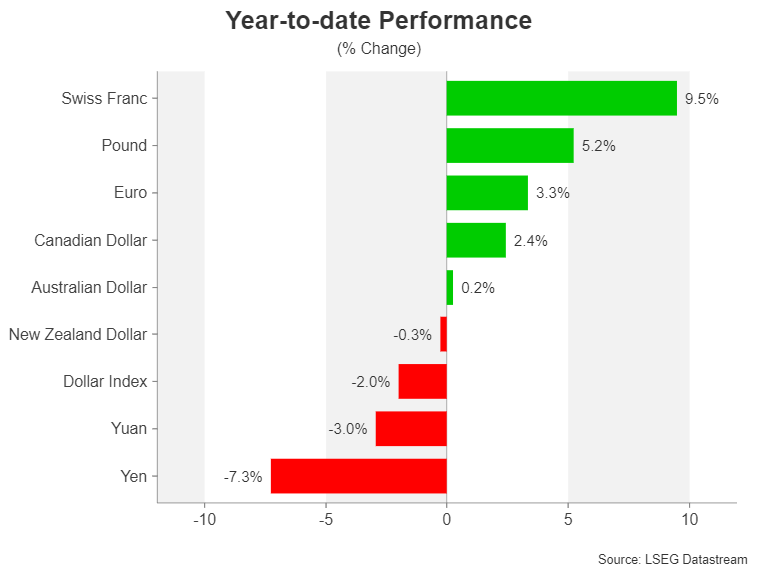
Cumulative rate cut odds for 2024 are fast approaching 160 basis points. This seems excessive when considering that the US economy is not in recession and Fed officials are only predicting about three 25-bps cuts. The minutes of the December meeting that produced those forecasts are due on Wednesday and FOMC members might attempt to use the publication to reinforce their view of only modest policy easing over the next couple of years.
A not too cold, not too hot jobs report
Another clue on the rate path will be policymakers’ outlook on the jobs market as they’ve recently indicated that as inflation comes down, their focus on the Fed’s other mandate – employment – will increase.
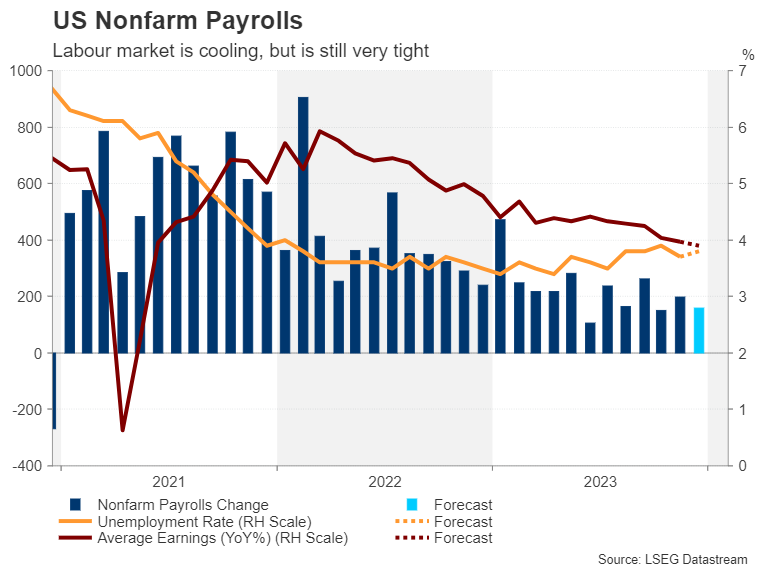
This might explain Powell’s lack of caution in being eager to steer policy towards easing on fear that holding rates at restrictive levels for too long might push up the unemployment rate. However, it’s been so far so good as far as the labour market is concerned. Jobs growth has slowed but companies aren’t laying off staff in big numbers, allowing wages to rise at a moderate pace.
Analysts don’t expect this picture to have altered much in December. Nonfarm payrolls are projected to rise by 158k, down from 199k in November, while the jobless rate is forecast to tick up slightly to 3.8%. Average earnings aren’t anticipated to rock the boat either, with the month-on-month rate expected at 0.3% and the year-on-year figure at 3.9% versus 4.0% previously.
Will there be a rude awakening for the markets?
Given investors’ strong conviction that the Fed will soon start slashing rates, a small beat or miss in the headline print is unlikely to generate anything more than a kneejerk reaction in the dollar. A very disappointing report isn’t very probable as weekly jobless claims have been quite low during the month. So if there will be a shock, it will be from an unexpectedly hot report.
The dollar could jump higher along with yields, while Wall Street could succumb to panic selling from investors scaling back their rate cut bets on the back of upbeat NFP readings. But in the event that the jobs data fails to provide any fresh direction, investors will probably turn to the other releases of the week.
These will include the ISM manufacturing and non-manufacturing PMIs, due on Wednesday and Friday, respectively, the JOLTS job openings on Wednesday, Challenger layoffs on Thursday, and factory orders on Friday.
Some risks ahead for the loonie and aussie
Across the border in Canada, the loonie will be keeping tabs on the domestic labour market as rate cut bets for the Bank of Canada have also been ratcheted up lately. The Canadian dollar is on track to have gained about 2.5% against its US counterpart in 2023, faring somewhat better than the other commodity-linked currencies, the Australian and New Zealand dollars. Less exposure to China and a more unquestionably hawkish stance by the BoC have contributed to its relative outperformance versus the aussie and kiwi.
However, there’s a risk that 2024 might be more of a struggle for the loonie if stagnating economic growth forces the Bank of Canada to start lowering rates. The country’s unemployment rate has been steadily edging up since May and likely rose further in December to 5.9%, data on Friday is expected to show.
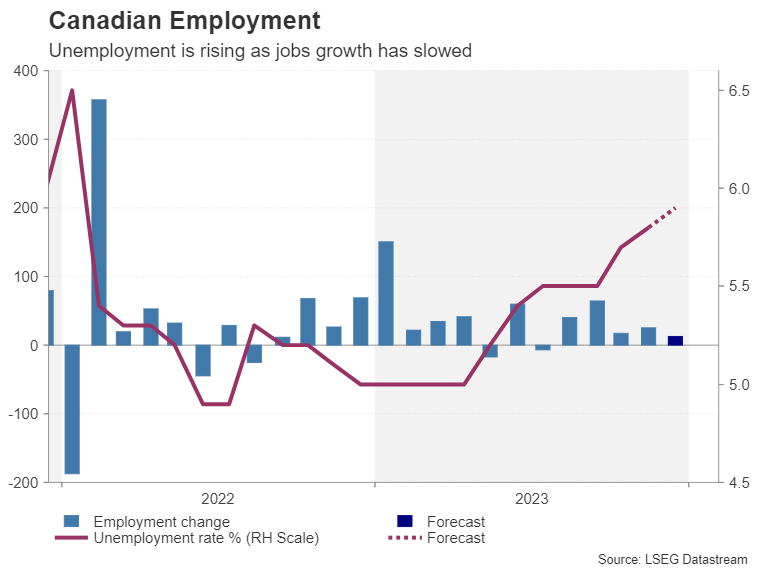
Although employment has been rising during this period, it hasn’t been able to keep pace with the growth in the number of jobseekers. It’s expected that the economy added just 13.2k jobs in December. Nevertheless, wage growth remains elevated at 5.0% so investors will be watching that figure too, as well as the latest Ivey PMI gauge on Friday.
PMI data will also be important for the Australian dollar as China’s two sets of releases are due next week. The official government survey is out on Sunday and the Caixin/S&P Global version will follow on Tuesday. Any slowdown in China’s manufacturing PMIs in December could hurt risk sentiment at the turn of the year, weighing on equities as well as the aussie.
Eurozone inflation could reverse decline
A currency that will probably take the middle spot in the 2023 FX league table is the euro. The single currency has had a few ups and downs of its own over the past year, but overall, it’s been propped up by a more hawkish-than-anticipated ECB. It’s likely, though, that in 2024, a weaker Eurozone economy will spur the European Central Bank to slash rates more than the Fed. Yet, with US yields falling faster than Eurozone ones, the euro has come out a winner from all the frenzy of rate cut speculation.
Unlike the Fed, the ECB is wary about sending any pivot signals before it can be sure that inflation is well and truly headed towards 2%. The flash CPI readings for December will probably justify this caution on Friday. Headline CPI is forecast to accelerate from 2.4% to 3.0% y/y in December, suggesting there’s still some way to go before inflation settles sustainably around the 2% target.
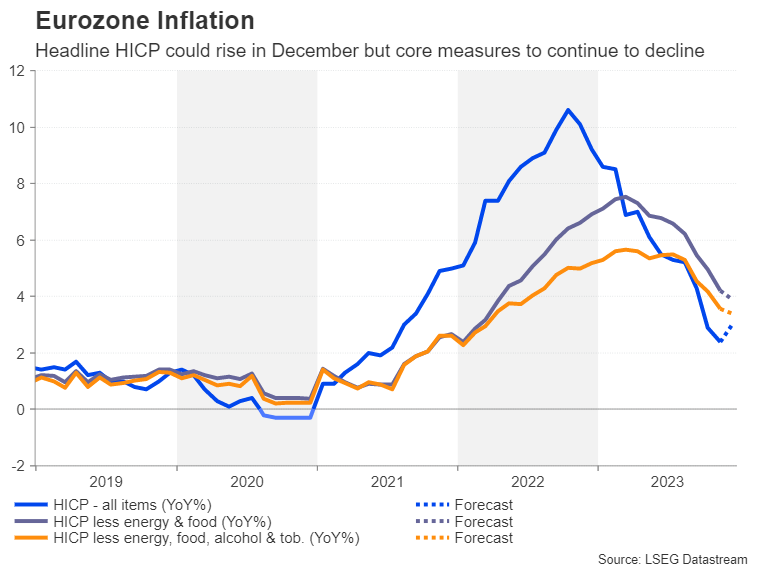
However, the forecasts for the underlying measures of inflation are more encouraging, with core CPI that excludes food and energy, as well as tobacco and alcohol prices, projected to decline from 3.6% to 3.4% y/y.
If that turns out to be the case, investors may well leave their rate cut wagers untampered, meaning there may not be any additional boost for the euro against the greenback from any pickup in headline inflation.
What To Trade In January
Hey friends, as we prepare for the new month, and the new year, here are some of my anticipated trade ideas for January. Do note, however, that these are long-term views and would therefore require patience as they unfold.
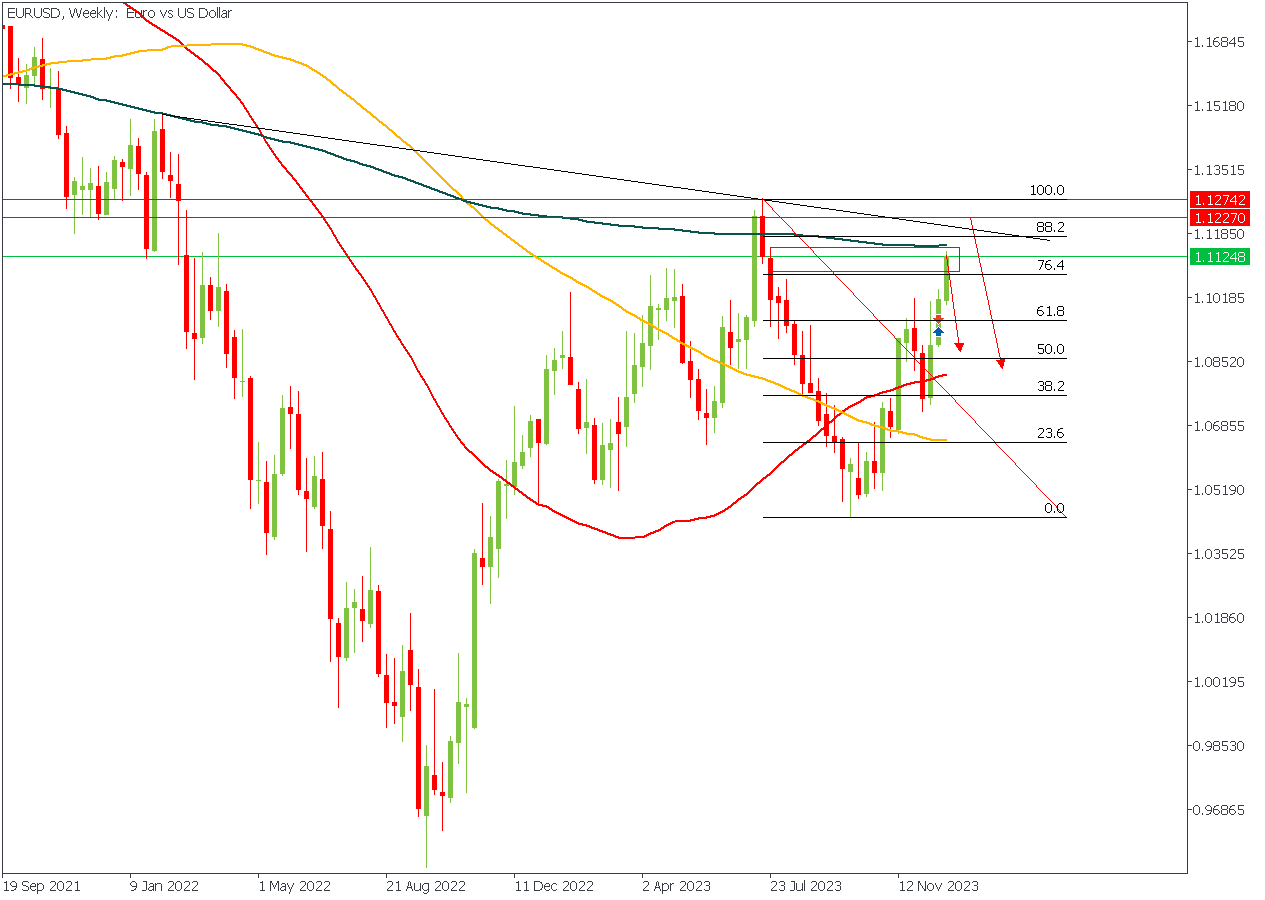
EURUSD - W1 Timeframe
EURUSD on the Weekly timeframe has reached a supply zone, and price could begin to fall from that region. In addition to the supply zone, there are also other confluences present, including; the 200-period moving average resistance, the Fibonacci retracement level, Quassimodo reversal pattern, and a resistance trendline.
Analyst’s Expectations:
- Direction: Bearish
- Target: 1.08659
- Invalidation: 1.11551
GBPUSD - D1 Timeframe
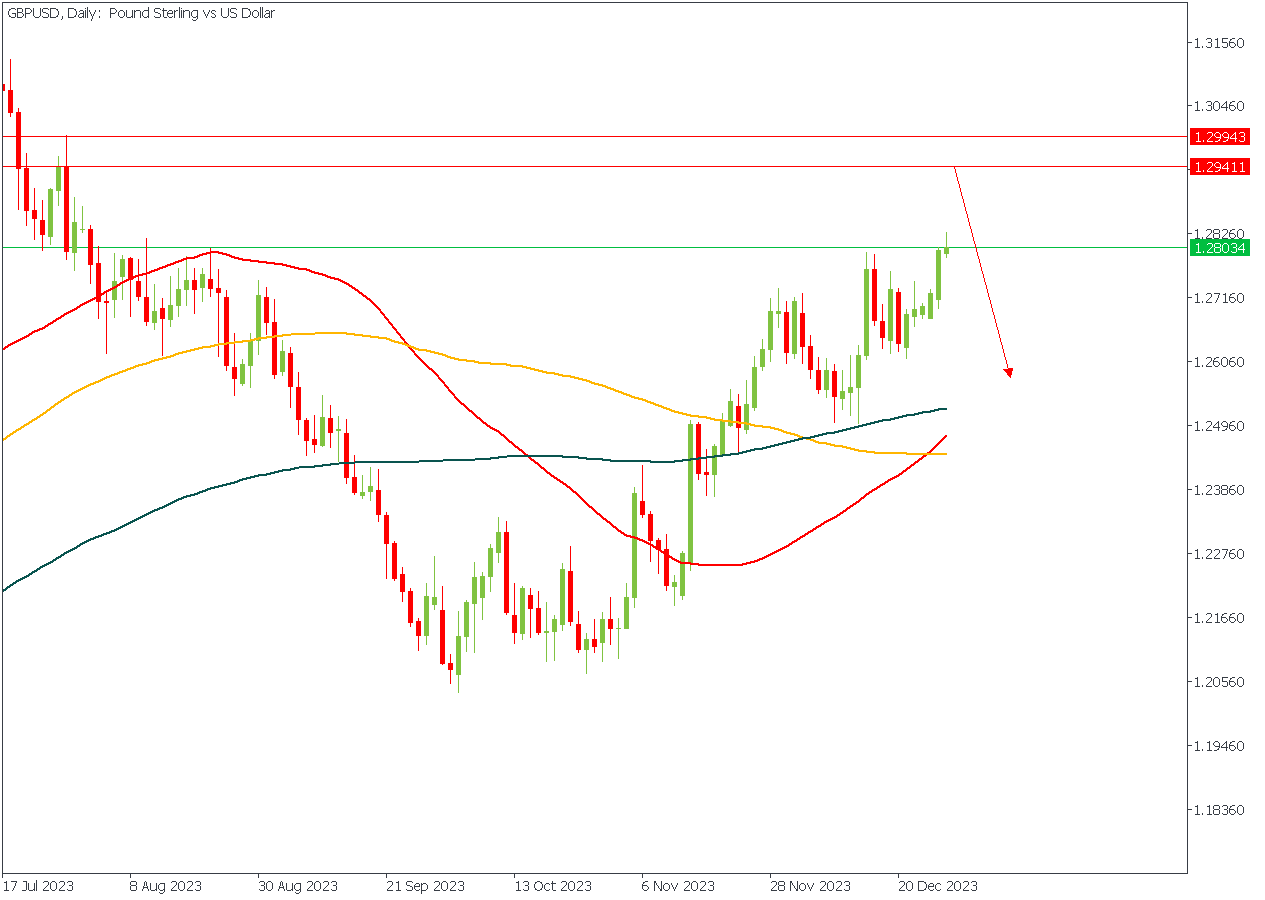
In the case of GBPUSD, price has not yet reached the supply zone. It is my expectation, however, that price would make a quick bounce away from the supply zone as soon as it reaches it. Another possible scenario is that price could begin to decline any time from now, provided that we get to see a change in the market structure (ChoCh).
Analyst’s Expectations:
- Direction: Bearish
- Target: 1.09328
- Invalidation: 1.11535
USDCHF - W1 Timeframe
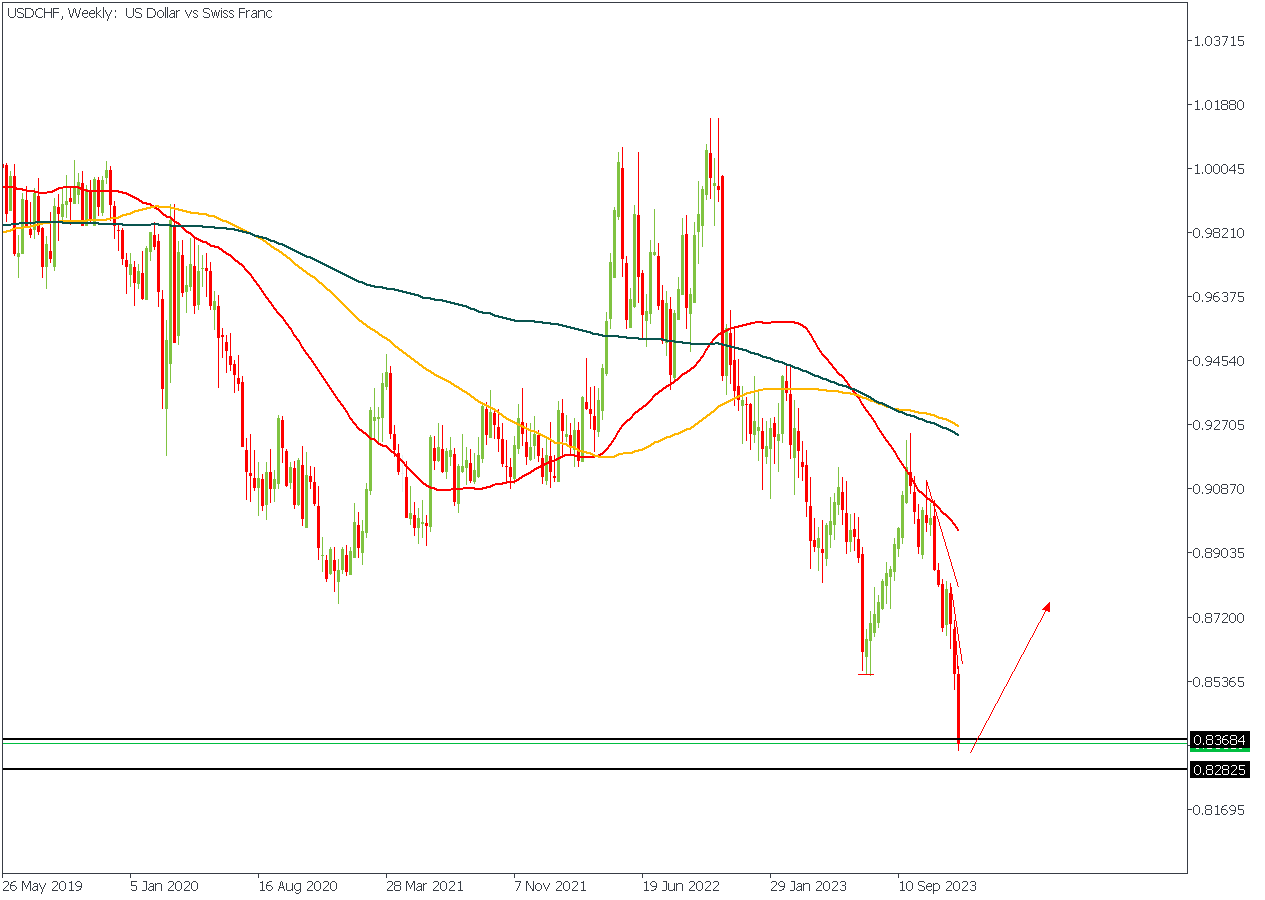
The weekly timeframe of USDCHF presents us with an interesting scenario as we see price trading within the demand zone. Within this demand zone, I will be waiting patiently for a clear reversal pattern before I take a long position, however, I am certain the overall sentiment is bullish since price has not created a new lower high yet in recent times.
Analyst’s Expectations:
- Direction: Bearish
- Target: 0.85041
- Invalidation: 0.82790
CONCLUSION
The trading of CFDs comes at a risk. Thus, to succeed, you have to manage risks properly. To avoid costly mistakes while you look to trade these opportunities, be sure to do your due diligence and manage your risk appropriately.
USDCAD Stages a Rebound After Sharp Selloff
- USDCAD is recovering following December nosedive
- Positive momentum is gaining traction but sustained rebound not certain yet
- Is this just a temporary respite?
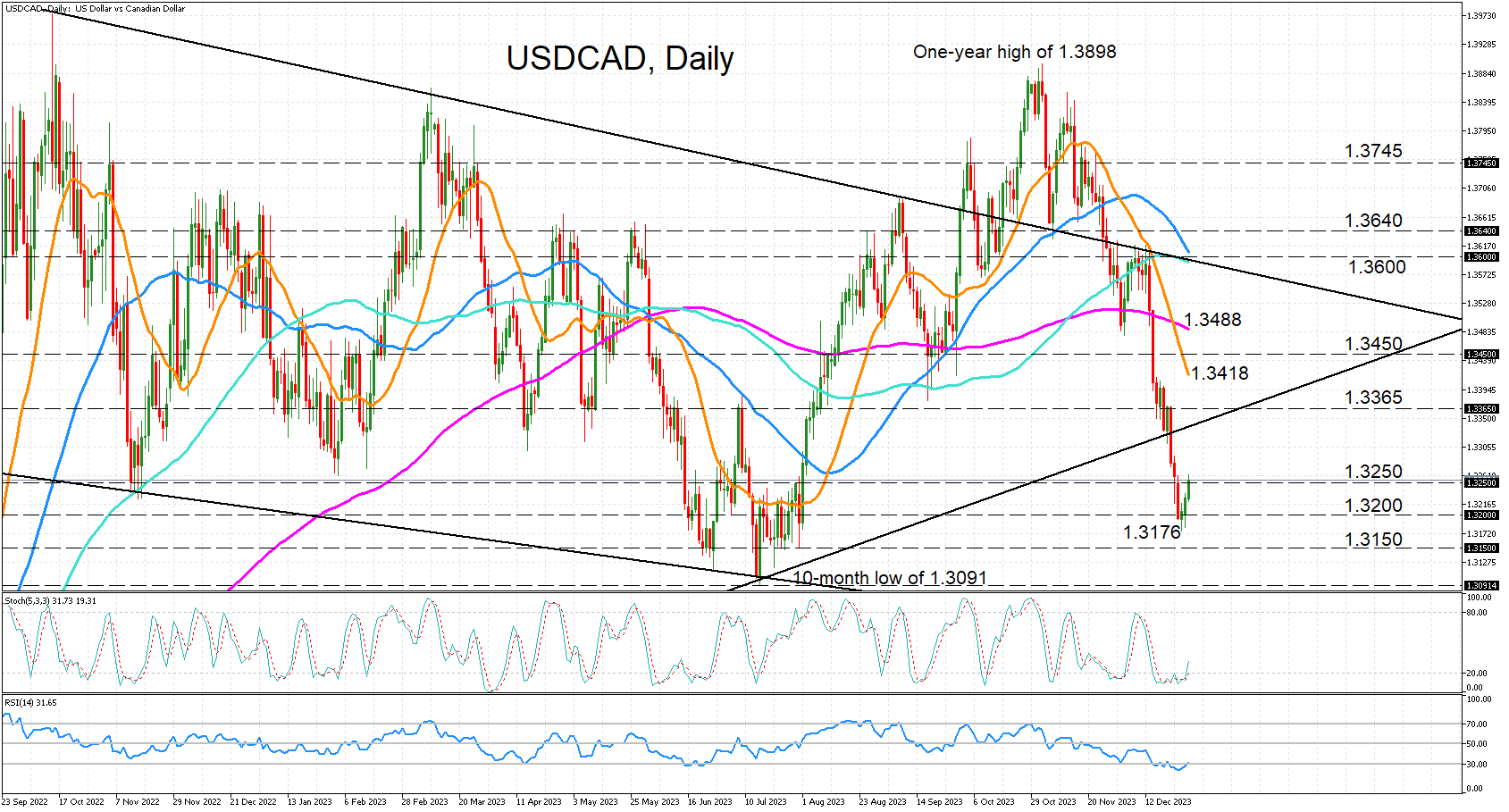
USDCAD is headed for a third straight day of gains as it recovers from Wednesday’s five-month low of 1.3176. The pair’s two-month old slide accelerated in mid-December, pushing the momentum indicators deep into oversold territory.
But the bearish pressures have started to ease, with the immediate bias turning positive, as both the stochastics and RSI are attempting to exit their oversold zones. However, there is some way to go before a clearer picture of a durable recovery starts to emerge.
The pair is testing the congestion region of 1.3250 today. A daily close above this level followed by a break above the next hurdle of 1.3365 would provide more tenacity to the bulls. But ideally, the price would need to climb to at least above the 20-day simple moving average (SMA), currently located at 1.3418, for the rebound to become more sustainable. If successful, this would lay the groundwork for a push towards the 1.3600 area where the 50- and 100-day SMAs are about to intersect.
However, if the bullish momentum fades and the price reverses lower, the 1.3200 level is the nearest and only support preventing USDCAD from resuming its medium-term downtrend. A drop below 1.3200 would clear the path for the 1.3150 area before revisiting the July trough of 1.3091.
In brief, this week’s bounce for USDCAD is still in its infancy and for the short-term picture to improve convincingly, the bulls need to reclaim the 20-day SMA. Otherwise, the pair could be headed for fresh lows.
Japanese Yen Edges Higher
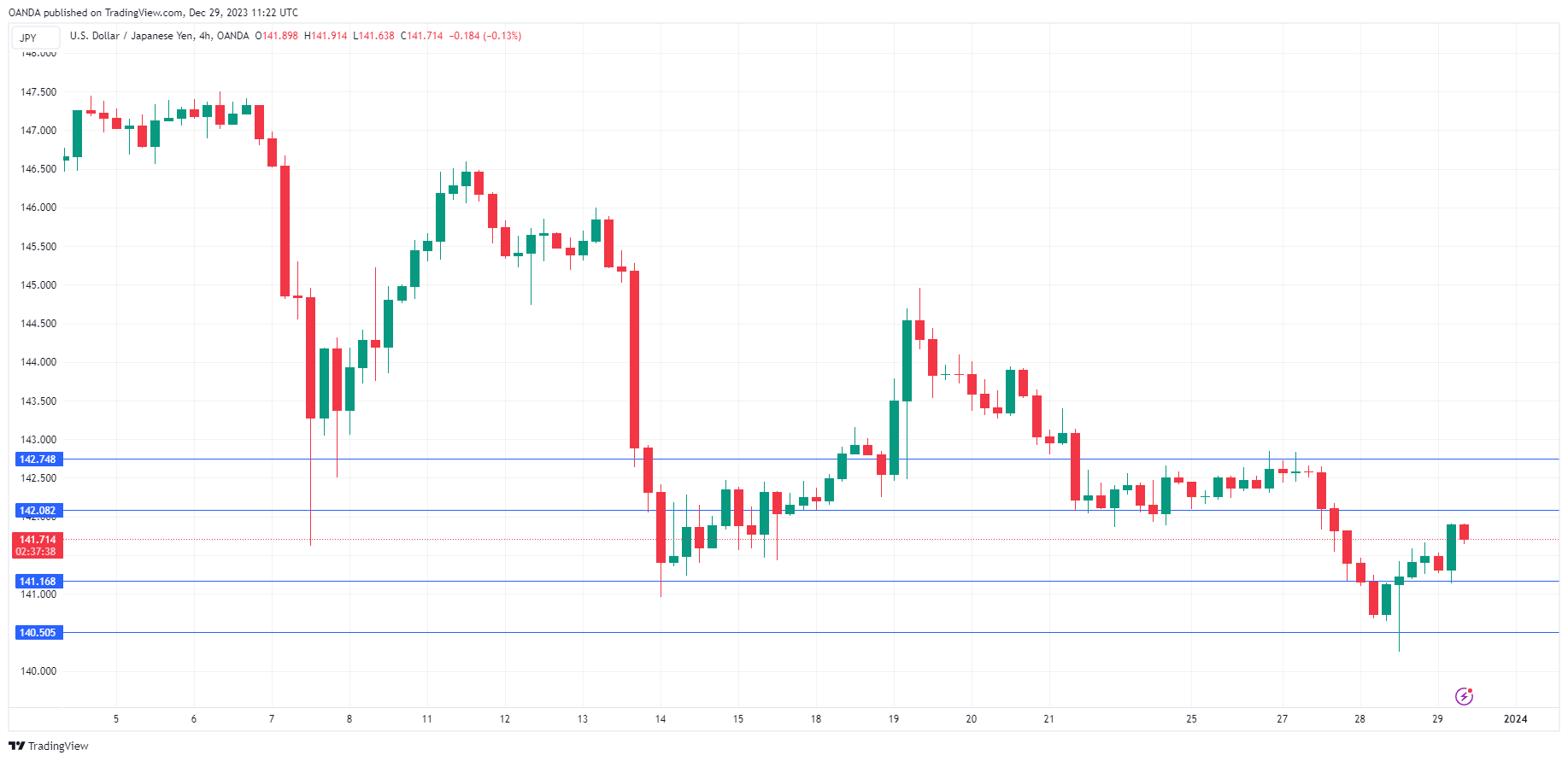
The Japanese yen is slightly lower on Friday. In the European session, USD/JPY is trading at 141.75, up 0.27%.
The US dollar has taken a tumble in recent weeks against most of the major currencies, including the yen. Since mid-November, the yen has jumped 6.4% against the ailing US dollar. This has relieved pressure on Tokyo to intervene in the currency markets, which was a serious concern just six weeks ago when the exchange rate was above 151.
The Bank of Japan didn’t adjust its policy settings at the December meeting, although speculation was high that the BoJ might make a shift after Governor Ueda hinted at a change in policy before the meeting. The BoJ could make a move in January or perhaps in April, after the annual wage negotiations in March.
The markets are expecting the Fed to hit the rate cut button early and often next year. The markets have priced in a rate cut by March at 86% and anticipate 150 basis points in cuts next year. The Fed is more cautious, and Fed members have urged the markets to lower these expectations.
Chicago PMI expected to decelerate
The US releases Chicago PMI, an important business barometer, later today. The PMI was unexpectedly strong in November with a reading of 55.8, which marked the first expansion after fourteen straight months of contraction. The 50 line separates expansion from contraction.
The upward spike may have been a one-time occurrence due to the end of the United Auto Workers strike as activity rose in the auto manufacturing industry. The consensus estimate for December stands at 51.0, which would point to weak expansion.
USD/JPY Technical
- USD/JPY tested support at 141.16 before reversing directions. The next support level is 140.50
- There is resistance at 142.08 and 142.74
New Zealand Dollar Under Pressure, Chinese PMIs Next
- Chicago PMI expected to decelerate
- China releases PMIs on Saturday
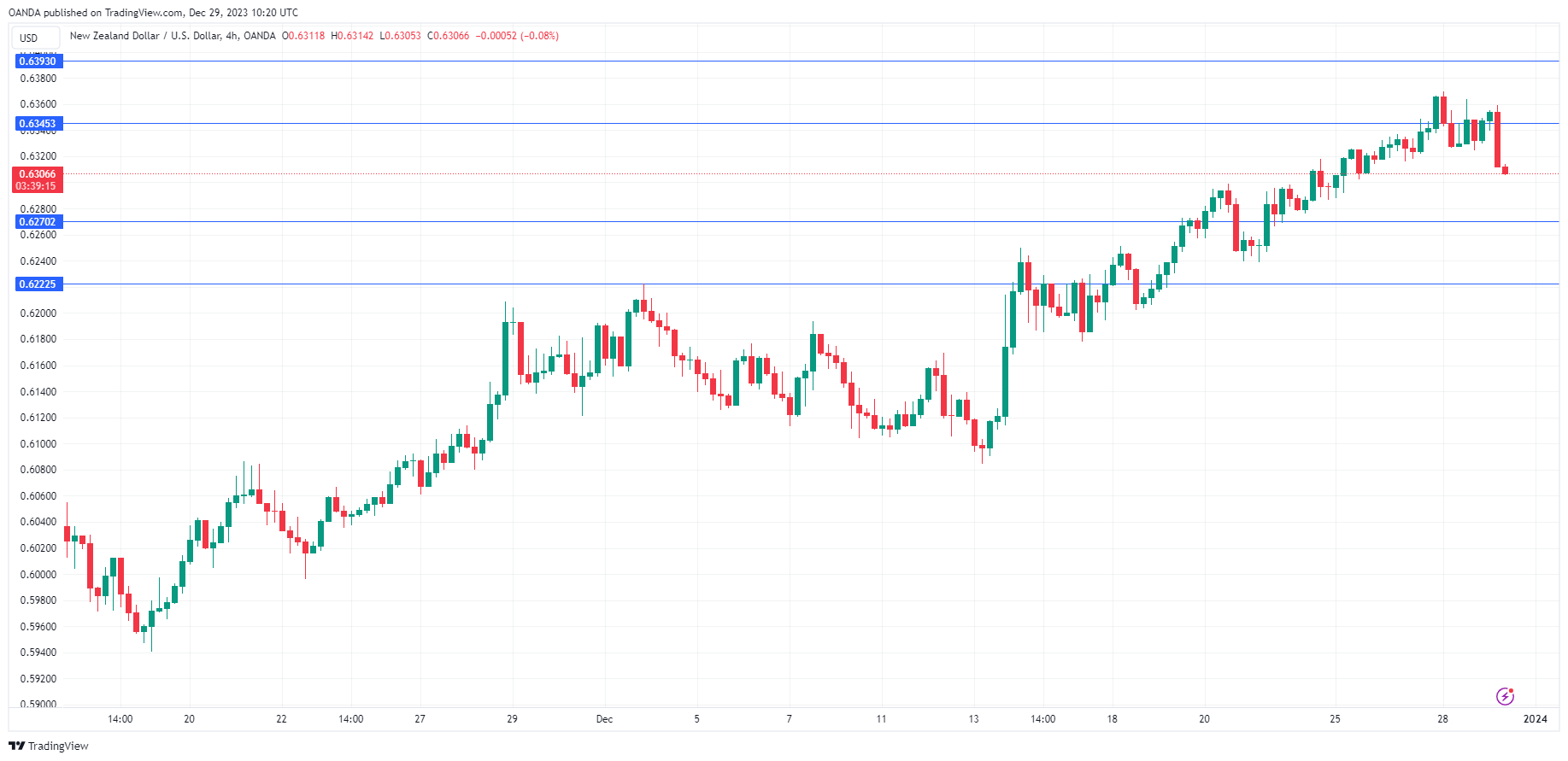
The New Zealand dollar is in negative territory on Friday. In the European session, NZD/USD is trading at 0.6308, down 0.37%.
The US dollar has hit a rough patch lately and retreated against most of the majors. The New Zealand dollar has been full marks, climbing some 400 basis points over the past five weeks. The Federal Reserve meeting earlier this month has boosted risk appetite, as Fed Chair Powell jumped on the rate-cut bandwagon, signalling that the Fed is finally done raising interest rates.
Powell pencilled in three rate cuts next year while the markets have priced in double that. Fed members have urged caution, but the markets remain exuberant and have priced in an initial rate cut in March. Inflation is getting closer to the 2% target and with the labour market in good shape, it looks like the Fed could guide the US economy to a soft landing and avoid a recession.
New Zealand doesn’t release any tier-1 events until mid-January, but Chinese PMIs, which will be released on Saturday, could have an impact on the direction of the New Zealand dollar. China is New Zealand’s largest export market and the PMIs will provide a report card on the health of China’s service and manufacturing sectors. China’s recovery has been patchy and the slowdown has resulted in deflation in the world’s number two economy. The manufacturing sector has been stuck in contraction for most of this year and non-manufacturing expansion has been steadily falling and has stagnated over the past two months.
The US releases Chicago PMI, an important business barometer, later today. The PMI shocked in November with a reading of 55.8, which marked the first expansion after fourteen straight months of contraction. The upward spike may have been a one-time occurrence due to the end of the United Auto Workers strike as activity rose in the auto manufacturing industry. The consensus estimate for December stands at 51.0, which would point to weak expansion.
NZD/USD Technical
- NZD/USD tested resistance at 0.6345 in the Asian session but has reversed directions. Below, there is support at 0.6031
- There is resistance at 0.6150 and 0.6195
EUR/USD Steady as Spanish CPI Lower than Expected
- Spanish CPI lower than expected at 3.1%
- Chicago PMI expected to decelerate to 51.0
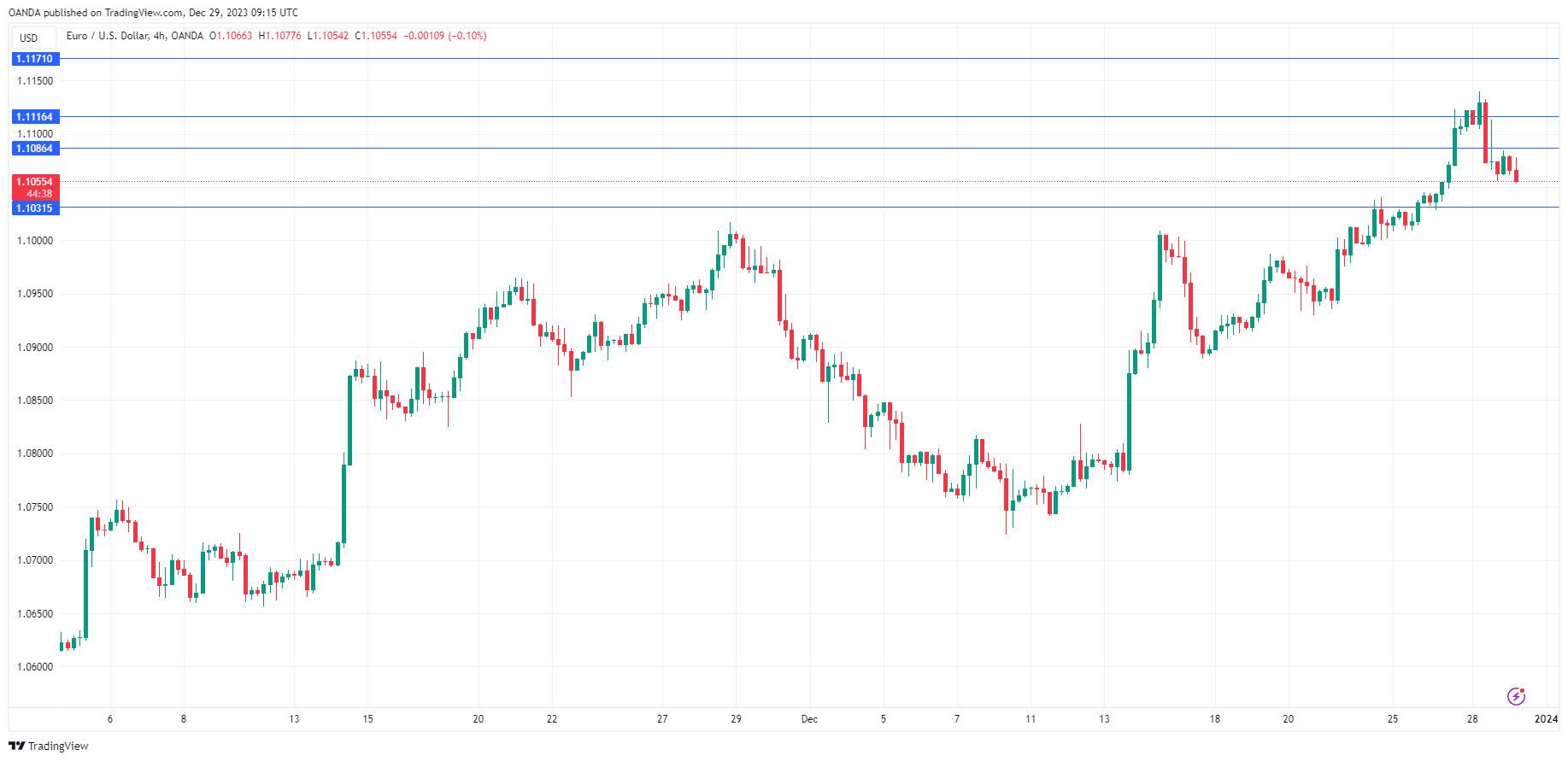
The euro is calm in Friday trade. In the European session, EUR/USD is trading at 1.1053, down 0.08%.
Spanish CPI dips to 3.1%
Spain released the December inflation report today, with CPI dipping to 3.1% y/y, down from 3.2% in November. This was better than expected as the consensus estimate stood at 3.4%. The reading was the lowest rate since August, with the drop attributed to lower prices for fuel, food and electricity. Monthly, CPI rose from -0.3% to 0.0%, but this was lower than the consensus estimate of 0.3%. Core CPI dropped to 3.8% y/y, down from 4.5% in November.
Germany, France and the eurozone will follow with their inflation releases next week. If the data shows that inflation eased in December, it will put pressure on the European Central Bank to cut rates in the first half of 2024. The ECB has not followed the Federal Reserve and continues to push back against rate-cut expectations. The markets have priced in 150 basis points from the ECB next year, with an initial cut expected in April.
ECB President Lagarde has poured cold water over rate-cut fever, saying that the ECB should “absolutely not lower its guard”. Lagarde may have to shift her hawkish stance or risk tipping the weak eurozone economy into a recession. If next week’s inflation report indicates that inflation is falling, we can expect the voices in the ECB calling for looser policy to get louder.
The US releases Chicago PMI, an important business barometer, later today. The PMI shocked in November with a reading of 55.8, which marked the first expansion after fourteen straight months of contraction. The upward spike may have been a one-time blip due to the end of the United Auto Workers strike as activity rose in the auto manufacturing industry. The consensus estimate for December stands at 51.0, which would point to weak expansion.
EUR/USD Technical
- EUR/USD continues to put pressure on resistance at 1.1086. Above, there is resistance at 1.1171
- 1.1116 and 1.1031 are providing support
GBPUSD Halts Advance But Retains Bullish Structure
- GBPUSD pares some gains after posting a 4-month peak
- Positive bias holds as momentum indicators are skewed to the upside
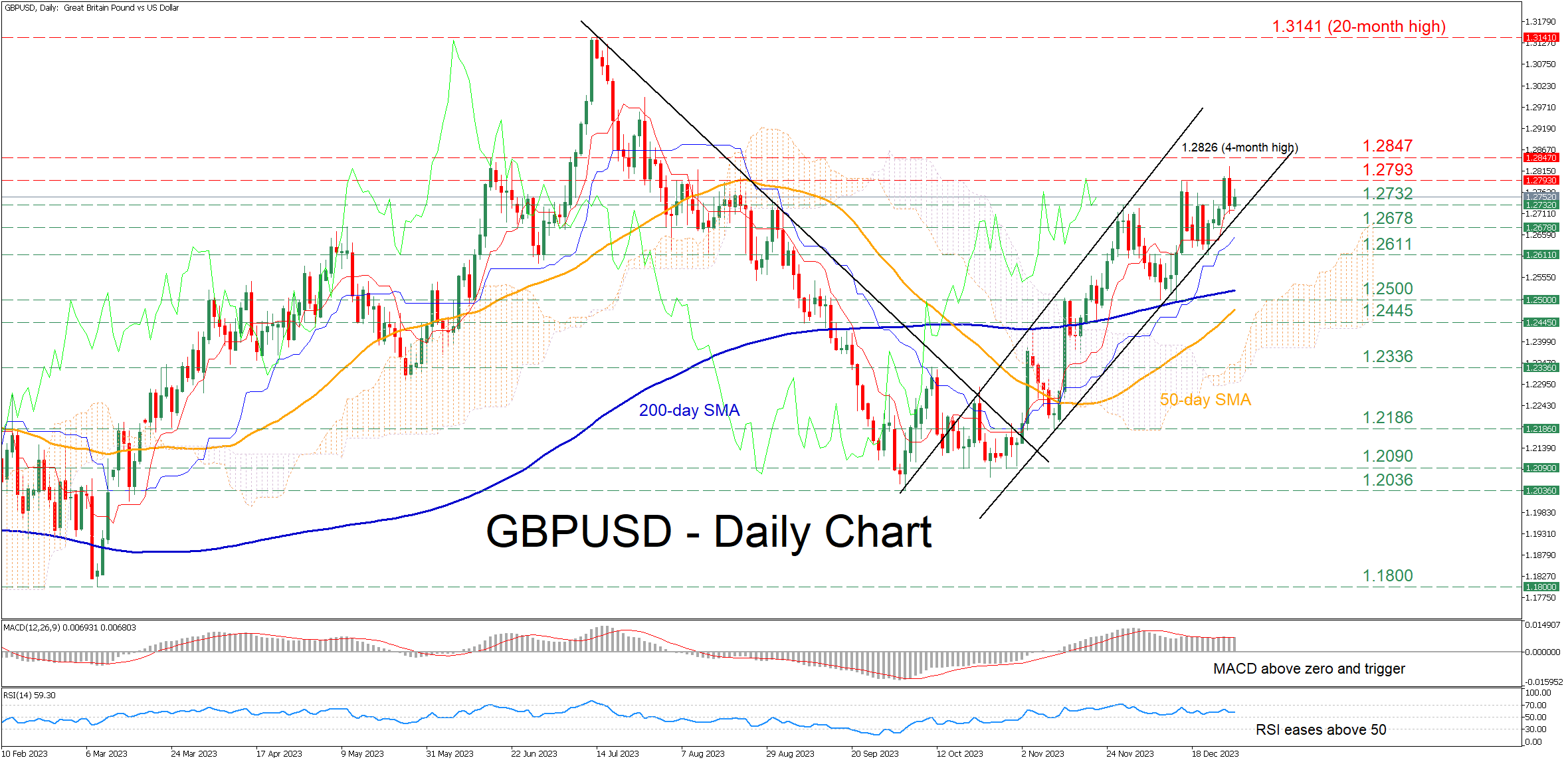
GBPUSD had been forming a profound structure of higher highs following its break above a crucial descending trendline in early November. Although the pair’s rally has temporarily paused at the four-month peak of 1.2826, the impending completion of a golden cross between the 50- and 200-day simple moving averages (SMAs) could infuse upside pressures.
Given that both the RSI and MACD are within their positive territories, the bulls could attempt to erase the latest weakness and conquer the recent resistance of 1.2793. A violation of that hurdle could open the door for the four-month peak of 1.2826. Failing to halt there, the pair might advance towards the June high of 1.2847.
On the flipside, if the pair reverses lower, a couple of previous resistance territories such as 1.2732 and 1.2678 may now act as initial lines of defense. Piercing through that floor, the price may then descend towards the recent support of 1.2611. Even lower, the December bottom of 1.2500 could provide downside correction.
In brief, even if GBPUSD’s advance seems to be losing steam, near-term risks remain clearly tilted to the upside. For that to change, the price needs to decisively break below its upward sloping channel.
EUR/GBP Daily Outlook
Daily Pivots: (S1) 0.8667; (P) 0.8691; (R1) 0.8713; More...
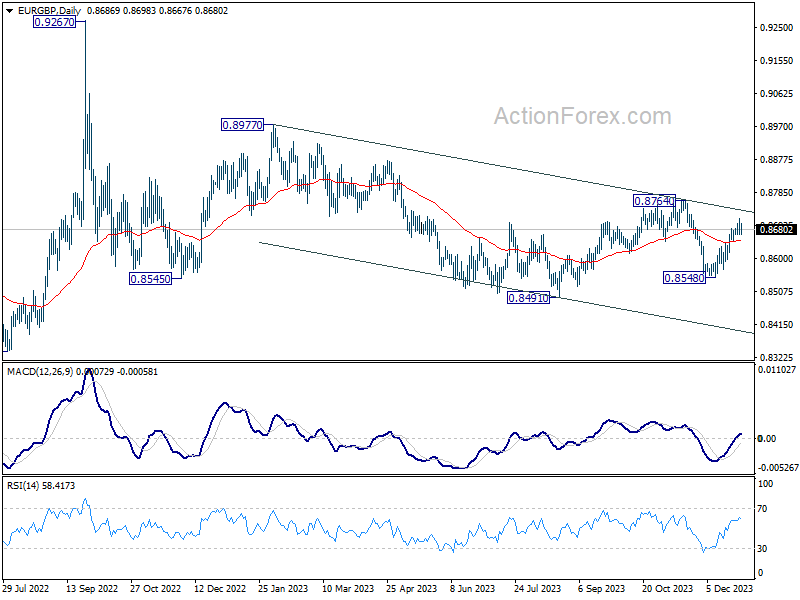
For now, further rally could still be seen in EUR/GBP with 0.8649 intact. Rebound from 0.8548 could extend to 0.8764 key resistance. Nevertheless, break of 0.8649 will argue that the rebound has completed, and turn bias back to the downside for 0.8548 support instead.
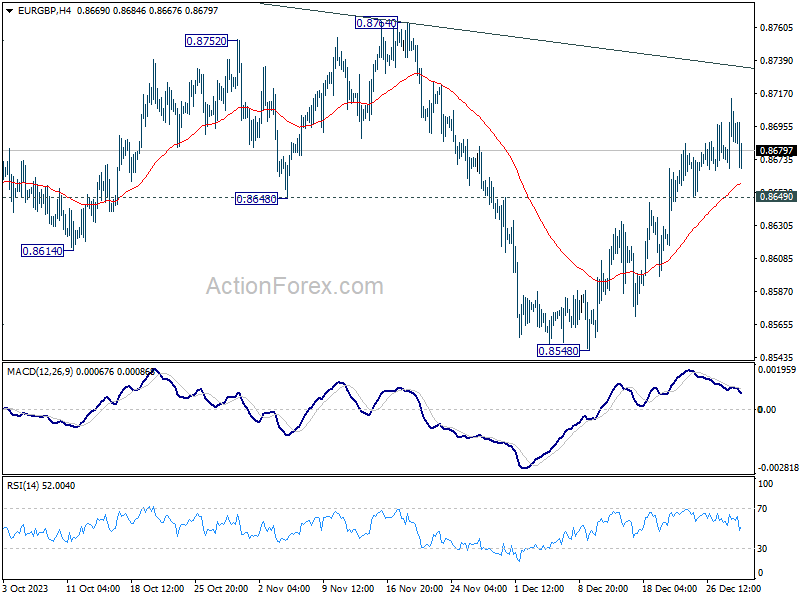
In the bigger picture, current development suggests that down trend from 0.9267 (2022 high) is still in progress. This decline is seen as the third leg of the pattern from 0.9499 (2020 high). Break of 0.8201 will target 100% projection of 0.9499 to 0.8201 from 0.9267 at 0.7969. In any case, outlook will stay bearish as long as 0.8764 resistance holds.