Sample Category Title
EUR/USD Mid-Day Outlook
Daily Pivots: (S1) 1.0908; (P) 1.0930; (R1) 1.0962; More...
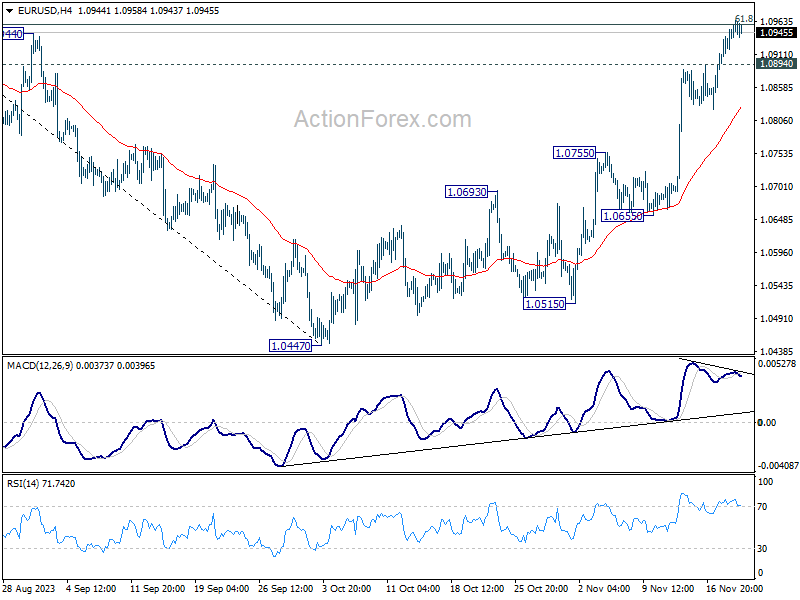
EUR/USD is losing some upside momentum as seen in 4H MACD, but there is no clear sign of topping yet. Sustained break of 61.8% retracement of 1.1274 to 1.0447 at 1.0958 will pave the way to retest 1.1274 high. On the downside, below 1.0894 minor support will turn bias to the downside for deeper retreat.
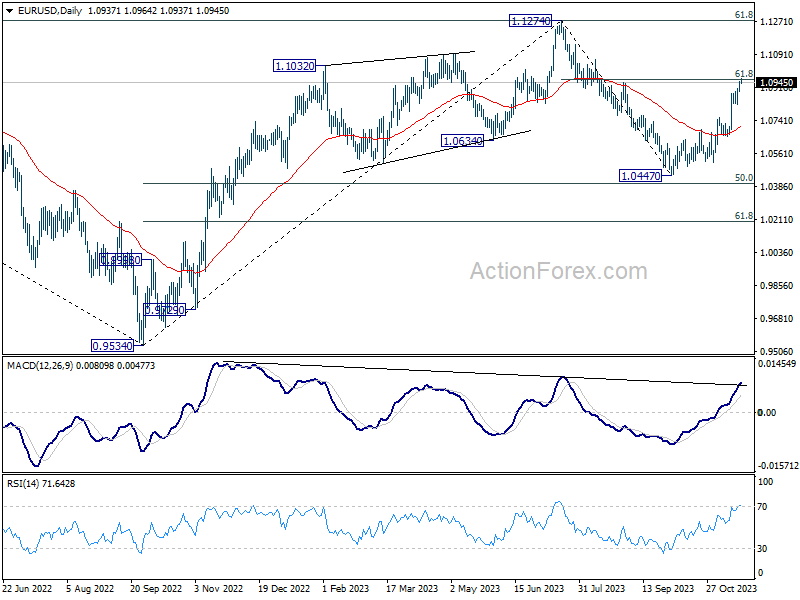
In the bigger picture, price actions from 1.1274 are viewed as a corrective pattern to rise from 0.9534 (2022 low). Rise from 1.0447 is tentatively seen as the second leg. Hence while further rally could be seen, upside should be limited by 1.1274 to bring the third leg of the pattern.
GBP/USD Mid-Day Outlook
Daily Pivots: (S1) 1.2461; (P) 1.2490; (R1) 1.2533; More...
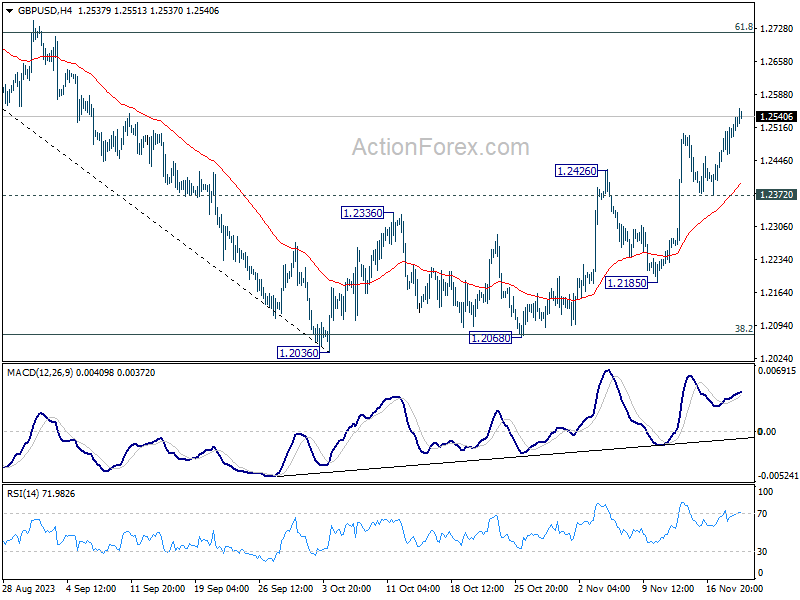
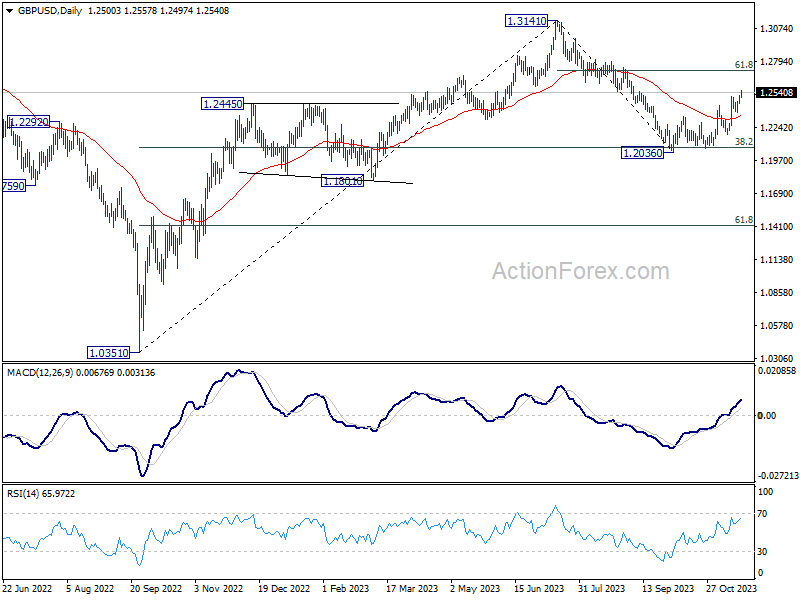
GBP/USD's rise form 1.2036 is extending and intraday bias stays on the upside. Current rally should target 61.8% retracement of 1.3141 to 1.2036 at 1.2716 next. On the downside, break of 1.2372 support is needed to indicate short term topping. Otherwise, further rally will remain in favor in case of retreat.
In the bigger picture, price actions from 1.3141 are seen as a corrective pattern to rise from 1.0351 (2022 low). Strong rebound from 38.2% retracement of 1.0351 (2022 low) to 1.3141 at 1.2075 argues that current rise from 1.2036 is the second leg. However, while further rally could be seen, upside should be limited by 1.3141 to bring the third leg of the pattern.
USD/CHF Mid-Day Outlook
Daily Pivots: (S1) 0.8828; (P) 0.8849; (R1) 0.8872; More....
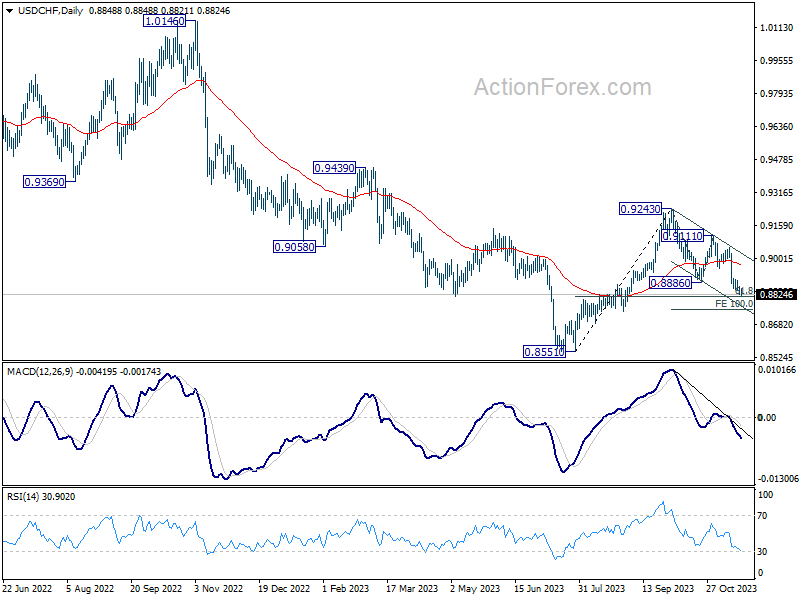
USD/CHF is losing some downside momentum as seen in 4H MACD. But intraday bias stays on the downside with 0.8898 minor resistance intact. Current fall from 0.9243 should target 100% projection of 0.9243 to 0.8886 from 0.9111 at 0.8754 next. On the upside, above 0.8898 minor resistance will turn intraday bias neutral and bring consolidations again. But in case of recovery, outlook will stay bearish as long as 0.8952 support turned resistance holds.
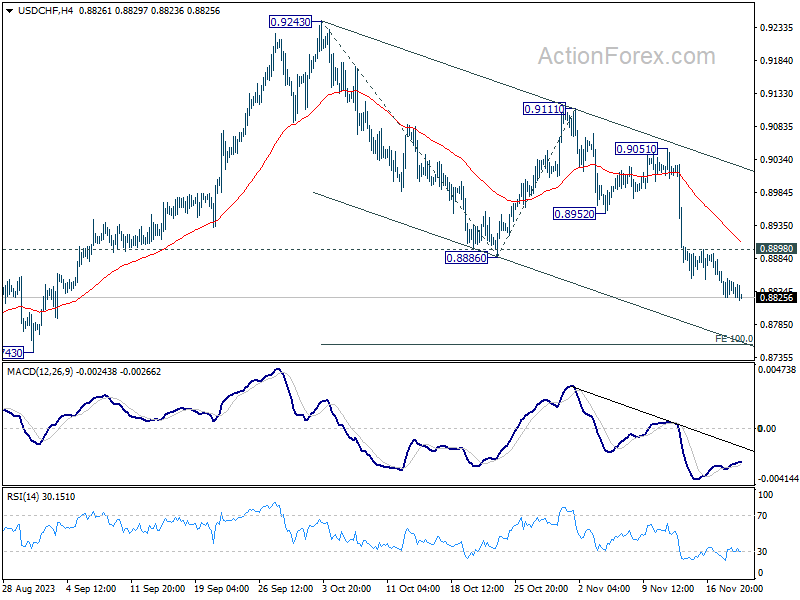
In the bigger picture, price actions from 0.8551 are currently seen as part of a corrective pattern to the decline from 1.0146 (2022 high). Fall from 0.9243 is seen as the second leg for now. Deeper fall would be seen to 61.8% retracement of 0.8551 to 0.9243 at 0.8815. Sustained break there will bring retest of 0.8551 low. For now, this will remain the favored case as long as 0.9111 resistance holds.
USD/JPY Mid-Day Outlook
Daily Pivots: (S1) 147.68; (P) 148.83; (R1) 149.55; More...
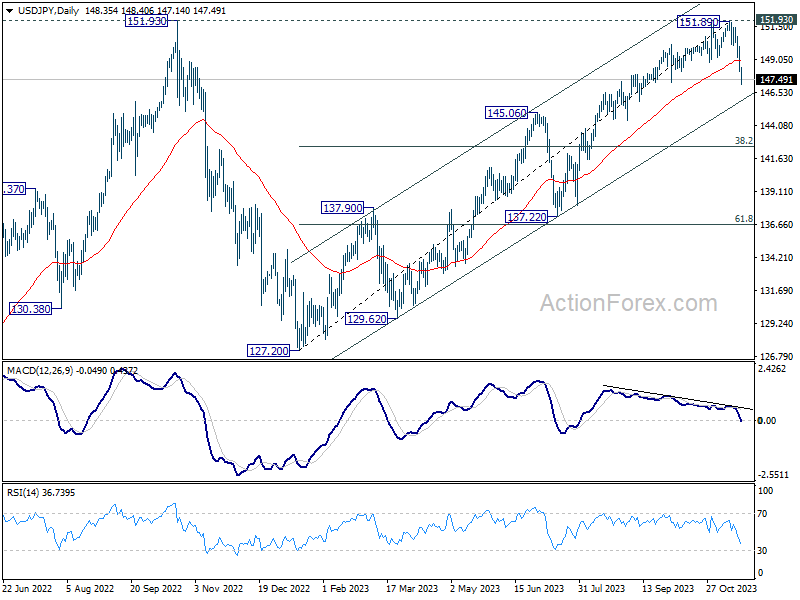
USD/JPY's fall from 151.89 is still in progress. Intraday bias stays on the downside for medium term channel support at 146.00 next. On the upside, above 148.67 minor resistance will turn intraday bias neutral and bring recovery. But risk will stay on the downside as long as 151.89 resistance holds.
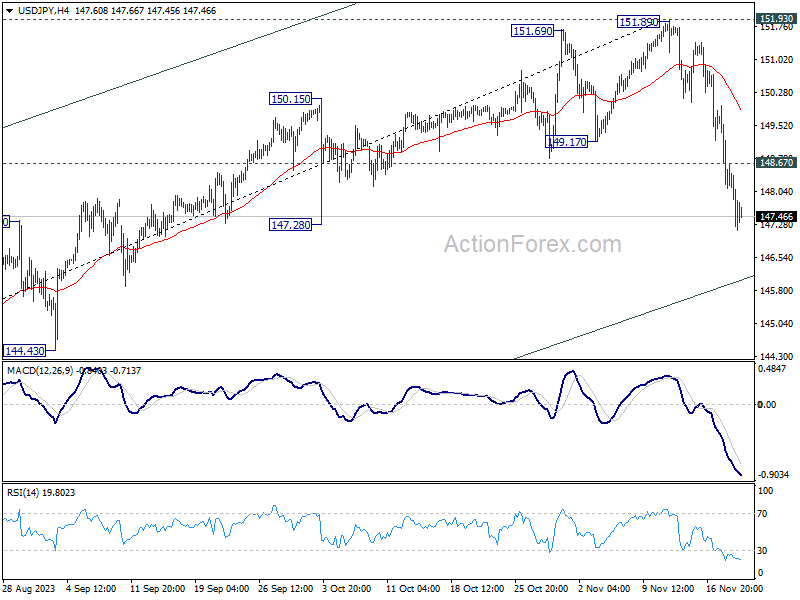
In the bigger picture, rise from 127.20 (2023 low) is seen as the second leg of the pattern from 151.93 resistance (2022 high). Decisive break of 145.06 resistance turned support will confirm that this second leg has completed, after rejection by 151.93. Deeper fall would be seen through 38.2% retracement of 127.20 to 151.89 at 142.45 to 61.8% retracement at 136.63. Nevertheless strong bounce from 145.06 will retain medium term bullishness for another test on 151.93 at a later stage.
USD/CAD Mid-Day Outlook
Daily Pivots: (S1) 1.3694; (P) 1.3722; (R1) 1.3754; More...
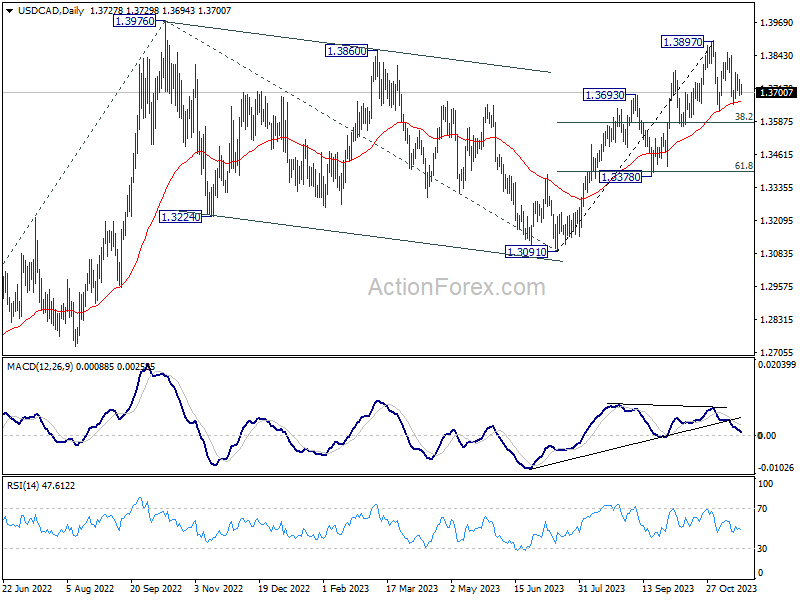
Intraday bias in USD/CAD remains neutral at this point as sideway trading continues. While another fall cannot be ruled out, downside should be contained by 38.2% retracement of 1.3091 to 1.3897 at 1.3589 to bring rebound. Break of 1.3897 is expected at a later stage to resume larger rally.
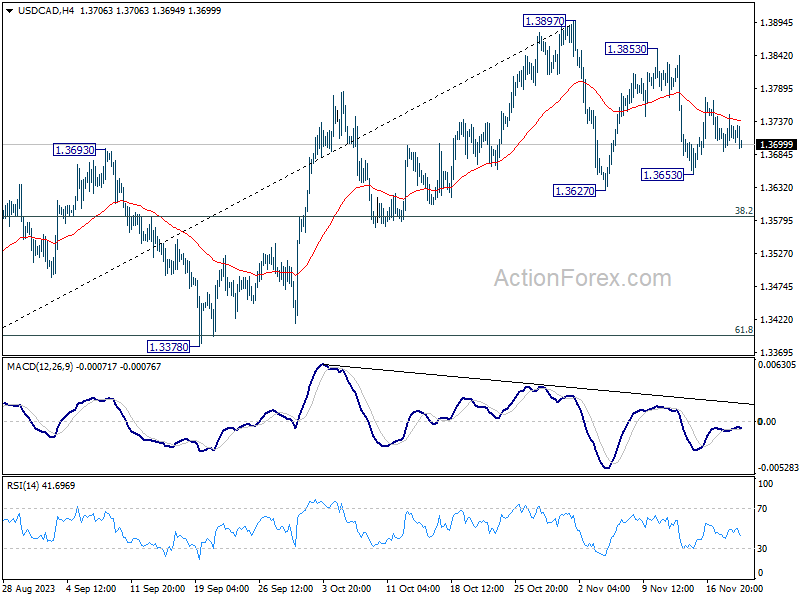
In the bigger picture, corrective pattern from 1.3976 (2022 high) should have completed with three waves down to 1.3091. Decisive break of 1.3976 high will confirm resumption of up trend from 1.2005 (2021 low). Next target is 61.8% projection of 1.2401 to 1.3976 from 1.3091 at 1.4064. This will remain the favored case as long as 1.3378 support holds.
Canadian Dollar Remains Weak Post-CPI, as Gold Breaches 2000 Barrier
Canadian Dollar exhibited softness in early US session, a reaction to lower-than-expected consumer inflation readings. This development, indicative of ongoing disinflation, could bolster BoC's confidence to maintain its current policy stance in the upcoming December meeting. Notably, Canadian Dollar has been unique among major currencies in its inability to break above prior week's high against Dollar. This performance is also influenced by recent weaknesses in oil prices, as WTI crude remains capped well below 80 mark despite some recovery this week.
Elsewhere in the currency markets, Dollar is trailing as the weakest performer. The upcoming FOMC minutes are not expected to provide substantial support to the greenback redirecting focus to developments in risk markets. Euro, meanwhile, is showing signs of struggle, especially evident in EUR/USD, which is losing upside momentum after encountering resistance at 1.0958 Fibonacci level. In contrast, Sterling is benefiting from hawkish comments by BoE Governor, making it a stronger European major currency.
New Zealand Dollar has emerged as today's strongest performer, narrowly outpacing the Japanese Yen. However, Yen still holds potential for further strengthening, particularly against Dollar. Australian Dollar, on the other hand, appears to be losing momentum.
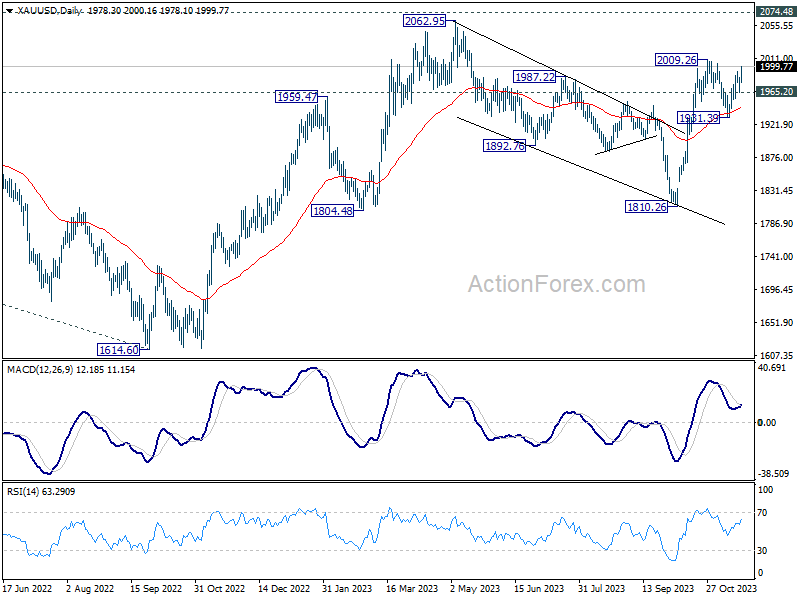
On the technical front, Gold's rise from 1931.39 resumed today and breached 2000 briefly. Further rally is expected as long as 1965.20 support holds. Retest of 2009.26 should seen next. Firm break there will resume whole rise from 1810.26 for key long term resistance zone at 2062.95/2074.48.
In Europe, at the time of writing, FTSE is down -0.55%. DAX is up 0.07%. CAC is down -0.35%. Germany 10-year yield is down -0.030 at 3.585. Earlier in Asia, Nikkei dropped -0.10%. Hong Kong HSI dropped -0.25%. China Shanghai SSE dropped -0.01%. Singapore Strait Times dropped -0.49%. Japan 10-year JGB yield dropped -0.0445 to 0.699.
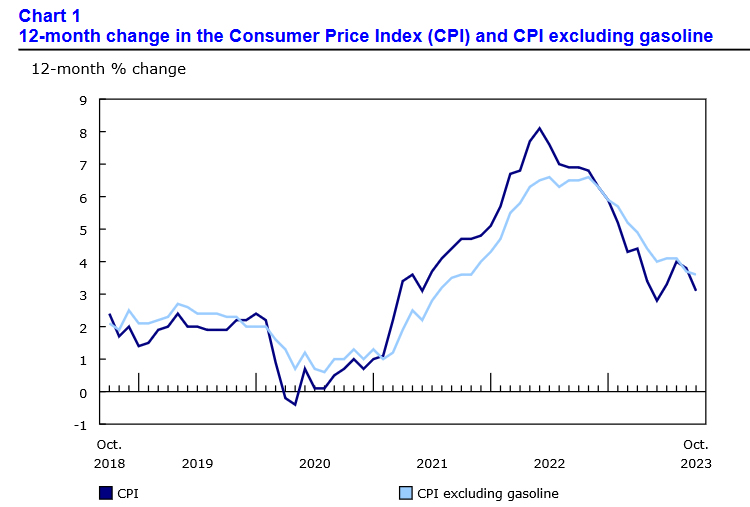
Canada CPI eased to 3.1% yoy in Oct, driven mainly by gasoline prices
Canada's CPI in October showcased a slowdown, dropping from 3.8% yoy to 3.1% yoy, falling slightly below market expectation of 3.2% yoy. This deceleration in inflation is primarily attributed to a significant reduction in gasoline prices, which decreased by -7.8% yoy. When gasoline is excluded from the equation, the CPI exhibited only a marginal decline, easing from 3.7% yoy to 3.6% yoy.
The breakdown of CPI data reveals contrasting trends between goods and services. Prices for goods saw notable deceleration, moving from 3.6% yoy to 1.6% yoy, with lower gasoline prices playing a major role in this decrease. Conversely, prices for services experienced acceleration, rising from 3.9% yoy to 4.6% yoy. This increase in service prices was driven largely by costlier travel tours, rent, property taxes, and other special charges.
In terms of the core inflation measures, CPI median aligned with expectations, slowing from 3.9% yoy to 3.6% yoy. CPI trimmed, which eliminates the most extreme price movements, showed a reduction from 3.7% yoy to 3.5% yoy, coming in slightly below anticipated 3.6% yoy. Meanwhile, CPI common, which tracks common price changes across categories, also slowed down from 4.4% yoy to 4.2% yoy, falling below expected 4.3% yoy.
BoE's Bailey highlights market misjudgment on inflation persistence
During today's Treasury Committee hearing, BoE Governor Andrew Bailey expressed concern that the markets might be overly focused on recent data releases, including the recent decrease in inflation for October. He highlighted that the market is perhaps "putting too much weight" on these short-term data points, potentially overlooking the broader challenge of persistent inflation.
BoE Governor stressed the significance of not becoming complacent with current data trends, emphasizing the potential "persistence" of inflation. "I think the market is underestimating that," he said, pointing towards the complexity of the inflationary environment.
Addressing the debate around inflation targets, Bailey firmly rejected the notion that the target should be adjusted to 3%. He said that it's a "very bad argument," underscoring the difficulties in bringing inflation down from 3% to 2%.
Regarding the 2% target, Bailey explained that while there isn't an "objective magic" to this figure, it is widely recognized as the operational definition of price stability.
RBA's Bullock: Australian economy faces prolonged inflation challenge
RBA Governor Michele Bullock, speaking at the Australian Securities and Investments Commission Annual Forum, emphasized the persistent challenge of inflation for the Australian economy. Bullock forecasted that inflation would remain a "crucial challenge" for the next "one or two years," highlighting the complexity and longevity of the problem.
Bullock addressed a common misconception about the current inflationary environment, stating, "There is a bit of a perception around that the inflation at the moment really is all a supply driven thing – petrol prices, rents, these sorts of things, energy." However, she clarified that there is also a significant "demand component" contributing to inflation, which central banks globally are striving to manage.
Governor Bullock also touched upon global issues, noting, "In a world of fragmentation and conflicts … We're going to see more potential for supply shocks." She explained the dilemma central banks face regarding such shocks: while the typical approach is to look through temporary supply shocks, a continuous stream of them can lead to entrenched inflation expectations. Bullock warned, "If inflation expectations adjust, then that's a problem."
RBA minutes indicate inflation control at forefront
RBA meeting minutes from November 7 reveal a decisive step in monetary policy adjustment, with a 25bps increase in cash rate to 4.35%. This move reflects the RBA's heightened focus on managing inflationary pressures and aligning with its long-term targets.
The members' discussion was centered around two options: raising the cash rate or maintaining it at its current level. The decision to increase the rate was influenced by the consensus that this was the "stronger" course of action.
Achieving inflation targets by the end of 2025 played a significant role in the decision-making process. RBA members acknowledged an increased risk of not meeting these targets, suggesting the necessity of a prompt policy response.
The minutes also reveal a strategic consideration of future scenarios. Delaying the rate adjustment was seen as potentially necessitating a "larger" policy response in the future, especially if inflation pressures intensify.
Preventing a significant rise in inflation expectations was another critical concern. The RBA aimed to avoid any shift in market sentiment that could destabilize inflationary trends. This is particularly relevant given the Board's emphasis on "low tolerance" for delayed inflation target achievement.
Also, staff's inflation forecasts, which anticipated one or two rate rises, further underscored the necessity of the rate hike.
New Zealand's trade deficit narrows, led by reduced exports and imports to China
New Zealand's trade figures for October have shown significant decrease in both goods exports and imports, leading to a narrowed monthly trade deficit. Exports fell by NZD -552m, or 9.3% yoy decline, totaling NZD 5.4B. Imports also saw a substantial drop of NZD -1.2B, or -14% yoy, to NZD 7.1B. Trade deficit consequently narrowed from NZD -2425m to NZD -1709m, which is larger than expected deficit of NZD -1150m.
A significant aspect of these shifts was the marked decrease in both exports and imports to and from China. China, being New Zealand's top trading partner, saw the highest monthly fall in exports with a decrease of NZD -308m, amounting to - 19% reduction. This decline was echoed in imports from China, which fell by NZD -353m, a decrease of -18%.
Other key trading partners also showed varied trends. Exports to Australia decreased by NZD -128m (-15%), and to EU by NZD -84m (-24%). In contrast, exports to US slightly increased by NZD 2.9m (0.5%), and to Japan by NZD 25m (9.3%).
In terms of imports, apart from China, EU and US also registered significant drops, with decreases of NZD -138m (-11%) and NZD -146m (-20%), respectively. Imports from Australia and South Korea saw reductions of NZD -35m (-4.4%) and NZD -133m (-23%), respectively.
USD/CAD Mid-Day Outlook
Daily Pivots: (S1) 1.3694; (P) 1.3722; (R1) 1.3754; More...
Intraday bias in USD/CAD remains neutral at this point as sideway trading continues. While another fall cannot be ruled out, downside should be contained by 38.2% retracement of 1.3091 to 1.3897 at 1.3589 to bring rebound. Break of 1.3897 is expected at a later stage to resume larger rally.
In the bigger picture, corrective pattern from 1.3976 (2022 high) should have completed with three waves down to 1.3091. Decisive break of 1.3976 high will confirm resumption of up trend from 1.2005 (2021 low). Next target is 61.8% projection of 1.2401 to 1.3976 from 1.3091 at 1.4064. This will remain the favored case as long as 1.3378 support holds.
Economic Indicators Update
| GMT | Ccy | Events | Actual | Forecast | Previous | Revised |
|---|---|---|---|---|---|---|
| 21:45 | NZD | Trade Balance (NZD) Oct | -1709M | -1150M | -2329M | -2425M |
| 00:30 | AUD | RBA Meeting Minutes | ||||
| 07:00 | CHF | Trade Balance (CHF) Oct | 4.60B | 5.87B | 6.32B | 6.28B |
| 07:00 | GBP | Public Sector Net Borrowing (GBP) Oct | 14.0B | 21.0B | 13.5B | |
| 13:30 | CAD | New Housing Price Index M/M Oct | 0.00% | 0.00% | -0.20% | |
| 13:30 | CAD | CPI M/M Oct | 0.10% | 0.20% | -0.10% | |
| 13:30 | CAD | CPI Y/Y Oct | 3.10% | 3.20% | 3.80% | 3.90% |
| 13:30 | CAD | CPI Median Y/Y Oct | 3.60% | 3.60% | 3.80% | |
| 13:30 | CAD | CPI Trimmed Y/Y Oct | 3.50% | 3.60% | 3.70% | |
| 13:30 | CAD | CPI Common Y/Y Oct | 4.20% | 4.30% | 4.40% | |
| 15:00 | USD | Existing Home Sales Oct | 3.91M | 3.96M | ||
| 19:00 | USD | FOMC Minutes |
Canada CPI eased to 3.1% yoy in Oct, driven mainly by gasoline prices
Canada's CPI in October showcased a slowdown, dropping from 3.8% yoy to 3.1% yoy, falling slightly below market expectation of 3.2% yoy. This deceleration in inflation is primarily attributed to a significant reduction in gasoline prices, which decreased by -7.8% yoy. When gasoline is excluded from the equation, the CPI exhibited only a marginal decline, easing from 3.7% yoy to 3.6% yoy.
The breakdown of CPI data reveals contrasting trends between goods and services. Prices for goods saw notable deceleration, moving from 3.6% yoy to 1.6% yoy, with lower gasoline prices playing a major role in this decrease. Conversely, prices for services experienced acceleration, rising from 3.9% yoy to 4.6% yoy. This increase in service prices was driven largely by costlier travel tours, rent, property taxes, and other special charges.
In terms of the core inflation measures, CPI median aligned with expectations, slowing from 3.9% yoy to 3.6% yoy. CPI trimmed, which eliminates the most extreme price movements, showed a reduction from 3.7% yoy to 3.5% yoy, coming in slightly below anticipated 3.6% yoy. Meanwhile, CPI common, which tracks common price changes across categories, also slowed down from 4.4% yoy to 4.2% yoy, falling below expected 4.3% yoy.
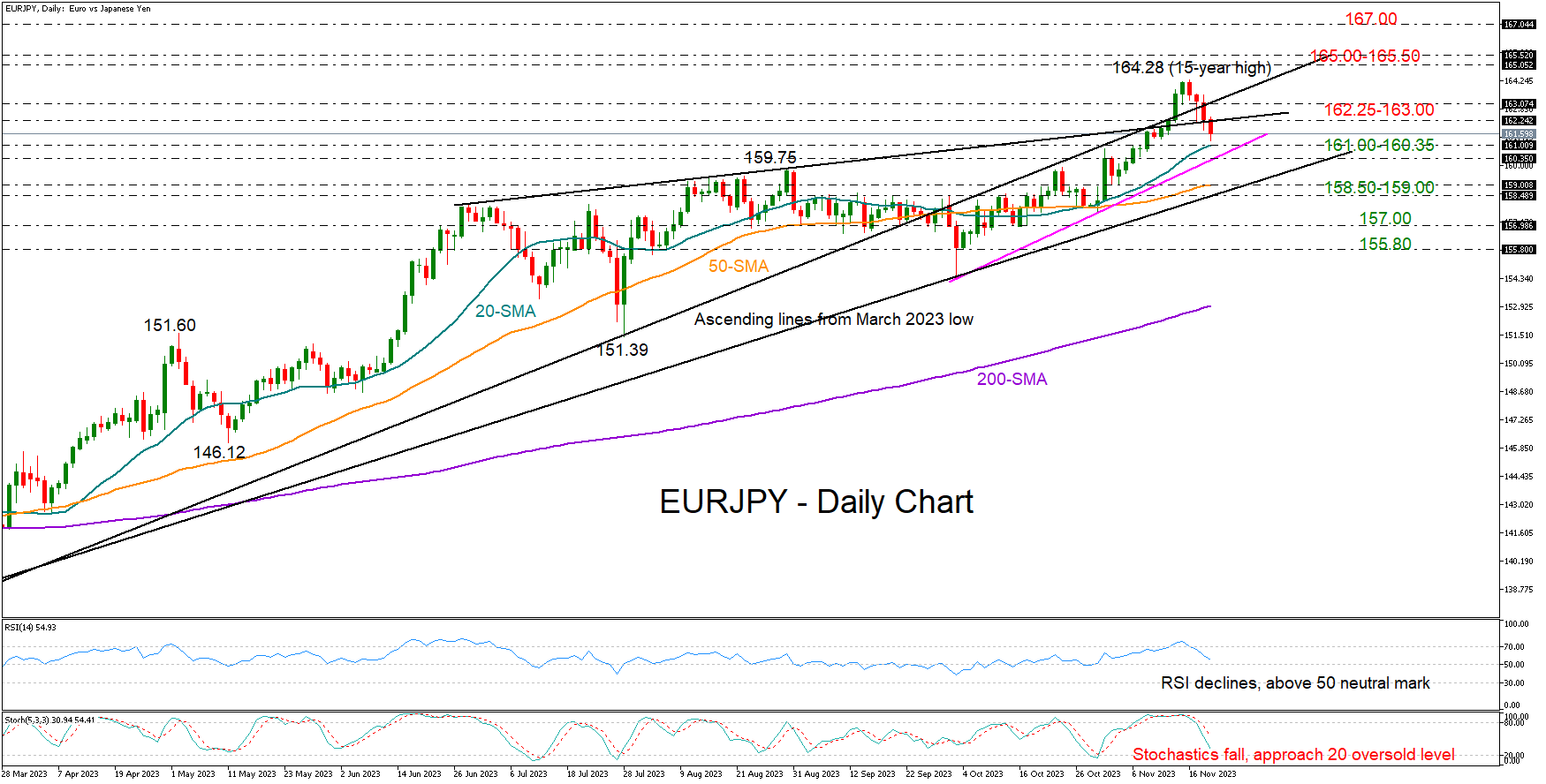
EURJPY Starts a New Bearish Wave
- EURJPY turns down after 15-year high, faces weakening bias
- Immediate support could develop within 160.35-161.00 region
EURJPY traders engaged in some profit taking near last week’s top of 164.28, marking four negative consecutive days to drive the pair as low as 161.38 early on Tuesday.
The negative slope in the momentum indicators is a discouraging signal ahead of Eurozone’s flash business PMI data due on Thursday at 09:00 GMT. But the 20-day simple moving average (SMA) at 161.00 and the tentative support trendline from October at 160.35 are in sight and could still come to the rescue as long as the RSI stands above its 50 neutral mark. Should the bears breach that floor and reclaim August's high of 159.75, they may next target the 50-day SMA at 159.00. A step below the tentative descending trendline drawn from March 2023 could confirm additional losses to 157.00 and then down to 155.80.
If the price returns above yesterday's base of 162.25 and runs higher than 163.00, the bulls might again attempt to reach the 165.00-165.50 caution area from June 2007-August 2008. A victory there could then form a new higher high around the 167.00 bar, which had been limiting both upside and downside movements during the same period, too.
In brief, EURJPY started a new bearish wave after new 15-year highs, but hopes for a pivot have not evaporated yet as a key support region is in a short distance.
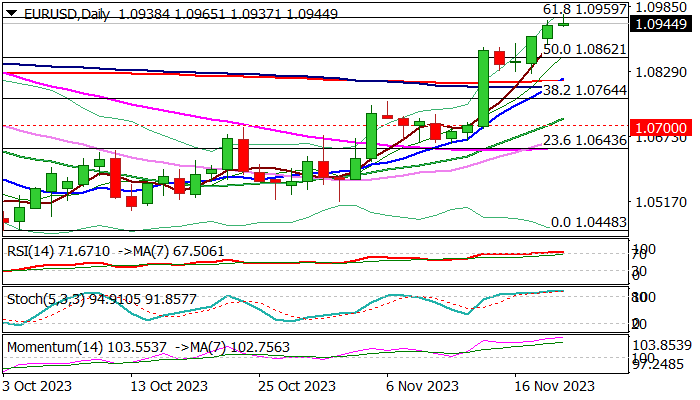
EUR/USD: Bulls Hold Grip ahead of FOMC Minutes
EURUSD continued to benefit from growing expectations of an end of Fed’s tightening cycle and talks about rate cuts and hit new multi-week high on Tuesday.
Fresh extension higher cracked important Fibo resistance at 1.0959 (61.8% retracement of 1.1275/1.0448 downtrend) the last obstacle on the way to psychological 1.10 barrier.
Bulls remain firmly in play on daily chart (very strong positive momentum / multiple MA bull-crosses) but overbought conditions warn of possible strong headwinds at this zone, which may pause bulls for consolidation.
Dips should find ground above broken Fibo 50% (1.0862) and a higher base at 1.0830 zone to keep larger bulls in play for further gains, with break of 1.0959/1.1000 pivots to spark fresh acceleration higher.
Fed minutes is the key release today, as markets expect more details about the US central bank’s next steps, while ECB’s President Lagarde speech (due later today) will be also closely watched.
Res: 1.0959; 1.1000; 1.1065; 1.1080.
Sup: 1.0899; 1.0862; 1.0824; 1.0813.
Canadian Dollar Quiet Ahead of Canadian CPI
- Canada inflation expected to drop to 3.2%
- US releases FOMC minutes
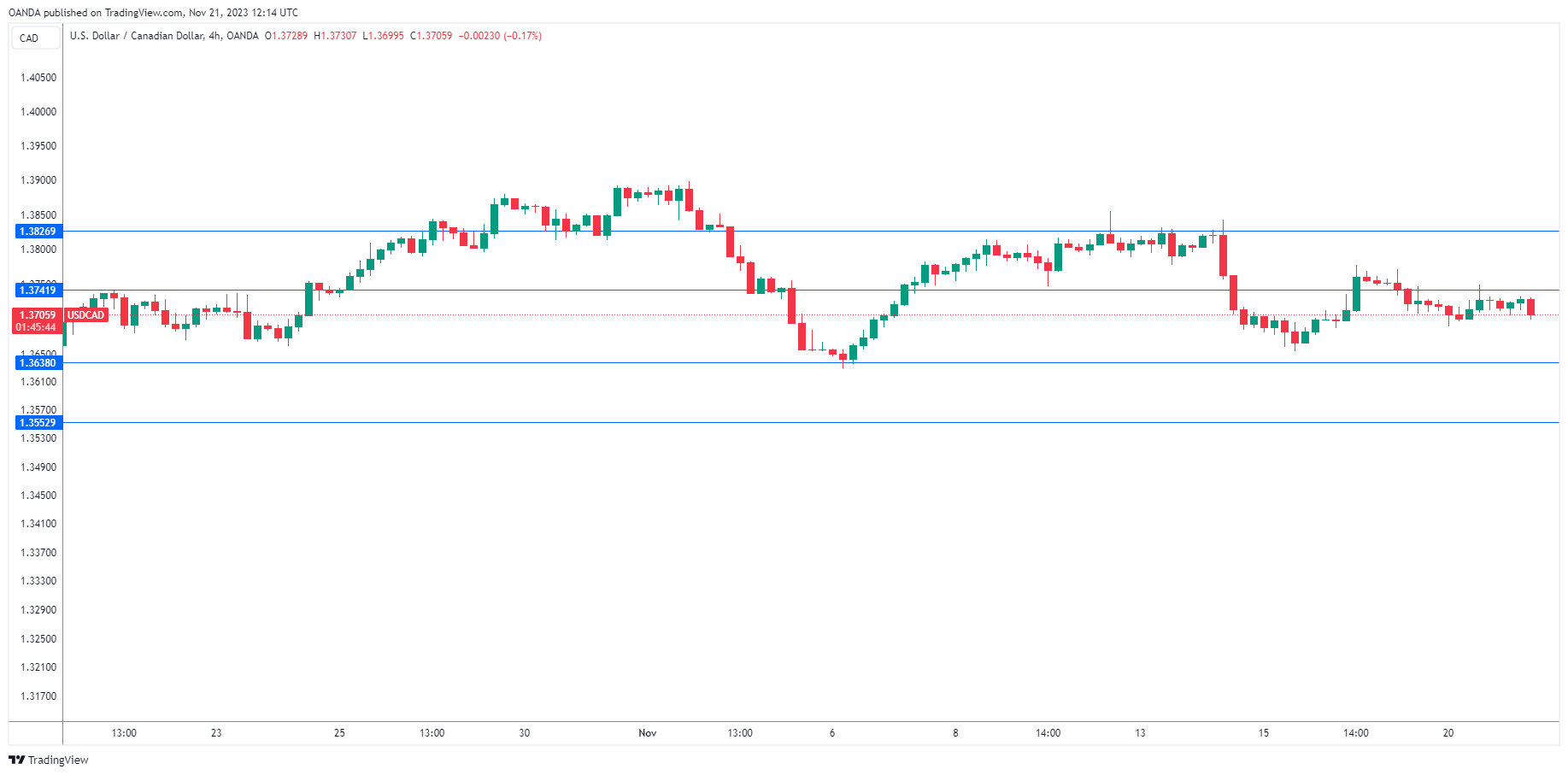
The Canadian dollar continues to have a quiet week. In the European session, USD/CAD is trading at 1.3709, down 0.12%. We could see stronger movement in the North American session, with the release of Canada’s inflation report.
Canadian inflation expected to drop
Canada’s inflation rate has been dropping and the markets are expecting good news from today’s inflation release. October inflation is expected to have declined to 3.2%, compared to the 3.8% gain in September. Monthly, CPI is expected to increase to 0.1%, up from -0.1% in September. CPI Trimmed Mean, a key core inflation gauge, is projected to dip to 3.6%, down from 3.7% in September.
The expectations for the rosy inflation report are based on the sharp decline in gasoline prices, with crude oil plunging about 10% in October. As well, the rise in food prices has slowed. Inflation is still well above the 2% inflation target, but inflation has been moving in the right direction and another drop will be an encouraging sign for the Bank of Canada.
The central bank has held rates at 5% at its past two meetings, as GDP has slowed and the employment market is showing some cracks in its resilience. The BoC has stressed that it is prepared to raise rates again if needed, but another pause at the December meeting will raise expectations that rates have peaked and there is talk of a rate cut in mid-2024.
All eyes will be on the Federal Reserve, which releases the minutes of its November meeting later today. At the meeting, the Fed held rates at 5.25-5.50% for a second straight time. Fed Chair Powell struck a hawkish note after the meeting, saying that inflation remained too high and left the door open to further rate hikes. The minutes will likely have a similar message and that could provide a boost to the sluggish US dollar.
USD/CAD Technical
- 1.3638 and 1.3552 are providing support
- There is resistance at 1.3741 and 1.3827