Sample Category Title
Dollar’s Shallow Correction May Be Over
After starting the week in retreat, the US dollar reversed sharply higher in the European session on Tuesday and is on the offensive on Wednesday. Dollar bulls have returned to active buying after a long but shallow correction from earlier this month’s peak.
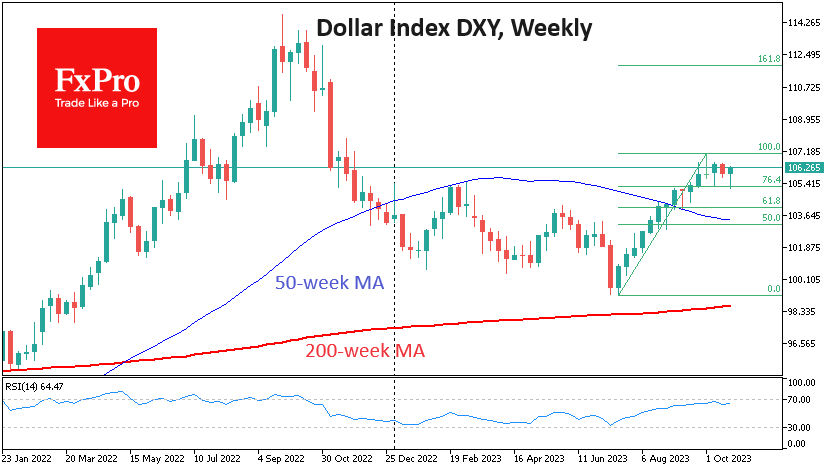
The Dollar Index peaked at 107 in early October after twelve weeks of gains. The market was then dominated by profit-taking. However, the pullback from the 107.1 peak was relatively shallow, and the DXY corrected 76.4% of the total upside amplitude, finding support at 105.2. Deeper corrections are seen as the norm, but there are truncated corrections in solid markets when there is sufficient reason to complete them.
On the news side, the reason for the resumption of buying in the US was the failure of the Eurozone PMIs. This starkly contrasted to the better-than-expected indices coming out of the US. These indices underlined that America is doing well with high interest rates, while Europe is losing traction, and its countries are likely to slip into recession one by one.
The technical reason for the sell-off was that the EURUSD touched its 50-day moving average as it approached 1.07. The dollar bulls did not let this vital trend indicator be taken away, proving once again that we are in a strengthening dollar environment.
The DXY index also approached its 50-day average but failed to touch it and was just minutes below its 76.4% retracement.
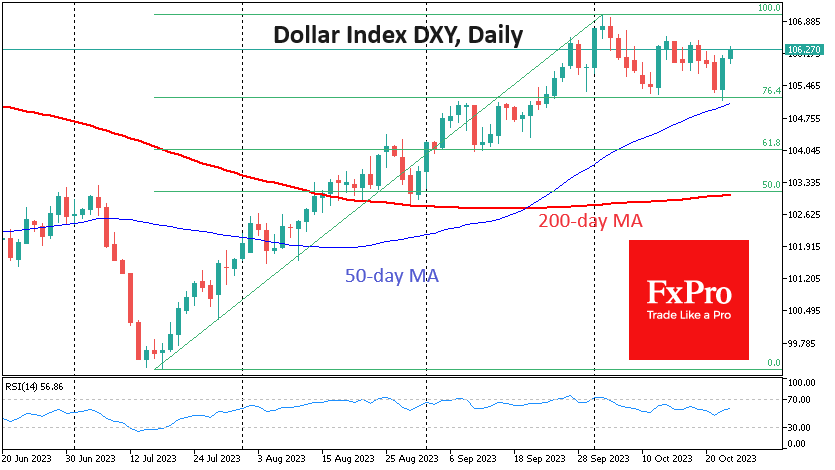
In general, it is too early to talk about a continuation of the dollar rally, and it is better to wait for confirmation in the form of an update of the previous local highs at 107.1.
However, the bulls have two critical factors on their side. First, the Carry trade – playing the interest rate differential – is now entirely on the side of US assets, not to mention the attractive liquidity and reliability of the US market.
Secondly, we note the strong dollar buying impulses on Tuesday and 12 October, suggesting impressive demand on the downside.
Thus, barring any surprises from macro data and next week’s FOMC meeting, it is only a matter of time before the Dollar Index reaches new highs.
USD/JPY Tiptoeing Just Shy of 150
- Japanese yen remains close to 150
- US GDP expected to accelerate to 4.5%
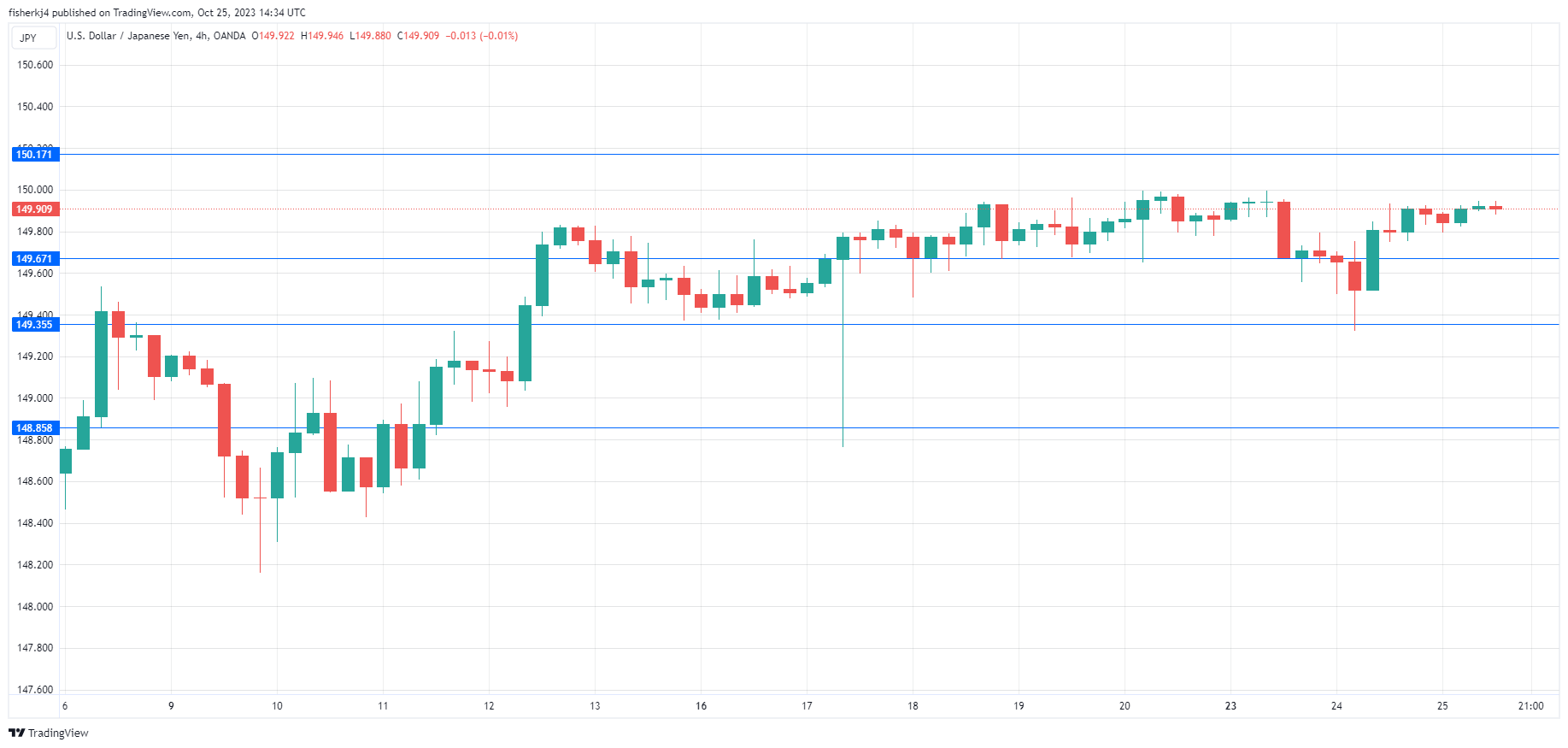
Dollar-yen is unchanged on Wednesday, trading at 149.91 in the North American session.
Will yen break past 150?
Like an acrobat on a tightrope, the yen has been hovering within a whisker of the 150 level. This has continued for almost two weeks, with investors keeping peeled eyes on the yen, waiting for it to breach the symbolic 150 line. It remains unclear if 150 is a ‘line in the sand’ for the Bank of Japan, which tends to remain mum about exchange levels in order to dissuade speculation on the currency.
The last time the yen broke above 150 was October 3rd, at which time the yen recovered and spiked lower. The BoJ refused to announce if it had intervened, although an examination of the BoJ data suggests that there was no currency intervention. The central bank has been jawboning about the yen being too low, and if the yen depreciates further, there is a real possibility of intervention.
Japan’s inflation has been above the 2% target for about a year and a half, but the BoJ is sticking to its script that inflation is not sustainable until wage growth increases. BoJ Core CPI, which is closely monitored by the central bank, edged up to 3.4% in October, up from 3.3% in September and above the market consensus of 3.3%. High inflation, rising global rates and a weak yen are putting pressure on BoJ policymakers to tighten policy.
US GDP expected to jump to 4.5%
The US releases third-quarter GDP on Thursday and the markets are expecting a very strong print. The consensus estimate of 4.5%, compared to 2.1% in the second quarter. This would mark the highest level since Q4 2021, when the economy was in recovery mode from the Covid pandemic.
As the major economies grapple with weak growth, US exceptionalism has been marked by a strong labour market that is driving consumer spending. The Fed is clearly worried, with Jerome Powell stating last week that continuing strong growth could complicate the efforts to rein in inflation and force the Fed to raise rates. As far as the Fed is concerned, a strong GDP release could be “too much of a good thing” which may force the Fed to raise rates in December.
USD/JPY Technical
- USD/JPY is testing support at 149.67. Next, there is support at 149.35
- There is resistance at 150.49 and 150.99
Slowing Economic Momentum Enough for Bank of Canada to Hold Policy Rate at 5%
The Bank of Canada met expectations by maintaining the overnight rate at 5.0%, while stating that it will continue with Quantitative Tightening (QT).
The bank highlighted the slowing in economic momentum stating, "consumption has been subdued, with softer demand for housing, durable goods and many services." In the BoC's accompanying Monetary Policy Report, the Bank downgraded its growth forecast to 1.2% this year (from 1.8% in July) and 0.9% in 2024 (1.2% in July).
On the persistence of high inflation, it stated that "CPI inflation has been volatile in recent months" and that "the Bank’s preferred measures of core inflation show little downward momentum." The Bank upgraded its CPI forecast to 3.3% year-on-year (y/y) in 2023 (2.9% y/y in July), though it still sees inflation return to target in 2025.
On the future path of policy, the Bank "is concerned that progress towards price stability is slow and inflationary risks have increased". It maintained that it is "prepared to raise the policy rate further if needed".
Key Implications
The BoC didn't throw any curveballs today. It acknowledged the growing evidence that economic momentum is slowing – falling retail sales, declining job vacancies, and a cooling housing market to name a few. All of this showed up in its updated forecast, where the BoC expects below-trend growth over the next twelve months. At the same time, the BoC didn't declare victory. With wage growth running at 5% y/y and underlying inflation averaging 3.5% on a three-month annualized basis, the Bank is still leaving the door open to further hikes should economic data start to re-accelerate.
Although the BoC has painted a clear picture for why it doesn't need to hike again, we expect its hawkish rhetoric to persist. It needs to maintain current tight financial conditions in order to achieve its forecasted slowdown. And while markets are hesitant to build in another hike, the impact of the BoC's rhetoric has resulted in a higher for longer path for the BoC's policy rate. This has the Canada 10-year yield sitting at its highest level since 2007.
Sunset Market Commentary
Markets
With only few data on the agenda and investors looking forward to the ECB policy decision and the first estimate of US Q3 GDP tomorrow, (bond) markets were captured in technical trading. German Ifo business confidence was marginally better (less negative) than feared. Both the current assessment (89.2 from 88.7) and expectations (84.7 from 83.1) improved. The picture looks a bit more constructive compared to yesterday’s PMI’s. Ifo even mentioned some ‘silver lining’ ahead for the German economy and President Clemens Fuest saw chances of stabilization/slight growth in Q4. Nice, but his assessment for now isn’t a consensus view. Plenty more better news is needed to mitigate the recessionary narrative (on Germany and EMU). European equities opened in red as they ignored China signalling additional fiscal and monetary support, but selling eased. At least today, a less aggressive risk-off apparently allowed yields to reverse some of yesterday’s setback post the poor EMU PMI’s. German yields add between 1.5 bps (2-y) and 5.5 bps (30-y). US yields gain between 4.5 bps (5-y) and 10 bps (30-y). The yield decline (2.5 bps) in the 2-y is affected by a benchmark change. If anything, the ‘by default’ upward drift in LT yields apparently isn’t completely destroyed after recent more volatile swings. Brent oil stabilizes near $88.5 p/b. The Eurostoxx50 briefly moved in the green but currently again loses 0.2%. US indices open up to 1.0% lower after yesterday’s rebound. The sell-on upticks dynamics remains in place.
After a disappointing performance over the previous two weeks, the dollar tries to build on yesterday’s PMI-driven rebound. DXY touched the 106.5 area, compared to a ST correction low at 105.36 yesterday. EUR/USD dropped further to currently trade near 1.0575. A drop below a tentative ST uptrend line coming in near 1.0555 would signal the failure of a tentative ST bottoming out pattern. Sterling remains in the defensive, with EUR/GBP (0.8725) holding north of the 0.87 support/previous resistance. CE currencies also fight an uphill battle today. EUR/CZK at 24.69 is nearing the YTD top. EUR/PLN jumped from 4.4625 area to 4.48 on headlines that the incoming coalition wants to avoid fiscal consolidation. The forint extends losses as yesterday’s bigger than expected MNB rate cut raises questions on its commitment to keep policy tight enough for long enough to bring inflation back to target. EUR/HUF extends yesterday’s rebound to EUR/HUF 385 compared to 381 area before yesterday’s policy decision.
News & Views
Donald Tusk travelled to Brussels, vowing to officials he would use all possible methods to win over the EU’s trust in Poland again with the ultimate goal of unlocking the €34bn in NextGen funds. Tusk as leader of the opposition’s Civic Platform has been put forward as candidate for prime minister after winning the elections from the incumbent ruling PiS party. The latter, however, is still expected to be given the first shot in trying to form a governing coalition since they turned out to be the single biggest party. A new government with Tusk at the helm could take until December. Tusk noted that he showed up in his capacity as the opposition’s leader, adding that the talks were only informal. But in doing so, he makes good on an election promise to visit EU officials the day after winning them. Several of them warned Tusk of “expecting too much, too soon”. Aside from fixing the frayed relations with the bloc, the incoming administration also seeks to avoid fiscal tightening next year and possibly longer due to a busy election calendar, people familiar with the matter said. Poland holds local and European parliament elections in 2024 and a presidential ballot in 2025. Not closing the fiscal taps may complicate the central bank’s task against inflation, which still stood at 8.2% in September. The NBP has already lowered policy rates by a cumulative 100 bps.
Belgian business confidence fell in October from -14.4 to -16.8, the lowest since June 2020. Business-related services severely deteriorated following a short-lived uptick in September. This is the result of a clearly more unfavourable assessment of current and future activity levels and to a lesser extent of demand expectations. All components in trade dipped, with employment and demand expectations catching the eye. More pessimistic views on demand expectations and the assessment of order books weighed on the building industry indicator. By contrast, demand expectations were more favourable in the manufacturing industry, which also witnessed a slight improvement in the assessment of stock levels. Sharply dropping employment expectations balanced out the overall indicator.
USD/CAD Mid-Day Outlook
Daily Pivots: (S1) 1.3660; (P) 1.3698; (R1) 1.3729; More...
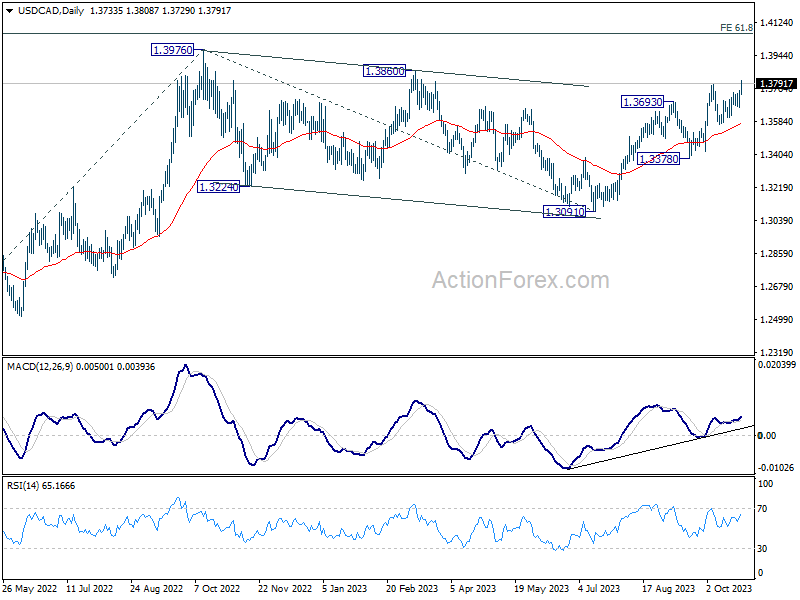
USD/CAD's solid break of 1.3784 resistance confirm resumption of the rally from 1.3091. Intraday bias is back on the upside for retesting 1.3976 high. Decisive break there will resume larger up trend. On the downside, below 1.3729 minor support will turn intraday bias neutral and bring consolidations. But near term outlook will remain bullish as long as 1.3568 support holds.
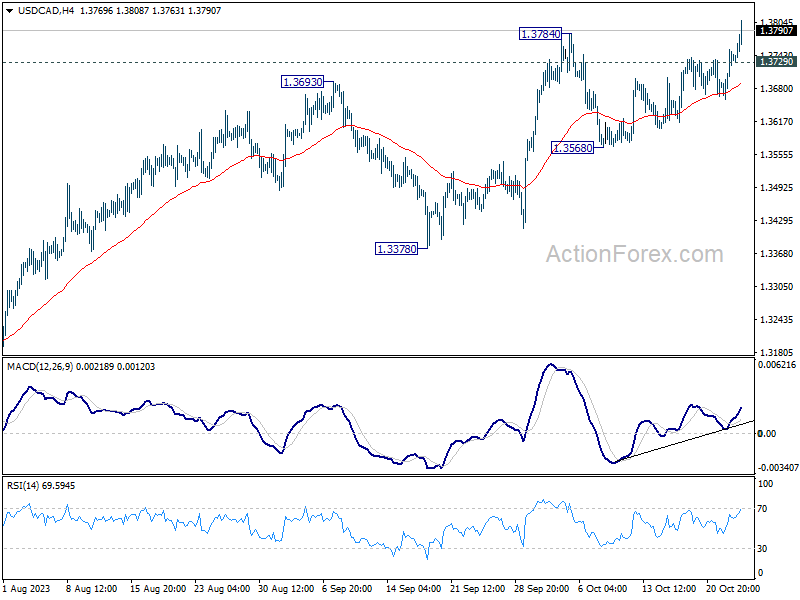
In the bigger picture, current development revives the case that corrective pattern from 1.3976 (2022 high) has completed with three waves down to 1.3091. Decisive break of 1.3976 high will confirm resumption of up trend from 1.2005 (2021 low). Next target will be 61.8% projection of 1.2401 to 1.3976 from 1.3091 at 1.4064. This will now remain the favored case as long as 1.3378 support holds.
Loonie Sinks Despite BoC’s Hawkish Hold, Aussie Rally Fizzles Out
Canadian Dollar encountered heavy headwinds after BoC made the anticipated decision to keep interest rates steady. The bank's hawkish tone persisted, highlighting concerns over the sluggish pace of disinflation. However, the central bank also acknowledged emerging signs indicating that past rate hikes might be curbing economic activity.
Earlier in the day, Australian Dollar experienced a boost on the back of robust CPI data, prompting major financial institutions such as Commonwealth Bank of Australia and ANZ to change their tune regarding interest rate forecasts. Both banks now anticipate a 25 basis point rate hike come November.
Yet, the buoyancy of Aussie was short-lived, reverting to a mixed stance shortly thereafter. This change in sentiment is reflective of a broader realization in the markets: many major central banks, like BoC, are grappling with inflation rates that are more resilient than initially expected.
Presently, the market's attention has pivoted back to rising treasury yields and a general inclination towards risk aversion. Commodity currencies, with Canadian Dollar at the forefront, are trailing behind as the day's most underwhelming performers. This trend is mirrored by Aussie and Kiwi.
On the flip side, Dollar stands tall as the day's top performer, trailed the Yen the Euro. Sterling and Swiss Franc, meanwhile, oscillate, reflecting a more ambivalent performance in the markets.
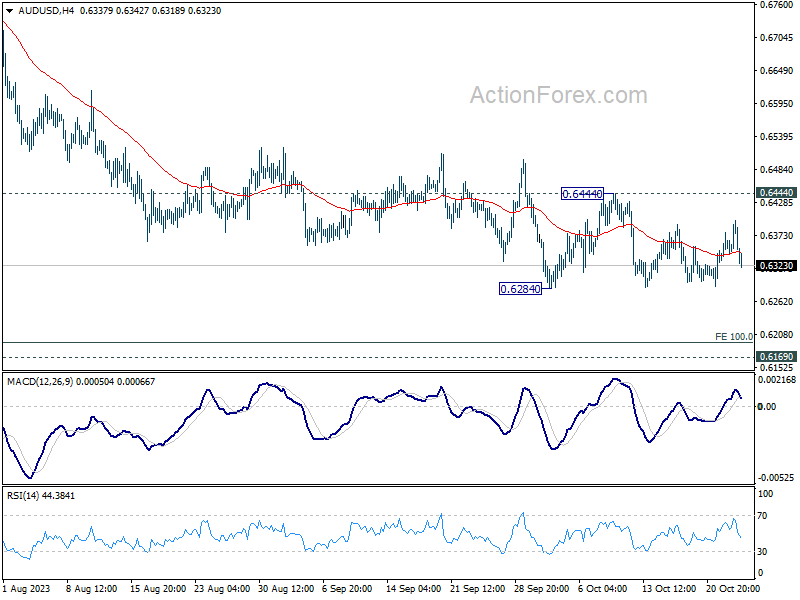
Technically, as AUD/USD's earlier rebound falters, focus could be back on 0.6284 support in the near term. Decisive break there will resume the whole down trend from 0.7156 to 100% projection of 0.7156 to 0.6457 from 0.6894 at 0.6195, which is close to 0.6169 medium term support.
In Europe, at the time of writing, FTSE is down -0.22%. DAX is down -0.55%. CAC is down -0.45%. Germany 10-year yield is up 0.0590 at 2.886. Earlier in Asia, Nikkei rose 0.67%. Hong Kong HSI rose 0.55%. China Shanghai SSE rose 0.40%. Singapore Strait Times dropped -0.17%. Japan 10-year JGB yield rose 0.0065 to 0.861.
BoC stands pat, concerned on slow disinflation progress
BoC left overnight rate unchanged at 5.00% as widely expected. Bank Rate and deposit rate are held at 5.25% and 5.00% respectively. The Governing Council expressed concerns that "progress towards price stability is slow and inflationary risks have increased". The central bank is "prepared to raise the policy rate further if needed", maintaining hawkish bias.
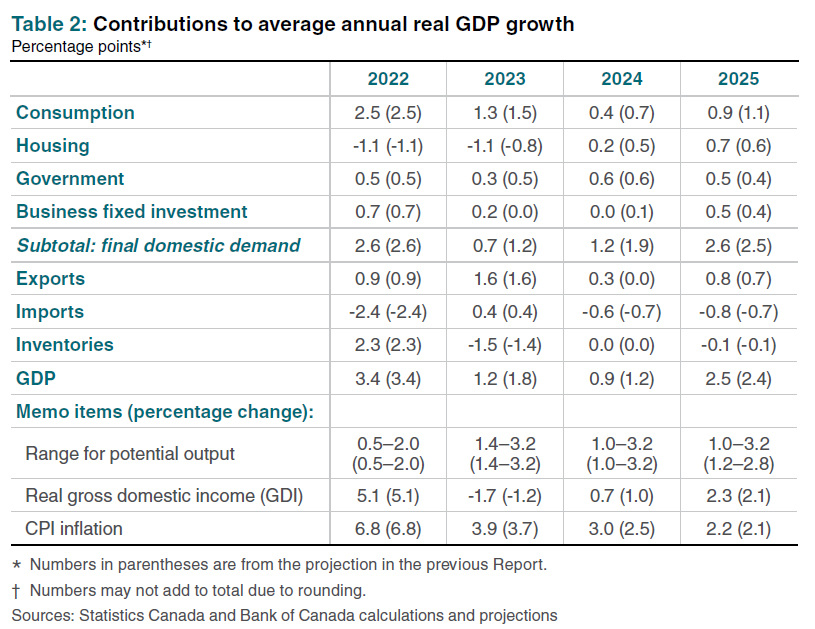
Growth projections are revised notably lower for 2023 and 2024, but raised slightly for 2025. GDP growth is projected to be at 1.2% in 2023 (vs prior 1.8%), 0.9% in 2024 (vs prior 1.2%), and 2.5% in 2025 (vs prior 2.4%).
CPI inflation forecasts are revised higher through the projection horizon, at 3.9% in 2023 (vs prior 3.7%), 3.0% in 2024 (vs prior 2.5%), and 2.2% in 2025 (vs prior 2.1%).
German Ifo business climate rose to 86.9, seeing a silver lining
German Ifo Business Climate rose from 85.8 to 86.9 in October. Current Assessment Index rose from 88.7 to 89.2. Expectations Index rose from 83.1 to 84.7.
By sector, manufacturing rose from -16.2 to -15.9. Services rose from -4.9 to -1.5. Trade dropped from -25.0 to 27.2. Construction ticked up from -31.2 to -31.1.
Ifo said: "Managers were less pessimistic in their view of the coming months. Germany's economy can see a silver lining ahead."
Australia CPI slows to 5.4% yoy in Q3, but rises to 5.6% yoy in Sep
Australia's CPI for Q3 registered a 1.2% qoq rise, exceeding expectation of 1.1% qoq and marking an acceleration from the previous quarter's 0.8% qoq. Notably, some of the most pronounced price hikes were observed in automotive fuel (+7.2%), rents (+2.2%), new dwelling purchases by owner-occupiers (+1.3%), and electricity (+4.2%).
Over the twelve months, inflation saw a deceleration, with CPI moving from 6.0% yoy to 5.4% yoy in Q3. However, this figure surpassed the anticipated 5.3% yoy. It's essential to note that this is the third consecutive quarter where the annual inflation rate has experienced a downturn, dropping from its high of 7.8% in Q4 2022.
The trimmed mean CPI, which excludes volatile items, recorded a 1.2% qoq increase again outpacing the forecasted 1.1% qoq and the previous quarter's 1.0% qoq . When analyzing the annualized data, the trimmed mean CPI decelerated from 5.9% yoy to 5.2% yoy, surpassing the predicted 5.1% yoy.
Commenting on the latest figures, Michelle Marquardt, ABS head of price statistics, highlighted that "prices continued to rise for most goods and services." However, she also noted a few sectors that registered price declines, notably child care, vegetables, and domestic holiday travel and accommodation.
Furthermore, the monthly CPI for September recorded acceleration from 5.2% yoy to 5.6% yoy , which was above the anticipated 5.4% yoy. Significant price surges in this period were identified in Housing (+7.2%), Transport (+9.4%), and Food and non-alcoholic beverages (+4.7%).
Reflecting on these trends, Marquardt stated, "This is the second consecutive rise in the annual movement up from 5.2% in August and 4.9% in July. While many industries' price increases are slowing, automotive fuel has had large annual increases in the last two months, which has been driving the movement higher."
USD/CAD Mid-Day Outlook
Daily Pivots: (S1) 1.3660; (P) 1.3698; (R1) 1.3729; More...
USD/CAD's solid break of 1.3784 resistance confirm resumption of the rally from 1.3091. Intraday bias is back on the upside for retesting 1.3976 high. Decisive break there will resume larger up trend. On the downside, below 1.3729 minor support will turn intraday bias neutral and bring consolidations. But near term outlook will remain bullish as long as 1.3568 support holds.
In the bigger picture, current development revives the case that corrective pattern from 1.3976 (2022 high) has completed with three waves down to 1.3091. Decisive break of 1.3976 high will confirm resumption of up trend from 1.2005 (2021 low). Next target will be 61.8% projection of 1.2401 to 1.3976 from 1.3091 at 1.4064. This will now remain the favored case as long as 1.3378 support holds.
Economic Indicators Update
| GMT | Ccy | Events | Actual | Forecast | Previous | Revised |
|---|---|---|---|---|---|---|
| 00:30 | AUD | Monthly CPI Y/Y Sep | 5.60% | 5.40% | 5.20% | |
| 00:30 | AUD | CPI Q/Q Q3 | 1.20% | 1.10% | 0.80% | |
| 00:30 | AUD | CPI Y/Y Q3 | 5.40% | 5.30% | 6.00% | |
| 00:30 | AUD | RBA Trimmed Mean CPI Q/Q Q3 | 1.20% | 1.10% | 1.00% | |
| 00:30 | AUD | RBA Trimmed Mean CPI Y/Y Q3 | 5.20% | 5.00% | 5.90% | |
| 08:00 | CHF | Credit Suisse Economic Expectations Oct | -37.8 | -27.6 | ||
| 08:00 | EUR | Germany IFO Business Climate Oct | 86.9 | 85.9 | 85.7 | 85.8 |
| 08:00 | EUR | Germany IFO Current Assessment Oct | 89.20 | 88.5 | 88.7 | |
| 08:00 | EUR | Germany IFO Expectations Oct | 84.7 | 83.3 | 82.9 | 83.1 |
| 08:00 | EUR | Eurozone M3 Money Supply Y/Y Sep | -1.20% | -1.70% | -1.30% | |
| 14:00 | USD | New Home Sales Sep | 759K | 684K | 675K | |
| 14:00 | CAD | BoC Interest Rate Decision | 5.00% | 5.00% | 5.00% | |
| 14:30 | USD | Crude Oil Inventories | -0.5M | -4.5M | ||
| 15:00 | CAD | BoC Press Conference |
BoC stands pat, concerned on slow disinflation progress
BoC left overnight rate unchanged at 5.00% as widely expected. Bank Rate and deposit rate are held at 5.25% and 5.00% respectively. The Governing Council expressed concerns that "progress towards price stability is slow and inflationary risks have increased". The central bank is "prepared to raise the policy rate further if needed", maintaining hawkish bias.
Growth projections are revised notably lower for 2023 and 2024, but raised slightly for 2025. GDP growth is projected to be at 1.2% in 2023 (vs prior 1.8%), 0.9% in 2024 (vs prior 1.2%), and 2.5% in 2025 (vs prior 2.4%).
CPI inflation forecasts are revised higher through the projection horizon, at 3.9% in 2023 (vs prior 3.7%), 3.0% in 2024 (vs prior 2.5%), and 2.2% in 2025 (vs prior 2.1%).
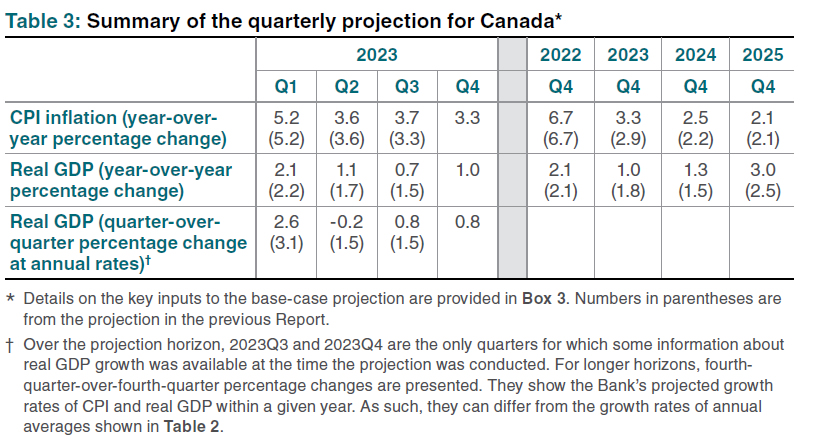
Full BoC statement and Monetary Policy Report here.
(BOC) Bank of Canada maintains policy rate, continues quantitative tightening
The Bank of Canada today held its target for the overnight rate at 5%, with the Bank Rate at 5¼% and the deposit rate at 5%. The Bank is continuing its policy of quantitative tightening.
The global economy is slowing and growth is forecast to moderate further as past increases in policy rates and the recent surge in global bond yields weigh on demand. The Bank projects global GDP growth of 2.9% this year, 2.3% in 2024 and 2.6% in 2025. While this global growth outlook is little changed from the July Monetary Policy Report (MPR), the composition has shifted, with the US economy proving stronger and economic activity in China weaker than expected. Growth in the euro area has slowed further. Inflation has been easing in most economies, as supply bottlenecks resolve and weaker demand relieves price pressures. However, with underlying inflation persisting, central banks continue to be vigilant. Oil prices are higher than was assumed in July, and the war in Israel and Gaza is a new source of geopolitical uncertainty.
In Canada, there is growing evidence that past interest rate increases are dampening economic activity and relieving price pressures. Consumption has been subdued, with softer demand for housing, durable goods and many services. Weaker demand and higher borrowing costs are weighing on business investment. The surge in Canada's population is easing labour market pressures in some sectors while adding to housing demand and consumption. In the labour market, recent job gains have been below labour force growth and job vacancies have continued to ease. However, the labour market remains on the tight side and wage pressures persist. Overall, a range of indicators suggest that supply and demand in the economy are now approaching balance.
After averaging 1% over the past year, economic growth is expected to continue to be weak for the next year before increasing in late 2024 and through 2025. The near-term weakness in growth reflects both the broadening impact of past increases in interest rates and slower foreign demand. The subsequent pickup is driven by household spending as well as stronger exports and business investment in response to improving foreign demand. Spending by governments contributes materially to growth over the forecast horizon. Overall, the Bank expects the Canadian economy to grow by 1.2% this year, 0.9% in 2024 and 2.5% in 2025.
CPI inflation has been volatile in recent months—2.8% in June, 4.0% in August, and 3.8% in September. Higher interest rates are moderating inflation in many goods that people buy on credit, and this is spreading to services. Food inflation is easing from very high rates. However, in addition to elevated mortgage interest costs, inflation in rent and other housing costs remains high. Near-term inflation expectations and corporate pricing behaviour are normalizing only gradually, and wages are still growing around 4% to 5%. The Bank's preferred measures of core inflation show little downward momentum.
In the Bank's October projection, CPI inflation is expected to average about 3½% through the middle of next year before gradually easing to 2% in 2025. Inflation returns to target about the same time as in the July projection, but the near-term path is higher because of energy prices and ongoing persistence in core inflation.
With clearer signs that monetary policy is moderating spending and relieving price pressures, Governing Council decided to hold the policy rate at 5% and to continue to normalize the Bank's balance sheet. However, Governing Council is concerned that progress towards price stability is slow and inflationary risks have increased, and is prepared to raise the policy rate further if needed. Governing Council wants to see downward momentum in core inflation, and continues to be focused on the balance between demand and supply in the economy, inflation expectations, wage growth and corporate pricing behaviour. The Bank remains resolute in its commitment to restoring price stability for Canadians.
Information note
The next scheduled date for announcing the overnight rate target is December 6, 2023. The Bank will publish its next full outlook for the economy and inflation, including risks to the projection, in the MPR on January 24, 2024.
EUR/USD Mid-Day Outlook
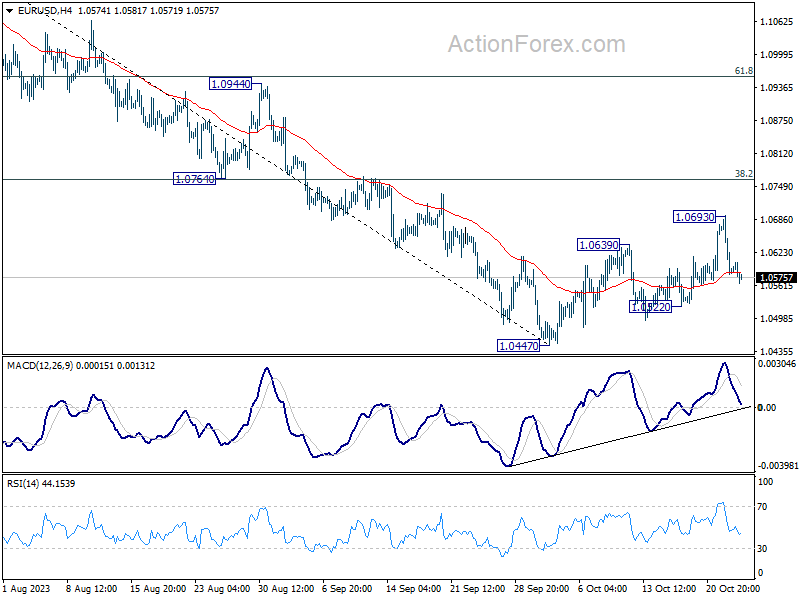
Daily Pivots: (S1) 1.0551; (P) 1.0623; (R1) 1.0662; More...
Intraday bias in EUR/USD is remains neutral and outlook is unchanged. On the upside, above 1.0693 will resume the rebound from 1.0447 to 1.0764 cluster resistance (38.2% retracement of 1.1274 to 1.0447 at 1.0763). On the downside, break of 1.0522 support will retain near term bearishness for resuming the whole decline from 1.1274 through 1.0447 next.
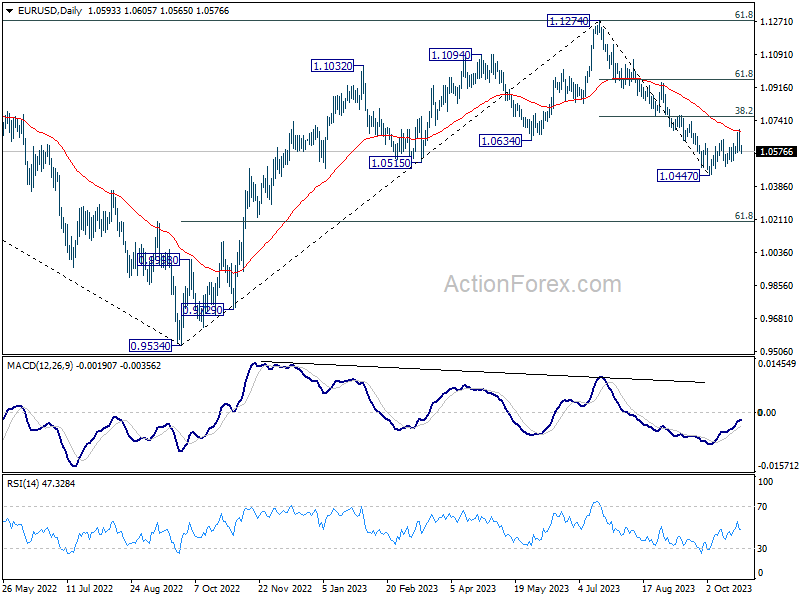
In the bigger picture, fall from 1.1274 medium term top could still be a correction to rise from 0.9534 (2022 low). But chance of a complete trend reversal is rising. In either case, current fall should target 61.8% retracement of 0.9534 to 1.1274 at 1.0199 next. For now, risk will stay on the downside as long as 55 D EMA (now at 1.0684) holds, in case of rebound.
GBP/USD Mid-Day Outlook
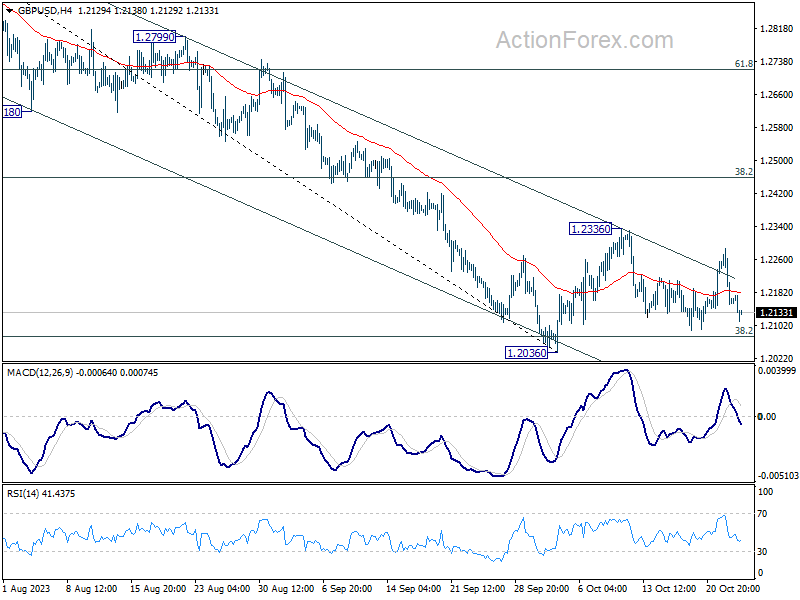
Daily Pivots: (S1) 1.2113; (P) 1.2201; (R1) 1.2249; More
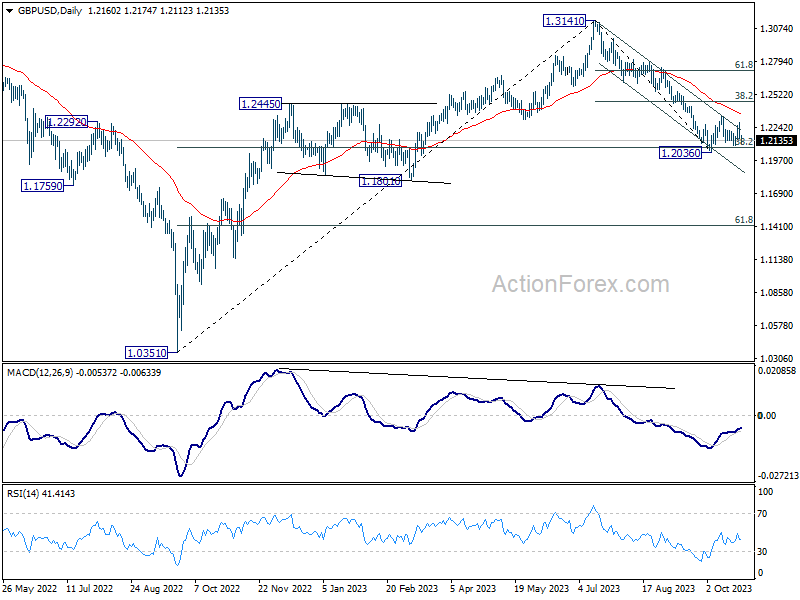
No change in GBP/USD's outlook as consolidation from 1.2036 is extending. Downside breakout is still mildly in favor. On the downside, decisive break of 1.2036 will resume whole decline from 1.3141 for 1.1801 support next. However, break of 1.2336 will turn bias back to the upside for 38.2% retracement of 1.3141 to 1.2036 at 1.2458.
In the bigger picture, fall from 1.3141 medium term top could still be a correction to up trend from 1.0351 (2022 low) only. But risk of complete trend reversal is rising. Sustained break of 38.2% retracement of 1.0351 to 1.3141 at 1.2075 will pave the way to 61.8% retracement at 1.1417. For now, risk will stay on the downside as long as 55 D EMA (now at 1.2384) holds, in case of rebound.