

Sample Category Title
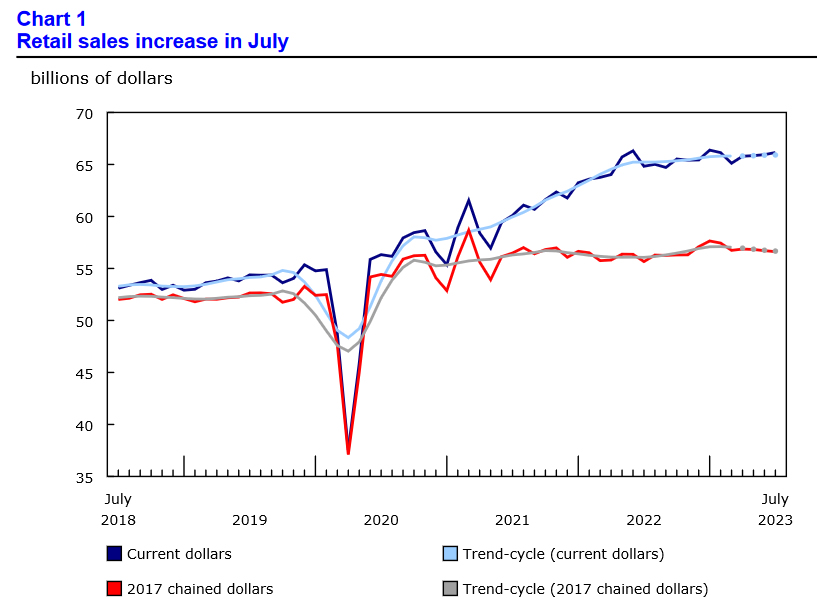
Canada retail sales rose 0.3% mom in Jul, missed expectations
Canada retail sales rose 0.3% mom to CAD 66.1B in July, below expectation of 0.4% mom. Core retail sales—which exclude gasoline stations and fuel vendors and motor vehicle and parts dealers—were up 1.3% mom. In volume terms, retail sales was down -0.2% mom.
Advance estimate suggests that sales declined -0.3% mom in August.
Ethereum and Bitcoin Ready to Dive
Market picture
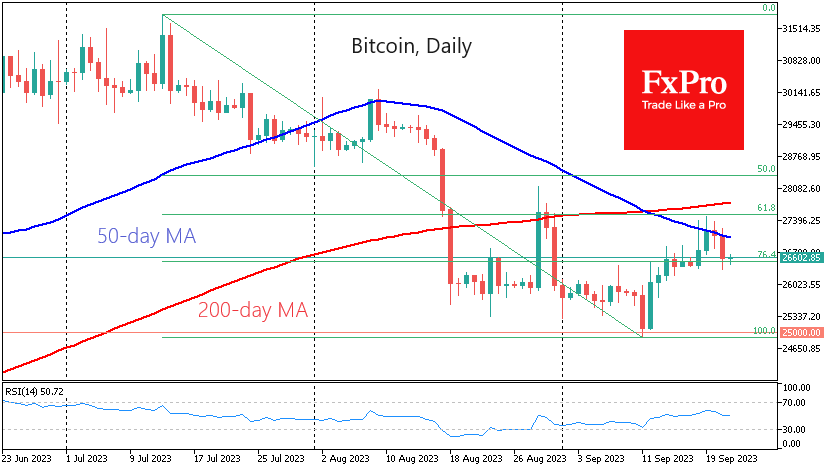
The crypto market capitalisation has fallen to $1.056 trillion, losing around 0.9% in the last 24 hours. The main pressure on the market came from outside, as equity indices fell, with the US market losing a further 1.8% on the Nasdaq, returning to August lows. It should be noted that against such an unfavourable external backdrop, the consolidation of cryptocurrencies near the levels seen at the beginning of the week looks like a vote of confidence from crypto enthusiasts.
The bitcoin price has returned to $26.6, erasing the mini pump at the beginning of the week. The ability to hold on to last week’s support looks like a positive signal. On the other hand, we saw earlier this week that bears control the market. But they aren’t in a hurry yet.
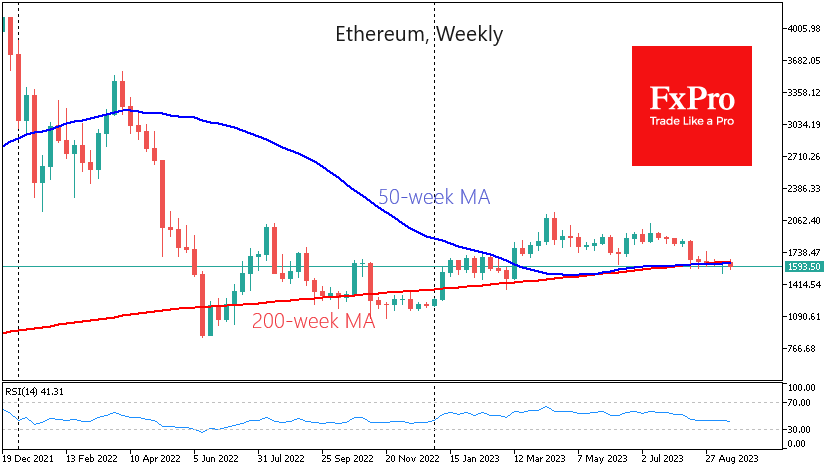
Ethereum looks weak. After five weeks of trying to stay above its 50- and 200-week moving averages, the digital silver is in danger of closing below these lines and $1600 this week. The following essential lines of defence look to be the $1500 and $1200 levels, where buyers came to the coin’s rescue in March and December last year.
News Background
Bloomberg notes that Bitcoin continues to evolve as a global payment network while carbon emissions fall. That’s what’s needed to increase adoption of the world’s first cryptocurrency.
The court allowed bankrupt cryptocurrency exchange MtGox to extend its deadline to repay creditors until 31 October 2024. These reports supported bitcoin exchange rates earlier in the week, removing a potential overhang of crypto assets from the market. MtGox’s creditors have been expecting repayment for nearly a decade, and the deadline has been pushed back several times.
According to the Wall Street Journal, Tether has increased its USDT lending again despite promising investors it would reduce it to zero by 2024. According to the paper, Tether’s inconsistent lending policy is causing serious concern among crypto investors.
Binance has warned of a possible delisting of stablecoins in Europe. This is because the exchange’s lawyers have not yet found a way to meet the requirements of the new MiCA rules adopted in the European Union.
EUR/USD Analysis: Key Support Zone Resists Selling Pressure
Today, fresh monthly values of the PMI index, which is considered a leading indicator of the state of the economy, have become known:
- France: actual 43.6, expected 46.2. This is the worst economic contraction since the coronavirus.
- Germany: actual 39.8, expected 39.5.
As a reminder, values below 50 indicate a slowing economy.
Thus, the PMI witnessed the worsening economic problems in the European Union. And not only. The PMI indicator for the UK also published today was 44.2, which, although higher than the previous value 42.5, is still below 50.
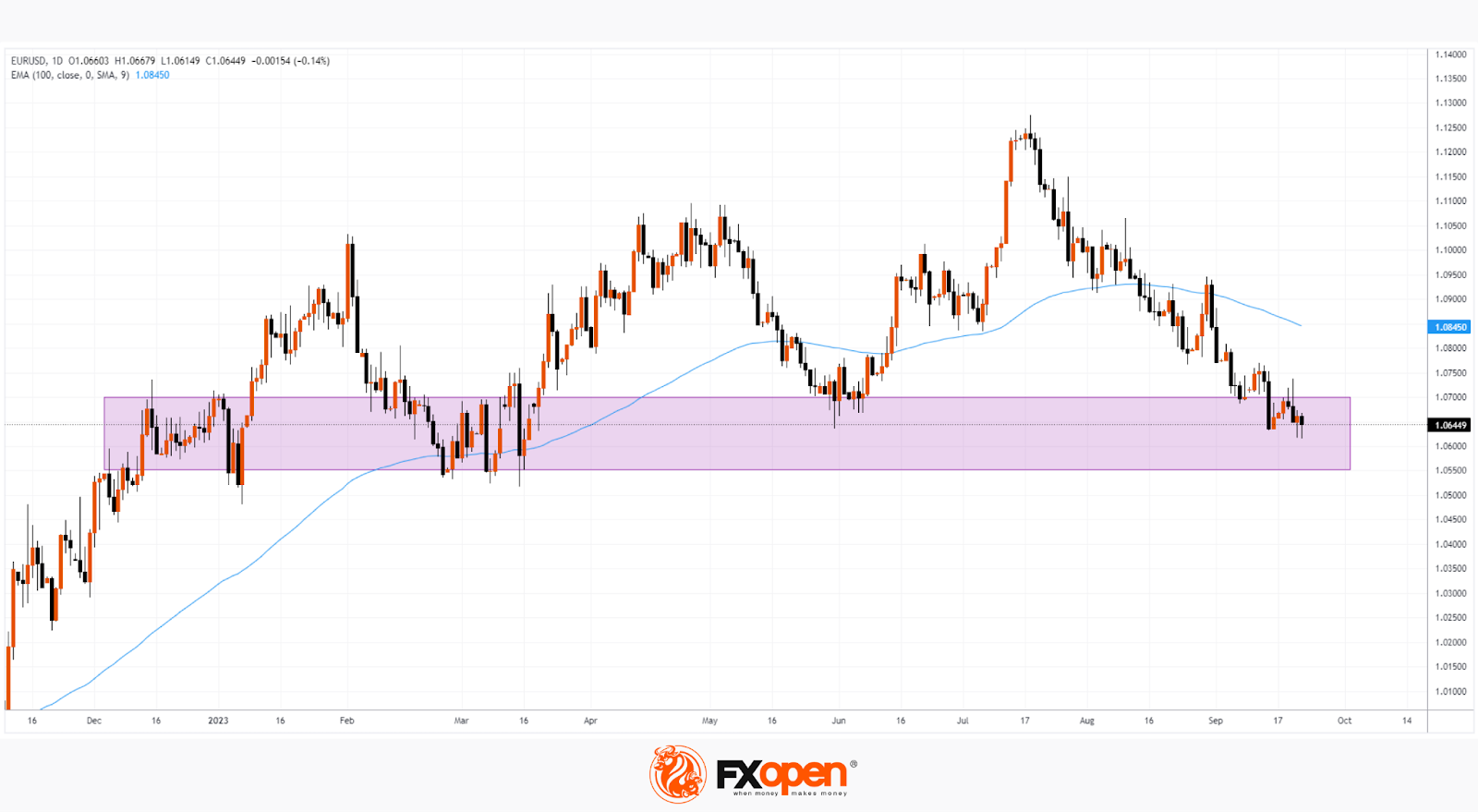
The euro immediately reacted to the disappointing news. The exchange rate against the dollar fell to its lowest level in six months. However, then an encouraging recovery followed — apparently, the proximity of the rate to the key support zone had an effect.
Bullish arguments:
- The price is in a range that has started in the first half of the year. There, the bears had several attempts to establish a downward trend, but failed. The price has been holding above this zone since the end of March.
- Yesterday’s candlestick was formed with a long lower shadow – evidence of bullish activity in the indicated zone.
- The downward trend has been maintained since mid-July – the rate dropped by 5.5%. As they say, an upward correction is overdue. That is, the bears could have lost their pressure and wanted to take profits.
Bearish arguments:
- The price is below the EMA (100), which is directed downward and may resist growth attempts.
- The state of the economy in the United States is more favorable according to the latest data, which is confirmed by the dynamics of the exchange rate. However, the balance of opinions may change today – news on the PMI index in the US is expected this afternoon at 16:45 GMT+3.
This article represents the opinion of the Companies operating under the FXOpen brand only. It is not to be construed as an offer, solicitation, or recommendation with respect to products and services provided by the Companies operating under the FXOpen brand, nor is it to be considered financial advice.
GBP/USD: Weak UK Economic Data Add to Cable’s Negative Outlook
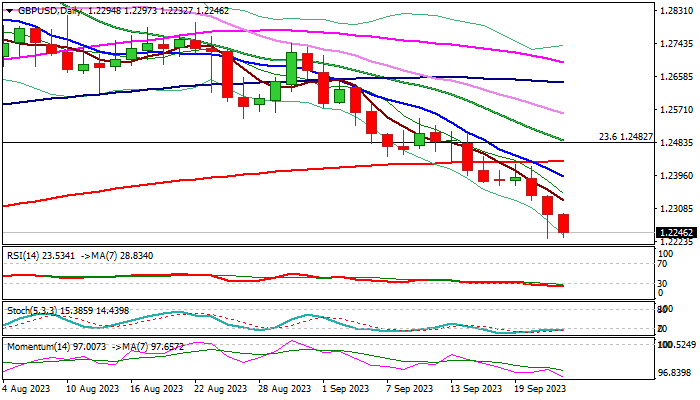
Bears tightened grip on Friday, offsetting initial positive signal of Thursday’s long-tailed daily candle, formed on post-BoE dip and subsequent bounce.
Fresh weakness is pressuring six-month low (1.2231) and nearby 55WMA (1.2204) which produced headwinds on Thursday, on track to break these supports and extend larger bear-leg from 1.3141 (2023 high) towards targets at 1.2074/00 (Fibo 38.2% of 1.0348/1.3141 uptrend / psychological).
Increasingly bearish technical picture on daily chart points to negative near-term outlook, with downside pressure being boosted by weaker than expected UK Aug retail sales and drop of UK services PMI well below forecast, which blows expectations of those advocating further BoE rate hikes.
However, strongly oversold conditions warn that bears may take a breather for limited consolidation, before resuming, as the pair is on track for another big weekly loss, which maintains downside pressure.
Res: 1.2297; 1.2332; 1.2393; 1.2433.
Sup: 1.2231; 1.2204; 1.2074; 1.2000.
EUR/USD: Overall Picture Bearish But Headwinds Continue to Slow the Action
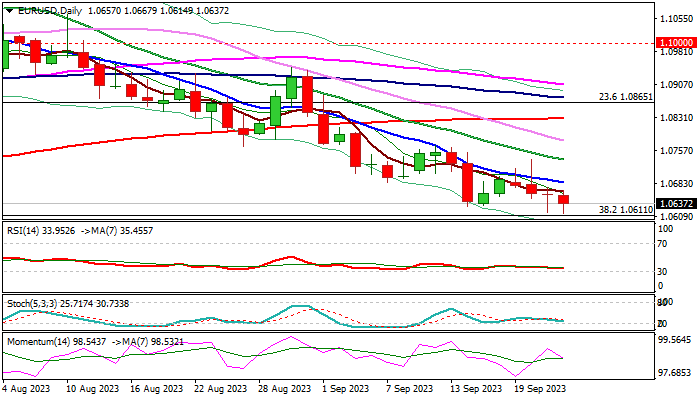
EURUSD keeps negative tone, but near-term action seems to be lacking firmer direction signals.
Wednesday’s strong upside rejection left a daily candle with long upper shadow and formed a bull-trap above 10 DMA, signaling strong bearish pressure, but long lower shadows on daily candles of Thursday / today, suggest that bears face headwinds from immediate support at 1.0611 (Fibo 38.2% of 0.9535/1.1275 uptrend and nearby top of thickening weekly Ichimoku cloud (1.0553).
Although the pair is on track for the tenth consecutive weekly close in red, the action of this week is shaped in Doji candle which signals indecision and may result in extended consolidation above 1.0611 Fibo support.
However, potential consolidation should not be long-lasting and likely limited as technical picture on daily chart is firmly bearish and negative outlook reinforced by bearish fundamentals as latest economic data added to signals that euro zone economy will likely contract in the third quarter, with unclear signs when the economy will return to growth.
This fuels expectations for bearish continuation scenario on break of 1.0611/1.0553 pivots and attack at next key target at 1.0516 (Mar 15 low) break of which would expose supports at 1.0405 (50% retracement) and 1.0295 (weekly cloud base).
Falling 10DMA offers initial resistance at 1.0686) which should ideally cap upticks and keep intact falling 20DMA (1.0736) violation of which would put larger bears on hold and unmask upper pivot at 1.0828 (200DMA).
Res: 1.0686; 1.0700; 1.0736; 1.0779.
Sup: 1.0611; 1.0553; 1.0483; 1.0405.
UK PMI composite fell to 46.0, heightened recession risk supports BoE pause
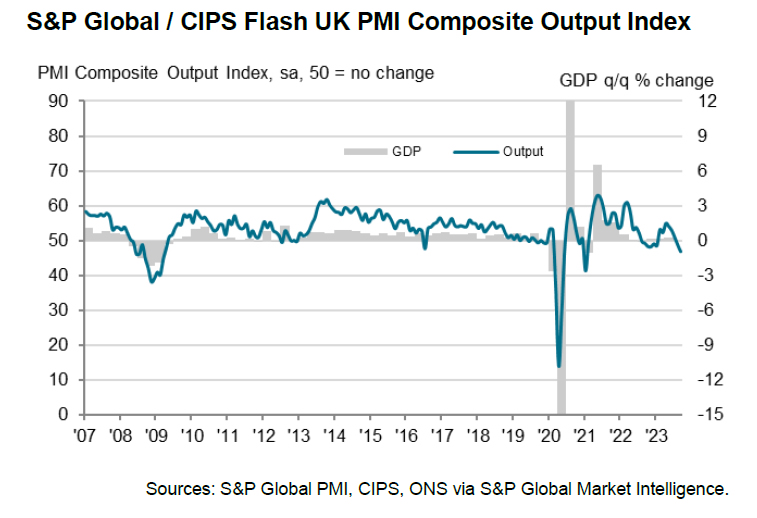
UK PMI Manufacturing sector had a slight uptick in September, moving from 43.0 to 44.2, surpassing expectations set at 43.0. Services PMI disappointed, recording a drop from 49.5 to 47.2, underperforming against the forecasted 49.0, marking a 32-month low. Consequently, PMI Composite followed suit, declining from 48.6 to 46.8, also registering a 32-month low.
Chris Williamson, Chief Business Economist at S&P Global Market Intelligence, stated, "The disappointing PMI survey results for September mean a recession is looking increasingly likely in the UK."
The current PMI data aligns with a potential GDP contraction of over -0.4% on a quarterly basis. Williamson mentioned, "September's downturn is the steepest since the height of the global financial crisis in early 2009 barring only the pandemic lockdown months."
A significant point of apprehension in the inflation framework remains wage growth. However, with the survey indicating the most significant employment decline since 2009, wage negotiation leverage appears to be dwindling swiftly.
Williamson believes the unsettling indications of heightened recession risk coupled with diminishing inflationary pressures are likely to have "added to calls to halt rate hikes" by BoE.
GBPJPY Recovers Some Ground after BoE Slump
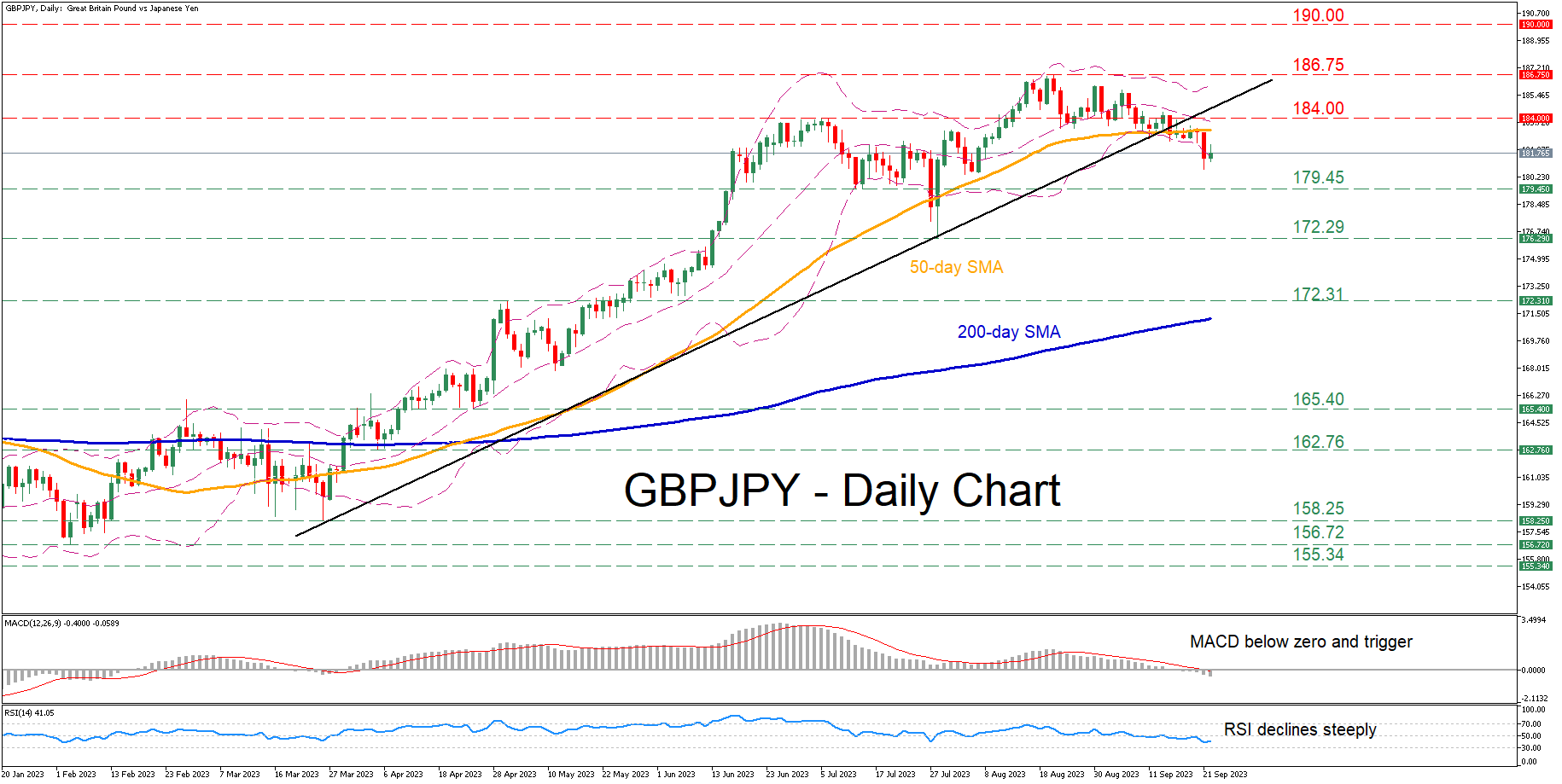
- GBPJPY slid below 50-day SMA after BoE surprise decision to hold rates steady
- Remains in a gentle downward path despite today’s bounce after BoJ leaves policy unchanged
- Will the short-term pullback extend?
GBPJPY had been stuck in a prolonged uptrend since the beginning of the year, posting an eight-year high of 186.75 on August 22. However, the pair has been experiencing a downside correction since then, with the momentum indicators suggesting more losses in the near term.
If selling interest persists, the July support of 179.45 could provide initial downside protection. Breaking below that zone, the price might face the July bottom of 172.29. A violation of that hurdle could open the door for the May resistance of 172.31, which could serve as support in the future.
Alternatively, should the price reverse back higher and reclaim its 50-day simple moving average (SMA), the bulls could attack the July peak of 184.00. Piercing through that wall, the pair could attempt to re-test its eight-year high of 186.75. If that barricade also fails, the price could ascend to fresh multi-year highs, where the 190.00 psychological mark might curb further upside attempts.
In brief, GBPJPY has been undergoing a strong pullback, which strengthened after the BoE’s dovish surprise. Nevertheless, traders should not rule out an impending bounce as the price is trading below the lower Bollinger band, hinting that the pair has reached oversold conditions.
USDCAD bears still in control
- USDCAD is in the red today, tests the support of the 200-day simple moving average
- The mixed momentum indicators complicate the outlook
- The SMAs’ convergence could open the door to a sizeable move ahead
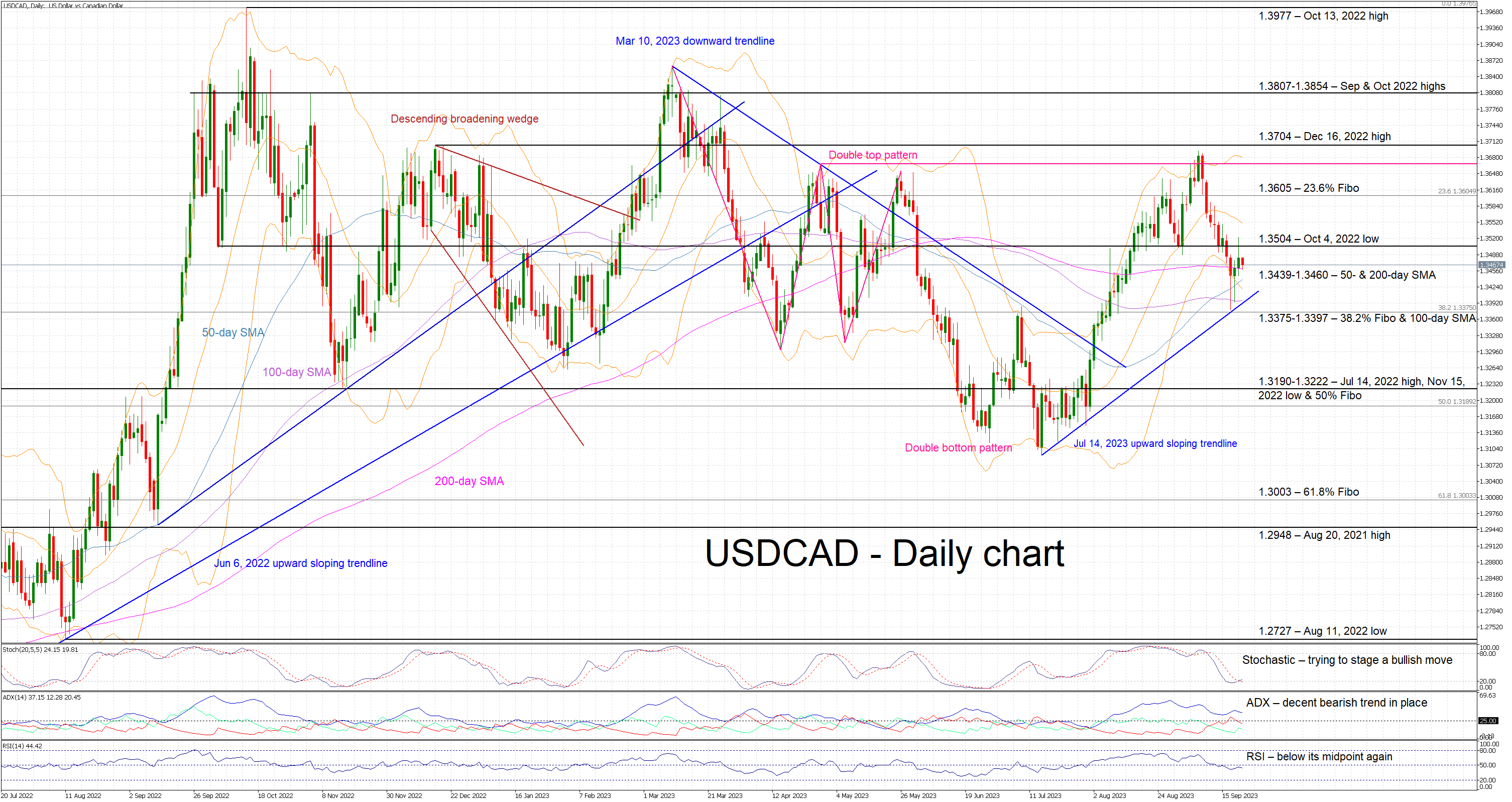
USDCAD is moving lower today after bouncing off the July 14, 2023 upward sloping trendline. The downleg since the September 7, 2023 peak has been impressive but the path appears to be trickier at this stage, especially as the bulls have decided to react more forcefully. Interestingly, the convergence of the SMAs is probably opening the door to a sizeable move soon but it is also elevating the importance of the 1.3439-1.3460 region.
Amidst this price action, the momentum indicators are currently split. On the one hand, both the RSI and Average Directional Movement Index (ADX) confirm the current bearish tendency in USDCAD and therefore are supportive of the bears’ intentions. On the other hand, the stochastic oscillator is once again spoiling the bears’ party. It is trying to edge above both its oversold territory and moving average. If successful, it will send a strong bullish signal.
Should the bulls try to capitalize on a likely bullish signal, they would try to keep USDCAD above the busy 1.3439-1.3460 area that is populated by the 50- and 200-day SMAs. They could have a go at overcoming the October 4, 2022 low at 1.3504 and then potentially set their eyes on the 23.6% Fibonacci retracement of the April 5, 2022 – October 13, 2022 uptrend at 1.3605.
On the flip side, the bears are probably feeling confident and preparing to break the 1.3439-1.3460 area. They could then target the busy 1.3375-1.3397 area, defined by the 38.2% Fibonacci retracement and the 100-day SMA, and the July 14, 2023 upward sloping trendline. They could then have a look at pushing USDCAD even lower, towards the key 1.3190-1.3222 range.
To sum up, USDCAD bears are probably taking a breather but appear ready for another pullback. However, the mixed momentum indicators are complicating the outlook.
USD/JPY: Rises Towards 2023 High on Dovish BOJ
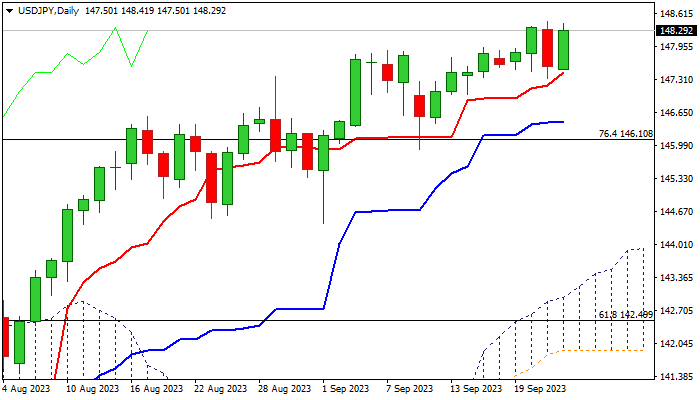
USDJPY bounced after BOJ policy decision, reversing Thursday’s loss and pressuring new 2023 high.
The Bank of Japan left its ultra-low interest rate unchanged, in line with expectations and kept its dovish stance in a forward guidance that put yen under fresh pressure.
Policymakers signaled they are so far not in rush to start tightening monetary policy and will continue to support economy until inflation, which is currently above BOJ’s target, returns to 2%.
The pair keeps full bullish stance, which was reinforced by the latest BOJ’s decision and remains on track for further gains, as recent talks about intervention also started to fade.
Rising daily Tenkan-sen (147.44) contained Thursday’s dip and continued to underpin the action, keeping near-term bias firmly with bulls for potential acceleration towards 150 target.
Daily Kijun-sen (146.45) and broken Fibo 76.4% (146.10) marks lower pivots, loss of which would sideline bulls and risk deeper correction.
Res: 148.45; 148.84; 149.70; 150.00.
Sup: 147.44; 147.01; 146.45; 146.10.
Eurozone PMIs point to -0.4% GDP contraction in Q3
Eurozone Manufacturing PMI was slightly disappointing in September, dipping from 43.5 to 43.4, failing to meet expectations set at 44.0. On the other hand, Services PMI indicated a slight revival, progressing from 47.9 to 48.4, surpassing the anticipated 47.5. Composite PMI reflected this marginal uplift, moving from 46.7 to 47.1.
Cyrus de la Rubia, Chief Economist at Hamburg Commercial Bank predicts a contraction for Eurozone in the third quarter, with a potential decrease of -0.4% relative to the previous quarter.
In services sector, "the heat on input prices shows that the risk of a wage-price spiral must remain very much on the radar of the ECB." Manufacturing continues to be a drag. But "destocking process" may bottom out over the next few months, which is crucial for the manufacturing sector's recovery for the beginning of next year.
Making a comparison between the two European giants, de la Rubia pointed out that while the French manufacturing sector "catching up" with Germany's weaknesses. When it comes to services, France's sector is "in a much worse state".