Sample Category Title
The Two-Month Pound Correction Not Over Yet
Business activity in the UK is losing ground, as is the case in Europe and China, although the final reading for August saw the services PMI rise to 49.5 from the first estimate of 48.7. According to today’s PMI, the services sector moved from growth to contraction in August, falling to 49.5.
At the end of last week, the PMI for the manufacturing sector fell to 43.0. Apart from April and May 2020, the index was only lower between October 2008 and February 2009.

This dynamic clearly shows the harshness of the current monetary policy for the manufacturing sector. The services sector has only begun correcting, enjoying a long tailwind from the post-pandemic recovery.
However, the markets seem to be paying more attention to signs of a contracting economy than ‘better than expected data’. GBPUSD fell as low as 1.2530 during the day before recovering to 1.2570 by the start of active trading in New York. The pair has lost around 4.5% since mid-July, with successive lows and highs.
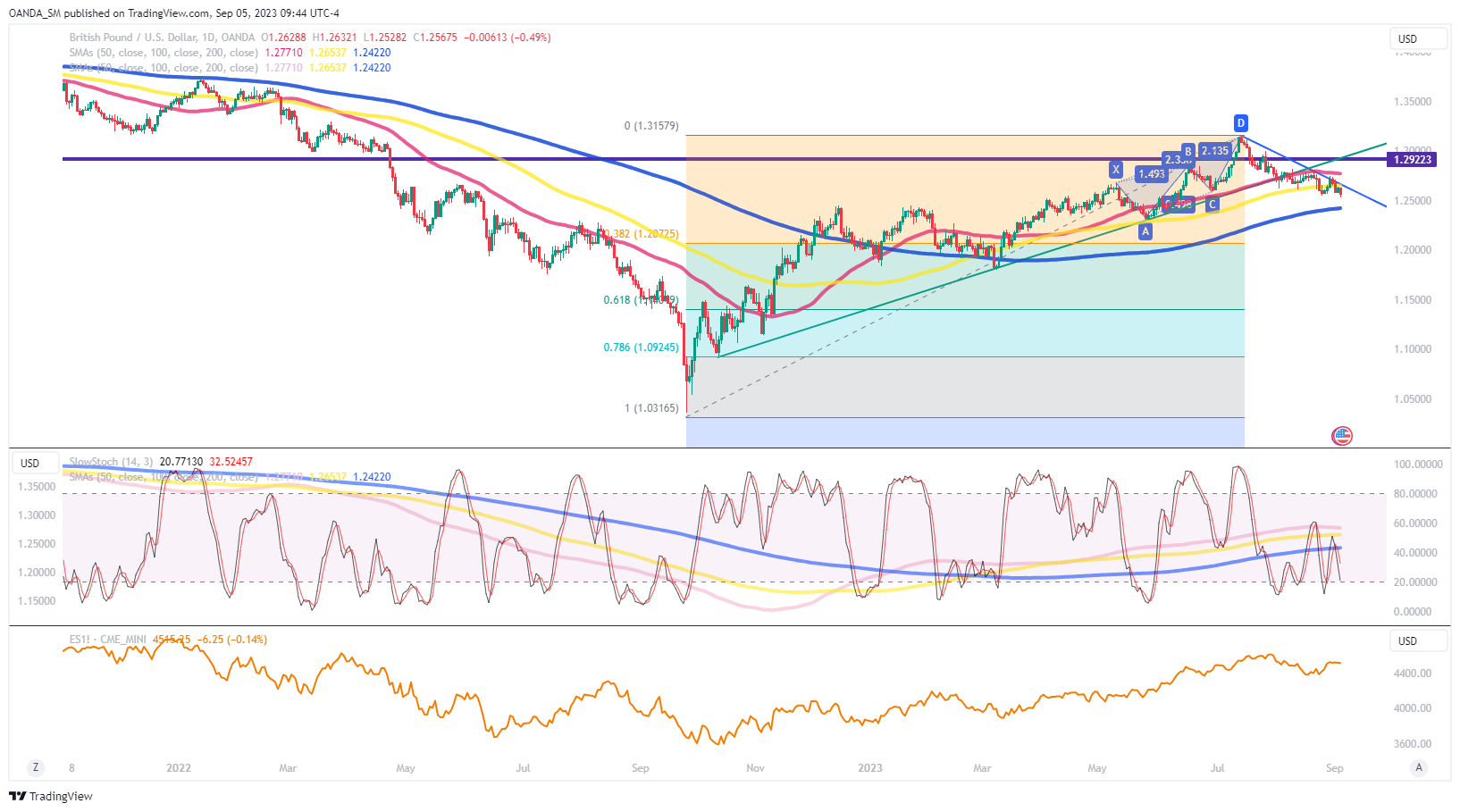
The pair may find tangible support in the 1.2410-1.2470 area, with the lower boundary being the 200-day average and the upper boundary being the 76.4% Fibonacci level of the entire rally from September last year to July this year.
One should also be prepared for a deeper dive to 1.2060 for an established (61.8%) retracement of this advance.

Sunset Market Commentary
Markets
The dollar returned from a long weekend and immediately left a stamp on trading. EUR/USD lost support from the lower bound of the 2023 upward sloping trading range at around 1.0785 before moving further south towards next support at 1.0735 (December 2022 interim high). That technical level is currently under heavy test as well. DXY (trade-weighted dollar, 104.58) temporarily rose above 104.7 resistance (May correction high). USD/JPY hits a new 2023 high at 147.40 with few to no obstacles in the way for a return towards the October 2022 multi-decade top. A risk-off environment that spilled over from Asian dealings into Europe couldn’t completely explain the strong move. The likes of the EuroStoxx50 indeed opened with losses of about 1% but pared losses as the session evolved. Most indices currently even trade flat. US Treasuries do underperform German Bunds today. Yields rise 2.5-4.9 bps across the curve with real yields accounting for about half of the move higher again. The 10-y real yield variant is nearing the 2% level again, the highest since 2009. Aside from monetary policy expectations (high for longer) we’d argue that it reflects at least as much the resilience of the US economy. Fed’s Waller in an interview today said that data is looking “pretty good” in terms of avoiding a recession. He did add that the recent batch doesn’t say the Fed needs to do anything imminent and that it can proceed carefully. His comments further downplay chances for a September hike but lift those for a final increase in November marginally. German Bund yields tried to join the US higher but lack momentum. They currently trade 0.8-3.1 bps higher. European data came in mixed and offered little guidance. In its consumer inflation survey, the ECB said 1-year ahead expectations stopped declining and stabilized at 3.4%. The 3-year ahead series even ticked higher from 2.3% to 2.4%. Final PMIs were revised downwardly, with services now standing at 47.9 instead of the preliminary 48.3. The composite gauge as a result fell to 46.7, the lowest since November 2020, instead of the initial 47. Unlike in the US, worsening growth prospects prevent European real yields to rise as much as they should to act forcefully against high inflation. A Bloomberg article today, which was given little market attention, mentioned that speculation is mounting for the ECB to shrink its bond portfolio faster than currently as a countermeasure. APP is being wound down as fast as bonds are maturing (about €30/m on average for the next 12 months). PEPP reinvestments run through 2024 but calls are growing for a faster ending.
News & Views
South African GDP grew by 0.6% Q/Q in Q2 (1.6% Y/Y), beating the 0.3% Q/Q consensus estimate and slightly outpacing Q1 growth (0.4%). The supply side picture shows that six of ten industries recorded growth with manufacturing and finance outperforming. The main drag came from utility and from transport. The demand side picture showed an increase in investments (3.9% Q/Q) and government consumption (1.7%) with net exports (-2.4%) and household consumption (-0.3%) decreasing. Customers cut back expenses on nearly every category apart from health, education, transport and restaurants & hotels. Apart from GDP numbers, the August South African PMI rose significantly in August (51 from 48.2). It’s only this year’s second 50+ reading (February). S&P Global, responsible for the survey, talks about an encouraging turnaround in the private economy midway through the third quarter with companies reporting an increase in output for the first time in a year and order books starting to improve even as inflation saps spending power. Input purchases rose the strongest since June 2022. The August improvement is welcome, but doesn’t balance relatively weak growth in H1 2023. The South African rand can’t profit from today’s better-then-expected figures. USD/ZAR closes in on the August high at 19.30. Higher core bond yields are to blame.
The Swedish services PMI crashed from 53.4 to 49 in August, erasing the July uptick. The composite measure followed, declining from 51.9 to 48.1 and returning back to contraction territory where it had been all year. Details showed a huge setback in new orders which had triggered the July spike (46.3 to 58) with actual and planned business volumes both dropping. Companies significantly reduced their order backlog, but employment remains surprisingly strong. Supplier input prices accelerated to their highest level since December of last year (69.6 from 62.2) suggesting no signs of easing price pressure. The Swedish krone is again at the backfoot, closing in on the all-time lows just below EUR/SEK 12.
GBP/USD Breaks Down Amid Global Risk-Aversion
- EU and China Service PMIs drive global growth concerns
- UK Final Services PMI revised higher but downward trend remains
- Fed’s Waller (hawk) says “There is nothing that is saying we need to do anything imminent anytime soon.”
GBP/USD (daily chart) as of Tuesday (9/5/2023) has made a quick and strong breakdown below multiple support levels, indicating a potential bearish breakdown could target the 38.2% Fibonacci level, which resides at 1.2072. A bearish near-term outlook has been in place over the past month on the decline of both the longstanding bullish support trendline that was in place since last October and below the 50-day SMA. Price action is currently trading below the 100-day SMA and if downside continues, could target the 200-day SMA at 1.2421.
Upward UK PMI revisions
The British pound pared losses this morning after UK services data came in better-than expected, outperforming what came from the Eurozone and following the downbeat readings from China. The UK service sector is still in contraction territory, standing at 49.5, but it did buck the trend we saw with the rest of Europe. While the service reading was revised higher from a preliminary reading of 48.7, the downward trend that started in April remains firmly in place.
Central bank expectations
Slowing global growth concerns are sending rate hike expectations lower across the board. Fed fund futures now are only pricing in a 6.8% chance of a rate hike at the September 20th meeting and the November 1st odds are currently at 37.2%. The ECB rate hike odds for the September 14th meeting are now at 25.5% and the October 26th meeting has a 25.8% expectation for a rate increase.
Both the BOE and Riksbank are the only central banks (advanced economies) that are close to fully pricing in rate increases at their respective September policy decisions. The BOE appears poised to deliver two quarter-point rate increases as financial markets price a 97.6% chance of an increase at the September 21st meeting.
Short-term drivers
The GBP/USD pair reacted positively to Fed’s Waller’s comment that the data doesn’t say we need to do anything imminent. Waller is considered one of the more hawkish Fed members, so this comment could help convince markets that the Fed is likely done raising rates. It appears that global sentiment will likely be the primary driver here for the British pound, but dollar weakness could emerge if more Fed officials signal the end of tightening has arrived. If the UK labor market starts to loosen and household spending softens, BOE rate hike odds could come down and that could also fuel further downward pressure on sterling.
Fed Waller cautiously optimistic on inflation trend, eyes further data for rate decisions
Fed Governor Christopher Waller offered a cautious but upbeat assessment of recent US economic indicators in a CNBC interview today. Describing the previous week's data as "a hell of a good week," Waller emphasized that positive trends, particularly in inflation, would allow Fed to "proceed carefully" on interest rates.
Waller stated that inflation remains Fed's primary concern at this time. "The biggest thing is just inflation," he said, adding that consecutive favorable reports have been encouraging. However, he refrained from being overly optimistic, noting that Fed needs to "see whether this low inflation is a trend or if it was just an outlier or a fluke."
His cautious tone comes from recent history. "We've been burned twice before," Waller observed. In both 2021 and the end of 2022, initial indications suggested inflation was stabilizing, only to shoot up or be revised away later. As a result, Waller emphasized the need for a more sustained pattern of data before making any conclusive statements. "I want to be very careful about saying we've kind of done the job on inflation until we see a couple of months continuing along this trajectory," he elaborated.
When asked about the possibility of further tightening, Waller insisted that decisions would be data-dependent. He did, however, reassure that one more rate hike wouldn't necessarily throw the economy into recession. "It's not obvious that we're in real danger of doing a lot of damage to the job market, even if we raise rates one more time," he stated.
USD/JPY Mid-Day Outlook
Daily Pivots: (S1) 146.18; (P) 146.34; (R1) 146.65; More...
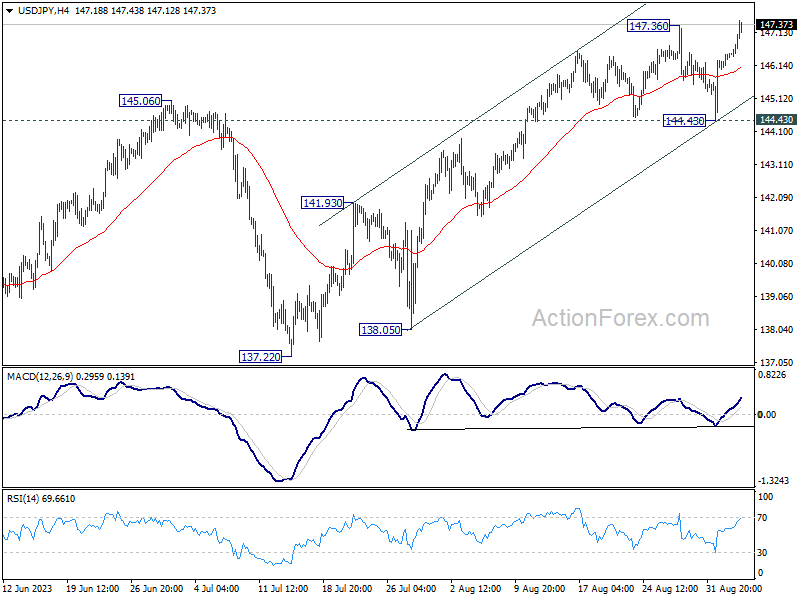
Break of 147.36 resistance indicates resumption of recent rally in USD/JPY. Intraday bias is back on the upside. Current rise from 127.20 should target a test on 151.93 high. For now, near term outlook will stay bullish as long as 144.43 support holds, in case of retreat.
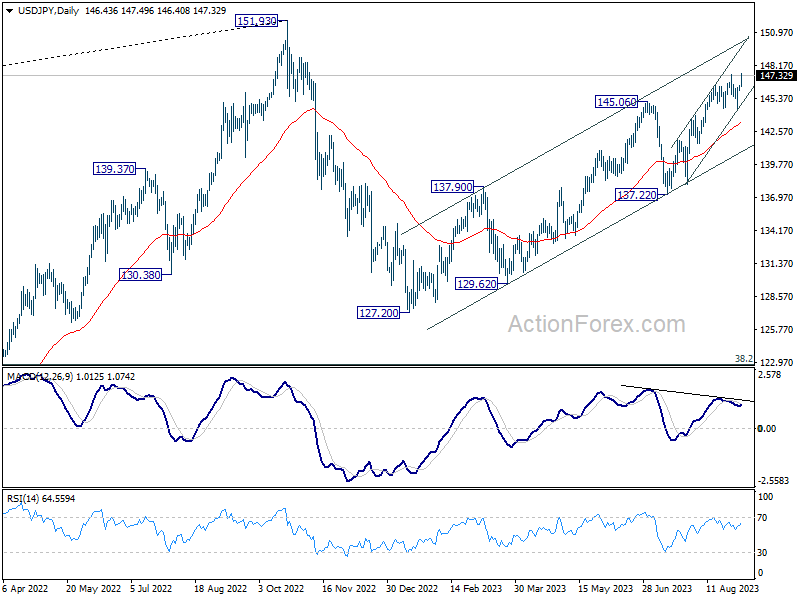
In the bigger picture, overall price actions from 151.93 (2022 high) are views as a corrective pattern. Rise from 127.20 is seen as the second leg of the pattern and could still be in progress. But even in case of extended rise, strong resistance should be seen from 151.93 to limit upside. Meanwhile, break of 137.22 support should confirm the start of the third leg to 127.20 (2023 low) and below.
USD/CHF Mid-Day Outlook
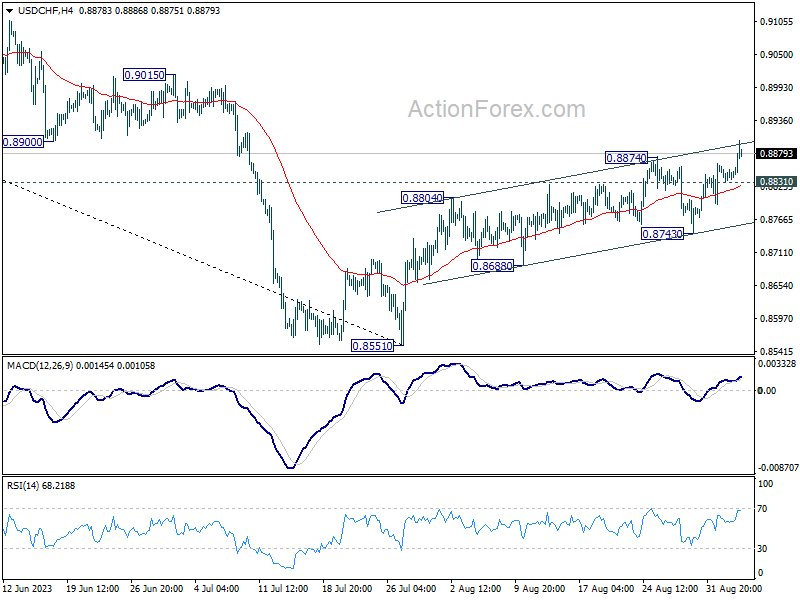
Daily Pivots: (S1) 0.8831; (P) 0.8847; (R1) 0.8860; More....
USD/CHF's break of 0.8874 resistance confirms resumption of rebound from 0.8551. Intraday bias is back on the upside. Further rally should be seen to 0.9146 cluster resistance. On the upside, below 0.8831 minor support will turn intraday bias neutral first. But risk will stay on the upside as long as 0.8743 support holds.
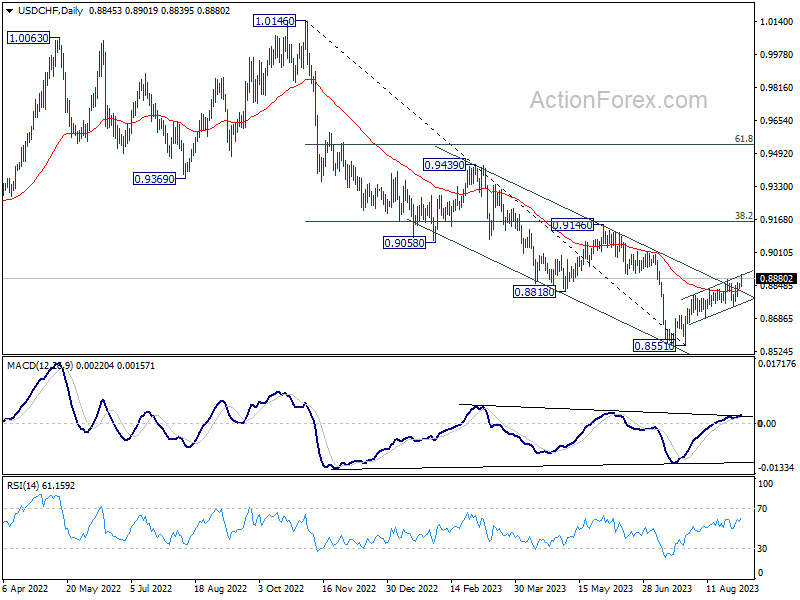
In the bigger picture, rebound from 0.8551 medium term bottom is currently seen as a correction to the downtrend from 1.0146 (2022 high). Further rally would be seen to 0.9146 cluster resistance (38.2% retracement of 1.0146 to 0.8551 at 0.9160). Strong resistance could be seen there to limit upside, at least on first attempt.
GBP/USD Mid-Day Outlook
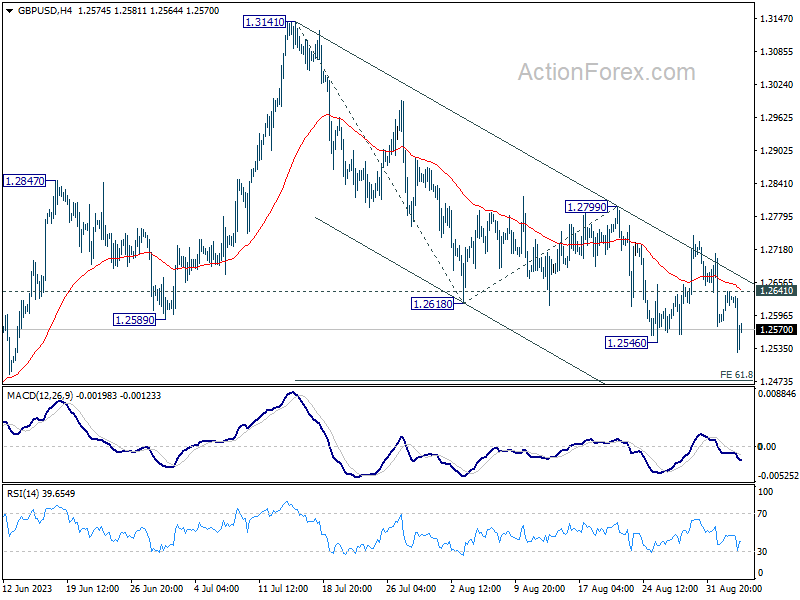
Daily Pivots: (S1) 1.2596; (P) 1.2620; (R1) 1.2652; More...
Breach of 1.2546 support indicates resumption of whole fall from 1.3141. Intraday bias ins GBP/USD is back on the downside for 61.8% projection of 1.3141 to 1.2618 from 1.2799 at 1.2476. Firm break there could prompt downside acceleration to 100% projection at 1.2276. On the upside, above 1.2641 minor resistance will turn intraday bias neutral first.
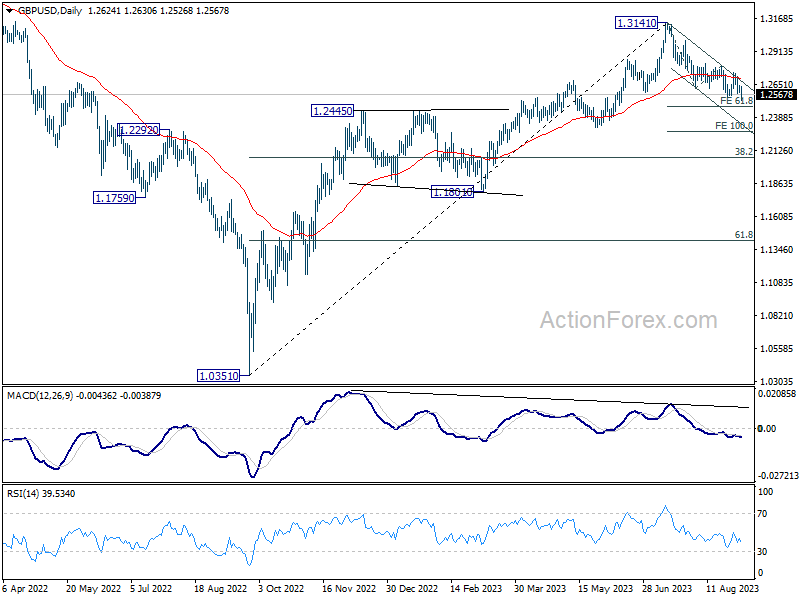
In the bigger picture, fall from 1.3141 medium term top is seen as a correction to up trend from 1.0351 (2022 low). Deeper decline would be seen to 38.2% retracement of 1.0351 to 1.3141 at 1.2075. Strong support would be seen there to bring rebound on first attempt. But outlook will be neutral at best as long as 1.3141 resistance holds, and consolidation from there is set to extend, until further development.
EUR/USD Mid-Day Outlook
Daily Pivots: (S1) 1.0776; (P) 1.0793; (R1) 1.0813; More...
EUR/USD's break of 1.0764 support confirms resumption of whole decline from 1.1274. Intraday bias is back on the downside for 1.0609/34 cluster support next. On the upside, above 1.0808 minor resistance will turn intraday bias neutral first. But risk will stay on the downside as long as 1.0944 resistance holds, in case of recovery.
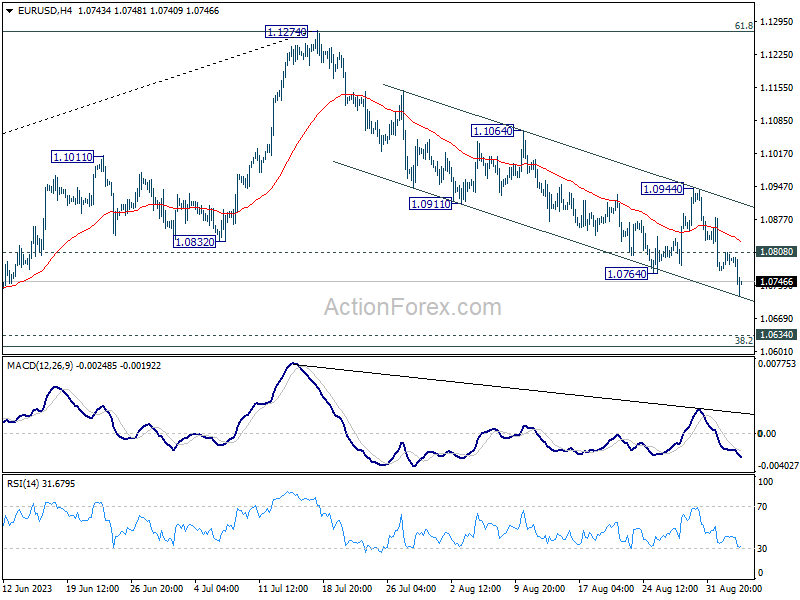
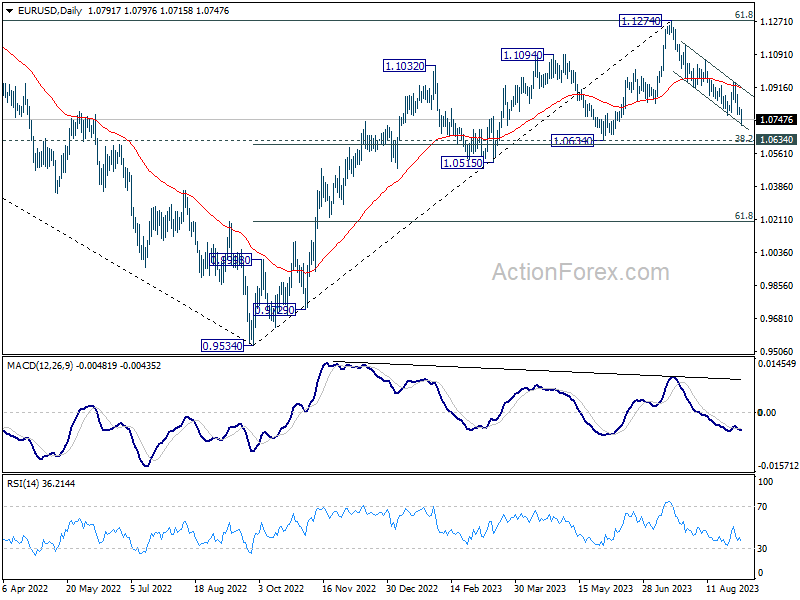
In the bigger picture, fall from 1.1274 medium term top is seen as a correction to up trend from 0.9534 (2022 low). Deeper decline would be seen to 1.0634 cluster support (38.2% retracement of 0.9534 to 1.1274 at 1.0609). Strong support could be seen there, at least on first attempt, to bring rebound. Yet, medium term outlook will be neutral for now, as long as 1.1274 resistance holds. However, sustained break of 1.0609/34 will raise the chance of bearish trend reversal, and target 61.8% retracement at 1.0199.
Dollar’s Dominant Rally Highlights Resilient US Economy as Global Growth Wanes
Dollar is making a powerful rally today, breaking through near-term resistance levels against all its major counterparts. This surge is anchored by recent economic data, which paints a picture of a US economy that is cooling but not cracking. This robustness stands in stark contrast to the weakening growth conditions seen in other major economies, as evidenced by today's disappointing services PMI data from China, Eurozone, and UK. Given the relative strength of the US economy, Fed might eventually find itself being the last among major central banks to initiate interest rate cuts. This scenario becomes increasingly likely if the US continues to demonstrate economic resilience while its global peers falter.
The greenback's strength today is not just noteworthy but dominant. It reached a new year-high against Yen, while Euro and Sterling plummeted to their lowest levels since mid-June. Australian Dollar, often seen as a proxy for China risk, was the hardest hit, dropping to its lowest point since last November. New Zealand Dollar didn't fare much better, coming in as the day's second-worst performer. In a curious twist, Canadian Dollar displayed a bit of resiliency, standing as the second strongest for the day. Among European currencies, Sterling appeared to be the better performer, albeit in a losing game.
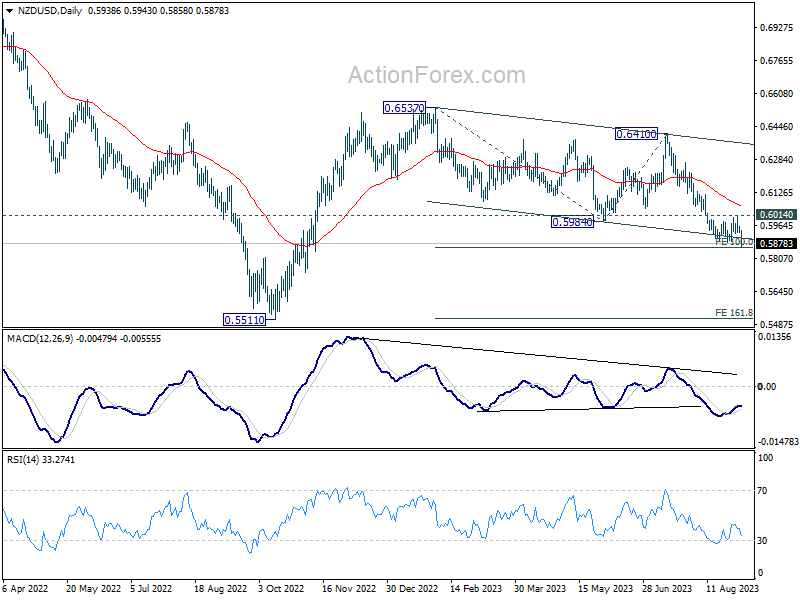
Technically, NZD/USD resumes the fall from 0.6410 today by breaking through 0.5885 support. Immediate attention is now on 100% projection of 0.6537 to 0.5984 from 0.6410 at 0.5857. Decisive break there, together with sustained trading below medium term channel support, could prompt downside acceleration to 161.8% projection at 0.5515, which is close to 0.5511 (2022) low). Even in the event of a strong recovery, the pair's outlook remains bearish as long as 0.6014 resistance holds.
In Europe, at the time of writing, FTSE is up 0.12%. DAX is down -0.07%. CAC is down -0.08%. Germany 10-yaer yield is up 0.0082 at 2.590. Earlier in Asia, Nikkei rose 0.30%. Hong Kong HSI dropped -2.06%. China Shanghai SSE dropped -0.71%. Singapore Strait Times dropped -0.37%. Japan 10-year JGB yield rose 0.0112 to 0.658.
ECB Lane emphasizes need for timely return to 2% inflation
In an interview with The Currency, ECB Chief Economist Philip Lane offered some guarded optimism about the inflationary environment in Eurozone, despite acknowledging that the current inflation rate is a lofty 5.3%. Lane was keen to highlight a "welcome development" in the latest data, pointing to a slight easing in both goods and services inflation as potentially indicative of changing momentum.
Lane emphasized ECB's ongoing challenge of steering inflation rate back to its 2% target. "What is a timely manner?" Lane posed, elaborating that the goal is to return to 2% "sufficiently quickly that everyone understands that the current inflation episode is time-limited."
He underscored the importance of convincing the public that this is a "temporary inflation episode," and that they should not alter their longer-term behavior in anticipation of persistently high inflation rates. The key objective here is to prevent inflation expectations from becoming unanchored.
ECB consumer survey sees rising 3-yr inflation expectations, more pessimistic growth outlook
ECB has just released its Consumer Expectations Survey for July 2023, offering an inside look into how consumers are viewing the economic outlook.
Most notably, median expectations for inflation over the next year remained static at 3.4%. Even more telling is that forecast for inflation three years out saw a marginal uptick, moving to 2.4% from 2.3% recorded.
On the other hand, mean economic growth expectations for the next 12 months turned a bit more pessimistic, registering at -0.7% as compared to -0.6% in June.
In terms of employment, expectations for unemployment rate a year from now remained stable at 11.0%. Consumers perceive the current unemployment rate to be 10.8%, suggesting an expectation of a broadly stable labor market.
Eurozone PPI down -0.5% mom, -7.6% yoy in Jul
Eurozone PPI fell -0.5% mom -7.6% yoy in July, versus expectation of -0.6% mom, -7.6% yoy. For the month, Industrial producer prices decreased by -1.2% mom for intermediate goods and by -0.9% mom in the energy sector, while prices increased by 0.1% mom for non-durable consumer goods and by 0.2% mom for both capital goods and durable consumer goods. Prices in total industry excluding energy decreased by -0.4% mom.
EU PPI was down -0.6% mom, -6.6% yoy. The largest monthly decreases in industrial producer prices were recorded in Ireland (-8.1%), the Netherlands (-2.6%) and Sweden (-1.8%), while the highest increases were observed in Latvia (+2.2%), Slovakia (+1.7%) and Croatia (+1.3%).
Eurozone PMI services finalized at 47.9, Q3 GDP to contract -0.1%
Eurozone is grappling with weakening economic indicators, as PMI Services for August (final) slipped to a 30-month low of 47.9, down from July's reading of 50.9. Composite PMI, which combines services and manufacturing data, also sank to a 33-month low of 46.7, down from July's 48.6.
The fall in PMI scores was particularly evident in Germany (44.6) and France (46.0), which reported 39-month and 33-month lows, respectively. On the other hand, Ireland managed to score a 4-month high of 52.6, showing some resilience amid the general downturn.
Cyrus de la Rubia, Chief Economist at Hamburg Commercial Bank, provided a sobering analysis. "The disappointing numbers contributed to a downward revision of our GDP nowcast, which stands now at -0.1% for the third quarter," he said. According to de la Rubia, the services sector, a stabilizer for Eurozone economy, has turned into a "drag".
Furthermore, he noted that input price increases have surprisingly accelerated, questioning the outlook for rapidly decreasing inflation. Employers are also becoming cautious about expanding their workforces, hinting that job cuts could be on the horizon.
UK PMI services finalized at 49.5, faltering growth and sticky inflation
UK PMI Services was finalized at 49.5 in August, down from July's 51.5, and represents the lowest level since January. Furthermore, PMI Composite was finalized at 48.6, down from 50.8 in July, indicating the first contraction since the start of the year.
Tim Moore, Economics Director at S&P Global Market Intelligence, elaborated on the concerning developments. He noted that service sector businesses are "clearly feeling the impact of rising interest rates on client demand"
"Worries about the broader business climate also dampened spending in August," Moore said, adding that "faltering UK economic growth and sticky inflation" are contributing to more cautious outlook.
A key takeaway from the survey is the pace at which backlogs of work are decreasing—reported as the fastest in over three years. This suggests that businesses are scaling back their operations, perhaps in anticipation of tougher times ahead. The survey also highlighted cooling job market within service sector, as job creation dipped to its lowest point since March.
The report pointed out that competitive pressures may have started to curb inflation within the service economy. The latest round of price hikes was the slowest seen in two years, offering a glimmer of hope that inflation may stabilize or even decline in the near term.
RBA holds rates steady at 4.10%, maintains hawkish bias
RBA held its cash rate target unchanged at 4.10% in a widely expected move, offering additional time to evaluate impact of previous interest rate hikes and evolving economic outlook. Although the central bank maintained hawkish bias, it emphasized that future decisions would be highly data-dependent, particularly scrutinizing global economic trends, household spending, and conditions in labor and inflation.
In its accompanying statement, the RBA noted, "Some further tightening of monetary policy may be required to ensure that inflation returns to target in a reasonable timeframe."
RBA stated that the Australian economy is undergoing a period of "below-trend growth," a situation expected to persist. Unemployment rate is anticipated to rise gradually to around 4.5% by the end of next year. Recent data suggests that inflation will likely re-enter the 2-3% target range over the forecast horizon.
However, it cautioned that uncertainties abound, including the persistent nature of services price inflation observed overseas, which could manifest similarly in Australia. Other uncertainties revolve around the lag effects of monetary policy, labor market's response to slower economic growth, and behavior of firms in their pricing and wage-setting decisions.
It also expressed concerns about the household sector. Global uncertainties, particularly those related to the Chinese economy, were noted as an additional risk, given the ongoing stresses in China's property market.
China's Caixin PMI services fell to 51.8, waning economic momentum
China Caixin PMI Services for August fell to 51.8, down from 54.1 in July and below market expectations of 53.6. This marks the lowest reading in eight months. According to Caixin, the softer performance was due to a slower increase in business activity and new orders. While employment continued to rise, input cost inflation reached a six-month low.
Composite Output Index, which includes both manufacturing and services sectors, slightly decreased from 51.9 to 51.7. Though it still indicates expansion, the rate of growth was the slowest since January this year. A milder expansion in services sector was partially offset by a modest uptick in factory production.
Wang Zhe, Senior Economist at Caixin Insight Group, attributed the lackluster performance to seasonal fluctuations, extreme weather conditions like high temperatures and flooding, and a complicated global economic environment. These factors are further exacerbated by weak domestic demand.
Wang also warned of the long-term challenges facing the Chinese economy, stating, "Looking ahead, seasonal impacts will gradually subside, but the problems of insufficient domestic demand and weak expectations may form a vicious cycle for a protracted period of time." He added that given the uncertainty in external demand, downward pressure on the economy may continue to intensify.
EUR/USD Mid-Day Outlook
Daily Pivots: (S1) 1.0776; (P) 1.0793; (R1) 1.0813; More...
EUR/USD's break of 1.0764 support confirms resumption of whole decline from 1.1274. Intraday bias is back on the downside for 1.0609/34 cluster support next. On the upside, above 1.0808 minor resistance will turn intraday bias neutral first. But risk will stay on the downside as long as 1.0944 resistance holds, in case of recovery.
In the bigger picture, fall from 1.1274 medium term top is seen as a correction to up trend from 0.9534 (2022 low). Deeper decline would be seen to 1.0634 cluster support (38.2% retracement of 0.9534 to 1.1274 at 1.0609). Strong support could be seen there, at least on first attempt, to bring rebound. Yet, medium term outlook will be neutral for now, as long as 1.1274 resistance holds. However, sustained break of 1.0609/34 will raise the chance of bearish trend reversal, and target 61.8% retracement at 1.0199.
Economic Indicators Update
| GMT | Ccy | Events | Actual | Forecast | Previous | Revised |
|---|---|---|---|---|---|---|
| 23:01 | GBP | BRC Like-For-Like Retail Sales Y/Y Aug | 4.30% | 2.20% | 1.80% | |
| 01:30 | AUD | Current Account Balance (AUD) Q2 | 7.7B | 8.1B | 12.3B | 12.5B |
| 01:45 | CNY | Caixin Services PMI Aug | 51.8 | 53.6 | 54.1 | |
| 04:30 | AUD | RBA Interest Rate Decision | 4.10% | 4.10% | 4.10% | |
| 07:45 | EUR | Italy Services PMI Aug | 49.8 | 50.2 | 51.5 | |
| 07:50 | EUR | France Services PMI Aug F | 46 | 46.7 | 46.7 | |
| 07:55 | EUR | Germany Services PMI Aug F | 47.3 | 47.3 | 47.3 | |
| 08:00 | EUR | Eurozone Services PMI Aug F | 47.9 | 48.3 | 48.3 | |
| 08:30 | GBP | Services PMI Aug F | 49.5 | 48.7 | 48.7 | |
| 09:00 | EUR | Eurozone PPI M/M Jul | -0.50% | -0.60% | -0.40% | |
| 09:00 | EUR | Eurozone PPI Y/Y Jul | -7.60% | -7.60% | -3.40% | |
| 14:00 | USD | Factory Orders M/M Jul | -2.50% | 2.30% |
European and Chinese Economies Drag Markets Down
Economic data from China and the eurozone sent markets back into sell-off mode.
China’s services PMI fell from 54.1 to 51.8, the smallest growth rate since last December. That’s a sharper slowdown than the 53.6 expected. The momentum of the recovery from lifting COVID restrictions is quickly fading, and the stimulus measures announced so far have proved unable to reverse the trend.
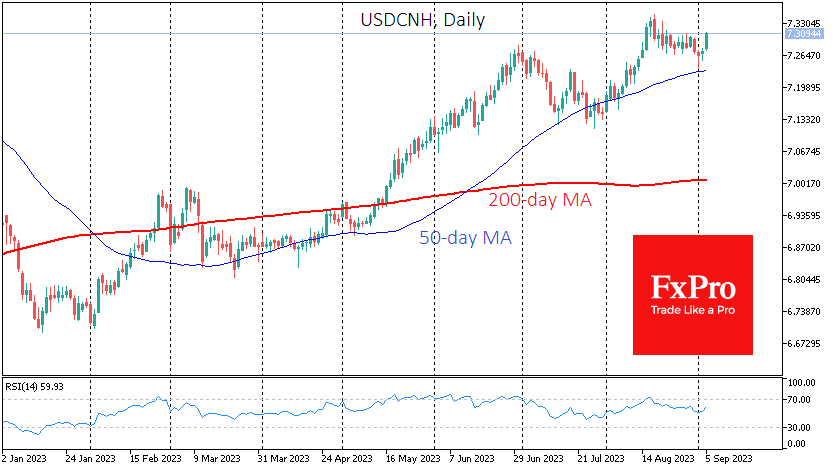
Sellers have taken control after a two-week rally in Chinese indices. The dollar is once again approaching 7.31 yuan, back in the range of the multi-year highs reached in August. And that’s bad news for global equities, too, given the size of the Chinese economy and its links to others, especially Europe.
Meanwhile, Europe is, unfortunately, one step ahead of China in this economic cycle. The latest composite PMI estimates for the eurozone marked a contraction in business activity at the fastest pace since November 2020. The index peaked at 54.1 in April and has declined every month since, falling to 46.7 in August.
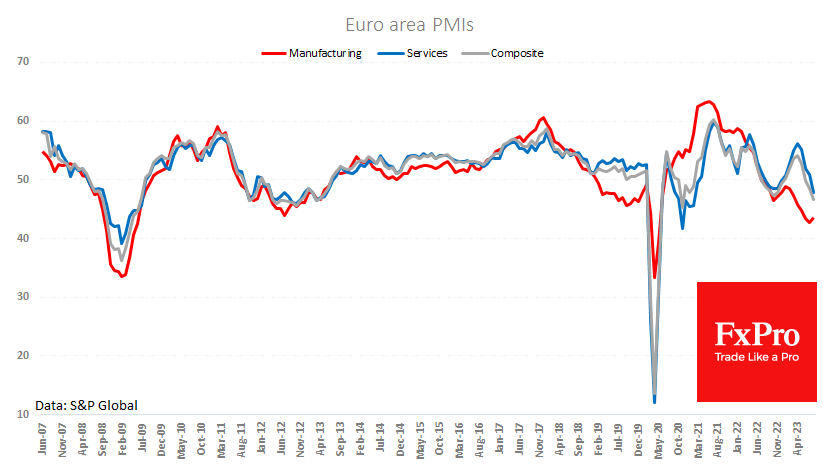
Lower gas prices and full storage facilities could not overcome the factor of high interest rates and weaker demand from China.
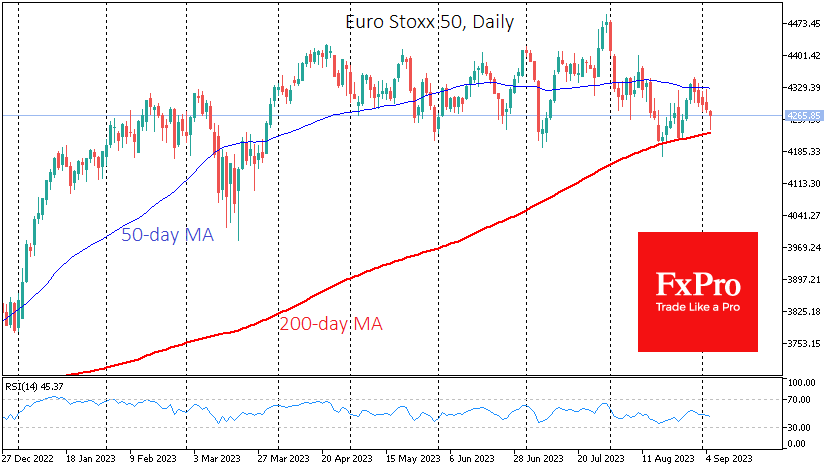
Since the middle of last month, the EuroStoxx50 has regularly tested its 200-day moving average and found support on the way down to 4220. It is fair to say that the European market is now clinging to hopes of ending the ECB’s policy tightening and that the economy is adjusting to higher rates.
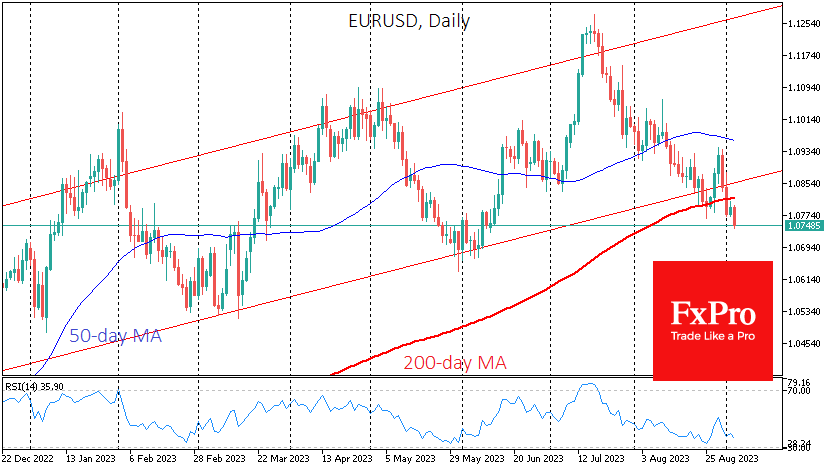
The second major factor is the 4% weakening of the euro over the past seven weeks. The EURUSD fell to 1.0750, its lowest level since June. Last Friday, it fell below its 200-day moving average, which signals a change in the long-term trend and could drag the pair down to the 1.0500 area.
The currency market is often one step ahead of the stock market, and in periods of strong trends, the correlation between stocks and the euro is often direct rather than inverse, as in the US or Japan. Therefore, if EURUSD continues to fall into a bear market, euro zone blue chips are also at risk of an intensified sell-off towards 4000.