Sample Category Title
Elliott Wave View: DAX Looking to Extend Lower in Double Three
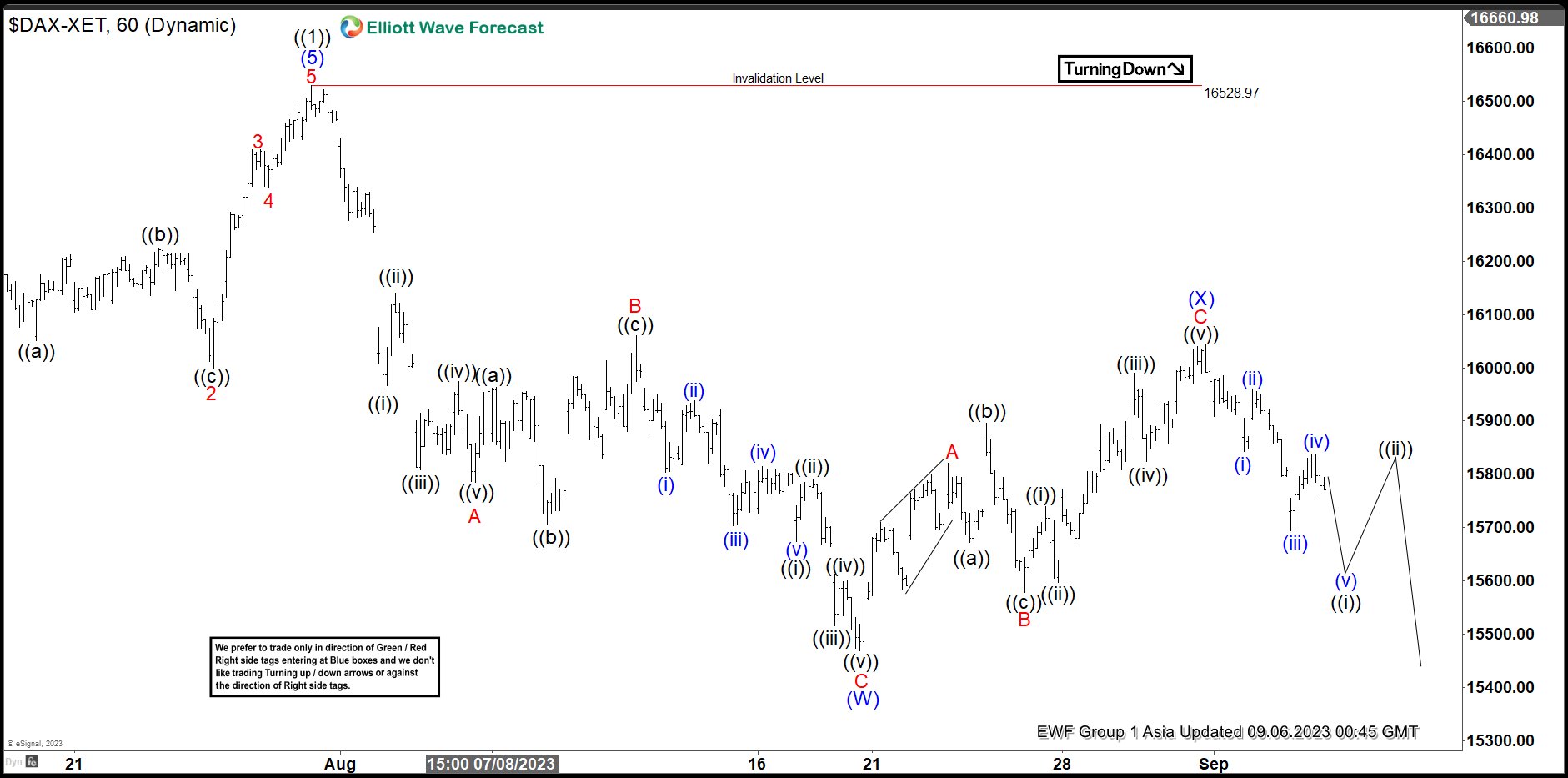
DAX ended cycle from September 28, 2022 low with wave ((1)) at 16528.97 as the 1 hour chart below shows. Index is currently in wave ((2)) pullback to correct the larger degree from September 2022 low. Internal subdivision of wave ((2)) is unfolding as a double three Elliott Wave structure. Down from wave ((1)), wave A ended at 15784.52. Wave B rally ended at 16060.27 as an expanded Flat. Index resumed lower again in wave C towards 15468.65 which completed wave (W).
Index then turned higher in wave (X) with internal subdivision as a zigzag Elliott Wave structure. Up from wave (W), wave A ended at 15820.95 and pullback in wave B ended at 15578.97. Index then extended higher in wave C towards 16042.66 which completed wave (X). DAX has turned lower in wave (Y) but still needs to break below wave (W) at 15468.65 to rule out any double correction. Down from wave (X), another leg lower is expected to end wave ((i)). Afterwards, it should rally in wave ((ii)) before turning lower again. Near term, as far as pivot at 16528.97 high stays intact, expect the Index to extend lower.
DAX 60 Minutes Elliott Wave Chart
DAX Elliott Wave Video
https://www.youtube.com/watch?v=4_bMF25IaTo
Japan’s Kanda flags “high urgency” as Dollar bears 148 Yen
Japan's Vice Minister of Finance for International Affairs, Masato Kanda, issued a strong warning as Dollar approaches 148 yen, marking a high for this year.
Kanda stated, "We are closely monitoring the situation, with a high sense of urgency. If such moves continue, the government will take appropriate measures, and all options are on the table."
These remarks are the first significant warning since the Ten dropped below the 145-per-dollar mark in mid-August. Since then, Japanese authorities had been relatively silent.
With the declared "high sense of urgency", Japan has effectively put currency traders on alert for potential intervention or other policy moves. The "all options are on the table" comment raises the possibility of multiple policy actions, ranging from more verbal warnings to more market interventions to curb yen's fall.
BoJ’s Takata signals new dawn in wage-price cycle
BoJ board member Hajime Takata highlighted in a speech today the significant shifts in firms' behavior on price-setting and wages, leading to a budding "virtuous cycle between wages and prices" in Japan.
The existence of the virtuous wage-price cycle, if it sustains, could give BoJ more room to navigate its monetary policy and prompt an exit from the ultra-loose monetary policy, particularly if it's accompanied by "proactive and forward-looking efforts by firms" and appropriate "policy responses by the government."
"My understanding is that, on the whole, firms' price-setting behavior has changed from that observed during the deflation period," Takata said. This shift in behavior indicates that Japanese firms, traditionally cautious in raising prices, are beginning to pass on increased costs to consumers.
The significant point here is not merely the change but also the why of the change. According to Takata, firms' new willingness to adjust selling prices upwards is "likely because consumption has been solid even when prices have been rising, underpinned by standby funds that accumulated during the pandemic and by pent-up demand."
Another key takeaway is the substantial change in firms' wage-setting behavior. "As reflected in the results of the annual spring labor-management wage negotiations this year, firms' wage-setting behavior has changed, leading to wage increases and moves to pass on higher wage costs to selling prices," Takata highlighted. This wage growth has, in turn, boosted consumer sentiment, potentially setting the stage for a self-sustaining cycle of growth and inflation.
What financial markets should keep an eye on are the upcoming annual spring labor-management wage negotiations. Takata expects a "relatively high wage growth rate," given that labor shortages and high inflation rates are likely to continue.
Gold Price Starts Downside Correction, $1,915 Is The Key
Key Highlights
- Gold price struggled near $1,950 and corrected lower.
- It traded below a declining channel with support near $1,932 on the 4-hour chart.
- Crude oil prices surged further higher above the $87.00 level.
- The US ISM Services Index could decline marginally from 52.7 to 52.6 in August 2023.
Gold Price Technical Analysis
Gold price faced resistance near the $1,950 zone against the US Dollar. The price peaked near $1,952 and recently started a downside correction.
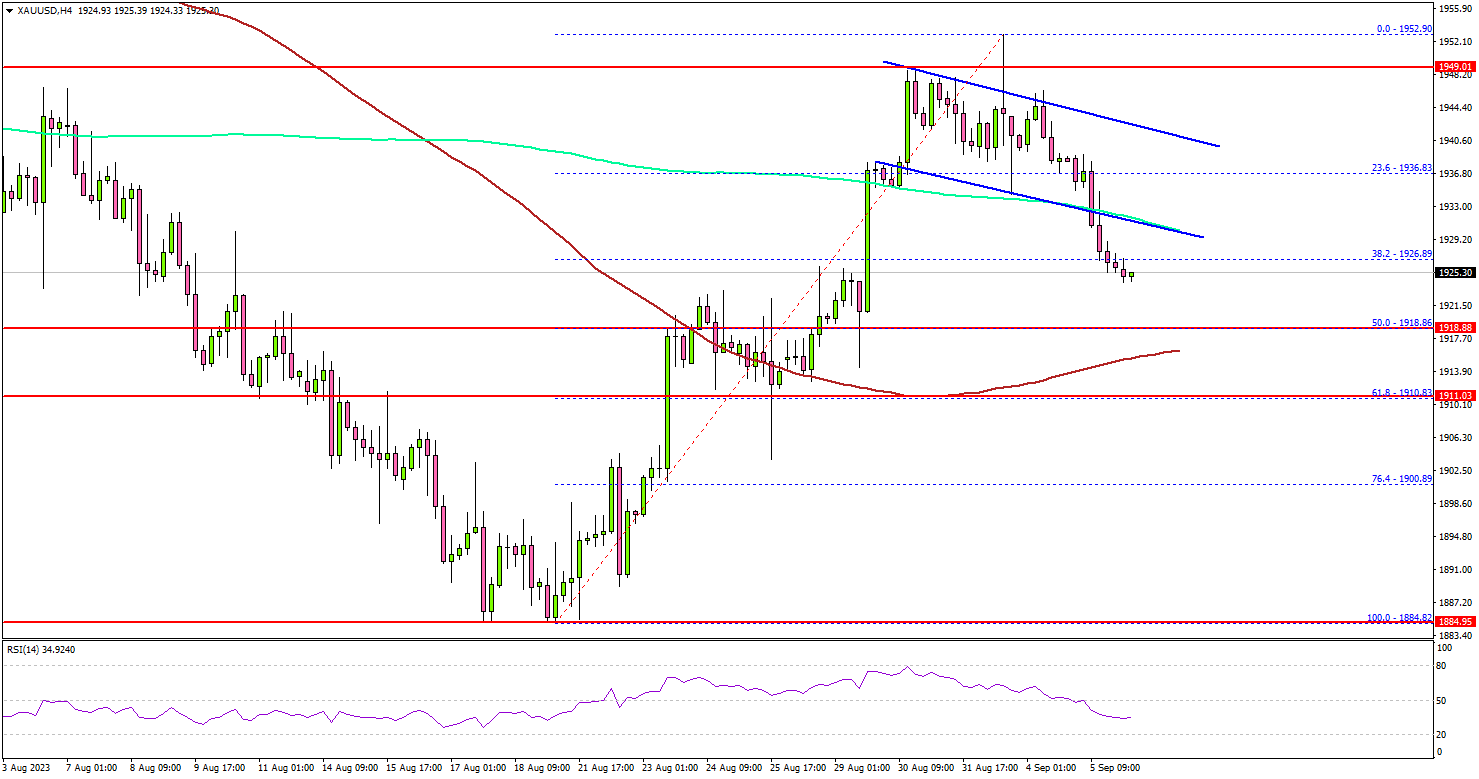
The 4-hour chart of XAU/USD indicates that the price declined below the 38.2% Fib retracement level of the upward move from the $1,884 swing low to the $1,952 high. Besides, the price traded below a declining channel with support near $1,932.
There was also a close below the 200 Simple Moving Average (green, 4 hours). If the price continues to move down, it could test the $1,920 support.
The 50% Fib retracement level of the upward move from the $1,884 swing low to the $1,952 high is also near $1,920. The main support could be $1,915 and the 100 Simple Moving Average (red, 4 hours).
If the bulls fail to protect the $1,915 support, there is a risk of a major decline. In the stated case, the price could decline toward the $1,885 level.
Immediate resistance is near the $1,935 zone. The next major resistance is near the $1,940 level, above which Gold could revisit the key $1,950 resistance zone.
Looking at crude oil prices, there was a sustained upward move and the price even broke the $87.00 resistance zone.
Economic Releases to Watch Today
- US ISM Services Index for August 2023 – Forecast 52.6, versus 52.7 previous.
- BoC Interest Rate Decision – Forecast 5.0%, versus 5.0% previous.
BoC to pause today, EUR/CAD down in consolidation pattern
BoC is widely anticipated to maintain its current interest rate of 5.00% today. This expected pause in rate adjustments comes on the heels of surprising economic contraction in Canada, with the GDP shrinking at an annualized rate of -0.2% in Q2. The contraction signals the onset of economic slowdown, a stark contrast to the relatively robust performance seen in previous quarters.
Although July's inflation rate of 3.3% remains well above BoC's target, weakening economic backdrop is likely to bolster policymakers' confidence that inflation will gradually fall back to target over time. The slower economy could apply downward pressure on prices, providing the central bank with some breathing room to keep rates unchanged for now.
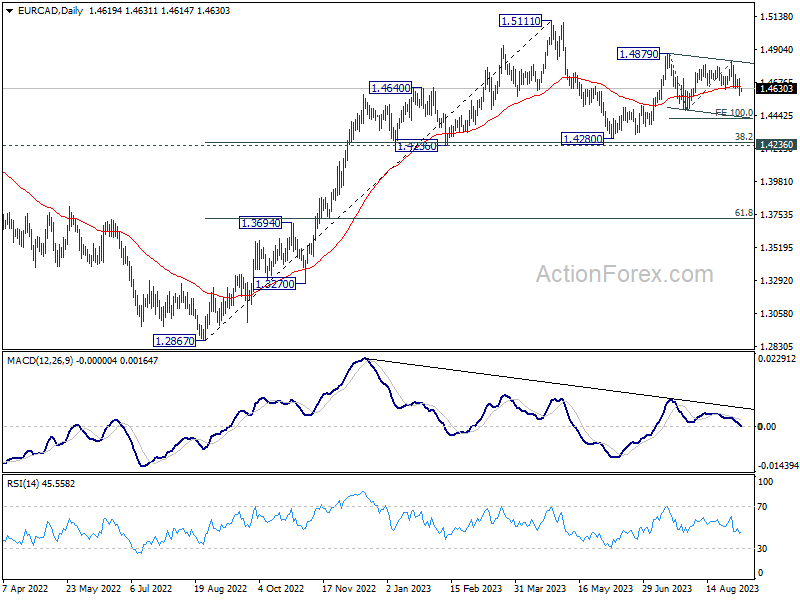
EUR/CAD's decline since last week suggests that recovery from 1.4482 has completed at 1.4822 already, ahead of 1.4879 resistance. For now, price actions from 1.4879 are seen as a consolidation pattern only, and thus, rise from 1.4280 should resume after this pattern completes. Hence, while deeper fall is in favor in the near term as long as 1.4700 resistance holds, downside should be contained by 100% projection of 1.4879 to 1.4482 from 1.4822 at 1.4425.
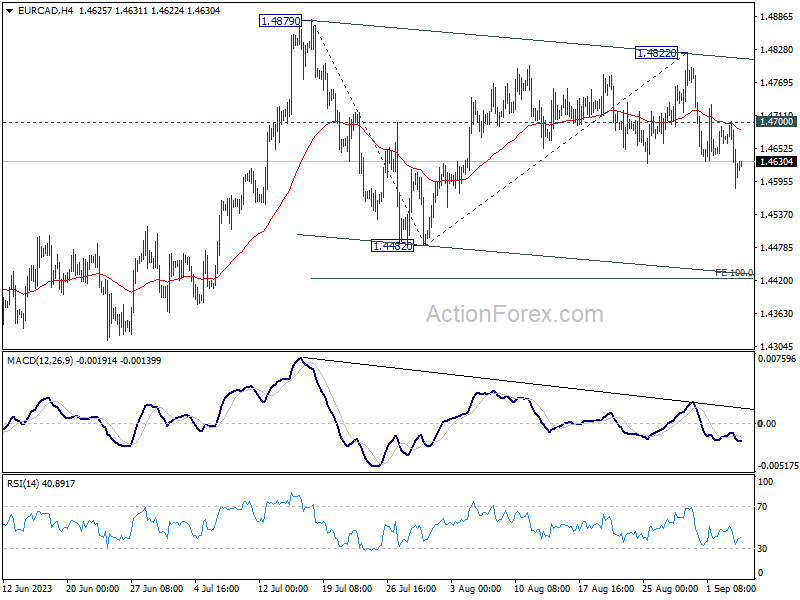
On a broader scale, price actions from 1.5111 are seen as a corrective pattern only and the up trend from 1.2867 is not over. The lingering question is whether the rise from 1.4280 constitutes the second leg of a medium-term pattern or signifies a resumption of the upward trend. More clarity on this could emerge once the current consolidation phase from 1.4879 completes.
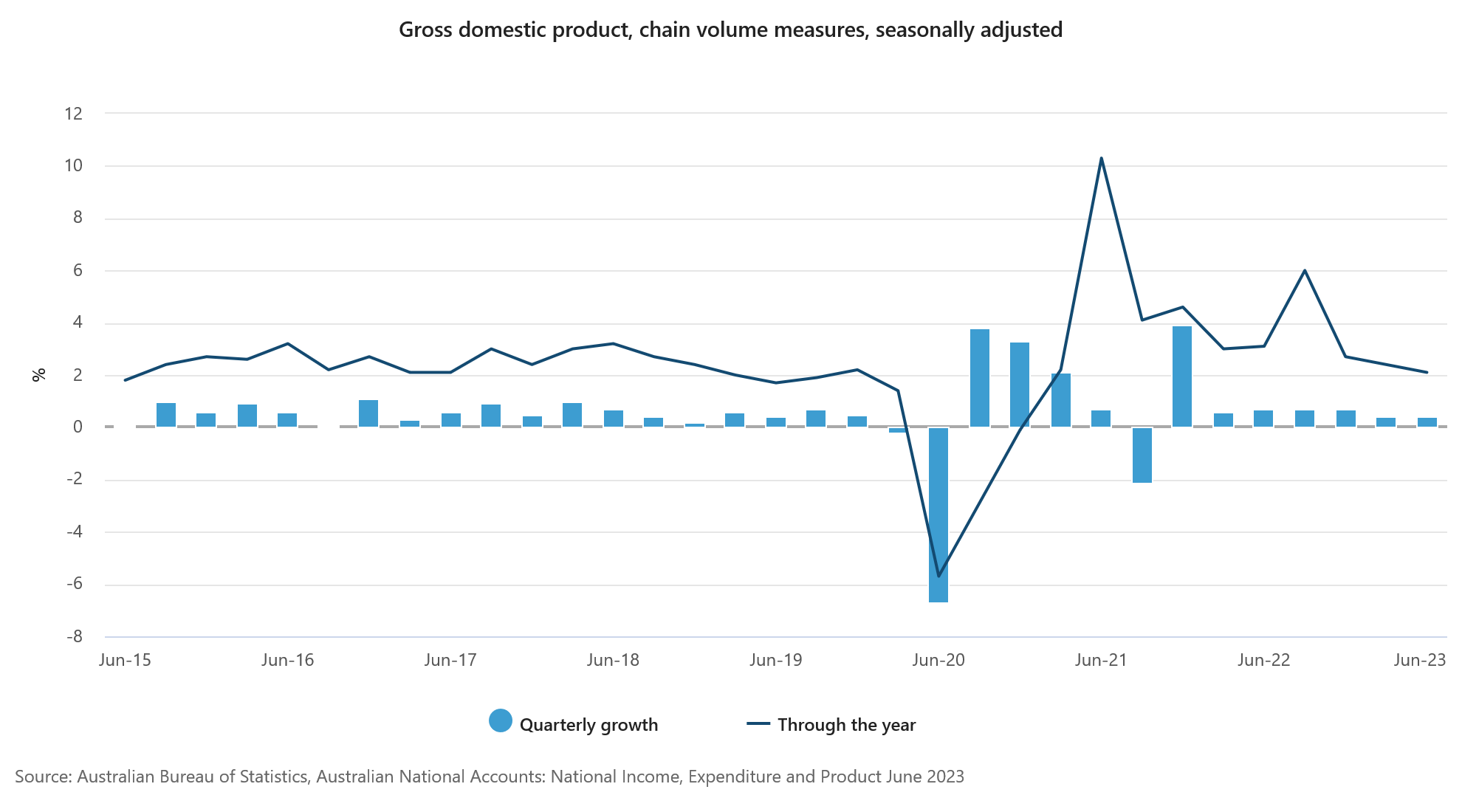
Australia GDP grew 0.4% qoq on capital investment and services exports
Australia's GDP saw 0.4% qoq growth in Q2, aligning perfectly with market expectations. This marks the seventh consecutive quarter of economic growth for the nation. The economy exhibited resilience with a 3.4% annual growth rate for 2022-23 financial year, comfortably surpassing 10-year pre-pandemic average of 2.6%.
However, it wasn't all good news: nominal GDP dropped by -1.2% qoq in the June quarter. GDP implicit price deflator also fell -1.5%, primarily due to -7.9% decline in terms of trade. Export prices fell by -8.2%, exceeding -0.3% fall in import prices. Despite this, domestic price growth remained stable at 1.2%, buoyed by increases in household rents, food prices, and the cost of capital goods, which escalated due to Australian Dollar's depreciation.
The positive quarterly GDP numbers were largely driven by two key factors: capital investment and the exports of services. Total gross fixed capital formation surged by 2.4%, reflecting growth in both public and private investment sectors.
Services exports soared 12.1%, with a significant push coming from 18.5% uptick in travel services.
Net trade in goods added 0.5% to GDP, with 2.5% rise in goods exports led mainly by mining commodities.
Household spending, on the other hand, remained rather muted, contributing just 0.1T to the GDP growth with modest 0.1% increase.
EURJPY Wave Analysis
- EURJPY reversed from support level 156.95
- Likely to rise to resistance level 159.50
EURJPY currency pair recently reversed up from the pivotal support level 156.95 (low of the previous correction 2), intersecting with the support trendline from March.
The support level 156.95 was further strengthened by the lower daily Bollinger Band and the 61.8% Fibonacci correction of the upward impulse from the start of August.
Given the strong daily uptrend, EURJPY can be expected to rise further toward the next resistance level 159.50 (which reversed the price 3 times last month).

CHFJPY Wave Analysis
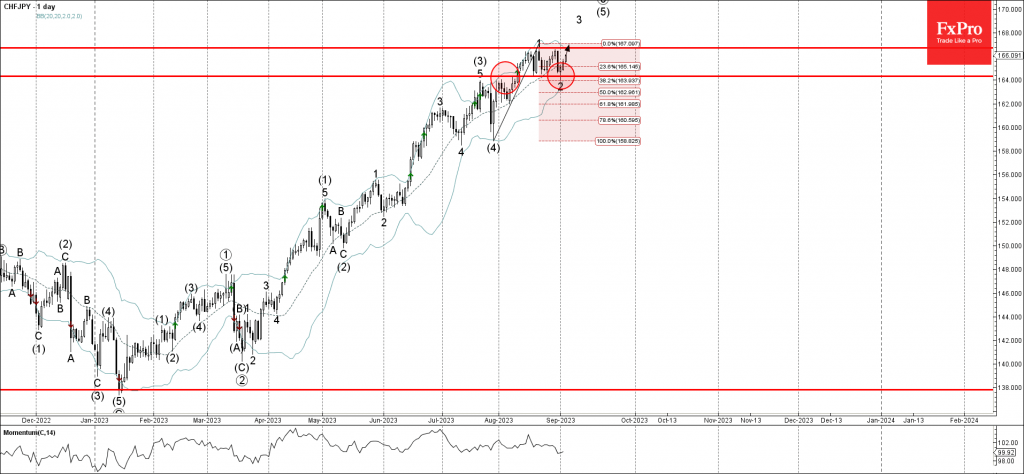
- CHFJPY reversed from support level 164.30
- Likely to rise to resistance level 166.70
CHFJPY currency pair recently reversed up from the pivotal support level 164.30 (which has been reversing the price from the middle of August), coinciding with the 38.2% Fibonacci correction of the upward impulse from July.
The upward reversal from the support level 164.30 started the active short-term impulse wave 3, which belongs to the higher order impulse wave (5) from July.
Given the clear daily uptrend, CHFJPY can be expected to rise further toward the next resistance level 166.70 (top of the previous impulse wave 1).
Will BoC Come to Loonie’s Rescue?
The Bank of Canada (BoC) might move to the sidelines on Wednesday at 14:00 GMT after two rate increases during the summer. Investors are not seeing any additional hikes in the year ahead, but they have not excluded the case entirely. Hence, any clues the central bank could return to the tightening path in the foreseeable future could provide some footing to the loonie. Yet, with the economy fizzling out, the central bank may refrain from boosting rate expectations, likely providing poor support to the Canadian currency.
Will the BoC pause rate hikes?
The Canadian dollar has been a victim of the greenback, depreciating by more than 4.0% since July’s BoC policy meeting helped it bounce to a nine-month high. The loonie has completely reversed its May-July upleg, and despite the recent resurgence in crude oil prices, it could barely find its feet, with traders currently wondering whether September’s policy meeting on Wednesday could stop the melting.
The short answer is no. Investors are certain that the central bank will leave interest rates unchanged at 5.0% and perhaps it may not have a good reason to justify additional rate increases this time.
During its previous gathering, the central bank saw inflation returning sustainably to its 2.0% midpoint target by the middle of 2025. Therefore, since policymakers are not scheduled to update their economic projections before October, it would be unwise to suddenly shut the door to additional tightening. Unlike its US peer, the BoC has a flexible inflation target set within a control band of 1-3%, and the CPI measures are currently slightly above that range. This could lead to less commitment to future rate increases, especially since the Q2 GDP data arrived surprisingly lower than expected.
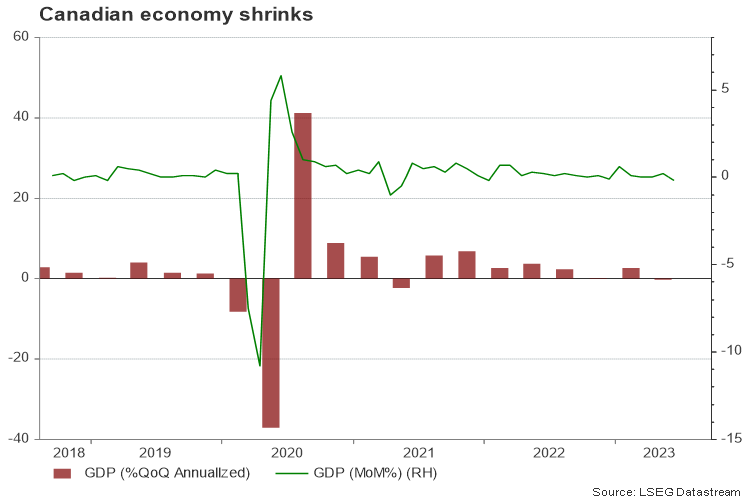
Canadian economy shrinks
The Canadian economy contracted by 0.2% on an annualized basis in Q2, while a preliminary GDP estimate for July and the latest gloomy Ivey business PMI survey sent negative warnings for the third quarter too. Recall that the central bank hoped for a stronger annualized growth of 1.5% y/y back in July.
Probably the wildfires in the country caused limited access to resources and disturbed business activities. But the decline in housing investment and the slowdown in consumption could also be a broader sign that the economy is starting to feel the pain from higher borrowing costs.
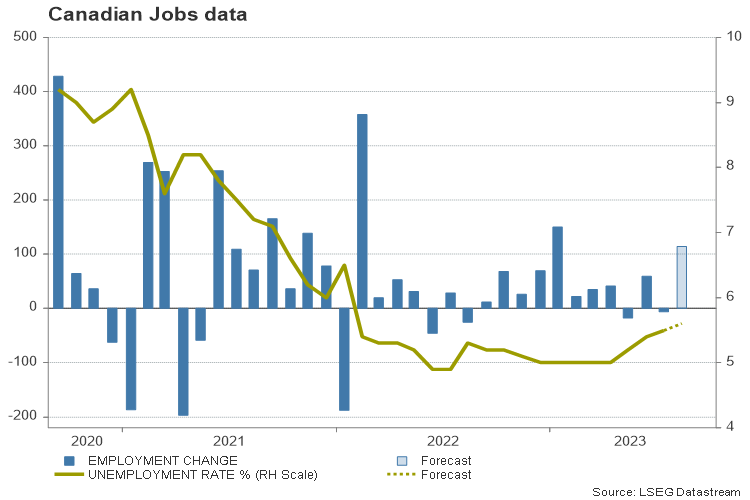
The soft rebound in the unemployment rate might further motivate a pause this month and allow some time for monitoring. August’s jobs report will be published two days after the rate announcement on Friday at 12:30 GMT, with forecasts pointing to a higher employment growth of 15k compared to the 6.4k decline registered in July. Interestingly, the unemployment rate is expected to rise for the third consecutive month to 5.6%.
Market reaction
For now, the central bank could switch to a neutral stance, avoiding any hawkish signals, and, more importantly, any language that could bolster rate cut speculation. If this scenario plays out, the loonie may find it hard to change course to the upside, unless the Canadian Jobs numbers show a significant improvement and US headlines add pressure to the greenback.
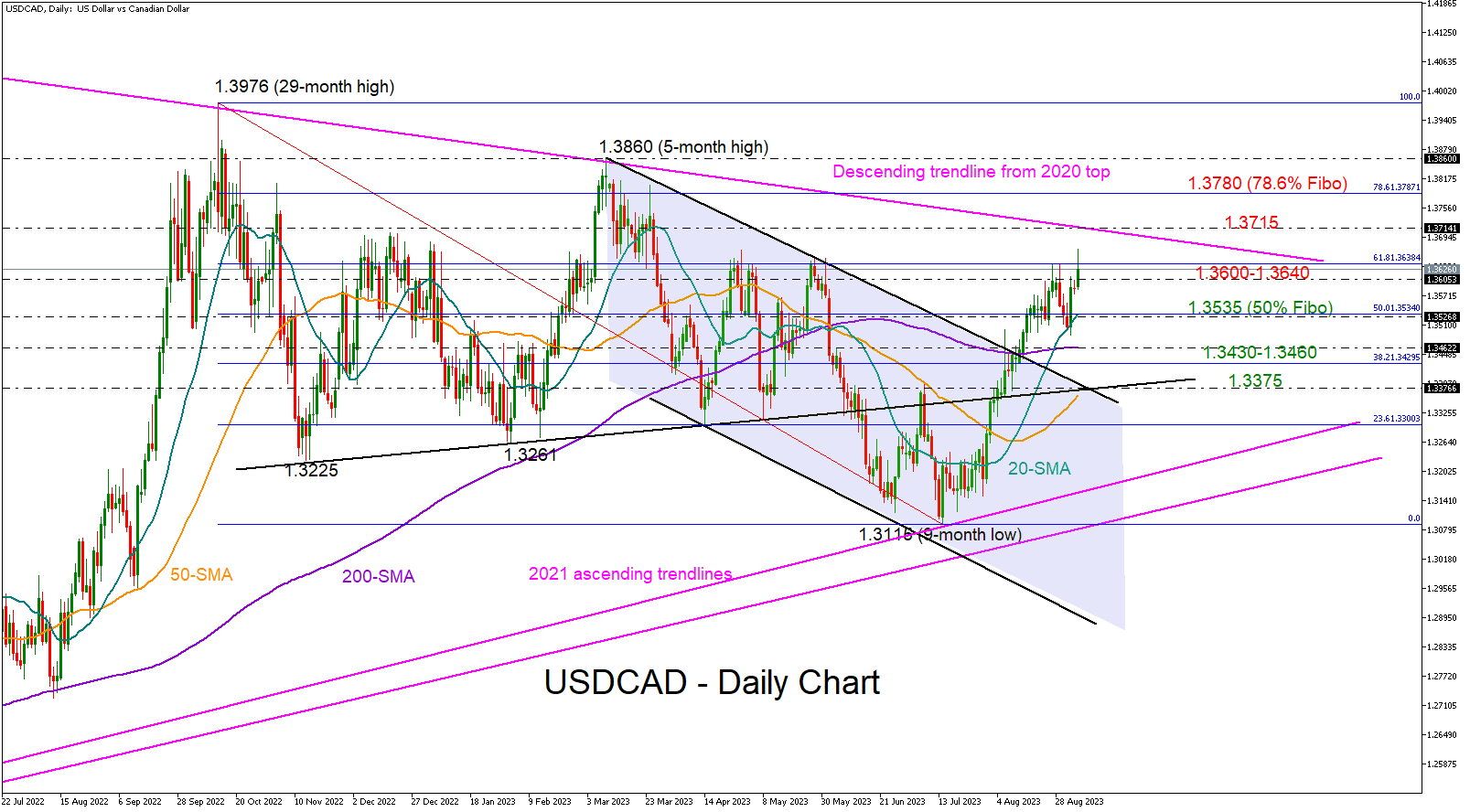
From a technical perspective, a rebound in the loonie cannot be ruled out. Dollar/loonie is currently struggling to overcome the familiar resistance of 1.3640, while the descending trendline from the 2020 top could be another headache at 1.3730.
On the downside, the 20-day simple moving average (SMA) could ease downside forces around 1.3535 ahead of the 200-day SMA at 1.3460 and the 1.3430 support region.