Sample Category Title
USD/CHF Rises as Swiss Retail Sales Fall, Swiss CPI Next
- Swiss retail sales decline by 2.3%
- Swiss inflation expected to dip to 1.5%
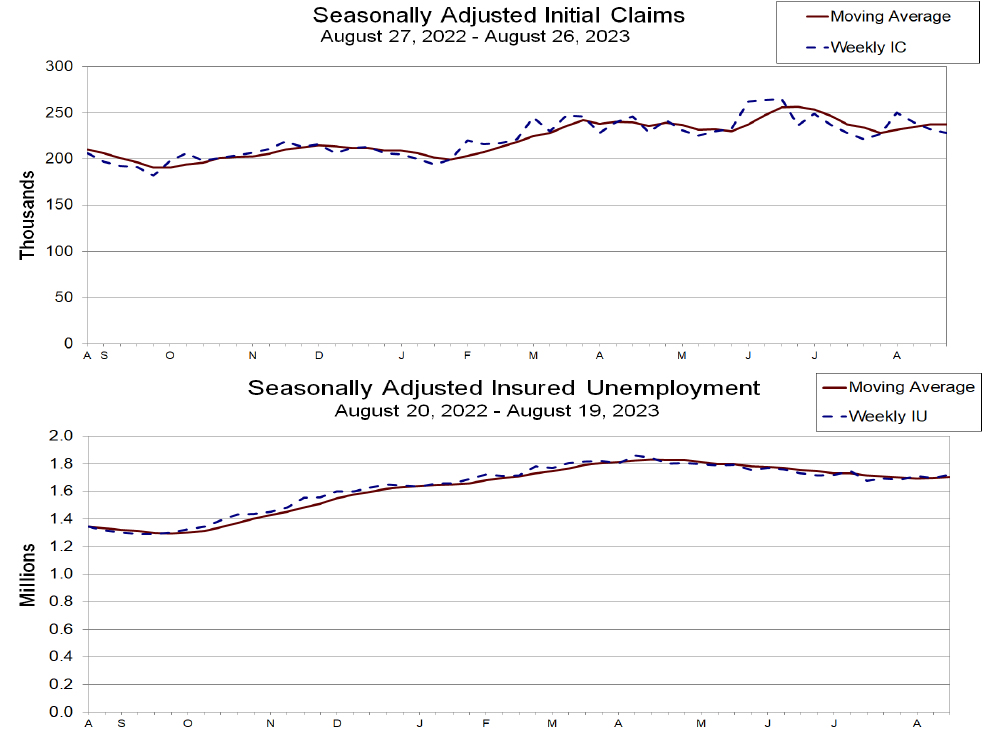
- US unemployment claims drop to 228,000
- US PCE Price Index rises by 3.3%
The Swiss franc has lost ground on Thursday. In the North American session, USD/CHF is trading at 0.8835, up 0.59%.
Thursday’s Swiss retail sales for July looked awful, falling 2.3% m/m. This follows a revised gain of 1.5% in June. Market attention has now shifted to Swiss inflation, which will be released on Friday. Swiss inflation dropped to 1.6% in July, the lowest level since July 2022. The downtrend is expected to continue in August with a consensus estimate of 1.5%.
Policy makers at the Swiss National Bank have to be pleased with the inflation rate. Switzerland boasts the lowest inflation rate in the developed world and both headline and core inflation are comfortably nestled in the central bank’s inflation target range of 0%-2%. Still, the SNB remains wary about inflation, with concerns that increases in rents and electricity prices could push inflation back up to 2%. Food inflation remains high and rose from 5.1% to 5.3% in July.
Unlike other major central banks, the SNB meets quarterly, which magnifies the significance of each rate decision. At the June meeting, the central bank raised rates to 1.75% from 1.50% and hinted that further hikes were coming. The SNB has projected inflation will hit 2.2% in 2023 and 2024, above its target. That means the SNB expects to have to continue raising rates, although, as is the case with many other central banks, the peak rate appears to be close at hand.
In the US, unemployment claims dropped to 228,000 last week, down from a revised 232,000 and below the estimate of 236,000. All eyes will be on Friday’s job report, with nonfarm payrolls expected to dip to 170,000, down from 187,000.
The Fed’s favourite inflation gauge, the PCE Price Index, increased in July by 0.2% for a second straight month, lower than the estimate of 0.3%. On an annualized basis, the PCE Price Index climbed 3.3% in July, up from 3.0% in June. Service prices rose by 0.4% in July, up from 0.3% from the previous month. The numbers indicate that the Fed’s battle with inflation is far from over, and the final phase of pushing inflation down to 2% may prove the most difficult.
USD/CHF Technical
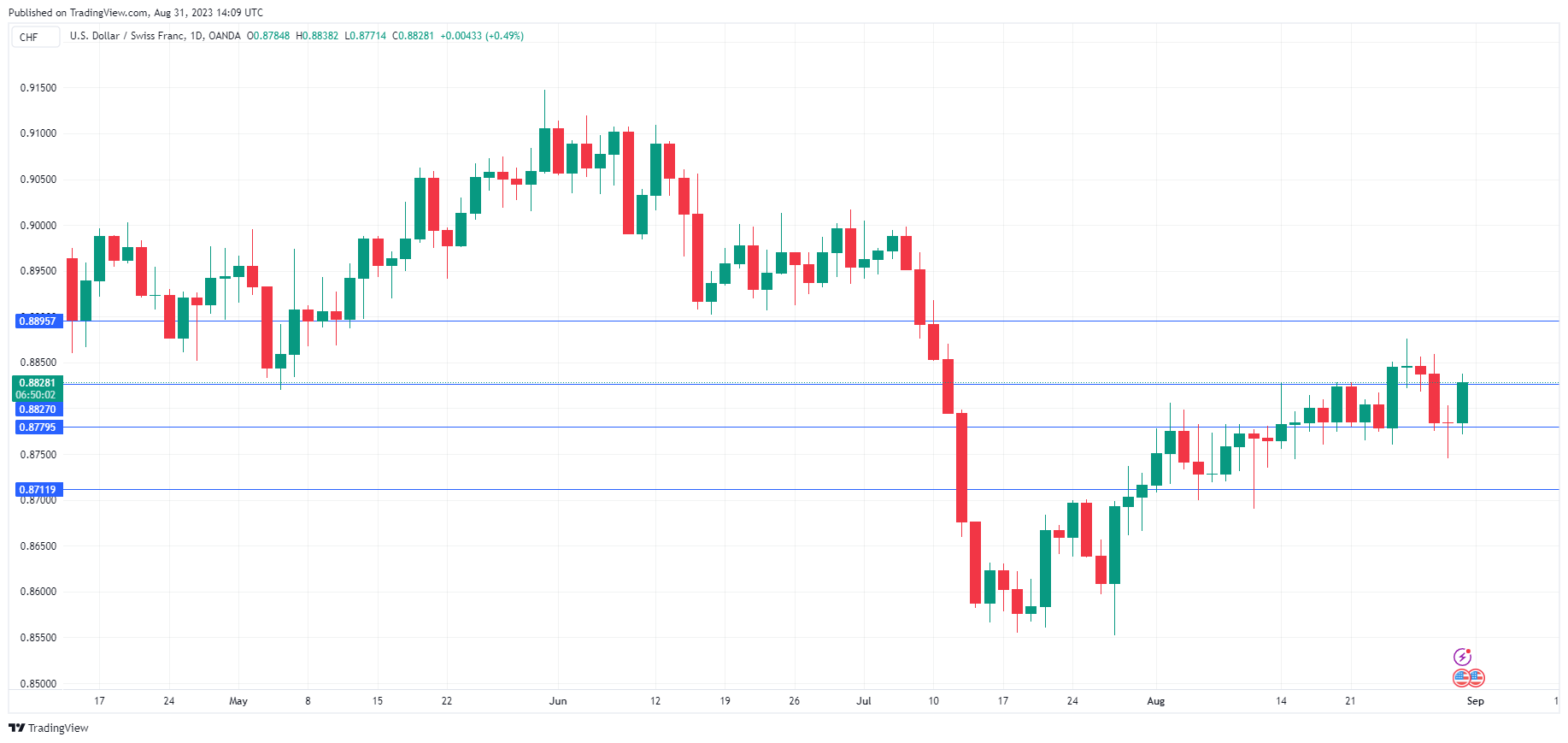
- USD/CHF is testing resistance at 0.8827. Above, there is resistance at 0.8895
- 0.8779 and 0.8711 are providing support
US: Consumer Spending Expands, Even as Prices Tick Higher in July
Personal income grew 0.2% month-on-month (m/m) in July, which was below market expectations for a gain of 0.3%. This marked a slight deceleration from the prior month's 0.3% gain. The increase primarily reflected a rise in compensation to employees that was partly offset by a decrease in personal current transfers.
Accounting for inflation and taxes, real personal disposable income fell -0.2% m/m, relative to the flat figure recorded the previous month.
Personal consumption expenditures rose 0.8% m/m, accelerating from the upwardly revised 0.6% posted in June (previously 0.5%). July's reading came in just above market expectations for 0.7% growth.
- Expenditures on services grew 0.8% m/m, up from 0.6% in June. Spending on financial services and insurance, housing and utilities, food services and health care were the primary contributors to movements in the services category.
- There was also an increase in goods spending. Goods spending rose by 0.7% m/m, an acceleration from the 0.6% posted in June. Both durables and non-durable goods spending advanced by 0.7% on the month.
Adjusting for inflation, real spending grew 0.6% for the month, coming in just above the consensus estimate for a 0.5% gain. In real terms, goods spending was up 0.9% m/m, while services were up 0.4%.
The personal consumption expenditure (PCE) price deflator rose 0.2% m/m, and 3.3% on a year-on-year (y/y) basis – bang-on the consensus forecast (3.3% y/y) but above June's reading (3.0% y/y).
The core PCE price deflator (which excludes food and energy and is the Fed's preferred measure of inflation) rose 0.2% m/m for the second consecutive month and was in line with the consensus forecast. On an annual basis, core PCE inflation accelerated to 4.2% y/y from 4.1% y/y the month prior.
The personal savings rate fell to 3.5% in July, down 0.8%-pts from June's reading of 4.3%. This is the first time the measure has fallen below 4% since the start of the year.
Key Implications
With the labor market slowly coming back into better balance, easing wage pressures helped to cool income growth last month. However, with excess savings still available, U.S. households were able to keep spending, resulting in a pullback in the personal savings rate. July's personal consumption expenditure number provided a solid start to Q3, with real PCE expected to accelerate from 1.7% annualized in Q2 to 4% in Q3.
As the Fed chair reminded us at the Jackson Hole Symposium last week, the fight against inflation is far from over. Today's core PCE inflation reading brought that back into focus with the measure still notably above the Fed's 2% target. Recent labor market data suggest things are cooling, which should continue to ease wage pressures and lead to further downward pressure on inflation. Should this trend persists, it will abate the need for further rate increases. The Central Bank will have more opportunities to gauge the temperatures of both inflation and the labor market before the September meeting, but current market pricing suggests the Fed will skip the September meeting but potentially hike in November should the data continue to surprise to the upside.
BTCUSD Rebounds Strongly But 200-SMA Caps Upside
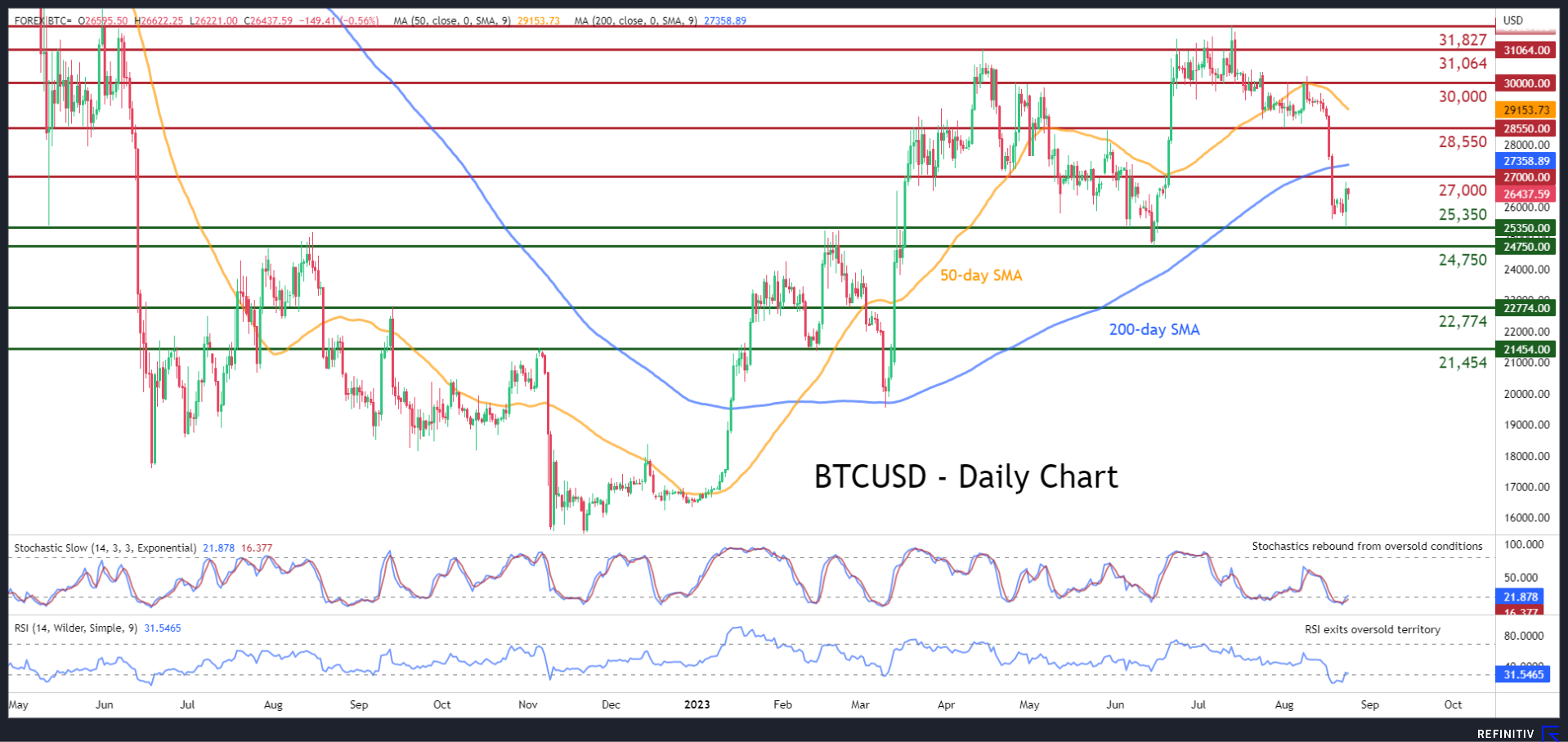
BTCUSD (Bitcoin) broke aggressively above its rangebound pattern on Tuesday, temporarily jumping above the 28,000 mark. However, the bulls lost the battle around the 200-day simple moving average (SMA), with the price slipping before entering a tight range in the last couple of sessions.
The momentum indicators currently suggest that near-term risks remain tilted to the upside. Specifically, the MACD is strengthening above both zero and its red signal line, while the stochastic oscillator is advancing steeply.
If buying interest intensifies, the king of cryptos could initially test the recent resistance of 28,140. Should that barricade fail, the spotlight could turn to 28,550, which acted both as support and resistance in August and May, respectively. Slicing through that region, the price may then advance towards the crucial 30,000 psychological mark.
On the flipside, bearish actions could send the price to challenge the March support of 26,520. Further declines could then cease at the recent two-month low of 25,350 ahead of the June bottom of 24,750. A violation of the latter could open the door for the 21,454 hurdle.
Overall, BTCUSD seems to be entering a consolidation phase as the 200-day SMA has so far repelled all upside attempts. Thus, a clear break above that barrier is needed for the rebound to resume.
Sunset Market Commentary
Markets
German ECB governing council member Schnabel set the tone for trading today immediately after the European opening bell. Her nationality makes her monetary hawk both by nature and by nurture. The observation that she kept options open for the September policy meeting took part of a divided market by surprise and tempered those expecting a 25 bps rate hike, including ourselves. Should the ECB’s assessment be that the transmission of monetary policy suggest that the pace of disinflation is proceeding as desired, then they may afford to wait until the next (October) meeting to gather more evidence. Schnabel admitted that underlying price pressures remain stubbornly high with domestic factors being the main drivers, but put a lot of onus of the weaker growth outlook compared to June ECB forecasts. Back then, the central bank prognosed 0.9%, 1.5% and 1.6% GDP growth for the 2023-2025 period. The timing of Schnabel’s comments added to the astonishment for some given that they came as EMU inflation numbers were about to print on the upside of expectations following several national releases. Headline CPI effectively accelerated to 0.6% M/M (vs 0.4% expected) with the annual figure stabilizing at 5.3% Y/Y (vs 5.1% expected). Underlying core CPI moderated as forecast from 5.5% Y/Y to 5.3% Y/Y. EMU money markets yesterday attached a 50 bps probability to a September move with a 25 bps hike fully discounted by the end of the year. After today’s comments and CPI data, those dropped to respectively 25% and 50%. In today’s momentum, markets also spotted some more “pause” signals in the Minutes of the July ECB gathering. These included a reference to the contained risk of a wage-price spiral and an initial preference for not hiking even though all members eventually supported the July 25 bps rate hike. However, Minutes concluded that “Taken together, the September projections, the evolution of underlying inflation and incoming information on monetary transmission would help the GC update its assessment of the appropriate monetary policy stance.” So the jury remains out on the issue and we don’t alter our 25 bps rate hike call.
The repricing on money markets was visible further down the curve as well. German Bunds outperform US Treasuries today. German yields lose 2.5 bps (30-yr) to 6.5 bps (2-yr). US yields changes vary between +0.4 bps (2-yr) and -1.7 bps (30-yr) but US Treasuries obviously outperformed the past two sessions on slightly disappointing US data. The loss of interest rate support pulls EUR/USD back below 1.09 (1.0860 currently) while stock markets record small gains (+0.25% in both Europe and the US).
News & Views
Polish inflation flatlined in August (0.0% M/M), bringing the yearly figure further down from 10.8% to 10.1%, data from Statistics Poland released today showed. The near-consensus outcome is the lowest print since February last year. Food again dipped at a solid -1% monthly pace but fuels for personal transport rose by 1.9% amid a powerful oil price rise in recent weeks. National Bank of Poland governor Glapinski has repeatedly cited single-digit inflation as a prerequisite for (beginning the debate on) rate cuts, provided price pressures maintained a downward trend. This is likely to be the case next month. The central bank meets next week (September 6). At the meeting thereafter (October 4) it will have the September inflation print (29/09) at its disposal, potentially allowing the NBP to make a dovish U-turn ahead of important parliamentary elections on October 15. The Polish zloty reacted muted to the numbers. EUR/PLN is going nowhere near its recently found equilibrium around 4.47.
The Turkish economy topped estimates by growing 3.5% Q/Q in the second quarter of the year. Analysts had penciled in 2.3%. GDP is now 3.8% bigger than in the same quarter last year. The expansion was fueled by higher consumer demand and government spending, in particular in the run-up to the May election. Re-elected president Erdogan amongst others had distributed one month of free natural gas to woo voters. Household consumption shot up 15.6% while government expenditures rose by 5.3%. Exports tumbled 9%, highlighting weaker global demand. In terms of sectors, value added in the construction sector rose 6.2% as the country’s infrastructure recovery continued going into Q2 after the February earthquake. Looking ahead, Turkish growth is expected to ease following, amongst others, the sharp increase in central bank interest rates. The CBRT last week lifted the policy rate from 17.5% to 25%.
USD/JPY Mid-Day Outlook
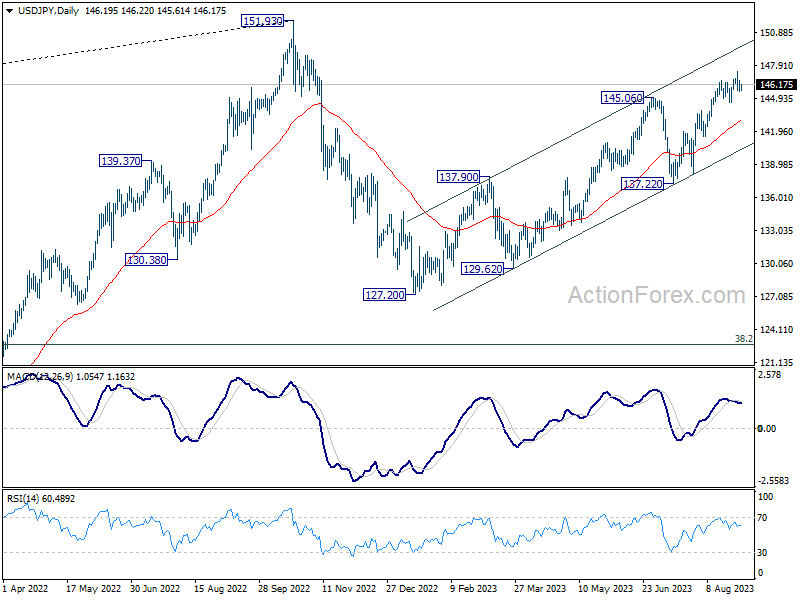
Daily Pivots: (S1) 145.70; (P) 146.12; (R1) 146.68; More...
Intraday bias in USD/JPY remains neutral and outlook is unchanged. As long as 144.52 support holds, further rally remains in favor. Above 147.36 will resume the rise from 127.20 to retest 151.93 high. On the downside, however, firm break of 144.52 should confirm short term topping, and turn bias back to the downside for 55 D EMA (now at 142.96).
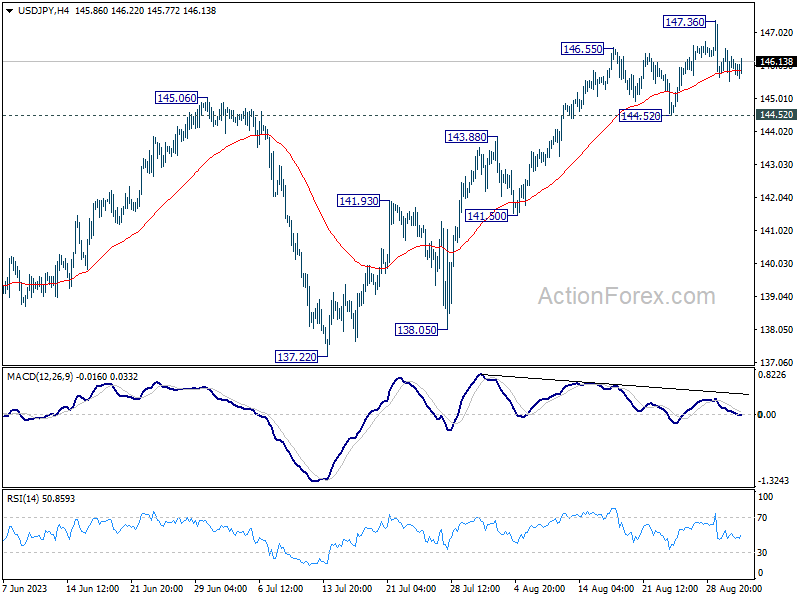
In the bigger picture, overall price actions from 151.93 (2022 high) are views as a corrective pattern. Rise from 127.20 is seen as the second leg of the pattern and could still be in progress. But even in case of extended rise, strong resistance should be seen from 151.93 to limit upside. Meanwhile, break of 137.22 support should confirm the start of the third leg to 127.20 (2023 low) and below.
USD/CHF Mid-Day Outlook
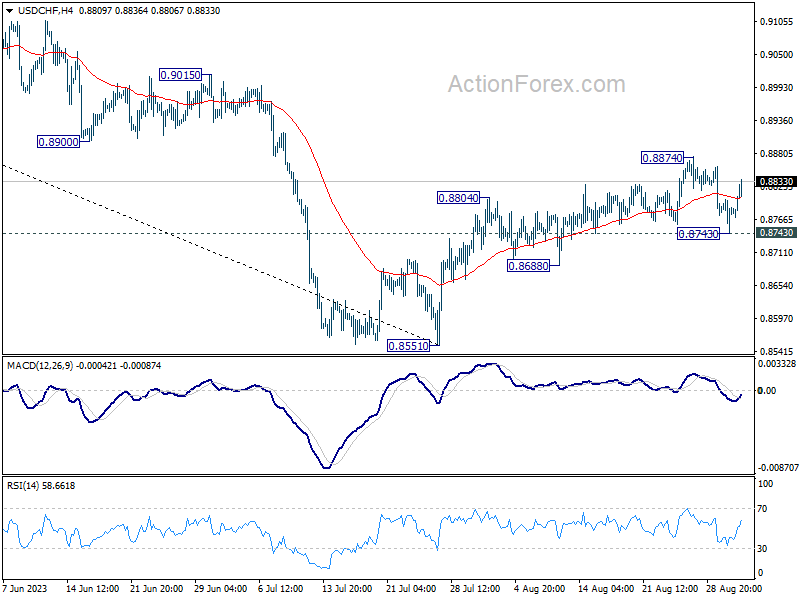
Daily Pivots: (S1) 0.8752; (P) 0.8778; (R1) 0.8811; More....
Intraday bias in USD/CHF stays neutral at this point, as today's recovery is capped below 0.8874 resistance so far. On the upside, firm break of 0.8874 will resume the rise from 0.8551. Next target is 0.9146 cluster resistance. On the downside, tho0ugh, break of 0.8743 minor support will argue that rebound from 0.8551 has completed, and bring retest of this low.
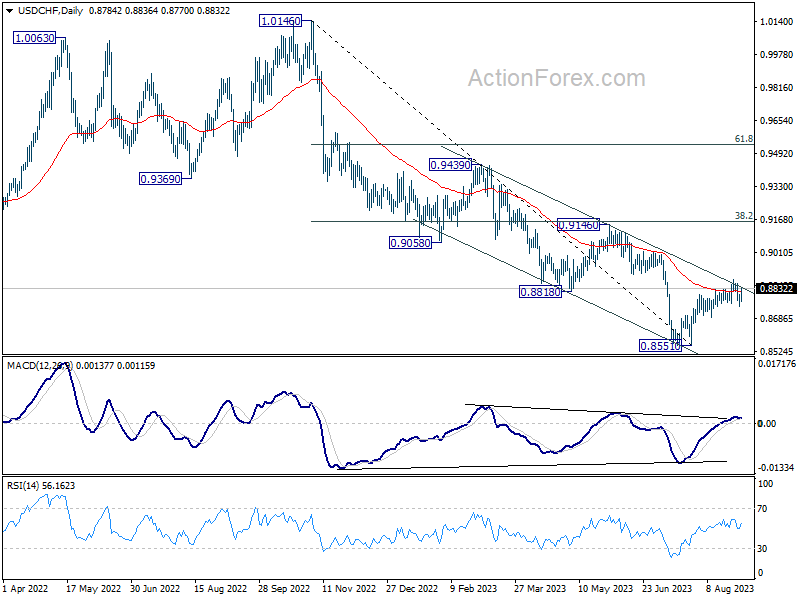
In the bigger picture, rebound from 0.8551 medium term bottom is currently seen as a correction to the downtrend from 1.0146 (2022 high). Further rally would be seen to 0.9146 cluster resistance (38.2% retracement of 1.0146 to 0.8551 at 0.9160). Strong resistance could be seen there to limit upside, at least on first attempt. Nevertheless, medium term outlook is neutral at best as long as 0.8551 holds, until further developments.
GBP/USD Mid-Day Outlook
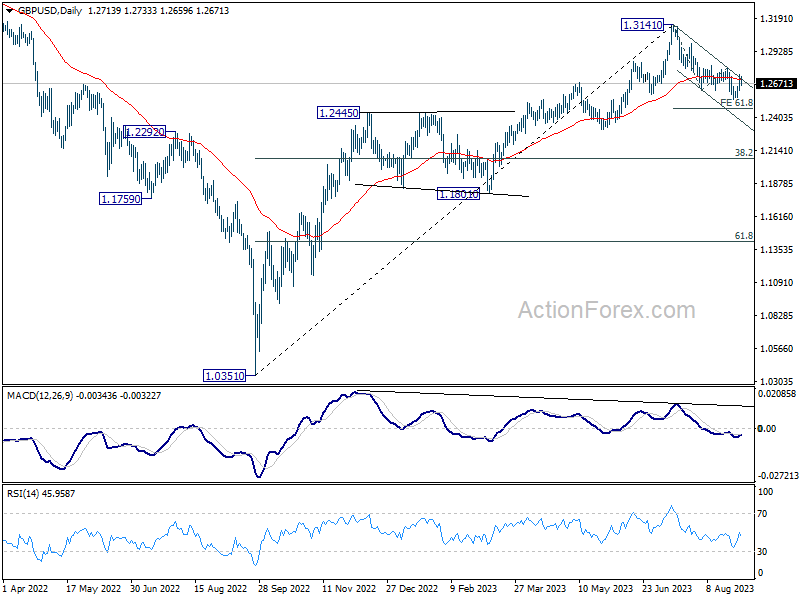
Daily Pivots: (S1) 1.2644; (P) 1.2696; (R1) 1.2772; More...
Intraday bias in GBP/USD remains neutral and outlook is unchanged. On the downside, break of 1.2546 will resume whole fall from 1.3141 to 61.8% projection of 1.3141 to 1.2618 from 1.2799 at 1.2476. However, on the upside, firm break of 1.2799 will indicate that the correction from 1.3141 has completed with three waves down to 1.2546. Intraday bias will be turned back to the upside for retesting 1.3141.
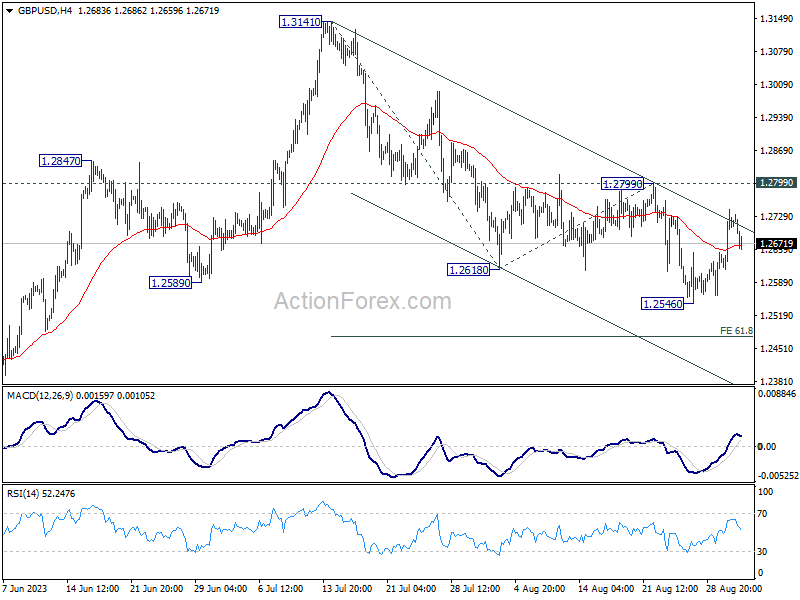
In the bigger picture, for now, fall from 1.3141 medium term top is seen as a correction to up trend from 1.0351 (2022 low). Deeper decline would be seen to 38.2% retracement of 1.0351 to 1.3141 at 1.2075. Strong support would be seen there to bring rebound on first attempt. But outlook will be neutral at best as long as 1.3141 resistance holds, and consolidation from there is set to extend, until further development.
EUR/USD Mid-Day Outlook
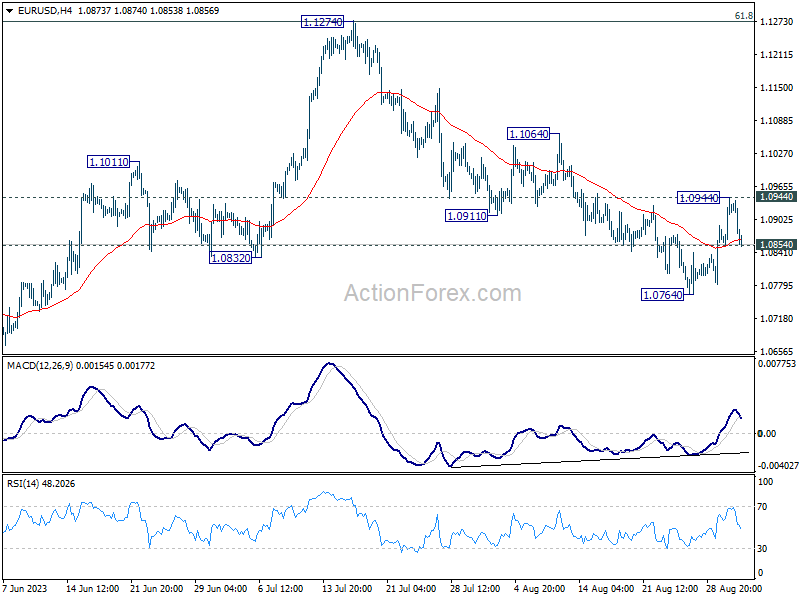
Daily Pivots: (S1) 1.0870; (P) 1.0908; (R1) 1.0960; More...
Intraday bias in EUR/USD stays neutral first as today's dip is contained by 1.0854 minor support so far. On the downside, break of 1.0854 will bring retest of 1.0764 low first. Break there will resume larger fall from 1.1274 to 1.0609/34 cluster support next. On the upside, however, break of 1.0944 resistance will argue that the corrective fall from 1.1274 has completed with three waves down to 1.0764. Further rally would then be seen to 1.1064 resistance for confirmation.
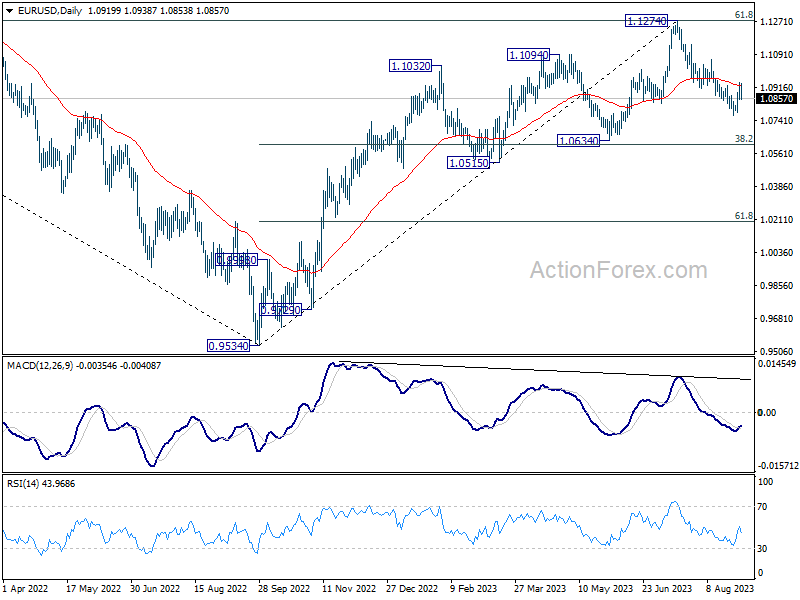
In the bigger picture, fall from 1.1274 medium term top is seen as a correction to up trend from 0.9534 (2022 low). Deeper decline would be seen to 1.0634 cluster support (38.2% retracement of 0.9534 to 1.1274 at 1.0609). Strong support could be seen there, at least on first attempt, to bring rebound. Yet, medium term outlook will be neutral for now, as long as 1.1274 resistance holds.
Euro Slips after CPI and ECB Minutes, Dollar Shrugs PCE
Euro falls broadly today together with other European majors. Some might point to the expected slowdown in Eurozone core inflation in August as a factor. But indeed headline inflation was steady from the prior month, above expectations. Comments from ECB officials were also hawkish. Traders are probably just squaring positions ahead of tomorrow's US non-farm payroll, after failing to push Dollar lower. Talking about the greenback, there is no clear reaction to PCE inflation data which came in as expected.
For now, Yen is the strongest one for the day, riding on the decline in benchmark yields in US, Germany and UK. Australian Dollar is the second strongest, followed by Canadian Dollar. Euro is the worst, followed by Swiss Franc and Sterling. Dollar is mixed in the middle.
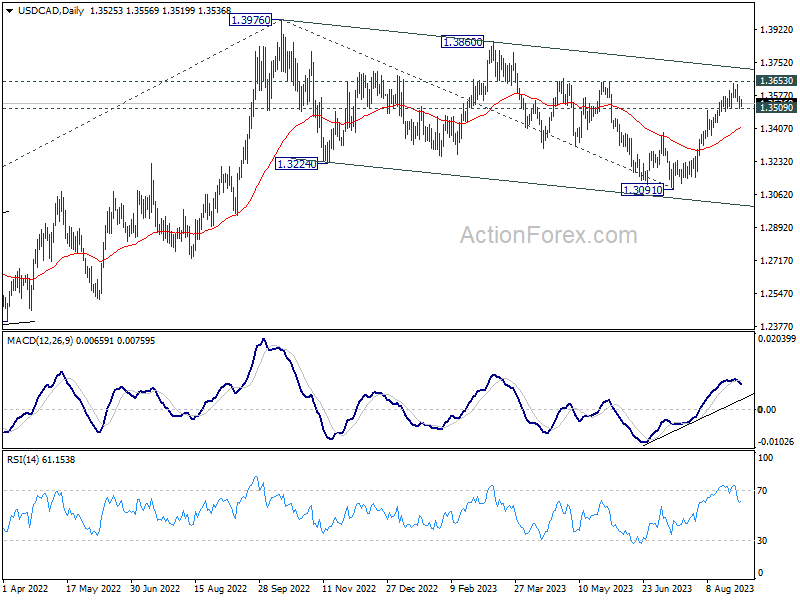
Technically, USD/CAD is holding above 1.3509 minor support, and further rise is in favor. The corrective pattern from 1.3976 should have completed at 1.3091 already. Firm break of 1.3653 resistance will target 1.3860 and then 1.3976. However, break of 1.3509 will dampen this view, and bring deeper pull back to 55 D EMA first. Given that US NFP and Canada GDP will be featured tomorrow, the pair would likely unveil the next move soon.
In Europe, at the time of writing, FTSE is up 0.20%. DAX is up 0.73%. CAC is up 0.04%. Germany 10-year yield is down -0.0462 at 2.502. Earlier in Asia, Nikkei rose 0.88%. Hong Kong HSI dropped -0.55%. China Shanghai SSE dropped -0.55%. Singapore Strait Times rose 0.41%. Japan 10-year JGB yield dropped -0.0085 to 0.647.
US PCE price index rose to 3.3% yoy, core PCE up to 4.2% yoy
US personal income edged up by 0.2% mom, or USD 45.0 billion, missing the anticipated 0.3% increase. The modest gain in income primarily reflected an uptick in compensation, which was partially offset by a decline in personal current transfer receipts.
Conversely, personal spending outperformed expectations, registering a 0.8% mom rise, or an increase of USD 144.6 billion, compared to the projected 0.7%. This growth was predominantly driven by a USD 102.7 billion expansion in spending on services and a USD 41.9 billion increase in goods expenditure.
PCE price index and Core PCE price index (excluding food and energy), both rose 0.2% mom, matching market expectations. The components within the inflation basket displayed a mixed pattern, with prices for goods falling by -0.3% and prices for services rising by 0.4%. Additionally, food prices saw a modest increment of 0.2%, while energy prices edged up by 0.1%.
On a year-over-year basis, PCE price index climbed from 3.0% yoy to 3.3% yoy, while Core PCE price index ascended from 4.1% to 4.2%, both in alignment with market predictions. A disaggregated look at the year-over-year data reveals that prices for goods dropped by -0.5%, and prices for services surged by 5.2%. Meanwhile, food prices increased by 3.5%,and energy prices dipped by a notable -14.6%.
US initial jobless claims dropped to 228k
US initial jobless claims dropped -4k to 228k in the week ending August 26, slightly above expectation of 227k. Four-week moving average of initial claims rose 250 to 237.5k.
Continuing claims rose 28k to 1725k in the week ending August 19. Four-week moving average of continuing claims rose 8k to 1704k.
Fed Bostic said policy restrictive enough, warns against unnecessary economic pain
In a set of prepared remarks, Atlanta Fed President Raphael Bostic noted emphasizing that the current restrictive stance is appropriate. He urged for a cautious and patient approach, warning against the potential for "unnecessary economic pain" if the Fed tightens policy too aggressively.
Importantly, Bostic clarified that his endorsement for a patient approach should not be interpreted as support for easing monetary policy in the near term. He stated, "that does not mean I am for easing policy any time soon."
He argued that Fed must remain "resolute" in keeping policy tight until it is clear that inflation is moving towards the 2% target within a reasonable time frame. "I believe policy is already restrictive enough to get us there," he added.
Eurozone CPI holds steady at 5.3%, core CPI slows to 5.3%
In August, Eurozone's CPI defied market expectations by remaining unchanged at a 5.3% yoy, contrary to anticipated slowdown to 5.1% yoy. Core inflation, which excludes energy, food, alcohol, and tobacco, did slow down, but only to match expectations, declining from 5.5% yoy to 5.3% yoy.
A breakdown of the main components contributing to Eurozone's inflation rate reveals a mixed bag. Food, alcohol, and tobacco are expected to register the highest annual rate in August at 9.8%, albeit lower than the 10.8% seen in July. Services come next, slipping slightly from 5.6% to 5.5%, followed by non-energy industrial goods which also dipped from 5.0% to 4.8%. Notably, energy costs seem to have eased their downward trend, registering at -3.3% compared to -6.1% in the previous month.
ECB accounts: Diverging views on the need of a Sep hike
ECB released account of its monetary policy meeting held on July 26-27, shedding light on the deliberations among the policymakers.
According to the minutes, all members supported the 25 basis point rate increase. Nevertheless, some members expressed a preference initially for not raising key ECB interest rates further, citing risks of stronger-than-anticipated transmission of rate hikes into the economy.
Interestingly, the account captured diverging views on the necessity for another rate hike in September. On one side, it was argued that if inflation did not decline as swiftly as expected, interest rates would need to be adjusted further to ensure a timely return to the 2% target.
On the other side, some members posited that the September ECB staff projections could potentially show a downward revision in the inflation path, making another rate hike in September unnecessary.
ECB Holzmann: We could do another hike or two
ECB Governing Council member Robert Holzmann said he has yet to make a decision about the upcoming September meeting but pointedly did not rule out the possibility of an interest rate hike.
"We are not yet at the highest level; it could be that we do another hike or two," Holzmann commented, offering a glimpse into his thoughts on the current stance of ECB monetary policy.
However, Holzmann also put forth a scenario that could lead to an earlier-than-expected easing of rates. "If we were to move this year to above 4% ... and inflation comes down, then we could be able, perhaps, to change it already to lower rates in 2024. If that's not the case, we'll have to wait for 2025," he said.
ECB Schnabel: Underlying price pressures remain stubbornly high
ECB Executive Board member Isabel Schnabel said in a speech that despite decline in headline inflation, largely due to unwinding of previous supply-side shocks, "underlying price pressures remain stubbornly high," with domestic factors now becoming the main drivers of inflation.
Given this backdrop, Schnabel emphasized the necessity of maintaining "sufficiently restrictive monetary policy" to steer inflation back to target. She advocated for a data-dependent approach, stating that the bank will continually assess whether current policy is effective in ensuring "a sustained and timely return of inflation to our 2% target."
To guide this assessment, Schnabel pointed to the need for a comprehensive risk analysis that looks beyond baseline inflation forecasts. This approach accounts for an "exceptionally large degree of uncertainty" in medium-term inflation projections, with risks on both the upside and downside.
Upside risks include stronger-than-expected growth in unit labor costs, firmer corporate pricing power, and the potential for new adverse supply-side shocks. Conversely, downside risks include possibility that impact of current monetary policy may become more pronounced over the medium term.
Notably, Schnabel also raised the issue of real risk-free rates, which have declined recently as investors reassess their expectations for economic growth and inflation. She warned that this decline could potentially "counteract" the ECB's efforts to control inflation effectively.
BoE Pill: Current emphasis on sufficiently restrictive policy for sufficiently long
In a speech in South Africa today, BoE Chief Economist Huw Pill underscored the importance of seeing "the job through" to ensure a "lasting and sustainable return of inflation to the 2% target," highlighting the critical balance the bank must strike as it's now in the territory of restrictive policy.
Pill acknowledged the perils of "doing too much," and "inflicting unnecessary damage on employment and growth".
Nevertheless, the present emphasis, he noted, is on maintaining "sufficiently restrictive" policy for "sufficiently long" to assure a sustainable return to the inflation target, echoing the language used in the MPC's last statement.
Japan's industrial production slips -2% in Jul, but retail sales resilient
Japan's industrial production took a hit in July, falling by a worse-than-expected -2.0% mom, versus consensus forecast of -1.4% mom. The seasonally adjusted production index stumbled to 103.6, based on 2020 base of 100.
Production was primarily pulled down by substantial drops in electronic parts and devices, which declined -by 5.1% mom. Also, production machinery output shrank by -4.8% mom, with semiconductor manufacturing equipment segment plunging a stark 16.4% mom. However, not all was grim. Production of automobiles showed a modest uptick of 0.6% mom, attributed to the easing of supply chain bottlenecks.
A Ministry of Economy, Trade, and Industry official remarked that the slump in output across various sectors was largely due to diminishing domestic and overseas orders. Consequently, METI has revised its assessment of industrial output from "showing signs of moderately picking up" to "fluctuated indecisively."
Despite the grim industrial landscape, manufacturers surveyed by METI are optimistic, projecting a 2.6% rise in output for August and a 2.4% increase in September.
In contrast to the industrial sector's lackluster performance, retail sales exhibited considerable strength. Sales surged 6.8% yoy in July, beating expectations of a 5.4% yoy increase. This marks the 17th consecutive month of expansion since March 2022. Additionally, retail sales increased 2.1% mom in July, recovering from a -0.6% mom decline in the previous month.
BoJ Nakamura: Achievement of 2% inflation isn't in sight yet
In a marked contrast to fellow BoJ board member Naoki Tamura's recent remarks, Toyoaki Nakamura, known for his dovish stance, stressed the need for a more cautious approach towards tightening Japan's monetary policy. Speaking at an event, Nakamura noted, "Sustainable and stable achievement of our 2% inflation isn't in sight yet. We therefore need more time before shifting to monetary tightening."
Nakamura emphasized the necessity for "close scrutiny of conditions and cautious decision-making" when it comes to modifications in Japan's ultra-loose monetary policy. He further cited weakening economic signs in China and potential ripple effects of aggressive US interest rate hikes as risks clouding Japan's economic outlook.
Interestingly, Nakamura was the sole dissenting voice last month against the BoJ's decision to loosen its grip on yield curve control, underscoring his position as the board's most dovish member. His comments are in stark contrast to those of board member Naoki Tamura, who expressed optimism yesterday that BoJ could have sufficient data by the first quarter of 2024 to assess whether the 2% inflation target could be met sustainably.
NZ ANZ business confidence rose to -3.7, the worst could be over
New Zealand's ANZ Business Confidence index showed a marked improvement in August, rising from -13.1 to -3.7. The data suggests a positive shift in the economic outlook among New Zealand businesses. Own Activity Outlook also jumped from a tepid 0.8 to a robust 11.2.
Several other sub-indicators within the report signaled optimism. Export intentions rose from 1.5 to 7.5, indicating that businesses are more confident about overseas demand. Investment intentions climbed from -3.3 to -1.3, suggesting that companies are less hesitant about capital expenditures. Employment intentions also saw a notable uptick, moving from -1.6 to 4.6, pointing to potential job market expansion.
On the inflationary front, businesses appear to be less worried. Cost expectations decreased from 80.6 to 75.3, pricing intentions fell from 48.1 to 44.0, and inflation expectations eased marginally from 5.14 to 5.06. This cooling in inflationary pressure might be a welcome sign for both the market and RBNZ.
In their commentary, ANZ stated: "Many firms appear to have been pleasantly surprised at how well demand has held up, considering; and the Reserve Bank has stopped raising the OCR (Official Cash Rate), (while reserving the right to change their minds), which may be creating a sense that the worst is over."
China's PMI manufacturing edges up to 49.7, fifth month in contraction
China's official PMI Manufacturing for August rose slightly to 49.7, surpassing market expectations of 49.5. Despite the increment, this marks the fifth consecutive month that the metric is below the 50-threshold, signaling a contraction in the manufacturing sector.
Key sub-indexes within the PMI data painted a mixed picture. Production sub-index saw improvement, rising from 50.2 in July to 51.9 . Similarly, the gauge for new orders nudged up to 50.2 from 49.5. On the downside, new export orders sub-index stayed low at 46.7, though it was slightly up from 46.3 , marking its fifth consecutive month in contraction territory.
Manufacturers' business expectations did see some improvement, rising from 55.1 to 55.6, indicating a slight uptick in future outlook despite current headwinds.
Zhao Qinghe, a senior official from China's National Bureau of Statistics, commented on the situation. "The survey results show that insufficient market demand is still the main problem that enterprises are facing, and the foundation for the recovery and development of the manufacturing industry needs to be further consolidated," he said.
Meanwhile, PMI Non-Manufacturing fell from 51.5 to 51.0, missing market expectations of 51.1, although it still remains in the expansionary territory above 50.
EUR/USD Mid-Day Outlook
Daily Pivots: (S1) 1.0870; (P) 1.0908; (R1) 1.0960; More...
Intraday bias in EUR/USD stays neutral first as today's dip is contained by 1.0854 minor support so far. On the downside, break of 1.0854 will bring retest of 1.0764 low first. Break there will resume larger fall from 1.1274 to 1.0609/34 cluster support next. On the upside, however, break of 1.0944 resistance will argue that the corrective fall from 1.1274 has completed with three waves down to 1.0764. Further rally would then be seen to 1.1064 resistance for confirmation.
In the bigger picture, fall from 1.1274 medium term top is seen as a correction to up trend from 0.9534 (2022 low). Deeper decline would be seen to 1.0634 cluster support (38.2% retracement of 0.9534 to 1.1274 at 1.0609). Strong support could be seen there, at least on first attempt, to bring rebound. Yet, medium term outlook will be neutral for now, as long as 1.1274 resistance holds.
Economic Indicators Update
| GMT | Ccy | Events | Actual | Forecast | Previous | Revised |
|---|---|---|---|---|---|---|
| 23:50 | JPY | Industrial Production M/M Jul P | -2.00% | -1.40% | 2.40% | |
| 23:50 | JPY | Retail Trade Y/Y Jul | 6.80% | 5.40% | 5.90% | |
| 01:00 | NZD | ANZ Business Confidence Aug | -3.7 | -13.1 | ||
| 01:00 | CNY | NBS Manufacturing PMI Aug | 49.7 | 49.5 | 49.3 | |
| 01:00 | CNY | Non-Manufacturing PMI Aug | 51 | 51.1 | 51.5 | |
| 01:30 | AUD | Private Capital Expenditure Q2 | 2.80% | 1.10% | 2.40% | 3.70% |
| 05:00 | JPY | Housing Starts Y/Y Jul | -6.70% | -0.80% | -4.80% | |
| 06:00 | EUR | Germany Retail Sales M/M Jul | -0.80% | 0.30% | -0.80% | -0.20% |
| 06:45 | EUR | France Consumer Spending M/M Jul | 0.30% | 0.30% | 0.90% | |
| 06:45 | EUR | France GDP Q/Q Q2 | 0.50% | 0.50% | 0.50% | |
| 07:55 | EUR | Germany Unemployment Change Jul | 18K | 10K | -4K | |
| 07:55 | EUR | Germany Unemployment Rate Jul | 5.70% | 5.60% | 5.60% | |
| 08:00 | EUR | Italy Unemployment Jul | 7.60% | 7.40% | 7.40% | 7.50% |
| 09:00 | EUR | Eurozone Unemployment Rate Jul | 6.40% | 6.40% | 6.40% | |
| 09:00 | EUR | Eurozone CPI Y/Y Aug P | 5.30% | 5.10% | 5.30% | |
| 09:00 | EUR | Eurozone CPI Core Y/Y Aug P | 5.30% | 5.30% | 5.50% | |
| 11:30 | EUR | ECB Monetary Policy Meeting Accounts | ||||
| 12:30 | CAD | Current Account (CAD) Q2 | -6.6B | -11.1B | -6.2B | |
| 12:30 | USD | Initial Jobless Claims (Aug 25) | 228K | 227K | 230K | 232K |
| 12:30 | USD | Personal Income M/M Jul | 0.20% | 0.30% | 0.30% | |
| 12:30 | USD | Personal Spending Jul | 0.80% | 0.70% | 0.50% | |
| 12:30 | USD | PCE Price Index M/M Jul | 0.20% | 0.20% | 0.20% | |
| 12:30 | USD | PCE Price Index Y/Y Jul | 3.30% | 3.30% | 3.00% | |
| 12:30 | USD | Core PCE Price Index M/M Jul | 0.20% | 0.20% | 0.20% | |
| 12:30 | USD | Core PCE Price Index Y/Y Jul | 4.20% | 4.20% | 4.10% | |
| 13:45 | USD | Chicago PMI Aug | 44.1 | 42.8 | ||
| 14:30 | USD | Natural Gas Storage | 20B | 18B |
US initial jobless claims dropped to 228k
US initial jobless claims dropped -4k to 228k in the week ending August 26, slightly above expectation of 227k. Four-week moving average of initial claims rose 250 to 237.5k.
Continuing claims rose 28k to 1725k in the week ending August 19. Four-week moving average of continuing claims rose 8k to 1704k.