

Sample Category Title
Downside risks for NFP, yet market impact may be fleeting
Today, the financial markets are keenly focused on US Non-Farm Payrolls data, which is expected to show growth of 170k jobs in August. While unemployment rate is anticipated to remain steady at 3.50%, average hourly earnings are projected to grow by 0.3% mom. However, related data paint a murkier picture, suggesting that risks could be skewed to the downside for the NFP report. Yet, it's unsure if the impact on the markets would last long.
Earlier this week, ADP private job growth came in at 177k, slightly missing expectations and dampening the overall employment outlook. Moreover, JOLTS data showed that job openings have plummeted to their lowest level since March 2021, and consumer confidence took a significant hit, dropping from 114.0 to 106.1. The employment components of ISM Manufacturing and Non-Manufacturing reports are not yet available, leaving a gap in the data to fully assess labor market conditions.
Traders have been notably indecisive recently. While it is almost certain that Fed will pause its tightening this month, the likelihood of a rate hike by year's end seems to be teetering around 50% mark. Market participants are unlikely to get more clarity until the Fed releases its new economic projections and dot plot on September 20, alongside the rate decision.
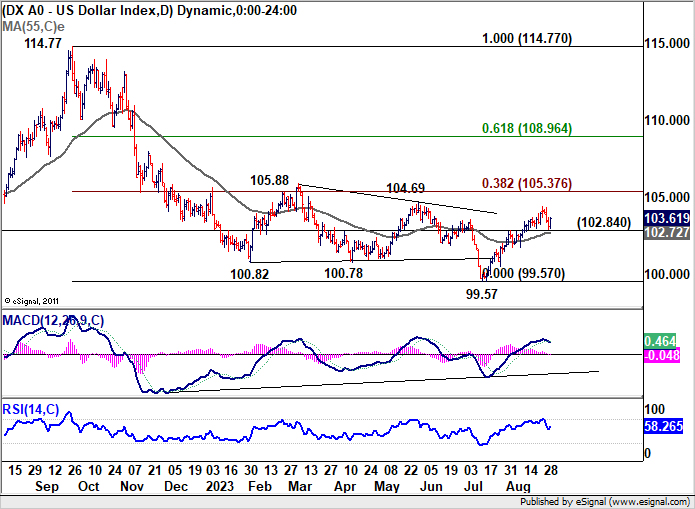
As for Dollar Index, it's clearly losing upside momentum as seen in D MACD. While another rise cannot be ruled out as long as 102.84 support holds, strong resistance is likely at 38.2% retracement of 144.77 to 99.57 at 105.37 to limit upside. Break of 102.84 will argue that the corrective rally from 99.57 has completed earlier then expected.
Yuan spikes higher as PBoC slashes FX RRR, but move quickly undone
Chinese Yuan saw a sharp uptick after PBoC announced a substantial 200 bps cut in foreign exchange reserve requirement ratio to 4% from 6%, effective September 15. According to PBoC, the move aims to "improve financial institutions' ability to use foreign exchange funds."
This RRR cut is set to release approximately USD 16.4B in foreign exchange, based on China's FX deposits standing at USD 821.8B as of end-July. Market analysts also note that the FX RRR reduction could have the added effect of lowering dollar funding costs in the interbank market, thereby alleviating some of downward pressure on Yuan.
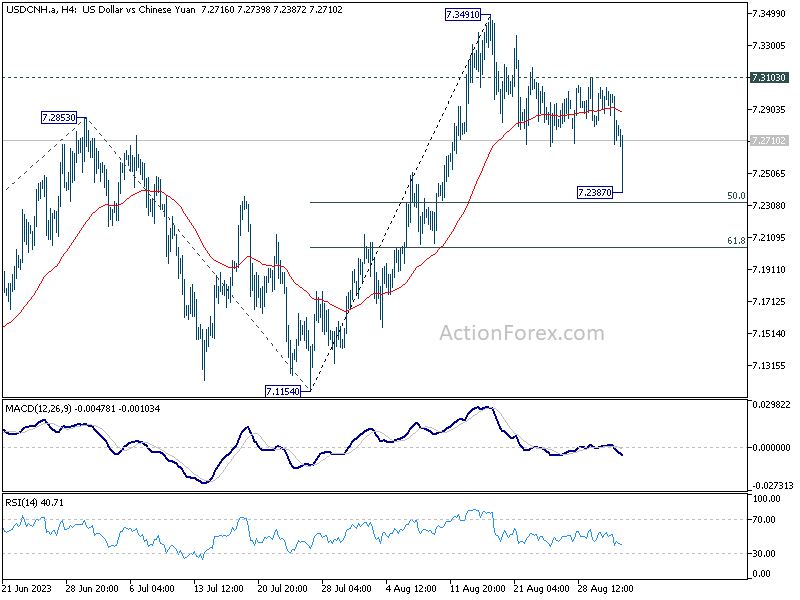
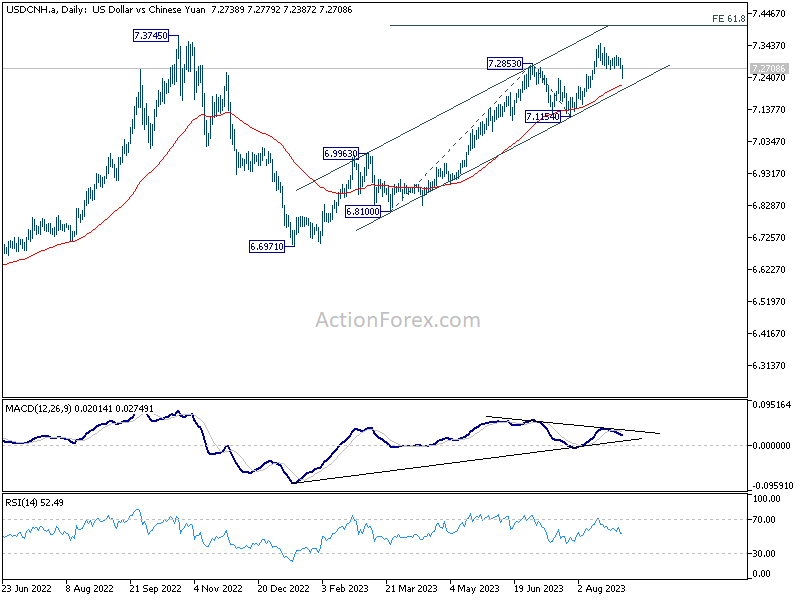
On the technical front, USD/CNH saw a drop to as low as 7.2387 following the announcement, but it has since recovered most ground. Despite the knee-jerk reaction, the broader uptrend from 6.6971 appears to remain intact. Should it break 7.3103 minor resistance, this would signal completion of the correction from 7.3491 and likely pave the way through 7.3491 for testing 7.3745 high.
However, considering bearish divergence condition in D MACD, strong resistance is likely at 61.8% projection of 6.8100 to 7.2853 from 7.1154 at 7.4091 to limit upside, to complete the five wave sequence from 6.6971.
While technical landscape seems to suggest further upside for USD/CNH, it is crucial to note that these views could be rendered academic at a moment's notice. The Chinese authorities may implement various intervention measures any time, adding an extra layer of unpredictability to the equation.
China’s Caixin PMI manufacturing rose to 51, output and employment see uptick
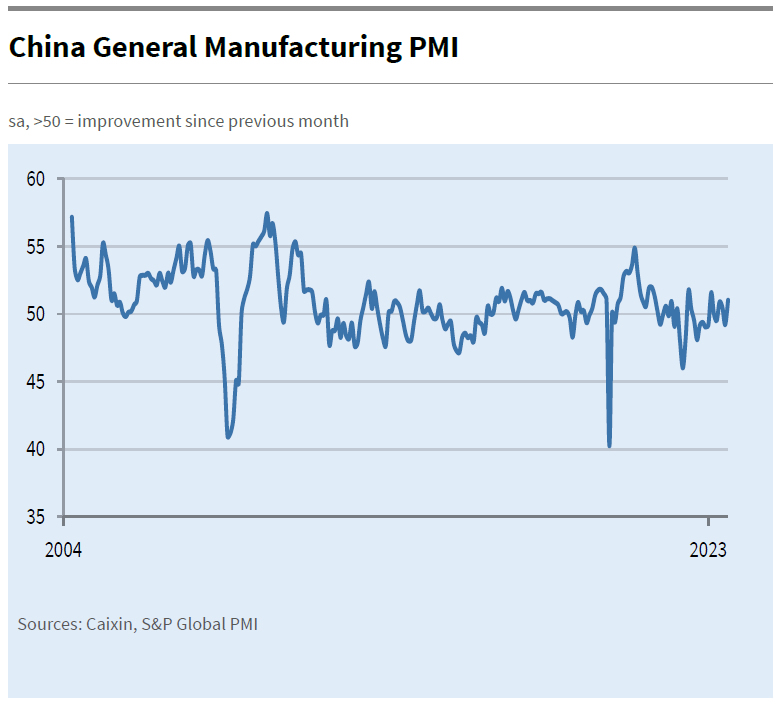
China's Caixin PMI for manufacturing defied expectations in August, rising from 49.2 to 51.0 and beating market forecasts of 49.4. This indicates a return to expansionary territory. The report noted several key improvements, including increases in output, new business, and a rebound in employment levels. Significantly, input costs rose for the first time since February, suggesting an easing in deflationary pressures.
Wang Zhe, Senior Economist at Caixin Insight Group, elaborated on the data, stating, "In August, the manufacturing sector showed overall improvement. Apart from sluggish exports, the gauges for supply, total demand, and employment were all in expansionary territory." Wang also noted that the "slight rise in prices buffered the pressure of deflation" and that logistics remained smooth.
However, caution still underlines the market's medium-term outlook. According to Wang, "Looking ahead, seasonal impacts will gradually subside, but the problem of insufficient internal demand and weak expectations may form a vicious cycle for a longer period of time." Wang also warned that "combined with the uncertainty in external demand, the downward pressure on the economy may continue to increase."
Japan PMI manufacturing finalized at 49.6, input costs inflation at three-month high
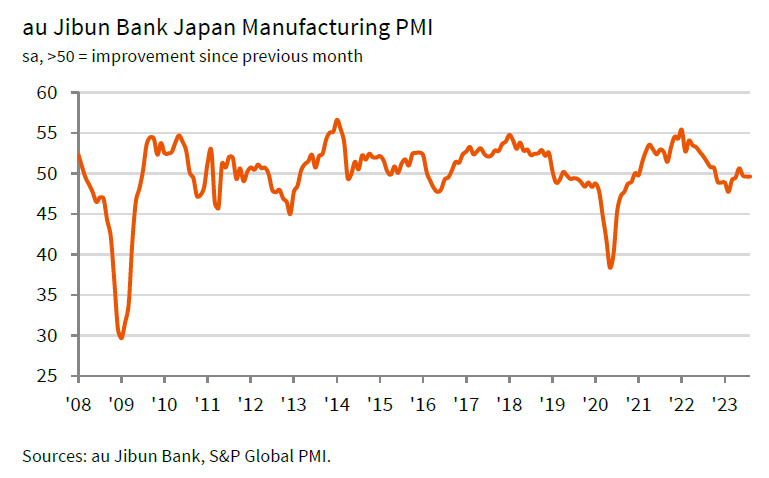
Japan's PMI Manufacturing remained stagnant at 49.6 in August, indicating a third consecutive month of sectoral contraction. According to Usamah Bhatti at S&P Global Market Intelligence, the rate of deterioration was "unchanged from July and only fractional," primarily due to a "slower reduction in new orders."
The report highlighted concerning trends in cost pressures. "Input prices rose at a quicker pace for the first time since September 2022, pushing the rate of input cost inflation to a three-month high," Bhatti stated. The escalation in input costs was specifically attributed to high raw material prices, labor costs, and a weakened yen.
Despite these pressures, the report found that manufacturers increased their selling prices at the "weakest rate in two years," indicating that companies may be absorbing the additional costs instead of transferring them to consumers.
The employment situation also emerged as a point of concern. Bhatti noted, "The rate of job creation broadly stalled, with the latest increase the slowest recorded in the 29-month sequence."
ECB de Guindos: Decision is open for Sep
In a cautious tone, ECB Vice President Luis de Guindos said yesterday that "For September, the decision is open," dropping no hint on whether the central bank would deliver another rate hike, or pause.
Nevertheless, de Guindos was clear about the new economic projections to be published at the September meeting. He noted, "forecasts for economic growth are worse than we had projected in June, while inflation projections are similar to what we had in June."
De Guindos added that the ECB is "entering the final stretch" of its tightening cycle. He put emphasis on second-round effects and inflation expectations as the factors for any future monetary policy decisions.
USD/JPY Eyes Fresh Increase Above 147.00
Key Highlights
- USD/JPY is consolidating above the 145.50 support.
- A key bullish trend line is forming with support near 145.50 on the 4-hour chart.
- EUR/USD struggled to clear the 1.0940 and trimmed gains.
- The US nonfarm payrolls could increase by 170K in August 2023.
USD/JPY Technical Analysis
The US Dollar started a short-term downside correction from the 147.40 zone against the Japanese Yen. USD/JPY declined below the 147.00 and 146.50 levels.
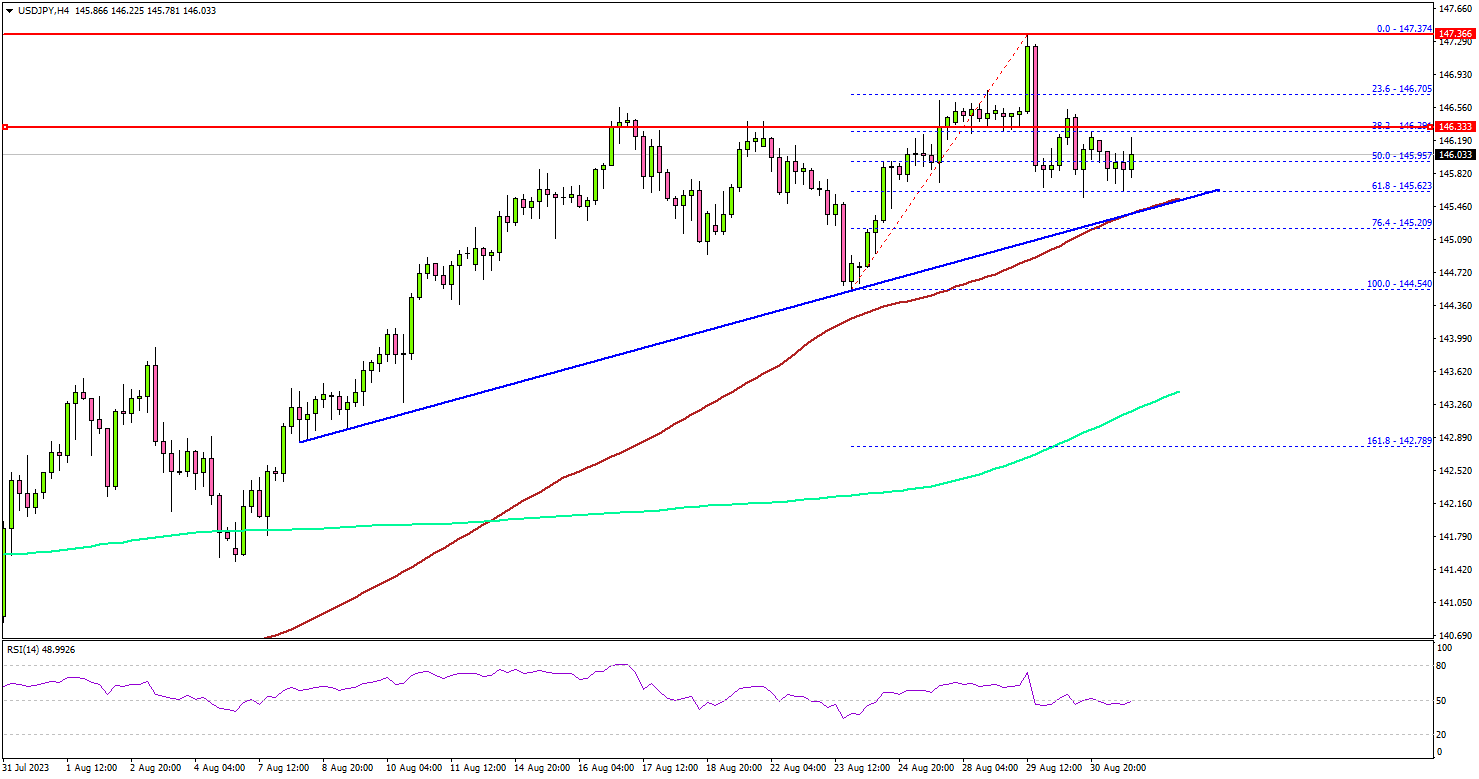
Looking at the 4-hour chart, the pair is still trading well above the 145.00 support, the 100 simple moving average (red, 4 hours), and the 200 simple moving average (green, 4 hours).
It is now consolidating and might attempt a fresh increase. On the upside, an initial resistance is near the 146.35 level. The first major resistance is near the 146.50 level.
A close above 146.50 could start a decent increase. In the stated case, the pair could rise toward the 147.40 level. Any more gains could send the pair toward the 148.00 level.
If not, the pair might start a fresh decline below the 145.65 support. The next key support is seen near the 145.50 level. There is also a key bullish trend line forming with support near 145.50 on the same chart.
If there is a move below 145.50, the pair could dive toward 145.20. Any more losses might send the pair toward the 144.50 level.
Looking at EUR/USD, the pair struggled to recover above the 1.0940 zone, faced rejection, and started a fresh decline.
Economic Releases
- Germany’s Manufacturing PMI for August 2023 - Forecast 39.1, versus 39.1 previous.
- Euro Zone Manufacturing PMI for August 2023 – Forecast 43.7, versus 43.7 previous.
- UK Manufacturing PMI for August 2023 – Forecast 42.5, versus 42.5 previous.
- US ISM Manufacturing PMI for August 2023 – Forecast 47.0, versus 46.4 previous.
- US nonfarm payrolls for August 2023 – Forecast 170K, versus 187K previous.
- US Unemployment Rate for August 2023 - Forecast 3.5%, versus 3.5% previous.
EURJPY Wave Analysis
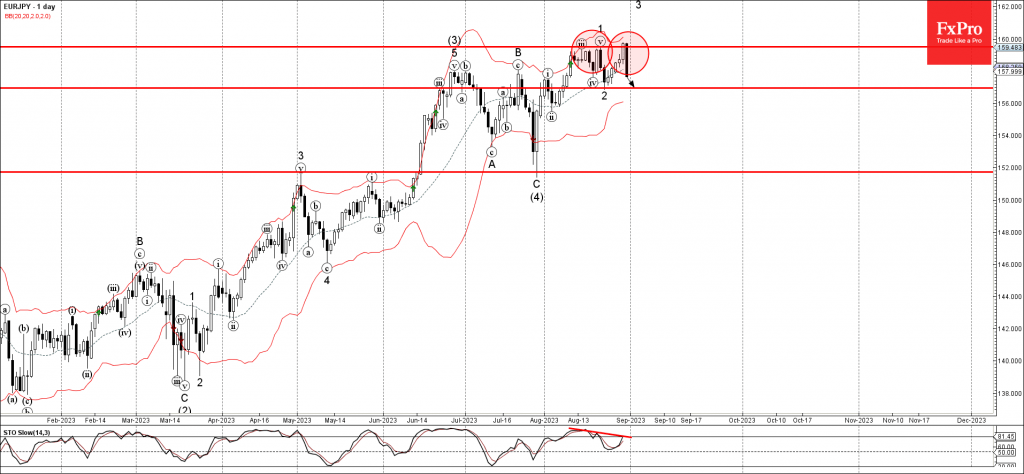
- EURJPY reversed from resistance level 159.50
- Likely to fall to support level 156.95
EURJPY currency pair recently reversed down from the key resistance level 159.50 (top of the previous minor impulse wave 1) intersecting with the upper daily Bollinger Band.
The downward reversal from the resistance level 159.50 is likely to form the daily Japanese candlesticks reversal pattern Bearish Engulfing.
Given the clear bearish divergence on the daily Stochastic indicator, EURJPY currency pair can be expected to fall further toward the next support level 156.95 (low of the previous wave 2).
WTI Crude Oil Wave Analysis
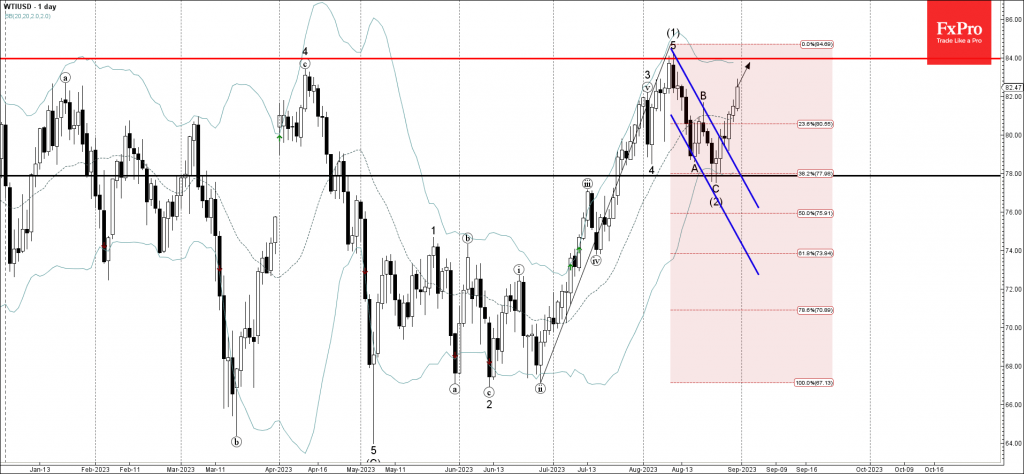
- WTI crude oil rising inside impulse wave (3)
- Likely to test resistance level 84.00
WTI crude oil continues to rise inside the intermediate impulse wave (3), which previously broke the daily down channel from the start of August (enclosing the earlier ABC correction (2)).
The breakout of this down channel strengthened the bullish pressure on WTI crude oil.
Given the strength of the active impulse wave (3), WTI crude oil can be expected to rise further toward the next resistance level 84.00 (which stopped the previous impulse wave (1)).
A Jump in Consumer Spending May Be Bad News for US Indices
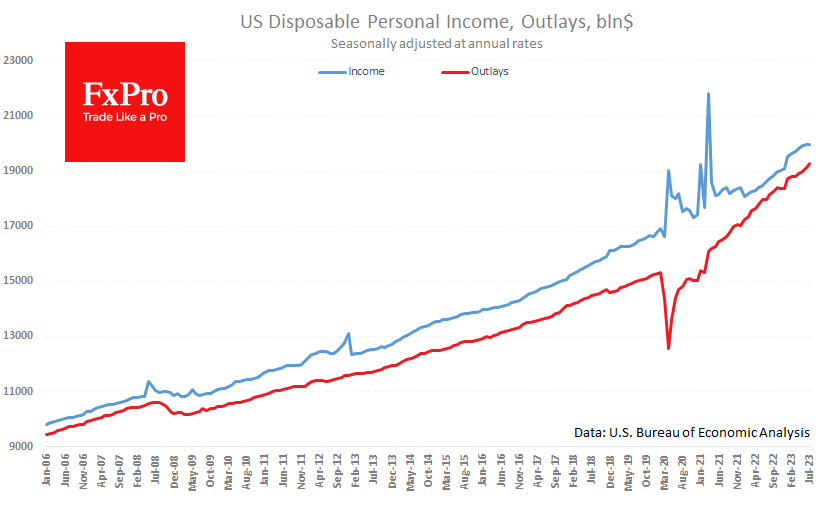
Personal spending by Americans in July points to increased risks of a return to inflation. Consumer spending rose 0.8% in July, following a 0.7% increase a month earlier. Meanwhile, incomes rose 0.2% in July and 0.3% in June. Disposable personal income was unchanged in July after increasing 0.2% a month earlier.
As a result, personal savings fell to 3.5% of income, the lowest since last October, down from 4.7% two months ago.
These are signs of inflationary pressures in the US, contrary to the slump in many commodity prices that fuelled inflation last year. The price index accelerated growth from 3.0% to 3.3% in July. The core index accelerated from 4.1% to 4.2%— a turn upward from double the levels of the Fed’s 2% target.
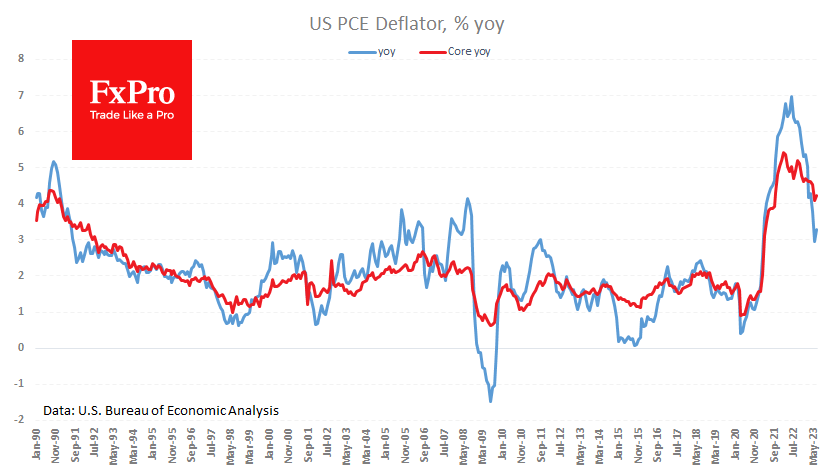
The conventional wisdom is that stronger-than-expected spending growth is good news for the dollar and (often) the stock market, demonstrating buyer confidence. For the dollar, that rule of thumb remains valid. But it could be bad news for the stocks, pressing down expectations that the Fed Funds rate has already peaked.