Sample Category Title
EUR/USD Eyes German, Eurozone CPI Reports
- Germany to release CPI on Wednesday, Eurozone on Thursday
- US consumer confidence and jobs data disappoint
The euro’s mini-rally has run out of steam. EUR/USD climbed 0.80% over the past two days but is trading in negative territory on Wednesday. In the European session, the euro is trading at 1.0867, down 0.11%.
The markets will be keeping a close eye on European inflation releases today and Thursday. Germany releases the July CPI report later today, with a consensus estimate of 6.0%, compared to 6.2% in July. The once-formidable German juggernaut is in trouble and inflation remains high. The eurozone releases July CPI on Thursday, which is expected to drop from 5.3% to 5.1%.
The ECB meets next on September 14th and ECB President Lagarde may have signalled that another rate hike is coming. Lagarde attended the Jackson Hole summit last week and said that interest rates would remain high “as long as necessary” in order to bring inflation back to the ECB’s 2% target. Lagarde’s hawkish remarks were more hawkish than her comments at the July meeting, where she said that ECB policy makers had an “open mind” about the September decision.
There’s no arguing that eurozone inflation remains too high, but the argument against raising rates even higher is that the eurozone economy is not in great shape, and nine straight rate hikes from the ECB have cooled economic growth. Further hikes could tip the economy into a recession, which means that the ECB has its work cut out in deciding whether to raise rates again or take a pause in September.
The Federal Reserve is widely expected to hold rates at next week’s meeting, and disappointing data on Tuesday may have cemented a pause. The Conference Board Consumer Confidence Index fell sharply to 106.1 in July, compared to 116.0 in August, marking a two-year low. As well, JOLTS Jobs Openings slowed to 8.82 million in July, down from 9.16 million in June and well off the estimate of 9.46 million. This was the sixth decline in the past seven months, a sign that the resilient US labour market is showing cracks.
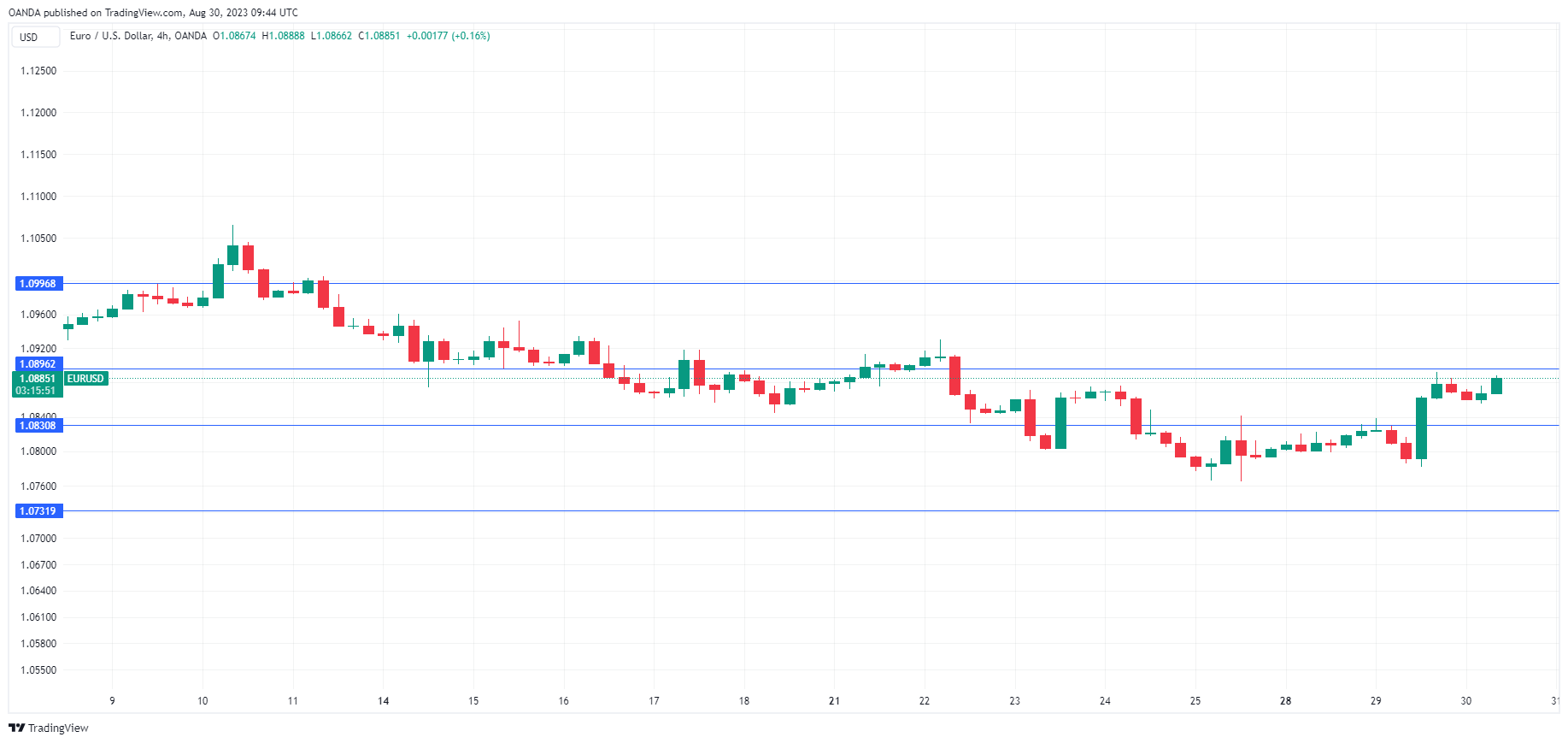
EUR/USD Technical
- EUR/USD is putting strong pressure on resistance at 1.0896. The next resistance line is 1.0996
- 1.0831 and 1.0731 are providing support
Bitcoin: The Battle for the Long-Term Trend Has Begun
Market picture
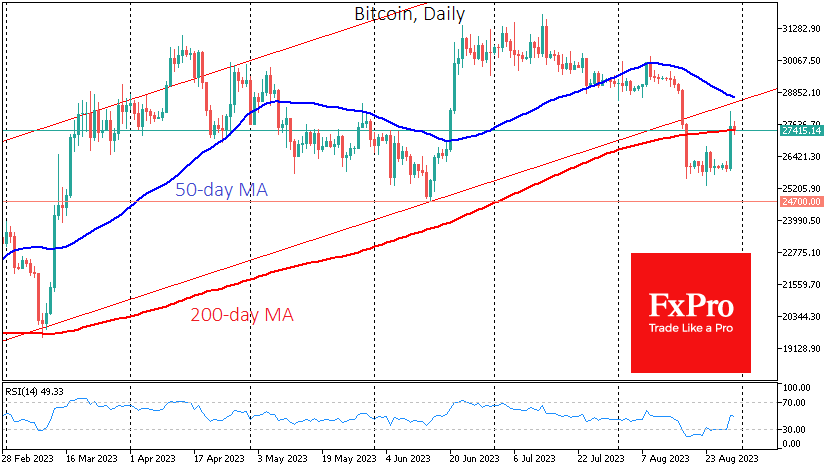
As expected, the constricted crypto market is a compressed spring, which means more volatility ahead, not a lack of interest. On Tuesday, Bitcoin jumped above $28.3K, adding over 2K in less than a couple of hours, on news that a US court had granted Grayscale Investments’ motion in its case against the SEC.
In June, Grayscale, an investment management company, sued the regulator for refusing to convert its flagship GBTC trust into a bitcoin ETF. An appeals court ordered the SEC to reconsider its decision.
On Wednesday morning, Bitcoin pulled back to $27.4K, close to the 200-day and 200-week moving averages. The real battle for the long-term trend has just begun, and the next few days could provide a crucial signal for weeks and months ahead.
News background
According to CoinShares, investments in crypto funds fell by $168 million last week, the largest since March. Outflows have been recorded in five of the previous six weeks.
According to CryptoQuant, Bitcoin trading volume in August was the lowest in almost five years as retail investors retreated during the bear market. In addition, this dynamic was influenced by US regulatory action on cryptocurrencies, combined with the end of the banking crisis in May.
The SEC classified NFTs as investment contracts for the first time. The SEC accused Impact Theory of making unregistered securities offerings by selling non-fungible tokens.
The Fed has been accused of creating obstacles to advancing a bill to regulate stablecoins in Congress. According to a group of congressmen, the Fed’s recent moves to increase oversight of banks’ ties to cryptocurrencies are getting in the way.
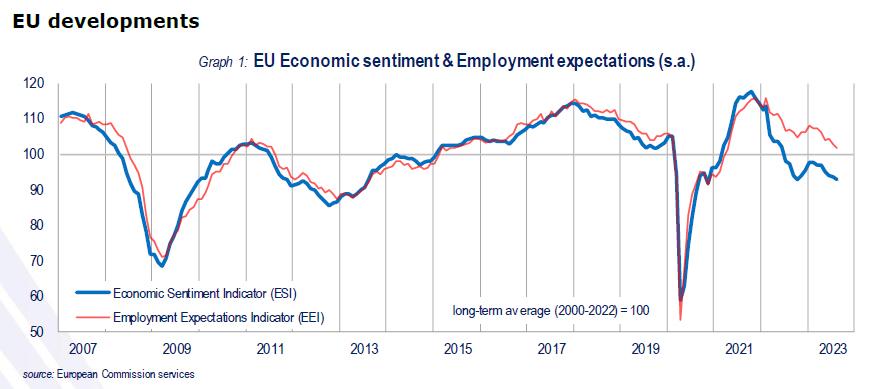
Eurozone economic sentiment deteriorates across the board
Eurozone Economic Sentiment Indicator (ESI) witnessed a drop from 194.5 to 93.3 in August, casting a dark shadow over the economic outlook of the bloc. Nearly all sectoral confidence indicators fell, with industry confidence sliding from -9.3 to -10.3, services from 5.4 to 3.9, retail trade from -4.5 to -5.0, and construction from -3.6 to -5.2. Employment Expectations Indicator (EEI) also showed a decline from 103.4 to 102.1, while the Economic Uncertainty Indicator (EUI) dipped from 21.3 to 20.0.
Similarly, EU-wide ESI fell modestly from 93.5 to 92.9, and its EEI from 102.7 to 101.7. EUI also registered a decline from 20.7 to 19.7. Breaking down the ESI numbers by individual countries, sentiment deteriorated in France -by 2.5 points, in Germany by -2.4 points, and in Italy by -1.1 points. Conversely, sentiment improved in Spain by 1.5 points and in Poland by 1.2 points, while the sentiment in the Netherlands remained almost unchanged, up by just 0.2 points.
EUR/USD Accelerates Gains from 2.5-month Low
This was facilitated by disappointing data on the US labor market. According to the Bureau of Labor Statistics, the number of new vacancies has fallen sharply: actual — 8.8 million, forecast — 9.4 million new vacancies. The last time the value of the indicator fell below 9 million was in the spring of 2021.
The news came as a big surprise, which sent the dollar index down sharply. Accordingly, USD-denominated shares and gold rose, as well as exchange rates traded against the dollar.
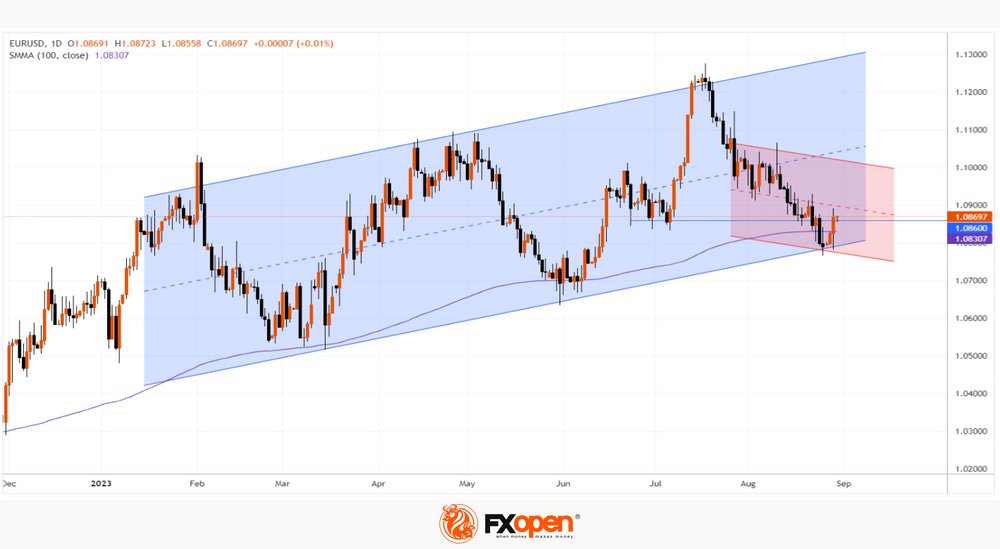
The EUR/USD chart shows that:
→ the price accelerated yesterday's rise from the 2.5-month low set on August 25;
→ the price continues to be supported by the lower line of the rising channel;
→ the price continues to be supported by SMA (100);
→ the presence of bears may appear near the lines of the descending channel (shown in red).
The bulls will consolidate their success if they manage to keep the price of EUR/USD above the level of 1.086, from which resistance can be expected. Decrease in the number of vacancies is a leading indicator of the state of the economy. If market participants receive more signals about the slowdown in the US economy, this could lower the USD against other currencies even more.
This article represents the opinion of the Companies operating under the FXOpen brand only. It is not to be construed as an offer, solicitation, or recommendation with respect to products and services provided by the Companies operating under the FXOpen brand, nor is it to be considered financial advice.
AUD/USD: Violation of Current Range Boundaries to Generate Fresh Direction Signal
AUDUSD edged lower in early European trading on Wednesday, reversing some gains made in Asian session, in reaction to weaker-than-expected US labor data released late Tuesday.
JOLTS report showed drop in job opening to the lowest in over two years, adding to signals of gradual slowdown in the US labor market, which deflated US dollar.
Australia’s inflation report, released overnight, showed unexpectedly low monthly inflation in July (4.9% vs 5.4% in June and 5.2% f/c), which reduces risk of another rate hike and add pressure on Aussie dollar.
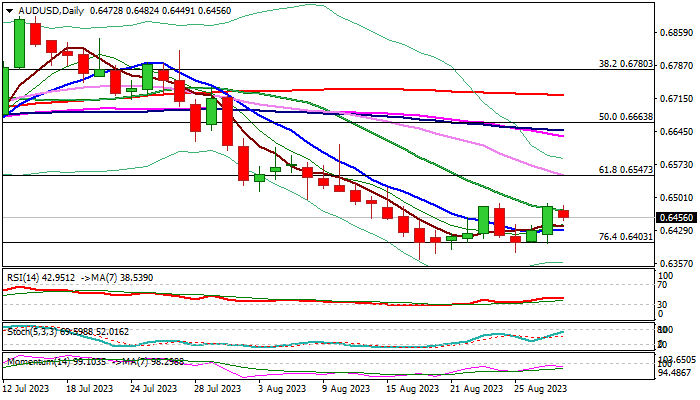
Technical picture on daily chart remains bearishly aligned (14-d momentum stays in the negative territory, most of MA are in bearish setup), with fresh weakness generating initial signal of repeated recovery rejection just under initial Fibo resistance at 0.6489 (23.6% of 0.6894/0.6364 bear-leg).
However, signals require confirmation, as near-term price action is in range, after a multiple failures to register close below 0.6403 (Fibo 76.4% of 0.6170/0.7157) and repeated stall of subsequent bounces.
Expect fresh direction signals on breach of either range boundary, with sustained break of 0.6472/89 (20DMA / Fibo 23.6%) upper triggers to open way for further recovery and unmask targets at 0.6547/67.
Conversely, dip below 10DMA (0.6431) would weaken near-term structure and risk renewed probe through 0.6400 zone, break of which will be bearish.
We also look for a number of important US economic releases these days (ADP, Core PCE, personal spending and NFP) which are expected to provide more details about the situation in the US economy, particularly in inflation and labor sector and influence Fed’s monetary policy decisions in the near future.
Res: 0.6472; 0.6489; 0.6547; 0.6567.
Sup: 0.6431; 0.6403; 0.6364; 0.6272.
EUR/AUD Daily Outlook
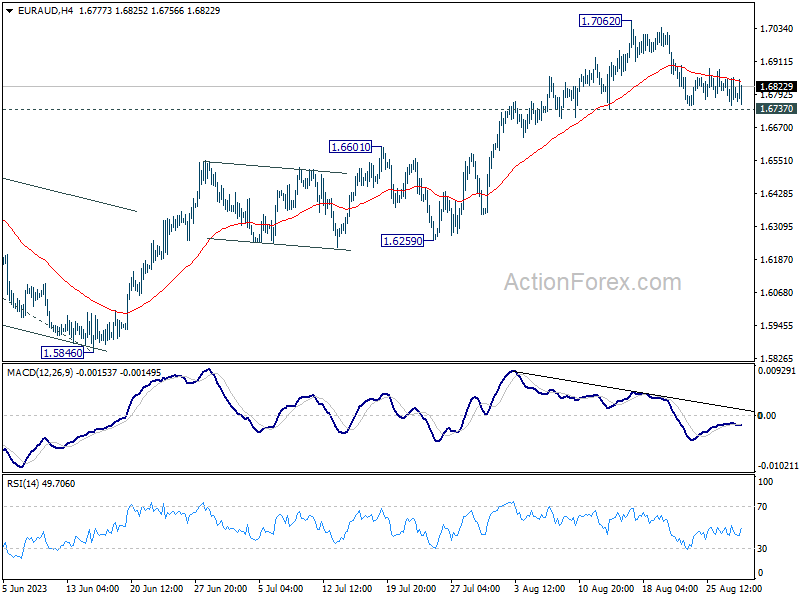
Daily Pivots: (S1) 1.6743; (P) 1.6799; (R1) 1.6845; More...
Range trading continues in EUR/AUD and intraday bias stays neutral. Further rise is mildly in favor as long as 1.6737 support holds. On the upside, break of 1.7062 resistance will resume larger up trend to 1.7377 projection level next. However, firm break of 1.6737 will bring deeper pull back to 1.6601 resistance turned support instead.
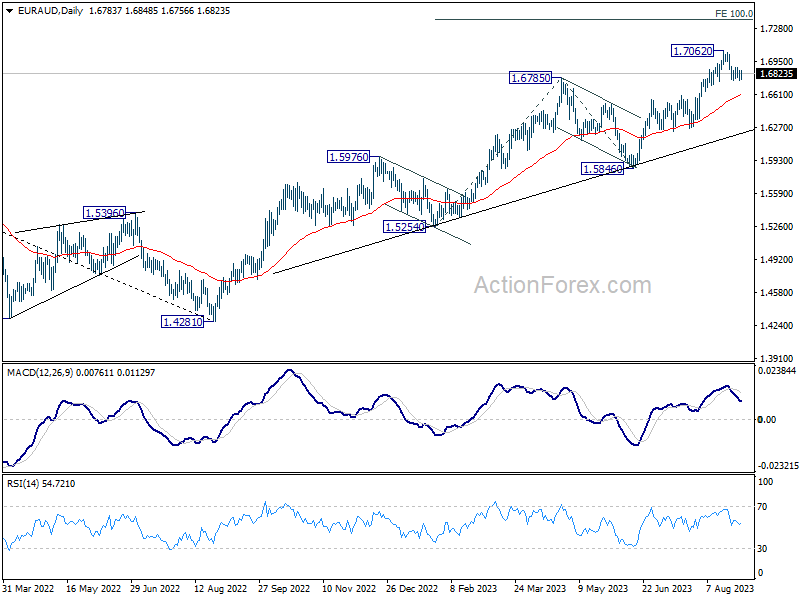
In the bigger picture, the rise from 1.4281 (2022 low) is in progress. Next target is 100% projection of 1.5254 to 1.6785 from 1.5846 at 1.7377. For now, outlook will stay bullish as long as 1.5846 support holds, even in case of another pull back.
EUR/GBP Daily Outlook
Daily Pivots: (S1) 0.8576; (P) 0.8593; (R1) 0.8621; More...
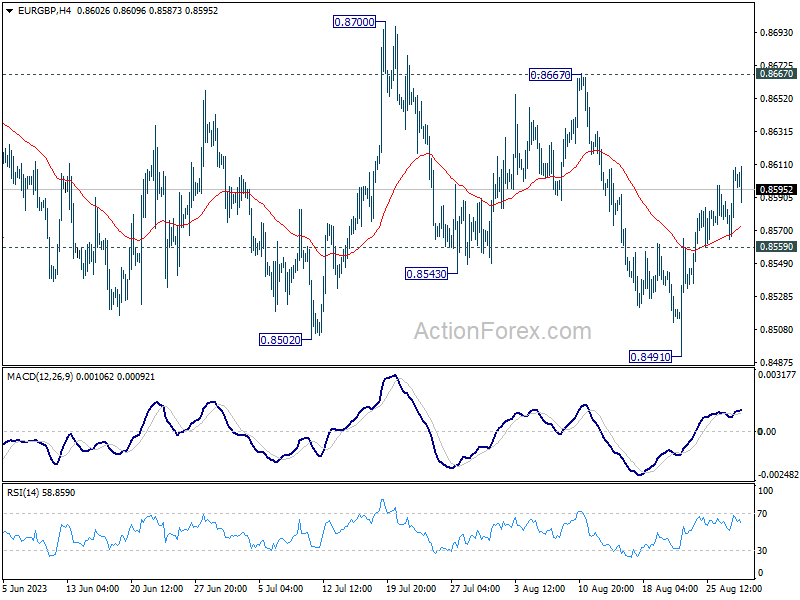
Intraday bias in EUR/GBP is back on the upside as rebound from 0.8491 resumed. While further rally could be seen, near term outlook will stay bearish with 0.8667 resistance intact. On the downside, below 0.8559 minors support will turn bias to the downside for retesting 0.8491 low first. Firm break there will resume larger down trend.
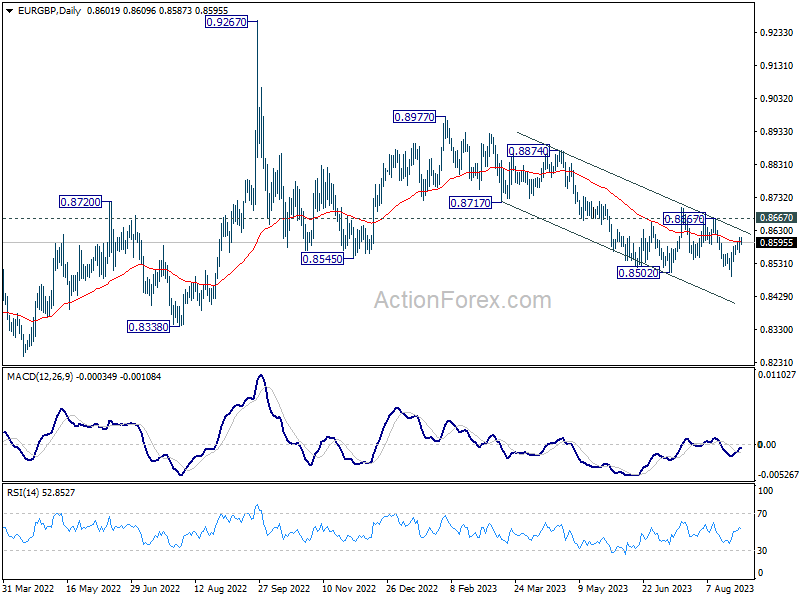
In the bigger picture, the down trend from 0.9267 (2022 high) is seen as part of the long term range pattern from 0.9499 (2020 high). Further decline is in favor as long as 0.8667 resistance holds. Break of 0.8502 will resume the fall towards 0.8201 (2022 low).
EUR/JPY Daily Outlook
Daily Pivots: (S1) 158.29; (P) 158.68; (R1) 159.10; More....
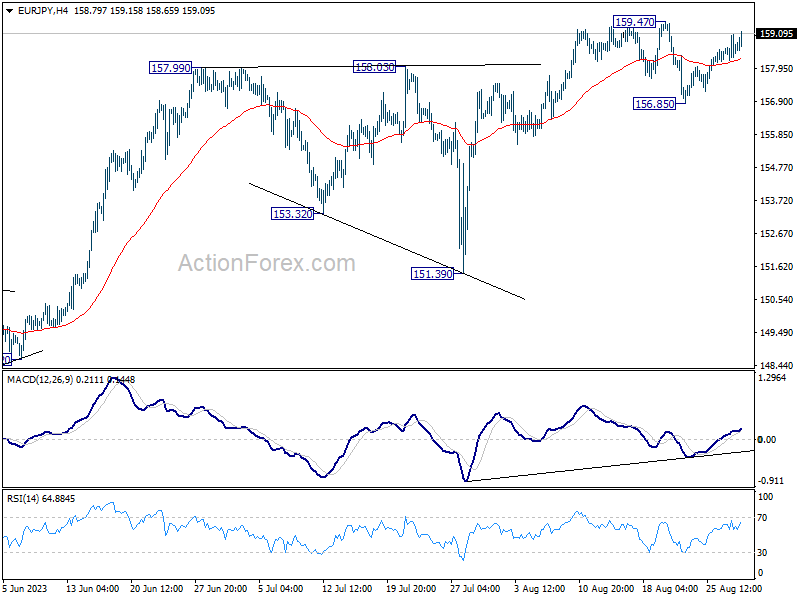
Intraday bias in EUR/JPY remains neutral at this point. Price actions from 159.47 are seen as a corrective pattern, and another decline cannot be ruled out. Break of 156.85 will target 55 D EMA (now at 155.98) and possibly below. Nevertheless, firm break of 159.47 will resume larger up trend instead.
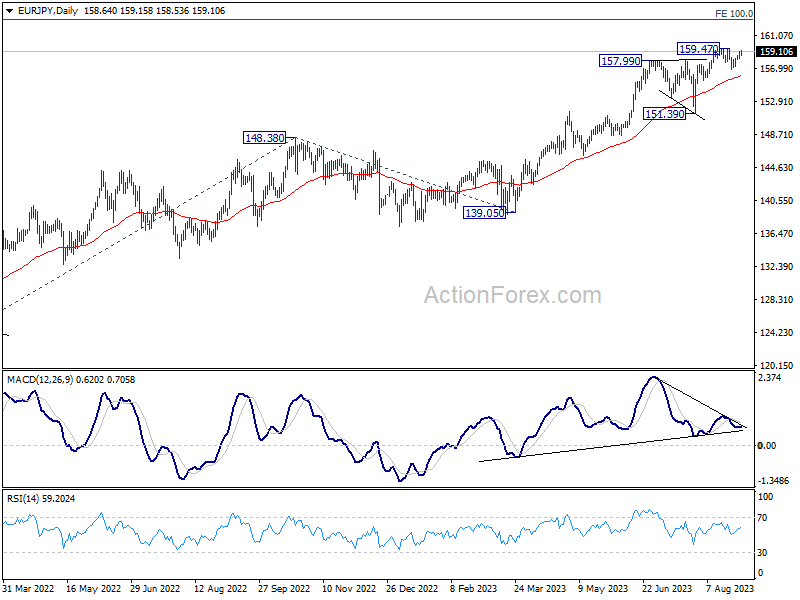
In the bigger picture, rise from 114.42 (2020 low) is in progress. Next target is 100% projection of 124.37 to 148.38 from 139.05 at 163.06. Sustained break there will pave the way to retest long term resistance at 169.96. This will remain the favored case as long as 151.39 support holds, even in case of deep pull back.
GBP/JPY Daily Outlook
Daily Pivots: (S1) 183.93; (P) 184.60; (R1) 185.13; More...
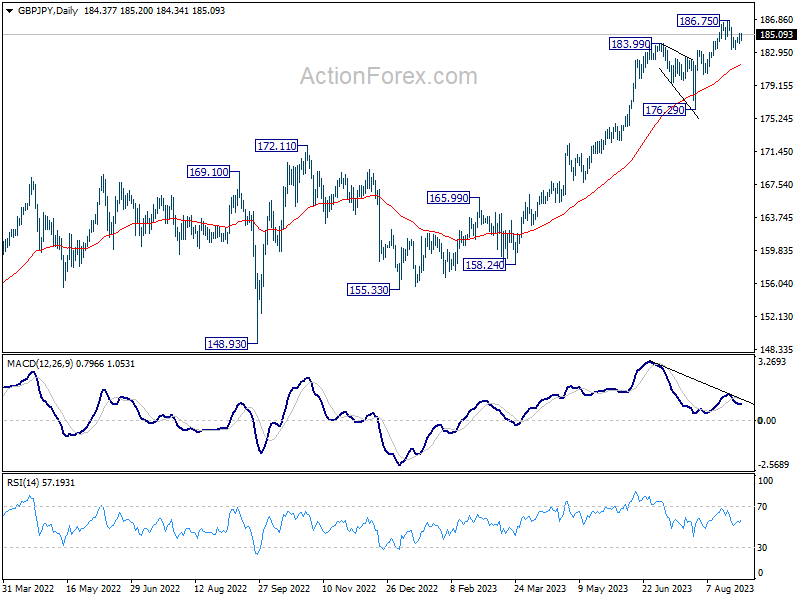
Intraday bias in GBP/JPY remains neutral for the moment. Price actions from 186.75 are viewed as a corrective pattern. Another fall could still be seen and break of 183.35 will turn bias to the downside for 55 D EMA (now at 181.54). Nevertheless, firm break of 186.75 will resume larger up trend.
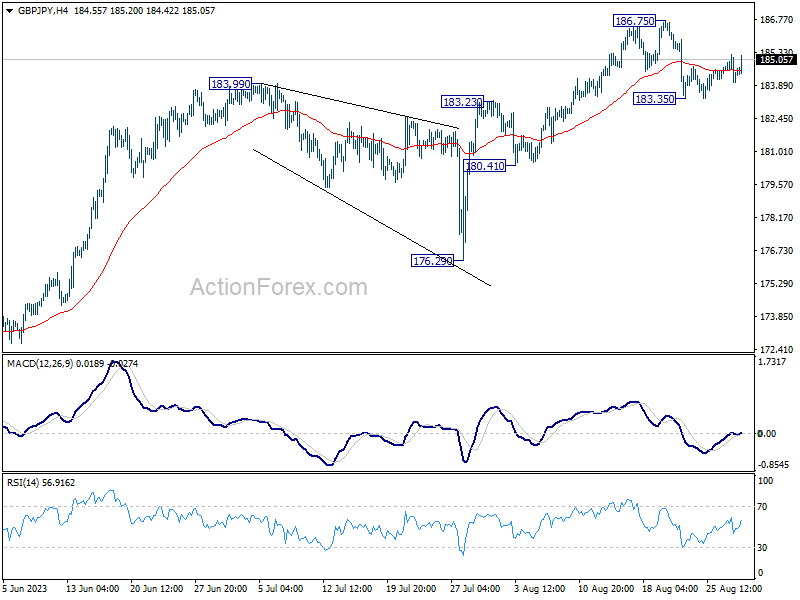
In the bigger picture, up trend from 123.94 (2020 low) is in progress. Next target is 195.86 (2015 high). This will remain the favored case as long as 176.29 support holds, even in case of deeper pull back.
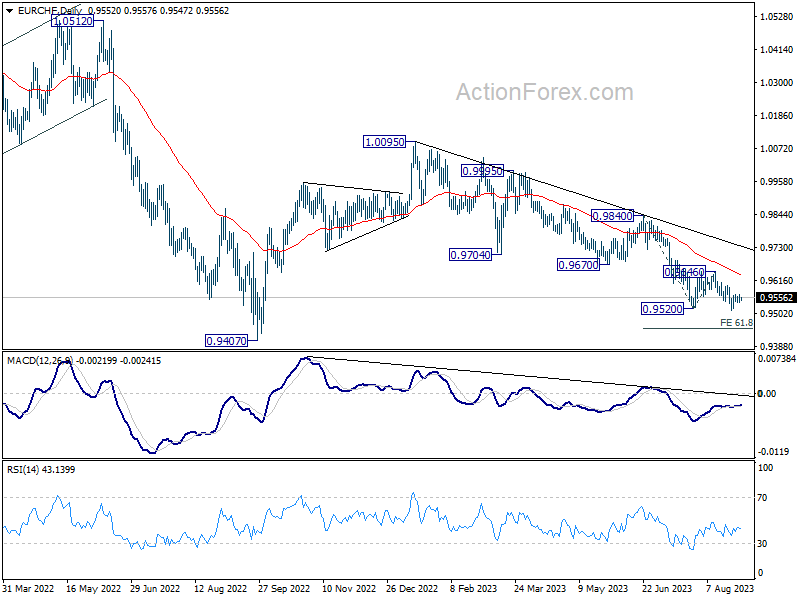
EUR/CHF Daily Outlook
Daily Pivots: (S1) 0.9543; (P) 0.9556; (R1) 0.9570; More...
Intraday bias in EUR/CHF remains neutral for the moment as it's staying bounded in consolidation above 0.9513. With 0.9599 resistance intact, further decline is expected. On the downside, firm break of 0.9513 will resume larger down trend from 1.0095. Next target is 61.8% projection of 0.9840 to 0.9520 from 0.9646 at 0.9448.
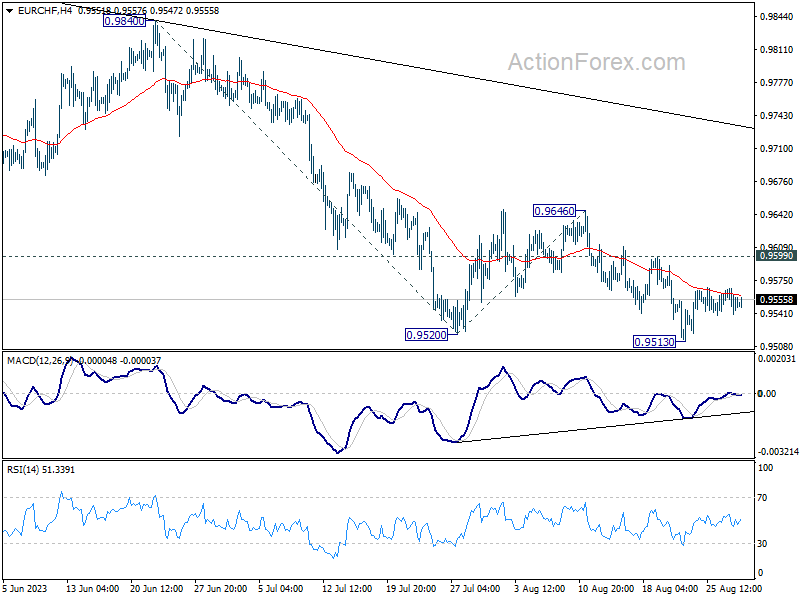
In the bigger picture, medium term outlook is staying bearish as the pair is capped well below falling 55 W EMA (now at 0.9829). Down trend from 1.2004 (2018 high) is in favor to continue. Sustained break of 0.9407 will target 61.8% projection of 1.1149 to 0.9407 from 1.0095 at 0.9018. For now, this will remain the favored case as long as 0.9670 support turned resistance holds, in case of strong rebound.